Hamer
Phantom
Hamer built Andy Summers a guitar out of his own ideas. He still went back to his Telecaster.
1982. Andy Summers of the Police has been playing two new Hamers since February. They have a longer horn, a deeper cutaway, and reworked pickups, and according to Paul Hamer, every one of those changes came from Summers.
- Introduced
- 1982
- Type
- Solidbody electric
- Class
- Production
Have a photograph of this guitar? Send a picture
The short version
1974
Gibson shapes
Hamer starts with an Explorer shape, the Standard. The Sunburst and the Special follow Gibson outlines too.
1981
The Prototype
The first Hamer that isn’t a copy of anything. Three coils at the bridge.
1982
Summers’s guitars
From February, Andy Summers plays two new Hamers built around his ideas.
1983
“An experiment”
Paul Hamer plans commercial production for early this year.
1984
Version two
Six tuners in a row, a Kahler vibrato, a five-way switch. Glenn Tipton moves to Hamer around now.
1986
Turbo Lover
Tipton plays a Phantom A7 synth controller into a Roland GR-700 on the Judas Priest track.
1997
Name recycled
Hamer puts the Phantom name on a renamed Prototype. A different guitar.
Side A
A1
Everything about it was his idea
For its first seven years, Hamer made Gibson shapes. The Standard in 1974 was an Explorer. The Sunburst in 1977 was a Junior-style double-cut. The Special in 1980 was Gibson-flavored too. They were good guitars, and you always knew what they were descended from.
In 1981 the Prototype broke the habit: a slightly offset double-cut with three coils packed into the bridge pickup ring. Then Andy Summers of the Police got involved, and the idea got stretched.
By February 1982 Summers had two new Hamers. In December, Paul Hamer told a magazine exactly whose guitars they were:
Everything about the new guitars are his ideas — the longer horn, the deeper cutaway and especially the changes in the pickups.
The version without a vibrato would come first, because the vibrato wasn’t finished. Commercial production would wait until early 1983. For now, Paul Hamer said, it was “an experiment.” If you ever wanted to know what a guitar looks like when it’s built to one man’s wish list, this is it.
A2
A humbucker and a single in one ring
The Phantom looks like somebody grabbed a Hamer by the upper horn and pulled. That long horn and the offset waists make it hang differently on a strap, and there’s an odd pickguard that hides the neck joint. Underneath: a glued-in mahogany neck, 22 frets of rosewood with dots, a 24¾" scale.
The real idea is in the bridge. Instead of one pickup, there’s a ring holding a humbucker and a single-coil side by side. A mode switch picks which one you get: the fat humbucker when you want weight, the single when you want snap, without the bridge sound moving anywhere. Up by the neck there’s one more single-coil, slanted, mounted in the pickguard. Master volume, master tone, and a three-way. By 1984 the pickups were Hamer’s own Slammers, still made by DiMarzio.
A British magazine reviewed a pearl-pink one in December 1985 and weighed it at about seven and a half pounds, with a list price of £823. That’s a lot of guitar for a lot of money, and it came in colors like Ice Pearl and Laser Pearl, which tells you exactly what decade it was.
And no, it isn’t the Vox Phantom. That one’s a five-sided British guitar from 1962. Same word, different planet.
A3
Version two, and a metal guitarist
The first Phantom didn’t make it through 1984. The second version got six tuners in a row, a Kahler vibrato as standard, and a five-way switch on the pickguard. A maple neck came in 1985.
Around 1984 Glenn Tipton of Judas Priest moved to Hamer, and the company made him a Phantom GT: one pickup at the bridge, a Kahler, custom colors and graphics. As Jol Dantzig explained it, “Glenn has traditionally favoured Strat-shaped guitars, and the GT is sort of a combination of different models we’ve made for him in the past.”
Then there was the A7, a Phantom with a Roland hex pickup built in so it could drive a guitar synthesizer. Tipton ran one into a Roland GR-700 on “Turbo Lover” in 1986. If you’ve ever wondered what that sound was, part of the answer is a Hamer.
Flip the record · By the numbers
3
Coils in the bridge pickup ring. A humbucker and a single-coil, side by side.
24¾"
Scale length, the same as Hamer’s Explorer-shaped Standard.
£823
UK retail price in December 1985.
7½
Pounds, give or take, on a pearl-pink review sample in 1985.
Side B
B1
Eighteen strings in Holland
Def Leppard’s Steve Clark had one of the strangest: a custom Phantom doubleneck with eighteen strings, two pickups per neck. He was photographed with it at Wisseloord studio during the Hysteria sessions. Whether it made the record, I can’t tell you.
The GT and the rest of the series lasted into the mid-’80s. Exactly how long depends on whose dates you trust; some run it to 1986, some to the end of the decade. In 1997 Hamer put the Phantom name on a renamed Prototype, which is a different guitar wearing the badge.
B2
The Telecaster wins
You’d think a guitar made entirely from one player’s ideas would be the last guitar he ever needed. Summers kept getting Hamers handed to him in Chicago, and years later he put it plainly: “they just couldn’t beat that Telecaster… I always had to go back to the Tele.”
The Phantom went on without him, to Tipton and Clark and anybody who wanted a humbucker and a single in the same spot. Hamer doesn’t make one now. And the man it was built for gave it an honest shot, then went back to the old guitar. They could build him every idea he had. They couldn’t build him the Telecaster.
Put this on
You’ve read about it. Now hear it. Here’s what this guitar sounds like, and what to listen for.
Turbo Lover
Glenn Tipton on a Phantom A7, the synth-controller version, driving a Roland GR-700. Listen for the guitar that doesn’t quite sound like a guitar. That’s a Hamer talking to a Roland.
Find it on YouTube (opens in a new tab)
The cast
The people, and the specific guitars, that made the legend.
1982
Andy Summers
Two early Phantoms
The longer horn, the deeper cutaway, and the pickup changes were his ideas. He went back to his Telecaster anyway.
1982
Paul Hamer
Co-founder
Said in December 1982 that the new guitars were all Summers’s ideas, and still “an experiment.”
1984
Glenn Tipton
Phantom GT and Phantom A7
Judas Priest. His GT had one pickup and a Kahler. The A7 synth version is on “Turbo Lover.”
1984
Jol Dantzig
Co-founder
Explained the GT as a mix of guitars Hamer had already built for Tipton.
mid-1980s
Steve Clark
18-string Phantom doubleneck
Def Leppard. Photographed with a custom Phantom doubleneck at Wisseloord during the Hysteria sessions.
Liner notes
Specs, construction, rarity, value, and every source we used.
Offset mahogany, a stretched upper horn, and a humbucker plus single in one ring — Hamer’s Phantom, not the Explorer-shape Standard, and not Vox’s five sides.
- Body
- Mahogany; offset double-cutaway, extended upper horn, offset waists, contoured. International Musician (Dec. 1985): 40 mm deep. A7 spec sheet: 1 3/4" deep, 13 1/2" wide. Mix flagged.
- Neck
- Set mahogany, 22-fret; three-and-three Hamerlock. Maple from 1985; six-in-line on the 1984 second version.
- Fingerboard
- Unbound rosewood, pearl dots
- Scale
- 24 3/4". No millimetres on the 1980s Phantom sources. Mix flagged.
- Pickups
- Triple-coil at the bridge (humbucker plus single in one ring) and a slanted pickguard-mounted neck single. DiMarzio, then Hamer Slammer (still DiMarzio).
- Hardware
- Sustain Block string-through or Sustain Block tremolo; Kahler available by 1984, Flat-Mount standard on the second version. Hamerlock tuners.
- Electronics
- Master volume, master tone, 3-way, 2-way coil-mode. Second version: 5-way on the guard (Wright).
- Finish
- Blue Book: Black, Ice Pearl, Laser Pearl, Midnight Pearl, Red, White. Custom colors and graphics on the GT.
- Nut
- Lubritrak. International Musician: 42.5 mm. Chicago Music Exchange 1983: 1-5/8". A7 spec: 1 11/16". Mix flagged.
Open the full research fileConstruction details, the complete player record, production numbers, dated value estimates, and sources
Classic living example = 1980s USA Phantom A5 (first version, three-and-three). No current typical Phantom SKU this pass: hamerguitars.com lists Monaco, Sunburst, Archtop, Special Jr. — not this outline (fetched 21 September 2026). 2017 Indonesian reissue did not include a Phantom. Phantom GT, Phantom A7, Phantom 12-string, and the 1997–99 Phantom / Phantom Custom are other Hamers. CruiseBass is the matching bass. GT Custom is Tipton’s Explorer-ish one-off line, not this table. No Gibson SKU. No Vox SKU.
Construction
The job was an original Hamer outline you could take on a 1982 stage. Until then the Arlington Heights shop had been Gibson-shaped: Explorer Standard 1974, Junior-shape Sunburst 1977, Special 1980. The Prototype 1981 was the first Hamer that was not a copy — slightly offset double-cut, equal waists, a three-coil ring at the bridge. The Phantom stretched that idea until it hung differently.
Paul Hamer, Electronics & Music Maker, December 1982: Andy Summers of the Police had been playing two new Hamers since February. “Everything about the new guitars are his ideas — the longer horn, the deeper cutaway and especially the changes in the pickups.” Commercial production, Hamer said then, would wait until early 1983; they were still “an experiment.” Wright dates the Phantom A5 to around ’82. Blue Book prints manufacture 1982–84. Hamer Fan Club (Andrew Large, on the Sunburst): 1982 also brought Blitz, CruiseBass, and the Phantom. Keep 1982 and 1983. This plate starts in 1982.
Not the Standard. That is hamer-standard — Explorer-shape, Honduras mahogany, optional bound flametop, hockey-stick six-in-line. This is an offset with a pickguard. Sibling factory. Not that guitar. Not the Prototype — equal waists, 1981, listed through ’86. Wright: the Phantom A5 is similar to the Prototype II except for a more dramatically extended upper-cutaway horn and a contoured body with offset waists. Ancestor in the triple-coil job. Not that outline. Not Vox’s Phantom (vox-phantom) — five-sided, Dartford then Eko, 1962. Same English word. Different country, different decade, different silhouette. Elliott Easton’s seafoam Teardrop (Wright) was a Vox pentagon with Hamer Phantom electronics, handed over before a Cars Saturday Night Live. That is a Teardrop. Off this table.
What you get is set mahogany, 22-fret rosewood dots, 24 3/4", a weird pickguard that hides the neck joint, and the pickup that made the name stick. Wright: a three-coil/single-coil combination, the same idea as the Prototype — a single tucked next to a humbucker in one ring, plus a slanted neck single on the guard. By ’84 those were Slammers, still DiMarzio. International Musician (Dave Burrluck, December 1985), on a pearl-pink UK sample: the bridge ring is two Slammer units; the neck single dips on the treble side. Mode switch picks humbucker or single in the ring; 3-way is bridge, both, neck. Master volume and tone. Burrluck: about 7½ lbs, body 40 mm deep, nut 42.5 mm. Mix flagged against the A7 spec’s inches.
First-version hardware is the short-lived in-house Sustain Block — string-through or the Sustain Block tremolo, a non-locking Fender-style pivot on the same milled-brass block. Hamerlock tuners, three-and-three. Kahler top-mount optional by ’84. Wright: that first version did not survive through ’84.
Second version, 1984: six-in-line, Kahler Flat-Mount standard, 5-way on the guard. Maple neck from 1985. The A7 Synthesizer Controller, on that second version, added a Roland hex pickup, MIDI/regular/both, 1/4″ and synth DIN. Phantom GT, Wright: beginning ’84, one Slammer at the bridge, one volume, custom colors and graphics. Glenn Tipton’s site and Hamer Fan Club (Steve Matthes, 2009): GT 1984–86. Blue Book prints GT 1986–89, A5 six-in-line 1984–89, A7 and 12-string 1984–89. Wright: the Phantom series lasted through ’86. Keep both ends.
Not the 1997 Phantom. After the New Hartford move, Wright: Hamer reintroduced the Prototype under the name Phantom (PHAN) — equal double-cut, extended upper horn, rounded lower bout, Seymour Duncan triple-coil, stop tail. Lasted a year. Phantom Custom (PHANC) 1998–99: flamed maple, pearloid guard, five-way rotary. That is a Prototype with a Phantom badge. It is not a 1982 A5.
Kaman bought Hamer 1988. Fender bought Kaman 31 December 2007. Premier Guitar, 9 January 2013: FMIC suspends production. KMC / JAM reissued Import shapes at Winter NAMM 2017. hamerguitars.com this pass still sells other 2017–18 shapes. It does not sell a Phantom.
Classic vs current: 1982–86 USA Phantom A5 — offset mahogany, triple-coil ring, Sustain Block then Kahler — against no new Phantom you can order from Hamer in 2026.
Players
Do not hang a Standard, a Vector, or Tipton’s GT Custom on this plate. Do not recruit Easton’s Teardrop as if it were this offset. Nielsen’s five-neck was laminated from Special bodies. Summers’s Telecaster is not this guitar.
Andy Summers (The Police). The player this outline is for. Paul Hamer, EMM December 1982: Summers had been on two new Hamers since February — longer horn, deeper cutaway, new neck coil — and the non-tremolo would come first because the vibrato was not finished. That is the Phantom being designed in public, before the catalog. MusicRadar (4 April 2018), on the Hamers they kept handing him in Chicago: “they just couldn’t beat that Telecaster… I always had to go back to the Tele.” Keep both. Stage photographs on the Ghost in the Machine tour are the fact. Album-to-guitar credits for named Police sides unpublished here.
Glenn Tipton (Judas Priest). Moved to Hamer around 1984 (his site). Phantom GT: contoured offset, pickguard, 24.75", 22-fret rosewood dots, mahogany then maple 1985, Kahler 2300 C, one Slammer. Limited production 1984–86 on that page. Personal guitars: Duncan or EMG. Dantzig, quoted there: “Glenn has traditionally favoured Strat-shaped guitars, and the GT is sort of a combination of different models we’ve made for him in the past.” Not the GT Custom — non-production, 1986, Fuel for Life tour, Explorer-ish black angular, maple board, two humbuckers. Different guitar. Phantom A7: Turbo Lover (1986), Tipton into a Roland GR-700, factory patch 3-5 (Wayne Joness / GR-300 archive). Named track. Named controller.
Steve Clark (Def Leppard). Dantzig, via steveclarkguitar.com: an 18-string Phantom doubleneck, custom, two pickups per neck, neck-select. Photographed at Wisseloord during the Hysteria sessions. Dantzig: looks identical to a trade-show guitar except two pickups missing, possibly recovered by a new guard. Live use unpublished. Album-to-guitar credits unpublished. The photograph is the fact. His white 1979 Standard stays on hamer-standard.
Also known to play stays short. Wright’s ca. 1979 artist list is pre-Phantom. None invented.
Rarity
You cannot buy a new Phantom from Hamer this pass. hamerguitars.com does not list the slug. 1997–99 Phantom / Phantom Custom guitars are Prototype-shaped, Connecticut-era. They are not a 1980s A5.
Hamer did not publish yearly Phantom totals. None invented. Year-prefix serials (Sunburst system from 1977) date a guitar. They don’t count a year. That is why a first-year census is unknown, not the chapter.
What is actually thinner: first-version three-and-three Sustain Block examples 1982–84; A7 synth controllers; 12-strings; GT production, which Tipton’s site already calls limited. Summers’s tour guitars, Tipton’s A7, and Clark’s doubleneck are unique objects. They are not a vintage Phantom.
Value
Informal estimate, 21 September 2026. Not an appraisal.
Ask vs sold labeled. Celebrity lots are not-comps. No invented medians or factory counts. Period UK retail — International Musician, December 1985, RRP £823; Burrluck’s non-tremolo “around £636,” non-locking Hamer trem “approximate retail of £650” — is 1985 money, not 2026 street. Reverb Price Guide on early USA Phantom A5 did not print a clean band in the static fetch this pass.
New street. None under Phantom this pass. hamerguitars.com (21 September 2026) has no Phantom cart. 2017 NAMM Imports did not revive this outline.
Used modern. 1997–99 Phantom / Phantom Custom trade used. Named asks this pass, not hammers: Fat Bottom Guitars 1998 transparent red $2,476 (sold out); Music Go Round 1998 trans red $1,999.98 (sold out). Named older Hamer Fan Club ask, later marked sold: 1998 black down to $850. Don’t invent a midpoint. Those are Prototype-shaped Connecticut guitars, not a 1982 A5.
Vintage / collectible. Named dealer sold-listed, not a series: Roadhouse 1983 black Sustain Block A5 $1,599; Roadhouse 1984 pearl white $2,399. Named ask this pass: Chicago Music Exchange 1983 yellow, serial 3 9879, $1,395 (sold out). Blue Book’s Reverb rail this pass, asks not hammers: $980, $1,250, $1,399, $2,199, $2,448, $2,499. Do not average those asks. Tipton’s stage GT and Clark’s doubleneck are unique objects. Not comps.
See also
- hamer-standard — Explorer-shape sibling; not this offset
- vox-phantom — five-sided 1962 Phantom this Illinois guitar is not
- jackson-soloist — 1984 neck-through superstrat; not Hamer’s set-neck offset
Sources
- Vintage Guitar, Michael Wright, The History of Hamer, Part One — around ’82 Phantom A5; Prototype II comparison; extended horn, offset waists; Slammers by ’84; Hamerlock; Sustain Block / Kahler; second version 1984 six-in-line and 5-way; maple 1985; A7; GT from ’84; series through ’86; CruiseBass as Phantom bass; Easton Teardrop; ca. 1979 artist list pre-Phantom
- Vintage Guitar, The History of Hamer, Part Two — Phantom among early-’80s catalog models
- Vintage Guitar, The History of Hamer, Part Four — 1997 Phantom (PHAN) as Prototype renamed; Phantom Custom 1998–; ~750 four-digit serials through 1985; dating, logos, bridges, tuners, pickups
- Hamer Fan Club, Andrew Large, The Hamer Sunburst — 1982 Blitz, CruiseBass, and Phantom
- Hamer Fan Club, Phantom Information (Steve Matthes, 27 October 2009) — A5 first version 1982–84; second version 1984–86; GT 1984–86; A7; Sustain Block then Kahler
- Wikipedia, Hamer Guitars — Phantom among Arlington Heights models; Tipton Phantom GT and GT Custom; Kaman 1988; Fender 31 Dec 2007; cease 2012; NAMM 2017 imports
- Electronics & Music Maker, Jerry De Muth, America, December 1982 — Summers on two new Hamers since February 1982; Paul Hamer: longer horn, deeper cutaway, new neck pickup; commercial early 1983; vibrato not yet released
- International Musician & Recording World, Dave Burrluck, Hamer Phantom Guitar, December 1985 — pearl pink UK sample; 24¾"; 42.5 mm nut; 40 mm body; ~7½ lbs; Slammer triple-coil and slanted neck single; 3-way plus mode switch; Kahler; RRP £823; non-trem ~£636; non-locking trem ~£650
- Glenn Tipton, Hamer Guitars — to Hamer around 1984; Phantom GT spec and 1984–86 run; Dantzig quote; GT Custom 1986 as a different guitar
- Wayne Joness, Hamer A7 Phantom — A7 spec (24 3/4", 1 11/16" nut, 1 3/4" / 13 1/2", 8 lbs 8 oz, Lubritrak, Slammers, Kahler); Tipton / Turbo Lover / GR-700 patch 3-5
- steveclarkguitar.com, Hamer Guitars — Dantzig on Clark’s Phantom doubleneck; Wisseloord / Hysteria sessions
- MusicRadar, Andy Summers’ career in gear, 4 April 2018 — Hamers in Chicago; could not beat the Telecaster
- hamerguitars.com — living 2017–18 models this pass (Monaco, Sunburst, Archtop, Special Jr.); no Phantom (21 September 2026)
- Premier Guitar, FMIC Suspends Hamer Production — 9 January 2013
- Blue Book, HAMER ELECTRIC: PHANTOM SERIES — A5 1982–84; six-in-line 1984–89; 12-string / A7 1984–89; GT 1986–89; PHAN 1998; PHANC 1998–99; Reverb-rail asks this pass
- Chicago Music Exchange, 1983 Phantom Yellow — serial 3 9879; 24 3/4"; 1-5/8" nut; 10" radius; 7 lbs 15 oz; 3-way and 2-way; ask $1,395 sold out
- Roadhouse Vintage, 1983 Phantom A5 black — Sustain Block; sold-listed $1,599
- Roadhouse Vintage, 1984 A5 pearl white — sold-listed $2,399
- Fat Bottom Guitars, 1998 Phantom transparent red — 24.75"; Duncan; five-position rotary; ask $2,476 sold out
- Music Go Round, 1998 Phantom Custom trans red — ask $1,999.98 sold out
Keep digging
Guitars this one gets compared to, confused with, or descended from.
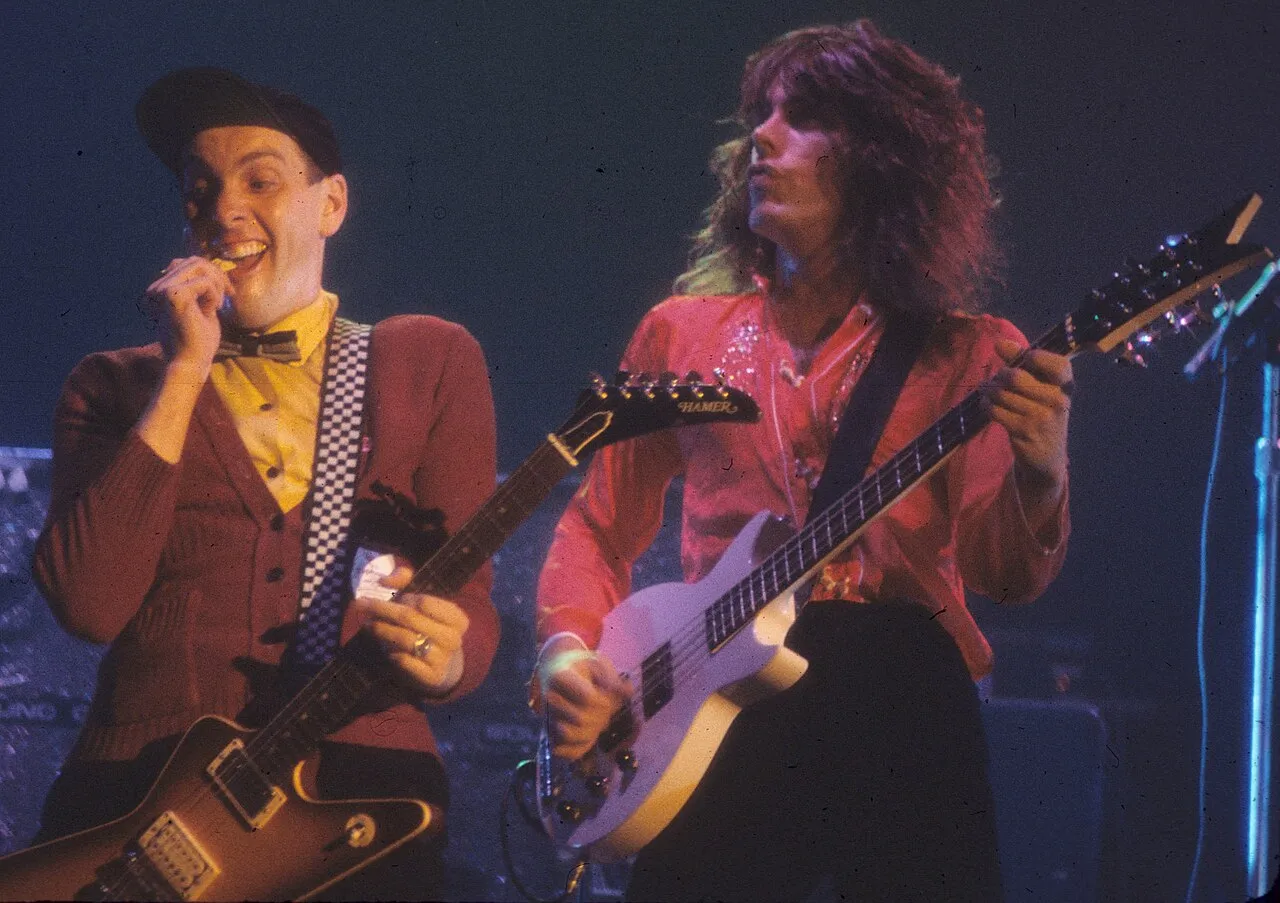
Photo: Carl Lender / Wikimedia Commons / CC BY-SA 3.0 Hamer
Standard
1974
They built the first one for Paul Hamer. It ended up with Rick Nielsen, and he still has it.
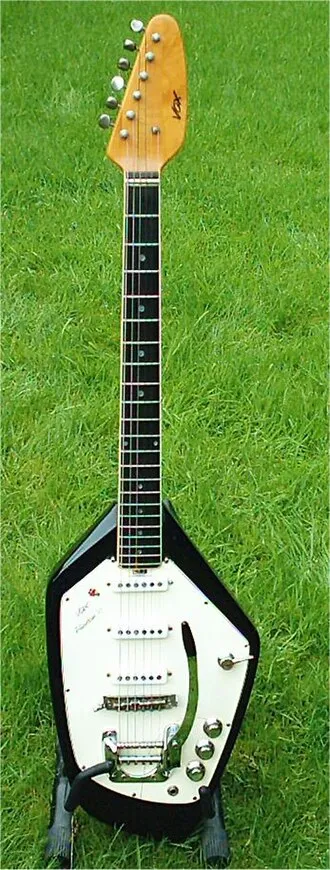
Photo: LittleRoughRhinestone / Wikimedia Commons / Public domain Vox
Phantom
1962
No Fenders in Britain, so Vox built a Strat in a five-sided coat you could spot from the back of the hall.
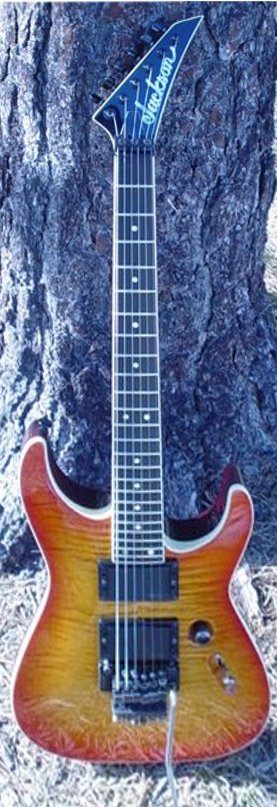
A 1987 Soloist archtop. Photo by Jimshine; perspective correction by GreyCat. Licensed under CC BY-SA 4.0. Via Wikimedia Commons. Jackson
Soloist
1984
Grover Jackson took the Strat shape and ran the maple neck straight through it. Jeff Beck’s was pink.