Vox
Phantom
No Fenders in Britain, so Vox built a Strat in a five-sided coat you could spot from the back of the hall.
Dartford, Kent, 1962. The amplifier company everybody in British beat music plugs into wants a guitar of its own, and not another copy of an American one. It wants something you’d know was a Vox from across the room. What comes out of the factory has five sides.
- Introduced
- 1962
- Type
- Solidbody electric
- Class
- Production
The short version
1961
The first Phantom?
One account puts a Phantom Mark I in October 1961. Most put the start a year later.
1962
Dartford
Vox’s first original guitar goes into production, and the Echoes get the first ones to try.
1965
Italy helps out
Demand outruns Dartford, and Eko starts building Phantoms too. By 1966, production has moved there.
1966
“True spring action vibrato”
The U.S. catalog lists the Phantom VI at $299.90, padded back included.
1979
Ian Curtis
Joy Division’s manager buys a white Phantom VI Special for his singer.
1998
The first reissue
Korg brings the Phantom back, made in the USA.
Side A
A1
Nobody could buy a Fender
In the early ’60s, if you were a kid in Britain who wanted an American electric guitar, good luck. They were effectively locked out of the country. So Tom Jennings, whose company made Vox amps, did what British firms did: he sold student copies. The Apache, the Stroller, the Clubman. They came out of a furniture shop.
Jennings wanted more than that. He wanted a deluxe guitar that nobody would mistake for a Fender, one you could read as a Vox from the back of the hall before the band had played a note.
A2
Five sides and a secret
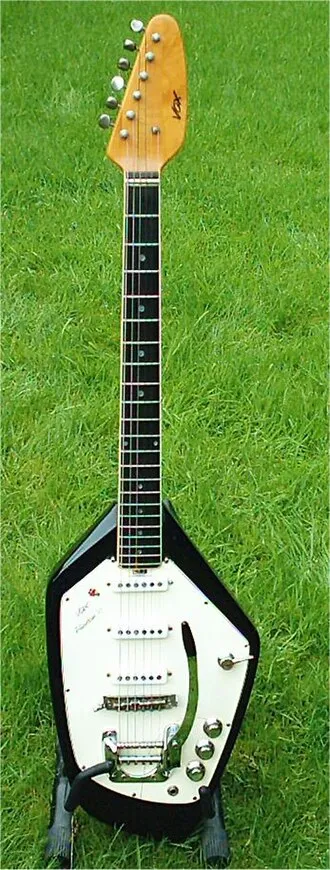
Who drew it depends on who you ask. Vox’s Dick Denney said the company hired the London Design Centre in 1962. Other people say it was done in-house. Either way, in 1962 the factory in Dartford started building its first original guitar, and it was a pentagon. People have been calling it a coffin ever since.
Inside the coat, it’s a Stratocaster. Three single-coil pickups, a bolt-on maple neck, a vibrato arm, a contoured back. The vibrato was modeled on a Bigsby, the pickups and the neck joint on Fender’s. It was an American guitar in a very British costume, and it was awkward to play sitting down. Nobody built a five-sided guitar for the couch.
An American guitar in a very British costume.
The first catalog had two versions. The Phantom I used a rotary knob to pick the pickups, and the Phantom II had three little slides. The rotary won. That’s the switch the Phantom VI kept.
A3
Too popular for Kent
The first Phantoms went to a band called the Echoes to try out in 1962. They kept playing them until 1970. The Hollies’ Tony Hicks played the twelve-string Phantom XII. Pretty soon Dartford couldn’t keep up. By 1965 Eko, in Italy, was building Phantoms too, and by 1966 guitar production had moved there. The Italian ones came with a padded cushion that snapped onto the back. Nearly every Phantom that ended up in America is Italian, which makes a Dartford one the scarce end of the name over here.
The U.S. catalog in 1966 offered an ebony board, a “true spring action vibrato,” a string damper, and the padded back, for $299.90.
Then Vox got carried away, which is my favorite part of any Vox story. The Phantom XII. A Stereo version that split the pickups to two amps. The Phantom VI Special, which put fuzz, boosts, and a “repeat percussion” effect right on the pickguard, behind push-buttons. One of the buttons says “Replat.” It was supposed to say “Repeat.” There was even a Guitar-Organ, Continental organ electronics stuffed inside a Phantom body. John Lennon was given one. He didn’t record with it.
Flip the record · By the numbers
5
Sides. Coffin, pentagon, or trapezoid, depending who’s describing it.
3
Single-coil pickups, a bolt-on neck, and a vibrato. Underneath, it’s a Strat.
$299.90
U.S. list price for a Phantom VI in the 1966 catalog.
6
Push-buttons on Ian Curtis’s Phantom VI Special, one of them labeled “Replat.”
Side B
B1
A singer and a white Special
By the late ’70s the Phantom VI had been out of production for years, and that’s exactly when it found its best-known player. In September 1979, Rob Gretton, Joy Division’s manager, bought a white Phantom VI Special for Ian Curtis. Pentagonal mahogany body, a Bigsby-type tremolo, a roller bridge, six push-buttons, “Replat” included.
Curtis played it in the “Love Will Tear Us Apart” video and on the 1980 European tour, and it’s tied to “Heart and Soul” on Closer. He owned two white Specials. People sometimes say he used a Guitar-Organ. He didn’t.
B2
Recognizable from the back
After Curtis died in 1980, the guitar passed through Bernard Sumner and then Johnny Marr, which makes it about the most Manchester object you could name. Korg reissued the Phantom in 1998, and there’s a little three-quarter-size travel version today. A full-size Phantom isn’t in the catalog.
Put on the “Love Will Tear Us Apart” video and look at Curtis for one second. You don’t need to read the headstock. You don’t need to hear it. It’s a white pentagon, and it could only be a Vox, which is all Tom Jennings ever asked of it.
Put this on
You’ve read about it. Now hear it. Here’s what this guitar sounds like, and what to listen for.
Love Will Tear Us Apart (video)
Ian Curtis with his white Phantom VI Special. Watch it with the sound down first and see how fast you can name the guitar.
Watch it on YouTube (opens in a new tab)Heart and Soul
A track from Closer that his Phantom VI Special is tied to.
Find it on YouTube (opens in a new tab)
The cast
The people, and the specific guitars, that made the legend.
1962
The Echoes
The first Phantoms
Given the first ones to trial, and still using them in 1970. They backed Dusty Springfield on record.
1960s
Tony Hicks
Phantom XII
The Hollies’ guitarist, on the twelve-string version of the pentagon.
1979
Ian Curtis
White Phantom VI Special
Mahogany body, push-button effects, and one misprinted button. In the “Love Will Tear Us Apart” video and on the 1980 European tour.
1979
Rob Gretton
The buyer
Joy Division’s manager bought Curtis the Special in September 1979.
After 1980
Bernard Sumner & Johnny Marr
Later keepers
After Curtis died, his Special passed through both of them.
Liner notes
Specs, construction, rarity, value, and every source we used.
Five sides, three single-coils, and a bolt-on — Vox’s Phantom, not the teardrop Mark VI.
- Body
- Five-sided solidbody (coffin / pentagon / trapezoid in the sources); contoured back. Wikipedia: maple or ash. RetroFret 1965 UK example: mahogany. Mix flagged.
- Neck
- Bolt-on maple; six-in-line spearpoint headstock
- Fingerboard
- 1966 U.S. catalog: ebony, nickel-silver frets. Wikipedia: rosewood. Mix flagged. Zero fret typical.
- Scale
- 25.5" (Wikipedia). Cream City Music listing: 25". Mix flagged. No millimetres invented for the 1960s guitar.
- Pickups
- Three single-coils (Phantom VI). Early Phantom I/II: Vox V.1 bar-magnet coils with chrome covers.
- Hardware
- Roller bridge / Tune-o-matic-style saddles; Hank Marvin (Bigsby-inspired) vibrato; 2-way string damper; Italian examples: snap-on padded back pad
- Electronics
- Master volume, two tones, 3-position rotary pickup selector (the Phantom I switch that later production kept)
- Finish
- Polyester typical (RetroFret: black polyester on a 1965 UK guitar). Wikipedia: black, white, green, light blue, red; custom colors in smaller numbers.
- Nut
- Zero fret plus a string guide. Cream City: 1 5/8". hearandwear listing: 1.62". Mix flagged.
Open the full research fileConstruction details, the complete player record, production numbers, dated value estimates, and sources
Classic living example = 1960s Phantom VI (Dartford, then Eko). No current typical full-size Phantom SKU this pass: factory guitar pages are Bobcat and Giulietta. Mark V Mini (476 mm / 18-3/4"; two coils; poplar; Vox Showroom $149.99, 15 January 2025) is a ¾-scale travel guitar on this silhouette, not this table. Apache (2011) is onboard-amp travel. Mark VI is the teardrop. Phantom XII, bass, Stereo, Special, Guitar-Organ, and Delta stay on this plate, not as second slugs.
Construction
The job was a British solidbody that did not look like a Fender. Jennings already had student copies — Apache, Stroller, Clubman — from a furniture shop, because American electrics were effectively locked out of the UK. Tom Jennings wanted a deluxe guitar you could read as Vox from across a stage.
Who drew the five sides is split. Dick Denney, in The Vox Story (1991), said JMI contracted the London Design Centre in 1962. Vox Showroom notes others say in-house. Guitar Player (Dave Hunter): Design Centre 1962, “resulting in the original Vox Phantom series.” Factory: “In 1962 Vox’s Dartford, UK factory started production of its first original model, the Phantom,” trapezoidal, three single-coils, vibrato, bolt-on. Wikipedia’s Phantom page, citing Guitar Player (Thompson, Babiuk, Elyea, October 2007), puts a Phantom Mark I in October 1961, Dartford for two years, redesigned 1963. Keep 1961 and 1962. This plate starts in 1962. Blue Book: Phantom VI 1962–67.
Under the pentagon it is a Strat layout: three single-coils, bolt-on maple, vibrato, contoured back. Wikipedia company page: Strat neck and attachment, Strat pickups, a vibrato that copied a Bigsby. Awkward seated. The 1962 catalog had Phantom I (rotary 3-way), Phantom II (three slides), and a bass. The rotary is the one later Phantoms kept. Early coils were V.1 bar magnets. Vox Showroom: Phantom VI, late 1962, moved to pole-piece single-coils.
Not a Mark VI. That is the teardrop. Factory: Phantoms “were joined by the teardrop-shaped Mark VI and Mark XII in 1964.” Guitar Player: Mark series “joined the fold in ’63.” Wikipedia: a year later; two-pickup prototype for Brian Jones; Hank Marvin bridge. Jones’s teardrop lives off this slug. Robert Smith with Siouxsie, and Chris Martin later, played Mark VI (Guitar Player). Off this plate.
Demand outran Dartford. Vox Showroom: by 1965 Eko in Italy supplemented UK production; Italian guitars got a snap-on padded back pad. Guitar Player: in 1966 JMI moved guitar production to Eko. Keep both. The 1966 U.S. V209 catalog: ebony board, nickel-silver frets, 3-position switch, “true spring action vibrato,” six saddles, 2-way damper, padded back. U.S. list $299.90 — historical, not 2026 street.
Vox Showroom: Phantom XII in the February 1964 JMI catalog. Guitar Player: 12-string Vox models arrived in ’65 after Harrison’s Rickenbacker 360/12. Stereo (1965) split coils to two amps. Phantom VI Special put fuzz, boosts, and repeat percussion on the guard, including a misprinted “Replat.” Guitar-Organ (1966) stuffed Continental electronics into a Phantom body; Wikipedia: Lennon was given one and did not record with it. Delta (1967) kept the five sides with Ferro-Sonic pickups. Those are Phantom-shaped. They are not this table.
Korg reissued USA Phantoms in 1998. Apache reused the pentagon in 2011. Mark V Mini is the living ¾-scale cart. Jack Charles’s Phantom Guitarworks is Oregon replicas, not Vox.
Classic vs current: 1962–67 Dartford then Eko Phantom VI — five sides, three single-coils, bolt-on, Hank Marvin vibrato — against no new full-size Phantom in 2026, and a Mark V Mini you can order: poplar, two coils, 476 mm.
Players
Do not recruit Mark VI players as if they were this guitar. Brian Jones, Robert Smith (Siouxsie), and Chris Martin stay on the teardrop. Phil “Fang” Volk’s Phantom IV is a bass.
Ian Curtis (Joy Division). The Phantom this plate can name. British-made Phantom VI Special, serial 76634, white pentagonal mahogany, Jennings Bigsby-type tremolo, roller bridge, six push-buttons including “Replat,” five rotaries (Bonhams; Guitar World, 1 October 2020). Manager Rob Gretton bought it in September 1979. Love Will Tear Us Apart video; 1980 European tour; Closer track “Heart and Soul.” Wikipedia: he owned two white Specials. After his death the guitar passed through Bernard Sumner and Johnny Marr; Natalie Curtis offered it at Bonhams, London, 13 October 2020. Hammer £162,563 against £60,000–£80,000 (Bonhams press; Post-Punk.com ~$211,513). Celebrity lot, not-a-comp. Wikipedia: he is sometimes believed to have used a Guitar-Organ; he did not.
Tony Hicks (The Hollies). Wikipedia company page: Phantom XII used by Hicks. Guitar Player: “various models of Vox six- and 12-strings” in the hands of the Hollies, the Dave Clark Five, and Paul Revere and the Raiders. Phantom XII is this silhouette. It is still a Phantom.
The Echoes. Wikipedia company page: first Phantoms given to them to trial in 1962; used until 1970; records with Dusty Springfield. Named as the trial band, not a census.
Also known to play (Wikipedia laundry list, last, short): Captain Sensible and Greg Kihn on Phantom XII. Dave Clark Five six-strings are named by Vox Showroom without a serial here.
Rarity
Factory does not publish Phantom unit totals. None invented.
The 1960s UK-then-Italy run is closed. 1998 USA reissues are closed. Apache and Mark V Mini are other objects on the pentagon. RetroFret on a 1965 Dartford guitar: nearly all Phantoms sold in the U.S. were Italian, not UK — that is why a Dartford example is the scarce end of this name in America, not a factory count. Early Phantom I/II (1962–63) and Specials are thinner on the ground than a standard Italian V209. Ian Curtis’s 76634 is a unique object. It is not a vintage Phantom.
Value
Informal estimate, 1 September 2026. Not an appraisal.
Ask vs sold labeled. Celebrity lots are not-comps. No invented medians or factory counts. Reverb Price Guide widget on a Phantom VI product page did not print a clean USD band in the static fetch this pass.
New street. No living full-size Phantom cart. Mark V Mini factory/Showroom street $149.99 (15 January 2025 snapshot) is the ¾-scale sibling, not this guitar. Bobcat S66 / V90 are hollow-body SKUs on other plates.
Used modern. 1990s USA reissues exist. No clean 2024–26 reissue median isolated this pass.
Vintage / collectible. Named asks this pass, not a midpoint: Blue Book’s Reverb rail, 1966–67 Phantom VI Black $3,204.00; 1965 Phantom VI Black $3,590.00. Older named asks, not hammers: Cream City Music 1960s Italian Black $2,999 (ended); hearandwear 1960s Italian $2,299.99 (ended); RetroFret 1965 Dartford serial 63922 $2,500 (ended). 1966 U.S. list $299.90 is historical. Ian Curtis’s Special at £162,563 is celebrity, and it is a Special.
See also
- fender-stratocaster — three pickups and a bolt-on, the layout under the pentagon
- mosrite-ventures — another British Invasion-era shape guitar; not a Phantom
- rickenbacker-360-12 — the 12-string the Phantom XII answered; not this five-sided six
Sources
- VOX Guitars European History — 1961 student line; 1962 Dartford Phantom; Mark VI / XII 1964; Brian Jones on the teardrop; Eko / Crucianelli
- VOX Mark V mini Guitar — living ¾-scale; poplar; 476 mm / 18-3/4"; 19 frets; two single-coils; nut 42 mm / 1.654"
- The VOX Showroom, Phantom VI V209 — late 1962 Phantom VI; Strat layout; Hollies, Dave Clark Five, Paul Revere and the Raiders; 1965 Eko; 1966 catalog copy; $299.90 list
- The VOX Showroom, Phantom I / II — 1962 catalog Phantom I rotary vs Phantom II slides; Denney / Design Centre vs in-house split; V.1 pickups
- The VOX Showroom, Mark V Mini — Phantom shape 1962–67; Mini street $149.99 (voxampshop.com, 15 January 2025)
- Guitar Player, Dave Hunter, Vox teardrop — Design Centre 1962 → Phantom; coffin vs Mark in ’63; Eko 1966; Jones / Smith / Martin are Mark VI; Hollies, DC5, Raiders on various Vox six- and 12-strings
- Wikipedia, Vox Phantom — 25.5"; maple/ash; rosewood; Oct 1961 Mark I via Guitar Player Oct 2007; Special / Curtis; 1998 USA reissue; Apache 2011
- Wikipedia, Vox (company) — 1962 pentagonal Phantom; Echoes trial; Mark VI for Jones; Phantom XII / Hicks; Guitar-Organ; Curtis two Specials not a Guitar-Organ
- Blue Book, VOX Phantom VI — 5-sided; spearpoint; roller/tremolo; 3 single-coils; mfg. 1962–67; Reverb rail $3,204 / $3,590
- Bonhams, Ian Curtis guitar — 13 October 2020; Phantom VI Special; £162,563; estimate £60,000–£80,000
- Guitar World, Ian Curtis Phantom VI Special — serial 76634; pentagonal mahogany; Replat; Gretton 1979; Love Will Tear Us Apart; Heart and Soul
- Post-Punk.com, Curtis guitar sold — ~$211,513; prints £162,562 vs Bonhams £162,563
- Reverb, RetroFret 1965 Phantom VI — Dartford serial 63922; mahogany; black polyester; 1962-3 introduction; Italian majority in the U.S.; ask $2,500
- Reverb, Cream City 1960s Phantom VI — Italian; 1 5/8" nut; zero fret; 25" scale; ask $2,999
- Reverb, hearandwear 1960s Phantom VI — Italian; nut 1.62"; 6 lb 12 oz; ask $2,299.99
- Guitar Interactive, Vox guitars — Phantom I/II satin black polyester; Mark VI within a year; Jones on Ed Sullivan
Keep digging
Guitars this one gets compared to, confused with, or descended from.

Photo: Lightburst / Wikimedia Commons / CC BY-SA 4.0 Fender
Stratocaster
1954
The guitar most people mean when they say “electric guitar.” Designed by a man who didn’t play one.
- Send a picture
Mosrite
Ventures
1963
Semie Moseley offered Nokie Edwards the guitar free. He paid $200, and the Ventures dropped their Jazzmasters.
- Send a picture
Rickenbacker
360/12
1963
George Harrison was too sick to see it. Roger McGuinn saw it in a movie theater. Tom Petty bought one because McGuinn had one.