Hamer
Standard
They built the first one for Paul Hamer. It ended up with Rick Nielsen, and he still has it.
Wilmette, Illinois, 1974. Two guys who buy and sell used Gibsons and Fenders for a living build an Explorer-shaped guitar for one of them, Paul Hamer: cherry sunburst, a bound flame-maple top, and a pair of old Gibson pickups. They call it the Standard. It won’t be Paul’s for long.
- Introduced
- 1974
- Type
- Solidbody electric
- Class
- Production
The short version
1973
The shop
Paul Hamer and Jol Dantzig are selling vintage guitars at Northern Prairie Music. Dantzig builds himself a Flying V bass.
1974
Number 0000
An Explorer-shape with a bound flametop, built for Paul. They name it the Standard.
1974
Backstage
On 7 December they show it to Wishbone Ash in Chicago. What comes back is an order for a bass.
1975
“The Hamer guitar”
The first catalog. The guitar doesn’t have a name in it yet. $799, case extra.
1978
Checkerboard
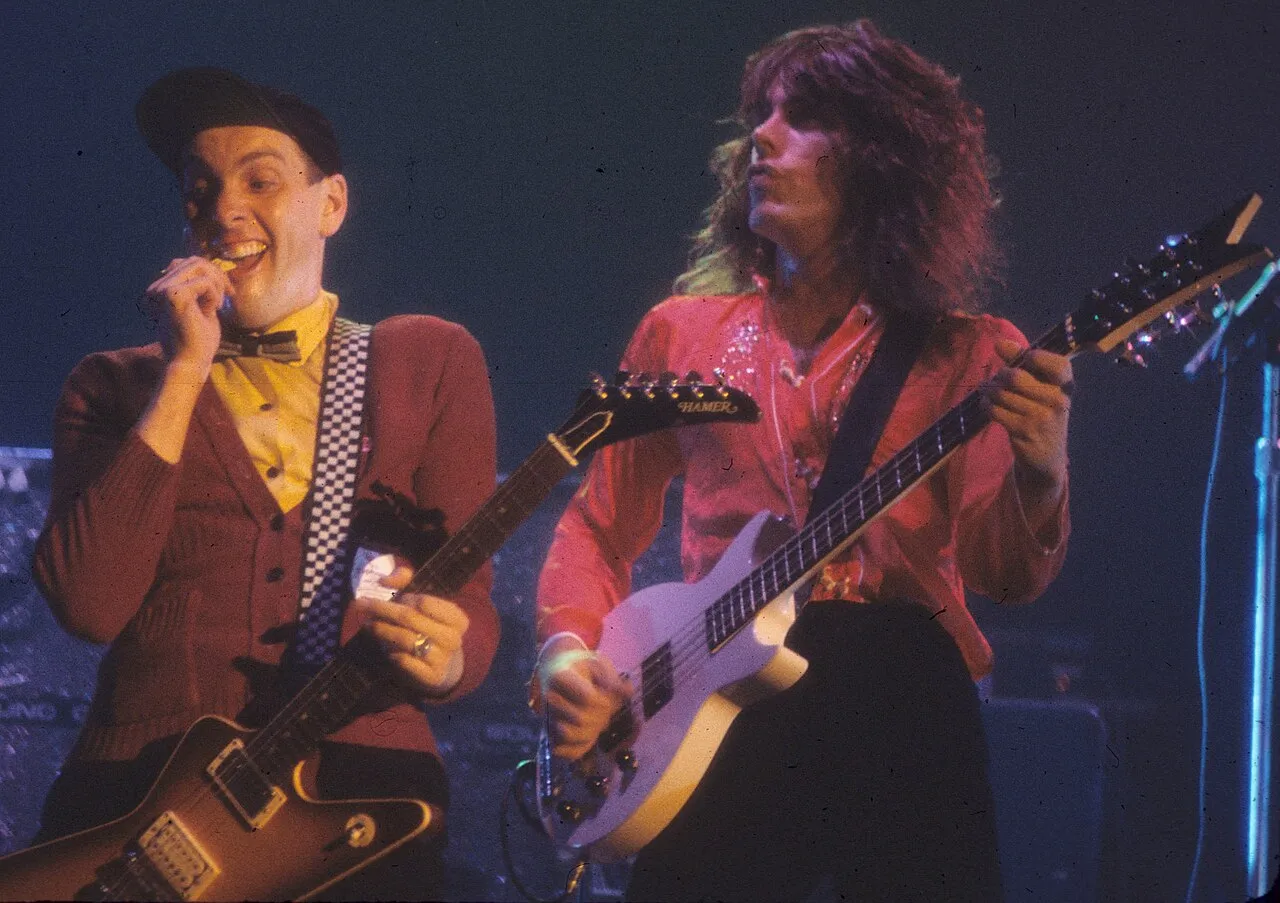
Rick Nielsen gets his checkerboard Standard. The old Gibson pickups have run out.
1979
Dream Police
The checkerboard Standard is on the cover of Cheap Trick’s album.
2012
Lights out
Fender, which had bought Hamer’s parent company, announces the brand will stop.
2017
The import
An Indonesian Standard comes back at $799.99.
Side A
A1
Built for Paul
In 1973 Paul Hamer and Jol Dantzig were selling used Gibsons and Fenders out of a shop called Northern Prairie Music in Wilmette, Illinois. If you spend your days buying and selling old guitars, you get opinions about what the new ones are missing. What they wanted was a vintage guitar you could take on the road.
So they made one. The first Hamer was a short-scale Flying V bass that Dantzig built for himself. The second, in 1974, was for Paul: an Explorer shape with a bound flame-maple top, cherry sunburst, and real Gibson PAF pickups. It got the number 0000. They named it the Standard.
Remember whose guitar that was. It matters later.
A2
A Les Paul top on a shape Gibson gave up on
Gibson had built the Explorer back in 1958, shipped a couple dozen in korina wood, and quit. Hamer’s version wasn’t a copy of that guitar. It was a mash-up: the pointy Explorer outline, cut from one piece of Honduras mahogany, with an optional bound, bookmatched curly maple top, the kind of top people pay extra for on a Les Paul. Six tuners in a row on a hockey-stick headstock. A glued-in mahogany neck, 22 frets, a 24¾" scale.
The early ones often had old Gibson PAFs in the bridge, “lovingly retrieved from old parts bins at Gibson’s Kalamazoo factory,” as one Hamer historian put it. The neck pickup was wound by DiMarzio or Duncan, and then deliberately de-wound, for arena volume. That tells you exactly what kind of stage they had in mind. By 1978 the PAFs had run out, and DiMarzio built both pickups to Hamer’s spec.
Two guys who sold old Gibsons for a living built the Gibson that Gibson wasn’t making.
A3
Backstage at Wishbone Ash
On 7 December 1974, Hamer and Dantzig took the new guitar backstage at a Wishbone Ash show in Chicago. Andy Powell passed. What they came home with was an order for an Explorer bass, from one of the band’s two Turners. Depends who tells it whether that was Martin, the bassist, or Ted, the guitarist.
The first catalog came out in the fall of 1975, and the guitar still didn’t have a name in it. It was just “the Hamer guitar,” $799 without a case. Production started in a garage. Dantzig figured they built maybe 50 Standards between 1975 and 1978, ten or fifteen a year. That’s not a factory. That’s a couple of guys who know every customer by name, and the customers came to include Paul Stanley of Kiss, Mick Ralphs of Bad Company, and a very young Lita Ford.
The shop grew up anyway. Hamer incorporated in 1976, moved to Palatine, then to Arlington Heights in 1980. By September 1978 the Standard listed at $1,199.95. The Sunburst became the volume guitar, the one that sold in numbers, and the Standard stayed the flagship. Around 1980 you could get one in an opaque color with no flametop at all, and for a few years there were even three-quarter-size Standards.
Flip the record · By the numbers
0000
The number on Paul Hamer’s Standard, the first one. Rick Nielsen still has it.
$799
List price in the Fall 1975 catalog, no case.
~50
Standards built from 1975 to 1978, by Dantzig’s estimate. Ten or fifteen a year.
<500
Original Standards built from 1975 to 1985, by one count.
Side B
B1
The one Nielsen kept
Rick Nielsen of Cheap Trick ordered one. The way one historian tells it, Hamer took so long building his that they gave him Paul’s guitar, number 0000. Nielsen tells it more simply:
They brought it to me to check out and I wouldn’t give it back.
He bought number 0004 too. Around 1978 Hamer built him a checkerboard Standard, and in 1979 it was on the cover of Dream Police. That checkerboard guitar is still working: it’s on Cheap Trick’s In Another World, released in 2021.
Steve Clark of Def Leppard played a plain white 1979 Standard, no maple top, no binding, Honduras mahogany and rosewood dots. It’s the guitar in the High ’n’ Dry tour photographs.
B2
Nobody sells a new one
The first run of Standards ended in 1985 or 1989, depending who you ask. Kaman bought Hamer in 1988, the Standard came back in 1995, and after 1997 the plain version became an import. Fender bought Kaman at the end of 2007, and in December 2012 announced the brand would stop. In 2017 an Indonesian reissue showed up at $799.99, ninety-nine cents more than the 1975 list price, forty-two years and an ocean later. Today Hamer doesn’t sell a Standard at all.
The Standard started as one guitar made for one man. A company grew out of it with Paul Hamer’s name on it, and that company doesn’t make the Standard anymore. The guitar built for Paul is still with Rick Nielsen, who, by his own telling, was only supposed to be checking it out.
Put this on
You’ve read about it. Now hear it. Here’s what this guitar sounds like, and what to listen for.
In Another World
Nielsen’s checkerboard Standard, the Dream Police guitar, is on this record, more than forty years after it was built.
Find it on YouTube (opens in a new tab)
The cast
The people, and the specific guitars, that made the legend.
1974
Rick Nielsen
Number 0000, and the checkerboard
Ended up with Paul Hamer’s 0000 and kept it. Bought 0004 too. The checkerboard Standard is on the Dream Police cover.
1974
Paul Hamer
The first Standard
Co-founder. The first Standard was built for him. It didn’t stay his.
1973
Jol Dantzig
Co-founder
Built the first Hamer, a Flying V bass for himself, and helped turn a used-guitar shop into a guitar company.
1979
Steve Clark
White 1979 Standard
No maple top, no binding, rosewood with dots. It’s the guitar in the High ’n’ Dry tour photographs.
late 1970s
Lita Ford
Standard
Very young, carrying a Standard in a promo photo from Hamer’s Palatine shop.
1979
Mick Ralphs
Standard
Bad Company. In the same Palatine-era promo, and on Hamer’s artist list around 1979.
Liner notes
Specs, construction, rarity, value, and every source we used.
Hamer’s 1974 Explorer-shape with a bound flametop — Standard, not a 1958 korina, and not the Sunburst.
- Body
- One-piece British Honduras mahogany; optional bound bookmatched curly maple top. Explorer-shape.
- Neck
- Set mahogany, one-piece; six-in-line hockey-stick / scimitar headstock
- Fingerboard
- Unbound rosewood, pearl dots, 22 frets. Bound rosewood or ebony with crown inlays as an option.
- Scale
- 24 3/4". 2017 Indonesian reissue: 24 3/4" / 628 mm. Mix flagged.
- Pickups
- Two uncovered humbuckers. Early: Gibson PAF in the bridge; DiMarzio- or Duncan-wound neck. Then DiMarzio to Hamer spec.
- Hardware
- Tune-o-matic / fine-tune + stop tailpiece; Grover Deluxe (Schaller from about 1979–80)
- Electronics
- Two volumes, master tone, 3-way on the treble bout
- Finish
- Cherry or tobacco sunburst, natural, opaque black or white
- Nut
- Factory width unpublished this pass. Named dealer 1978: 1 11/16". 2017 reissue: 1 5/8" graphite. Mix flagged.
Open the full research fileConstruction details, the complete player record, production numbers, dated value estimates, and sources
Classic living example = 1970s USA Standard (first catalogued as “the Hamer guitar”). No current typical Standard SKU this pass: hamerguitars.com /standard 404 (fetched 16 September 2026). Living 2017–18 Hamer pages list Monaco, Sunburst, Archtop, Special Jr. — not this outline. 2017 Indonesian STDF-CS is a reissue, not this table. Sunburst, Vector, Blitz, and the Standard Bass are other Hamers. No Gibson SKU.
Construction
The job was a vintage guitar you could take on the road. Paul Hamer and Jol Dantzig were already selling used Gibsons and Fenders out of Northern Prairie Music in Wilmette, Illinois, 1973. Dantzig’s first Hamer was a short-scale Flying V bass for himself that year — no serial, never a production model (Vintage Guitar, Michael Wright). The second was an Explorer-shape for Paul in 1974: bound flametop, cherry sunburst, original Gibson PAFs, serial 0000. They named it the Standard. Dantzig (Premier Guitar): they took it backstage at Wishbone Ash, UIC Pavilion, Chicago, 7 December 1974. Andy Powell passed; bassist Martin Turner ordered an Explorer bass. Wright calls the first order, serial 0001, an Explorer Bass for Ted Turner, “bassist for Wishbone Ash.” Ted was the guitarist; Martin was the bassist. Keep both names. The bass is not this table.
Not a 1958 korina Explorer. Kalamazoo’s original is gibson-explorer-1958-korina — 19 shipped in 1958, 3 in 1959. This is Illinois, mahogany, a Les Paul top on an outline Gibson had already dropped. Ancestor in the pointed-offset job. Not that guitar. No Gibson SKU. Not the Sunburst — Hamer’s double-cut Junior-shape, 1977 (Wright); Baker Rorick on the Fan Club dates that launch 1978. Keep both. Not the Vector (V, 1982). Not the Blitz (cheaper Explorer-shape, 1982–84). Not a Jackson Kelly, Ibanez Destroyer, or Dean ML. Those are other factories on other years.
Wright: garage production 1975. Rorick: first catalog Fall 1975, still unnamed — “the Hamer guitar,” list $799 without case. KMC’s 2017 press and Blue Book print 1974 as the Standard’s introduction. This plate starts in 1974. Keep 1975.
The recipe is a hybrid, not a copy with a different logo. Rorick: one-piece British Honduras mahogany body, optional bookmatched curly maple, one-piece set mahogany neck, hockey-stick six-in-line, 22-fret rosewood, 24 3/4", Grover Deluxe, tune-o-matic and stop. Two volumes, master tone, 3-way. Early Standards often carried salvaged Gibson PAFs in the bridge — Rorick: “lovingly retrieved from old parts bins at Gibson’s Kalamazoo factory” — with the neck wound by DiMarzio or Duncan on Patent Number bobbins. Wright: they de-wound the neck for arena volume. The PAF supply was gone by 1978. DiMarzio then built both to Hamer spec; later baseplates read Hamer (the Slammer pickups). Wright’s two articles disagree on early bobbin colors: Part One has black lead then zebra on the lead, cream neck; Part Four has cream bridge, zebra neck. A named 1978 (Willie's): double-white bridge, zebra neck. Keep the split. Bound board and crown inlays were an upcharge; they start showing on Standards once the Sunburst exists. Opaque colors and no-flametop bodies from about 1980. A few 3/4-size Standards 1978–82. Tuners: Grover through the ’70s, Schaller 1979 or 1980 (Wright).
Hamer Guitars Inc. incorporated in Illinois 1976. Wikipedia: Palatine shop 1977. Wright: Frank Untermeyer joined 1978, then the Palatine move. Keep both. Arlington Heights 1980. The Standard was the flagship while the Sunburst became the volume guitar. Wright: first run ’74 until ’85. Blue Book prints manufacture 1974–1989. Keep both. September 1978 list $1,199.95; March 1980, dots $1,199.95, crowns $1,299.95. Historical lists, not 2026 street.
Kaman bought Hamer 1988. Wright: revived 1995 as Standard Custom (bound rosewood, crowns) and Standard (dots). 1995/96 korina Standards — Fan Club: fewer than 100; one with a split-V headstock. That korina run is a replica of Gibson’s 1958 outline, not this mahogany-and-maple guitar. After the 1997 move to New Hartford, Connecticut, the USA Standard Custom stayed; the plain Standard went Import. Fender bought Kaman 31 December 2007 (Wikipedia); Blue Book: late 2007. Fender announced the brand would cease, December 2012; Premier Guitar, 9 January 2013: FMIC suspends production. Keep both.
KMC / JAM reissued six Import shapes at Winter NAMM 2017, including Standard Flame STDF-CS, MAP $799.99 (Guitar Girl Magazine press, 20 January 2017). Guitar Planet (6 May 2017): Indonesian, mahogany with solid maple cap and flame veneer, set mahogany, rosewood crowns, 15.7" radius, graphite nut 1 5/8", 24 3/4" / 628 mm, two Hamer humbuckers, two volumes and a tone. Mix flagged on that millimetre. hamerguitars.com this pass still sells other 2017–18 shapes. It does not sell a Standard.
Classic vs current: 1974–85 USA Standard — Honduras mahogany, optional bound flametop, hockey-stick, DiMarzio-spec pair, stop tail — against no new Standard you can order from Hamer in 2026.
Players
Do not hang a 1958 korina Explorer on this plate. Do not recruit Sunburst, Vector, or five-neck users as if they were this guitar. Nielsen’s orange five-neck (1981) was laminated from Special bodies (Frank Untermeyer, Guitar Player). Tom Petersson’s 8- and 12-string basses are basses.
Rick Nielsen (Cheap Trick). The player this plate is known for. Wright: they took so long on the guitar he ordered that they gave him Paul’s 0000, “which he still has.” Nielsen, North American Guitar Connoisseur: “They brought it to me to check out and I wouldn’t give it back.” Keep both. He also bought 0004. Dantzig, Premier Guitar (24 November 2015): Nielsen “grabbed one of the first” as Hamer resurrected the Explorer shape in 1974; checkerboard Standard 1978. Fan Club: checkerboard 1978/1979, without body binding, plus a matching V. Dream Police (1979) cover is that checkerboard. Guitar Player (23 August 2021): the checkerboard “Dream Police” Hamer Standard is on In Another World. Unique objects. Not a vintage Standard.
Steve Clark (Def Leppard). Rorick: prominently used by the early ’80s. steveclarkguitar.com, citing Jol Dantzig: white 1979 Standard, no maple top, no body binding, Honduras mahogany, rosewood dots, DiMarzio PAFs — High ’n’ Dry tour photographs. Album-to-guitar credits for named tracks unpublished here. The photographs are the fact. His later Gibson years stay off.
Mick Ralphs (Bad Company). Wright’s undated Palatine promo and the ca. 1979 artist list: Standard. Rorick the same.
Paul Stanley (Kiss). Wikipedia: Kiss among the early touring customers. Wright’s ca. 1979 list: Standards (3). Which Kiss sides are unpublished here.
Lita Ford. Wright: a very young Lita Ford in that Palatine promo, carrying a Standard. Ca. 1979 list: Standard.
Tommy Bolin. Rorick: a pre-Hamer Explorer with Deep Purple. Wright’s promo names him. Pre-catalog object, not a later Standard SKU.
Also known to play stays short. Wright’s ca. 1979 purchase list also names Jan Akkerman, Roy Buchanan (two), Dave Hlubek, Andy Summers (Standard plus Sunbursts), Brad Whitford (two). Purchase is not a session log. None invented.
Rarity
You cannot buy a new Standard from Hamer this pass. hamerguitars.com 404s the slug. 2017 Indonesian STDF-CS and earlier XT / Import Standards are other factories on this silhouette. They are not a 1970s USA Standard.
Hamer did not publish yearly Standard totals. None invented. Four-digit stamps (0000 onward) date a guitar; they do not count a year. Wright / Fan Club: about 750 instruments carried four-digit numbers through 1985 — Standards, eight- and twelve-string basses, and other customs mixed. That is not a Standard census.
What is actually thinner: Dantzig, via Rorick and Blue Book, maybe 50 Standards 1975–78, 10 or 15 a year. Fan Club (Andrew Large): original Standards 1975–1985 fewer than 500. Keep both. The 1995/96 korina run is a labeled limited: Fan Club fewer than 100. Not a 1974 census, and not 2026 street. Nielsen’s 0000 and the Dream Police checkerboard are unique. They are not a vintage Standard.
Value
Informal estimate, 16 September 2026. Not an appraisal.
Ask vs sold labeled. Celebrity lots are not-comps. No invented medians or factory counts. Period lists — $799 (Fall 1975 catalog, Rorick); $1,199.95 (September 1978, Wright); March 1980 dots $1,199.95 / crowns $1,299.95 — are 1970s money, not 2026 street. Reverb Price Guide on early USA Standard did not print a clean band in the static fetch this pass.
New street. None under Standard this pass. hamerguitars.com /standard 404 (16 September 2026). Historical 2017 MAP $799.99 (Guitar Girl / KMC NAMM press) is a 2017 cart, not a living one.
Used modern. Indonesian 2017 STDF-CS and XT / Import Standards trade used. Named sold, not a series: 2017 Indonesian Standard $1,150 (Reverb, listing four years stale). Named ask this pass, not a hammer: 1999 Explorer-labelled Import $1,500 (eBay, via Blue Book feed). Don’t invent a midpoint.
Vintage / collectible. Named asks this pass, not hammers: 1976 tobacco sunburst $11,000; 1981 sunburst $13,250; 1980 four-digit natural $14,999; 1980 3/4-size Raspberry Metallic $9,999.99; 1995 USA korina $7,200; 2006 USA korina $9,000. Named older ended ask: Willie's American Guitars 1978 cherry sunburst $11,500 (serial under 200). Do not average those asks. Nielsen’s 0000 and the checkerboard Dream Police guitar are unique objects. Not comps. No Burst tier.
See also
- gibson-explorer-1958-korina — the 1958 original this Illinois flametop is not
- ibanez-destroyer — 1975 FujiGen Explorer-shape; not Hamer’s Standard
- jackson-kelly — 1983 San Dimas pointed offset; not this guitar
Sources
- Vintage Guitar, Michael Wright, The History of Hamer, Part One — 1973 V bass; 1974 Standard #0000; first order 1975; Nielsen given Paul’s guitar; woods, PAFs, DiMarzio de-wound neck, Grover/Schaller; $1,199.95 Sept 1978; March 1980 lists; 3/4-size 1978–82; ca. 1979 artist list
- Vintage Guitar, The History of Hamer, Part Two — Standard first run to ’85
- Vintage Guitar, The History of Hamer, Part Four — 1995 revival GSTC/GSTS; 1995/96 korina; ~750 four-digit serials; 1974 first Standard as 25th-anniversary marker; Grover 1974–80 / Schaller 1980–82; PAF then DiMarzio then Slammer
- Hamer Fan Club, Baker Rorick, Early Hamer Guitars — The Standard — Fall 1975 catalog; $799; 24 3/4"; two volumes + master tone; PAF bridge to mid-1977; Dantzig ~50 Standards 1975–78; Nielsen #0000; Clark / Ralphs / Stanley / Ford / Bolin
- Hamer Fan Club, Andrew Large, The Hamer Standard — first guitar 1974; production 1975; ~50 to 1978; <500 original Standards 1975–85; ~750 four-digit instruments; 1995 reissue; <100 korina 1996; Nielsen #0000 and 1978/79 checkerboard
- Hamer Fan Club, About Hamer Serial Numbers — four-digit from 0000; Sunburst year-prefix from 1977; ~750 four-digit through 1985
- Wikipedia, Hamer Guitars — founded 1973 Wilmette; Standard from Explorer; incorporated 1976; Sunburst 1977; Kaman 1988; Fender 31 Dec 2007; cease Dec 2012; NAMM 2017 imports
- Premier Guitar, Jol Dantzig, Creating a Museum-Quality Guitar — 24 Nov 2015; Standard named 1974; Nielsen first; checkerboard 1978
- Premier Guitar, Jol Dantzig, The Explorer That Got Away — Standard named; 7 Dec 1974 Wishbone Ash backstage
- Guitar Girl Magazine, Hamer 2017 NAMM lineup — 20 Jan 2017; Standard Flame STDF-CS; original USA Standard 1974; MAP $799.99
- MMR, Hamer Guitars Returns — 23 March 2017; Standard originally 1974; Kaman 1988; Fender discontinue; JAM/KMC 2017 six-model reissue
- Guitar Planet, Hamer Standard 2017 — 6 May 2017; Indonesian STDF-CS spec; 24 3/4" / 628 mm; 1 5/8" graphite; 15.7" radius
- hamerguitars.com — living 2017–18 models this pass (Monaco, Sunburst, Archtop, Special Jr.); no Standard (16 September 2026)
- Blue Book, HAMER STANDARD (THE HAMER GUITAR) — mfg. 1974–1989; 24.75"; ~50 1975–78; merchant asks this pass
- Premier Guitar, FMIC Suspends Hamer Production — 9 January 2013
- Rick Nielsen, North American Guitar Connoisseur — #0000 “wouldn’t give it back”; bought #0004; checkerboard on Dream Police
- Guitar Player, Tom Beaujour, Rick Nielsen — 23 August 2021; checkerboard “Dream Police” Standard on In Another World
- Guitar Player, Rick Nielsen five-neck — 4 March 2021; Untermeyer: checkerboard Standard already done by 1981; five-neck from Special bodies
- steveclarkguitar.com, Early Years / High ’n’ Dry — white 1979 Standard; Dantzig; High ’n’ Dry tour
- Willie's American Guitars, 1978 Hamer Standard — ended ask $11,500; 24.75"; 1 11/16" nut; serial under 200
- Reverb, 2017 Hamer Standard — sold $1,150; Indonesian
Keep digging
Guitars this one gets compared to, confused with, or descended from.
- Send a picture
Gibson
Explorer (1958–59 korina)
1958–59
Gibson shipped twenty-two of them. Everybody knows the shape. Hardly anybody has held the real thing.
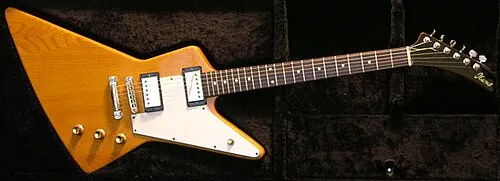
Photo: TheDestroyerGuy / Wikimedia Commons / Public domain Ibanez
Destroyer
1975
Ibanez copied the Explorer, right up until Gibson sued. Eddie Van Halen got a sound out of it nobody could copy.
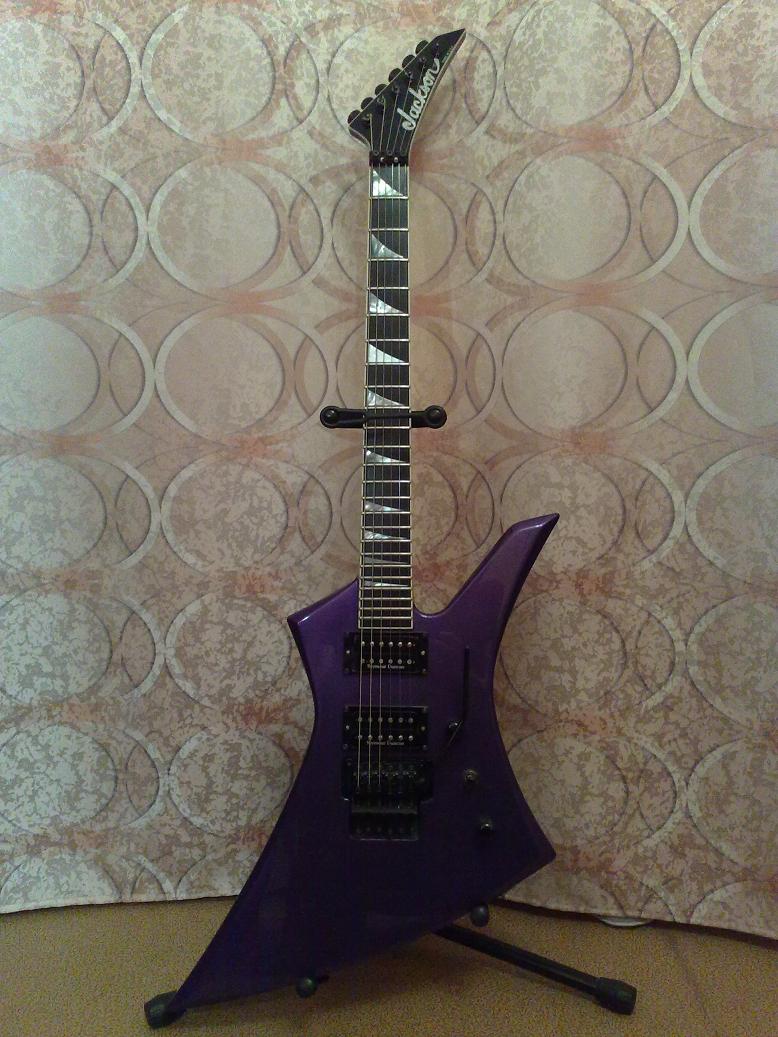
Photo: Saitaro / Wikimedia Commons / Public domain Jackson
Kelly
1983
It’s named after a guitarist from an Australian band called Heaven. Marty Friedman is why you know it.