Huss & Dalton
CM
The rest of the Huss & Dalton catalog is other people’s shapes. The CM is the one they drew themselves.
Two banjo builders from the Shenandoah Valley filled their catalog with dreadnoughts, OMs, and slope-shoulders. Then they drew a concert body with a dreadnought’s depth and a soft cutaway, and kept building it.
- Introduced
- 1997
- Type
- Acoustic
- Class
- Production
Have a photograph of this guitar? Send a picture
The short version
1995
Pizza Hut, Waynesboro
Jeff Huss and Mark Dalton meet that summer. The company dates itself to 1 October. Keep both.
1996
Out of the garage
Rented space in Stuarts Draft.
1997
The first CM, maybe
A seller dates a CM Custom to 1997, already on today’s outline. No serial on the listing.
1998
The first CMs on the record
The earliest CMs to cross an auction block are 1998 customs.
1999
The pencil factory
They buy a 1930s building in Staunton. The shop is still there.
2002
On the wall at Gryphon
Frank Ford has a CM on the wall, an auditorium with a dreadnought’s depth.
2021
Jeff Huss retires
Brian Dickel, in the shop since 2000, buys in.
2025
The Daltons retire
Mark and Kimberly Dalton step away on 26 September. Dickel is the sole owner.
Side A
A1
Two banjo men at a Pizza Hut
Summer 1995, a Pizza Hut in Waynesboro, Virginia. That’s where Jeff Huss and Mark Dalton, both out of Stelling Banjo Works, met, by one telling. The company dates itself to 1 October that year. Keep both.
They started in Huss’s garage, moved into rented space in Stuarts Draft, and in 1999 bought a 1930s pencil factory in Staunton. In 2008 they bought the building next door. Still Staunton.
Look at what they built in there. A square-shouldered rosewood dreadnought. An OM. A slope-shoulder. Later, a small L-style box. Good guitars, every one of them, on outlines somebody else drew first.
The CM is the one they drew.
A2
Concert, series, or mini dread
Even the letters depend who you ask. Concert Model, says one reviewer. Concert Series, says the listing on a 1997 guitar. One dealer calls it a mini dreadnought. Keep all three, because all three are trying to describe the same odd thing.
Across the lower bout it’s 15¼ inches, which puts it in the neighborhood of a 000 or an OM. Then look at it from the side. The sides are 4⅝ inches deep. The house OM is 4⅛. The house dreadnought is 4⅞. So the CM is a small guitar with almost a dreadnought’s worth of box behind the top.
That’s what you hear. A reviewer playing an Indian-rosewood standard in 2021 heard more air than a 000 or an OM, still OM-like, with a tighter dynamic range. Frank Ford had one on the wall at Gryphon in 2002 and described it the same way from the other direction: an auditorium with a dreadnought’s depth, a cutaway, for fingerstyle.
A3
1997, or 1998
The factory page prints no birth year. The earliest one anybody has put a date on is a CM Custom a seller listed as built in 1997, already on the outline you can order today: Engelmann top, Venetian cutaway, figured maple binding, abalone rosette, 15¼ inches wide, 4⅝ deep. No serial on the listing. The earliest CMs to come through an auction house are 1998, both customs.
Keep both years. And don’t date the guitar from 1995. The company came first.
Jeff Huss had a rule about how a shape earned its name: if they thought they could sell ten, they’d build a jig for it. By the late 1990s the CM was being built in cedar, koa, and Honduran rosewood, and in at least one long-scale twelve-fret version. Somebody was buying.
A small guitar with almost a dreadnought’s worth of box behind the top.
Flip the record · By the numbers
15¼″
Width across the lower bout. In the neighborhood of a 000 or an OM.
4⅝″
Depth of the sides. The house OM is only 4⅛″.
25 ft
The radius built into the top and sides of a Standard. The top is domed on purpose.
10
What Jeff Huss said they had to be able to sell before a shape got its own jig.
Side B
B1
The top is bent on purpose
The guitar on the card today is the radius-top Standard. A 25-foot radius is built into the braces and into the sides, so the top is very slightly domed instead of flat. The Traditional series keeps the curved braces and leaves the sides flat. Braces are hand-split Appalachian red spruce, the tops are graded AAA and flex-tested before they go in, and the woods change on custom orders while the bracing doesn’t. Mark Dalton said so himself.
The standard recipe is Engelmann spruce over Indian rosewood or mahogany, a 25.4-inch scale, an ebony board with one abalone scroll at the twelfth fret and nothing else, and gold tuners with ebony buttons. The finish, in the shop’s own words on a forum in 2015: “Our finish is a catalyzed urethane. Not a true lacquer, and not a ‘poly’ urethane either.” A 1997 owner who asked about matching the early finish was told the shop needed the serial first.
Don’t confuse it with the CM-12. Same body, shorter 24.9-inch scale. That one’s blurb calls itself “a cutaway version of our CM,” even though the CM card already has the cutaway. There’s a non-cutaway CM too. Neither is this card.
B2
The names on the building
Nobody has pinned a CM to a record yet. Paul Simon, Bob Weir, Molly Tuttle, and Mary Chapin Carpenter all turn up on lists of Huss & Dalton players, with no model named. Even guitar number 6,000 was a custom DM, not a CM.
The founders have handed it on. Jeff Huss retired in 2021. Brian Dickel, in the shop since 2000, bought in that year. Mark and Kimberly Dalton retired on 26 September 2025, and Dickel owns it now, six builders turning out roughly two hundred guitars a year.
The two banjo men from the Pizza Hut have both gone home. The card on the factory page still says 15¼ by 20 by 4⅝, Venetian cutaway, the one shape in the building that was theirs.
Put this on
You’ve read about it. Now hear it. Here’s what this guitar sounds like, and what to listen for.
Huss & Dalton CM Cutaway Standard
A demo on an Indian-rosewood standard, the catalog guitar. He hears more air than a 000 or an OM, with a tighter dynamic range.
Watch it on YouTube (opens in a new tab)
The cast
The people, and the specific guitars, that made the legend.
1995
Jeff Huss
Co-founder
Out of Stelling Banjo Works. The company started in his garage. He retired in 2021.
1995
Mark Dalton
Co-founder
Also from Stelling. Retired with Kimberly Dalton on 26 September 2025.
2021
Brian Dickel
The shop since 2000
Part owner from 2021, sole owner after the Daltons. Six builders, roughly two hundred guitars a year.
2002
Frank Ford
A CM on the wall at Gryphon
Described it as a 15¼″ auditorium with a dreadnought’s depth and a cutaway, for fingerstyle.
2021
Teja Gerken
CM Cutaway Standard, Indian rosewood
The demo on the Put this on card. Later he spelled out the letters as Concert Model.
Liner notes
Specs, construction, rarity, value, and every source we used.
A deep concert with a Venetian cutaway — Huss & Dalton’s CM, not their slope-shoulder and not the Crossroads.
- Body
- The shop’s own concert outline. Not a 000. Not a slope-shoulder. Soft Venetian cutaway on the live catalog card. Engelmann spruce top (the factory page spells it Englemann). Indian rosewood or mahogany back and sides — Peghead, 2021; the factory cell does not name the back. Figured-maple binding, black/white/black purfling, abalone rosette, clear pickguard. Radius top. 15¼" wide, 20" long, 4⅝" deep. Soundhole 4 3/16".
- Neck
- Mahogany on the reviewed standards. Quarter-sawn. The shop’s menu also lists maple, walnut, or Spanish cedar. Two-way steel truss rod. The factory CM cell does not print the joint.
- Fingerboard
- Ebony, maple-bound, radiused. Radius not printed. Abalone scroll at the 12th only. 20 frets on Swee Lee’s sheet and Reverb’s model field — not on the factory cell.
- Scale
- 25.4"
- Pickups
- None
- Hardware
- Belly bridge; ebony on the reviewed guitars. Factory cell says belly and does not name the wood. Bone nut, fully compensated bone saddle, 2 7/32" spacing. Gold H&D tuners with ebony buttons. Tweed hardshell case.
- Electronics
- None
- Finish
- Catalyzed urethane. Shop reply, 27 February 2015: not a true lacquer, and not a polyurethane. Swee Lee’s CM sheet: Catalysed Urethane.
- Nut
- Bone, 1¾"
Open the full research fileConstruction details, the complete player record, production numbers, dated value estimates, and sources
Classic living example = current factory CM, Staunton, radius-top Standard, fetched 8 October 2026. Factory inches. No millimetre SKU. Mix flagged. Dream Guitars measured 2004 serial 1373 at 25.4000 in / 645.2000 mm, nut 1.7500 in / 44.5000 mm, spacing 2.2500 in / 57.2000 mm — not the factory 2 7/32". Same guitar: lower bout 15.375" against 15¼"; depth 4" at the heel and 5" at the tail against one factory figure of 4⅝". Do not average. Northern Lights printed 24.9" on a sold CM Cutaway. That is the CM-12 scale. Peghead’s 2021 demo names Gold Gotoh Mini; Heartbreaker #5230 prints Gold H&D/Gold; that Northern Lights guitar prints Waverly 1129. Don’t average the tuners. Not the CM-12. Not a non-cutaway. Not the Crossroads. Not the DS. Not a TOM. Not a Martin OM-28.
Construction
The catalog around this guitar is other people’s shapes. The TD-R is a square rosewood dread. The TOM is an OM. The DS is the slope-shoulder. The Crossroads is the small L-style box. The CM is the outline Huss & Dalton drew.
Teja Gerken (Peghead Nation, 6 March 2025) expands the letters: Concert Model. A dealer listing of a 1997 guitar says Concert Series. Acoustic Music Works sometimes calls it a mini dreadnought — concert outline, dreadnought depth. Keep all three. It is not the Crossroads, and it is not the slope-shoulder.
Lower bout 15¼", in the neighborhood of a 000/OM, and sides 4⅝" deep. The house TOM is 15⅛" wide and only 4⅛" deep. The house dread and the DS are 4⅞". Frank Ford, at Gryphon on 23 March 2002, already had one on the wall: a 15¼" auditorium with a dreadnought’s depth, a cutaway, for fingerstyle. Gerken, 8 December 2021, on an Indian-rosewood standard: more air than a 000/OM, and OM-like, with a tighter dynamic range. One review. Not a slogan.
The factory page prints no birth year. This header is 1997, and the credit is a seller. 3 Pillars listed a CM Custom as built that year, already on the living outline: Engelmann, Venetian cutaway, figured maple, abalone rosette, the scroll, 25.4", 1¾", 4⅝" deep, 15¼" wide, a 4 3/16" hole. No serial on the listing. Honduran rosewood, a slotted peghead, and an under-saddle pickup were the upgrades he named, on a CM he treated as already a model. Heritage’s earliest auction CMs are 1998, serials 089 and 148, both Custom. A 1999 12-fret custom is serial 247. A 2002 CM is serial 700. Don’t collapse 1997 into 1998. Don’t date the model from the company’s 1995 start.
Jeff Huss and Mark Dalton, both out of Stelling Banjo Works. Okra: they met at the Pizza Hut in Waynesboro in the summer of 1995. Wikipedia: the company started 1 October 1995. Keep both. Huss’s garage, then rented space in Stuarts Draft — Americana has Mark putting that move in 1996. 1999: they bought the Staunton building. Okra calls it a 1930s pencil factory. 2008: the building next door. Still Staunton. Jeff Huss retired in 2021. Mark and Kimberly Dalton’s date, on the company’s own note, is 26 September 2025. Brian Dickel, there from 2000, part owner from 2021, sole owner after that.
The living guitar is the radius-top CM in the table. Standard Series puts a 25-foot radius in the braces and in the sides. Traditional Series keeps the radiused braces and leaves the sides flat. The CM cell says Radius Top. Braces are hand-split Appalachian red spruce; Wikipedia adds Mt. Rogers. Bridge plates are Honduras rosewood. Tops are AAA and deflection-tested. Mark Dalton, Americana 2015: customs change cosmetics and woods, not the bracing. A 2000 CM sheet and later CM-12 customs print a scalloped X. The factory CM cell does not.
Finish is the shop’s sentence. Unofficial forum, 27 February 2015, the reply a later poster addresses to Mark: “Our finish is a catalyzed urethane. Not a true lacquer, and not a ‘poly’ urethane either.” Swee Lee’s CM sheet prints the same coat. A 1997 owner on that thread was told the shop needed a serial before matching the early finish. Don’t paint 2015 urethane onto serial 089. Nitro on a stage-worn top, or on a Pilgrim sheet, is another model.
Gerken, reviewing the Crossroads for Acoustic Guitar in December 2012, calls a bolt-on neck a house trait, and a bit more top radius than a vintage flat-top. The CM page does not print the joint. That review is not a CM build sheet. Don’t invent a dovetail.
Not the CM-12. Same body inches. Scale 24.9", not 25.4". Gerken, 2025: 14-fret with a cutaway, 14-fret without, and a 12-fret with a cutaway. The factory CM blurb includes the Venetian cutaway. The CM-12 blurb calls itself “a cutaway version of our CM.” Keep both. Serial 247, the 1999 12-fret, is still 25.4", with a 1 13/16" nut. Not today’s CM-12. A non-cutaway exists. It is not this card.
Not the Crossroads. Jeff Huss, Premier Guitar, NAMM 2014: an L-style body from about a year earlier — 2013 on his clock — and the slope-shoulder beside it was new. Factory Crossroads: flat top, 14⅝" × 19¼" × 4 5/16", scale 24.75", a 4" hole, cream binding, firestripe guard, Indian rosewood board, straight rosewood bridge. The DS Crossroads at that booth was a prototype at $3,900. Not 2026, and not this guitar. Not the DS: slope-shouldered, 15¾" × 20" × 4⅞", scale 25.4", hole 4⅜", tobacco burst, snowflakes, nut 1 23/32". Not the TD-R: square, flat top, herringbone, ivoroid, 15⅝" wide. Not the TOM: 15⅛" × 19¼" × 4⅛", hole 3⅞". A Martin OM-28 is someone else’s 25.4" 14-fret.
Players
No verified named CM is pinned to a record here. Gerken’s 2021 and 2025 pieces are listening sessions. Which songs, if any, were cut on a CM is unpublished.
Not this guitar. Albert Lee’s signatures are the T-OO14 (a 2013 collaboration) and the MJ line. The factory page: he began playing an MJ in 2007. John McCutcheon’s Acoustic Guitar Sessions guitar is a 2002 MJ-C. Guitar number 6,000 (Peghead, May 2023) is a custom DM. George Shuffler and James Alan Shelton each had a run of 25 (Wikipedia). The model is not named as a CM. Wikipedia’s longer list — Paul Simon, Edie Brickell, Bob Weir, Molly Tuttle, Mary Chapin Carpenter — and Okra’s note that Simon bought one for Brickell, are the brand. No CM, no serial, no session.
Also known to play: none sourced as this model.
Rarity
You can order a new CM. Mahogany and Indian rosewood are woods, not limited editions. The catalog card is the 14-fret cutaway.
No CM unit total is published. None invented. Serials date a guitar — Heritage 089 (1998), 700 (2002), Heartbreaker 5230. They don’t count a year. A first-year census is unknown for that reason.
Shop output is not this model, and the figures disagree. Okra, undated here, after the CNC: 250 steel-string flat-tops and about a dozen banjos a year, in batches of five. Americana, 2015: several hundred a year, more before the recession; the crew from 13 to seven, then eight. Wikipedia: around 250 instruments a year. Brian Dickel, 20 February 2025: six builders, roughly 200 guitars a year. The 6,000th guitar is a DM. Huss’s line in Okra — jig a model if they could sell ten — is how a shape gets a name. Not a CM count.
Thinner, not rarer as a model: the 1997–99 customs, cedar and koa and Honduran, and a long-scale 12-fret from before the CM-12’s 24.9" card. One-off woods on this outline. Not a vintage Martin.
Value
Informal estimate, 8 October 2026. Not an appraisal.
Ask vs sold labeled. No celebrity CM lot is sourced. No invented medians. The models page prints no price. A December 2012 Crossroads list of $3,400, and the 2014 DS Crossroads prototype at $3,900, are other guitars.
New street. No current U.S. cart for a standard Engelmann CM turned up this pass. Peghead, 8 December 2021: $4,503 on an Indian-rosewood CM Cutaway Standard. A 2021 demo price. Heartbreaker still shows $4,375 on sold-out 2019 serial 5230. Not a 2026 tag. Swee Lee Singapore titles one Custom Cutaway Standard and prints the Engelmann / East Indian recipe at $6,599 SGD, tax in. Not a U.S. cart. Customs are a different guitar. Carter, 2025, Adirondack and mahogany: $6,300. Peghead’s March 2025 CM-12 custom: $7,417 list / $6,675 street, as shown. Down Home’s 2026 Fretboard Summit CM-12, quilted maple and Italian spruce: $9,317, then $8,385. Organic Sounds’ 2023 NAMM non-cutaway, serial 5941: $7,167 / $6,450, sold out. Don’t average a standard into a show guitar.
Used modern. No Reverb Price Guide dollar band this pass. Flag: thin sold-comp access. Named asks, not hammers. Acoustic Guitar Forum, 14 October 2025: rosewood cutaway, excellent-plus, $3,750 plus $100 shipping. UMGF, 10 February 2025: a 2010 rosewood cutaway, $3,650 shipped. No midpoint. 3 Pillars asked $3,599 plus $99 for the 1997 Custom, listed about six years before this pass. Hammer not shown.
Vintage / collectible. No pre-war tape. A 1998 or 2002 CM is a used Staunton guitar, not OM-28 money and not J-45 money. Heritage sold 1998 and 2002 CMs on 9 October 2024. The public pages do not print the hammers. Early customs sit outside any later band. Not a comp.
See also
- martin-om-28 — Nazareth’s 25.4" 14-fret 000/auditorium; this concert is deeper, and it isn’t that outline
- bourgeois-om-vintage — another small shop’s long-scale OM; Lewiston, not Staunton
- gibson-j-45 — Gibson’s round-shoulder dreadnought; Huss & Dalton’s slope-shoulder is the DS, not the CM
Sources
- Huss & Dalton, models — live CM card, 8 October 2026: radius top, Englemann, maple binding, abalone rosette, 12th-fret scroll, clear guard, gold H&D/ebony, 1¾", 2 7/32", 25.4", hole 4 3/16", 4⅝" × 15¼" × 20", Venetian cutaway. CM-12 at 24.9". Crossroads, DS, TD-R, TOM, and the Albert Lee cards as keep-aparts.
- Huss & Dalton, technical information — 25-foot radius, Standard vs Traditional; hand-split Appalachian red spruce braces; Honduras rosewood bridge plates; AAA tops, deflection-tested; bone nut and compensated saddle; quarter-sawn necks and a two-way truss rod; tweed case in the price; CNC in 2004.
- Huss & Dalton, about — founded 1995, Shenandoah Valley, Jeff Huss and Mark Dalton; the company’s 2021 telling of the handoff to Brian Dickel.
- Peghead Nation, Teja Gerken, CM Cutaway Standard, 8 December 2021 — company 1995; 15¼" and deeper than a 000/OM; mahogany or Indian rosewood; Engelmann, mahogany neck, ebony board and bridge; 25.4", 1¾", 2 7/32"; flamed maple, zigzag backstrip, scroll; Gold Gotoh Mini; $4,503.
- Peghead Nation, Teja Gerken, CM-12, 6 March 2025 — “Concert Model”; three variations; CM-12 standard is Engelmann with mahogany or Indian rosewood; demo scale 24.9"; $7,417 list / $6,675 street as shown.
- Wikipedia, Huss & Dalton — 1 October 1995; Stuarts Draft, then Staunton in 1999; around 250 a year; Mt. Rogers braces; Shuffler and Shelton runs of 25; brand-level player list. Notability warnings on the article. The player list is not a CM list.
- Okra, Guitar Men — summer 1995, Pizza Hut, Waynesboro; garage, Stuarts Draft, then the Staunton pencil factory; 250 flat-tops and about a dozen banjos; batches of five; “if we could sell ten”; Simon’s guitar for Edie Brickell, model unnamed. Undated in this pass.
- Americana Music Magazine, Build It, They Will Play — 2015 interview; Stelling; 1996 Stuarts Draft; 1999 Staunton; 2008 adjacent building; several hundred a year; crew of 13, then seven, then eight; customs don’t change the bracing.
- Acousonix, Brian Dickel, 20 February 2025 — six builders; roughly 200 guitars a year.
- Peghead Nation, A New Era Begins, 9 September 2025 — Jeff Huss retired 2021; Mark and Kimberly Dalton retire 26 September 2025; Dickel sole owner.
- Staunton News Leader, 17 June 2021 — Dickel buys in; both founders ex-Stelling; Jeff Huss retiring.
- Peghead Nation, Guitar Number 6,000, 17 May 2023 — the 6,000th is a custom DM, not a CM.
- Frank Ford, Gryphon, Huss & Dalton CM, 23 March 2002 — 15¼" auditorium, dreadnought depth, cutaway, fingerstyle.
- Premier Guitar, NAMM 2014, DS Crossroads demo — Jeff Huss: L-style Crossroads about a year earlier; the slope-shoulder new at the booth; 24¾"; $3,900; a prototype.
- Acoustic Guitar, Crossroads review, 18 December 2012 — Teja Gerken: L-00 styling; bolt-on and extra top radius as house traits; 24¾"; list $3,400. A Crossroads, not a CM.
- Unofficial Huss & Dalton Forum, finish, 27 February 2015 — shop reply: catalyzed urethane; early serials not confirmed from the thread.
- Swee Lee, CM Custom Cutaway Standard — concert, Venetian cutaway, Engelmann / East Indian rosewood, catalysed urethane, 25.4", 20 frets; $6,599 SGD.
- Reverb, Huss and Dalton CM Natural — model field: 20 frets; rosewood or mahogany; Engelmann. Price Guide dollar band not captured this pass.
- 3 Pillars, 1997 CM Custom (Reverb) — seller’s 1997 date, no serial; standard outline; ask $3,599 + $99. Sold. Hammer not shown.
- Heritage, 1998 CM Custom #089 — flamed mahogany, cedar; sold 9 October 2024; hammer not on the public page.
- Heritage, 1998 CM Custom #148 — quilted mahogany; same sale; hammer not public.
- Heritage, 2002 CM #700 — cutaway; same sale; hammer not public.
- Acoustic Music Works, 1999 CM Custom #247 — 12-fret, Adirondack, Honduran; “mini dreadnought”; 25.4"; nut 1 13/16"; spacing 2¼".
- Dream Guitars, 2004 CM #1373 — measured inches and millimetres. Mix flagged. One guitar.
- Heartbreaker, CM #5230 — 2019 Engelmann / East Indian rosewood; 25.4"; $4,375; sold out.
- Northern Lights, CM Cutaway — sold; Engelmann / East Indian rosewood; scale printed 24.9"; Waverly 1129. Not averaged into the 25.4" card.
- Acoustic Guitar Forum, 14 October 2025 — rosewood cutaway ask $3,750 + $100. Not a hammer.
- UMGF, 2010 CM, 10 February 2025 — ask $3,650 shipped.
- Carter Vintage, 2025 CM Custom — ask $6,300; Adirondack and mahogany. Not the Engelmann standard.
- Down Home, 2026 CM-12 custom — $9,317 then $8,385. Not the standard CM.
- Organic Sounds, 2023 NAMM CM non-cutaway #5941 — was $7,167 / $6,450; sold out. Not the catalog card.
- Acoustic Guitar, John McCutcheon — 2002 MJ-C. Not a CM.
- Galloup Guitars, Brian Dickel — at Huss & Dalton from 2000; partnership with Mark, spring 2021.
Keep digging
Guitars this one gets compared to, confused with, or descended from.
- Send a picture
Martin
OM-28
1929
In 1929 one player asked Martin for a longer neck. The answer was a new guitar, and it lasted about four years.
- Send a picture
Bourgeois
OM Vintage
2000
Tony Rice was polite about the dreadnought. Then he picked up the OM and didn't put it down.
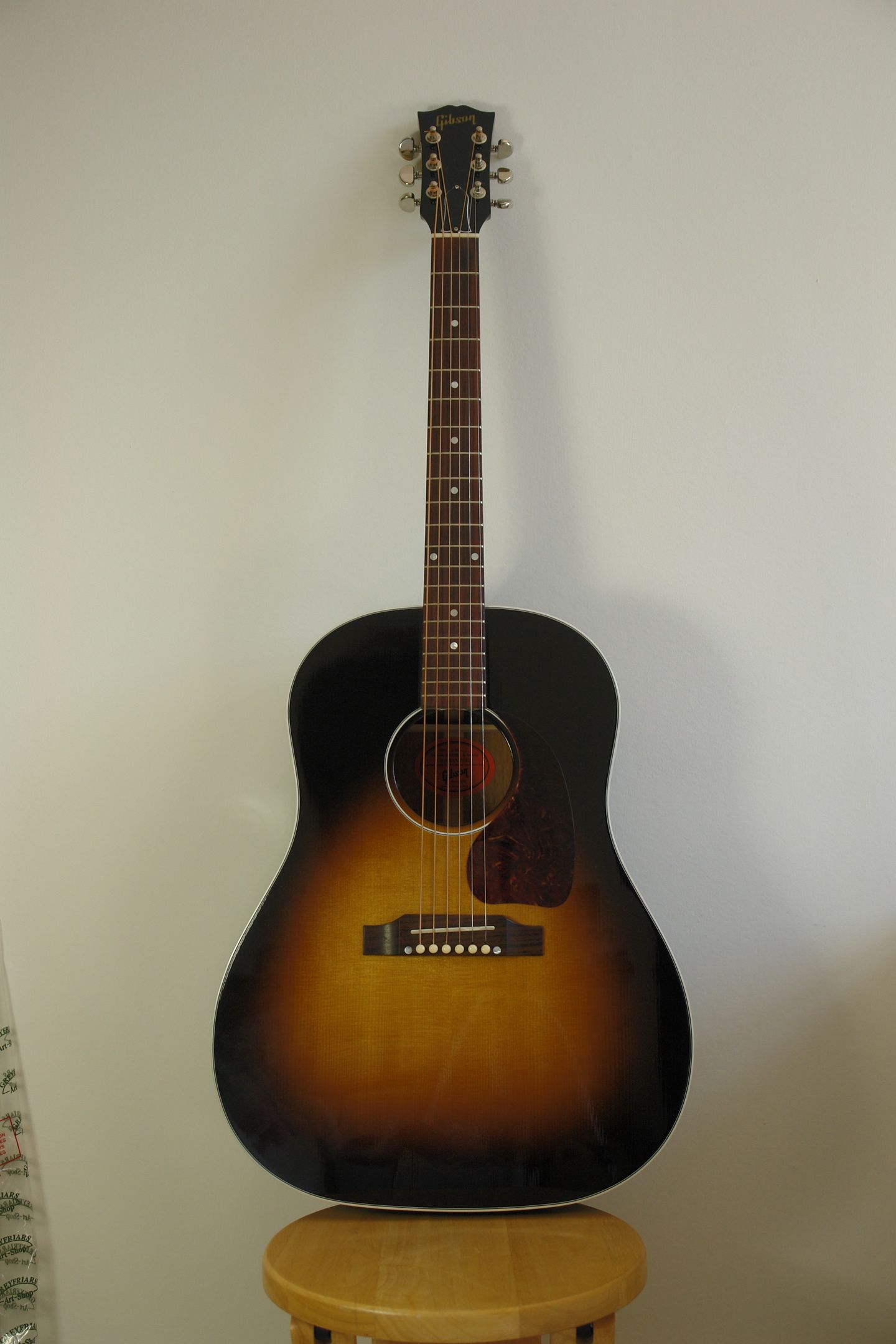
Gibson J-45. Photo by Jim Hutcheson. Licensed under CC BY 2.0. Via Wikimedia Commons. Gibson
J-45
1942
Born in 1942 out of whatever wood a wartime factory could find. Gibson calls it its best-selling acoustic ever.