Alvarez
Yairi
Steve Earle traded a pre-war Martin for one, because the Martin wouldn't stay in tune.
The name on the headstock belongs to a music company in St. Louis. The guitar comes from a shop in Kani, Japan, where some of the people at the benches have been there longer than most guitarists have been alive.
- Introduced
- 1970
- Type
- Acoustic
- Class
- Production
Have a photograph of this guitar? Send a picture
The short version
1965
The Alvarez name
St. Louis Music puts it on Spanish guitars. In Kani, the Yairi family shop gets a new name.
1970
The first ones land
Or 1968, or 1966, depending who you ask. Steve Earle has one in a U.S. shop this year.
1974
Earle goes to Nashville
He'd played his Yairi until then.
1986
The bridge
Kazuo's direct-coupled bridge is filed in Japan. The U.S. patent follows in 1989.
1991
Bob Weir's prototype
The guitar that becomes the WY1, with Weir deeply involved.
2014
Kazuo Yairi dies
In March, at 81. The shop keeps building.
2018
The Honduran pile
Mahogany Kazuo had bought in the mid-1970s turns into a line of guitars.
Side A
A1
The Martin wouldn't hold
- Steve Earle has restaurant gigs and a pre-war Martin D-18, which sounds like the start of a very good story until you put a capo on it. The Martin won't stay in tune.
So he trades it. For an Alvarez Yairi.
Earle had a set to play. He kept the Yairi until he went to Nashville in 1974, and then he bought a '57 Gibson J-45 from George Gruhn for $250. Nobody wrote down which Yairi model it was. What matters is that it played in tune when the night needed it to.
A2
A shop that still worked by hand
St. Louis Music had been putting the Alvarez name on Spanish guitars since 1965. Gene Kornblum wanted steel-strings to go under the same name, and he wanted them from a shop that still built by hand. He found one in Kani, in Gifu, north of Nagoya: Kazuo Yairi's.
Kazuo was born in 1932. His father, Gi'ichi, had trained at the Suzuki violin factory and then built violins and classical guitars under the family name. Kazuo took over in 1965, or became president in 1970, depending who you read. One telling has him studying steel-string making in the United States; another says the family wasn't building steel-strings at all when Kornblum came calling, and that this partnership was the first time Yairi made anything but a classical. Those two stories don't have to agree, and they don't.
When the first ones reached America is a three-way argument: 1966, 1968, or 1970. Earle had one in 1970. That much is settled.
A3
Same shop, other badges
Most Alvarez guitars are made in China. The ones with Yairi on the label are not. A Yairi label means Kani. In Europe the same guitars went out as K. Yairi, which is the shop's own badge. S. Yairi is someone else entirely, with no real relationship to these.
The shop is small. Alvarez counts 24 luthiers, four of them masters, with benches held for up to 55 years. Chris Meikle of Alvarez said in 2025 it was 24 or 25, and that two of them had been at one bench for 60. Either way, the person who fits your neck may have been at it since about the time the first ones crossed the Pacific.
For many years they built a solid top over laminated back and sides, on purpose: outer plies of the same wood, the middle ply running the other way. Today's WY1 sheet names East Indian rosewood for the back and doesn't say solid. Some current Yairis say solid. Check the paperwork on the one you're holding.
A Yairi label means Kani.
Flip the record · By the numbers
3
Launch years on record, 1966, 1968, and 1970. Nobody has a catalog to settle it.
24
Luthiers in the Kani shop. Ask the man who runs it and he'll say 24 or 25.
55
Years one luthier has spent at the same bench. Another count says two of them at 60.
~50
Years the Honduran mahogany seasoned on Kazuo's land before anyone built with it.
Side B
B1
Pins below the saddle
The thing people notice on a Yairi bridge came later. In the 1980s Kazuo set the bridge pins lower than the saddle, so the strings bear down on it harder. Alvarez calls it direct-coupled. It was filed in Japan in November 1986 and granted a U.S. patent in 1989, with St. Louis Music on the paperwork.
So a 1970s Yairi, like Earle's, doesn't have it. That's not a flaw, just a date.
In 1991 Bob Weir was deeply involved in a prototype for a new Yairi, a body size the shop hadn't used before. It became the WY1, and the W is him. Ani DiFranco wrote a lot of songs on a WY1 and built her whole percussive right hand on one. She'd "always played Alvarez," she said. In 2013 Joe Bonamassa's tech had four WY1s on the road, with the electronics they came with.
B2
Kazuo's woodpile
Some of the wood has been waiting almost as long as the luthiers. While spec'ing a guitar for Jack Pearson, the shop turned up a stash of Honduran mahogany billets on land Kazuo owned. The wood dated to the mid-1970s. It had been seasoning for around 50 years. The cache came to light in 2017 and the guitars came in 2018.
Kazuo didn't see that. He died in March 2014, at 81, in Kani or a hospital in Tajimi, depending who you read. The brand had moved owners more than once by then. The benches hadn't moved.
B3
Still taking orders
You can still order a WY1 from Kani. This fall the natural one was backordered. Two dozen people building by hand don't hurry.
Collectors wince at Earle's trade. But he wasn't buying a collectible. He was buying a guitar that would stay in tune under a capo in a restaurant, and it took him all the way to Nashville. The people who build that kind of guitar are still in Kani, some of them at the same bench.
The cast
The people, and the specific guitars, that made the legend.
1970
Steve Earle
An Alvarez Yairi, model unpublished
Traded a pre-war Martin D-18 for it because the Martin wouldn't stay in tune under a capo. Played it until Nashville in 1974.
Bob Weir
The 1991 prototype that became the WY1
The W in the model name. The guitar was "originally designed for, and with" him, in a body size Yairi hadn't used before.
Ani DiFranco
A pair of WY1 Bob Weir signatures
Said she'd "always played Alvarez." Wrote a lot of songs on a WY1 and built her percussive right hand on it.
Joe Bonamassa
Four WY1s, 2013
Carried four on tour with the electronics they came with. Two new WY1-JBs joined him for a 2020 tour.
Steve Hackett
Nylon-string Alvarez by Kazuo Yairi
A classical, not a WY1. Dated to the 1970s in one telling and 1987 in another. Used on the quieter parts of his Foxtrot replay.
Liner notes
Specs, construction, rarity, value, and every source we used.
Kazuo Yairi’s hand-built acoustics from Kani, badged Alvarez for St. Louis Music — not the import line that shares the name.
- Body
- Folk/OM. Solid AA Western red cedar top; East Indian rosewood back and sides (the factory sheet does not print “solid” on the back). 400 mm wide, 100 mm at the heel, 125 mm at the base — the same block the DY70CE dreadnought page prints. No inches on that block.
- Neck
- One-piece mahogany, 50/50 semi-gloss, extended dovetail, 14th-fret join
- Fingerboard
- Rosewood, 20 frets, 12th-fret abalone inlay
- Scale
- 635 mm / 25" (factory pair). A dealer sheet prints 25.5". Mix flagged. Do not average.
- Pickups
- LR Baggs Element undersaddle on this Stage guitar. A Yairi with no pickup is a different SKU.
- Hardware
- Rosewood direct-coupled bridge, ebony pins, Gotoh gold tuners, ivoroid binding, paua purfling
- Electronics
- LR Baggs StagePro EQ
- Finish
- Natural satin on this sheet. Sunburst is another current cart.
- Nut
- Bone, 44 mm / 1 23/32" (factory pair). One dealer sheet prints 1.718". Mix flagged. Do not average.
Open the full research fileConstruction details, the complete player record, production numbers, dated value estimates, and sources
Representative current production = Yairi Stage WY1 (Alvarez factory page). Alvarez calls it a benchmark designed with Bob Weir. Not every Alvarez Yairi. DY is the dreadnought prefix. DYMR70 is a current 12-fret round-shoulder Masterworks dread; Sweetwater’s list has no pickup and says solid aged East Indian rosewood. Artist, Regent, and the Masterworks series announced in 2014 are other factories. K. Yairi is this shop’s own badge. S. Yairi is not this shop. Scale and nut mix factory millimetres with inches — flagged, not averaged. The 400 / 100 / 125 mm block is not converted. The DY70CE’s scale is 648 mm / 25 1/2". Different model.
Construction
The job was a steel-string St. Louis could sell under a name it already owned. Alvarez had been on the company’s Spanish guitars since 1965 (Andertons; Wikipedia). Gene Kornblum wanted the next ones from a shop that still worked by hand: Kazuo Yairi’s, in Kani, Gifu, north of Nagoya.
Kazuo was born in 1932. Vintage Guitar and MMR: his father, Gi’ichi, trained at the Suzuki violin factory, then built violins and classicals as Yairi Musical Instruments. Japanese Wikipedia: a 1962 trip to the United States to study acoustic making; the company renamed Yairi Guitar Co. in 1965; Kazuo president in 1970. Vintage Guitar: he took the business over in 1965, studied steel-string making in the U.S., formed the Yairi Guitar Factory, and began exporting. Andertons, after speaking with Chris Meikle, says the family was not building steel-strings when Kornblum met them. guitarguitar calls the partnership the first time Yairi made anything but a classical. The study trip and the “first steel-string” claim stay separate.
The launch year is three dates. Blue Book: first imported to the U.S. in 1966, produced since 1966. FundingUniverse: 1968, “Alvarez-Yairi acoustic guitars are introduced,” the year Kornblum met Yairi through a Japanese trading partner. Andertons: years of design, then the first Alvarez Yairi guitars in the USA in 1970. guitarguitar: the steel-string range “born” in 1970. Earle had one in a U.S. shop that year. This plate starts in 1970. No catalog scan was in hand. A 2026 page’s “55-year partnership” and “over 80 years” in Kani, and the January 2025 60th (Masterworks OMs, 60 each), are the family shop and the brand’s 1965 birthday. Not a Yairi census.
Alvarez’s “Why Alvarez” page: 24 luthiers, four masters, benches up to 55 years. Meikle told The Acoustic Shoppe in 2025 it was 24 or 25, two of them 60 years at one bench. Wikipedia: the same guitars also shipped as K. Yairi in Europe. Same shop, other badge. Artist and Regent are the volume lines. Laureate is a separate range on that same Andertons list, not this shop’s badge. Premier Guitar, 8 January 2014, is when Alvarez announced Masterworks as its own series. Andertons keeps those ranges apart and says most Alvarez guitars are made in China. A Yairi label is Kani. A plain Alvarez label is not. The Twelfth Fret: S. Yairi, another Sadao, has “no real relationship” to these guitars. That shop licensed the Lowden (lowden-o-25).
The table is today’s Stage WY1, not a 1970 box. Dealers call it a cutaway. The factory key features say Folk/OM and do not print the word. The back splits by era. J. Hayes, Yairi brand manager, told Tarpley Music in 2023 that for many years the shop built a solid top over laminate back and sides on purpose — outer plies the same wood, center ply the other way. Blue Book’s early-1980s DY47 is laminated mahogany. The WY1 sheet names East Indian rosewood and does not say solid. Sweetwater’s DYMR70 does.
The bridge people notice is late. In the 1980s Kazuo set the pins lower than the saddle so the strings bear down harder (Alvarez). U.S. patent 4,807,508, Kazuo Yairi of Kani; Japanese priority 25 November 1986; U.S. filing 17 November 1987; granted 28 February 1989; assignee St. Louis Music Supply. A 1970s Yairi does not have it. Blue Book’s mid-1970s DY sheets still say ebony bridge. This WY1’s bracing is FST2, forward-shifted, asymmetric tone bars. FST6 shows up in 2024 on the Honduran and Masterworks series (2026 Yairi page). A Walmart listing prints FST6 on a WY1. Retailer line, not this factory sheet.
Honduran on the later guitars is a pile Kazuo had already bought. The DYM60HD page: billets on land he owned, seasoning around 50 years, turned up while the shop was spec’ing a guitar for Jack Pearson. Wikipedia, citing Alvarez’s 1 April 2018 note: cache in 2017, the line in 2018, wood from the mid-1970s. No board-foot count.
LOUD Technologies bought St. Louis Music in 2005. The guitar shop stayed in St. Louis; headquarters talk moved to Woodinville (Blue Book; Wikipedia). Mark Ragin brought management and distribution back in 2009. Meikle’s revival starts in 2011 (Andertons). Vintage Guitar, 2014: the Kani company was the primary manufacturer of Alvarez and Alvarez-Yairi, “which are now owned by St. Louis Music.” The brands, not the benches. Kazuo died 5 March 2014. Vintage Guitar and MMR say Kani. Japanese Wikipedia says a Tajimi hospital, 8:14 a.m., multiple organ failure. NAMM’s page prints 3 March 2014.
Players
Bob Weir. The current WY1 page calls it a benchmark “originally designed for, and with Bob Weir” — the W — and a body size Yairi had not used when it launched. Harmony Central, 30 January 2006: the WY1BW replicates the 1991 prototype he was “deeply involved” in. Due April 2006, MSRP $2,799: cutaway folk, figured coral rosewood, solid hand-scalloped cedar, ebony board, 12th-fret lightning-bolt inlay, direct-coupled bridge, a piezo-plus-condenser crossover in place of his rack. Musician’s Friend’s later page prints Sitka spruce on that same replica. Cedar in 2006, spruce later. No Grateful Dead song is pinned on it.
Ani DiFranco. Premier Guitar, 9 June 2017: two Alvarez-Yairi WY1 Bob Weir signatures with System 500 preamps. She had “always played Alvarez,” wrote a lot of songs on a WY1, and built the percussive right hand there. The 4 January 2012 list adds an Alvarez-Yairi DY62C with a System 600. Harmony Central, 24 January 2005: her ADY1G, direct-coupled bridge, System 600T Mk II, list $2,799, shipping that February, after years on the WY1. Mark Kemp: Alvarez on stage from the early ’90s. Acoustic Guitar, 17 November 2024: Gibsons, an Alvarez MSD1, and a one-off YBM7C baritone. The MSD1 is not called a Yairi on the Premier Guitar lists.
Joe Bonamassa. Premier Guitar, 5 June 2013, tech Mike Hickey in Rockford: four Alvarez WY1s “with his preferred electronics that came stock,” and a Gibson Songwriter as backup. The Songwriter is not this plate. Facebook, 12 February 2020: two new WY1-JBs “for the tour.” Different guitars from the 2013 four.
Steve Earle. Vintage Guitar: in 1970 he traded a pre-war Martin D-18 for an Alvarez Yairi. The Martin would not stay in tune under a capo, and he had restaurant gigs. He played the Yairi until Nashville in 1974, then a ’57 Gibson J-45 from George Gruhn for $250. Model unpublished.
Steve Hackett. Premier Guitar, 13 December 2023. The lede says a nylon-string Alvarez “built by master luthier Kazuo Yairi in the 1970s.” The gear block says a 1987 Alvarez CY127 CE: solid cedar, rosewood back and sides, 12-fret mahogany neck, ebony board, 19 frets, individual saddles, used on the calmer parts of the Foxtrot replay. Both dates stay. A classical, not a WY1.
FundingUniverse names Roy Clark and Waylon Jennings as early endorsements. No instruments, no records. Also known to play stops there. Jerry Garcia, Paul McCartney, Johnny Cash, Crosby, Stills & Nash, Thom Yorke, and Carlos Santana are on lists that never name a Yairi. Ani’s MSD1, a China Artist, and an S. Yairi stay off.
Rarity
You can still order a new one from Kani. Sweetwater’s WY1 natural was backordered this pass, estimated November 2026. The sunburst WY1 and the DYMR70 were live carts the same week. The shop did not stop in 2014.
Alvarez has not published a Yairi unit total. None invented. The official date finder says Yairi serials are a 4- or 5-digit number and that the database is still being filled in from the archives. Jedistar, quoting D. Hughes of the old Alvarez-Yairi group: the heel-block stamp on K. Yairi and early Alvarez Yairi is an emperor-year code, messy after 1999, when some guitars carry both that code and a Western year. Those stamps date a guitar. They do not count a year.
What is actually thinner: the 1991 Weir prototype against a later WY1; the 2002 Alvarez Yairi WY80, which Harmony Central capped at 80 guitars, Brazilian back and sides, list $2,999, a closed run based on the WY1 and not the WY1 itself. The Honduran billets are a finite pile. Alvarez did not say how many guitars they will make.
Value
Informal estimate, 8 October 2026. Not an appraisal.
Ask vs sold labeled. Period lists are old money. No invented median. Celebrity guitars were not isolated as auction comps.
New street. Stage WY1 natural: Sweetwater $2,299, backordered, estimated November 2026. Musician’s Friend natural $2,299 on backorder; sunburst $2,499, available date 27 October 2026. Sweetwater’s sunburst reviews page printed $2,599; its Gear Exchange advisor printed new $2,499. The sunburst asks are not averaged. An Alvarez WY1 URL headed “2024 Model” printed MSRP $3,249 — factory list, not that week’s cart. A different current Yairi, the DYMR70 sunburst, was $2,999 at Sweetwater, estimated 20 October 2026. Not a WY1.
Used modern. Sweetwater Gear Exchange, WY1 sunburst: suggested $1,624–$1,924, recommended $1,749; the same page also prints $1,299–$1,924. Musician’s Friend: one used natural in Good condition, $944.99, and that listing’s preamp is a System 600T, not StagePro. One unit. Not a median.
Vintage / collectible. No clean Reverb Price Guide band this pass. Thin sold-comp access. Historical list, not a 2026 hammer: WY1BW MSRP $2,799 (2006); ADY1G list $2,799 (2005); WY80 list $2,999 (2002, eighty guitars). Earle’s 1970 Yairi has no model and no price. Weir’s 1991 prototype is one object, not a comp for a 1970s DY.
See also
- lowden-o-25 — Japan years were S. Yairi near Nagoya; not this Kani shop
- yamaha-fg180 — the other Japanese folk guitar of the same era; Hamamatsu, not K. Yairi
- martin-d-18 — the American mahogany dread a player might have traded in; not a Yairi
Sources
- Alvarez, WY1 (Yairi Stage) — benchmark; designed with Bob Weir; solid AA Western red cedar; East Indian rosewood; FST2; direct-coupled rosewood bridge; StagePro and Element; 635 mm / 25"; nut 44 mm / 1 23/32"; 400 / 100 / 125 mm; 14th fret; 20 frets; natural satin
- Alvarez, DY70CE — Yairi Standard dreadnought; same 400 / 100 / 125 mm block; scale 648 mm / 25 1/2"
- Alvarez, Why Alvarez — 24 luthiers, four masters, benches up to 55 years; direct-coupled bridge developed in the 1980s
- Alvarez, Yairi series — Kani; “over 80 years”; “55-year partnership”; FST6 in 2024 on Honduran and Masterworks
- Alvarez, DYM60HD — Honduran billets on land Kazuo owned; seasoning “around 50 years”; search started for Jack Pearson
- Alvarez, 60th anniversary — brand anniversary; Masterworks MF70 limited to 60 each; not a Yairi census
- Alvarez, date finder — Yairi serials 4 or 5 digits; database still being filled from the archives
- Alvarez, WY1 “2024 Model” — MSRP $3,249 printed on that URL
- Andertons, history of Alvarez, Sam Beattie, 21 July 2026 — spoke with Chris Meikle; Alvarez name 1965 on Spanish guitars; met late 1960s; first Alvarez Yairi guitars arrived in the USA in 1970; Yairi vs Artist/Regent/Masterworks
- FundingUniverse, St. Louis Music history — key date 1968, Alvarez-Yairi introduced; Kornblum met Yairi that year; Roy Clark and Waylon Jennings endorsements
- Vintage Guitar, Ward Meeker, Kazuo Yairi obituary, 11 March 2014 — born 1932; Gi’ichi; Suzuki; took over 1965; late-1960s partnership; died 5 March 2014 in Kani; brands owned by St. Louis Music
- MMR, Trade Regrets: Kazuo Yairi, 13 March 2014 — died 5 March 2014, Kani; Gi’ichi; 1965; steel-string study in the U.S.; K. Yairi Guitar Company, Shimoedo, Kani
- Japanese Wikipedia, 矢入一男 — born 1932; U.S. study 1962; company renamed 1965; president 1970; died 5 March 2014, Tajimi hospital
- NAMM oral history, Kazuo Yairi — birth 27 April 1932 on that page; deceased date printed 3 March 2014
- Wikipedia, Alvarez Guitars — late-1960s meeting; steel-strings under the existing Alvarez name; K. Yairi badge elsewhere; LOUD 2005–2009; Ragin 2009; Kani; 1932–2014; Honduran line 2018 via the 1 April 2018 Alvarez note; player list on that page is unsourced
- Blue Book, Alvarez Yairi — first imported 1966; Kani; LOUD 2005; Ragin 2009; DY47 laminate early 1980s
- U.S. patent 4,807,508 — direct-coupled bridge; Kazuo Yairi; Japanese priority 25 November 1986; U.S. filing 17 November 1987; granted 28 February 1989; assignee St. Louis Music Supply
- guitarguitar, History of Alvarez, 8 July 2025 — steel-string range “born” 1970; Japan Yairi team of 24; most Alvarez production in China
- Premier Guitar, Alvarez announces Masterworks, 8 January 2014 — Masterworks as its own 2014 announcement; not this Yairi table
- The Twelfth Fret, 2005 Alvarez by Kazuo Yairi FYM95V — S. Yairi “no real relationship” to K. Yairi Alvarez guitars; direct-coupled bridge described
- Harmony Central, Bob Weir WY1BW, 30 January 2006 — 1991 prototype; April 2006; MSRP $2,799; cedar top
- Musician’s Friend, WY1BW — later page prints Sitka spruce on the replica story
- Harmony Central, Ani DiFranco ADY1G, 24 January 2005 — list $2,799; direct-coupled; System 600T Mk II
- Harmony Central, WY80 / SLM80, 24 January 2002 — WY80 limited to 80; list $2,999; based on the WY1
- Premier Guitar, Ani DiFranco, 9 June 2017 — two Alvarez-Yairi WY1 Bob Weir signatures, System 500; songs and right hand on the WY1
- Premier Guitar, Ani DiFranco, 4 January 2012 — WY1 pair and Alvarez-Yairi DY62C
- Premier Guitar, Joe Bonamassa Rig Rundown, 5 June 2013 — Mike Hickey, Rockford; four Alvarez WY1s with stock electronics; Gibson Songwriter backup
- Joe Bonamassa, Facebook, 12 February 2020 — two WY1-JBs for the tour
- Premier Guitar, Steve Hackett Rig Rundown, 13 December 2023 — lede says 1970s; gear block says 1987 CY127 CE; Kazuo Yairi; Foxtrot replay
- Vintage Guitar, Steve Earle — 1970 trade of a pre-war D-18 for an Alvarez Yairi; played until the 1974 J-45
- Mark Kemp, Ani DiFranco interview — Alvarez on stage from the early ’90s
- Acoustic Guitar, Ani DiFranco, 17 November 2024 — 2024 touring list; MSD1; YBM7C baritone
- The Acoustic Shoppe, Chris Meikle, 23 August 2025 — 24 or 25 luthiers; two at a bench 60 years; direct-coupled bridge, late ’80s
- Tarpley Music, J. Hayes, 22 July 2023 — many years solid top, laminate back and sides, on purpose
- Jedistar, Alvarez dating — D. Hughes on emperor-year heel stamps; post-1999 overlap
- Sweetwater, WY1 natural — $2,299; backordered; estimated November 2026
- Sweetwater, WY1 sunburst reviews — page printed $2,599
- Sweetwater Gear Exchange, WY1 sunburst — new $2,499 on that page; used advisor $1,624–$1,924, recommended $1,749; also prints $1,299–$1,924
- Sweetwater, DYMR70 sunburst — $2,999; estimated 20 October 2026; Kani; 12-fret round-shoulder; solid rosewood on that copy
- Musician’s Friend, WY1 — natural $2,299 backorder; sunburst $2,499, available date 27 October 2026
- Musician’s Friend, used WY1 — one Good unit $944.99; System 600T
- Music Store Live, WY1 — dealer sheet 25.5" scale, 1.718" nut; conflicts with the factory pair
Keep digging
Guitars this one gets compared to, confused with, or descended from.
- Send a picture
Lowden
O-25
1977
George Lowden refused to copy an American guitar. Twenty years on, David Gray bought one and made White Ladder.
- Send a picture
Yamaha
FG180
1966
Built to survive a ship’s hold. Decades later, the photos put one in Elliott Smith’s hands at the Oscars.
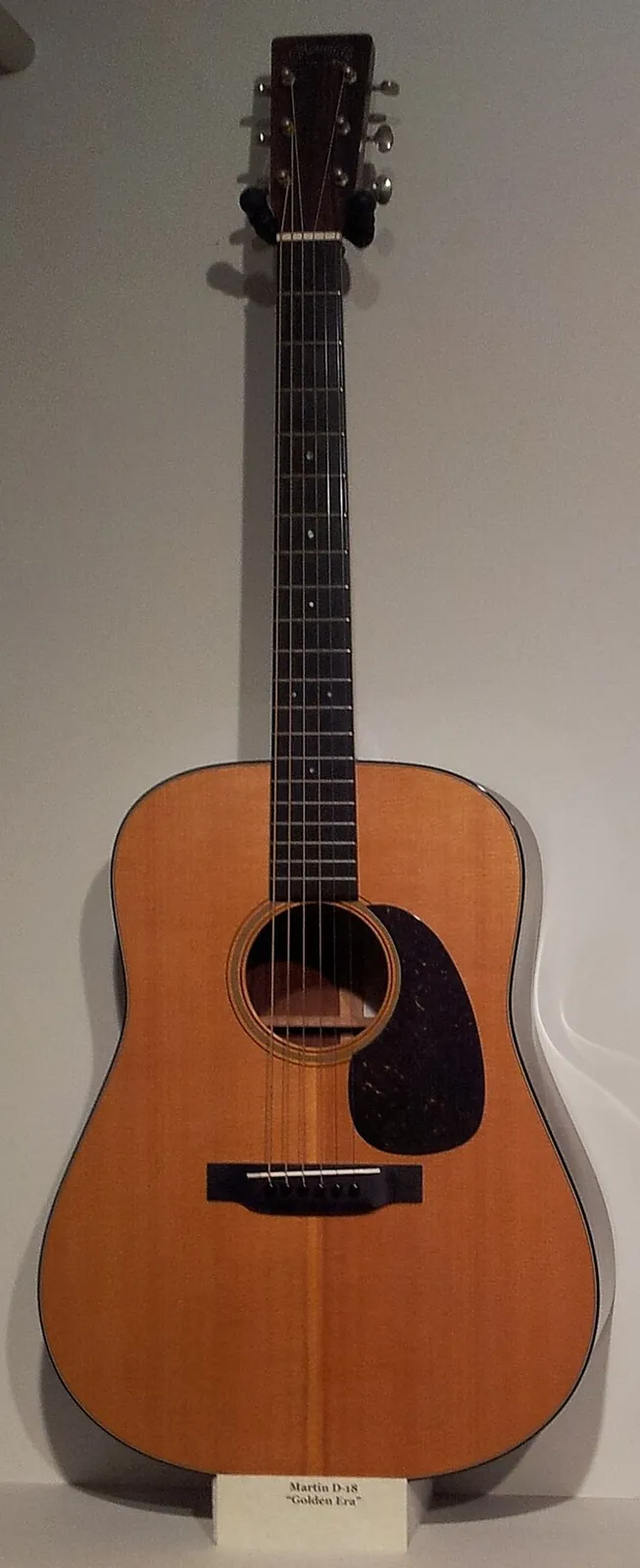
Photo: doryfour / Wikimedia Commons / CC BY-SA 2.0 Martin
D-18
1931
Elvis traded his D-18 up for a leather-covered D-28. The plain one had already been there for the Sun records.