Martin
5-18
Martin sold it as a guitar for children. Marty Robbins took it onstage.
The catalog said Junior, three-quarter size, easy to hold and to play. It never said the other thing: that this little Martin was a terz, an old European guitar built to sit three frets above everybody else.
- Introduced
- 1898
- Type
- Acoustic
- Class
- Production
Have a photograph of this guitar? Send a picture
The short version
1840
Sizes 1 through 5
By the 1840s and ’50s Martin’s bodies run from size 1 down to size 5, the terz.
1898
The 5-18 is listed
Style 18 on the smallest standard Martin body. One account just says the late 1800s.
1917
Mahogany
Rosewood back and sides give way to mahogany.
1951
A good decade
150 shipped that year. The 1950s averaged over a hundred.
1989
Last catalog
The 5-18 leaves the Martin catalog.
2009
The Marty Robbins
A signature 5-18, on sale from 2009 to 2011 by one guide, or since 2006 by another. The card finally says to tune it up.
2026
The terz comes back
Size 5 returns as the 5-28 Terz, in rosewood. Not a 5-18.
Side A
A1
Out of the kids’ section
Turn to the small guitars in an old Martin catalog and you find this line, shared with the cheaper 5-17:
“Junior, or three-quarter, sizes fine for children; easy to hold and to play.”
That was the 1930s. A 1960 catalog page still sells the 5-18 the same way: Junior, three-quarter, spruce and mahogany. A guitar for a kid who isn’t ready for a full-size one.
Meanwhile, through the 1950s and ’60s, a grown man with a string of country hits was using one onstage, a lot. Marty Robbins didn’t need a smaller guitar. He needed this one.
A2
A third above
The thing the catalog didn’t mention is what the 5-18 actually was. Terz is German for “third.” A terz guitar is tuned a minor third up, three frets, the same pitch you’d get from a capo at the third fret. It isn’t meant to double a regular guitar. It’s meant to sit above one.
C. F. Martin Sr. knew the pattern from Johann Stauffer in Vienna. Giuliani and Sor wrote parts for it. Martins that survive from the 1830s and ’40s include terz guitars. By the 1840s and ’50s Martin’s bodies ran from size 1 down to size 5, and size 5 was the terz. The bigger 0, 00, and 000 bodies came later, as guitars kept growing.
So the 5-18 isn’t a shrunken 0-18. It’s the old small end of the line that the big ones grew away from.
A3
Style 18 on the smallest box
The named 5-18 shows up in 1898. Style 18 on size 5: a spruce top, a neck joining at the 12th fret, and a plain rectangular bridge. Rosewood back and sides until 1917, then mahogany. The body is 11¼ inches across the lower bout and 16 inches long.
How long the strings are is a small fight. Most of the old ones people have actually measured come in around 21.4 inches. One price guide says 22 inches from 1924. The measured postwar guitars aren’t 22. Keep both.
It’s playable in standard tuning. But tune it at least two frets up, the way it was built for, and the sound comes alive. That short, light box was never going to boom like a dreadnought. Pitched high, it rings.
The changes over the years were trim, not shape. The slotted headstock gave way to a solid one in the late 1940s, though some 1947s are still slotted. Adirondack spruce before the war, Sitka after.
Flip the record · By the numbers
11¼"
Across the lower bout. The smallest standard Martin body.
3 frets
How far up a terz is tuned. A minor third, where a capo at the third fret puts a regular guitar.
2,774
5-18s made from 1898 to 1989, by one count.
150
Shipped in 1951, in a decade that averaged over a hundred a year.
Side B
B1
Robbins
Marty Robbins is the person this guitar belongs to, if it belongs to anybody. In the 1950s and ’60s he popularized the 5-18 and used it extensively onstage. Martin still calls him the musician most closely associated with the Size 5.
Martin points to a 1969 clip of “Devil Woman” from The Marty Robbins Show where he plays a Size 5. Martin doesn’t say which model it is in that clip, so neither will I. And “El Paso” isn’t pinned to this guitar anywhere, so don’t go there either.
Dolly Parton has been seen with a 5-18 over the years. Don McLean owned a 1947 one, slotted headstock, with a case tag reading “5/8 Martin / Marty Robbins.” That tag tells you what the guitar reminded somebody of. It doesn’t prove it was his.
B2
2,774 and done
Martin made 2,774 of them, by one count, from 1898 to 1989. The 1950s were the busy years, averaging over a hundred a year, with 150 shipped in 1951. Then in 1989 the 5-18 left the catalog.
A Marty Robbins signature model came afterward, a short run in Adirondack and mahogany with a Texas inlay at the 5th fret and a star at the 7th, and a label signed by Ronnie Robbins. When it started depends who you ask: 2006 or 2009. And the card in the case finally said what the guitar was for: tune it three frets up.
B3
The terz, by name
In 2026 Martin put size 5 back in the Standard line. It isn’t a 5-18. It’s a 5-28 Terz, in East Indian rosewood, and Martin prints the tuning right on the page: G, C, F, A♯, D, G. They call it the smallest guitar they offer. If you want a 5-18 now, it’s a Custom Shop order, one guitar at a time.
For most of a century Martin sold this body to parents. The grown-ups who kept playing it knew what it was. Now it’s on the page with its real name.
Put this on
You’ve read about it. Now hear it. Here’s what this guitar sounds like, and what to listen for.
Devil Woman (The Marty Robbins Show)
Martin points to this clip as Robbins playing a Size 5. It doesn’t say which stamp, so call it a size-5 Martin, not a confirmed 5-18.
Watch it on YouTube (opens in a new tab)
The cast
The people, and the specific guitars, that made the legend.
1950s–60s
Marty Robbins
5-18
Popularized the 5-18 and used it extensively onstage. His stage guitar has no serial on record, and the signature model came long after.
Dolly Parton
5-18
Seen with a 5-18 over the years. No session pinned to it.
1947
Don McLean
1947 5-18
Slotted headstock, mahogany. The case tag reads “5/8 Martin / Marty Robbins,” which is a tag, not proof it was Robbins’s.
Liner notes
Specs, construction, rarity, value, and every source we used.
Style 18 on Martin’s size 5 — the smallest standard Martin, built as a terz, not an 0-18 and not a dreadnought.
- Body
- Size 5, 12-fret. Smallest standard Martin body. Gruhn: lower bout 11.25", upper bout 8.25", length 16". Blue Book: 11.25" wide, 3.875" deep, 16" long. Spruce top. Back and sides rosewood 1898–1917, mahogany 1917–1989 (Blue Book).
- Neck
- Mahogany on Gruhn’s 1935 and on post-war examples. Joins at the 12th fret. Slotted peghead until the late 1940s, then solid (Gruhn). Elderly’s 1947, serial 100570, is still slotted.
- Fingerboard
- A fight. Blue Book: unbound ebony, plain 1898–1902, dots 1902–1989. Gruhn’s late 1935, serial 61745: Brazilian rosewood board; Indian rosewood from 1970. RetroFret and Carter call 1950s boards Brazilian. Elderly’s 1947 page splits: the intro says ebony, the repair list says Brazilian. Don’t pick.
- Scale
- Another fight. Gruhn, on the model and on 61745: 21.4". Blue Book: 21.4" (1898–1924) or 22" (1924 on). Elderly 1947: 21 3/8". Carter’s 1951: 21.5". MM Guitar Bar’s 1960: 21.4". Measured postwar guitars here are not 22". Don’t average.
- Pickups
- None
- Hardware
- Rectangular bridge (Blue Book) — not the belly bridge of a later 0-18 or 00-18. Brazilian on the 1935; Indian from 1970 (Gruhn). Three-per-side tuners.
- Electronics
- None
- Finish
- Natural. The 1935 top is Adirondack; post-war tops are Sitka (Gruhn).
- Nut
- No factory width in Gruhn or Blue Book. Elderly 1947: 1 5/8". Carter 1951: 1.609". MM Guitar Bar’s 1960, replacement nut: 1.650". Don’t average.
Open the full research fileConstruction details, the complete player record, production numbers, dated value estimates, and sources
Classic living example = the catalog 5-18 (Nazareth, 1898–1989). Not an 0-18. Not a 00-18. Not a 000. Not a D. No Standard 5-18 on Martin.com (fetched 6 October 2026). The 2026 Standard on this body is a 5-28 Terz, SKU 10Y26528: East Indian rosewood, 21.38" scale, 1 3/4" nut. Different stamp. Mix flagged. RetroFret prints the same paired figures on a 1951 and a 1959: 21 3/8 in. (543 mm) scale, 1 5/8 in. (41 mm) nut, 11 1/4 in. (28.6 cm) lower bout, 4 in. (10.2 cm) deep at the end block. Do not convert Gruhn’s 21.4" or Blue Book’s 22" into millimetres. Do not average 21.4 / 21⅜ / 21.5 / 22.
Construction
The job was a high voice in a small box. Terz is German for third. Tune a minor third up — three frets, where a capo at the third fret puts a standard guitar — and this one sits above a partner instead of doubling it. C. F. Martin Sr. knew the pattern from Johan Stauffer. Giuliani and Sor wrote parts for it. Gruhn: Martins that survive from the 1830s and ’40s include terz guitars, and those have a 22" scale. They are not this model name.
By the 1840s and ’50s the sizes were 1 through 5. Size 1 was 12.75" wide. Size 5 was the terz, the small end. Size 4 was a terz too, and very rare. The 0 (13.5"), the 00 (14.125"), and, after 1900, the 000 (15") came in as guitars got bigger (Gruhn). An 0-18 is a concert. A 00-18 is a Grand Concert. A D-18 is a dreadnought. This plate is the body under all of them.
The named 5-18 is 1898. Gruhn: listed as early as 1898, last catalog 1989. Blue Book: manufactured 1898–1989. YAML introduced: 1898 is that listing, not a claim that no size-5 Martin existed earlier. Peghead Nation (Teja Gerken, 29 July 2026) puts the body in the late 1800s and treats the 2026 5-28 as the terz after a gap. Keep both.
Style 18 on that box is a spruce top, a 12-fret neck, and the rectangular bridge Blue Book still lists. The 0-18 and the 00-18 grew a belly. This stamp did not. Back and sides were rosewood through 1917, then mahogany. The catalogs did not sell the tuning. They sold a child’s guitar. Gruhn quotes the 1930s line, shared with the cheaper 5-17: “Junior, or three-quarter, sizes fine for children; easy to hold and to play.” Martin’s 27 August 2026 article reprints a 1960 catalog page that still says Junior, three-quarter, spruce and mahogany, 12-fret. The scale is about a standard guitar capoed at the third fret, and the pre-war books through the ’80s still said three-quarter (Gruhn). Playable at standard pitch. Tuned at least two frets up, he writes, the sound comes alive.
The changes are trim, not a new body. Slotted peghead out in the late 1940s, solid peghead in (Gruhn) — except a 1947 can still be slotted. Elderly 100570 and McLean’s 99596 are. Adirondack on the 1935, Sitka after the war. The board is the fight in the table. Binding’s outer layer, Blue Book: rosewood 1898–1932, black 1932–36 and 1966–1989, tortoise 1936–1966. Rosette: colored rope through 1902, then three-stripe, and the rings were not actually inlaid until the mid-1930s.
Catalog production stopped in 1989. The Marty Robbins 5-18 is a short, separate object, and the start year fights. Gruhn (2014): offered since 2006. Blue Book: summer 2009 to mid-2011. Adirondack and mahogany, ebony with old Style 18 dots, a Texas inlay at the 5th and a star at the 7th, a Madagascar overlay, a label signed by Ronnie Robbins (Blue Book). Sweetwater, 16 July 2009: 12-fret, low-oval, straight ebony bridge, butterbean tuners. Gruhn: the card finally says tune three frets up. Not a 1935. Not the guitar he played.
In 2026 the size 5 came back as a 5-28 Terz, not a 5-18. SKU 10Y26528: East Indian rosewood, not this mahogany, non-scalloped 1/4" X, 21.38", 1 3/4" nut, 18 frets, no pickguard. Martin prints the pitches as G–C–F–A♯–D–G and calls it the smallest guitar they offer. Price is in Value. A Custom Shop 5-18 is a shop order: Telluride’s Engelmann, serial 3066026, Modified Low Oval, 1 3/4" nut, patterned on a 2026 NAMM piece. Telluride says you can still order one. Not a Standard. A Little Martin’s scale is 23". A 5-15, 5-16, 5-17, 5-21, the old 5-28, and the size-5 tenors are other stamps.
Players
Named instruments first. A size-5 Martin that does not say 5-18 stays off the verified list. Martin’s 27 August 2026 terz article is a Size 5 list, not a stamp list.
Marty Robbins. The player this small Martin is tied to. Gruhn: in the 1950s and ’60s he popularized the style 5-18 and used it extensively onstage. No serial. Martin (27 August 2026) calls him the musician most closely associated with the Size 5, and points at a 1969 “Devil Woman” from The Marty Robbins Show where he plays a Size 5. Martin does not print 5-18 on that clip. Don’t upgrade the frame. The signature is the reissue above, not the guitar in his hands. Not a comps tape. “El Paso” is not documented here as this instrument.
Dolly Parton. RetroFret: a longtime fan, seen with a 5-18 over the years. Martin puts her on the same Size 5 / terz list, no year and no song. Dealer pages repeat the sighting. No session is pinned.
Don McLean — 1947 5-18, serial 99596. Julien’s, “Property from the Life and Career of Don McLean,” 11 November 2022. Spruce, mahogany, rosewood board and bridge, slotted headstock, Waverly strip tuners. The case tag reads “5/8 Martin / Marty Robbins.” That tag is not a chain of title. Julien’s says Robbins popularized the model and toured with one; it does not say this serial was his. Julien’s also calls the guitar “5/8 sized.” Martin’s catalogs said three-quarter. Artist-owned — not a comp. His “Vincent” guitar in that sale is a 1969 00-21, a different lot. Not this.
Also known to play stays Martin’s Size 5 / terz list, and it is not a 5-18 census: Johnny Cash, Billy Corgan, Grant Geissman, Bobbie Gentry, Michael Hedges, John Mayer, Tony McManus, Steve Miller, Sting (pictured with “his Terz”), Neil Young. No album credits invented. JP Guitars says Gentry played a 5-18 on “Ode to Billy Joe.” Martin does not name the song or the stamp. The record is “Ode to Billie Joe.” Don’t move it. Corgan, in Martin’s sentence, is the terz idea on an electric. Not this acoustic.
Rarity
You cannot order a new Standard 5-18. The size 5 in the 2026 book is a 5-28. A Custom Shop 5-18 is one guitar at a time. The Robbins signature was a short run after the catalog had already closed.
One lifetime figure is in print. Blue Book: 2,774 instruments, 1898–1989. That is the volume model of the size, and it is still a small total next to a 00-18. The year book is not here. RetroFret, on a 1951: the 1950s averaged over 100 a year; 1951 was an even 150 shipped; 1950 had just been the best year, and that page does not print the 1950 count. Don’t invent the missing year. The tenor on this body outran the six-string: Blue Book’s 5-17T, 3,666, 1927–1949. A historical 5-28, same book, is 26 guitars: 15 from 1901–1939, 10 from 1968–1981, and a single 1988. The 2026 5-28 is a new Standard, not those 26.
Thinner than the 2,774: a clean pre-1917 rosewood-back 5-18, and a slotted pre-war example. No other year counts were in hand. Gruhn’s 61745 is one guitar. Robbins’s stage guitar has no serial here. McLean’s 99596 is one object. None of them is “a vintage 5-18.”
Value
Informal estimate, 6 October 2026. Not an appraisal.
Ask vs sold. Robbins’s stage guitar and McLean’s 1947 are not comps. A 2026 5-28 is not a 5-18. A Custom Shop Engelmann is not a 1935. No period list price for the catalog 5-18 turned up in a named source this pass. None invented.
New street. None under a Standard 5-18. Martin.com, fetched 6 October 2026, lists the 5-28 Terz at $3,599.99 with the case. That is the living size-5 price, and it is the other stamp. Telluride’s Custom Shop 5-18 Engelmann, serial 3066026, ask $4,199.99. A shop guitar, not a catalog cart. No Robbins-edition list price isolated this pass.
Used modern. Robbins editions and later Custom Shop builds. No clean Reverb Price Guide band isolated on them this pass. Don’t invent a midpoint.
Vintage / collectible. Reverb’s Price Guide pages for 5-18 1946–1962 and 1898–1945 did not render a dollar band (fetched 6 October 2026). Flag: thin sold-comp access. Named asks, not hammers: Elderly, 1947, serial 100570, $3,500; Reverb, a 1957 in Good condition that needs a neck reset, $3,899 (was $4,999). guitar-list’s US page, fetched 6 October 2026: a 1953 at $5,795, a 1964 at $3,300. MM Guitar Bar’s 1960, sold out at $4,399.99, has had a neck reset and a replacement nut. Don’t average those. Don’t paste 0-18 or 00-18 ladders onto this size. A reset is not a collector original.
McLean’s 1947, serial 99596, Julien’s, 11 November 2022: estimate $5,000–$7,000, sold $7,680, buyer’s premium 27% plus an online service fee. One celebrity lot. Not a comp.
See also
- martin-0-18 — Style 18 on a 13½" concert, one body up; Tweedy’s writing guitar is an 0-18, not a 5
- martin-00-18 — Style 18 on a Grand Concert; Howe’s 1953 lives there
- martin-d-18 — Style 18 on a dreadnought, the body this guitar was never trying to be
Sources
- Vintage Guitar, George Gruhn, Martin 5-18 (June 2014; web 11 October 2014) — serial 61745, late 1935; 11.25" / 8.25" / 16" body; 21.4" scale; Junior catalog line; Robbins onstage in the 1950s–60s; 1830s–40s terz Martins at 22"; Stauffer; Giuliani and Sor; sizes 1–5; 0 / 00 / 000 widths; listed 1898, last catalog 1989; Robbins reissue since 2006, tune three frets up; slotted peghead out in the late 1940s; Adirondack vs Sitka; Brazilian vs Indian from 1970; mahogany neck, back, and sides
- Blue Book of Guitar Values, Martin Size 5 models — 11.25" × 3.875" × 16"; scale 21.4" (1898–1924) or 22" (1924–present); 5-18 total 2,774, 1898–1989; rosewood then mahogany 1917; ebony-board table; rectangular bridge; binding and rosette dates; 5-17T 3,666; historical 5-28 total 26 (15, then 10, then one in 1988)
- Blue Book, 5-18 Marty Robbins — summer 2009–mid-2011; Adirondack, mahogany, ebony, Texas at the 5th, star at the 7th; Madagascar overlay; Ronnie Robbins signed label
- Martin, 5-28 Terz, SKU 10Y26528 — current Standard size 5; 21.38"; 1 3/4"; 18 frets; 12-fret joint; East Indian rosewood; non-scalloped 1/4" X; list $3,599.99 (fetched 6 October 2026). Not a 5-18
- Martin, four new models (16 July 2026) — 5-28 becomes the smallest guitar in the 2026 lineup; Size 5 player list includes Robbins, Gentry, Parton, Sting, Corgan, McManus, Mayer; 24.9" short scale and 23" Little Martin for comparison
- Martin, What is a terz guitar? (27 August 2026) — G–C–F–A♯–D–G; 1960 catalog page of the 5-18 as a Junior; Robbins and the 1969 “Devil Woman”; Sting pictured; Cash, Geissman, Gentry, Hedges, Mayer, McManus, Miller, Parton, Young on the Size 5 / terz list; Corgan’s terz idea on electric
- Peghead Nation, Teja Gerken, Martin 5-28 Terz (29 July 2026) — size 5 introduced in the late 1800s; terz retired, then the 5-28; 21.38"; $3,599 street. Not this stamp
- RetroFret, 1951 5-18 — 150 shipped in 1951; 1950 the best year; 1950s average over 100; Dolly and Robbins sightings; paired inch/mm dimensions (same sentence as the 1959)
- RetroFret, 1959 5-18 — same paired dimensions; Brazilian board and bridge; Dolly; Robbins
- Elderly Instruments, 1947 5-18, serial 100570 — slotted; 11¼" lower bout; 1 5/8" nut; 21⅜" scale; 18-fret Brazilian board on the repair list; ask $3,500
- Carter Vintage, 1951 5-18 — measured scale 21.5"; nut 1.609"; Brazilian board and bridge
- MM Guitar Bar, 1960 5-18 — scale 21.4"; replacement nut 1.650"; Sitka and mahogany; Brazilian board and bridge; sold out at $4,399.99; neck reset
- Julien’s Auctions, Don McLean 1947 5-18 — serial 99596; sold $7,680; estimate $5,000–$7,000; premium 27% plus online service fee; case tag “5/8 Martin / Marty Robbins”; slotted; rosewood board
- Julien’s results, McLean sale — lot 4 hammer recorded at $7,680
- Julien’s catalog note — McLean sale, Friday 11 November; 2022 from the sale record
- Sweetwater InSync, Marty Robbins Custom Edition (16 July 2009) — 12-fret; Adirondack; mahogany; ebony; Texas inlays; low-oval; straight ebony bridge
- Telluride Music Co., Custom Shop 5-18 Engelmann, serial 3066026 — ask $4,199.99; 1 3/4" nut; Modified Low Oval; 2026 NAMM Custom Shop pattern; standard production ended 1989 in that copy
- Reverb, 1957 5-18 — ask $3,899, was $4,999; Good; needs a neck reset (fetched 6 October 2026)
- Reverb Price Guide, 5-18 1946–1962 — dollar widget did not render, fetched 6 October 2026
- guitar-list, 5-18 US asks (fetched 6 October 2026) — named asks, not solds: 1953 $5,795; 1964 $3,300
- JP Guitars, 1958 5-18 — dealer claim that Gentry played a 5-18 on “Ode to Billy Joe”; not adopted
Keep digging
Guitars this one gets compared to, confused with, or descended from.
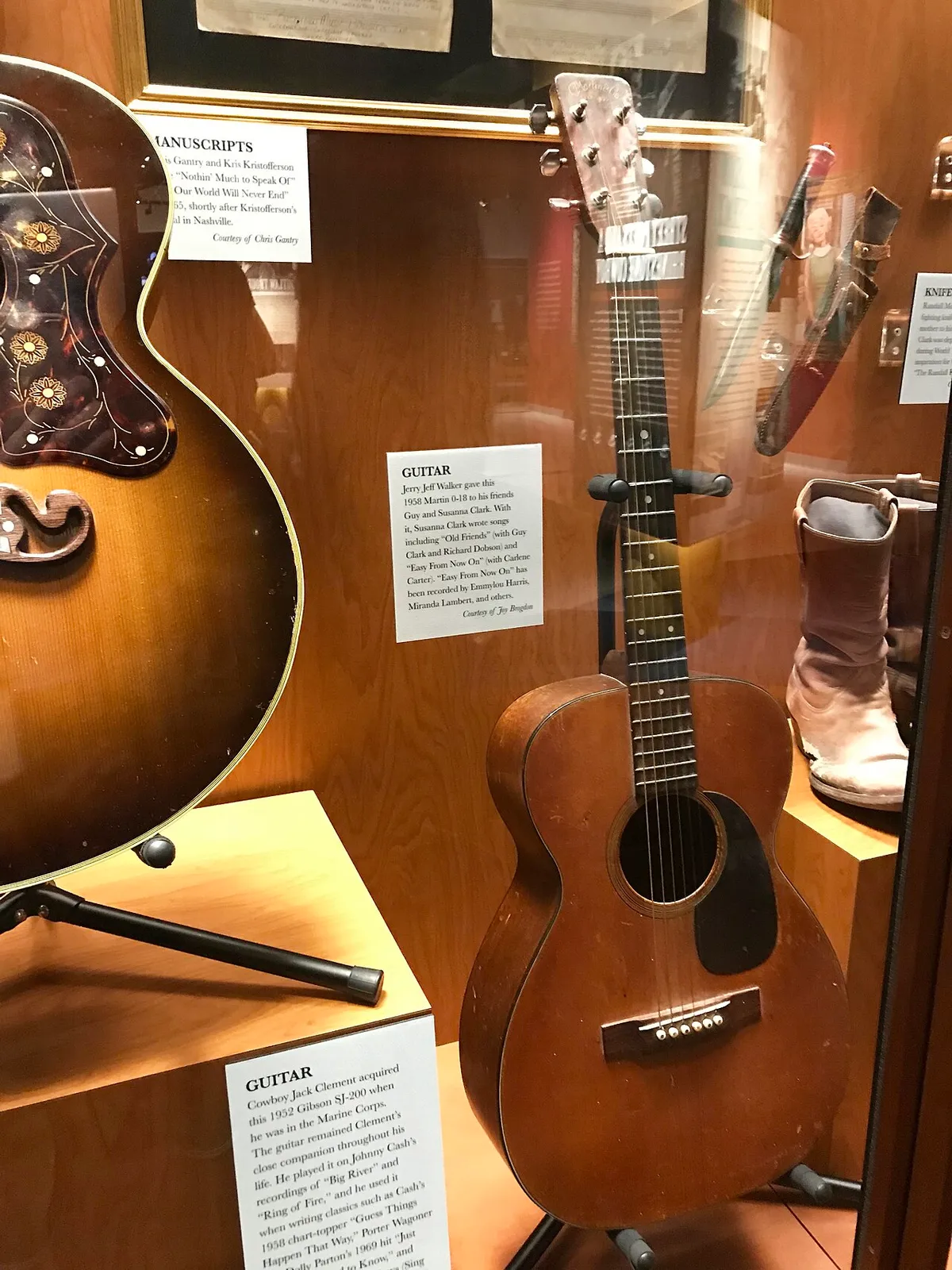
Photo: e Kat / Wikimedia Commons / CC0 Martin
0-18
1898
Martin keeps dropping the little 0-18 from the catalog. The people who own one never put it down.
- Send a picture
Martin
00-18
1898
Not the big dreadnought. The small mahogany Martin you can carry into a field and write a song on.
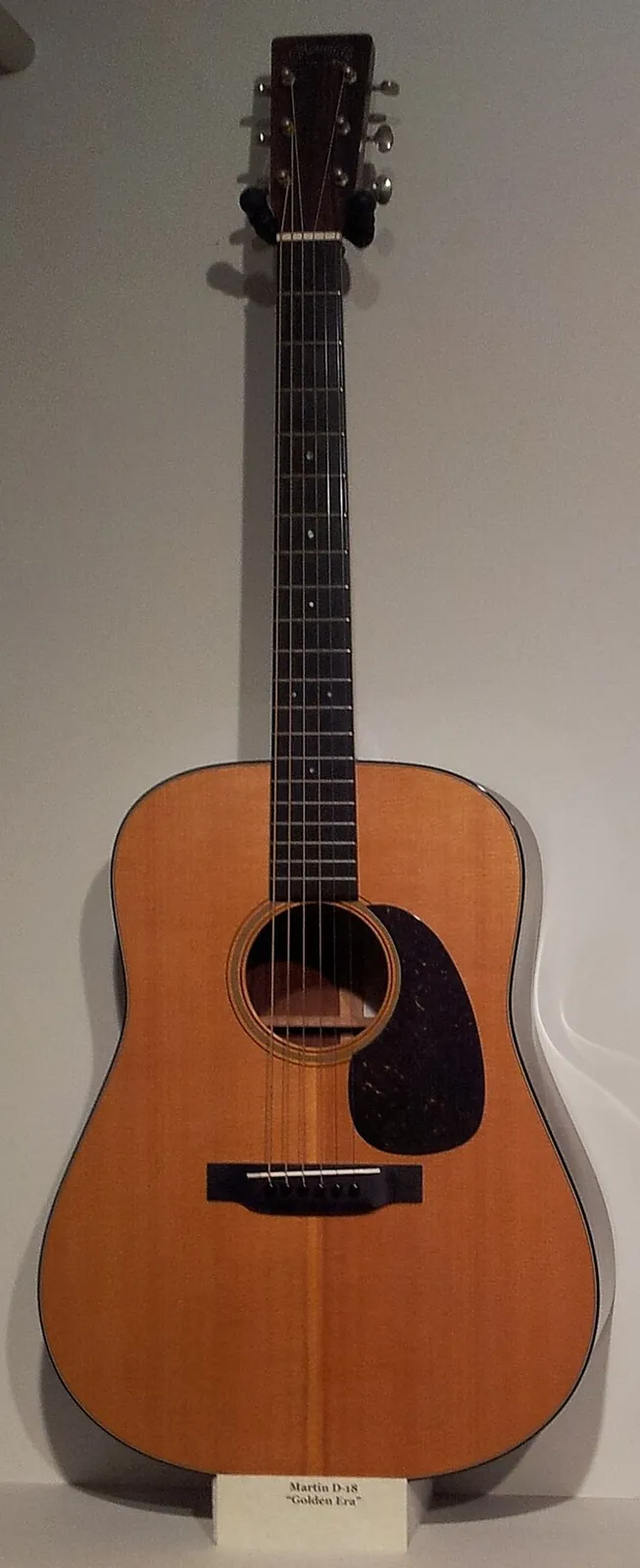
Photo: doryfour / Wikimedia Commons / CC BY-SA 2.0 Martin
D-18
1931
Elvis traded his D-18 up for a leather-covered D-28. The plain one had already been there for the Sun records.