Gibson
J-45
Born in 1942 out of whatever wood a wartime factory could find. Gibson calls it its best-selling acoustic ever.
Kalamazoo, August 1942. The country is at war, good wood is hard to get, and on the 17th a new round-shoulder flat-top goes into Gibson’s ledger. It costs forty-five dollars, so they call it the J-45.
- Introduced
- 1942
- Type
- Flat-top steel-string acoustic
- Class
- Production
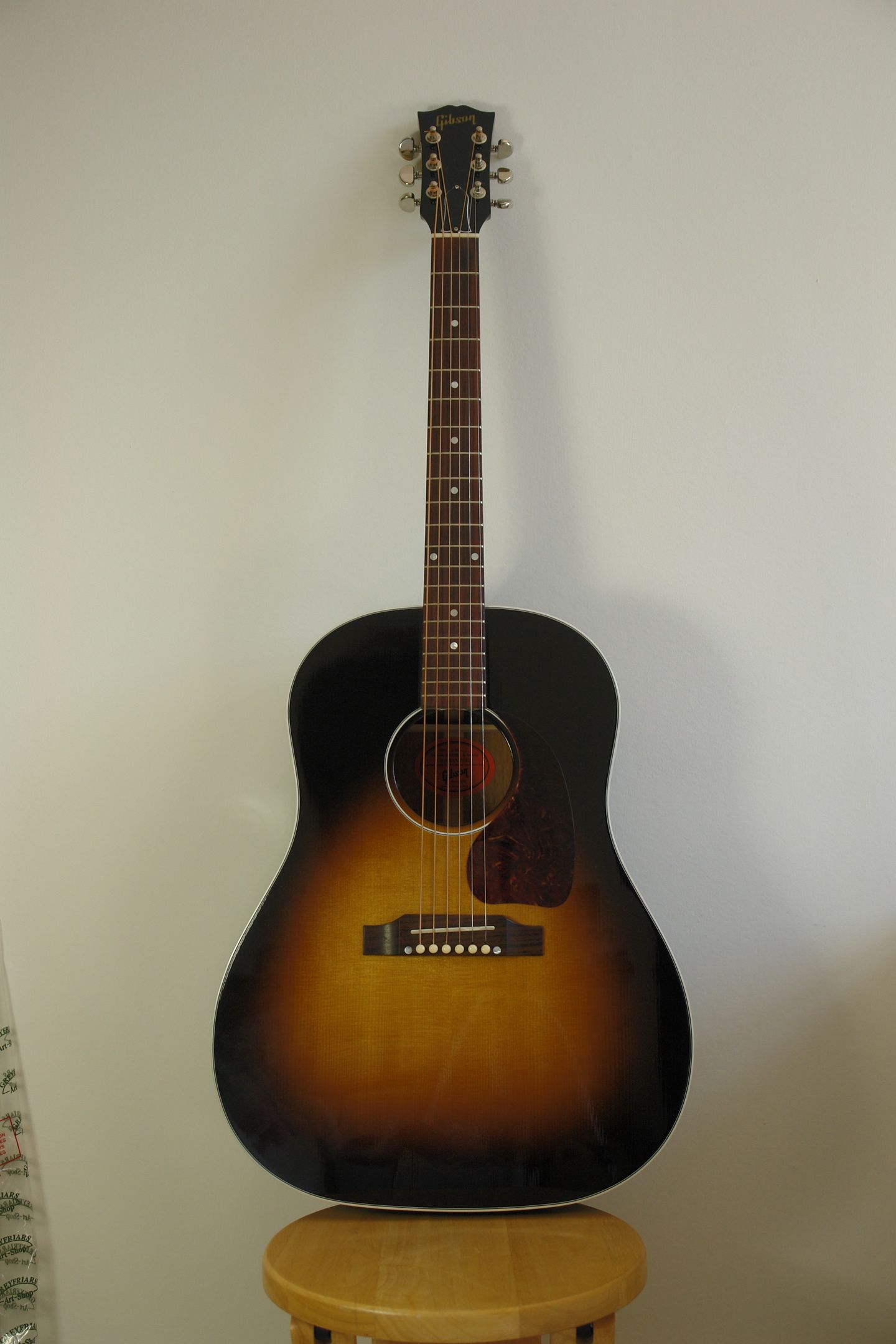
The short version
1942
Forty-five dollars
First J-45 in the ledger on 17 August, with the wartime banner logo on the headstock.
1943
Making do
Many J-45s this year have no steel truss rod. Wartime guitars turn up with maple where the mahogany should be.
1946–47
Banner down
The “Only a Gibson Is Good Enough” banner goes away. Sources split on exactly when.
1955
A bigger pickguard
Shorter, unscalloped braces, a larger guard, and a 20th fret.
1956
The adjustable bridge
Optional at first, then standard by 1961. Collectors aren’t fans.
1969
Square shoulders
Gibson squares the shoulders and stretches the scale to 25.5 inches.
1984
Round again
After a two-year gap, the round-shoulder J-45 comes back. Bozeman takes over in 1989.
Side A
A1
Forty-five dollars and a new logo
Plenty of famous guitars got built when a company was flush and feeling ambitious. The J-45 got built in a war, with the good wood going scarce, out of whatever Gibson could find in the building. It has been working ever since.
It started as a small change to an old guitar. Gibson’s mahogany J-35 had been named for its $35 price. In 1942 Gibson replaced it with a guitar that, in one history’s words, “looked just like the J-35 except for its pickguard and wartime peghead logo,” with slightly heavier bracing. It cost $45. A natural-top version cost $50. You can guess the names.
The shape is round-shouldered, about sixteen inches across, and mahogany under a spruce top. It isn’t a Martin with square shoulders. Gibson trademarked a nickname for it: “The Workhorse.”
A2
Whatever was in the building
The new headstock had a gold script “Gibson” and a banner that said “Only a Gibson Is Good Enough.” Bold words, from a factory short of nearly everything.
The recipe was a spruce top over mahogany. What actually shipped, during the war, was whatever Gibson had. Some J-45s got mahogany tops. Some got laminated maple backs and sides, sometimes stained to look like mahogany. Some tops were pieced together from four bits of spruce, or didn’t match down the middle. Some necks were maple. A lot of 1943 guitars have no steel truss rod at all. Sources mention ebony bars, maple reinforcement, or nothing.
The brown sunburst hid the flaws in the wood. The necks were thick, like a baseball bat, with three tuners on a plate. These were not precious guitars. They were guitars that needed to get made.
“Only a Gibson Is Good Enough” is a bold thing to print on a guitar when you’re short of nearly everything that goes into one.
A3
The one with the leather jacket
The J-45 doesn’t have a long list of famous named guitars in museums. Its job was to be common. But a few stories stick.
Buddy Holly had a 1942 J-45, and after seeing a guitar Elvis played, he made leather for it. One source says he “hand-crafted a bespoke leather case for his own 1942 Gibson J-45.” Others describe a tooled leather cover on the body, Elvis-style. The sources don’t line up on case versus cover, so neither will we.
Donovan played one enough that Gibson made a Donovan J-45 in 1965. A story goes around that he taught John Lennon to fingerpick on it in India in 1968. Donovan does tell the lesson story, and Lennon asked him, “How do you do that?” But he doesn’t name the guitar, and Lennon’s own writing guitar at the time was a Martin. Keep the lesson. Hold the J-45 part loosely.
And Bob Dylan on his first album cover is holding a J-50, the natural-top sibling. Not this one.
Flip the record · By the numbers
$45
The 1942 list price, and the name. The natural-top J-50 was $50.
1,309
J-45s Gibson shipped in 1948, the first year with a published count.
5,670
J-45s Gibson shipped in 1967, the published peak.
1982
The year Gibson stopped making it. It was back in 1984.
Side B
B1
Gibson keeps fiddling
After the war the J-45 settled down, and then Gibson couldn’t leave it alone. The banner went away around 1946 or ’47, depending on who you ask. Block letters in 1948. A new bridge in 1950. A bigger pickguard, shorter braces, and a 20th fret in 1955.
Then in 1956 came an adjustable bridge, optional at first and standard a few years later. Collectors generally treat it as a step down in tone. In 1963 Gibson tried a plastic bolt-on bridge, which didn’t last. From 1969 the shoulders were square and the scale was longer.
None of it killed the guitar. Gibson shipped 1,309 J-45s in 1948 and 5,670 in 1967, the peak year in the published counts. It stopped making them in 1982, then brought back the round-shoulder version in 1984. Production moved to Bozeman, Montana, in 1989.
B2
The original workhorse
Walk into a guitar shop now and you’ll find a J-45 Standard with a Sitka top, a slim neck, and a pickup inside. You’ll also find recreations of the 1942 banner guitar, with hide glue and tops that have been baked on purpose to sound old. Gibson sells one as “The Original Workhorse.” It calls the J-45 “the best-selling Gibson acoustic model of all time.”
Which is a funny place to end up. Gibson now spends real effort recreating a guitar that was put together from leftovers, in a factory that didn’t have enough of anything. Nobody in 1943 was trying to make a legend. They were trying to get guitars out the door with no truss rods and the wrong wood.
They got them out the door. People have been playing them ever since.
The cast
The people, and the specific guitars, that made the legend.
1950s
Buddy Holly
1942 J-45, in tooled leather
Made a leather case, or cover, for his J-45 after seeing Elvis’s. The sources don’t agree which.
1965
Donovan
J-45
Played one enough that Gibson made a Donovan J-45 in 1965.
1962
Bob Dylan
A J-50, not this
The Gibson on his first album cover is a natural-top J-50. People mix them up constantly.
Woody Guthrie
A Southern Jumbo, not this
The “This Machine Kills Fascists” guitar is usually said to be a Southern Jumbo. Guthrie-on-a-J-45 is a common mix-up.
Liner notes
Specs, construction, rarity, value, and every source we used.
The round-shoulder mahogany dreadnought Gibson never stopped making — just don't hang Dylan's debut cover on this one. That's a J-50.
- Body
- Round-shoulder dreadnought; solid Sitka spruce top, solid mahogany back and sides; multi-ply top binding, single-ply back
- Neck
- Mahogany, SlimTaper; compound dovetail neck-to-body joint
- Fingerboard
- Rosewood, 12" (304.8 mm) radius, mother-of-pearl dots, 20 frets
- Scale
- 628.65 mm / 24.75"
- Pickups
- L.R. Baggs VTC under-saddle piezo (current Standard; vintage J-45s have none)
- Hardware
- Traditional belly-up rosewood bridge; TUSQ saddle and TUSQ bridge pins; nickel Grover Rotomatics with kidney buttons; teardrop pickguard
- Electronics
- Soundhole-mounted volume and tone
- Finish
- Gloss nitrocellulose lacquer; Heritage Cherry Sunburst is the catalog default
- Nut
- 43.82 mm / 1.73". Body copy says TUSQ; spec table says "Black." Treat as TUSQ, likely black-colored.
Open the full research fileConstruction details, the complete player record, production numbers, dated value estimates, and sources
Current Standard (Gibson.com Heritage Cherry Sunburst page, model MCRS45HCS). Banner-era shortages, 1969–82 square-shoulder 25.5" guitars, and Historic/Murphy Lab recreations are different instruments — see Construction.
Construction
Gibson trademarked "The Workhorse." Ignore the slogan and look at the shape: a round-shoulder dreadnought, not a square-shoulder Martin D. Vintage examples sit in the 16" class. Current production is Bozeman, Montana; the original run was Kalamazoo.
The current Standard is Sitka spruce over mahogany, "Traditional Hand-scalloped X-bracing," gloss nitro, with a factory L.R. Baggs VTC. Hide glue is not on that spec sheet — don't assume it. Historic/Murphy Lab 1942 Banner recreations advertise hot hide glue and thermally aged Adirondack tops; those are separate SKUs. Some Historic/Original SKUs ship without pickups. Vintage J-45s had none.
Predecessor: the J-35, named for its $35 price. Vintage Guitar: the J-45 looked just like the J-35 except for its pickguard and wartime peghead logo, with slightly heavier bracing. The model name is the 1942 price — $45, natural-top J-50 at $50 (Premier Guitar; Guitar Center Riffs).
Gibson's copy says 1942. Vintage Guitar (Gruhn/Carter) puts the first J-45 ledger entry on 17 August 1942, with a handful of J-50 listings from 7 July 1942. guitarhq.com lists some Joe Spann FON assignments as "1941 J-45," which that site itself treats as probably 1942. So: 1942, with a slightly messy first-build date.
Banner era (typically 1942–c.1946) is the collected slice: gold script "Gibson" plus "Only a Gibson Is Good Enough." Standard formula was spruce top, mahogany back/sides/neck. Shortages produced documented variants — mahogany tops, laminated maple back/sides (sometimes stained as mahogany), four-piece or non-bookmatched spruce tops, maple necks. Many 1943 examples lack a steel truss rod; sources mention ebony bars, maple reinforcement, or no rod. Don't over-specify the mix. Dating is by FON, not consistent serials. Early 1942 often firestripe/"firegrain" pickguard; later wartime tortoise teardrop. Brown sunburst hid wood flaws. Natural (J-50 / J-45N) was rare in 1942.
When the banner ends is contested. guitarhq.com: gone in 1946, script logo retained. Some dealer guides (Edgewater Guitars) drop it mid-1947. Don't pick a winner.
1947: J-50 becomes a regular companion. 1948: block "Gibson" logo (guitarhq.com). 1950: upper-belly bridge, triple-bound top. 1955: shorter unscalloped braces, larger pickguard, 20th fret (Banner boards typically had 19). 1956–61: adjustable bridge (J-45ADJ) optional then standard — collectors generally treat that as a tonal step down. 1963: a plastic bolt-on bridge that didn't last. 1969–1982: square-shoulder body, 25.5" scale; discontinued 1982; reintroduced 1984 as round-shoulder 24.75" (Guitar Center Riffs; guitarhq.com). Bozeman from 1989.
Wartime necks were thick "baseball bat" mahogany or maple; tuners were 3-on-a-plate Kluson, often plastic buttons. Current Standard: SlimTaper mahogany, Grover Rotomatics, 1.73" nut.
Players
The J-45 does not have a Stratocaster-style canon of named, museum-held hero guitars. Its historical job was to be common. This list is short on purpose. Unsourced celebrity dumps are not repeated here.
Buddy Holly — 1942 Gibson J-45 with a tooled leather covering. Genesis Publications, in a 2025 note on Holly opening for Elvis Presley seventy years earlier: Holly, captivated by a guitar he had seen Elvis play, "hand-crafted a bespoke leather case for his own 1942 Gibson J-45." Acoustic Guitar independently names Holly among the J-45's historic players. Secondary accounts (including Guitar Center Riffs) describe a tooled leather cover on the body (Elvis-style), not only a case; Genesis's wording is "leather case." Treat the year (1942 instrument, used in Holly's 1950s career) as reported by Genesis, and treat cover-versus-case as not fully aligned across sources.
Donovan. Associated strongly enough that Gibson issued a 1965 Donovan J-45 (Guitar World, Damian Fanelli, 12 March 2014 — that URL 404s as of August 2026; cited via Wikipedia as a lead). A dealer history describes a 1965 J-45 as the guitar Donovan took to Rishikesh in 1968. Do not upgrade the India guitar to a verified named instrument from the dealer page alone. Rolling Stone (19 April 2012): Donovan recounts that in India, Lennon asked "How do you do that?" and learned Donovan's fingerpicking. Rolling Stone does not name the guitar. Later White Album songs ("Julia," "Dear Prudence") are commonly linked to that lesson in secondary guitar writing. The specific claim that Lennon learned the pattern on Donovan's J-45 is repeated by dealer/enthusiast sites, not by the Rolling Stone interview. Lennon's primary White Album writing guitar is separately a Martin D-28. Two guitars. Don't collapse them.
Bob Dylan's famous early-1960s Gibson is a J-50, not a J-45. Walter Carter (Carter Vintage) states it in a D-28 history: in the folk era "Dylan played a J-50, a re-topped Nick Lucas, a J-200 and other guitars, but not a D-28." Specialist J-50 writing identifies the guitar on the cover of the debut album Bob Dylan (recorded November 1961, released March 1962) as a script-logo Gibson J-50, also used at The Freewheelin' Bob Dylan sessions. The debut cover photograph is reversed (strings appear backwards) so the headstock would not hide the Columbia logo. Do not put the debut/Freewheelin' Gibson on this page as if it were a J-45. Later J-45 stage use by Dylan is often asserted; a named instrument with year and song was not verified here.
Woody Guthrie's "This Machine Kills Fascists" stencil is on a Gibson Southern Jumbo, not a J-45. Guitar Center's J-45 history itself says Guthrie painted the slogan on a Southern Jumbo — an upscale relative of the jumbo family — "and a few other of his favorite guitars." Acoustic Guitar's J-45 Vintage review still lists Guthrie as a J-45 player. Treat Guthrie-on-J-45 as a common mix-up.
Elvis Presley is a Martin D-28 / Gibson J-200 story, not a documented J-45 story. James Taylor's early records are J-50 territory in the same specialist literature that documents Dylan's J-50. Do not migrate those guitars onto this page. Long buying-guide player lists (Springsteen, Gillian Welch, Lightnin' Hopkins, Lucinda Williams, Steve Earle) without named instruments are not used as evidence here.
Rarity
Current production: regular catalog. Gibson calls it "the best-selling Gibson acoustic model of all time." Current Bozeman unit counts are unknown. Used Bozeman Standards are common. Vintage round-shoulder (late 1940s–early 1960s): moderately common; guitarhq.com notes J-45s are easier to find than most other Gibson flattops. Banner / wartime (1942–c.1946): scarcer and more collected. 1942–47 shipping is unknown (Meiners / GuitarHQ gap — wartime J-45 cells are “?”; FON batch lists are not production counts). From 1948 GuitarHQ publishes year totals (e.g. 1,309 in 1948; 1967 peak 5,670). Variants — mahogany top, maple body, no truss rod, four-piece top, natural 1942 J-45N/J-50 — are individually scarce. Square-shoulder 1969–82: less collected; still around in player-grade supply. Not continuous since 1942: discontinued 1982; round-shoulder return 1984.
Value
Informal estimate, 25 August 2026. Not an appraisal.
New street: Gibson.com lists the J-45 Standard at $2,999 (Heritage Cherry Sunburst, fetched 25 August 2026). Guitar Center's buying guide had the same figure as of a March 2026 snippet. Historic 1942 Banner reissue (new) listed $4,999; Murphy Lab Light Aged $6,499; Heavy Aged $7,499. Different SKUs, not the Standard — reissues are not wartime originals.
Used modern (Bozeman Standard, roughly 2000s–2020s): Reverb Price Guide for J-45 Standard 2009–2019 shows monthly average used sales $1,639–$2,105, and a separate "estimated used value" of $2,849 (1,144 orders, Good to Mint). Those are not the same statistic. Recent sold examples include May 2026 Very Good at $2,100 and $1,599.99. Informal range for a clean used Standard: approximately $1,600–$2,500, mint/recent nearer new street.
Vintage / collectible: distinguish sold vs ask; the sold series is thin. Reverb sold Banner Logo 1942–1945 in 2024: $8,500 (14 May 2024, Good) and $8,074 (29 Jan 2024, Very Good). Excellent original-finish banner dealer-ask neighborhood $12,000–$18,000 — not a dense sold series. Asking examples in that neighborhood: Music City Vintage Guitars 1943 at $13,000 (was $14,500); UMGF report of a 1943 at Carter Vintage around $17,500 asking (a commenter paid about $10k less there in 2020). Garrett Park Guitars dealer 1940s excellent–mint original $5,000–$12,000 — may be conservative for clean banner. Original finish vs refinish, and provenance, can double or halve a result. Celebrity-owned J-45s are a separate market.
Late 1940s–mid-1950s round-shoulder (non-banner): generally below banner money. Garrett Park 1950s excellent original $3,500–$7,500 (undated dealer guide; may be a floor-to-mid band for clean pre-1955). No clean 2024–26 sold extract this pass — data thin. Adjustable-bridge 1960s and square-shoulder 1969–82: typically the cheapest vintage J-45s; Garrett Park 1960s excellent original $2,500–$5,000.
See also
- gibson-j-50 — natural-top sibling; Dylan’s debut cover lives there
- martin-d-28 — the square-shoulder dreadnought this was always measured against
- martin-d-45 — Martin's flagship D; pre-war originals live in a sidebar there
Sources
- https://www.gibson.com/products/gibson-j-45-standard-heritage-cherry-sunburst
- https://www.gibson.com/collections/gibson-j-45-acoustic-guitars
- https://www.vintageguitar.com/3457/gibson-j-45/
- https://www.guitarhq.com/j45.html
- https://reverb.com/p/gibson-j-45-banner-logo-1942-1945
- https://reverb.com/p/gibson-j-45-standard-2009-2019
- https://www.guitarcenter.com/riffs/buying-guides/guitars/gibson-j45-acoustic-guitar-history-guide
- https://www.premierguitar.com/features/gear-features/margo-price-on-her-j45
- https://www.premierguitar.com/features/gear-features/history-of-the-gibson-j-45
- https://americana-uk.com/the-unsung-heroes-of-americana-gibson-j-45
- https://cartervintage.com/shop/gibson-j-45-standard-2026-goldtop/3Forj7RxhkKcUl1xR4HfFDxftWy
- https://musiccityvintageguitars.com/products/1943-gibson-j-45-banner-sunburst
- https://umgf.com/1943-banner-j45-at-carter-s-t227477.html
- https://www.guitarcenter.com/Gibson/Murphy-Lab-1942-Banner-J-45-Light-Aged-Acoustic-Guitar-Vintage-Sunburst-1500000399779.gc
- https://www.guitarhq.com/shippin2.html
- https://gpguitars.com/pages/gibson-j-45-appraisal-value
- https://www.genesis-publications.com/news/70-years-ago-buddy-holly-opens-for-elvis-presley
- https://www.rollingstone.com/music/music-news/donovan-on-teaching-guitar-technique-to-beatles-80293/
- https://cartervintage.com/blog/how-did-the-d-28-become-the-legendary-d-28
- Gibson Custom: 1942 Banner J-45 Reissue — "The Original Workhorse."
- Gibson Brand Book: Banner Guitars (1942)
- Acoustic Guitar: Gibson J-45 Vintage review — workhorse framing; Guthrie listed (mix-up flag).
- T.C. Gakki / Advance Guitars: History of the Gibson J-50 — debut-cover J-50; James Taylor J-50 territory.
Keep digging
Guitars this one gets compared to, confused with, or descended from.
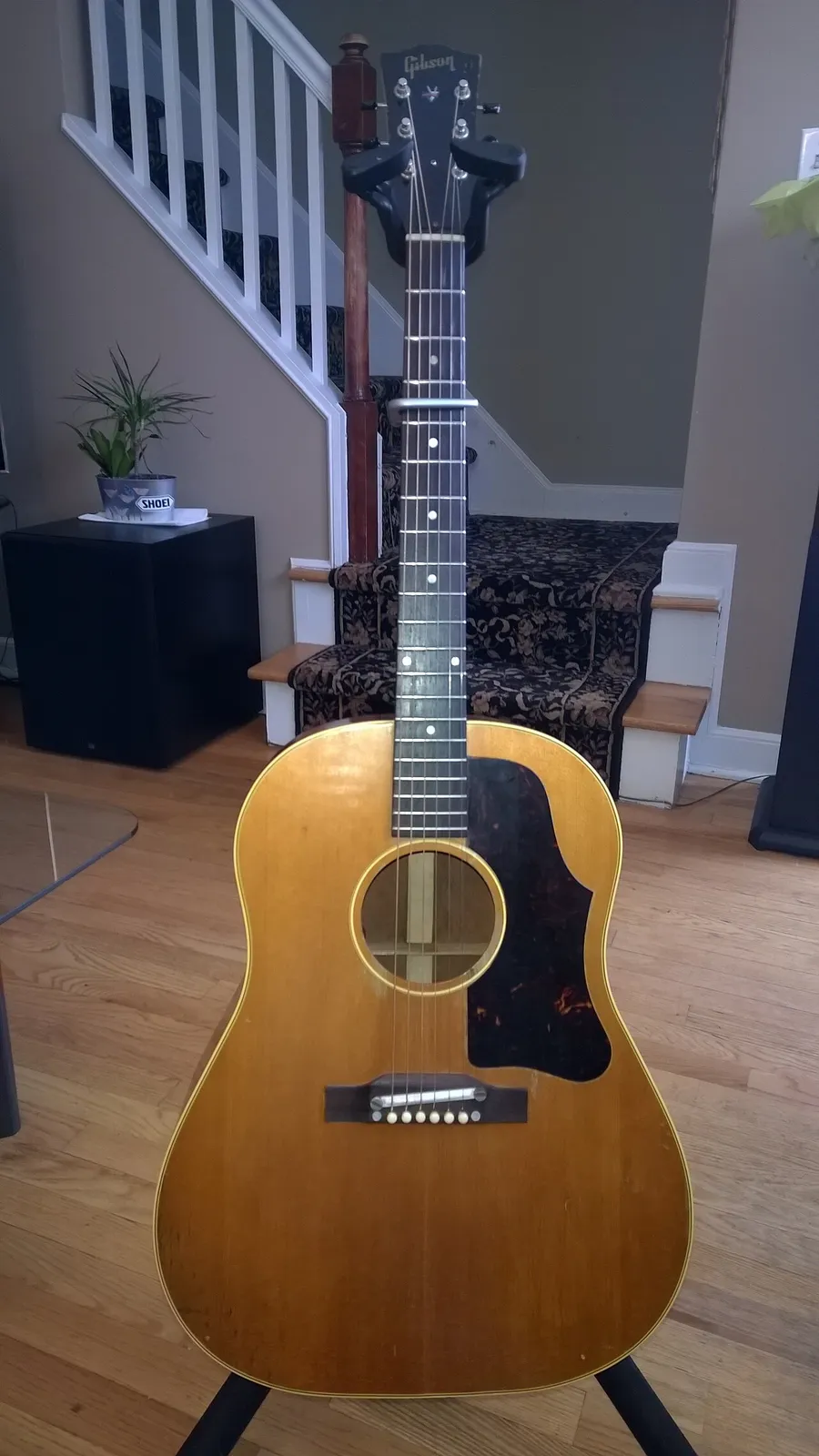
Photo: sbaimo from United States / Wikimedia Commons / CC BY 2.0 Gibson
J-50
1942
The J-45 with nothing to hide: a bare natural top, five dollars more, and Bob Dylan’s first album cover.
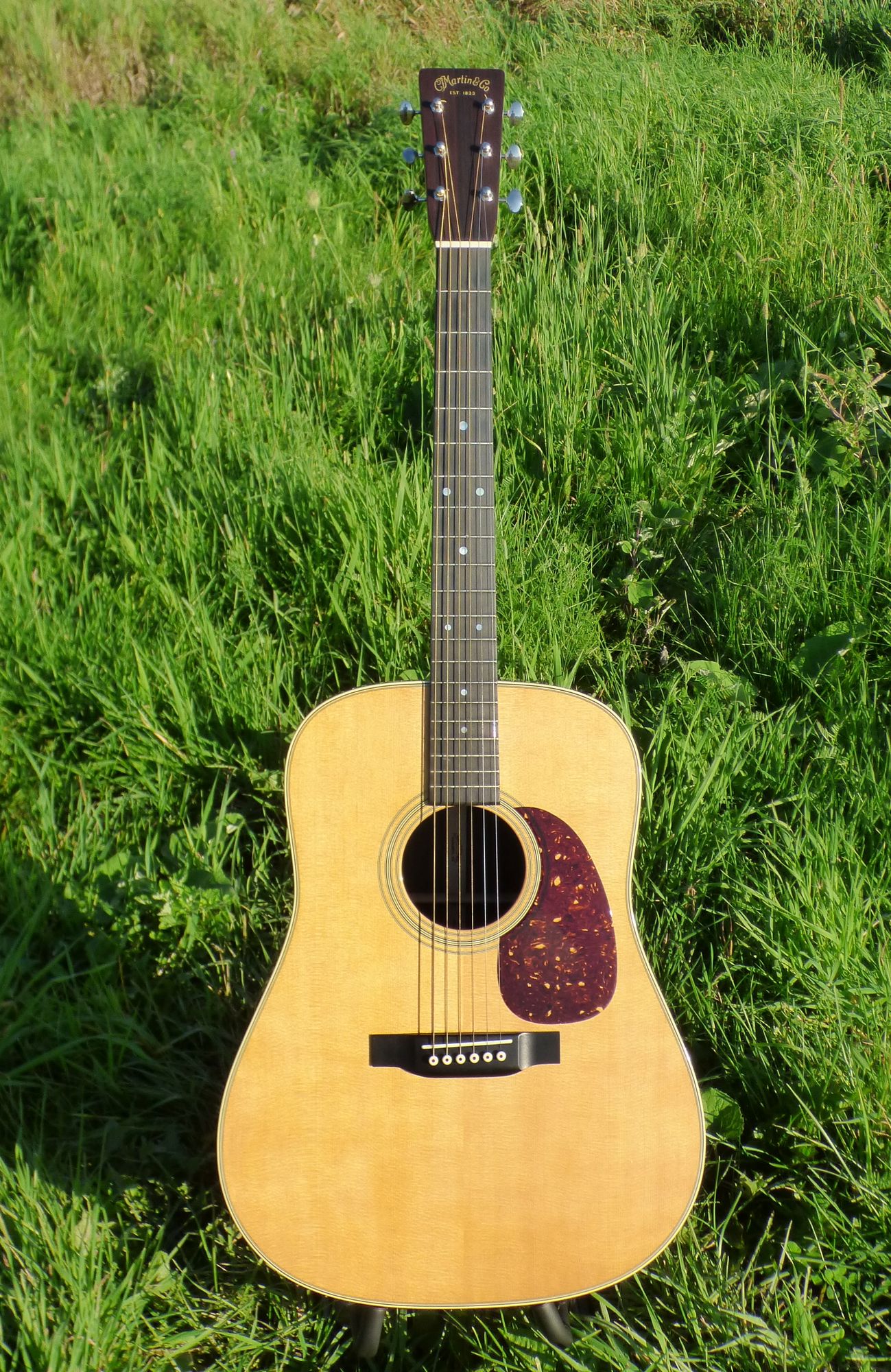
Martin D-28 Acoustic Guitar. Photo by Niranjan Arminius. Licensed under CC BY-SA 4.0. Via Wikimedia Commons. Martin
D-28
1931
You’ve heard a D-28 your whole life. It just never asked for the credit.
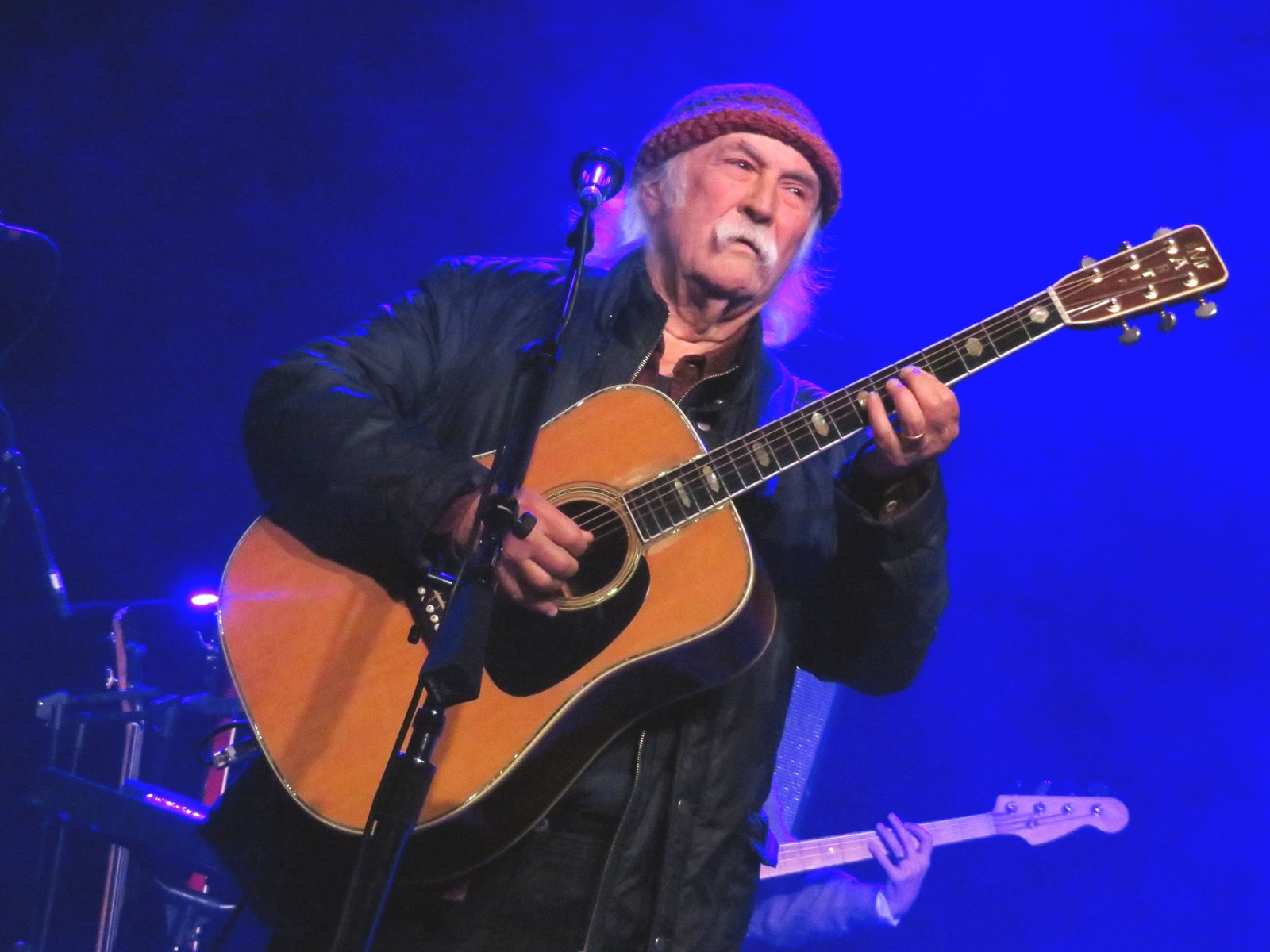
Photo: Eddie Janssens / Wikimedia Commons / CC BY-SA 4.0 Martin
D-45
1933
Pearl takes time. When the war took Martin’s time away, the D-45 stopped, and it waited 26 years to come back.