Kiesel
Osiris
Kiesel’s Vader went headless with a neck-through. People asked for a bolt-on. The Osiris is the bolt-on.
The shop already knew how to build a guitar without a headstock. In January 2018 it screwed the neck on instead of running it through, kept the tuners down at the bridge, and called the result the Osiris.
- Introduced
- 2018
- Type
- Solidbody electric
- Class
- Production
Have a photograph of this guitar? Send a picture
The short version
1946
Lowell Kiesel’s company
Los Angeles or San Diego, depending who you ask. The Carvin name follows in 1949 or 1950.
2015
The family name
Guitars split from Carvin’s audio company on 1 February, and the headless neck-through Vader arrives.
2016
Escondido
A purpose-built factory in September 2016, or 2017, or 2015. The dates don’t agree. Keep all three.
2018
The Osiris at NAMM
A bolt-on headless double-cut, launched in January alongside the single-cut Zeus.
2018
The JBO6X
Jason Becker’s Numbers look on Osiris construction. A hundred guitars, each signed and numbered by Jeff.
2025
Osiris 2
Offset body, radiused heel, new saddles, about half a pound lighter. Shown on 4 January.
Side A
A1
People asked for the other joint
January 2018, a NAMM booth, a camera in Jeff Kiesel’s face. He has a small double-cut guitar with no headstock, and he explains it the simplest way there is. Kiesel already had a headless guitar, the Vader, out since 2015, and its neck ran straight through the body. People asked for the other joint.
This was that guitar.
It isn’t a complicated idea. A neck-through is one long piece of wood from the nut to the strap button, with the body glued on either side. A bolt-on is a neck screwed into a pocket, the Fender way. Same missing headstock. Different joint. Somebody said they wanted it, and a shop that builds to order went and built it.
A2
The family name on the door
The shop is older than the name on it. Lowell Kiesel started his company in 1946, in Los Angeles or in San Diego depending who you ask. The name Carvin, from his sons Carson and Gavin, came in 1949, or 1950 if you ask Zak Kiesel. Keep both.
In 2015 the guitars split off from Carvin’s audio business and took the family name. Kiesel Guitars opened on 1 February, with Mark as president and Jeff as vice president. The move into a purpose-built Escondido factory is dated September 2016, or 2017, or 2015. That depends who you ask too.
So an Osiris is the old Carvin custom shop, under the family name, built in Escondido. It never wore a Carvin badge.
A3
The brother to Zeus
The Osiris didn’t arrive alone. Kiesel launched it next to the Zeus, a headless single-cut, and the pitch was that it was the same guitar for people who wanted two horns instead of one. Kiesel’s own film called it “the brother to Zeus.” One demo that week called it the second new model of the year, available that day. A later page calls the launch simultaneous. Keep both.
Jeff’s standard spec was alder, maple, ebony, stainless frets, and Luminlay, the side dots that glow in the dark. He said 22 frets. The demo filmed the same week has 24, and the sheet today says 24. Six, seven, or eight strings, with a multiscale option that fans the frets so the low string can be longer: on his seven-string example, 25.5 inches up top and 27 down low. He quoted a starting price of $1,099.
The shape looked like Kiesel’s headed double-cut, the Aries, with the headstock gone and the bottom rounded off more than a Vader. It was lighter than the Zeus beside it. With the tuners moved into a Hipshot bridge at the far end, there’s nothing hanging off the top of the neck. It’s a small guitar.
Same missing headstock. Different joint.
Flip the record · By the numbers
22 / 24
Frets. Jeff said 22 at the launch booth. The demo that week had 24, and so does the sheet now.
5.15 lb
Listed weight of a current six-string O2.
100
Jason Becker JBO6X guitars, signed and numbered. The only closed run on this body.
8
Years between the two versions, by Kiesel’s count. January 2018 to January 2025 is seven.
Side B
B1
Not the Holdsworth
The easy mistake is to file every headless Kiesel together. Allan Holdsworth’s guitar is a set neck with a chamber, headless since 2012, one player’s instrument. The Vader is the neck-through that, in Kiesel’s words, “firmly planted” the shop in headless work. The Osiris is the bolt-on.
The players sort themselves out the same way. Dan Sugarman played “The Unattainable,” the opening track of Inside/Out - Part I, on his Osiris for Kiesel’s camera in February 2018. Jason Becker didn’t take one onstage. His name is on the JBO6X, his Numbers look on this body, a hundred guitars, each signed and numbered by Jeff.
And Lee McKinney, of Born of Osiris, got one in the mail. In his words, Kiesel sent it “for letting them use the name.” His signature model turned out to be half Osiris and half Zeus, its own outline. A cousin, not this guitar.
B2
Nobody’s Osiris looks the same
There is no catalog color. That’s the point. Joss Allen’s is alder with a walnut-and-purpleheart neck and Lithium pickups, and he says the five-way switch pulls a single-coil sound out of the humbuckers. Charlie Robbins’s first Kiesel was limba under a flame top in deep orange burst, with gold frets and a tremolo. Same name, nothing in common but the outline and the bolts.
B3
Eight years, by their count
On 4 January 2025, Kiesel showed the Osiris 2. The body went offset, with a deeper arm contour and bevels on the lower horn. The heel got rounded for more reach up the neck. New saddles cut a string change to a third of the old time, and the guitar came out about half a pound lighter. The company said it arrived “eight years after their inception.” January to January, that’s seven. Keep their eight.
The eight-string only comes multiscale now. The six and the seven you can still order straight.
Go to the page today and you get a start price, a long list of options, and no single color. The Osiris still gets made the way it started: someone says what they want, and the shop builds it.
Put this on
You’ve read about it. Now hear it. Here’s what this guitar sounds like, and what to listen for.
The Unattainable
The opening track of Inside/Out - Part I, played on his own Osiris O6X in Kiesel’s video from February 2018.
Watch it on YouTube (opens in a new tab)Kiesel Osiris demo
Filmed the week of the launch, on a swamp-ash Osiris with Lithium pickups and 24 stainless frets. He calls it lighter than the Zeus next to it.
Watch it on YouTube (opens in a new tab)
The cast
The people, and the specific guitars, that made the legend.
2018
Dan Sugarman
Osiris O6X
Played “The Unattainable” on it for Kiesel’s camera. His later “Murder Axe” is a Crescent with a headstock, not an Osiris.
2018
Jason Becker
JBO6X edition
Not a stage guitar. His Numbers styling on a maple bolt-on Osiris, a hundred of them. His Bluey and Yin Yang have headstocks.
Lee McKinney
An Osiris, sent as thanks
Of Born of Osiris. Kiesel sent him one “for letting them use the name.” His signature is half Osiris, half Zeus, its own shape.
2018
Joss Allen
His own Osiris
Alder, a walnut-and-purpleheart neck, Lithium pickups. He says the 5-way pulls a single-coil voice out of the humbuckers.
2020
Charlie Robbins
Limba custom Osiris
The first Kiesel they sent him, before he endorsed. Flame top, deep orange burst, gold frets.
Jesse Michel
The new Osiris on film
Playing it in Jeff’s 2018 booth film, and credited on the January 2025 O2 film beside Nate Navarro.
Liner notes
Specs, construction, rarity, value, and every source we used.
Bolt-on, double-cut, tuners at the bridge — Kiesel’s Osiris, not the neck-through Vader and not Holdsworth’s set-neck.
- Body
- Alder. 31" long, 1.62" thick, 12" wide
- Neck
- Bolt-on, radiused heel. Tung-oiled maple, two-way truss, dual carbon-fiber rods. 0.78" at the 1st fret, 0.88" at the 12th
- Fingerboard
- Ebony, 20" radius, 24 stainless medium-jumbo (.103" × .048"), white pearl dots, Luminlay side dots
- Scale
- 25.5". Six-string multiscale option 25.5"–26.5"
- Pickups
- Direct-mount passive Kiesel Lithium humbuckers
- Hardware
- Hipshot headless fixed bridge, .4125" (10.5mm) spacing; black. Mix flagged
- Electronics
- Master volume, master tone, 5-way blade
- Finish
- Custom. No single catalog color. Hardware black on the sheet
- Nut
- 1.69" wide (1.71" if the six is multiscale). Material not on the sheet
Open the full research fileConstruction details, the complete player record, production numbers, dated value estimates, and sources
Current production typical = O2 (Osiris 2), 6-string, SKU O26, read 8 October 2026. Weight on that column: 5.15 lb. Not the January 2018 Osiris. 7 (O27): 25.5" or 25.5"–27", 12.12" wide, 5.25 lb, nut 1.90" / 1.92" multiscale. 8 (O28): the page forces multiscale — 26"–27.5", 12.5" wide, 5.45 lb, nut 2.12" — and the control reads “8 String Standard Scale Is Not Available.” The same script still holds a straight 27" eight and a 29" nine. Neither is a button on the product fetched this pass. O2 Bass is a bass. Zeus 2 is the single-cut. The LM is a hybrid. The JBO6X was 100 guitars. The HH2 is Holdsworth. Mix flagged: the bridge line is the only millimetres on this sheet, .4125" (10.5mm). Do not convert.
Construction
The job was a headless double-cut with a bolt-on neck. The Vader, 2015, had already done headless as a neck-through. Jeff Kiesel, at the Guitar World NAMM booth: people asked for the other joint. The Osiris was that guitar.
The shop is the Carvin custom shop under the family name. Lowell Kiesel’s company, 1946. Wikipedia puts the start in San Diego. The about page, the Reverb shop history, and Lowell Kiesel’s Union-Tribune obituary put it in Los Angeles, then a short stay in Gothenburg, Nebraska. Carvin, from sons Carson and Gavin: 1949 on Wikipedia, the about page, and Reverb; Zak Kiesel told the Times-Advocate 1950. Keep both. 2015: guitars leave Carvin’s audio company. Guitar World and the Union-Tribune, 20 January: Kiesel takes guitar and bass manufacturing effective 1 February, Mark president, Jeff vice president, still under the San Diego roof. Reverb’s shop history: the name on 1 February 2015, a purpose-built Escondido factory in September 2016. The about page dates the Escondido move 2017. Zak, March 2020, says 2015, 2015 Aldergrove Avenue. The trademark sits on that street. Keep the three dates. This plate is built there. It is not a Carvin-badged guitar.
2018. Trademark OSIRIS, filed 22 December 2017, first use January 2018, guitars and basses. The filing is an application, not a bench guitar. Gear Gods, 25 January: NAMM model, the double-cut if you didn’t want the single-cut Zeus, “identical specs,” 6, 7, and 8, plus multiscale. Kiesel’s line in that piece: “in conjunction with the new Zeus.” Fleckenstein, 24 January: the second new model of 2018, available that day. The 2025 page calls the original launch simultaneous. Keep both. This plate starts in 2018.
What you got was a small double-cut, tuners in a Hipshot. Jeff’s standard, in that speech: alder, maple, ebony, stainless, Luminlay. He said 22 frets. Fleckenstein’s demo the same week has 24 stainless jumbos. The current sheet is 24. Keep the spoken 22. Six, seven, eight, “standard or multi scale,” and a tremolo in the same breath. His multiscale example is still the seven on the sheet: high E 25.5", seventh string 27". Premier’s booth: sloped heel, recessed ferrules; plain maple on alder, or a walnut-and-purpleheart three-piece; basses in four, five, and six. Those basses are not this table. Fishman Fluence was a 2018 option, not the Lithium pair. Gear Gods: Vader-like, rounder along the bottom. Fleckenstein: “pretty much on par with the Aries,” an Aries made headless, and lighter than the Zeus next to it. The Aries is the headed double-cut from 2015. Kiesel’s later line: the Vader “firmly planted” the shop in headless work after the Holdsworth HH2. Same missing headstock. Different joint.
Not the Holdsworth (carvin-holdsworth). Set neck, the 20" board he asked for, a chamber, headed in 1996, headless from 2012. One player’s guitar. Not a Boden (strandberg-boden): EndurNeck, EGS, chambered ash on the Original. Not a Steinberger GL (steinberger-gl): graphite, 1984.
2025. Osiris 2. Video and Instagram, 4 January: Z2 and O2. The updates page says “eight years after their inception.” January 2018 to January 2025 is seven. Keep their eight. Don’t move the introduction to 2017 to fix the sum. Offset body, deeper arm contour. Bevels on the lower horn, “reminiscent of the wildly popular A2.” Radiused heel, more fret access than the old slope. Fixed-bridge guitars get the rear access jack; the video and the post both withhold it from a tremolo. New saddles, across the headless line, cut a string change to a third of the old time. The video: about half a pound off, and black, chrome, or gold accent hardware, bridge and nut still black. Sheet weight for a six: 5.15 lb. Equipboard’s 2018 block prints 5.5 lb, 30.5" overall, a 1.67" nut, Eastern hard-rock maple. Not this table. Don’t average them.
The eight cannot be ordered straight-scale. The six and the seven can. A 29" nine sits in the scale map and is not a variant.
The O2 Bass is a 2025 bass: multiscale only, after the A2 bass, plus a slap ramp, Darkglass, and Tritium. Not this card.
Classic versus current: the 2018 bolt-on, alder and maple and ebony in Jeff’s speech, against an O2 six from the builder in 2026. Same name. Offset body, new heel, new saddles.
Players
Do not hang a Vader, a Zeus, or a Holdsworth HH2 here because the headstock is gone. Do not hang Lee McKinney’s signature, Becker’s headed tributes, or the Osiris bass.
Dan Sugarman. Kiesel’s video, 21 February 2018: “The Unattainable,” opening track of Inside/Out - Part I, on his Osiris O6X. The later “Murder Axe” is a Crescent seven with a headstock. Off this page.
Jason Becker. Not a stage Osiris. The JBO6X, blog, 20 June 2018, puts the Numbers look on this construction: swamp ash, Raw Tone, maple bolt-on, maple board, Numbers inlays, multicolored Seymour Duncans, Kiesel/Hipshot tremolo. 100 guitars, each signed and numbered by Jeff. His JB200 “Bluey,” the JB24, and the Yin Yang have headstocks. The NAMM “Perpetual Burn” beside the booth was that headed tribute, $1,499 in the Premier video. Another guitar. Not an Osiris price.
Lee McKinney (Born of Osiris). They sent him one. NAMM 2019, his words: a model called Osiris, sent “for letting them use the name.” The signature is not that model. Blog, 14 November 2018: LM6X and LM7X “combine the aesthetic of the single-cutaway Zeus and the double-cutaway Osiris.” Current page: upper half Osiris, lower half Zeus, its own outline. Chambered swamp ash, Hipshot tremolo. A cousin.
Joss Allen. Guitar Interactive, 1 December 2018: his own Osiris, and he was endorsing. Alder, walnut and purpleheart, Lithium, birdseye. He says the 5-way pulls a single-coil voice from those humbuckers. His guitar, not a factory split spec.
Charlie Robbins. 12 April 2020: the first Kiesel they sent, before an endorsement, while he was still with Ernie Ball. Flame top, deep orange burst, limba body, five-piece maple and limba, Hipshot tremolo, birdseye, crescent inlay, Evo gold frets, Lithium with gold poles. One custom. Not the alder-and-ebony sheet.
Tim Miller. August 2020 roster: Osiris and Zeus, and the SH550. The M6 (2024) is another guitar: neck-through semi-hollow headless, 22 frets, 6.3 lb, Beryllium. Don’t file it here.
McRocklin. Same roster: Osiris and Zeus. March 2019, with Jeff: a limited in-stock Osiris six with a trem, roasted 5A flame neck and board, thin profile, 20" radius, swamp ash, Antique Ash Raw Tone, Fishman Tosin Abasi pickups, $2,000, against a one-off they priced over $2,500 before the pickups. Edition size unpublished.
Also known to play stays short. Jesse Michel is on the new Osiris in Jeff’s 2018 booth film — the auto-transcript mangles the name — and credited on the January 2025 O2 film beside Nate Navarro. Felix Martin’s roster line is a custom Osiris/Zeus hybrid 8×8 doubleneck. Not this guitar. None invented.
Rarity
You can order a new O2. Six, seven, or eight, options on top of the start price. Custom shop, not a numbered run. Not rare the way a first-year Strat is rare.
No Osiris total has been published. None invented. A serial dates a guitar. It doesn’t count a year. Company-wide figures are not this model, and they disagree: Wikipedia’s “almost 4,000” instruments a year, the Reverb shop page’s “over 5000.” Don’t average them onto the Osiris.
Thinner, without a census: the JBO6X, 100 guitars, signed and numbered, 20 June 2018. The McRocklin run, size unpublished. First-week NAMM guitars. Sugarman’s O6X is one object. A lefty double-neck one buyer commissioned — he wrote a lefty base of $3,650 and a build a little over $6,100 — is one order. Not a used O2.
Value
Informal estimate, 8 October 2026. Not an appraisal.
Ask versus sold, labeled. No factory count and no invented median. A signed edition is not a comp for a stock O2. Kiesel sells direct. No dealer street under this name.
New street. O2 variant prices, fetched 8 October 2026: 6-string O26 $1,649; 7-string O27 $1,719; 8-string O28 $1,999. Starts. Options move them. The eight is the multiscale the page will sell. Old money: Jeff, Guitar World booth, 27 January 2018, “as low as $1,099,” up to about $4,000. Premier’s booth video the day before: about $1,100. Guitar Interactive prints MSRP $2,499 on Allen’s review and, in the same piece, “under one thousand dollars.” Do not average. The March 2019 McRocklin run was $2,000 in hand. The Perpetual Burn at $1,499 in that Premier video is the other guitar.
Used modern. No clean Reverb Price Guide band this pass. Flag: thin sold-comp access. Named asks, not hammers: a 2024 OM6 multiscale, primer gray, excellent, $1,350 (from $1,575); a 2023 Osiris, good, $1,300 (from $1,650); a 2023 headless seven, classic white, excellent, $1,650. Musician’s Friend used tags: an Osiris seven, excellent, $1,619.99 (from $1,799.99); a lefty red, $1,199.99 (from $1,299.99). A 2025 Black Magic Metallic Raw Tone listing shows sold at $1,400, plus $100 shipping. A 2018 6X, redwood burl, shows sold at $1,950; that listing was about seven years old. Don’t average a loaded custom with a stock six.
Vintage / collectible. A living 2018 guitar, not a 1954 market. Early ones trade as used modern. The JBO6X is the closed edition. A listing for signed 11/100 had ended; the page displayed $2,099.99. Not a confirmed hammer, and not a comp. The double-neck buyer’s $6,100 is what he said he paid. One receipt. Not a market level.
See also
- carvin-holdsworth — the set-neck headless signature; not this bolt-on double-cut
- strandberg-boden — another current headless solidbody; a different neck and a different job
- steinberger-gl — the 1984 graphite paddle this Escondido wood is not
Sources
- Kiesel, O2 — fetched 8 October 2026; alder; radiused-heel bolt-on; 31" × 1.62" × 12" on the six; ebony 20"; 24 stainless .103" × .048"; Lithium humbuckers; 5-way; tung-oiled maple; Hipshot .4125" (10.5mm); scales and nuts by string count; 8-string control forces multiscale; weights 5.15 / 5.25 / 5.45 lb; Shopify variants O26 $1,649, O27 $1,719, O28 $1,999
- Kiesel, 2025 updates — Z2 and O2 “eight years after their inception”; offset; A2-like bevels; radiused heel; rear jack on fixed-bridge models; saddles cut string changes to a third; O2 Bass multiscale only, slap ramp, Darkglass, Tritium
- Kiesel, O2 and Z2 film, 4 January 2025 — 2025 change; about half a pound lighter; rear jack withheld from tremolos; accent hardware black, chrome, or gold, bridge and nut stay black; demo credit Jesse Michel and Nate Navarro
- Kiesel Instagram, 4 January 2025 — “The Gods are Reborn”; released eight years after the originals; non-tremolo bridges get the access jack
- Gear Gods, 25 January 2018 — NAMM 2018 announcement; Zeus “recently released”; identical specs, double-cut; 6/7/8 and multiscale; rounder than a Vader; Kiesel’s “in conjunction” line and the O6 builder pitch
- Premier Guitar, NAMM 2018 — Ted Drozdowski, 26 January 2018; Zeus and Osiris headless, Becker tribute separate; video: bolt-on, 6/7/8, multiscale, 4/5/6 basses, sloped heel, maple-on-alder standard, about $1,100, Fishman Fluence as a 2018 option, Vader neck-through for three or four years, Perpetual Burn at $1,499
- Guitar World, NAMM 2018 booth — Jeff Kiesel: Vader neck-through, Osiris the bolt-on answer; alder, maple, ebony; spoken 22 frets; 6/7/8, tremolo or multiscale; 25.5" to 27" on the seven-string example; $1,099 to about $4,000; Escondido; Jesse Michel on the new guitar
- Frank Fleckenstein, 24 January 2018 — second new model of 2018; available that day; Aries outline, headless; 24 stainless jumbos on the demo; one-piece swamp ash, walnut, royal ebony, Lithium; lighter than the Zeus
- Kiesel, Osiris launch film — “the brother to Zeus”; bolt-on headless
- Kiesel blog, archived 17 November 2019 — JBO6X, 20 June 2018: Numbers styling on Osiris O6 construction; swamp ash; Raw Tone; maple bolt-on; Numbers inlays; Seymour Duncan; Hipshot tremolo; 100 numbered, signed by Jeff. LM6X/LM7X, 14 November 2018: Zeus-plus-Osiris outline; chambered swamp ash; Hipshot tremolo; Illusionist and Lithium
- Kiesel artists, archived 5 August 2020 — Tim Miller on Osiris and Zeus and the SH550; McRocklin on Osiris and Zeus; Felix Martin on a custom Osiris/Zeus hybrid 8×8; Lee McKinney on LM6X and LM7X
- Kiesel, Lee McKinney Signature — current LM: upper half Osiris, lower half Zeus, its own shape; not the Osiris sheet
- Kiesel, left-handed list — O2 under headless double-cuts; Vader as the model that planted Kiesel in headless after the HH2; JB200, JB24, and Yin Yang listed as other signatures
- Kiesel, About — 1946 Los Angeles; Carvin name; 2015 split; Aries and Vader among the first Kiesel-era models; Escondido move dated 2017 on this page
- Kiesel Museum, 2015 — split; move back toward Escondido; Vader Series headless introduced; HH2 already existed and was a different guitar
- Wikipedia, Kiesel Guitars — 1946 start dated San Diego on this page; Carvin name 1949; 2015 split; Escondido headquarters; “almost 4,000” a year is the company, not this model
- San Diego Union-Tribune, 20 January 2015 — split effective 1 February 2015; same roof at the announcement; Mark and Jeff
- San Diego Union-Tribune, Lowell C. Kiesel obituary — company started in Los Angeles, 1946; Nebraska; back to Southern California in 1949
- Guitar World, 20 January 2015 — Kiesel takes guitar and bass sales 1 February 2015; same U.S. facility
- Reverb, Kiesel shop history — name change 1 February 2015; Escondido factory September 2016; “over 5000” a year is the custom shop, not this model
- Escondido Times-Advocate, 19 March 2020 — Zak Kiesel: Carvin name in 1950; Escondido 1969–1995; 2015 return to 2015 Aldergrove Avenue
- USPTO via Trademarks411, OSIRIS — filed 22 December 2017; first use January 2018; guitars and bass guitars; owner at 2015 Aldergrove, Escondido
- Kiesel, Dan Sugarman Osiris O6X — “The Unattainable,” Inside/Out - Part I, on his O6X
- Kiesel, Dan Sugarman Murder Axe — later Crescent seven with a headstock; not an Osiris
- Guitar Interactive, Joss Allen, 1 December 2018 — his Osiris; alder, walnut/purpleheart, Lithium, birdseye; page prints MSRP $2,499 and “under one thousand dollars”
- Charlie Robbins, 12 April 2020 — first Kiesel, sent before endorsement; limba, flame top, deep orange burst, five-piece neck, Hipshot tremolo, Evo gold frets
- McRocklin with Jeff Kiesel, 29 March 2019 — limited Osiris six with trem at $2,000; spec over $2,500 before the Fishmans
- Gear Gods, Lee McKinney, NAMM 2019 — Osiris sent “for letting them use the name”; the LM that follows is the signature he is showing
- Headless Guitar Blog, Tim Miller M6, 2 July 2024 — a different headless: neck-through semi-hollow, 22 frets, 6.3 lb
- Equipboard, Kiesel Osiris — 2018-era spec block: 30.5" overall, 5.5 lb, 1.67" nut, Eastern hard-rock maple, 24 frets, 25.5"; Jacky Vincent’s photo on the same page is a Vader, so the artist list there is not used
- Reverb, 2024 OM6 multiscale — ask $1,350 from $1,575, excellent, primer gray
- Reverb, Kiesel Osiris 2023 — ask $1,300 from $1,650, good
- Reverb, Osiris headless 7, 2023 — ask $1,650, classic white, excellent
- Reverb, 2025 Black Magic Raw Tone — sold listing displayed at $1,400 plus $100 shipping
- Reverb, 2018 Osiris 6X redwood burl — sold listing displayed at $1,950; about seven years old
- Reverb, 2018 Osiris 11/100 signed — listing ended; page displayed $2,099.99; not a confirmed hammer
- Reverb, 2020 double-neck Osiris — seller’s stated lefty base $3,650 and build a little over $6,100; one commission
- Musician’s Friend, used Osiris 7 — ask $1,619.99 from $1,799.99, excellent
- Musician’s Friend, used lefty Osiris — ask $1,199.99 from $1,299.99
Keep digging
Guitars this one gets compared to, confused with, or descended from.
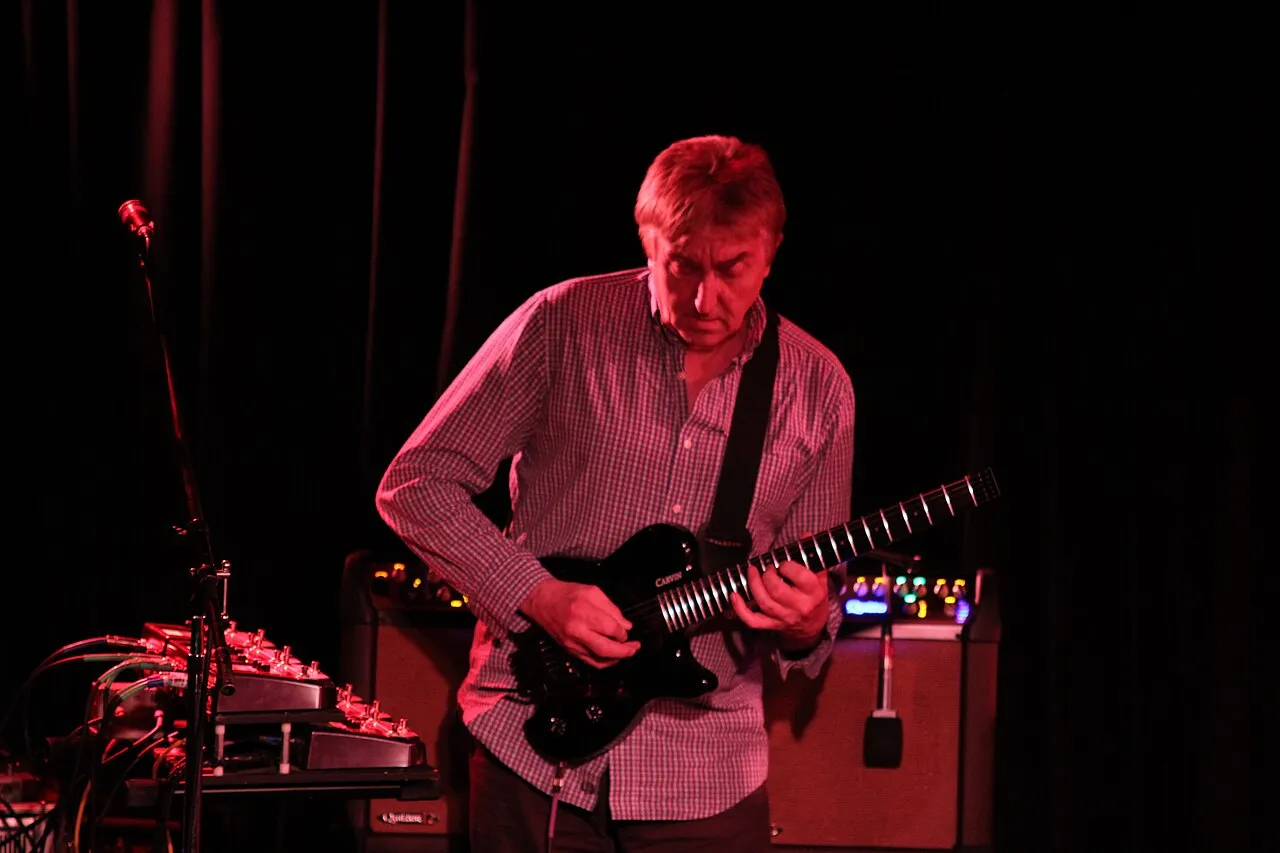
Photo: Chrisparks / Wikimedia Commons / CC BY-SA 4.0 Carvin
Holdsworth
1996
The guitar Allan Holdsworth couldn’t order, until Carvin built it: a flat board, a fat neck, hollow inside.
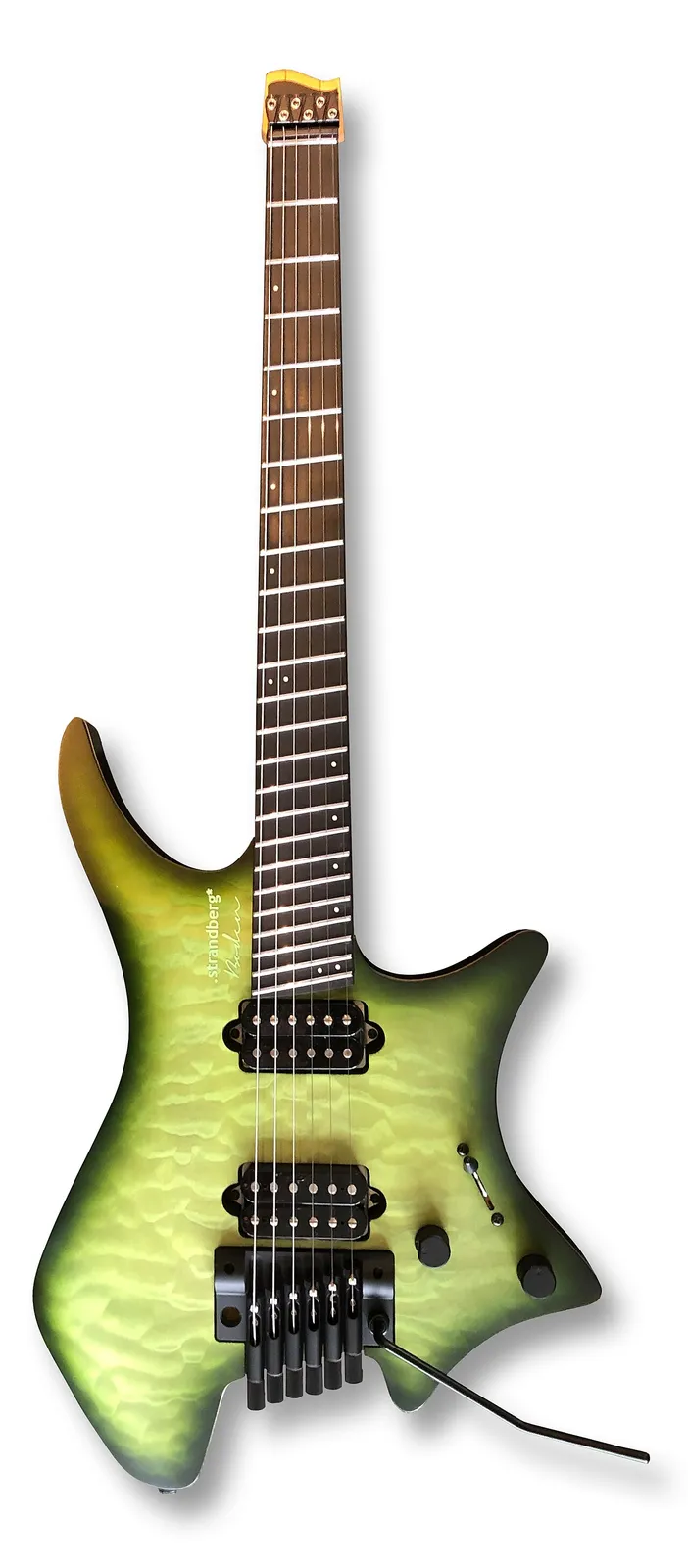
Photo: Auge=mit / Wikimedia Commons / CC BY-SA 4.0 Strandberg
Boden
2014
It started with a sore shoulder. A Swedish engineer built a guitar that would stop fighting him.
- Send a picture
Steinberger
GL
1984
No headstock, no wood, and designed by a man who didn’t play. Eddie Van Halen wrote two songs on it in days.