Steinberger
GL
No headstock, no wood, and designed by a man who didn’t play. Eddie Van Halen wrote two songs on it in days.
Brooklyn, the late 1970s. A furniture designer in a woodworkers’ co-op looks at the electric guitar and asks two questions nobody in the business was asking. Why does the tuning end have to hang off the far end? And why does the whole thing have to be wood?
- Introduced
- 1984
- Type
- Solidbody electric (headless guitar)
- Class
- Production
Have a photograph of this guitar? Send a picture
The short version
1979
The bass first
Ned Steinberger’s headless L2 bass shows up at summer NAMM.
1982
A guitar prototype
The GL is born as a prototype, on the same paddle shape as the bass.
1984
On sale
The first regular-production GLs are built that April and in shops by May. The TransTrem is announced the same year.
1985
New Orleans
Ned hands Eddie Van Halen a GL2T at summer NAMM.
1986
Gilmour writes in
David Gilmour’s office asks for a GL3T to try.
1987
Gibson buys in
Gibson buys Steinberger. Some accounts say 1986. Ned stays on as a designer.
1992
The wood version
The Spirit line keeps the shape but swaps graphite for wood.
1998
The paddle stops
Original graphite production ends.
Side A
A1
Two questions from a man who didn’t play
Most guitar designs come from guitar players. They know what they like, they change a little, and they keep the rest. That’s how you end up with seventy years of guitars that look mostly like each other.
Ned Steinberger wasn’t a guitar player. He wasn’t a musician at all. He was a furniture designer in a Brooklyn woodworkers’ co-op. He’d already reshaped a bass for Stuart Spector, who worked in the same co-op. Then he started asking questions a player would never think to ask.
Why does the tuning end have to hang off the end of the neck? And why does the thing have to be made of wood?
A2
The bass came first
The first answer was a bass. Ned’s L2 turned up at summer NAMM in 1979, a small paddle with no headstock, made of graphite. Early prototypes went to John Entwistle, Tony Levin, and Andy West. In 1981 Time named it one of the five best designs of the year. By 1982 demand was running 300 percent ahead of what the company could build.
The guitar version was the obvious next step. There was a prototype in 1982, and by 1983 the company had moved to Newburgh, New York, and built a pre-production run of more than a hundred guitars. The first regular-production GL was built in April 1984, and the GL2 was in shops by May.
That early bass is its own story, and its players are too. The GL is the guitar.
A3
Almost all neck
Pick one up and it feels like somebody forgot to finish it. The GL is 29 and three-quarter inches long, with a full 25½-inch scale. There’s barely any body. The whole thing is one moulded piece of graphite and carbon fiber, neck and body together, with no truss rod, a phenolic fingerboard, 24 frets, and a zero fret. It weighs about seven pounds.
The tuners live in the bridge, and it takes double-ball strings that just clip in at both ends. There’s a little rest that plugs in so it sits on your leg when you play sitting down. Early GL2s had a pair of EMG active humbuckers and a fixed bridge. It listed at $1,800 in 1984.
Ned took the headstock off and the wood out. What was left was almost all neck.
Flip the record · By the numbers
$1,800
List price of a GL in the 1984 catalog.
300%
How far demand for the Steinberger bass outran supply in 1982, before the guitar was even on sale.
6
Positions the TransTrem bar locks into, each one a different key.
~8,000
Graphite Steinbergers built before production ended in 1998, guitars and basses together.
Side B
B1
The bar that changes key
The other reason people still talk about the GL is the TransTrem, announced in 1984. On most guitars a whammy bar bends the strings out of tune with each other. The TransTrem moves them all together, so a chord stays a chord, just in a different key.
Better yet, you can lock the bar in six positions: B, C, D, E, F sharp, and G. Push it into a new slot and the whole guitar is in a new key. For a songwriter, that’s a toy you can’t put down.
After that came the S-Trem, which could float or lock solid on the same guitar, and more pickup layouts: three single-coils on the GL3, a humbucker and two singles on the GL4.
B2
Eddie, Allan, and David
Summer NAMM, New Orleans, 1985. Ned handed Eddie Van Halen a GL2T. Within days Eddie had written “Summer Nights” and “Get Up” on it. That November, Jeff Babicz built him the striped Steinberger he took on the road. Two different guitars, the one from NAMM and the one on stage. People tend to mash them together.
Allan Holdsworth was on the cover of Guitar World in May 1989 holding a GL2T. He didn’t hide how he felt about it: “I was so floored by the thing that I couldn’t believe it.” Years later he said the first headless guitar he ever played was a Steinberger.
In September 1986, David Gilmour’s office wrote asking for a GL3T to try. A white one arrived while Pink Floyd were making A Momentary Lapse of Reason on his houseboat studio, the Astoria, and he wrote the music for “Sorrow” on it.
Andy Summers, Steve Howe, Mark Knopfler, and Jerry Garcia all turned up with Steinberger guitars too.
B3
A paddle nobody makes anymore
Gibson bought Steinberger in 1987, or 1986 depending on who you ask, and kept Ned on as a designer. In 1992 came the Spirit, the same shape in wood. In 1998 the original graphite production stopped, after about 8,000 graphite instruments, guitars and basses together.
You can still buy a wooden Spirit today. You can’t buy a new graphite GL. It lasted about fourteen years, and it went into the hands of players who had already heard everything a normal guitar could do: the man who made two-handed tapping famous, a fusion player other guitarists still study, the man behind the “Comfortably Numb” solos. All of them found something new on a guitar drawn up by somebody who didn’t play one.
Put this on
You’ve read about it. Now hear it. Here’s what this guitar sounds like, and what to listen for.
Summer Nights
Eddie wrote this on the GL2T within days of Ned handing it to him in New Orleans. The paperwork says written on it. Which guitar is on the final tape isn’t documented.
Find it on YouTube (opens in a new tab)Get Up
The other song Eddie wrote on the GL2T in those first few days. Same caveat, written on it, not a studio log.
Find it on YouTube (opens in a new tab)Sorrow
Written on it, not necessarily recorded on it. David Gilmour wrote the music for this one on his white GL3T during the A Momentary Lapse of Reason sessions. Which guitar is on the final tape isn’t documented.
Find it on YouTube (opens in a new tab)
The cast
The people, and the specific guitars, that made the legend.
1979
Ned Steinberger
Designer
A furniture designer, not a musician. Designed the Spector NS bass first, then took the headstock and the wood off everything.
1985
Eddie Van Halen
GL2T
Got one from Ned at NAMM and wrote “Summer Nights” and “Get Up” on it within days. His striped stage guitar was built later that year.
1985
Jeff Babicz
Eddie’s striped GL
Built Eddie’s striped 5150 Steinberger in November 1985. A separate guitar from the NAMM one.
1989
Allan Holdsworth
GL2T
On the cover of Guitar World with one in May 1989. The first headless guitar he ever played was a Steinberger.
1986
David Gilmour
White GL3T
Asked for one to try in September 1986 and wrote the music for “Sorrow” on it.
Liner notes
Specs, construction, rarity, value, and every source we used.
A one-piece graphite paddle with no headstock — Steinberger’s GL guitar, not the L-series bass that wore this silhouette first.
- Body
- One-piece Steinberger Blend graphite/carbon-fiber rectangular paddle; removable rear faceplate
- Neck
- Integral with the body; headless; no truss rod
- Fingerboard
- Phenolic, 24 frets plus a zero fret, white dots
- Scale
- 25.5" / 25 ½" (1984 catalog; Guitar World). Overall length 29.75" / 29 ¾". Mix flagged.
- Pickups
- EMG 81 (bridge) and EMG 60 (neck) active humbuckers on the first GL2 (Guitar World)
- Hardware
- Double-ball tuners at the bridge; hardtail on the first GL2s; TransTrem (T) or S-Trem (S) later
- Electronics
- Master volume, master tone, 3-way (push-button on some later GL3/GL4/GL7)
- Finish
- Gelcoat black; white later optional
- Nut
- Zero fret; 1 5/8" at the zero fret (catalog / guitar-list). Carter Vintage 1.606". Mix flagged.
Open the full research fileConstruction details, the complete player record, production numbers, dated value estimates, and sources
Classic living example = USA graphite GL2 (Brooklyn pre-production, then Newburgh). No current typical GL SKU this pass. Factory inches only; no millimetres invented. Fingerboard radius prints mixed: Carter Vintage 14" vs Chicago Music Exchange 12.00" on a 1986 GL2T. Mix flagged. Spirit GT-PRO is the living Steinberger headless — basswood, maple through-neck, R-Trem, dealer $499 this pass — not this table. GP, GM, GS, Synapse, and NS Design stay off this slug.
Construction
The job was a six-string on the paddle that had already made the bass. Ned Steinberger was a furniture designer in a Brooklyn co-op with Stuart Spector. Vintage Guitar (George Gruhn, December 2015): he was not a musician. The Spector NS bass came first. Then he asked why a peghead had to hang off the end, and why the thing had to be wood.
The bass is the door. L2, summer NAMM 1979. Factory history: three prototypes sold at The Guitarman to John Entwistle, Tony Levin, and Andy West. Company 1980. Patent on the L2 that year. Frankfurt 1981. Industrial Designers Society of America Excellence Award; Time named the L2 one of the Five Best Designs of 1981 (factory; Gruhn; Reverb News). Demand for the bass exceeded supply by 300% in 1982 (factory). That is the L-series bass. It is not this guitar.
1982: the GL Prototype. Factory: GL-P. 1983: Newburgh, NY. Finebergers (collector compilation, 2020): a pre-production run of more than 100 guitars around 1983, P-serials, to get them out. First regular-production GL was #1578, April 1984. Guitar World (Chris Gill, 23 July 2026): first GL Series guitars on the market May 1984, starting with the GL2 — EMG 81 and 60, stop tailpiece. Keep April serial and May market. This plate starts in 1984. The 1982 prototype and 1983 P-run are the door, not a second slug.
The guitar is almost all neck. Graphite/carbon-fiber blend, phenolic board, 24 frets, zero fret, tuners in the bridge, double-ball strings. Factory 1984 catalog: 29.75" long, 25.5" scale, about 7 lbs, volume, tone, 3-way. Plug-in leg rest through the end of 1984; folding rest from 1985 (Finebergers). A rear faceplate comes off so you can get at the electronics. Guitar World: Co-x snap connectors on the EMGs.
Not the L-series bass. Naming: G = guitar, X = bass, L = the molded paddle. HeadlessUSA: L2/XL2 is the bass; GL is the guitar on the same boat-oar. Do not hang Levin, Entwistle, Sting, Geddy Lee, or Tina Weymouth on this plate.
The TransTrem is the other half of why players still mean this guitar. Factory: introduced Winter NAMM 1984. Finebergers: TT1 from July 1984, TT2 from April 1986. Guitar World: lock the bar in six positions — B, C, D, E, F#, G — and chords stay in relative pitch. S-Trem 1985 (factory): tremolo or a locked hardtail on one guitar. GL3 three EMG SAs, 1986 with TransTrem on the factory timeline (Gill puts GL3 in the 1985 expansion). GL4 HSS, 1986. GL7 HSH from 1991. Roland GR suffix is a MIDI controller on a GL, not a second encyclopedia object. HeadlessUSA: about 200 GL-GRs — attributed, not a GL census.
1987: Gibson bought Steinberger Sound (factory). Guitar.com (Justin Beckner, 6 June 2022) dates the sale 1986. Keep both. Ned stayed on as a designer. GM is Mike Rutherford’s wood-bodied Strat-layout, 1987 — not this paddle. GP is the cheaper graphite-neck Mini-V. GS is the one Steinberger with a headstock. GK is Klein. None of those are a GL.
1992: Nashville. Factory: Spirit by Steinberger that year — maple through-neck or bolt-on, wood, R-Trem, the silhouette without the graphite. Guitar.com: Gibson stopped original production in 1998, later built wood in South Korea. Gill: composite GL gone by the late ’90s; Spirit is what you can still order. 2002 factory graphite return names GM and GR, not a living GL SKU this pass. NS Design is Ned after he could not use his own surname. Not this guitar.
Classic vs current: 1984 Newburgh GL2 — one-piece graphite, phenolic, EMG 81/60, hardtail or TransTrem — against a Spirit GT-PRO you can order: basswood, maple, R-Trem, $499 dealer street. Same idea of a paddle. Different material, different factory, different slug.
Players
Do not recruit L-series bassists. Do not recruit GM/GP/GS players as if they were this paddle. Vito Bratta’s White Lion guitar is a GM2T. Mike Rutherford is the GM. Those stay off.
Eddie Van Halen (Van Halen). Guitar World (making of 5150): Ned handed Ed a GL2T at Summer NAMM 1985, New Orleans. He wrote “Summer Nights” and “Get Up” on it within days. The striped 5150 guitar is serial 3340, built November 1985 by Jeff Babicz (Babicz via Guitar World, 5 January 2016). Do not flatten the NAMM handoff and #3340 into one undocumented object. Live Without a Net tour. Kramer 1984 and the later Wolfgang live on those plates.
Allan Holdsworth. Guitar World May 1989 cover: GL2T in his hands. 1989 GW: “I was so floored by the thing that I couldn't believe it.” 2017 GW, days before he died: the first headless he played was a Steinberger. Later GM (wood body) and Carvin/Kiesel headless signatures are other guitars.
David Gilmour (Pink Floyd). Christie's: custom GL3T, serial 3965, white. Letter from David Gilmour Music Limited, 30 September 1986, asking for a GL3T to try. Received during A Momentary Lapse of Reason sessions on Astoria, November 1986–February 1987. Guitar World, July 1988: he wrote the music for “Sorrow” on it. The Black Strat stays on the Stratocaster plate.
Also known to play (Gill laundry list, last, short): Elliot Easton; Reeves Gabrels; Jerry Garcia; Steve Hillage; Steve Howe; Mark Knopfler; Mike Score; Andy Summers; David Torn. No named instruments invented for that list.
Rarity
No current graphite GL SKU. Factory does not publish GL unit totals. None invented. Spirit, Synapse, and later Korean wood are regular production on other names, not a GL census.
Finebergers’ #1578 / April 1984 dates a first regular guitar; the >100 P-run is a pre-production estimate, not a factory total. HeadlessUSA’s ~200 GL-GRs is a Roland-suffix subset. Jon Bondy: production ended 1998, about 8,000 graphite instruments — guitars and basses. That combined figure is not a GL count. Early hardtails and P-serials are the scarce end. Eddie’s #3340 and Gilmour’s #3965 are unique objects. They are not a vintage GL.
Value
Informal estimate, 1 September 2026. Not an appraisal.
Ask vs sold labeled. Celebrity lots are not-comps. No invented medians or factory counts. Reverb Price Guide widget did not print a clean band in the static fetch this pass.
New street. No living GL cart. Spirit GT-PRO Deluxe dealer this pass: Guitar Center / Musician’s Friend / Sweetwater $499.00; AMS $439.00 marked from $499. Guitar Center White also $599.00. Mix flagged. Spirit is wood, not a graphite GL.
Used modern. No clean 2025–26 sold sample isolated. Don’t invent a midpoint.
Vintage / collectible. 1984 catalog list $1,800 — historical, not 2026 street. Reverb News (17 August 2017): Steinbergers “averaged around $2,000 in the 1980s ($4,200 in today’s dollars)” — 2017 dollars, company-wide, not a GL hammer. Named asks this pass, not hammers: Carter Vintage 1985 GL-2 $6,500.00; Reverb 1991 GL-2T (Mel Guitar) $5,275 (was $9,875); HeadlessUSA 1986 GL2T listing ended at $12,499 ask. Bondy’s “over $6,000” for the rarest specimens is a dated collector note, not a 2026 median. Eddie’s #3340 and Gilmour’s #3965 are unique. They are not a vintage GL.
See also
- evh-wolfgang — Eddie’s later house guitar; not this paddle
- kramer-baretta — banana-headstock superstrat of the same years; not a GL
- jackson-soloist — 1984 neck-through superstrat, not a graphite paddle
Sources
- Steinberger History — 1979 L2; 1982 GL Prototype; 1984 GL-2 / TransTrem; 1986 GL3T / GL4T; 1987 Gibson purchase; 1992 Spirit / Nashville
- Steinberger, Spirit GT-PRO Deluxe Outfit — living wood headless; 25.5"; 14"; 1.625 zero nut; R-Trem; not a GL
- Guitar World, Chris Gill, 23 July 2026 — May 1984 GL2 on the market; 29 ¾" / 25 ½"; EMG 81/60; TransTrem locks; Spirit as the living line; player list
- Vintage Guitar, George Gruhn, 1978 prototype bass — 1979 commercial bass; Brooklyn co-op; Spector; ISDA / Time 1981; Gibson 1987
- Guitar.com, Justin Beckner, 6 June 2022 — Steinberger Blend; TransTrem 1984; Gibson sale 1986; 1998 stop; later Korean wood; NS Design
- Reverb News, Ron Denny, 17 August 2017 — graphite paddle; ~$2,000 1980s average / $4,200 then-current dollars; Gibson before the ’80s ended
- HeadlessUSA, Steinberger Models & History — G vs X vs L; ~200 GL-GR / ~100 XL-GR; GP / GM / GS / GK traps
- Finebergers, Steinberger guitar configurations 2.1.5 — first regular GL #1578 April 1984; >100 pre-production ~1983; TT1 July 1984; TT2 April 1986
- 1984 Steinberger GL-2 catalog copy via guitar-list — 29.75"; 25.5"; 24 frets; 7 lbs; $1,800 list
- Jon Bondy, Graphite — ~8,000 graphite instruments (guitars and basses); production ended 1998
- Guitar World, making of 5150 — Summer NAMM 1985 New Orleans GL2T; “Summer Nights” / “Get Up”
- Guitar World, 5 January 2016 — Babicz #3340 November 1985; 2016 restoration
- Guitar World, Allan Holdsworth on Steinbergers, 6 April 2025 — 1989 GW interview; May 1989 cover GL2T
- Guitar World, Holdsworth final interview, 19 April 2022 — first headless was a Steinberger
- Christie's, Steinberger GL 3T serial 3965 — Gilmour GL3T; 30 September 1986 letter; Sorrow / A Momentary Lapse of Reason
- Carter Vintage, 1985 GL-2 — ask $6,500; 25.5"; nut 1.606"; radius 14"
- Chicago Music Exchange, 1986 GL2T — 25 1/2"; nut 1-5/8"; radius 12.00"
- Reverb, 1991 GL-2T — ask $5,275
- Reverb, HeadlessUSA 1986 GL2T — ended ask $12,499
- Sweetwater, Spirit GT-PRO Deluxe White — $499.00
- Guitar Center, Spirit GT-PRO Deluxe — $499.00
- Musician’s Friend, Spirit GT-PRO Deluxe — $499.00
Keep digging
Guitars this one gets compared to, confused with, or descended from.
- Send a picture
EVH
Wolfgang
2009
Eddie named it for his son. It took three companies before it lived under the family name.
- Send a picture
Kramer
Baretta
1983
One humbucker, a bolt-on neck, a banana headstock. Kramer’s 1983 superstrat kept the loud part.
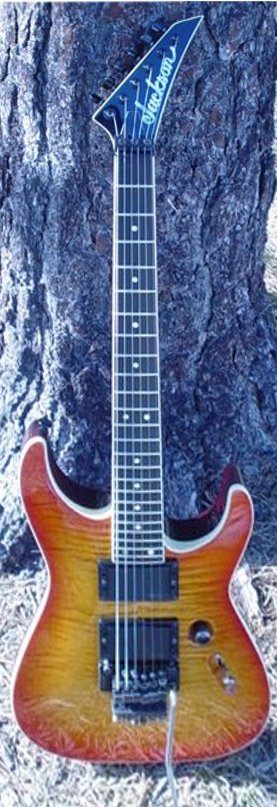
A 1987 Soloist archtop. Photo by Jimshine; perspective correction by GreyCat. Licensed under CC BY-SA 4.0. Via Wikimedia Commons. Jackson
Soloist
1984
Grover Jackson took the Strat shape and ran the maple neck straight through it. Jeff Beck’s was pink.