Relish
Mary
The back comes off in your hands and the pickups lift out. The company that built it didn’t last.
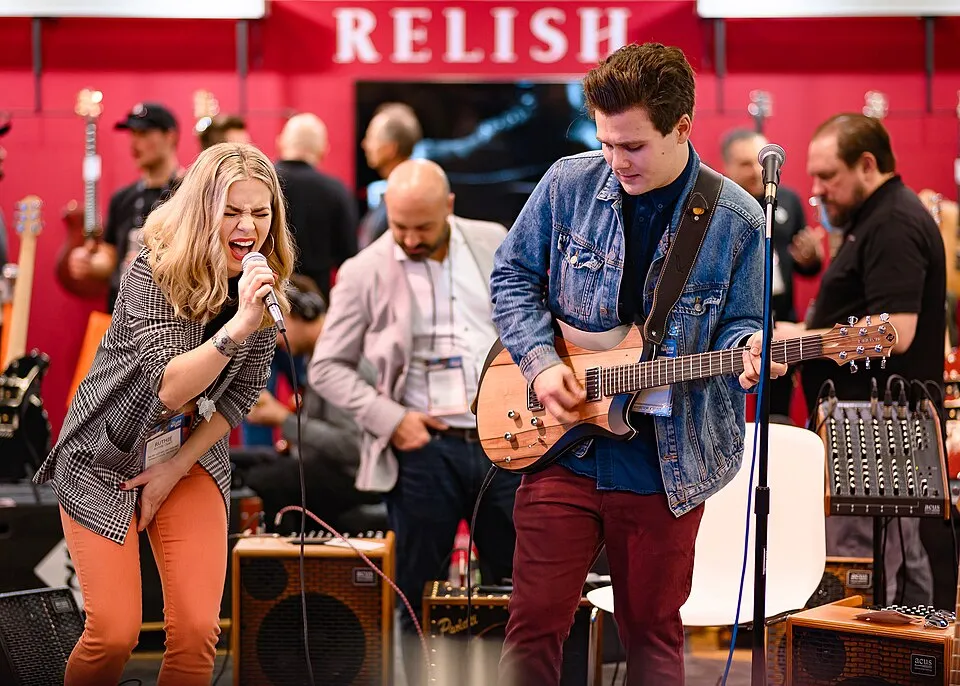
NAMM, January 2016. Two Swiss builders from a small shop outside Lucerne show a guitar with a magnetic back you pull off with your fingers. Years later, with the company gone, both of them would say that was the point: changing the sound without tools.
- Introduced
- 2016
- Type
- Solidbody electric
- Class
- Production
The short version
2013
Relish Brothers
Silvan Küng and Pirmin Giger enter the Lucerne register in November. Another account says the startup began in 2010.
2015
Jane
The first model, an aluminum frame between wood skins. The first run of 25 leaves Kriens.
2016
Mary at NAMM
Launched in January. A review guitar that autumn has an alder middle, not aluminum.
2017
Sempach
The shop outgrows Kriens and moves.
2018
Drop-in pickups
The replaceable-pickup patent is filed in January. Giger leaves the company.
2019
Mary One
A cheaper sibling at $3,799, a full $1,000 under the regular Mary.
2023
Bankruptcy
Opened at the end of September.
2025
Struck off
Relish Brothers AG is deleted from the commercial register on 8 January.
Side A
A1
Lid off
January 2016, NAMM. Two Swiss builders, Silvan Küng and Pirmin Giger, are launching their second guitar. The press release describes a sandwich: an aluminum middle, moulded veneer on the front and the back, the back held on with magnets. Take it off and the pickups lift out.
That was the idea: you open it yourself, no screwdriver. Getting all the way there, with no soldering iron and no trip to a tech, would take them two more years.
Relish Brothers had entered the Lucerne commercial register in November 2013, though one early write-up has the startup going back to 2010. Keep both. The shop was in Kriens, just outside Lucerne.
A2
Jane came first
Before Mary there was Jane. An aluminum frame between skins of walnut, cherry, or ash, with touch sensors where you’d expect a pickup switch. In 2015 it listed at £3,600, and by June the first run of twenty-five had left Kriens.
The famous names pinned to a specific Relish are on Janes. Richie Sambora played one. So did the Swiss bluesman Philipp Fankhauser, for federal officials, in 2014. Mary wasn’t out yet. Don’t hang those on this guitar.
Mary was Jane’s sandwich, opened up so the player could get at it.
A3
Three stories about the middle
What’s actually inside a 2016 Mary is a better question than it should be.
The press release said aluminum. In October 2016 a British reviewer got one on the bench and found alder instead: a flat slab about 51 mm thick, high-pressure veneers that he said looked like MDF, seven magnets and rubber O-rings holding the back on. Inside, the wiring was old-school: soldered joints, a paper-in-oil capacitor, a three-way switch, no coil split, no battery. A video demo that summer also said alder. The booth tape from NAMM says soft ash.
Three accounts of the 2016 center. Keep all three.
Three accounts of the 2016 center. Keep all three.
Meanwhile an aluminum-core Mary A was being tested in a German magazine that same month. So both existed at once. The version dealers kept selling is the aluminum one: 650 mm scale, the length of a classical guitar, just 2 mm longer than a Fender, so it feels familiar with a hair more tension. A bamboo fingerboard. A hardtail. Often a piezo in the saddles for acoustic sounds.
Flip the record · By the numbers
650 mm
The scale. The classical-guitar length, 2 mm longer than a Fender.
7
Magnets holding the back on the 2016 review guitar, with rubber O-rings.
~250
Instruments a year in 2019, every Relish model together.
2016–2023
The whole run, from NAMM to bankruptcy.
Side B
B1
Plugs, not solder
On the early Mary A the lid came off, but the pickups were still wired in. One dealer, selling a 2018 example, put it in capitals: “OLDER PICKUP SYSTEM, not drop in pickups.”
The drop-in system came in 2018, and the patent was filed that January. Humbucker-sized pickups sit in pre-soldered frames, held by magnets and connected through gold-plated spring contacts, in and out from the back. Later Marys added a 17-position touch pad and a two-finger coil split. Relish trademarked the attitude too: BEND IT!, SWAP IT!, TOUCH IT!
Then came cheaper models. Mary One in 2019, at $3,799, a full $1,000 under the regular Mary. Then Trinity, built with Cort in Indonesia out of basswood. Neither one is the Swiss Mary.
B2
The guitars outlived the company
The shop outgrew Kriens in 2016 and moved to Sempach in 2017. In 2018 it raised more than $3 million. Giger left the same year. He told a reporter he wanted to stay with premium guitars, and the board wanted cheaper ones. Küng stayed on as CEO until the end of 2022. A former Gibson Nashville man took over in 2023.
It didn’t hold. Bankruptcy opened at the end of September 2023. The proceedings closed in December 2024, and in January 2025 the company was struck from the register. The website doesn’t resolve.
Looking back, the two founders didn’t agree on much. They agreed on one thing: the point of the company was swapping pickups without tools.
There’s nobody left to send a Mary back to. On a drop-in Mary, that turns out not to matter much. Pull the back off with your fingers, lift the pickup out, drop another one in. It still works the way they said it would.
Put this on
You’ve read about it. Now hear it. Here’s what this guitar sounds like, and what to listen for.
Relish Mary at NAMM 2016
Launch week, 25 January 2016. The Relish booth demos the brand-new Mary and explains the sandwich.
Watch it on YouTube (opens in a new tab)Paul Riario demos the Relish Mary
August 2016. A Mary played through, Bucker XV pickups and all.
Watch it on YouTube (opens in a new tab)
The cast
The people, and the specific guitars, that made the legend.
2016
Paul Riario
Mary, then a Walnut Mary
Played a Mary on camera for Guitar World in 2016 and a Walnut Mary in 2019. Demos, not records.
2016
Dave Burrluck
Bloody Mary, alder core
Reviewed the Mary in October 2016 and found alder in the middle where the press release said aluminum.
Liner notes
Specs, construction, rarity, value, and every source we used.
A lid on magnets, an aluminum core, and pickups you can lift out — Relish’s Swiss Mary, not the Jane and not the Indonesian Trinity.
- Body
- Aluminum center, high-pressure veneer top and back; magnetic back. Relish: Floating Sandwich. MusicRadar’s 2016 Bloody Mary: alder core, about 51 mm thick, seven magnets, rubber O-rings. Mix flagged.
- Neck
- Bolt-on maple, modern “C.” Later cards: one-piece bent maple. 2016 review: small 3-a-side, not a straight string pull.
- Fingerboard
- Dark strand-woven bamboo, 10" radius, 24 medium-jumbo. Burrluck also prints 254 mm. Fret alloy contested. Mix flagged.
- Scale
- 650 mm (25.59"). Mix flagged. Burrluck: 2 mm over a 648 mm Fender scale.
- Pickups
- Relish Bucker XV. Graph Tech Ghost piezo on many aluminum cards. Not on the 2016 soldered review guitar.
- Hardware
- Hardtail; strings to the aluminum core on later cards. Gotoh SG 381 or 510Z on those cards. 2016 split: Burrluck, Schaller minis; Guitar World’s alder demo, Gotoh.
- Electronics
- Emerson. Early: 3-way, soldered, paper-in-oil, no battery. Later: 17-position touch, two-finger split, piezo toggle, 9V. Do not collapse.
- Finish
- Semi-matt varnish
- Nut
- Graphite. Aluminum cards: 42.5 mm (1.67"). Mix flagged.
Open the full research fileConstruction details, the complete player record, production numbers, dated value estimates, and sources
Classic living example = Swiss aluminum-core Mary (dealers: Mary A / Bloody A Mary), Lucerne-area, about 2016–2023. No current typical Mary SKU this pass. Relish Brothers AG was deleted from the commercial register 8 January 2025. Jane is the first model. Mary One is the later, cheaper sibling. Trinity is the Cort-built Indonesian solid. Mary Custom Limited wood-core guitars are a different center. None of those are this table. Mixed inch/mm flagged on every pair a source prints together. No millimetres invented. Weights are not one number: repeating spec cards 3.7 kg (8.2 lbs); a 2019 Flamed Bordeaux card 3.9 kg (8.6 lbs); Guitars-Shop’s aluminum Marine 3.8 kg (8.4 lbs). Ish’s Marine page also prints 7 lb 14 oz next to 8.2 lbs. Do not average.
Construction
The job was Jane’s sandwich, opened with your hands. Relish Brothers AG, Silvan Küng and Pirmin Giger, entered the Lucerne register 5 November 2013 (help.ch). Handelszeitung, November 2014, dates the startup to that November. Venture Kick, 22 October 2014, calls the startup founded in 2010 and, in the caption, has them developing Jane since 2010. A later Venture Kick page says November 2013, with the register. Keep both. The shop was in Kriens.
Jane came first. MusicRadar, 28 April 2015: an aluminum frame between walnut, cherry, or ash, touch sensors instead of a switch, £3,600. Wired, 23 February 2015: over $5,000 / 4,750 Swiss francs. Vintage Guitar’s December 2019 Trinity note says Relish was “first appearing in 2013 with Jane.” The Jane press is 2015. Don’t start Jane in 2013.
Mary is the next guitar. Guitar Interactive, 6 January 2016: launching Mary at NAMM, 21–24 January 2016. Premier Guitar’s booth tape is 25 January 2016. This plate starts in 2016. A February 2018 booth line says they came up with Mary “last year.” Loose. The launch tape is 2016.
The press release describes one sandwich: aluminum middle, moulded veneer front and back, magnets, pickups lifted out. Dave Burrluck’s MusicRadar guitar, 8 October 2016, is not that center. Flat slab about 51 mm against Jane’s 57 mm. High-pressure veneers — “although it does look like MDF.” Alder, not aluminium. Seven magnets, rubber O-rings, Emerson, a paper-in-oil cap, soldered joints, a 3-way, no coil-split, no battery. Scale 650 mm (25.59 inches), the classical length, 2 mm over a 648 mm Fender. Woven bamboo, 254 mm (10-inch) radius, stainless frets, graphite nut, Schaller minis. £1,599 / €1,855. Guitar World, 23 August 2016, also says alder. The NAMM ’16 transcript says soft ash. Three accounts of the 2016 center. Keep all three.
Mary A is the aluminum name. Gitarre & Bass (October 2019) points at a Mary A Marine test in the October 2016 issue, so an aluminum Mary was in that magazine the same month as Burrluck’s alder one. The repeating dealer card is the table above: aluminum core, veneer skins, 650 mm (25.59"), nut 42.5 mm (1.67"), Bucker XV, often a Ghost piezo, about 3.7 kg (8.2 lbs). South Shore on a 2018 Mary A: “OLDER PICKUP SYSTEM, not drop in pickups.” The lid came off. The pickups were not yet plugs.
The drop-in is 2018. Patent EP 3721427 B1, “Electric guitar with replaceable pickup,” Giger and Küng, Relish Brothers AG, priority 10 January 2018, grant 16 March 2022. Vintage Guitar: humbucker-sized pickups, pre-soldered frames, magnets on frame and body, in and out from the back. Guitar World (1 September 2020) first met that system on the Eucalypt Mary. Gitarre & Bass on the 2019 Flamed Marine Mary: four gold-plated spring contacts and four magnets per pickup, plus a 17-position touch pad and a two-finger coil-split. help.ch, citing the Swiss trademark office, lists BEND IT!, SWAP IT!, and TOUCH IT! on the company. Filing dates unpublished here.
Later Mary copy adds a bolted bent maple neck, Ghost saddles, a 9-volt battery, and a stereo mini-toggle. Guitar.com’s bending note — a Scandinavian bend instead of a scarf joint, and strings plus the piezo battery behind the lid — is a Mary One review, not the 2016 alder guitar. Fret alloy will not sit still: stainless on Burrluck’s 2016 guitar and on South Shore’s 2019 Mary card; nickel silver on Cream City’s Walnut Mary and on Guitar World’s March 2019 Mary One. Don’t average alloys or the weights in the caption.
Mary One is the third guitar, not this one. MusicRadar, 5 March 2019: a lower-priced makeover, aluminum core, two-second swap, $3,799, “a full $1,000 lower than the regular Mary.” Booth talk in February 2018 had it “right around $3,000,” due about May or June. Not the 2019 list. Guitar.com, 14 October 2019, measured one at 3.7 kg / 8.2 lb, nut 42.5 mm, 52 mm at the 12th, 22 mm deep at the 1st and the 12th. Sweetwater also sold a Mary One Custom Limited with an alder core. Wood center. Still not this table.
Trinity is the other miss. Vintage Guitar, 19 December 2019, from Sempach: first solidbody, built with PT Cort in Surabaya so the swap could be cheaper. Indonesia, basswood. Not a Kriens sandwich.
The shop outgrew Kriens in 2016, moved to Sempach in 2017, and in 2018 took financing of more than $3 million (Urner Zeitung, 14 October 2023). GuitarPR, 20 January 2018, announced that raise, “over 1,000 Swiss-made guitars since their founding in 2013,” and 300% yearly sales growth. The newspaper says sales tripled year to year, and that backers put about 5 million in from the start. Don’t fuse the percentage with “tripled.” 2020 turnover, Covid and all, first cleared a million francs. Company money, not a Mary price.
Giger was out in 2018. He told the paper he wanted to stay with premium guitars; the board wanted cheaper models in the thousands of francs. He kept about a fifth. Küng stayed CEO and quit at the end of 2022. From the start of 2023 the CEO was Cédric Leclerc, ex-Gibson Nashville. At the July 2023 meeting Giger and another shareholder refused the discharge and a new board. Organisational defect, then bankruptcy. Both of them, in that piece, call the tool-free pickup swap the point of the company. The sandwich, they say, was there for a longer note than one wood block. Their account. The alder guitar Burrluck played is still in the record.
Players
Do not hang a Jane on this plate. Do not promote a company customer into a Mary credit.
Urner Zeitung, 14 October 2023, lists customers: Jack Johnson, Phil Campbell of Motörhead, and Lucerne players Damian Lynn and Marco Kunz. No model. No record. The same article’s origin story is the Jane in Wired.
The pinned guitars are Janes, and they are early. SRF, 27 September 2015: Richie Sambora plays a Jane. Handelszeitung, November 2014: Philipp Fankhauser played a Jane for federal officials. That is 2014–15. Mary was not out. No session log puts Johnson, Campbell, Lynn, Kunz, Sambora, or Fankhauser on this slug.
Demos stay demos. Paul Riario played a Mary for Guitar World in 2016 and a Walnut Mary in 2019. Stig Trip’s Relish tape, 25 April 2019, is Mary One #003. Heartbreaker’s “prominent touring professionals” names nobody.
Also known to play: nobody, on a named Mary, in the sources above.
Rarity
You cannot order a new Mary. Giger, reported 13 October 2023: bankruptcy opened at the end of September 2023. Proceedings closed 20 December 2024. Deleted 8 January 2025 (SHAB; help.ch). relish.swiss did not resolve on 30 September 2026. Sweetwater’s Mary pages are reference only. Tele1 that week: the guitars are history. A Webflow storefront still paints a holiday banner. It is not a checkout.
No Mary total was published. None invented. The figures are the company, Jane included. Guitar.com, October 2019: about 250 instruments a year, two core models in the line. GuitarPR, January 2018: over 1,000 Swiss-made guitars since 2013. Urner Zeitung: hundreds of premium guitars a year, up to 8,000 francs; in Sempach, three or four people and a few hundred a year, later one person in Küssnacht. Jane’s first 25 (Berner Zeitung, June 2015) are Janes. Thinner inside the Mary run: the 2016 alder Bloody Mary, the pre-drop-in Mary A, a wood-core limited. Those are slices, not a census.
A used Swiss aluminum Mary is the living guitar. Mary One and Trinity are other models. This is not a 1950s rarity, and it is not new.
Value
Informal estimate, 30 September 2026. Not an appraisal.
Ask versus sold, labeled. No celebrity Mary lot in these sources. No Reverb Price Guide band isolated this pass. Flag: thin sold-comp access. Historical lists are not 2026 street. The period £1,599 / €1,855 (MusicRadar, 8 October 2016) is the alder review guitar. A Bloody A Mary listing prints a factory-style USD 2,499. Don’t average it with the 2016 European price.
New street. None. The register is closed.
Used modern. This is the market. Named asks and single solds, not a median. Musician’s Friend, used 2017 white Mary, $1,169.99 (was $1,299.99). That overview also prints 25.5" and a dark-walnut board. Retailer copy, not the 650 mm bamboo card. A used Mary Limited Burgundy Flame there is $2,299.99 (from $3,599.99). Ish’s aluminum Marine showed $1,999, sold through. Wurst’s used Shady A Mary: €1,590 (from €1,790), gone. A January 2025 forum ask, Bloody A Mary serial 5010: €1,299 plus shipping. That seller writes “alder body” and “aluminium frame” on the same guitar. Price only. Not a core ID. One Reverb sold, a new Bloody A Mary, closed at $1,250. One Reverb sold, Make’n Music’s new Snow White Mary A, closed at €899.41. Closeout hammers. Don’t average them with a $2,299 ask.
Vintage / collectible. There isn’t a separate one. The whole run is 2016 to the 2023 bankruptcy. Clean aluminum Marys with the drop-in frames and the piezo are the ones dealers still write up. They are not a pre-war price. Artist-owned comps: none found. Johnson, Campbell, Sambora, Fankhauser are not Mary hammers.
Later new prices, for the record, not a 2026 cart. MusicRadar, 5 March 2019: Mary One $3,799, a full $1,000 under the regular Mary. Cream City’s Walnut Mary page prints $4,799. Martel’s Flamed Shady Mary printed $4,999. Guitar World, 1 September 2020, range card: Mary €5,512, Mary One €4,868, Jane €6,349. Different years, different currencies. Leave them apart. Giger told Urner Zeitung that selling direct put instruments in players’ hands at practically half the old end price, and that it angered dealers. Küng’s version: wholesalers had been selling only with large discounts, so Relish had to react. Half of which list, in which year, is unpublished. Not a 2026 band.
See also
- parker-fly — piezo beside magnetics, and a factory that also closed; carbon skin, not this sandwich
- travis-bean-tb1000 — aluminum, but a through-neck billet in koa, not a magnet-lidded frame
- james-trussart-steelcaster — a metal-body electric still built in Los Angeles; hollow sheet, not a Swiss core
Sources
- Guitar Interactive, NAMM 2016: Relish (6 January 2016) — Mary launched at NAMM 21–24 January 2016; sandwich; aluminum middle in the release; magnetic back; pickups lifted out. Küng and Giger
- Premier Guitar, NAMM ’16 Mary demo (25 January 2016) — booth: sandwich adapted to a “solid woody” center; transcript says soft ash. Not the aluminum press line
- MusicRadar, Dave Burrluck, Relish Bloody Mary (8 October 2016) — £1,599 / €1,855; alder core, not aluminum; ~51 mm vs Jane ~57 mm; 650 mm / 25.59"; 254 mm / 10"; stainless; graphite; Schaller; seven magnets; rubber O-rings; Emerson; paper-in-oil; soldered; 3-way; no coil-split
- Guitar World, Paul Riario demos the Mary (23 August 2016) — middle layer alder; bamboo; 24 medium-jumbo stainless; Gotoh; hardtail; Bucker XV
- Gitarre & Bass, Michael Dommers, Flamed Marine Mary (26 October 2019) — aluminum frame carries neck and bridge; high-pressure veneer; flamed-maple top; four gold spring contacts and four magnets per pickup; 17-way touch; two-finger split; points to a Mary A Marine test in issue 10/2016
- MusicRadar, Mary One (5 March 2019) — third guitar; $3,799; $1,000 under the regular Mary; aluminum core; magnetic lid; Bucker XV; Bare Knuckle and Seymour Duncan swaps; Ghost piezo
- Guitar World, Mary One (5 March 2019) — rubber rings; industrial magnets; $3,799; 18 styles; nickel-silver frets; modern C; 10" bamboo; graphite nut; Gotoh SG 381; Emerson
- Guitar.com, Michael Watts, Mary One (14 October 2019) — ~250 instruments a year; €3,799 with case; 3.7 kg / 8.2 lb; 650 mm / 25.59"; nut 42.5 mm; 52 mm at the 12th; 22 mm depth; four-pin chassis; bent one-piece maple; stainless on that sample
- Premier Guitar, NAMM ’18 Mary One (6 February 2018) — booth: Mary “last year,” Mary One this year; swap in about 8–10 seconds; “right around $3,000”; May or June. Booth price, not the 2019 list
- Vintage Guitar, Trinity by Relish (19 December 2019) — Sempach dateline; pickup-swap system in 2018; Trinity with PT Cort, Surabaya; “first appearing in 2013 with Jane” against the 2015 Jane press
- Guitar World, Dave Burrluck, Trinity (1 September 2020) — swap first met on the Eucalypt Mary; Swiss range card Jane €6,349, Mary €5,512, Mary One €4,868
- EP 3721427 B1 (PubChem) — replaceable pickup; Giger and Küng; Relish Brothers AG; priority 10 January 2018; grant 16 March 2022
- help.ch, Relish Brothers AG in Liquidation — register entry 5 November 2013; UID CHE-279.403.936; deletion publication 8 January 2025; marks BEND IT!, SWAP IT!, TOUCH IT! (IGE)
- Moneyhouse, Relish Brothers AG in Liquidation — bankruptcy proceedings closed 20 December 2024; Konkursamt Luzern
- Urner Zeitung, Maurizio Minetti, «Relish war mein Baby» (14 October 2023) — Kriens too small 2016; Sempach 2017; 2018 financing over $3 million; ~5 million invested; hundreds a year up to 8,000 francs; 2020 revenue over 1 million francs; Sempach output and later Küssnacht one-person shop; Giger out 2018; Küng quit end of 2022; Leclerc from Gibson Nashville, early 2023; July 2023 organisational defect; customers Johnson, Campbell, Lynn, Kunz, no model; founders on the sandwich and on tool-free pickup swapping; direct-sale “half” versus Küng on wholesaler discounts
- Tele1, Relish ist konkurs (13 October 2023) — bankrupt; the guitars called history; customers named, models not
- relish.swiss — DNS did not resolve, 30 September 2026. Webflow storefront still loads a holiday banner. Not a factory checkout
- 20 Minuten / headtopics, shop already empty (13 October 2023) — Giger: bankruptcy opened end of September 2023; he left in 2018
- GuitarPR, $3 million raise (20 January 2018) — over $3 million; over 1,000 Swiss-made guitars since 2013; 300% growth claim; founded 2013. Company, not a Mary count
- MusicRadar, Jane unveiled (28 April 2015) — first model; Lucerne; Giger and Küng; aluminum frame; £3,600
- Wired, Jane (23 February 2015) — over $5,000 / 4,750 Swiss francs
- SRF, guitars made in Kriens (27 September 2015) — Sambora plays a Jane; about 5,000 francs. Not a Mary
- Handelszeitung, November 2014 — Relish Brothers founded November 2013; Fankhauser played a Jane
- Venture Kick, 22 October 2014 — lede: founded in 2010; caption: developing Jane since 2010
- Venture Kick, Jack Johnson / Stevie Wonder / Motörhead — company founded November 2013. Fans, not a Mary credit
- Guitars-Shop.de, Mary Alu Frame Marine — 3.8 kg (8.4 lbs); 25.59" (650 mm); stainless; Gotoh 510Z. One dealer card
- Martel Music, Flamed Shady Mary — printed $4,999, sold out; 3.7 kg (8.2 lbs); 650 mm (25.59"). Not a 2026 cart
- Wurst Guitars, used Shady A Mary — ask €1,590 from €1,790; aluminum core, magnets, rubber spacers; sold out
- Musician’s Friend, used Mary Limited Burgundy Flame — ask $2,299.99 from $3,599.99
- Reverb, Snow White Mary A, sold — one new Snow White Mary A closed at €899.41
- Sevenstring.org, Bloody A Mary serial 5010 (27 January 2025) — forum ask €1,299 plus shipping. Not a hammer. Seller also writes “alder body” and “aluminium frame” on the same guitar. Do not pick one
- Berner Zeitung, June 2015 — first Jane series of 25 left Kriens; about 5,000 francs with case. Jane, not Mary
- Cream City Music, Walnut Mary — $4,799 list, out of stock; aluminum / high-pressure veneers; 24 nickel-silver; 17-position touch; two-finger split; Ghost; Gotoh SG 381; 650 mm. Not a 2026 cart
- South Shore, 2018 Mary A — “OLDER PICKUP SYSTEM, not drop in pickups”; aluminum / veneer; 25.59"; 1.67"; ±8.2 lbs
- South Shore, 2019 Mary editions — Flamed Bordeaux Mary 3.9 kg (8.6 lbs); bent neck; stainless called out on that card; 42.5 mm (1.67"); 650 mm (25.59")
- Reverb, Bloody A Mary, sold — description prints USD 2,499 and the aluminum spec block (3.7 kg / 8.2 lbs, 650 mm, 42.5 mm); sold at a new price of $1,250. One hammer
- Musician’s Friend, used 2017 white Mary — ask $1,169.99; page also prints 25.5" and dark walnut. Not the factory card
- Ish Guitars, Mary aluminum Marine — spec block 3.7 kg (8.2 lbs) and, on the same page, 7 lb 14 oz. Do not average. Sold through at $1,999
- Relish, Stig Trip, Mary One #003 (25 April 2019) — a Mary One demo, 3.2 kg (7 lbs) on that video’s card. Not this model
Keep digging
Guitars this one gets compared to, confused with, or descended from.
- Send a picture
Parker
Fly
1993
Ken Parker built it like a lobster: wood on the inside, and all the strength in a skin thinner than the paint.

Photo: Somalley / Wikimedia Commons / CC BY-SA 4.0 Travis Bean
TB1000
1974
A motocross racer watched a repairman fight wooden necks all day. So he made one out of aluminum.
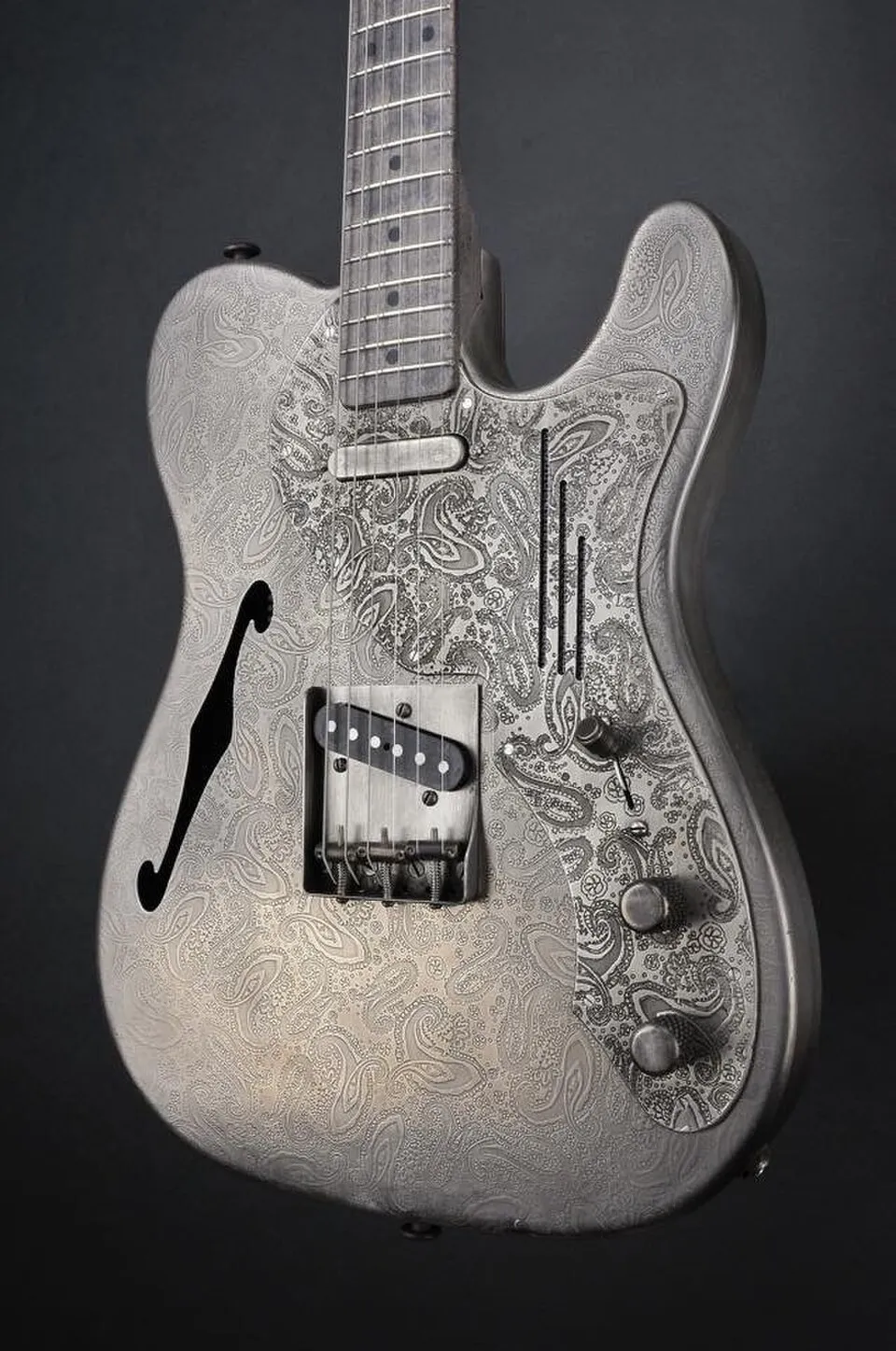
Photo: Mariecapron / Wikimedia Commons / CC BY-SA 4.0 James Trussart
SteelCaster
1983
A Telecaster shape in hollow steel, left outside to rust on purpose, so no two could ever match.