National
Style O
A nickel-plated brass guitar from 1930s Los Angeles, and the one Mark Knopfler wouldn’t sell.
Los Angeles, 1930. National is building guitars out of metal, with a cone inside that works like a loudspeaker. Its new Style O is brass, plated in bright nickel, with a Hawaiian scene sandblasted into the metal. Fifty-five years later, one of them is on the front of one of the best-selling records ever made.
- Introduced
- 1930
- Type
- Metal-body resonator
- Class
- Production

The short version
1930
Style O
National introduces it. The first ones are nickel-plated steel.
1931
Brass
The body switches to brass. One list says 1931; others just say quickly.
1934
Fourteen frets
The neck joins at the 14th fret, late in 1934 or in 1935.
1941
The run ends
The original Style O stops, after well over 5,000 by one estimate.
1980
“Romeo and Juliet”
Mark Knopfler plays his 1937 Style O on Dire Straits’ Making Movies.
1985
Brothers in Arms
Knopfler’s late-’30s Style O is tied to the album, and it’s the guitar floating on the cover.
Side A
A1
The one on the cover
Everybody has seen this guitar, even people who don’t know what it is. It’s the shiny one floating in the sky on the cover of Dire Straits’ Brothers in Arms. That’s Mark Knopfler’s National Style O, a 14-fret one from the late ’30s, most likely 1937. People have argued about the serial number, which is what people do.
Knopfler has owned a lot of guitars. He had this one by 1980, when it rang through “Romeo and Juliet” on Making Movies.
A2
A loudspeaker where the soundhole should be
National introduced the Style O in 1930. Before amplifiers were everywhere, the problem with a guitar was volume, and National’s answer was to put a cone inside the body, a thin aluminum disc that works like a loudspeaker. The strings sit on a saddle set into a wooden “biscuit” in the middle of the cone, and the cone throws the sound out. The Style O has one cone. Some Nationals have three.
The body is metal. The very first Style Os were nickel-plated steel. Very soon they were brass, plated in bright nickel, with a Hawaiian scene sandblasted into the finish. It’s a flashy-looking thing. In late 1934 or 1935, depending who you ask, the neck moved to join the body at the 14th fret. The original run ended in 1941. Nobody counted them, but the serial numbers suggest “well over 5,000.”
Pick one up and the first surprise is the weight. A modern one comes in at close to nine pounds, and the body is cold under your arm in a way no wooden guitar is. The neck is maple with an ebony board, the scale is a hair shorter than a Martin’s, and the sound comes straight at you: bright, loud, a little metallic, with a quick, snappy attack. Play it with a slide and you’ll understand the whole idea in about four notes.
Flip the record · By the numbers
1930
The year National introduced the Style O.
1
Cone. Not three, like National’s tri-cones. One, with a wooden biscuit in the middle.
5,000+
Original Style Os, going by what the serial numbers suggest. An estimate, not a count.
1937
The year of Knopfler’s Style O, give or take an argument over the serial.
Side B
B1
Not a Dobro, not a Duolian
Resonators get mixed up constantly, so here’s the short version.
A Dobro is a different company. John Dopyera left National to start it, and Dobros have wooden bodies and a spider bridge instead of a biscuit. A Duolian is a National, but the cheaper one: painted steel, no nickel, no Hawaiian etching. A tri-cone is a National with three cones. The Style O is the nickel brass one with a single cone.
The old blues players are where it gets slippery. There are photographs of Son House and Bukka White holding Style Os. That’s real. But a photo isn’t a session log, and it doesn’t mean every record they made is this guitar.
B2
It stayed home
Today National Reso-Phonic builds Style Os in San Luis Obispo, California, in 12-fret and 14-fret versions. The 12-fret one has the slotted headstock and the older look. The 14-fret one is Knopfler’s kind. There’s even a Weathered Steel version for people who like their resonators looking like they spent the ’30s on a porch. It’s a revival, not a straight line from the 1930s factory, but it’s the same idea: brass, nickel, one cone.
When Knopfler sold a lot of his guitars at Christie’s, he kept this one out of the sale. After all the guitars he’s bought and played and let go, the shiny one from the album cover is still his.
Put this on
You’ve read about it. Now hear it. Here’s what this guitar sounds like, and what to listen for.
Romeo and Juliet
Knopfler’s 1937 Style O. Listen to the opening, that bright, slightly tinny ring. It’s a metal box with a speaker cone in it, and it sounds like one, in the best way.
Find it on YouTube (opens in a new tab)
The cast
The people, and the specific guitars, that made the legend.
1980
Mark Knopfler
1937 Style O, 14-fret
“Romeo and Juliet” and Brothers in Arms. He kept it out of the auction when he sold much of his collection.
Son House
Seen in photos with one
Photographs show him with a Style O. That’s a photo, not a session log, so don’t assume every record is this guitar.
Bukka White
Seen in photos with one
Same story as Son House. The pictures are real. Nobody has matched the records to the guitar.
Liner notes
Specs, construction, rarity, value, and every source we used.
National’s nickel Style O is the etched brass single-cone — not a Gibson Dobro, and not a painted Duolian.
- Body
- Brass, bright nickel, sandblasted Hawaiian scene; 14-fret peghead on this table
- Neck
- Hard-rock maple
- Fingerboard
- Ivoroid-bound ebony, 16" radius
- Scale
- 25"; nut 1.82"
- Resonator
- Single biscuit cone (not a spider Dobro, not a tri-cone)
- Hardware
- National tuners; ebony peghead veneer; bone nut
- Case
- Deluxe hardshell included (factory 14-fret page)
- Weight
- Listed 8 lb 14 oz; body depth 3.125"
Open the full research fileConstruction details, the complete player record, production numbers, dated value estimates, and sources
Current production typical = Style O 14 Fret (National Reso-Phonic, San Luis Obispo; nationalguitars.com). Factory list $5,300 / direct $4,770. The 12-fret slotted-head Style O is the same list. Icon / Knopfler object is 14-fret. O-14 Replicon $5,600 / $5,040. Weathered Steel Style O $4,900 / $4,410. Thomann US 14-fret dealer $4,390 this pass.
Construction
Style O: 1930 (factory catalog quote; Vintage Guitar May 2006). First examples nickel-plated steel, quickly brass (VG); guitarhq: steel 1930, brass 1931. 14-fret late 1934 (VG / guitarhq) vs 1935 (12fret archive). Vintage run ends 1941 (guitarhq). Modern National Reso-Phonic is a California revival, not one factory count from 1930s Los Angeles.
Not Dobro. John Dopyera left National, formed Dobro 1928: wood body, spider bridge. Style O is National biscuit single-cone in nickel metal. Not Duolian unless that guitar: cheaper steel, no Hawaiian nickel etching. Not tri-cone Style 1/2/3/4. 12-fret and 14-fret are both Style O.
Players
Mark Knopfler. Factory 14-fret page: late-1930s Style O on Brothers in Arms (1985). Billboard: 1937 Style O 14-fret; Romeo and Juliet; he kept it out of the Christie's sale (Guitar Player). Serial/year fights on his guitar exist (oneverybootleg B1844 → 1937). Not a comp.
Son House and Bukka White: VG says Style O “can be seen in photos” — photo presence, not a named studio SKU. Do not flatten their catalogs to Style O only. Johnny Winter’s “garbage can lid” quote is sound, not an endorsement of this SKU.
Rarity
No factory census. VG: serials “suggest well over 5,000” — inference, not a count. Modern Style O is regular SLO production.
Value
Informal estimate, 26 August 2026. Not an appraisal.
Ask is not sold. Knopfler’s guitar is not a street tape. No invented median.
New street. List $5,300, direct $4,770 (12- and 14-fret). Thomann US 14-fret $4,390. Carter Vintage 2023 Style O-14 used ask $4,500.
Vintage asks (not hammers unless labeled). ATB 1937 14-fret £3,995. Reverb 1937 listing $4,612.43 ended (ask). Reverb 1933 12-fret ask $4,000. guitarprice.net aggregates mix modern/vintage — not used here as a median.
See also
- martin-d-28 — wood dreadnought, not a biscuit cone
- taylor-814ce — modern cutaway AE, not nickel
Sources
Keep digging
Guitars this one gets compared to, confused with, or descended from.
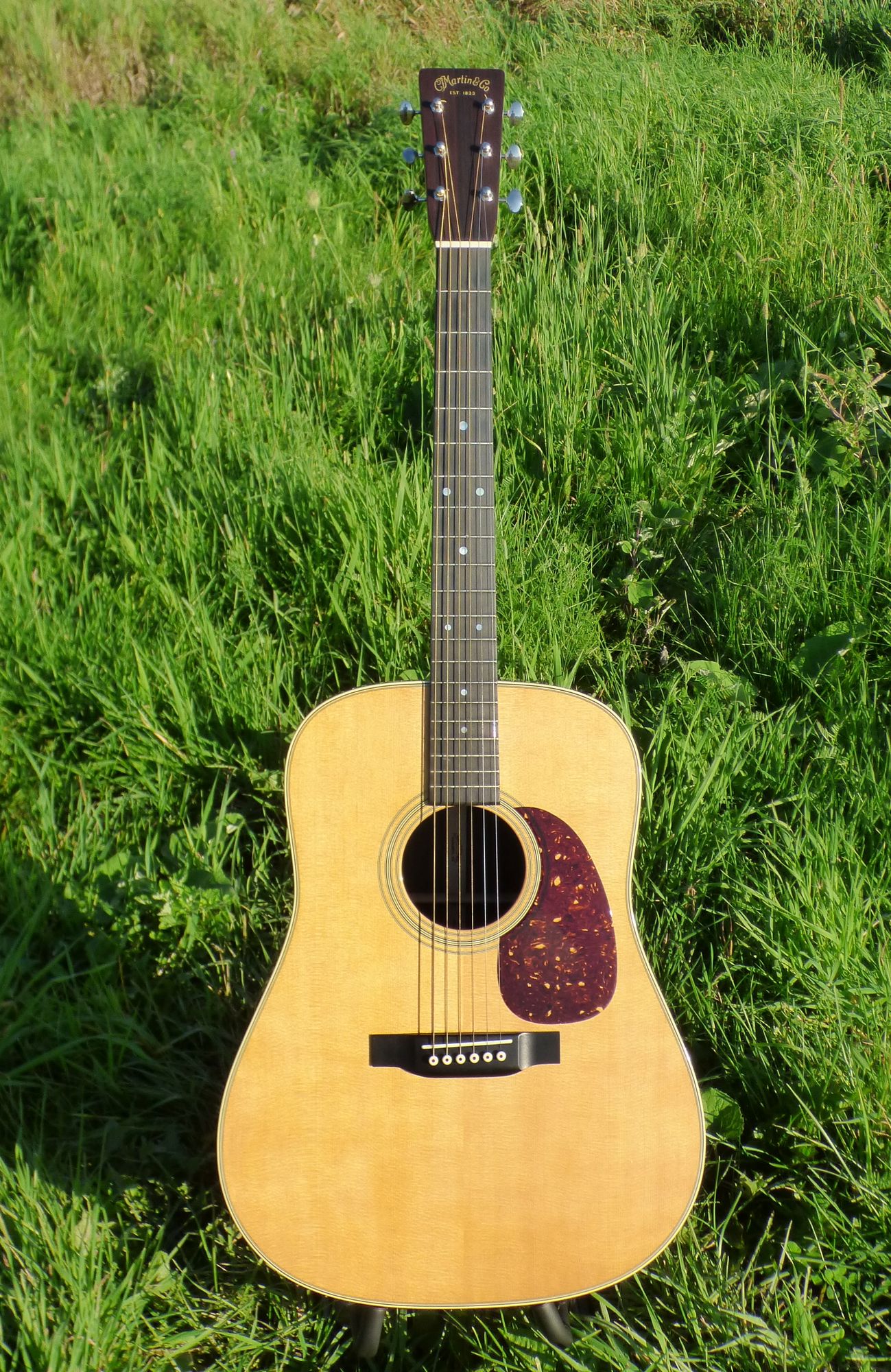
Martin D-28 Acoustic Guitar. Photo by Niranjan Arminius. Licensed under CC BY-SA 4.0. Via Wikimedia Commons. Martin
D-28
1931
You’ve heard a D-28 your whole life. It just never asked for the credit.
- Send a picture
Taylor
814ce
1996
Taylor has rebuilt its flagship from the braces out, again and again, and kept the same three numbers on it.