D'Angelico
New Yorker
One man carved them by hand on Kenmare Street. When he died in 1964, the name kept going. The guitar didn’t.
Kenmare Street, New York, September 1936. Out in Kalamazoo, Gibson has been selling an 18-inch carved archtop for a couple of years. In his own shop, John D’Angelico enters a New Yorker in the ledger: a guitar just as big, which he will carve himself.
- Introduced
- 1936
- Type
- Archtop acoustic
- Class
- Closed run
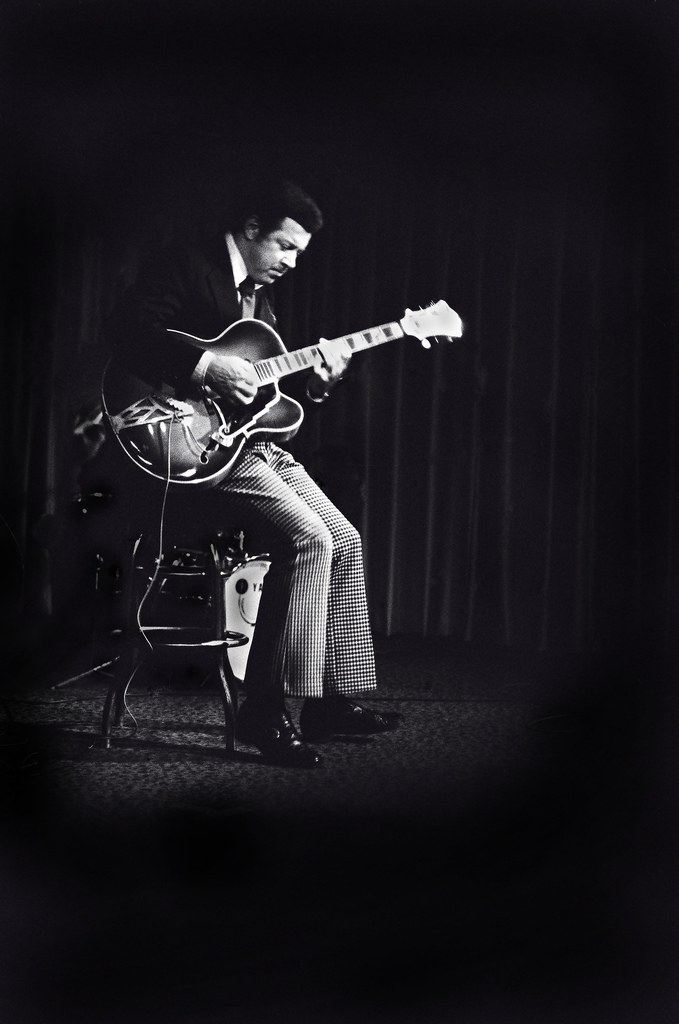
The short version
1905
John D’Angelico is born
The builder whose name the New Yorker carries.
1934
Gibson goes big
By late 1934 Gibson has its 18-inch Super 400. D’Angelico’s answer comes after it.
1936
The first New Yorker on the books
The earliest ledger entry for the model is dated 26 September 1936.
late 1950s
The cut
Cutaway New Yorkers become the preferred shape and stay that way to the end.
1964
The end
John D’Angelico dies, and the 18-inch Kenmare New Yorker ends with him.
Side A
A1
One man, one guitar at a time
A company can make guitars forever. It hires new people, it buys new machines, and the name on the headstock carries on long after anyone who started the place is gone. A man at a workbench can’t do that. When he stops, the guitars stop.
John D’Angelico had his bench on Kenmare Street in New York. He was born in 1905, and he built archtops one at a time: carved tops, carved backs, the whole thing by hand. The New Yorker was the biggest and fanciest of them.
A2
Gibson went to eighteen inches first
By late 1934, Gibson had put out the Super 400, a carved archtop eighteen inches across, bigger than its own 17-inch L-5. That set the size for a flagship. D’Angelico’s New Yorker came after it, also about eighteen inches. The earliest one in his ledger is dated 26 September 1936.
So 1934 is when Gibson set the bar, and 1936 is the first New Yorker anyone can point to on paper. People sometimes mash those dates together. They’re two different events.
The recipe was the classic one. A carved spruce top, carved maple back and sides, X-bracing inside. No pickups. The original New Yorker was an acoustic guitar, and the size was the point: more guitar, more sound.
A3
You can spot the headstock across the room
The New Yorker is dressed to be noticed. The tailpiece is brass, shaped in steps like the top of a skyscraper, and the pickguard matches it. The fingerboard has big geometric mother-of-pearl blocks. The headstock has what collectors call a hotel profile, with a matching inlay, and the gold tuners and layers of black-and-white binding finish it off. If you know it, you can pick it out from across the room.
What’s underneath varied. Neck shapes and top thicknesses were made to order, so there’s no single correct neck on a New Yorker. The Met measured two late-’50s examples and got 18 inches on one and 18⅛ on the other. That’s not sloppiness. That’s what a guitar looks like when a person made it instead of a template.
Flip the record · By the numbers
18″
Width of the body, give or take. Big enough to stand next to Gibson’s biggest.
18⅛″
What the Met measured on a second late-’50s cutaway. Hand-built guitars don’t come in sizes.
1936
Year of the earliest New Yorker in the ledger.
1964
The year John D’Angelico died. No 18-inch Kenmare New Yorker was built after.
Side B
B1
The cut
The early New Yorkers had no cutaway. By the late 1950s the cutaway had become the preferred shape, and it stayed that way to the end. Same 18-inch guitar, with a bite taken out of the treble side so you could get up the neck.
In those last years he was building three big guitars side by side: the 18-inch New Yorker, a 17-inch New Yorker Special, and the 17-inch Excel. The smaller two are good guitars. They aren’t the flagship.
B2
The name kept going
John D’Angelico died in 1964. That’s where this guitar ends. There is no factory to keep it going, because there never was a factory.
The name did keep going. Later companies have put D’Angelico and New Yorker on the headstock of their own guitars, and some of them are fine instruments. But they’re other guitars, built by other people in other ways, and the revival sold as a New Yorker was a 17-inch guitar. You can buy a D’Angelico today. You can’t buy one of these.
You can keep a name going forever. You can’t keep a pair of hands. Every 18-inch New Yorker that exists came off that bench on Kenmare Street, and there won’t be another.
The cast
The people, and the specific guitars, that made the legend.
1936
John D’Angelico
Builder
Built the New Yorker one at a time on Kenmare Street, from the 1930s until his death in 1964.
1958–59
The Metropolitan Museum of Art
Two 1958–59 New Yorker cutaways
Measured them at 18 and 18⅛ inches. Two guitars, two numbers, one bench.
Liner notes
Specs, construction, rarity, value, and every source we used.
Eighteen inches of carved spruce and maple, a stairstep tail, and a hotel-profile peghead — John D'Angelico's Kenmare flagship.
- Body
- Hand-carved archtop, typically about 18"; carved spruce top, carved maple back and sides; X-brace; multi-layer black-and-white binding
- Neck
- Custom (VG); hotel-profile peghead, hotel inlay
- Fingerboard
- Geometric mother-of-pearl blocks; split-block
- Scale
- VG / dealer vintage 25.5" class typical; custom orders vary. No single factory cell
- Pickups
- None on the original acoustic construction
- Hardware
- Stairstep brass tailpiece, stairstep guard, Grover Imperial, gold
- Electronics
- None
- Finish
- Not printed as a factory cell this pass
- Nut
- Custom; no single factory width
Open the full research fileConstruction details, the complete player record, production numbers, dated value estimates, and sources
Original Kenmare vintage inches. No 2026 18-inch millimetre SKU. MET 1958–59 cutaways measure 18 in (45.7 cm) and 18 1/8 in (46 cm) — two measured guitars, not a factory cell. Live Excel EXL-1 is 17", other guitar.
Construction
By late 1934 Gibson already had an 18-inch carved flagship. Super 400. The Advanced L-5 sat next to it at seventeen. John D'Angelico (1905–1964) worked on Kenmare Street. Vintage Guitar puts his 18-inch New Yorker after that Gibson prompt. The earliest ledger for a New Yorker is 26 September 1936 (prewargibsonl-5.com). Keep both: 1934 is the Gibson prompt. It is not a New Yorker ship year.
The job was size, in his hands. An 18-inch carved archtop in the Super 400 class, one guitar at a time. Not Kalamazoo. Not a millimetre table. Company copy typically calls the width about eighteen inches. The Met measured two 1958–59 cutaways: 18 in (45.7 cm) and 18 1/8 in (46 cm). Labeled museum pairs. Do not average them into a factory cell. There is no 2026 width SKU for this guitar.
What Kenmare actually carved is the recipe that stuck. Spruce on the top. Maple on the back and sides. GuitarPlayer's 1955 example is the named source for that pairing: carved spruce, carved maple. X-brace. Stairstep brass tail. Stairstep guard. Geometric mother-of-pearl blocks. Grover Imperial. Hotel inlay on a hotel-profile peghead. Multi-layer black-and-white binding. Gold. Split-block. You can tell the peghead from across the room if you know the hotel profile. That ornament is the flagship's face, not trim on a smaller body.
Necks were not a single cell. VG says necks and top thickness were custom. There is no one nut or one scale for every vintage New Yorker. Dealers and VG put vintage examples in a 25.5" class; custom orders vary. Typical on later vintage cards. Not a 1936 factory stamp. Not the live Excel EXL-1 25.5" moved unlabeled onto the first year.
Then the silhouette changed in the shop. Early New Yorkers were non-cutaway. Cutaway became the preferred shape in the late 1950s through 1964. That is the same 18-inch flagship with a cut. It is not a different model name. Late work concentrated on three objects at once: the 18-inch New Yorker cutaway, the 17-inch New Yorker Special, and the 17-inch Excel. The Special is late Kenmare on a smaller body. It is not the flagship. Excel is John's 17-inch L-5-class guitar. Different width. Different job.
John died in 1964. That ended this construction. Later D'Angelico Guitars of America and Vestax revivals are other constructions. They reuse names. They do not continue Kenmare carving.
What carries the name now is other wood. The live 2026 Excel EXL-1 is 17" × 3", nut 1 11/16" (43 mm). Inspired by a 1947 Excel, not the 18-inch New Yorker. Other guitar. Vestax/Terada NYL-2 sold as a "New Yorker" at 17" × 3", 25.5" scale, 1 11/16" nut class — a 17-inch revival using the name. Do not flatten it onto an 18-inch Kenmare. Gibson's Super 400 is the other maker's 18-inch carved, no factory pickups. L-5 and L-5 CES are Gibson 17". None of those guitars is this one.
Players
No verified named New Yorker is sourced here. This packet is construction only. Known to play: none sourced here.
Rarity
John's death in 1964 ended this construction. You cannot buy a new 18-inch Kenmare New Yorker. There is no 2026 18-inch millimetre SKU. The live Excel EXL-1 is 17". The NYL-2 revival is 17" and discontinued. Those are other supplies.
Factory totals were not published in the sources used here. None invented. Serial maps are unpublished here. The Met's 18 in and 18 1/8 in examples are two measured objects from 1958–59. They are not a census, and they are not a factory width cell.
A 17-inch guitar using the New Yorker name is not this guitar's supply. New Yorker Special (17") is late Kenmare work on a smaller body, not the 18-inch flagship. Excel is 17". NYL-2 is 17". They do not thin an 18-inch carved Kenmare, and they do not restock it.
Value
Informal estimate, 25 August 2026. Not an appraisal.
Catalog dollars omitted. None invented. Data is thin: this plate has vintage inches, a 1936 ledger date, two Met measurements, and a 1964 end. It does not have solds.
New street. No 2026 18-inch millimetre SKU. Live Excel EXL-1 is 17", other guitar; its street is not this guitar's number. NYL-2 is a discontinued 17-inch revival, not a Kenmare comparable.
Used modern. Later D'Angelico Guitars of America / Vestax bodies using the name are other constructions. They are not comps for a John D'Angelico 18-inch New Yorker.
Vintage / collectible. No sold sample, histogram, or dealer band in the sources used here. Dealer asks are not solds, and they are not in this file. Artist lots, if they exist, would sit outside any later band — none are sourced here.
See also
- L-5 CES — Gibson's carved 17-inch electric flagship; not the 18-inch Kenmare
- White Falcon — 17-inch white-and-gold hollow, another maker's flagship archtop
Sources
- D'Angelico archtop guitars: the New Yorker model — ~18" identity.
- Excel EXL-1 — live 17" Excel (not New Yorker); 17" × 3", nut 1 11/16" (43 mm).
- Vintage Guitar: D'Angelico New Yorker — 18" vs 17" Excel; 1934 Gibson prompt; 1964 late mix; custom necks/top thickness; 25.5" class typical.
- prewargibsonl-5.com D'Angelico — ledger 26 September 1936.
- blog.metmuseum.org, Guitar Heroes — measured 18 in (45.7 cm) and 18 1/8 in (46 cm) on two 1958–59 cutaways.
- archtop.com / Jazzwise NYL-2 — 17" × 3", 25.5" scale, 1 11/16" nut class; 17-inch revival FLAG.
Keep digging
Guitars this one gets compared to, confused with, or descended from.
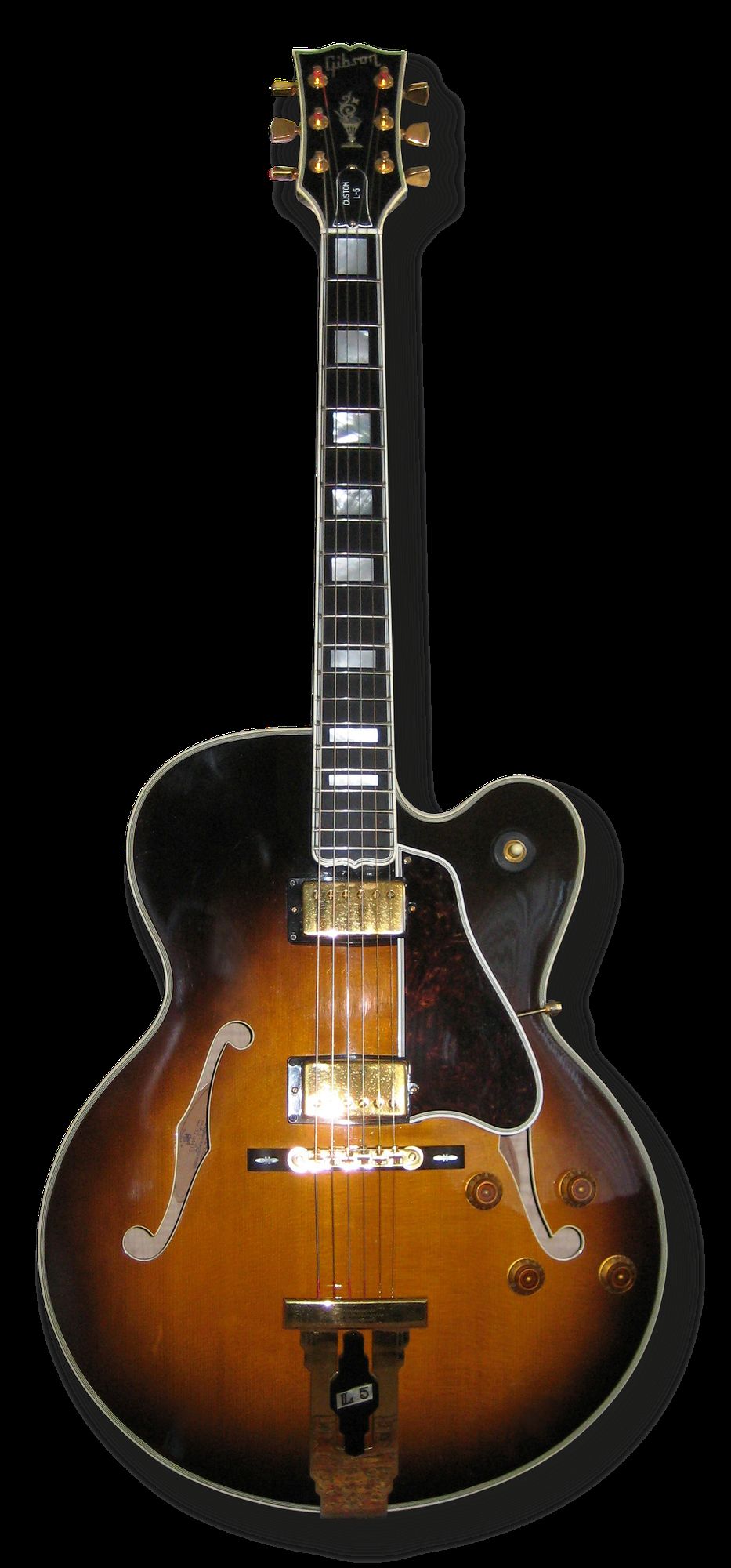
Gibson L-5 CES Tobacco Burst. Photo by Cruciniacus; isolated background by Auge=mit. Licensed under CC BY-SA 3.0. Via Wikimedia Commons. Gibson
L-5 CES
1951
In the ’50s Gibson shipped a few dozen a year. Wes Montgomery and Scotty Moore made them count.

Photo: Veronica Perina / Wikimedia Commons / CC BY 3.0 Gretsch
White Falcon
1955
Gretsch built it to stop people in the aisle of a trade show. It never stopped doing that.