Selmer
Modèle Jazz
Built so a guitar could be heard over a dance band. In Django Reinhardt’s hands, it led one.
In a saxophone factory west of Paris, an Italian luthier bent a spruce top like a mandolin’s and hid a second box inside. The box went. The small oval hole and the long neck stayed, and a man who had lost the use of two fingers made it the sound of a whole kind of music.
- Introduced
- 1936
- Type
- Acoustic guitar
- Class
- Closed run
Have a photograph of this guitar? Send a picture
The short version
1931
A workshop inside the factory
Henri Selmer gives Mario Maccaferri a workshop at Mantes-la-Ville at the end of the year.
1932
The Orchestre
The first steel-strings, with a D-shaped hole and a resonator inside, go to London.
1934
Maccaferri leaves
In January 1933, in 1934, or after 18 months. The sources print all three.
1935
Django’s first Selmer
Summer. Django Reinhardt plays a Selmer for the first time: a gut-string, then the D-hole.
1936
Modèle Jazz
No resonator, 14 frets clear, a small oval hole. Some put Django on it later in 1936, some in 1937.
1940
“DJANGO REINHARDT”
The guitar with his name between the slots leaves Mantes. It is in a Paris museum now.
1946
After the war
Production restarts in 1945 or 1946. Django goes to America with Duke Ellington and leaves his Selmer home.
1952
The shop closes
The last guitar in the register is 885. The workshop’s contents go to Jean Beuscher.
Side A
A1
Heard over the horns
Picture a European dance band in the early 1930s. Horns, an accordion, and somewhere in the back a guitarist nobody can hear. There was no amp anyone could count on.
In America the answer was to carve bigger tops. In France, at the Selmer saxophone factory in Mantes-la-Ville, the answer was a mandolin trick.
Mario Maccaferri had learned under the Italian maker Luigi Mozzani. At the end of 1931 Henri Selmer gave him a workshop inside the factory. His idea was to bend the spruce top at a floating bridge so it sat under tension, the way a mandolin’s does, and to hide a second box inside the first to make it louder.
That was the job. Be heard.
A2
The box in the box
The first steel-string was called the Orchestre, and soon nicknamed Jazz. It had a big D-shaped hole, the grande bouche, so the resonator inside had a way out. Twelve frets clear of the body, a zero fret, a cutaway. In 1932 the guitars went to London, for England only at first. They reached French shops by mid-1935.
That’s why English speakers still say Maccaferri. The early British ads sold the designer. The French say Selmer.
Players pulled the resonator out. Selmer says they did it for more volume. A dealer who sells the old ones says the box never did what it promised. Either way, it went.
So did Maccaferri. When is three dates: January 1933, 1934, or after eighteen months, depending which page you read. There was a contract fight. Selmer kept making guitars without the box he had patented.
A3
Small mouth, long neck
With no resonator, the big mouth was just extra hole. The hole shrank to a small oval, the petite bouche, and the neck moved out from 12 frets clear to 14.
It didn’t happen all at once. Selmer says the first guitars with both show up around number 400 in the register. A 1934 guitar numbered 403 already has the small hole but still has 12 frets, still says Orchestre on the label, and has Maccaferri’s name struck through in ink.
By 1936 it had settled, and it had a name: the Modèle Jazz. A thin spruce top, about two millimeters, bent instead of carved. Ladder braces. A floating bridge with two little moustache-shaped markers on the top to show where it goes. Strings gathered at a tailpiece. A slotted headstock and sealed tuners in oil. The scale grew to 670 millimeters, from the first ones’ 640, which means more string tension and more snap under the pick.
It was built so a guitar could be heard. Then it had to play the lead.
Flip the record · By the numbers
885
The last number in the register, for every model. Others say some 900, or fewer than 1,000.
Fewer than 200
Original Selmers publicly known today.
670 mm
The Modèle Jazz scale. The first D-holes were 640.
21
Frets on the 1940 guitar with Django’s name on the headstock.
Side B
B1
Two fingers
Django Reinhardt was born in 1910 in Liberchies, in Belgium. In 1928 a fire in his caravan cost him the use of two fingers, and eighteen months in hospital. In 1934 he and Stéphane Grappelli started the Quintette du Hot Club de France.
He first played a Selmer in the summer of 1935, a gut-string and then the D-hole steel-string. The small oval came later, in 1936 or 1937, depending who you ask. The deal, as one historian reads it, was a handshake. Selmer handed him guitars and he tried them as they came in. His accompanists paid for theirs.
Look at the late-1930s quintet and the split is right there in the instruments. The lead was the petite bouche. The rhythm guitars behind him were D-holes. The small mouth and the long neck were for the man out front.
After the war, in 1946, he toured America with Duke Ellington and left the Selmer in France. Over there he bought a Gibson, an L-5 or an ES-300 depending on the telling. What he told Charles Delaunay about American guitars comes down in more than one version. This is one:
“Mon frère, all the Americans will wish they could play on this guitar! … Don’t talk to me any more about their casseroles – their ‘tinpot’ guitars! Listen to this, it speaks like a cathedral!”
B2
A name between the slots
The shop slowed in the war and started again in 1945 or 1946. Almost everything it sold stayed in France. A guitar finished on 22 December 1951 sold on 22 February 1952, and that year the workshop closed. The last number in the register is 885. All models, every year, fewer than a thousand. Fewer than two hundred are publicly known.
One of them left Mantes in 1940 with “HENRI / SELMER / PARIS” on the headstock and, between the slots, “DJANGO REINHARDT.” Twenty-one frets. Screw holes where a pickup was added later.
Selmer says he played it until he died in 1953. Others say nobody knows how long. His widow, Naguine, and his mother are said to have burned his things, a “last guitar” among them, and at Samois his brother Joseph laid another guitar on the casket. Les Paul said Naguine gave him one of Django’s Selmers. Or so Paul said. Those are not one guitar.
In 1964 Naguine gave the 1940 guitar to the Musée de la Musique in Paris, where it hangs near one of Grappelli’s violins.
It was built so a guitar could be heard over the horns. It ended up with a man’s name written between the slots.
Put this on
You’ve read about it. Now hear it. Here’s what this guitar sounds like, and what to listen for.
Nuages
The wartime quintet, with a clarinet where Grappelli’s violin had been. By then every telling has Django on the small oval hole, though nobody logs which Selmer. Listen for the single-note lead cutting through with no amp.
Find it on YouTube (opens in a new tab)
The cast
The people, and the specific guitars, that made the legend.
1940
Django Reinhardt
Modèle Jazz, the 1940 guitar with his name between the slots
Played his first Selmer in 1935 and moved to the small oval hole in 1936 or 1937. Selmer handed him guitars; he tried them as they came in. Which one he played on which record isn’t written down.
Henri Crolla
Selmer Modèle Jazz
A friend of Django’s. Accompanied Yves Montand, Henri Salvador, Mouloudji, and Brigitte Bardot.
René “Didi” Duprat
Selmer
Took over the Montand chair and toured with Aznavour, Juliette Gréco, and Marlene Dietrich. No serial on record.
1947
Fapy Lafertin
1947 petite bouche
One later guitar is listed as formerly his. No record is pinned to it.
Liner notes
Specs, construction, rarity, value, and every source we used.
A bent spruce top, a floating bridge, and a small oval hole — Selmer’s Modèle Jazz, not the D-hole Maccaferri and not a carved archtop.
- Body
- Cutaway, squarish bouts, small oval soundhole. Spruce top, bent not carved. Musée de la Musique on 1940 #503: lower bout 398 mm, upper 290 mm, waist 257 mm, sides 96–103 mm, overall length 1015 mm. The same card prints 475 mm as Largeur (Caisse) — not the lower bout. archtop.com 1950 #824: lower bout 15 3/4" (400 mm). Mix flagged. Do not average 398 mm and 400 mm. Do not convert.
- Neck
- Walnut, set. Wikipedia: dovetail. #824: solid walnut. Galerie Casanova on 1940 #517: three-piece walnut. The 14-fret neck is narrower than the 12-fret Orchestre (Casanova). Don’t pick one blank.
- Fingerboard
- Ebony. #503: 21 frets, the board runs to the rosace (museum; Dregni). No separate catalog fret count.
- Scale
- Later oval-hole: 670 mm (26.38 in) (Wikipedia). #824: 26 3/8" (670 mm). Early D-hole, not this table: Wikipedia 640 mm; Casanova 64 cm. Mix flagged. Do not average 640 and 670.
- Pickups
- None. Screw holes for a Stimer are a later add, not this table.
- Hardware
- Movable bridge; strings gathered at a tailpiece. Two moustache markers on the top (Wikipedia). Bridge: ebony on #503 and #824; rosewood on Casanova’s 1949 #794, and rosewood in Wikipedia’s infobox. Don’t pick. #503: brass tuners and tailpiece (Dregni). #824: gold sealed tuners, gold tailpiece.
- Electronics
- None
- Finish
- Natural (Wikipedia). #824 still wears its original finish, ambered and checked.
- Nut
- Wikipedia, on the archetypal Jazz/Orchestre form: about 47 mm or 1.850 in. #824: 1 11/16" (42 mm). Casanova: the later nut is narrower, and prints no width. Mix flagged. Do not average 47 mm and 42 mm.
Open the full research fileConstruction details, the complete player record, production numbers, dated value estimates, and sources
Classic living example = a 14-fret oval-hole Selmer Modèle Jazz (Mantes-la-Ville). Not the 12-fret D-hole Orchestre. Not #403, a 1934 oval that is still 12 frets and still labeled Orchestre. Not the 2025 Jazz Guitar Limited Edition. No Gibson SKUs. Mixed inch/mm flagged on Wikipedia’s 670 mm (26.38 in), about 2 mm (0.079 in) top, and about 47 mm or 1.850 in nut, and on archtop.com’s 15 3/4" (400 mm), 26 3/8" (670 mm), 1 11/16" (42 mm), and 3 lb 13 oz (1.78 kg). Do not average the scales, the nuts, or 398 mm with 400 mm.
Construction
The job was to be heard. A European dance band had horns, an accordion, and no amp anyone could count on. American shops were carving bigger tops — Casanova names the Gibson L-5; Dregni names Gibson, Stromberg, Epiphone, D’Angelico, and the National tricone. Selmer’s answer was not a carved top. Mario Maccaferri, Luigi Mozzani’s apprentice, borrowed the mandolin: bend the soundboard at a floating bridge so the top sits under tension, and hide a second box inside the first.
Henri Selmer gave him a workshop inside the factory at Mantes-la-Ville at the end of 1931 (Selmer). Dregni: Maccaferri built the tooling, and the main shop stamped the brass tailpieces and the covered tuners. 1932, the guitars left for London, through Ben Davis, England only at first (Selmer). Dregni: on sale in France by mid-1935.
The first steel-string was named Orchestre, then nicknamed Jazz (Selmer). Grande bouche: a D-shaped hole so the internal resonator had a way out. Twelve frets clear. Wikipedia’s early scale is 640 mm. Casanova prints 64 cm, and a body 47 cm long, 29 / 25 / 40 cm across, 8.9 / 11.1 / 10.4 cm deep. Laminate back and sides. A three-piece walnut neck, an ebony board with a zero fret, the board over the hole out to 24 frets on the B and the high E. Players pulled the resonator. Selmer says they did it to get more volume. Casanova says the second box never did what it promised.
When Maccaferri left is three dates. Selmer’s history: the contract terminated in January 1933. The bio on the same page ends the collaboration in 1934. Wikipedia: 1934, and also “after 18 months.” Casanova: 1934, two years, a contract fight. Don’t pick. What Selmer says stayed: keep making guitars, without the resonator he had patented.
The big mouth had been the resonator’s exit. Without the box, it was extra hole (Selmer). The neck went from 12 frets clear to 14. Selmer: the first guitars with both — 14 frets and a small oval — show up around serial 400. No year on that sentence. Casanova’s #403 is 1934, and it is not that guitar yet. Twelve frets. Already a petite bouche. The label still says Orchestre. Maccaferri’s name is struck through in ink. Casanova dates the rosace change to 1934 and the settled 14-fret oval to the end of the 1930s. An oval hole in 1934 is not this plate.
1936 is the year those sources print for the definitive one. Wikipedia: by 1936, oval hole, no resonator, 14 frets clear, officially the Modèle Jazz — also petite bouche, also oval hole — scale 670 mm (26.38 in). archtop.com: introduced 1936. Dregni, Vintage Guitar July 2008: later in 1936 Django is on the small hole and the longer neck. Dregni, June 2018: 1936 or ’37. Keep both. This plate starts in 1936. That is not a claim that no small hole existed in 1934, and not a claim that the 1932 Orchestre was this model. English speakers still say Maccaferri, because the early British ads sold the designer (Wikipedia). The French say Selmer. Maker is Selmer. The oval-hole’s name is Modèle Jazz.
The top is thin spruce, bent, not carved. Wikipedia: about 2 mm (0.079 in) — an about, and a mix. Ladder braces. Selmer: an extra bar between bridge and tailpiece once the neck is 14 frets. Casanova: one more bar in the lower bout, and a narrower neck than the first period. The bridge floats. The strings gather at a tailpiece, mandolin-fashion (Wikipedia). Dregni, on the original with the internal box: the tailpiece attaches to the back. Two moustache markers sit on the top to locate the bridge. The cutaway stays, upper right bout (Wikipedia). Slotted headstock. Wikipedia calls the enclosed tuners the world’s first sealed oil-bath machines. No vintage card here prints a truss rod. Selmer lists one among the modern parts on the 2025 guitar.
Woods are not one recipe. Wikipedia: European spruce, rosewood or mahogany back and sides, walnut neck, ebony board. Casanova on 1949 #794, delivered 8 July 1949: spruce, Rio rosewood veneered over mahogany, ebony board, rosewood bridge and moustaches. Dregni on #503: French spruce, mahogany ply capped with a rosewood veneer, ebony board and bridge. The museum card on that same guitar says palissandre plaqué d’acajou. Don’t reconcile the two. archtop.com #824: Alpine spruce, Brazilian rosewood laminate, solid walnut, ebony bridge. #824 weighs 3 lb 13 oz (1.78 kg) — one guitar. Don’t average the bridges, and don’t average that weight with the 2025’s 1,9 kilos.
From the mid-1930s, Selmer says, almost everything sold was this 14-fret oval, and almost all of it stayed in France. A few went to Montreux, Brussels, Stockholm. The war cut the shop. Paul Alcantara: few guitars in the last war years, production recommenced in 1946, the workshop closed in 1952 and the contents went to Jean Beuscher. Casanova, on #794: Pierre Roulot joined in 1945, when production resumed; late in the decade the bench was Lucien Guérinet — there since 1931 — and Roulot. Keep 1945 and 1946. Fretboard Journal: #882 finished 22 December 1951 and sold 22 February 1952. The last serial is #885.
2025 is not this table. Sixty guitars, back at Mantes, for the house’s 140th year. Gérald Alonso and Fabian Le Dosseur worked from the old molds at MuPop and from #503. Serials start at 887. Prototype 886 stays at the factory, because 885 was the last one out in 1952 (Selmer). Slim neck, radiused board, truss rod, bronze zero fret, bone nut, ball-bearing tuners. A passive pickup Selmer spells Shatten, a Mi-Si Crystal preamp, the volume in the tailpiece. Carpathian spruce, French walnut, Indian rosewood, South American rosewood for the bridge and the moustache wings. The en-int page said in stock on 15 October 2026. A homage with a plug. Not a 1940 Modèle Jazz.
Not this guitar. The D-hole Orchestre. #403. A Busato, a Di Mauro, a Favino. Maccaferri’s later plastic guitars, f-holes, sold as Mastro after 1964 (Wikipedia). The late-1970s Ibanez D-holes he signed: Wikipedia says 440. Not an L-5. Not a Super 400. No Gibson SKUs.
Players
One name, and the years around it are a fight. A 1934 side does not go on a guitar the shop had not settled.
Django Reinhardt. Selmer: born 1910 in Liberchies. A fire in 1928, in the trailer — Dregni says caravan — cost him the use of two fingers. Eighteen months in hospital. No Selmer yet. The Quintette du Hot Club de France, with Stéphane Grappelli, is 1934. Dregni, June 2018: summer of 1935, he first played a Selmer. Gut-string, then the steel-string grande bouche. The petite bouche is later. July 2008: later in 1936. June 2018: 1936 or ’37. Dregni’s reading of the deal is a handshake. Selmer handed him guitars. He tried them as they came in. The accompanists paid.
#503 is the museum guitar, not every record. It left Mantes in 1940 (Selmer). The card: “HENRI / SELMER / PARIS” on the headstock, and between the slots “DJANGO REINHARDT.” Twenty-one frets. Screw holes from a Stimer. Naguine gave it to the Musée de la Musique in 1964. It hangs at the Cité de la Musique with a Julián Gómez Ramírez and one of Grappelli’s violins (Dregni). Selmer’s page calls it the guitar he used until his death in 1953. Dregni: how long he played this one is unknown. Reportedly Naguine and his mother Négros burned his things, including a “last guitar,” and at Samois Joseph laid another guitar on the casket. Les Paul said Naguine gave him one of Django’s Selmers — Dregni’s clause is “or so Paul said.” Don’t make those one object. Artist-owned — not a comps tape. Boulou Ferré, Biréli Lagrène, and Stochelo Rosenberg have said playing #503 is daunting (Dregni). That is a visit, not their stage guitar. Wikipedia’s 2012 photograph of Rosenberg is captioned original, with a question mark. Don’t upgrade it.
The quote is the 1946 trip with Duke Ellington. He had left the Selmer in France. The 2008 article says he bought a Gibson L-5. The 2018 article says an ES-300. Don’t pick. To Charles Delaunay, 2008: “Mon frère, all the Americans will wish they could play on this guitar! … At least it’s got tone, you can hear the chords like you can on the piano. Don’t talk to me any more about their casseroles – their ‘tinpot’ guitars! Listen to this, it speaks like a cathedral!” The 2018 printing drops “Mon frère” and “casseroles,” and says “tinny.”
Selmer names Minor Swing, 1937, and Nuages, several thousand copies, from the wartime quintet — a drum kit where a guitar had been, a clarinet where Grappelli’s violin had been, Grappelli having stayed in London. Neither sentence names a serial. 1937 still sits inside “1936 or ’37.” Don’t pin the side.
Not the rhythm chair. Wikipedia: in the late-1930s quintet the lead is the petite bouche and the rhythm guitars are D-holes. Joseph Reinhardt carried the guitar (Dregni). When his is the grande bouche, it is the other instrument.
Henri Crolla. Fretboard Journal: a friend of Django’s, on a Selmer Modèle Jazz, with Yves Montand. Selmer: he also accompanied Henri Salvador, Mouloudji, Montand, Brigitte Bardot. Wikipedia pairs him with Sacha Distel. No Distel serial. René “Didi” Duprat took the Montand chair and toured with Aznavour, Juliette Gréco, and Marlene Dietrich (Selmer). No serial.
Also known to play stays Dregni’s accompanists, who bought their own: Eugène Vées, Baro, Sarane, and Matelo Ferret, cousin Challain, Marcel Bianchi. DjangoBooks’ sold archive lists 1947 petite bouche #651 as formerly Fapy Lafertin’s. No side pinned. Keep off this oval: Len Fillis and Al Bowlly, the early London dance-band names (Wikipedia), the years Britain called them Maccaferris. Angelo Debarre, Antoine Boyer, and Leila Duclos are on the 2025 guitar. Not on #503.
Rarity
You cannot order a 1936 Modèle Jazz. The Mantes shop stopped in 1952. The page that is in stock is sixty other guitars.
The count is every Selmer, not this hole, and the sources don’t agree. Selmer’s history: 885 pieces, ceased 1952. The 2025 essay on the same site: some 900, 1932–1952. Wikipedia: fewer than 1,000 made, fewer than 200 publicly known. Alcantara: less than 1,000, all models. Fretboard Journal: last serial #885. Casanova’s “a bit more than a third,” the late 1940s, is a share of that register. Don’t multiply it out. Serials date a guitar. They don’t count a year. No oval-only census was in the sources read. None invented.
Thinner than that: a 1934 petite bouche that is still a 12-fret Orchestre (#403). A headstock with Django’s name — #503 wears “DJANGO REINHARDT”; Alcantara dates a “Modèle Django Reinhardt” stamp to June 1939–March 1940. Don’t add those into one pile. A top never screwed for a pickup, and a neck never reset. #503 is one guitar. So is whatever was burned, and whatever Joseph put on the casket.
Value
Informal estimate, 15 October 2026. Not an appraisal.
Ask vs sold. #503 is not a comp. A 2025 limited edition is not a 1940. A D-hole is not this table. No Reverb Price Guide band isolated this pass. No period list in francs turned up in the sources read. None invented. No invented median.
New street. None under the 1936 Modèle Jazz. Henri Selmer Paris, Jazz Guitar Limited Edition, 60 guitars. The en-int page, fetched 15 October 2026, said in stock and printed 12,875€ at the top. The same page’s pre-order copy prints a deposit of €3,090, called 20%, and a balance of €12,360, called 80%. Those two add to €15,450, the figure on the French product page. Selmer’s note: inside the EU the displayed price includes VAT; outside, customs and local tax are the buyer’s. Don’t average 12,875 and 15,450. Don’t call €3,090 the guitar. Casanova’s ask on 2025 #888 is €13,450 — a dealer ask, not a hammer, and not a 1949.
Used modern. What most players buy is a copy: Busato and Favino in their own years, and later shops on this outline. Not a Mantes Modèle Jazz. No clean 2026 sold band for a named current copy was isolated this pass. Don’t invent a midpoint.
Vintage / collectible. Named asks, not hammers. Galerie Casanova, 1949 petite bouche #794, €28,000, in stock (fetched 15 October 2026), the price for the shop or a bank transfer. It has had a refret and a neck reset. A reset is not an untouched top. Casanova, 1932 Orchestre #145, €39,000 — the D-hole, not a comp. Oscar Guitars prints €13,395.15 on a page marked sold, 1939 #470, fair, 5/10, a guitar the shop says wants a restoration. A player price. The sale date is not on the page. Barnebys, 18 October 2025: a Selmer from the Hank Risan IRS sale, hammer $30,000. The lot does not say oval or D. Don’t file it here. Older ended Reverb asks, not a 2026 tape and not solds: 1949 #758, €29,700 (the page said listed four years ago); 1941 #543, maple back, called a transition, $35,731.46 (listed six years ago). Don’t average euros, dollars, a fair player, and a D-hole.
See also
- gibson-super-400 — eighteen inches of carved spruce; the American volume archtop this bent top is not
- gretsch-synchromatic — cat’s-eye holes and a harp tailpiece; a 1939 Brooklyn archtop, not an oval bouche
- national-style-o — the other loud 1930s answer, a nickel biscuit cone, not a floating bridge
Sources
- Henri Selmer Paris, The history of SELMER guitars (11 March 2025) — 885 pieces, ceased 1952; workshop end of 1931; Orchestre, then nicknamed Jazz; 1932 to London; contract terminated January 1933; bio box ends the collaboration in 1934; resonator dropped; 14-fret oval around serial 400; mid-1930s almost only that Jazz model; #503 left in 1940, used until his death in 1953, given in 1964; Django 1910, 1928 fire, two fingers, 18 months; Quintette 1934; Minor Swing 1937; Nuages; Crolla; Duprat
- Henri Selmer Paris, The return of the SELMER guitar (24 April 2025) — some 900 jazz guitars, 1932–1952; 60-guitar 2025 run; Alonso and Le Dosseur; MuPop molds and #503; serials from 887; prototype 886; last 1952 guitar 885; Shatten and Mi-Si; 1.900 kg; Debarre, Boyer, Duclos
- Henri Selmer Paris, Jazz Guitar Limited Edition — en-int page fetched 15 October 2026: in stock; headline 12,875€; deposit €3,090 and balance €12,360; bone nut; bronze zero fret; 1,9 kilos. French product page prints 15,450€
- Wikipedia, Selmer guitar — 1932–about 1952; association ended 1934 / after 18 months; by 1936 the Modèle Jazz, 670 mm (26.38 in); early scale 640 mm; top about 2 mm (0.079 in); nut about 47 mm or 1.850 in; bent top; ladder braces; floating bridge; moustache markers; oil-bath tuners; fewer than 1,000; fewer than 200 publicly known; lead petite bouche / rhythm D-hole; Fillis, Bowlly, Crolla, Distel; Ibanez signed D-holes, 440; Mastro after 1964
- Vintage Guitar, Michael Dregni, Selmer Modèle Jazz and Stimer (July 2008) — 1931 atelier; 1932 to London; mid-1935 in France; later in 1936 the petite bouche; tailpiece to the back on the original; 1946 L-5; the “casseroles” / “cathedral” quote
- Vintage Guitar, Michael Dregni, Quest for Volume (June 2018) — summer 1935, first Selmer; 1936 or ’37 petite bouche; #503 woods, 21 frets, brass; 1964 donation; burned “last guitar”; Joseph’s casket guitar; Les Paul “or so Paul said”; 1946 ES-300; Ferré, Lagrène, Rosenberg; the accompanists who paid
- Galerie Casanova, Selmer — Orchestre 64 cm and the body in centimetres; zero fret; 24 frets on B and E; later model narrower, 14 frets, one more bar; #145 ask €39,000; #794 ask €28,000; #888 ask €13,450 (fetched 15 October 2026)
- Galerie Casanova, #403 (1934) — 12-fret Orchestre, petite bouche, Maccaferri’s name inked out; rosace from 1934; 14-fret oval formalized by the end of the 1930s. No price on the page this pass
- Galerie Casanova, #794 (1949) — delivered 8 July 1949; spruce, Rio over mahogany, ebony board, rosewood bridge and moustaches; Guérinet and Roulot; 1945 resumption; a bit more than a third of the register; ask €28,000; refret and neck reset
- Musée de la Musique, Guitare “Django Reinhardt,” E.964.5.1 — 1940, Mantes; #503; 398 / 290 / 257 mm; sides 96–103 mm; overall 1015 mm; 475 mm labeled Largeur (Caisse); ebony bridge; 21 frets; headstock inscriptions; palissandre plaqué d’acajou
- archtop.com, 1950 Selmer Modèle Jazz #824 — introduced 1936 in that note; 15 3/4" (400 mm); 26 3/8" (670 mm); 1 11/16" (42 mm); 3 lb 13 oz (1.78 kg); Alpine spruce; Brazilian laminate; ebony bridge
- Fretboard Journal, Catch of the Day: 1951 Selmer Modèle Jazz (January 2014) — #882 completed 22 December 1951, sold 22 February 1952; last serial #885; Crolla with Montand
- Paul Alcantara, The ‘Other’ Jazz Guitar — by 1936 the 14-fret oval; “Modèle Django Reinhardt” stamp June 1939–March 1940; production recommenced 1946; closed 1952, contents to Beuscher; fewer than 1,000, all models
- Oscar Guitars, 1939 Selmer #470 — page marked sold at €13,395.15; fair, 5/10
- Barnebys, Hank Risan Selmer, 18 October 2025 — hammer $30,000; hole not stated
- DjangoBooks, sold archive, Selmer Maccaferri — 1947 petite bouche #651, formerly Fapy Lafertin
- Reverb, Selmer #758 (1949) — ended ask €29,700; not a 2026 tape
- Reverb, Selmer #543 (1941) — ended ask $35,731.46; maple back; called a transition
Keep digging
Guitars this one gets compared to, confused with, or descended from.
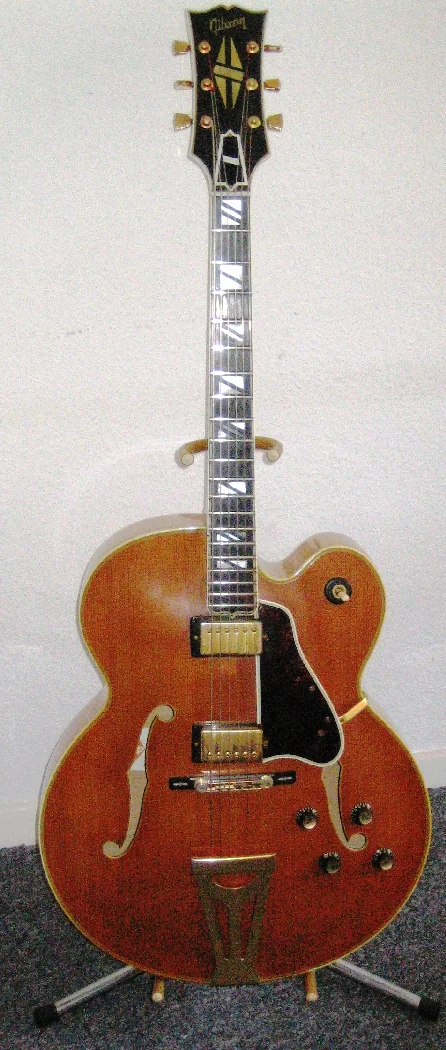
Photo: Cuetty / Clusternote / Wikimedia Commons / CC BY-SA 3.0 Gibson
Super 400
1934
Gibson priced it at $400 in the middle of the Depression and put the price right in the name.
- Send a picture
Gretsch
Synchromatic
1939
Gretsch’s answer to Gibson had cat’s eyes, a harp, and a neck with no rod in it. The files burned.
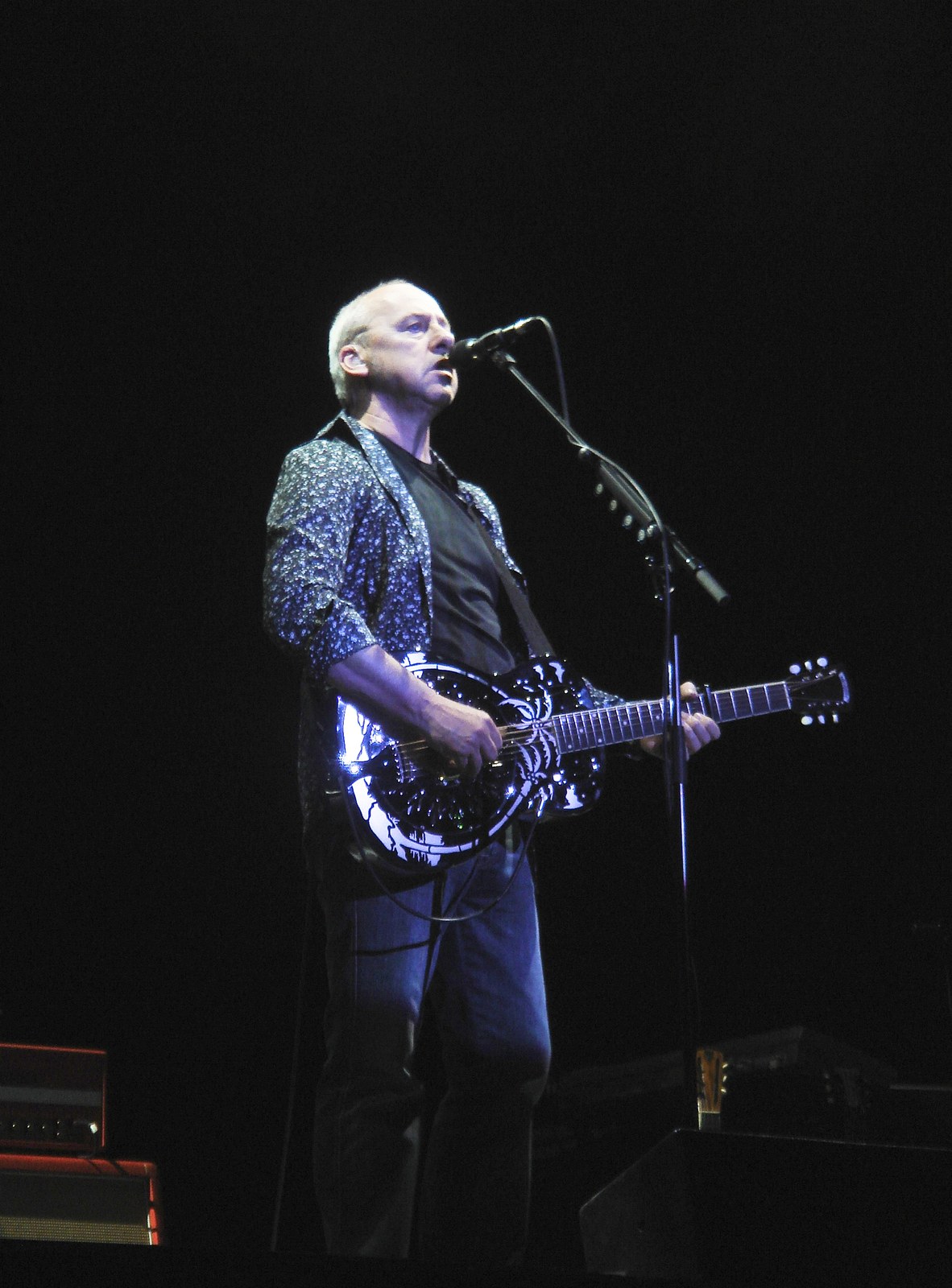
Photo: Chris J Bowley / Wikimedia Commons / CC BY 2.0 National
Style O
1930
A nickel-plated brass guitar from 1930s Los Angeles, and the one Mark Knopfler wouldn’t sell.