Olson
SJ
He left a guitar at James Taylor's hotel with his phone number. Taylor never gave it back.
Jim Olson was paying his rent by cleaning a church in Minnesota when James Taylor called about the cutaway he'd left at the hotel. That small jumbo has been one of Taylor's two main guitars ever since, and the body one man in Circle Pines still builds most often.
- Introduced
- 1989
- Type
- Acoustic flat-top
- Class
- Production
Have a photograph of this guitar? Send a picture
The short version
1975
The first guitar
Jim Olson builds his first, not expecting to make a living at it.
1977
Olson Guitars
The shop starts in a basement, then moves to a West St. Paul storefront shared with a harpsichord maker.
1982
The church
Olson moves into a church building and pays the rent as its janitor.
1983–84
The first cedar
He builds Phil Keaggy a spruce guitar, then his first cedar top. Olson has dated their meeting to both years.
1989
The hotel desk
James Taylor plays a cutaway SJ all weekend, then buys it, plus a non-cutaway and a dreadnought, around Christmas.
1991
On the road
Taylor tours on Olsons and nothing else.
1992
Circle Pines
The shop moves to ten acres north of the Twin Cities.
2002
One hundred
For the shop's 25th year, 100 James Taylor Signature models, each label signed by both men.
Side A
A1
A phone number at the hotel
Sometime in 1989, or maybe '88 as Olson remembers it, James Taylor came to Minneapolis to play a benefit. Jim Olson, a Minnesota guitar maker, wanted Taylor to try one of his guitars.
The only one he had on hand was a cutaway. Olson knew Taylor didn't want a cutaway. He took it downtown anyway and left it at the hotel with his phone number.
On Monday he was cleaning a church bathroom when the phone rang. Taylor had played the guitar all weekend, he and Mark O'Connor both.
A2
Rent paid in mops
That bathroom was Olson's rent. He'd moved his shop into the church building in 1982 and paid for it by being the janitor.
He had built his first guitar in 1975 without expecting to live on it, and opened Olson Guitars in 1977 in a basement. From there it went to a West St. Paul storefront he shared with a harpsichord maker. For the next two and a half years he built 78 guitars, dreadnoughts, for a company called Metro Music, and they were closed out at cost or below. In 1987, a full ten years in, he made $12,000 building guitars.
The first player who mattered was Phil Keaggy. Olson built him a spruce guitar, then a cedar one to replace Keaggy's guitar by Mark Whitebook. It was the first cedar top Olson ever made. Olson dates their meeting to 1983 in one telling and 1984 in another. Keaggy's 1991 record Beyond Nature, Olson says, was all that cedar guitar.
A3
Three guitars for Christmas
On the phone, Taylor asked for two guitars: one like the cutaway but without the cutaway, and a dreadnought, both to sound and play like the one at the hotel. Olson's price for the cutaway had been $2,150.
Around Christmas 1989, the other two shipped. Taylor wouldn't give the cutaway back. He bought all three.
Taylor had made his first three albums on his own Gibson J-50. He'd lost a guitar by Mark Whitebook in a divorce, then gone through a Takamine and a Yamaha custom. On the 1991 tour he played Olsons and nothing else. He has put the switch in one line.
As soon as I played it I've never looked back.
Flip the record · By the numbers
$2,150
Olson's price for the cutaway he left at Taylor's hotel in 1989.
8
Olsons James Taylor owns. Six of them are SJs.
100
James Taylor Signature models, all built for 2002, all sold. There won't be more.
15⅛"
Across the lower bout. A small jumbo, close to an OM, only deeper and curvier.
Side B
B1
A little deeper and curvier
The SJ is a small jumbo: 15⅛ inches across the lower bout, 19½ inches long, deeper at the tail than the heel. A British reviewer in 1998 said it resembled Martin's OM, "if a little deeper and curvier." The top is cedar or spruce, cedar on Taylor's, and the usual neck is a five-piece of maple and mahogany with a dark center strip. Olson says the laminated neck "sends better vibrations to the guitar's top."
What you hear is a guitar built to be played with the fingers. It's balanced up the neck, rich in overtones, and it doesn't fall apart when you put on a capo or tune it somewhere strange. That's most of what a James Taylor song asks of a guitar.
In 1992 Olson moved the shop to ten acres in Circle Pines, north of the Twin Cities. In 2002, for his 25th year, he built 100 James Taylor Signature models, cedar and rosewood, each with a label signed by both men. They sold out. He won't make more.
B2
Still on the bus
Taylor owns eight Olsons now. Six are SJs. The two he leans on are the first ones: the cutaway from the hotel desk, #1, and the non-cutaway he ordered over the phone, #2.
They've had a life. An airline crushed the non-cutaway, and Olson had it back on the road in three days, with new binding and pearl. In Italy, on tour with Bonnie Raitt, Taylor fell on the end jack of #1 and split it open from the tail to the neck block. Olson closed it up.
His guitar tech puts about 90 percent of a show on two guitars.
Olson hasn't retired. He's one man at one bench now, and the SJ is most of what he builds. Paul Stanley got one with rose inlays and called it "an elegant guitar." David Wilcox got his after a favorite Olson was stolen.
Taylor never gave the first one back. It's still one of the two he walks out with.
Put this on
You’ve read about it. Now hear it. Here’s what this guitar sounds like, and what to listen for.
Beyond Nature
Olson says Keaggy made this record on the first cedar-top guitar he ever built, and nothing else. Some accounts call that guitar an SJ cutaway; Olson's own words don't name the body.
Find it on YouTube (opens in a new tab)
The cast
The people, and the specific guitars, that made the legend.
1989
James Taylor
SJ cutaway #1 and non-cutaway SJ #2
Still his two main guitars. One was crushed by an airline, the other cracked when he fell on it in Italy. Olson fixed both.
1983–84
Phil Keaggy
A spruce Olson, then the first cedar one
The first player Olson names. Which body that cedar guitar is depends on who's telling it.
1996
David Wilcox
A 1996 SJ with an Adirondack top
Olson built it, as Wilcox tells it, after a favorite Olson of his was stolen.
Paul Stanley
SJ cutaway #1624, "The Rose"
Brazilian rosewood with rose inlays. He'd been thinking about a jumbo or a dreadnought.
Liner notes
Specs, construction, rarity, value, and every source we used.
One bench in Circle Pines — a small jumbo a little deeper than an OM, and the body James Taylor would not give back.
- Body
- Small jumbo. Factory card, fetched 26 October 2026: length 19.5", upper bout 11.125", lower bout 15.125", waist 9.250", depth at the tail 4.750", depth at the heel 3.750". Guitarist (Neville Marten, August 1998), one review guitar: lower bout 385 mm; depth 110 mm typical, 96 mm at the neck, 117 mm at the endpin. Gbase’s 2001 koa SJ: “just 15"” at the lower bout. Mix flagged. Do not average. Do not convert 15.125" or 4.750".
- Neck
- Five-piece laminate on the guitars Olson and the reviews describe. Blue Book: rosewood center, maple, mahogany outer. Guitarist: maple and mahogany with a centre strip that looks like rosewood. Customs exist. Not one neck for every SJ.
- Fingerboard
- Ebony on the James Taylor signature spec, the 1998 review, and Blue Book. Inlays are options (dots, doves, an “O”). Fret count not printed. Gbase’s 2001 example is a 14-fret neck. Dream’s 2010 Brazilian SJ #1311: 14 frets to the body. Don’t generalize.
- Scale
- Not on the factory page. Named measurements, not a standard: Dream often 25.4" (2010 #1311; a 2023 Brazilian listing, serial #1705); one 2002 Dream sheet 25.31" and, on that same sheet, 642.9 mm; Gbase 2001 25.35"; Carter Vintage’s 2022 replica 25.5". Mix flagged. Do not average. Do not invent millimetres for 25.4".
- Pickups
- None as an acoustic. An LR Baggs LB-6 on named used examples is an install, not the model.
- Hardware
- Ebony bridge on the usual card. Tuners are an option. Blue Book: chrome Schaller. James Taylor signature spec: Gotoh 510, “O” logo, goldtone casings, black faux-ebony knobs.
- Electronics
- None standard.
- Finish
- The model page does not name it. The shop page: a UV oven cures the finish. Blue Book: gloss nitrocellulose. Keep both. Don’t pick.
- Nut
- Factory page silent. Guitarist 1998, that review guitar: 44 mm, strings 58 mm at the bridge. Dealers commonly print 1.75" or 1 3/4" and about 2.25" at the saddle (Gbase 2.25"; the 2023 #1705 listing 1.75" and 2.25"; Dream’s 2002 sheet 1.75" / 44.5 mm and 2.22" / 56.4 mm; Carter 2022 1.756" and 2.23"). Mix flagged. Do not average. Do not invent millimetres for 1.75".
Open the full research fileConstruction details, the complete player record, production numbers, dated value estimates, and sources
Classic living example = a current Circle Pines SJ, the body on the factory page. Cedar or spruce. East Indian rosewood is the usual back. Appointments are options, so two SJs from the same year need not match. James Taylor Signature Series I is that non-cutaway body on a fixed spec, sold out. Clones of the spec are still made, without the label Taylor signed. A cutaway is an option, not a second model. The Dreadnought (lower bout 15.750"), the Jumbo (17"), and the Parlor (12-fret, lower bout 14") are other bodies. Standalone. No Gibson SKUs. Mixed inch/mm flagged. Do not invent millimetres for the factory inches, for 25.4", or for 1.75".
Construction
The job was a small steel-string that still spoke up the neck. Not the dreadnought James A. Olson had already tried to sell. Circle Pines, Minnesota. One bench. The body he still builds most of.
1977 is the shop, not this shape. His about page: Olson Guitars officially born in a basement, then a West St. Paul storefront shared with a harpsichord maker. The next two and a half years, 78 guitars for Metro Music, into Schmitt stores, closed out at cost or below. Fretboard Journal’s 2016 episode note: that deal was dreadnoughts. Dream Guitars lists a 1980 dread, serial 56. Guitar Broker lists a 1980 dreadnaught #056. The Star Tribune piece he reprints (Jon Bream; the reprint does not print the paper’s date) has a first guitar in 1975, and a man who did not expect to live on it. Keep 1975 and 1977. In 1987, that piece says, he earned $12,000 as a guitarmaker.
1982 is the church building, rent paid as janitor. Dream’s 1982 listing, serial 105, is filed as an “SJ Cutaway” and then described as something else: Olson told them it was one of about two small bodies modeled on classical guitars, steel strings. Not this card.
Phil Keaggy is the first name, and the body is where the sources split. Between the Strings (his essay for John Schroeter; he dates the ask to 2004): met Keaggy in 1983, spruce first, then a cedar to replace the Mark Whitebook — the first cedar top he ever made. The about page says the same, and that Beyond Nature was recorded exclusively on that cedar. Wikipedia: June 1991. On the shop interview he dates the meeting 1984, and says Keaggy still plays that first cedar. Keep 1983 and 1984. The SJ page calls this model Keaggy’s guitar of choice. Eddie’s, and the description under the interview, call the first cedar an SJ. Equipboard quotes an Olson artist profile — spruce SJ cutaway in 1983, cedar SJ cutaway delivered in 1984 — and that profile is not on the live gallery this pass (“Preparing Projects”). Don’t promote the profile over his own sentences, and don’t erase it.
Taylor is the order book, and here the body is named. Fretboard Journal, June 2021 (first in FJ #47), Olson talking: a benefit in town, “1989, maybe ‘88.” The only guitar on hand was a cutaway. He knew Taylor didn’t want one. He left it at the hotel with a phone number. Monday, cleaning a church bathroom, Taylor called. He and Mark O’Connor had played it all weekend. Taylor asked for a non-cutaway, and a dreadnought, to sound and play like that one. Olson’s price for the cutaway he had shown: $2,150. Around Christmas 1989 the other two shipped. Taylor would not give the cutaway back. He bought all three. The about page and the essay both say 1989, and that the 1991 tour used the Olsons exclusively. This header is that 1989 SJ. It is not a catalog birth, and it is not 1977. The cutaway already existed when he drove it downtown. The SJ page prints no earlier year. The site’s brochure is 1992. This pass did not read the poster.
The box he still prints: 19.5" long, 15.125" at the lower bout, waist 9.250", heel 3.750", tail 4.750". Marten, August 1998: small jumbo, and it resembles Martin’s OM, “if a little deeper and curvier.” His millimetres sit next to the inches. Mix flagged. Do not average. The dread on the same site is 15.750" across. The jumbo is 17" and 20.625" long. The parlor is the 12-fret, lower bout 14". Four side-bending forms, one per body size. Some Dream sheets print a 16" lower bout and a 5" tail on a guitar they still call an SJ. That is not this card. Dream’s 2010 #1311 lands on the factory lower bout, 15.125", with a heel of 3.688" and a tail of 4.625". One guitar. Don’t replace the card with it.
A usual neck is the five-piece. Olson, via Marten: it “sends better vibrations to the guitar’s top.” Cedar is the top on Taylor’s, and on the cedar Olson says Keaggy recorded. Sitka and other spruces are options. So is Brazilian. The page says the body favors overtones, stays balanced for a capo and for alternate tunings, and is fingerstyle first, with a flatpick welcome. Scale, nut, and fret count are not printed. The 1998 review guitar is 44 mm and 58 mm. Dealers cluster near 25.4" and 1.75" and then miss each other by tenths, out to 25.5". Don’t average that into a standard he never published.
2002, the 25th year: 100 James Taylor models. 80 Standard — Indian rosewood, cedar, non-cutaway, rosewood binding, dove and “O,” abalone, Gotoh 510s, a Calton case. 10 Indian specials and 10 Brazilian specials add a double inlay, a radial Brazilian rosette, an ebony peghead back. A label signed by both men. “James Taylor Signature Model” on the neck block, with the serial and the year. Ordering page, 26 October 2026: all 100 sold, none more will be made. Clones of the spec are still built. No signed label. They are SJs. They are not the 100.
Since 1992 the shop is ten acres in Circle Pines, 3200 square feet, 11840 Sunset Avenue. A Fadal in the front room. A UV oven by the spray booth. The 2004 Scaled Composites note: his CNC travels 40 inches. Fretboard Journal’s 2025 episode note says Bob Taylor talked him into the first one. Don’t date the purchase from that sentence.
He has not retired. Ordering page: the SJ is the bulk, about 20 a year, no backlog past a year, price by email. The FAQ, same day: as many as 60, a dozen in the lean early ’80s, lately about 30, and $30,000 for most requests, Brazilian and fancy inlay extra, about nine months. Guitarist in 1998 had two men and about 60. The webmaster’s note on the 2016 reprint: one man, somewhat more than that. Blue Book’s card, still up: sixty a year. Eddie’s says about forty. Don’t average them.
Not a Martin OM (martin-om-28). Not a Collings D2H. Not a Santa Cruz Tony Rice. Not the J-50 on Taylor’s first three albums (gibson-j-50). Not the dread shipped the same Christmas, not the jumbo, not the parlor. Chris Thile’s Olson video is the parlor page.
Players
Do not hang the J-50, the Whitebook, a Takamine, a Yamaha custom, the Olson dread, or the parlor here. FJ has Taylor’s path in his own words: a cheap nylon, a borrowed Gibson, his own J-50 for the first three albums, a Mark Whitebook lost in a divorce, a Takamine, a Yamaha custom, then the Minneapolis benefit. “As soon as I played it I’ve never looked back.” A Telecaster still turns up. The Olson years are not every song since 1989 on one guitar.
James Taylor — eight Olsons. Six are SJs, plus a dread and a parlor. FJ, June 2021: the unsolicited SJ cutaway; the non-cutaway SJ and the dreadnought ordered off it; a second non-cutaway SJ once the road wanted a spare; one each of the three signature SJs, which Olson insisted on giving him; and a parlor. All eight: cedar, ebony, the five-piece neck. Six are Indian rosewood. The Brazilian pair are one signature instrument and the parlor, so the dread is in the Indian six. He still uses the cutaway and the non-cutaway as the mains. FJ’s caption, on Olson’s photo: SJ #1 and #2. Airlines crushed the non-cutaway; binding and pearl replaced; back in three days on the One Man Band tour. In Italy, with Bonnie Raitt, he fell on the end jack of #1, split the end block, and opened the sides up to the neck block. Olson closed it. Jonathan Prince, tech since that 2006 tour (with Taylor since 2001): five Olsons on a bus-and-truck run; about 90 percent of the show on two guitars; the dread for a drop tuning such as “Country Road” when the weather allows. Acoustic Guitar, October 2015, on Olson’s site: very low action; they have lasted; he has abused them; Olson fixes them. Artist-owned — not a comps tape.
Phil Keaggy — spruce in 1983, then the first cedar Olson. The years and the body fight are above. Beyond Nature (June 1991) is the record Olson says was only that cedar. Acoustic Sketches: “my 1984 James Olson” on one piece, Olson credited on some tracks and Del Langejans on others. The liner does not name a body.
David Wilcox — a 1996 SJ, his telling. His channel, 2016: Olson built it after a favorite Olson was stolen; Adirondack; he had been playing cedar. Dream Guitars lists a 1996 Brazilian and Adirondack SJ, serial 657, as his. Don’t glue that serial to the video.
Paul Stanley — cutaway #1624, “The Rose.” Olson’s featured-guitar page: Brazilian, torrified Adirondack, rose inlays by Larry Robinson, a Calton case. Fretboard Journal calls it a Brazilian SJ. Stanley: “The SJ is terrific… It’s an elegant guitar… it might need a brother or a sister, but it’s very, very special.” He had been thinking about a jumbo or a dread. He did not order one in that piece.
Also known to play stays short. A sightings caption: a mahogany and Adirondack SJ delivered to Zac Brown. Not the Brazilian cutaway “Spider,” serial 1677 — that card does not say SJ. Mac McAnally, same sightings page: occasionally an SJ. Linda McCartney’s early-1990s photos in the Flaming Pie book show Paul with an Olson; the body is not named. Leo Kottke, in the Tribune piece, will not take his Olson on the road; the body is not named. John Mayer bought spec #1593; that card does not say SJ. Off this plate.
Rarity
You can order a new SJ. It is not rare. It is slow. About 20 a year on the ordering page, about 30 lately on the FAQ, 60 in the old Guitarist line and on Blue Book. None of those is an SJ total. Serials run from 1 across every body (FAQ). A number dates a guitar. It does not count SJs. That is why there is no first-year census.
Company figures only: 78 for Metro Music; the Tribune reprint’s 1,050 since 1977, written while he was taking orders for the new signature model; the 1,500th in 2015; a 1,600th commemorative on the recently sold page, body not named. The about page still says “over 1500” and “nearing 40 years.” Don’t add them.
Thinner than a new order: the 100 signed Taylor models, closed; Brazilian SJs; Taylor’s #1 and #2; Stanley’s #1624. A clone is not one of the 100. A dread, a jumbo, a parlor, and those two 1982 classical-shaped small bodies are other guitars.
Value
Informal estimate, 26 October 2026. Not an appraisal.
Ask vs sold labeled. Celebrity instruments are not comps. No invented medians. An OM, a Collings, and a Santa Cruz are not Olson comps. Brazilian is not an Indian-rosewood comp. The FAQ’s $30,000 is not a dealer ask.
New street. The ordering page does not print a price. Email. The FAQ, fetched the same day, still prints $30,000 for most requests, Brazilian and custom inlay extra, about nine months. Twenty-five percent down. The FAQ: cancel early and the deposit returns less $1,000. The ordering page: full cost minus delivery, refundable inside two days if you don’t want the guitar. Keep both.
Used modern. No clean sold series. Flag: thin sold-comp access. Named asks. Dream Guitars, 1995 Indian rosewood and cedar, serial 557, Reverb $26,500 (fetched 26 October 2026). Guitar Gallery, 2024 Brazilian and cedar, $54,995. Guitar Addiction Depot, a 2026 flamed-koa cutaway, cedar top, seller says made May 2026 and never played; Reverb has it Used–Excellent; ask $43,999, from $49,999. Don’t average the Indian ask with the koa or the Brazilian, and don’t average any of them with $30,000.
Vintage / collectible. Old is not the top of the money. $2,150 in 1989 is what Olson told Taylor, not a 2026 band. The Tribune piece, new-signature window: “$5,000 to $25,000.” Blue Book’s card: $12,500. Fretboard Journal, 17 August 2016: new ones from $15,000. Four years, four numbers. A Saint Louis Reverb listing, 2023 Brazilian and cedar SJ serial #1705, ask $48,250. Michael’s Gear Outlet, 2021 Brazilian #1643, ask cut from $60,000 to $45,000. Paul’s Guitars, a signed Standard, seller’s “#2 of 80”: the listing had ended at $42,750, down from $45,000, when fetched. That is one of the 80. It is not Taylor’s #1. Same depot as the 2026 koa marked a 2025 flamed-koa cutaway sold at A$71,632.74. Australian dollars. One object. Taylor’s eight, Stanley’s #1624, and Wilcox’s 1996 are one-object lots if they ever sell. Not comps.
See also
- martin-om-28 — the OM Guitarist says the SJ resembles, only a little deeper and curvier
- collings-d2h — Austin’s herringbone rosewood dread; another one-shop flat-top, not this body
- gibson-j-50 — Taylor’s guitar on the first three albums, before any Olson
Sources
- Olson, SJ — factory inches, 26 October 2026; Taylor and Keaggy; fingerstyle, capo, alternate tunings
- Olson, Dreadnought — lower bout 15.750"
- Olson, Jumbo — lower bout 17", length 20.625"
- Olson, Parlor — 12-fret; lower bout 14"; Thile’s video is this body
- Olson, About — 1977; 78 for Metro Music; 1982 church; Keaggy 1983, first cedar; Beyond Nature; Taylor 1989; 1991 tour; Circle Pines 1992; over 1500
- Olson, Between the Strings — Schroeter essay, asked 2004; met Keaggy 1983; spruce, then cedar replacing a Whitebook; Taylor, three guitars, 1989
- Olson, FAQs — $30,000; 60 / a dozen / about 30; 1500th in 2015; serials from 1; $1,000 cancel penalty; 26 October 2026
- Olson, Ordering — not retired; SJ is the bulk; about 20 a year; no printed price; 100 signatures sold out; clones; two-day refund; 26 October 2026
- Olson, James Taylor models — 2002; 80 + 10 + 10; signed label; Acoustic Guitar, October 2015
- Olson, Guitarist reprint, August 1998 — Neville Marten; 44 mm; 58 mm; 385 mm; 96 / 117 mm; five-piece neck; about 60 a year; webmaster note
- Olson, shop tooling — four side forms, one per body
- Olson, shop walk-through — Fadal; UV oven
- Olson, Scaled Composites — 29 September 2004; CNC travels 40 inches
- Olson, The Rose — #1624, Paul Stanley; Brazilian; torrified Adirondack; Larry Robinson
- Olson, recently sold — #1593 Mayer, body not named; Spider #1677, body not named; 1600th, body not named
- Olson, sightings — Flaming Pie photos, body unnamed; McAnally occasionally an SJ
- Olson, Jim Olson sightings — mahogany / Adirondack SJ to Zac Brown
- Olson, Star Tribune reprint — Jon Bream; first guitar 1975; $12,000 in 1987; 1,050 built; $5,000–$25,000; Kottke; new signature model, so the 2002 window; newspaper date not printed
- Fretboard Journal, James & Jim, June 2021 — eight guitars; 1989, maybe ’88; $2,150; #1 and #2; Italy; Prince; “Country Road”; originally FJ #47
- Fretboard Journal, Standard Bearer — J-50 on the first three albums; “never looked back”; #1 and #2 cedar / Indian rosewood
- Fretboard Journal, Paul Stanley — Brazilian SJ; Stanley on the body
- Fretboard Journal podcast 115, 17 August 2016 — from $15,000; late-’70s dreadnoughts; small jumbo discussed
- Fretboard Journal, Luthier on Luthier, March 2025 — Bob Taylor and the first CNC
- YouTube, Olson shop interview — Olson dates Keaggy 1984; description calls the first cedar an SJ
- Blue Book, Olson — five-piece neck; nitro; $12,500; sixty a year; no model year; 26 October 2026
- Wikipedia, Beyond Nature — June 1991
- Phil Keaggy, Acoustic Sketches — “my 1984 James Olson”; Langejans on other tracks
- David Wilcox, 1996 SJ — his channel, 2016; after a theft; Adirondack; he had played cedar
- Dream Guitars, 1982 small body — serial 105; model field says SJ Cutaway; text says maybe two classical-inspired bodies
- Dream Guitars, Olson brand list — 1980 dreadnought, serial 56
- Guitar Broker, 1980 dreadnaught — #056; not an SJ
- Reverb, Dream 1995 SJ #557 — ask $26,500; 26 October 2026
- Reverb, Guitar Gallery 2024 Brazilian — ask $54,995; scale 25.4"; nut 1.75"
- Reverb, 2023 Brazilian #1705 — Saint Louis; ask $48,250; 25.4"; 1.75"; 2.25"
- Reverb, Michael’s Gear Outlet #1643 — ask from $60,000 to $45,000
- Reverb, Guitar Addiction Depot, 2026 koa — ask $43,999 from $49,999; seller says made May 2026; Reverb: Used–Excellent
- Reverb Australia, 2025 koa, sold — Guitar Addiction Depot; sold A$71,632.74
- Reverb, Paul’s Guitars, signature #2 of 80 — ended ask $42,750 from $45,000; seller’s numbering
- Reverb, Dream 2010 SJ #1311 — 14 frets to the body; lower bout 15.125"; heel 3.688"; tail 4.625"; scale 25.4"
- Carter Vintage, 2022 replica cutaway — scale 25.5"; nut 1.756"; spacing 2.23"
- Gbase, 2001 cedar / koa — 14-fret; 25.35"; nut 1.75"; spacing 2.25"; “just 15"”
- Dream Guitars, 2002 SJ #1005 — 25.31" and 642.9 mm; 1.75" and 44.5 mm; 2.22" and 56.4 mm
- Equipboard, Olson SJ — quotes an Olson profile on the 1983/84 SJ cutaways; profile not live this pass
- Eddie’s Guitars — first cedar called an SJ; about forty a year, a dealer line
Keep digging
Guitars this one gets compared to, confused with, or descended from.
- Send a picture
Martin
OM-28
1929
In 1929 one player asked Martin for a longer neck. The answer was a new guitar, and it lasted about four years.
- Send a picture
Collings
D2H
1990
No famous owner, no famous record. Just a dreadnought recipe an Austin shop has never stopped making.
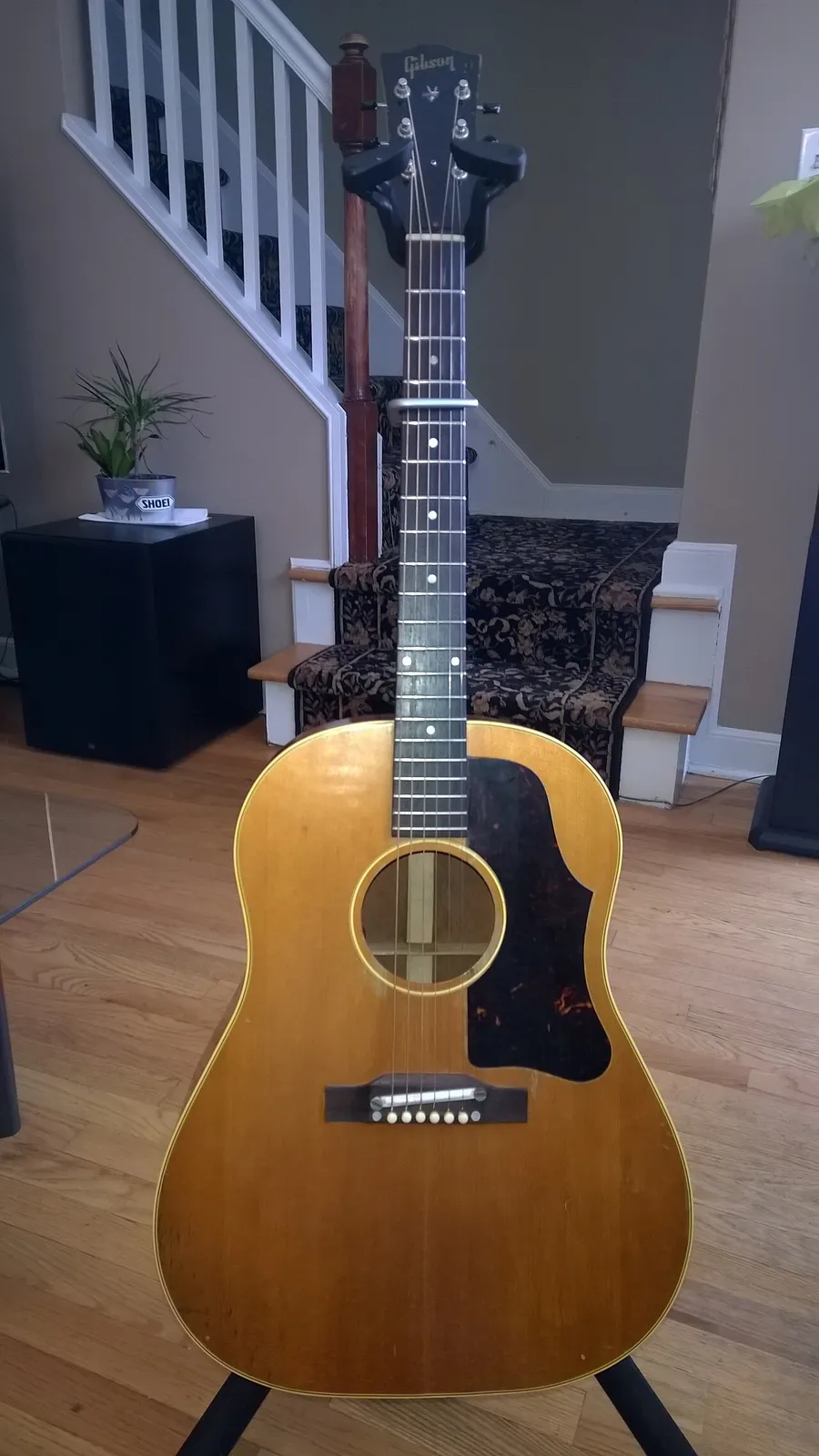
Photo: sbaimo from United States / Wikimedia Commons / CC BY 2.0 Gibson
J-50
1942
The J-45 with nothing to hide: a bare natural top, five dollars more, and Bob Dylan’s first album cover.