Collings
D2H
No famous owner, no famous record. Just a dreadnought recipe an Austin shop has never stopped making.
Austin, Texas, the late 1980s. Bill Collings is building steel-string guitars in a rented shop with a few hired hands, and George Gruhn in Nashville has just ordered two dozen of them. The house dreadnought that came out of that shop is still built off the same card.
- Introduced
- 1990
- Type
- Acoustic dreadnought
- Class
- Production
Have a photograph of this guitar? Send a picture
The short version
1973
The earliest date
The earliest year anyone gives for Collings as a builder. Other counts start much later.
1987
The order, maybe
One telling has George Gruhn ordering 25 guitars this year.
1989
A rented shop
Hired helpers, a rented space, and in the company’s own telling, Gruhn’s order for 24.
1990
The dreadnoughts
The nearest thing the D-series has to a birthday. The D2H’s own page doesn’t print one.
2017
Bill Collings dies
He dies in July. The shop keeps building on his recipe.
Side A
A1
Nobody famous
Most guitars on this site come with a cast. A kid and his dad. A surf band. A punk on an album cover. The D2H doesn’t have one. Nobody famous is tied to a particular D2H, and no famous record is pinned to one either.
What it has is a recipe. Sitka spruce on top, East Indian rosewood on the back and sides, herringbone around the edge. It came out of Bill Collings’s shop in Austin, and it’s the house acoustic: the guitar that says what the shop believes a dreadnought should be.
A2
Two dozen guitars, give or take
When Collings started depends who you ask. The earliest date anyone gives is 1973. Other counts start in 1986. The company’s own story has a rented shop and some hired helpers in 1989.
The best part of the origin story is an order. In the company’s telling, George Gruhn, the Nashville dealer, ordered 24 custom guitars in 1989. Another account makes it 25, in 1987. I’m not going to pick. Either way, a dealer asking a small Austin shop for two dozen guitars at once is the kind of thing that turns a builder into a company.
The D2H doesn’t have a birthday. Its page doesn’t print one. The rosewood D-3 is in the books from 1990, and that’s as close to a start date as the dreadnoughts get.
A3
What the recipe sounds like
If you’ve ever heard someone say “pre-war” in a guitar shop, this is what they mean. The top is braced in a scalloped X, the braces shaved down so the top moves more and the low end gets bigger. Rosewood back and sides give you deep bass and a bright, sparkly top end on top of that. On a big square-shouldered body, 15⅝" across, that adds up to the kind of dreadnought that fills a room when you strum it and still rings when you pick single notes.
The trim tells you where it comes from. Ivoroid binding with herringbone purfling, a zipper backstrip, abalone diamonds and squares on an ebony board. The neck is mahogany with a Modified V shape, and there’s a volute behind the headstock, the little bump that makes the weakest part of the neck stronger. Nitro lacquer on the body, harder-wearing polyester on the neck.
The standard nut is bone, 1 11/16" wide, which suits a flatpicker. If your fingers want more room, Collings will build it at 1 3/4" instead, and there are “Vintage” options that spread the strings wider at the bridge too. Same guitar, a little more elbow room.
If you’ve played a Martin D-28, a lot of this will feel familiar. Same conversation at the bench. Different maker, different shop, different guitar.
Flip the record · By the numbers
24–25
Guitars in George Gruhn’s early custom order. The tellings don’t agree on the count or the year.
15⅝"
Width of the body across the lower bout.
25½"
Scale length. The OM2H shares it. The I-35 electric is shorter, at 24⅞".
1 11/16"
Nut width on the standard guitar. Wider nuts are a custom order.
Side B
B1
The ones next to it on the wall
The D2H has siblings, and it helps to know which is which. The D1 keeps the same body in mahogany, which is drier and more focused. The D3 is rosewood without the herringbone. The D2H T keeps the body and changes how it’s built, with a Traditional neck carve and ultra-thin nitro. The DS2H is a 12-fret dreadnought, and the OM2H is a smaller shape altogether.
Years later, in 2006, Collings started building electrics too. Different story. Same shop.
B2
Still on the card
Bill Collings died in July 2017. The shop kept going, and the D2H kept its recipe: Sitka, East Indian rosewood, herringbone, 15⅝" across, a 25½" scale, a nut 1 11/16" wide. You can order one tomorrow.
It still has no famous owner. What it has is the next person who orders one, and a shop in Austin that will build it off the same card Bill Collings wrote.
The cast
The people, and the specific guitars, that made the legend.
1989
Bill Collings
Builder
Built the D2H in Austin and set the recipe the shop still follows.
George Gruhn
The big order
The Nashville dealer whose order for two dozen custom guitars is part of the Collings origin story. Nobody has tied a D2H to it.
Liner notes
Specs, construction, rarity, value, and every source we used.
Sitka, East Indian rosewood, and herringbone on a 14-fret square dreadnought — the acoustic Collings built as the house guitar.
- Body
- Square-shoulder 14-fret dreadnought; Sitka spruce top; E. Indian rosewood back and sides; ivoroid binding with herringbone purfling; 2-style zipper backstrip; 15 5/8" wide, 20" long, 4 7/8" deep; 40 1/4" total length
- Neck
- Honduran mahogany, Modified V; mortise and tenon hybrid; square peghead with volute
- Fingerboard
- Ebony, abalone long diamond and squares; 14"–26" compound radius; medium 18% nickel-silver frets (count not printed)
- Scale
- 25 1/2"
- Pickups
- None
- Hardware
- Ebony belly-style bridge, 2 3/16" spacing; bone drop-in saddle; nickel Waverly tuners; deluxe hardshell case; D'Addario EJ-17 (.013"–.056")
- Electronics
- None
- Finish
- High gloss nitrocellulose lacquer body; high gloss polyester resin neck
- Nut
- Bone, 1 11/16"
Open the full research fileConstruction details, the complete player record, production numbers, dated value estimates, and sources
Live factory D2H, 29 August 2026. Factory inches only; no millimetre SKU. Fret count not printed.
Construction
The D2H is Collings's 2-style rosewood dreadnought. Sitka on the top. East Indian rosewood on the back and sides. Herringbone and ivoroid around the body. A zipper backstrip. Long diamond and squares in abalone on ebony. Bill Collings built it in Austin, Texas. That is the house acoustic.
The job was a shop-built steel-string in the pre-war dreadnought vocabulary. Scalloped X. Modified V. Square peghead with a volute. Waverly nickel. Bone at the nut and a drop-in saddle. Nitro on the body, polyester on the neck. Collings kept printing that recipe as the D2H.
Shop-era Collings dreads share the envelope the factory still lists. Square, 14-fret. On the D2H, 2-style rosewood and herringbone. Width 15 5/8". Body 20" long and 4 7/8" deep. Scale 25 1/2". Nut 1 11/16". Total length 40 1/4". There is no vintage millimetre card this pass. The live page prints inches only.
First year of the named D2H is not a stamp. The factory page does not print one. Wikipedia dates the company to 1973. Blue Book dates the company to 1986. Collings "Our Story" has a rented shop and hired helpers in 1989, and in that same telling Gruhn ordered 24 custom guitars. Wikipedia's Gruhn figure is 25, in 1987. Keep both. Don't pick. Blue Book lists D-3 as manufactured 1990–present. The 1990 in this plate's header is that D-series Blue Book window, attributed — not a factory birth year chosen from the stack, and not a first year the D2H page itself claims. Collings's story puts electrics in 2006; Wikipedia dates the I-35 to 2006 NAMM. Either way, that line is not this guitar's start.
Current production is the live inches recipe. Sitka spruce top. E. Indian rosewood back and sides. Honduran mahogany neck. Ivoroid body binding with herringbone purfling. 2-style zipper backstrip. Ebony fingerboard, abalone long diamond and squares, 14"–26" compound radius. Modified V. Square peghead with volute. Mortise and tenon hybrid. Medium 18% nickel-silver frets; the factory cell does not print a count. Bone nut at 1 11/16". Bone drop-in saddle. Ebony belly-style bridge at 2 3/16" spacing. Nickel Waverly tuners. Sitka braces, pre-war scalloped X. High-gloss nitrocellulose lacquer on the body. High-gloss polyester resin on the neck. D'Addario EJ-17, .013"–.056". Deluxe hardshell case.
Custom nuts on the same factory page — 1 3/4" or 1 23/32", plus Vintage Now (1 3/4" nut / 2 5/16" spacing) and Vintage (1 3/4" / 2 3/8") — are options. They are not the standard 1 11/16" card.
The other Collings cards are other guitars. D1 keeps the dread box and switches the wood: Honduran mahogany back and sides, tortoise binding, a 1-style rosette, dots. D3 is rosewood at the same dimensions, ivoroid on body, fingerboard, and peghead, no herringbone, a chevron backstrip, an abalone rosette, no fingerboard inlays. D2H T keeps the body size and changes the construction — Traditional neck carve, ultra-thin nitro, abbreviated soundboard graft, gold MOP, limited custom. DS2H is the 12-fret dread. OM2H is the other shape: 15" × 19 1/4" × 4", still 25 1/2" and 1 11/16", strung EJ-16. I-35 is 2006 electric: semi-hollow mahogany with a maple center block and carved maple top, two Lollar Low Wind Imperials, 24 7/8" scale, 12" radius, body 15" × 1 5/8". I-35 LC is laminate maple with a maple/spruce block. Martin D-28 is another maker's Style 28 dreadnought. Same bench conversation. Not this plate.
Players
No verified named D2H is sourced here. The Gruhn order is a shop origin story — 24 guitars in 1989 on Collings's telling, 25 in 1987 on Wikipedia's — not a named recording instrument. Known to play: none sourced here.
Rarity
You can order a new D2H. Current production is not rare. The factory has not published model totals this pass. Serial maps are unpublished here. Early shop instruments from the 1989 rented-shop window sit in a different pile from a guitar you can buy tomorrow. That is age and a small shop, not a census. D2H T, D1, D3, DS2H, and OM2H are other cards. They do not thin this one.
Value
Informal estimate, 25 August 2026. Not an appraisal.
Catalog dollars were omitted from this pass. New-street, used-modern, and vintage/collectible bands are not printed here. Thin data: this plate has live inches and a shop story, not solds. Dealer asks are not solds, and they are not in this file. Artist lots, if they exist, would sit outside any later band — none are sourced here.
See also
Sources
- Collings D2H — live factory inches, 29 August 2026; D1 vs D2H vs D3; Standard vs Traditional; custom nut options.
- Collings OM2H — OM keep-apart inches.
- Collings I-35 — electric keep-apart inches.
- Collings I-35 LC — laminate keep-apart.
- Collings Our Story — 1989 rented shop; Gruhn 24; 2006 electrics.
- Blue Book of Guitar Values, Collings — company 1986; D-3 mfg. 1990–present.
- Collings Guitars (Wikipedia, lead only) — company 1973; Gruhn 25 in 1987; I-35 2006 NAMM. Not a millimetre source.
Keep digging
Guitars this one gets compared to, confused with, or descended from.
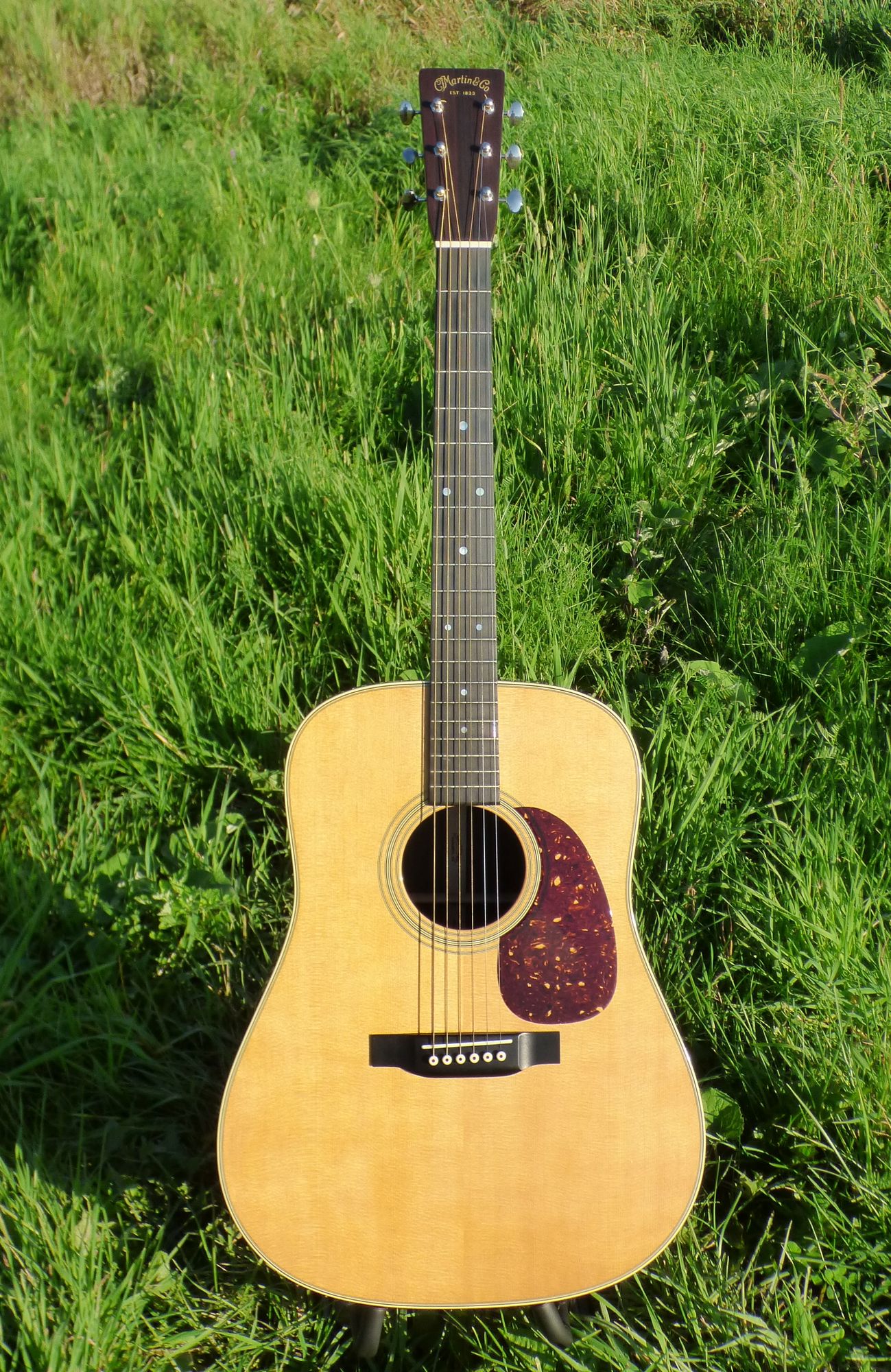
Martin D-28 Acoustic Guitar. Photo by Niranjan Arminius. Licensed under CC BY-SA 4.0. Via Wikimedia Commons. Martin
D-28
1931
You’ve heard a D-28 your whole life. It just never asked for the credit.
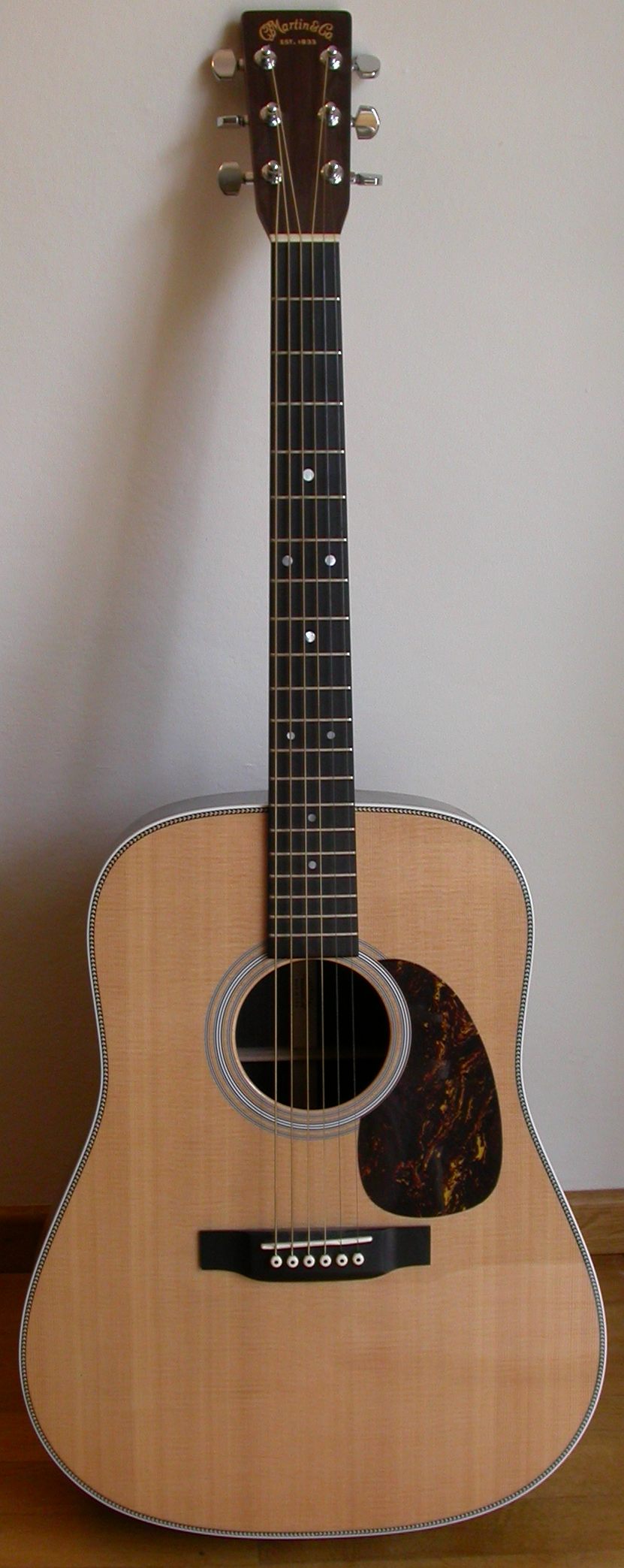
Photo: Maxo / Wikimedia Commons / CC BY-SA 2.5 Martin
HD-28
1976
For almost thirty years, a herringbone Martin meant finding an old one. In 1976 Martin added a letter.
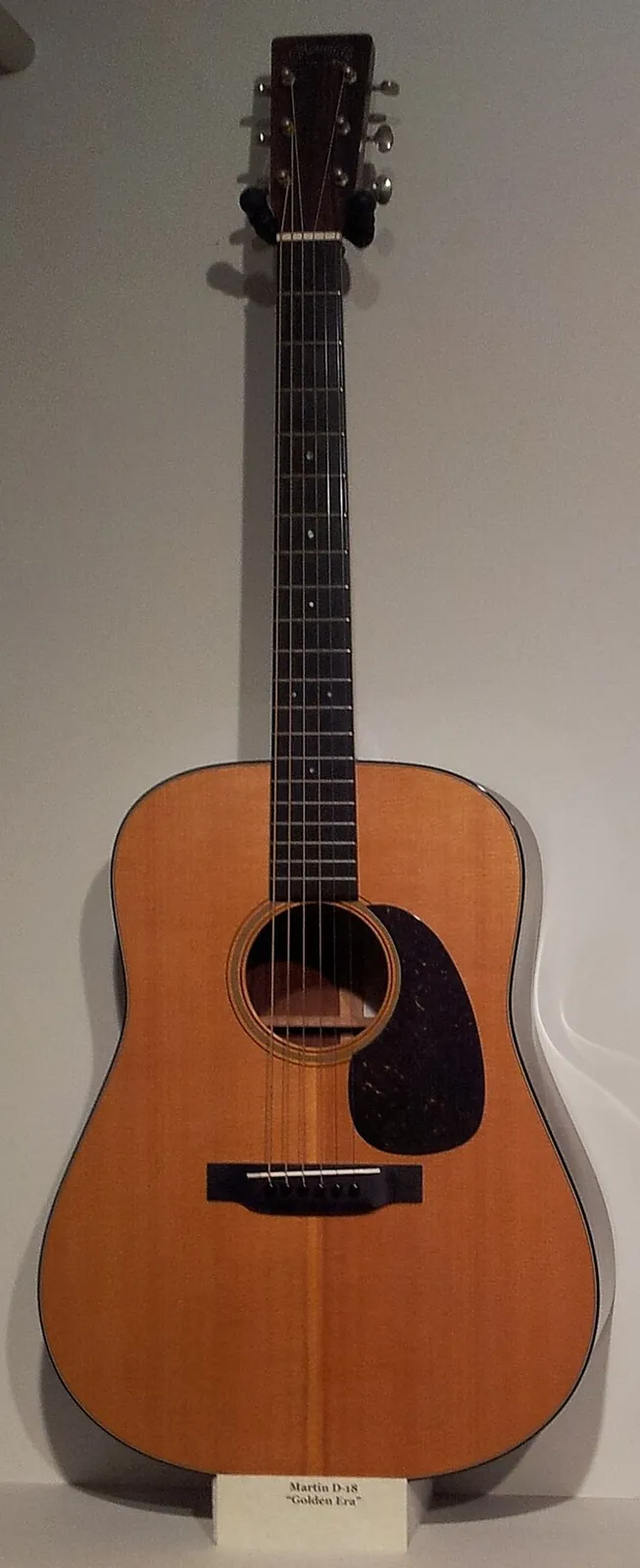
Photo: doryfour / Wikimedia Commons / CC BY-SA 2.0 Martin
D-18
1931
Elvis traded his D-18 up for a leather-covered D-28. The plain one had already been there for the Sun records.