Santa Cruz
Tony Rice
Tony Rice already owned the one guitar he couldn’t replace. Santa Cruz built him one he could.
Santa Cruz, California, 1977 or 1978. Darol Anger walks Tony Rice into a young guitar shop. On Rice’s knee, most days, is Clarence White’s old herringbone Martin. Richard Hoover’s job is to build him something he can take on the road instead.
- Introduced
- 1981
- Type
- Acoustic flat-top
- Class
- Production
Have a photograph of this guitar? Send a picture
The short version
1976
The shop
Richard Hoover, Bruce Ross, and William Davis start the Santa Cruz Guitar Company.
1977
The meeting
The company’s own timeline stamps the meeting 7-77. Rice remembered it as “around 1977.”
1978
The first Tony Rice Model
Rice picks it up on 13 June, with an oversized soundhole.
1981
In the catalog
After thirty or forty requests, the shop adds the model to the standard line. Some price guides say 1990.
2015
The last custom
About a dozen personal Santa Cruz guitars for Rice, from 1978 to here.
2020
Christmas
Tony Rice dies on 25 December.
Side A
A1
The guitar that couldn’t go on the bus
Tony Rice had the guitar. A herringbone Martin D-28 that used to belong to Clarence White. It had an enlarged soundhole, a replaced fingerboard, and some dubious repairs. Nobody is even sure who opened up that hole.
It was also not something you want bouncing around on a tour bus. There is exactly one of it.
So around 1977 or 1978, depending on whose memory you trust, Rice walked into the Santa Cruz Guitar Company, a shop Richard Hoover, Bruce Ross, and William Davis had started in 1976. In Hoover’s telling, it was Darol Anger who brought him in, to play the fourth guitar ever made under the Santa Cruz label.
What Rice needed wasn’t a copy of the Martin. It was a guitar he could replace.
A2
The one he sent back
They measured the Martin. Then they built the first rosewood guitar the shop ever made, for him, and they tried to improve on it. They balanced it. It came out, as Hoover later described it, “like an OM,” even and polite.
Rice sent it back. It ended up at Gryphon in Palo Alto, and Richard Johnston sold it the same day. Hoover says its serial number was d-28, which is the kind of joke you only get to make once.
So they undid the balancing. The next guitar had a bigger soundhole, and here’s the science: a larger hole raises the body’s air resonance, which gives you more treble and midrange. Rice needed that. He was playing David Grisman’s tunes, single-line melodies that had to speak up, not just boom-chick rhythm.
Rice picked up the first named Tony Rice Model on 13 June 1978. He kept that one.
A friendly and familiar package disguising the danger within.
A3
The Trojan Horse
That’s Hoover’s description of it. The guitar looks like the Martin on purpose: square shoulders, herringbone trim, the zipper stripe down the back. From the back of the room it could pass for a D-28. It doesn’t sound like one. The bracing, the neck weight, and the soundhole had all moved so the guitar would speak up for the single-note lines.
Today’s version is Sitka spruce over Indian rosewood, with a 4¼-inch soundhole. The Santa Cruz catalog says plainly that it was never meant as a copy of that D-28.
Flip the record · By the numbers
4¼"
Soundhole diameter on the Tony Rice Model. Enlarged on purpose, for more treble and midrange.
30–40
Calls from players wanting one like Tony’s before the shop gave in and made it a catalog model.
~12
Personal Santa Cruz guitars built for Rice between 1978 and 2015.
1/8"
How much longer the scale was on the 1978 Tony Rice Model than on the Martin.
Side B
B1
One like Tony’s
Then the phone started ringing. Players wanted one like Tony’s. Santa Cruz said no. After thirty or forty of those calls, the shop stopped saying no. In Hoover’s words, “SCGC finally bowed to public pressure and started offering the Tony Rice Model as part of the standard line.”
He dates that to 1981. Some price guides say 1990. I’m keeping both 1981 and 1990 and letting them fight it out.
Rice, meanwhile, kept getting new ones. About a dozen personal customs from 1978 to 2015, each an experiment: the bracing moved, the neck shape changed, the wood thinner or thicker. One of them was a Brazilian rosewood deluxe with double binding that he called “the best one that I’ve had to date.” The later ones were built with less fire and more relief for his joints, after sixty years of the same motion.
B2
Built to be replaced
Here’s what didn’t change. Rice always came back to the Martin. He called it the Antique, or the Herringbone. The Santa Cruz was the complement, the one with more treble and mid for the jazzier material, and the one that could be replaced if a bus door caught it.
Tony Rice died on Christmas Day, 2020. The Martin is its own story, on another page.
The Santa Cruz is still in the catalog, and you can order one tomorrow. Mark Karan bought an early-2000s Signature and made it his main gigging acoustic with Bob Weir’s RatDog. The finish on his is checked from festival sun. That’s what it was built for.
And one last twist. Hoover says the current Tony Rice Model has evolved until it sits closer in tone to that first balanced guitar, the one Rice sent back. The irreplaceable guitar stayed irreplaceable. The replaceable one kept changing until it was everybody’s.
Put this on
You’ve read about it. Now hear it. Here’s what this guitar sounds like, and what to listen for.
Tony Rice on his Santa Cruz
Rice himself, from his Homespun guitar lessons, with a Brazilian rosewood “Tony Rice deluxe model.” He calls it “the best one that I’ve had to date.”
Watch it on YouTube (opens in a new tab)Santa Cruz Tony Rice (Peghead Nation demo)
Mark Karan’s early-2000s Tony Rice Signature, the guitar he gigged with in Bob Weir’s RatDog. Listen to how much treble and midrange it throws for a dreadnought.
Watch it on YouTube (opens in a new tab)
The cast
The people, and the specific guitars, that made the legend.
1978
Tony Rice
About a dozen Santa Cruz customs
Each one an experiment in bracing, neck shape, or wood thickness. The Martin was still the one he came back to.
1978
Richard Hoover
Builder
Co-founder of Santa Cruz. Called the Tony Rice Model a Trojan Horse.
1977
Darol Anger
The introduction
In Hoover’s telling, he walked Rice into the shop to play the fourth guitar ever made under the Santa Cruz label.
Richard Johnston
Sold the reject
The first Santa Cruz Rice didn’t like ended up at Gryphon in Palo Alto. Johnston sold it the same day.
2000s
Mark Karan
Early-2000s Tony Rice Signature
His main gigging acoustic in RatDog, with the nitro finish checked from festival sun.
Liner notes
Specs, construction, rarity, value, and every source we used.
Sitka, Indian rosewood, and a 4¼-inch hole on a square dreadnought — Santa Cruz’s Tony Rice, not the herringbone Martin already on his knee.
- Body
- Square-shoulder 14-fret dreadnought; Sitka spruce top; Indian rosewood back and sides; ivoroid binding; herringbone purfling and rosette; zipper backstripe. Soundhole 4¼" (Miami Vintage 2026 dealer sheet; 2005 SCGC brochure). Japanese Acoustic Guitar Magazine, March 2026: about 108 mm on a Tony Rice D. Mix flagged.
- Neck
- Mahogany (2005 brochure; Miami 2026 sheet — live factory table does not print neck wood), V with volute; solid square peghead, unbound, ebony overlay, no headstock inlay
- Fingerboard
- Ebony, ivoroid bound; SCGC inlay at 12th fret; black side dots; 2-3/16" at 14th fret
- Scale
- 25.375"
- Pickups
- None
- Hardware
- Ebony belly bridge, 2-3/16" spacing; bone nut and saddle; ebony pins with mother-of-pearl dots; nickel Waverlys; tortoise pickguard (TR/D12 shape on the Miami sheet); SCGC mid-tension strings; hardshell case
- Electronics
- None
- Finish
- Clear gloss top and back/sides; clear matte neck. Factory cells do not print nitro. Peghead Nation on an early-2000s example: nitro.
- Nut
- Bone, 1-11/16"
Open the full research fileConstruction details, the complete player record, production numbers, dated value estimates, and sources
Current typical = live factory Tony Rice Signature Model (santacruzguitar.com, fetched 10 September 2026) plus a 2026 Miami Vintage dealer sheet on a new D Tony Rice. Factory inches; no millimetre SKU on the live page. Signature specs are not customizable — custom work goes to the D Model. Tony Rice Professional and 1934D are other cards. Blue Book: 20 frets. Reverb product spec and Elderly on a c. 1997: 21. Don’t average.
Construction
The job was a guitar Tony Rice could take on the road and replace. Clarence White’s herringbone Martin was already on his knee, and it was not coming on the bus.
Santa Cruz Guitar Company. Richard Hoover, Bruce Ross, and William Davis, 1976. The house dreadnought was the D: tapered braces in a box players still expected to boom. Rice wanted something that looked like the Martin and did not copy it. Hoover, Bluegrass Today, 31 December 2020: a Trojan Horse — “a friendly and familiar package disguising the danger within.” Bracing, neck weight, and soundhole size moved so the guitar would speak for Grisman’s single-line writing, not only boom-chick.
Year stack, not a winner. SCGC’s 20,000th-guitar timeline stamps the meeting 7-77. Rice, Homespun Tony Rice Guitar Method: “around 1977.” Hoover’s Bluegrass Today piece has Darol Anger walking him in to play the fourth guitar under the Santa Cruz label. Vineyards Press: he picked up the first named Tony Rice Model on 13 June 1978. Hoover, same remembrance, and Vineyards: about a dozen personal customs, 1978–2015. Keep 1977 and 1978. This header is the catalog year, not the first custom.
The first rosewood guitar the shop built was for him (Hoover, Fretboard Journal via Diamond Guitars). They measured the Martin. Enlarged hole, replaced bound board, dubious repairs. Nobody is sure who opened the hole; Hoover’s most likely story is pick wear dressed round. The first Santa Cruz they handed him was balanced — “like an OM,” he told Acoustic Guitar in 2021 — and he sent it back. Serial on that one, Hoover: d-28. Left at Gryphon in Palo Alto; Richard Johnston sold it the same day.
They undid the balance work. Roger Siminoff on Helmholtz: a larger aperture raises the chamber’s fundamental — here, more treble and mid. The next guitar had the bigger hole. Rice kept it. Players called for one like Tony’s. After thirty or forty of those calls, the shop stopped saying no. 1981: Hoover, same Fretboard Journal interview — “SCGC finally bowed to public pressure and started offering the Tony Rice Model as part of the standard line.” Acoustic Guitar, 23 September 2016: “within three years” of the 1978 approach. Vintage Guitar (Wolf Marshall, June 2021): marketed “since the ’80s.” Blue Book and Reverb print 1990–present. Keep 1981 and 1990. Don’t pick. This header is 1981.
Not the Martin. That guitar is martin-d-28, serial 58957, Clarence White then Rice. Fretboard Journal and this catalog’s D-28 plate: 1935. Hoover and Vintage Guitar: 1934, VG adding “one of only 11 made in 1934, the first year of 14-fret D-28s.” Keep both. Do not hang it here. No Depression: he always came back to the one he called the Antique or the Herringbone. The Santa Cruz was the complement — more treble and mid for the Dawg/Coltrane/Django work, and a guitar you could replace (Hoover, Fretboard Journal). Live factory copy, 10 September 2026: never intended as a copy of that D-28.
Not the Professional. This table: Indian rosewood and Sitka, 25.375", nickel Waverlys, tortoise, SCGC at the 12th, 4¼" hole. Professional: Brazilian, European or German spruce (Blue Book: German), often 25.25" (2005 brochure; Blue Book), hole 4 9/16", gold Waverlys, Dalmatian guard. Reverb: nearly twice the street. Diamond also prints 24.25" for the Professional “just like the d-28.” Conflict with the brochure’s 25.25" and with Diamond’s own 25.25" on the repaired Martin. Keep 25.25". Don’t flatten 24.25" into the D-28.
Not the 1934D. Premier Guitar, 17 June 2009: Adirondack, enlarged hole, dalmatian guard. The Acoustic Shoppe, 2025, on the 2008 NAMM prototype: forward-shifted scalloped X, French polish — closer antique, not the Rice-voiced catalog dread. Not the D Model. Same square box, tapered braces, violin purfle, round-barrel neck. Factory: customize that card. Not a Collings D2H. Austin, herringbone rosewood dread. Same bench conversation. Not this shop.
Live factory recipe, 10 September 2026: Sitka, Indian rosewood, herringbone, zipper, ivoroid, scalloped, V with volute, 1-11/16", 25.375", nickel Waverlys, tortoise, SCGC mid-tension. 2005 brochure: standard-positioned X “for less boom in the bass”; 4.25" hole. Hoover: the current model evolved with Rice and sits closer in tone to the first guitar he didn’t think he liked. Later customs (Bluegrass Today): less fire, more relief for joints after sixty years of repetitive motion.
Players
Do not hang 58957 on this plate. Do not credit Manzanita to a Santa Cruz — Vintage Guitar: Ovation, heard prominently on that record. The Martin was the mainstay for five decades (VG). Named Santa Cruz objects only.
Tony Rice. The guitar this plate is named for. About a dozen personal SCGC customs, 1978–2015 (Hoover, Bluegrass Today). Homespun Tony Rice Guitar Method: a “Tony Rice deluxe model,” Brazilian, double binding, “the best one that I’ve had to date,” in hand about a year as of that taping; relationship “around 1977.” Each one experimental — bracing moved, neck shape, wood thickness. The Deluxe is a personal guitar. It is not the Indian-rosewood Signature on the live page. Album-to-guitar credits that name a Santa Cruz versus the Martin, track by track, are unpublished here. Tone Poems (1994) is vintage instruments, one per track, with Grisman — not this model as a class.
Mark Karan. Peghead Nation (Teja Gerken, 12 February 2025): early-2000s Tony Rice Signature, Indian rosewood, bear-claw spruce, bought from Steve Swan while Karan was in Bob Weir’s RatDog. Main gigging acoustic. Sunrise in the hole. Nitro checking from festival sun. Named object. Which RatDog songs are unpublished here.
Also known to play stays short. Wyatt Rice’s 1990s band was named Santa Cruz; that is a band, not this guitar. Dana Bourgeois’s 2014 tribute (Vintage Guitar) is another maker’s enlarged-hole dread. Norman Blake on a Santa Cruz 12-fret D (Hoover, Fretboard Journal, second Blake & Rice record) is a 12-fret D. Not this card.
Rarity
You can order a new Tony Rice Signature. Current production is not rare. Santa Cruz does not publish Tony Rice unit totals. None invented. Serials date a guitar. They don’t count a year. That is why a first-year census is unknown, not the chapter.
Company output is not a model count. NBC Bay Area, 24 August 2026: more than 20,000 guitars since 1976. SCGC’s 20,000th is a 2026 commemorative H13, not a Tony Rice. Acoustic Guitar, 12 November 2025: a few hundred guitars a year now. Hoover, Fretboard Journal (published toward the 30th anniversary): almost 1,000 a year by 2006. Keep both company figures. Neither is a Tony Rice total.
What is actually thinner: the 1978–81 customs before the catalog line; early labels with Hoover and Ross, some signed by Rice; Brazilian Professional examples. Rice’s dozen personal guitars are unique objects. They are not a vintage Tony Rice Signature. The Professional, the 1934D, and the D Model do not thin this card.
Value
Informal estimate, 10 September 2026. Not an appraisal.
Ask vs sold labeled. Celebrity lots are not-comps. No invented medians or factory counts. Rice’s personal customs sit outside any band.
New street. Named dealer carts this pass, Indian-rosewood Signature, not Professional: Haggerty’s Music (Reverb, 2026 Founder Collection) $7,500. The Loft at Lay’s (2025 Sitka/Indian) $7,599. Northern Lights Music Founder Collection: original $8,460 / current $7,599. Heartbreaker (2025, #8052) $7,995. Organic Sounds list $8,755 / street $7,880. Equipboard, 21 August 2026: new $7,500. Japanese Acoustic Guitar Magazine, March 2026: ¥1,683,000 — yen, not a U.S. cart.
Used modern. Equipboard, same 21 August 2026 snapshot: used $5,200 (three available). Named asks, not hammers: a used Excellent $5,900; a German-spruce example $4,750. Reverb Price Guide exists on Santa Cruz Tony Rice; the dollar widget did not print a band this pass. Flag: thin sold-comp access. Don’t invent a midpoint.
Vintage / collectible. Early catalog and Brazilian examples are a different pile from a guitar you can order tomorrow. Named older asks, not a 2026 series: 1989 Brazilian $6,600 (listing ended, eleven years ago); 1997 German/Brazilian $6,950 (ended). Do not average those asks. Do not price these as pre-war D-28s. Professional new asks sit roughly double the Signature on Reverb’s own keep-apart line; a named Professional ask this pass $19,927. That is the other card. Rice’s Homespun Deluxe and the dozen customs are one-object lots. Not comps.
See also
- martin-d-28 — Clarence White / Rice herringbone 58957; this Santa Cruz is not that guitar
- collings-d2h — Austin herringbone rosewood dread; another shop’s 2-style, not this plate
- martin-hd-28 — Nazareth’s 1976 herringbone-and-scallop revival, not a Santa Cruz
Sources
- Santa Cruz, Tony Rice Signature Model — live factory recipe, 10 September 2026; not a copy of the 1935 D-28; Sitka / Indian rosewood; 1-11/16"; 25.375"; scalloped; herringbone; zipper; V with volute; nickel Waverlys; specs not customizable
- Santa Cruz, D Model — keep-apart: tapered braces, violin purfle, round barrel, customizable sibling
- Santa Cruz, Date Your Guitar — separate serial sequence for Tony Rice & Tony Rice Professional
- Santa Cruz, Milestone Guitars — 7-77 meeting; 20,000th guitar is a 2026 H13
- Santa Cruz, 2005 brochure (jedistar PDF) — Signature: standard-positioned X, 4.25" hole, Sitka, Indian, bone nut/saddle, mahogany neck; Professional: Advanced X, 4 9/16" hole, 25.25", Brazilian, European spruce, gold tuners
- Richard Hoover, Bluegrass Today, 31 December 2020 — 1978–2015 dozen customs; Trojan Horse; 1934 Martin in Hoover’s telling; touring replacement for the Quintet
- Hoover, Fretboard Journal via Diamond Guitars — 1976 founding; first rosewood guitar; serial d-28 prototype sold at Gryphon; Helmholtz / Siminoff; catalog 1981; 4¼" vs 4 9/16"; current model closer to the rejected first guitar
- Acoustic Guitar, 23 September 2016 — within three years of the 1978 approach, first important signature guitar
- Acoustic Guitar, 12 November 2025 — few hundred guitars a year; demand for “the Tony Rice guitar” put the model in the lineup
- Acoustic Guitar, 3 December 2021 — Hoover on the first prototype, more balanced, like an OM
- Vintage Guitar, Wolf Marshall, Fretprints: Tony Rice (June 2021) — Santa Cruz marketed since the ’80s; Sitka / Indian; not a copy of the D-28; Ovation on Manzanita; Martin mainstay; died 25 December 2020
- Peghead Nation, Teja Gerken, 12 February 2025 — Mark Karan early-2000s Signature; RatDog; Steve Swan; nitro
- Homespun / SCGC clip, Tony Rice on his Santa Cruz — “around 1977”; Deluxe, Brazilian, double binding
- Vineyards Press, The SCGC Tony Rice Model Guitar — 13 June 1978 pickup; oversized hole; 1/8" longer scale on that first Santa Cruz vs the Martin; dozen customs 1978–2015
- Reverb, Santa Cruz Tony Rice — years of production 1990–present; Professional keep-apart (German / Brazilian, nearly twice street); Price Guide widget no dollar band this pass
- Blue Book of Guitar Values, Santa Cruz Tony Rice Model — mfg. 1990–present; Professional variant 25.25", German, Brazilian, 1990–present
- Miami Vintage Guitars, D Tony Rice Model Brand New 2026 — 4-1/4" soundhole; mahogany; ebony board/bridge; 2-3/16" spacing; Waverly nickel; Sitka/Titebond scalloped
- The Loft at Lay’s, 2025 Sitka/Indian — new $7,599
- Northern Lights Music, TR Standard Founder Collection — $8,460 / $7,599
- Heartbreaker, 2025 #8052 — $7,995
- Equipboard, Santa Cruz Tony Rice — prices updated 21 August 2026; new $7,500 / used $5,200
- NBC Bay Area, 24 August 2026 — company 1976; more than 20,000 guitars
- Premier Guitar, Hands On With Santa Cruz 1934 D, 17 June 2009 — 1934D keep-apart
- The Acoustic Shoppe, 1934D prototype, 9 October 2025 — 2008 NAMM; Adirondack vs Professional German; not a recreation of 58957
- No Depression, White/Rice guitar excerpt, 16 February 2024 — SCGC collaborations mimic the hole, not copies; he came back to the Antique
- Fretboard Journal, 58957 — White/Rice 1935 D-28; that object lives on
martin-d-28 - Japanese Acoustic Guitar Magazine, March 2026 — Tony Rice D; hole about 108 mm; ¥1,683,000
- Elderly Instruments, Tony Rice Model D c.1997 — 21-fret ebony; 1-11/16"; 25.4" scale; SN 1933R
- Wayback Machine, SCGC Tony Rice page, 2008 — same inches recipe already in the catalog
Keep digging
Guitars this one gets compared to, confused with, or descended from.
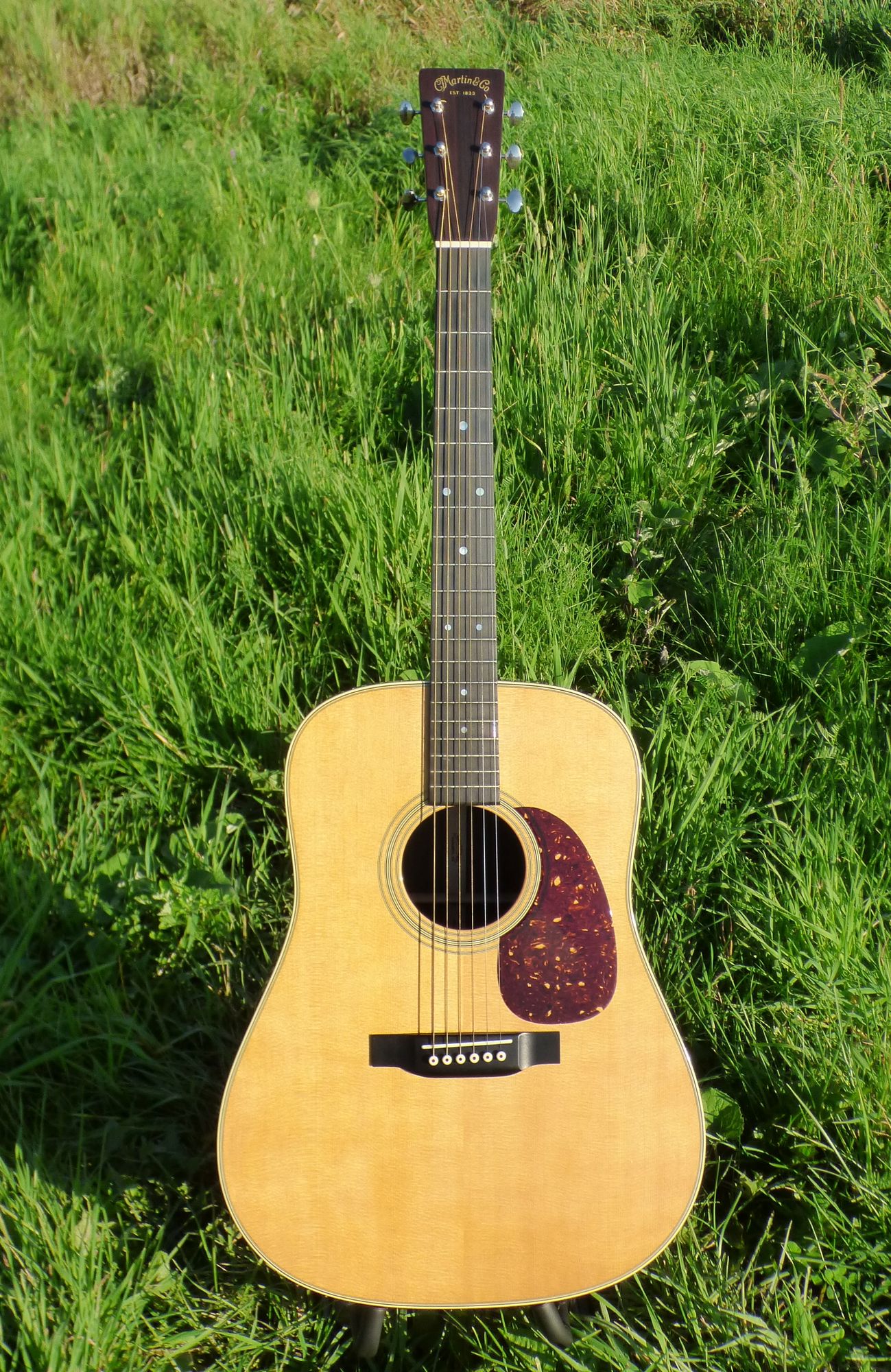
Martin D-28 Acoustic Guitar. Photo by Niranjan Arminius. Licensed under CC BY-SA 4.0. Via Wikimedia Commons. Martin
D-28
1931
You’ve heard a D-28 your whole life. It just never asked for the credit.
- Send a picture
Collings
D2H
1990
No famous owner, no famous record. Just a dreadnought recipe an Austin shop has never stopped making.
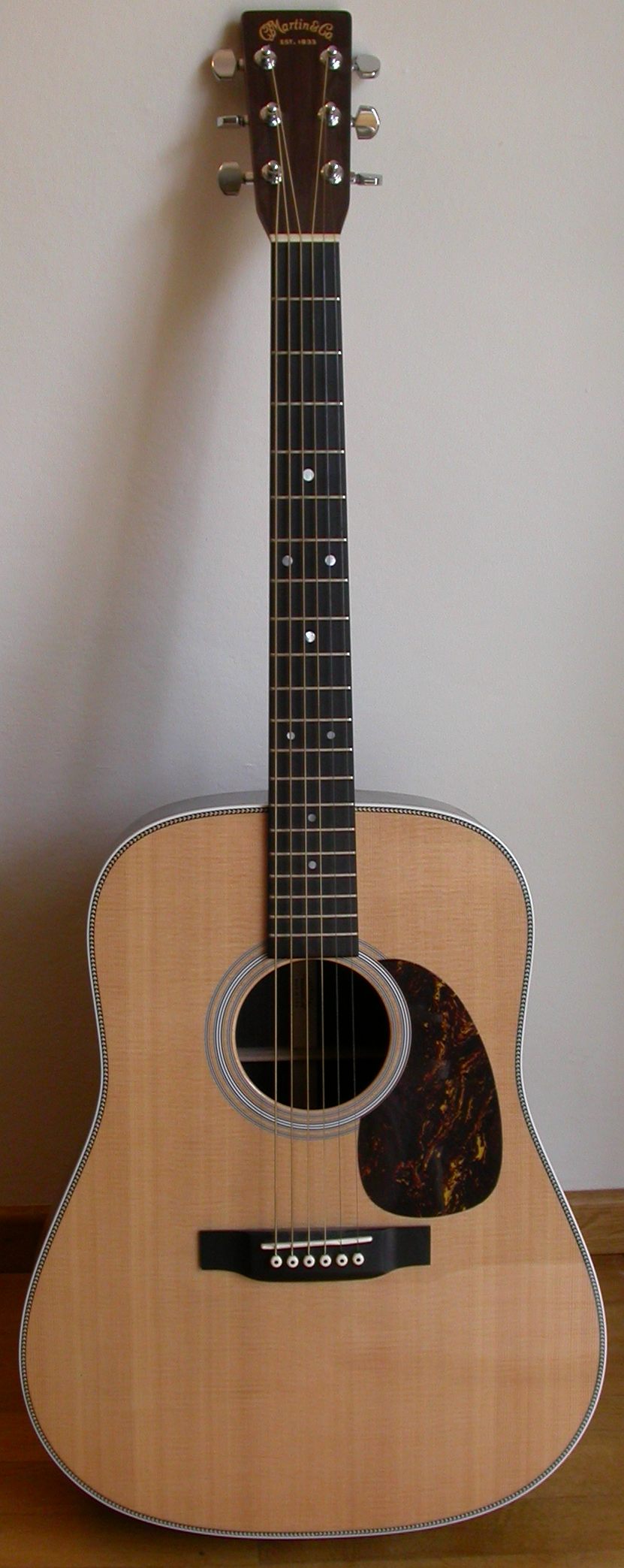
Photo: Maxo / Wikimedia Commons / CC BY-SA 2.5 Martin
HD-28
1976
For almost thirty years, a herringbone Martin meant finding an old one. In 1976 Martin added a letter.