Gibson
J-50
The J-45 with nothing to hide: a bare natural top, five dollars more, and Bob Dylan’s first album cover.
New York, November 1961. Bob Dylan, twenty years old, sits down at Columbia to make his first record. The guitar on his knee is an old Gibson with a plain, pale top and no sunburst to hide behind. A few months later it’s on the album cover, backwards.
- Introduced
- 1942
- Type
- Flat-top steel-string acoustic
- Class
- Production
The short version
1942
A few blond ones
One ledger has the first natural batch shipping on 1 June. Another has J-50s from 7 July. Then almost nothing until after the war.
1947
A regular model
The J-50 settles in as the natural-top companion to the J-45.
1950
Triple binding
A new bridge, and by one account the J-50’s triple-bound top starts here.
1953
Peak year
Gibson ships 1,212, the high point for the plain, non-adjustable J-50.
1961
The first Dylan sessions
20 and 22 November, for the album Bob Dylan, released the following March.
1963
The cover guitar
Davy Graham holds a J-50 on the cover of The Guitar Player. He played a Martin inside.
1964
Durham
James Taylor buys the J-50 he’ll use on his first three albums.
1965
Gone
After a fire in Suze Rotolo’s apartment, Dylan’s old J-50 is nowhere to be found.
Side A
A1
Nothing to hide
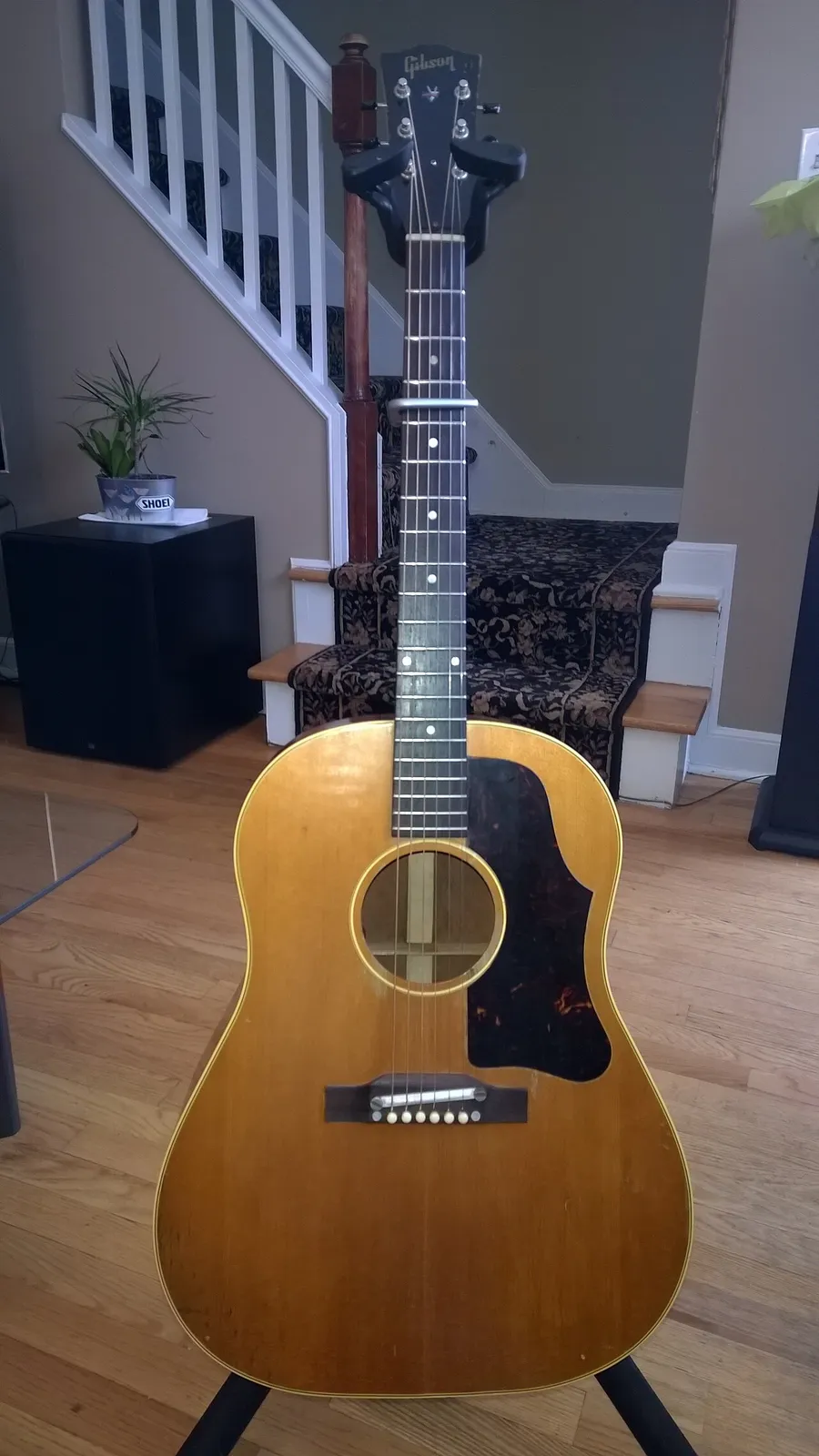
A sunburst finish is a little bit of makeup. Dark around the edges, light in the middle, and any streak or knot in the spruce disappears into the shading. That’s why so many wartime Gibsons wore one.
The J-50 went without. Same round-shoulder mahogany body as the J-45, same size. The difference is the top: left natural, pale spruce with nothing over it. After the war, one history puts it plainly: “identical to the J-45, except the top is natural.”
Leaving the top bare meant using better-looking wood, so it cost more. In 1942 a J-45 was $45 and a J-50 was $5 more, and you can guess where the names came from.
A2
A guitar Gibson wasn’t sure about
The first J-50s are a small mystery. One set of records has a first batch of natural tops shipped on 1 June 1942, to a music shop in Minerva, Ohio, and then none until after the war. Another has a handful of J-50s in the ledger starting 7 July 1942. Some of those early ones might really be J-45s with fancier binding. It’s possible Gibson hadn’t decided whether the natural version was a $45 guitar or a $50 one.
That makes a wartime banner-logo J-50 very rare. One dealer passes along a count of 144 natural jumbos in 1942 and 1943. The factory’s own numbers for those years are question marks.
From 1947 the J-50 became a regular companion to the J-45, and after that it followed the J-45 through every change: block logo, new bridge, bigger pickguard, adjustable saddle, and square shoulders from 1969.
The ’60s were good to it. Gibson shipped 731 adjustable-bridge J-50s in 1961, and 4,729 in 1967, the top of the published table. That’s a lot of bare spruce going out into the world.
Gibson still builds one in small batches in Bozeman: a red spruce top, hide glue, and a pickup inside, meant to feel like the ’50s. It’s a nod to the ’50s, not a 1952.
A3
The backwards cover
In November 1961, Bob Dylan recorded his first album with a 1940s J-50. By one account it was only his second acoustic guitar. Look at the cover of Bob Dylan and check the strings. The photo is flipped, so the headstock wouldn’t hide the Columbia logo. He used the same guitar at the Freewheelin’ sessions.
Nobody agrees on exactly how old it was. One specialist says 1946 or ’47, from the script logo and the bridge. Another says 1947 to 1950, from the pickguard. We won’t pick.
A lot of people think that guitar was a J-45. The historian Walter Carter, writing about a different guitar entirely, set it straight in passing:
Dylan played a J-50, a re-topped Nick Lucas, a J-200 and other guitars, but not a D-28.
The J-50 didn’t stay with him. After a fire in Suze Rotolo’s apartment in October 1965, the old Gibson was nowhere to be found. Rotolo thought it had been stolen. That’s her guess, and it’s the last anyone knows.
Flip the record · By the numbers
$5
The extra it cost over a J-45 in 1942, because a natural top needs cleaner spruce.
1,212
J-50s shipped in 1953, the peak year for the non-adjustable model.
144
Wartime natural jumbos, by a dealer’s count. The factory numbers for those years are blank.
3
James Taylor albums in a row with his J-50, from 1968 to 1971.
Side B
B1
The case he grabbed
In 1963 the British guitarist Davy Graham put out The Guitar Player, and on the cover he’s holding a J-50 from around 1953 or ’54. John Renbourn saw that cover and went and bought a J-50.
Later, Graham told Renbourn the album was actually a Martin. The J-50 was just the guitar in the case he grabbed the night before the photo shoot. So a cover that sent at least one young guitarist out to buy a J-50 was selling a guitar that wasn’t on the record. The J-50 didn’t mind. It photographs well.
B2
Sweet Baby James
James Taylor bought his J-50 in 1964, in Durham, North Carolina. By the late ’60s he’d taken the pickguard off. He has said he used it on his first three albums: James Taylor in 1968, Sweet Baby James in 1970, and Mud Slide Slim and the Blue Horizon in 1971.
Put on Sweet Baby James and listen for the guitar under his voice: plain, woody, nothing dressing it up.
Dylan’s cover was flipped so nothing would get hidden. Taylor took the pickguard off. The J-50 was always the guitar with nothing to hide, and it kept ending up with young songwriters who didn’t have anything to hide behind either.
Put this on
You’ve read about it. Now hear it. Here’s what this guitar sounds like, and what to listen for.
Bob Dylan
The J-50 is on the cover (flipped, so the headstock wouldn’t cover the Columbia logo) and on the sessions. A kid, a natural-top Gibson, and not much else.
Find it on YouTube (opens in a new tab)The Freewheelin’ Bob Dylan
The same J-50 was used at these sessions too.
Find it on YouTube (opens in a new tab)Sweet Baby James
Taylor has said he used his J-50 on his first three albums. This is the middle one, and the guitar had lost its pickguard by then.
Find it on YouTube (opens in a new tab)
The cast
The people, and the specific guitars, that made the legend.
1961
Bob Dylan
1940s J-50, script logo
On the cover of his first album and at the Freewheelin’ sessions. Sources disagree on the guitar’s year, so we won’t pick.
1964
James Taylor
J-50, pickguard removed
Bought it in Durham, North Carolina, and used it on James Taylor, Sweet Baby James, and Mud Slide Slim.
1963
Davy Graham
J-50, about 1953–54
On the cover of The Guitar Player. He later said the album itself was a Martin. The J-50 was the case he grabbed.
1960s
John Renbourn
A J-50, because of that cover
Bought one after seeing Davy Graham holding it.
Liner notes
Specs, construction, rarity, value, and every source we used.
Natural-top round-shoulder sibling of the J-45 — Dylan’s debut cover is this guitar, not a sunburst J-45.
- Body
- Slope-shoulder dreadnought; red spruce top; mahogany back and sides (Gibson groups that wood set with the J-45); red spruce hand-scalloped X-bracing; hide glue
- Neck
- Mahogany, Rounded profile (Gibson: reminiscent of 1950s examples); silkscreen Gibson logo
- Fingerboard
- Rosewood (named in Gibson’s J-50/J-45 wood-set paragraph on this page, not a separate numeric spec table)
- Scale
- Not printed as a number on the Gibson.com sheet fetched this pass. Do not copy 628.65 mm / 24.75" from the J-45 Standard.
- Pickups
- L.R. Baggs HiFi (this Custom Select). Vintage J-50s have none. The discontinued Original Collection 50s J-50 used an L.R. Baggs VTC — a different SKU.
- Hardware
- White button tuners; rosewood bridge named in the same wood-set paragraph. Bridge style not further specified on the sheet.
- Electronics
- Factory HiFi under-saddle system
- Finish
- Antique Natural; gloss nitro is not restated on this sheet
- Nut
- Nut Width / Nut Material labels exist on the page; numeric width was not in the extracted sheet. Do not copy 1.73" TUSQ from the J-45 Standard.
Open the full research fileConstruction details, the complete player record, production numbers, dated value estimates, and sources
Current living SKU on Gibson.com, fetched 25 August 2026: Custom Select J-50 50s with red spruce top, Antique Natural, model DTCRS50HFPSL1105, $3,999. Small-batch Custom Select / Made to Measure, Bozeman — not the J-45 Standard (MCRS45HCS), not a sunburst J-45, and not the Original Collection 50s J-50 (SKU OCRS5050AN, Sitka / VTC / Grover Strap Cream Button), which Gear4music marks DISC. Vintage Banner and 1969–82 square-shoulder J-50s are different instruments — see Construction.
Construction
Natural-top round-shoulder mahogany jumbo. Same 16" class outline as the J-45. The catalog difference is the top: blond / Antique Natural instead of sunburst. Do not hang a Heritage Cherry J-45 photograph on this plate.
First year is a fight. Keep both ledgers. Vintage Guitar (Gruhn/Carter, March 2008): first J-45 shipping entry 17 August 1942; a handful of J-50 listings from 7 July 1942. guitarhq.com: first blond batch shipped 1 June 1942 to Myers Music, Minerva, Ohio; then none until after the war — “making a banner logo J-50 (J-45N) a very rare guitar.” Wikipedia (citing that VG piece): first introduced 1942, continuous production 1947. guitarhq’s year block still titles 1947 as the blond brother’s introduction. tcgakki: banner-logo J-50s exist; first-ship June 1 1942 is enough for them to call it a 1942 guitar. YAML introduced is 1942. Regular companion from 1947. Do not pick 1942-or-1947 as if the other ledger were wrong.
VG: the J-50 would be the natural-top J-45 with a triple-bound rather than single-bound top — and some early J-45s also have triple binding (not standard on the J-45 until 1950), so the first ledger J-50s could be J-45s, or Gibson was unsure whether to price the new model at $45 or $50. Premier Guitar (Stutman): 1942 J-45 at $45, J-50 $5 more because natural needed cleaner spruce. Joe’s Vintage Guitars: same $5 / cosmetic-spruce logic; triple-bound top on the J-50 from 1950. guitarhq: after the war the J-50 is “identical to the J-45, except the top is natural.” Keep the trim conflict.
Wartime natural is scarce. guitarhq: sunburst hid wood flaws; a natural top did not. Banner-era shortages that produced mahogany tops, laminated maple, maple necks, and missing truss rods are documented on the J-45 plate; do not copy that mix onto every J-50. A dealer listing for FON 7117H (Retrofret / Reverb) repeats a wartime shipping claim of 144 natural jumbos (98 in 1942, 46 in 1943). GuitarHQ’s war-year cells for this family are “?”. Treat 144 as a dealer figure, not a Meiners census.
Spec changes otherwise run with the J-45. guitarhq / VG / Joe’s, in outline: 1947 regular natural companion, most still script logo; 1948 block “Gibson”; 1950 upper-belly bridge, triple-bound top (Joe’s dates the J-50 triple-bind here); 1955 shorter unscalloped braces, larger pointed pickguard, 20th fret (Banner boards typically 19); 1956 adjustable saddle optional, standard ~1960–61 (VG 1960; guitarhq J-45ADJ 1956 optional / 1961 standard — do not flatten); 1963 plastic bolt-on bridge; 1969 square-shoulder body, scale 25.5" (J-45 page; Reverb files square-era natural as J-50 Deluxe 1969–1982). Slope vs square is a dating fact, not a vote. VG: 1976 labels lumped J-45/50; in the 1970s only the J-50 outsold the J-45 among Gibson’s large flattops. J-45 discontinued 1982, round-shoulder return 1984. Do not invent a separate J-50 halt year beyond that Reverb Deluxe window and the J-45 halt.
Bozeman from 1989. Current Custom Select is red spruce, hide glue, HiFi, silkscreen logo, white buttons — 1950s reminiscent, not a 1952. Original Collection 50s J-50 was Sitka, VTC, Grover Strap Cream Button, SKU OCRS5050AN. Historic/Murphy Lab Banner recreations, if any, are other SKUs. Vintage Kalamazoo J-50s had no pickup.
Players
This plate owns Dylan’s debut cover. Unsourced “J-45 player” dumps that actually mean a natural jumbo stay off the J-45 page and are not repeated here as a celebrity list.
Bob Dylan — debut-cover Gibson J-50, not a sunburst J-45. Acoustic Guitar: Dylan’s second acoustic was a 1940s Gibson J-50, the guitar on the cover of Bob Dylan; the image is flipped (check the strings) so the headstock would not cover the Columbia logo. Walter Carter (Carter Vintage): in the folk era “Dylan played a J-50, a re-topped Nick Lucas, a J-200 and other guitars, but not a D-28.” tcgakki: script-logo J-50 on that cover; sessions 20 and 22 November 1961, album 19 March 1962; also used on The Freewheelin' Bob Dylan. tcgakki dates the cover guitar 1946–47 (script logo + rectangular bridge; they lean 1946). Ground Guitar: pre-1948 script logo, teardrop guard implying 1947–1950. Do not pick a year. Acoustic Guitar captions a studio still as Dylan recording Another Side of Bob Dylan with the J-50; the same article then assigns Another Side and Bringing It All Back Home to the Nick Lucas Special bought in 1963. Keep both captions. tcgakki, citing Peter MacKenzie and Suze Rotolo’s A Freewheelin' Time: the old Gibson was nowhere to be found after Rotolo’s October 1965 apartment fire; Rotolo thought it stolen. Fire vs theft is her speculation. Later Dylan J-200 (Nashville Skyline cover) lives on the J-200 plate. Later J-45 stage use is often asserted; a named J-45 with year and song was not verified on the J-45 plate and is not upgraded here.
James Taylor — J-50 on the first three albums. tcgakki: Taylor has said he used a J-50 on James Taylor (1968), Sweet Baby James (1970), and Mud Slide Slim and the Blue Horizon (1971); pickguard removed by the late 1960s; he has said he bought it in 1964 (Durham, North Carolina, in the Me and My Guitars tour). Fretboard Journal excerpts quote him buying his own J-50 and using it for his first three albums. That guitar is J-50 territory, not a J-45.
Davy Graham — The Guitar Player (1963) cover J-50. tcgakki: small guard, upper-belly short saddle, about 1953–54. John Renbourn bought a J-50 after that cover (Another Monday). tcgakki: Graham later told Renbourn the album was a Martin; the J-50 was the guitar in the case he grabbed the night before the shoot. Cover instrument ≠ tracking guitar. Do not migrate Martin players here.
Do not dump Buddy Holly’s leather jumbo (J-45), Guthrie’s “This Machine Kills Fascists” Southern Jumbo, Donovan’s J-45, Page’s borrowed J-200, or Richards’s Hummingbird onto this page.
Rarity
Current Custom Select: small-batch, not a numbered census. Original Collection 50s J-50 (OCRS5050AN): no longer a living Gibson.com SKU this pass; used Bozeman examples exist. Bozeman unit counts unpublished.
Wartime / banner natural: scarce. GuitarHQ war-year shipping unknown. Dealer 144 (98+46) is not that census. 1947 restart is the first regular natural companion; script-logo 1946–47 examples are the ones specialist J-50 writing ties to Dylan’s cover — uncommon, not a factory total.
GuitarHQ Meiners-era shipping (not survival, not 1942–47): J-50 1948 683 through 1961 145, with a 1953 peak 1,212 in that non-adj column. J-50 adj from 1956 93 through 1961 731, then 1962–71 1,175 / 2,207 / 3,613 / 4,312 / 3,408 / 4,729 / 3,702 / 2,701 / 3,574 / 3,074. 1967 adj 4,729 is the published peak in that table (J-45 adj that year 5,670). Square-shoulder 1969–82: the commoner vintage natural, less collected than round-shoulder 1947–early 1960s. Adjustable-bridge 1960s sit below scalloped pre-1955 money. Natural 1942 J-45N/J-50 remains the individually scarce object.
Value
Informal estimate, 25 August 2026. Not an appraisal.
Ask ≠ sold. Celebrity lots are not comps.
New street. Gibson.com lists the Custom Select J-50 50s (red spruce, HiFi, Antique Natural) at $3,999 (fetched 25 August 2026). That is Custom Select, not the J-45 Standard ($2,999 on its own plate) and not a Banner original. Original Collection 50s J-50 new street is not a current list this pass (Gear4music DISC). Gibson Certified Vintage 1956 J-50 ask $6,999 — dealer/CPO ask, not a sold.
Used modern Bozeman / Original Collection. No clean Reverb sold histogram extracted this pass (price-guide pages challenged). Do not invent a used-Standard band by copying the J-45 Standard $1,600–$2,500 tape.
Vintage round-shoulder, adjustable 1956–68. Reverb Price Guide J-50ADJ 1956–1968: estimated used $2,329–$4,022 (364 orders, Good to Mint) — a guide band, not a median you should quote as a hammer. Labeled solds on that page include 27 June 2026 Good $2,616 and Very Good $4,359.60; 26 June 2026 Very Good $3,550; 15 May 2026 Good $2,399; 12 May 2026 Very Good $3,000; 5 May 2026 Very Good $2,100; 15 April 2026 Very Good $3,100.
Vintage round-shoulder, Reverb’s 1955–1960 bucket. Guide $2,346–$4,491 (57 orders). Labeled solds: 19 March 2025 Excellent $3,595.50; 11 March 2025 Good $3,500; 29 December 2024 Very Good $2,900; 28 December 2024 Very Good $4,760.09; 25 September 2024 Excellent $4,200; 9 September 2024 Good $3,700; 17 August 2024 Good $1,100. That $1,100 Good is an outlier on the same table, not a floor for a clean 1950s.
Square-shoulder Deluxe 1969–82. Reverb guide $955–$1,873 (142 orders). Labeled solds: 26 June 2024 Very Good $1,400; 24 June 2024 Excellent $1,225; 22 May 2024 Excellent $1,600; 18 May 2024 Good $1,099; 24 April 2024 Good $900; 12 April 2024 Very Good $1,575; 3 March 2024 Good $1,800. Typically the cheap vintage J-50.
Banner / 1942 natural. Public 2024–26 sold series not extracted this pass. Retrofret/Reverb ask on FON 7117H in the mid-five-figures euros (€16,889.23 on the listing fetched as an ask). J-45 banner solds on that plate were $8,074 and $8,500 (2024) — a different model, useful only as a neighborhood, not a J-50 hammer. Dylan’s cover guitar, if it still exists, is a provenance market, not a production comp.
See also
- gibson-j-45 — sunburst round-shoulder sibling; Dylan’s debut cover is not that guitar
- gibson-j-200 — Super Jumbo; Dylan’s Nashville Skyline cover, not the debut J-50
- gibson-hummingbird — 1960 square-shoulder mahogany; not a natural J-50
Sources
- https://www.gibson.com/products/gibson-j-50-50s-with-red-spruce-top-antique-natural
- https://www.gibson.com/products/gibson-50s-j-45-original-vintage-sunburst
- https://www.gibson.com/products/gibson-certified-vintage-1956-gibson-j-50-sn-v6796-10
- https://assets.ctfassets.net/m8onsx4mm13s/5T0Q713fEbGoEoRkxHPkme/2c4d8dcabed21863f8337e680ed469ba/One_Sheet_ACC6P5331
- https://www.gear4music.com/Guitar-and-Bass/DISC-Gibson-J-50-Original-50s-Antique-Natural/39DF
- https://www.guitarhq.com/j45.html
- https://www.guitarhq.com/shippin2.html
- https://www.vintageguitar.com/3457/gibson-j-45/
- https://www.premierguitar.com/features/gear-features/history-of-the-gibson-j-45
- https://www.joesvintageguitarsaz.com/post/identify-vintage-gibson-j45-j50-sj/
- https://tcgakki.com/en/pages/gibson-j-50-history-the-gibson-j-50-and-its-history-with-beloved-musicians
- https://acousticguitar.com/bob-dylans-acoustic-guitars-how-to-emulate-his-sound/
- https://cartervintage.com/blog/how-did-the-d-28-become-the-legendary-d-28
- https://en.wikipedia.org/wiki/Gibson_J-45
- https://en.wikipedia.org/wiki/Bob_Dylan_(album)
- https://www.groundguitar.com/bob-dylan-gear/
- https://www.fretboardjournal.com/features/standard-bearer/
- https://www.youtube.com/watch?v=KVV8xK43nAA
- https://reverb.com/p/gibson-j-50adj-1956-1968
- https://reverb.com/p/gibson-j-50-1955-1960
- https://reverb.com/p/gibson-j-50adj-1969-1982
- https://reverb.com/item/81607621-gibson-j-50-banner-acoustic-guitar-1942-ser-7117h-fon-brown-tolex-hard-shell-case
- https://commons.wikimedia.org/wiki/Category:Gibson_J-50
Keep digging
Guitars this one gets compared to, confused with, or descended from.
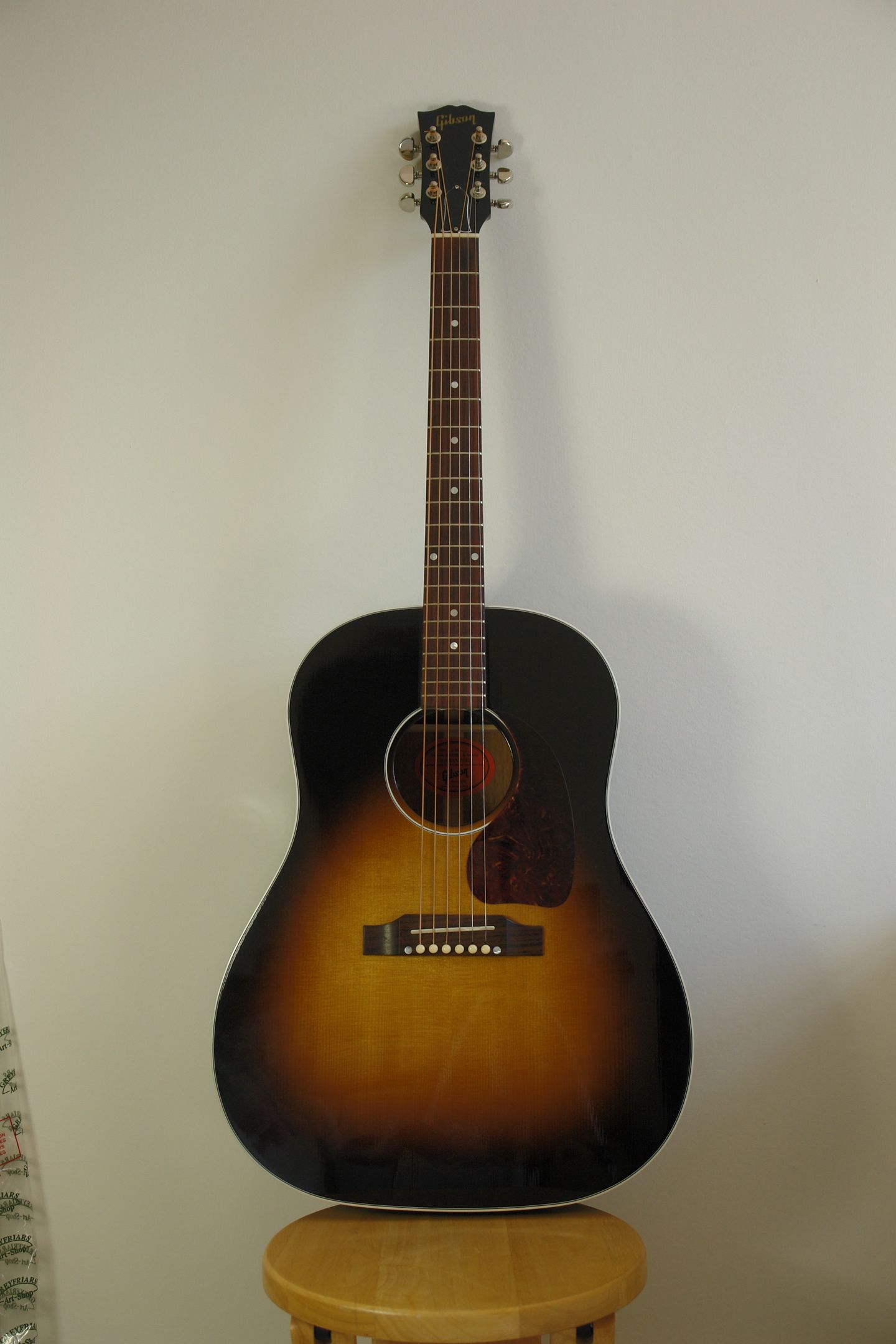
Gibson J-45. Photo by Jim Hutcheson. Licensed under CC BY 2.0. Via Wikimedia Commons. Gibson
J-45
1942
Born in 1942 out of whatever wood a wartime factory could find. Gibson calls it its best-selling acoustic ever.
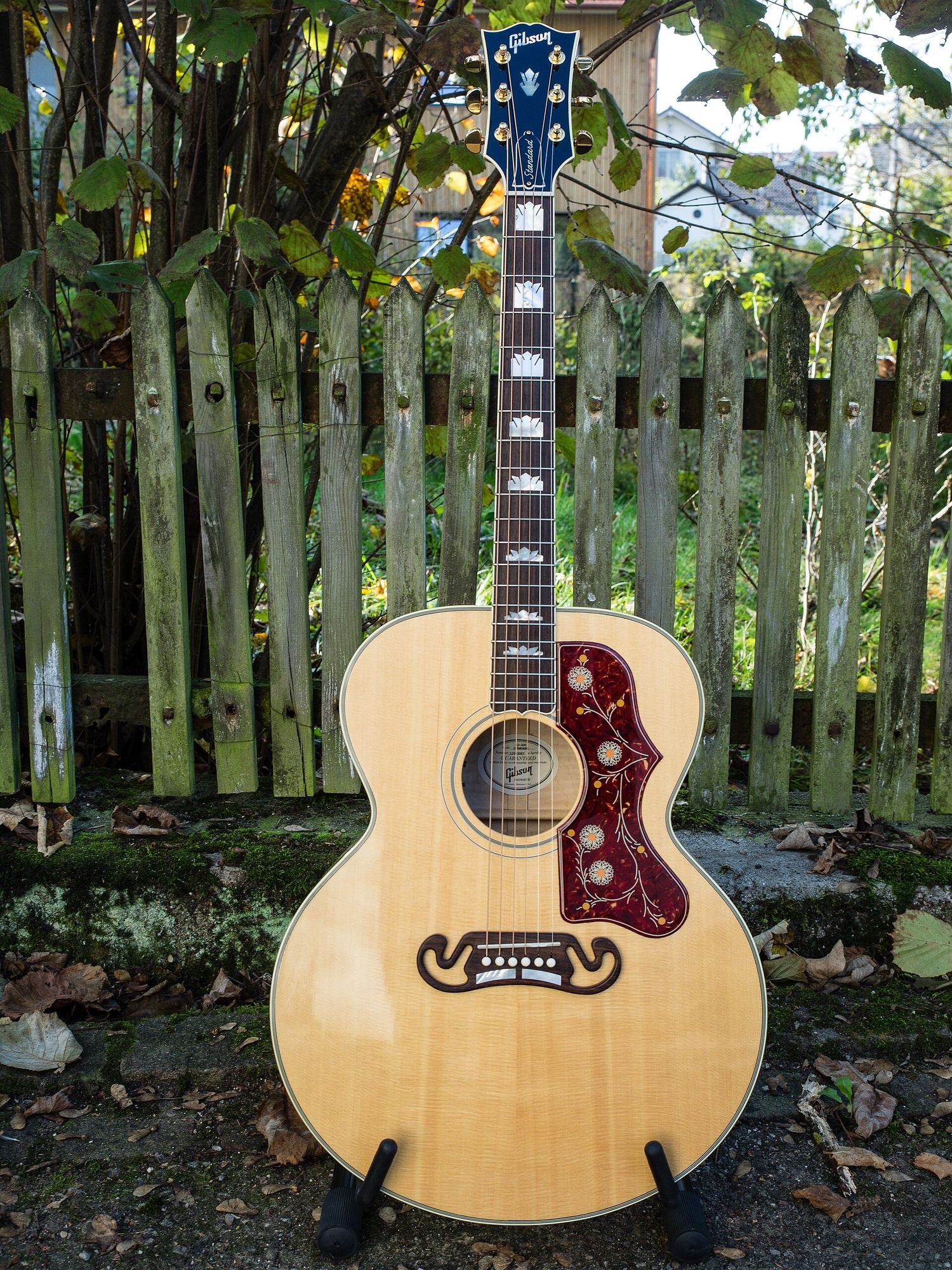
Gibson SJ-200 Standard Acoustic Guitar, Super Jumbo, Antique Natural Finish. Photo by Gibb Stutz. Licensed under CC BY 3.0. Via Wikimedia Commons. Gibson
J-200
1937
Gibson built the first one for a singing cowboy. It has been making people look like stars ever since.
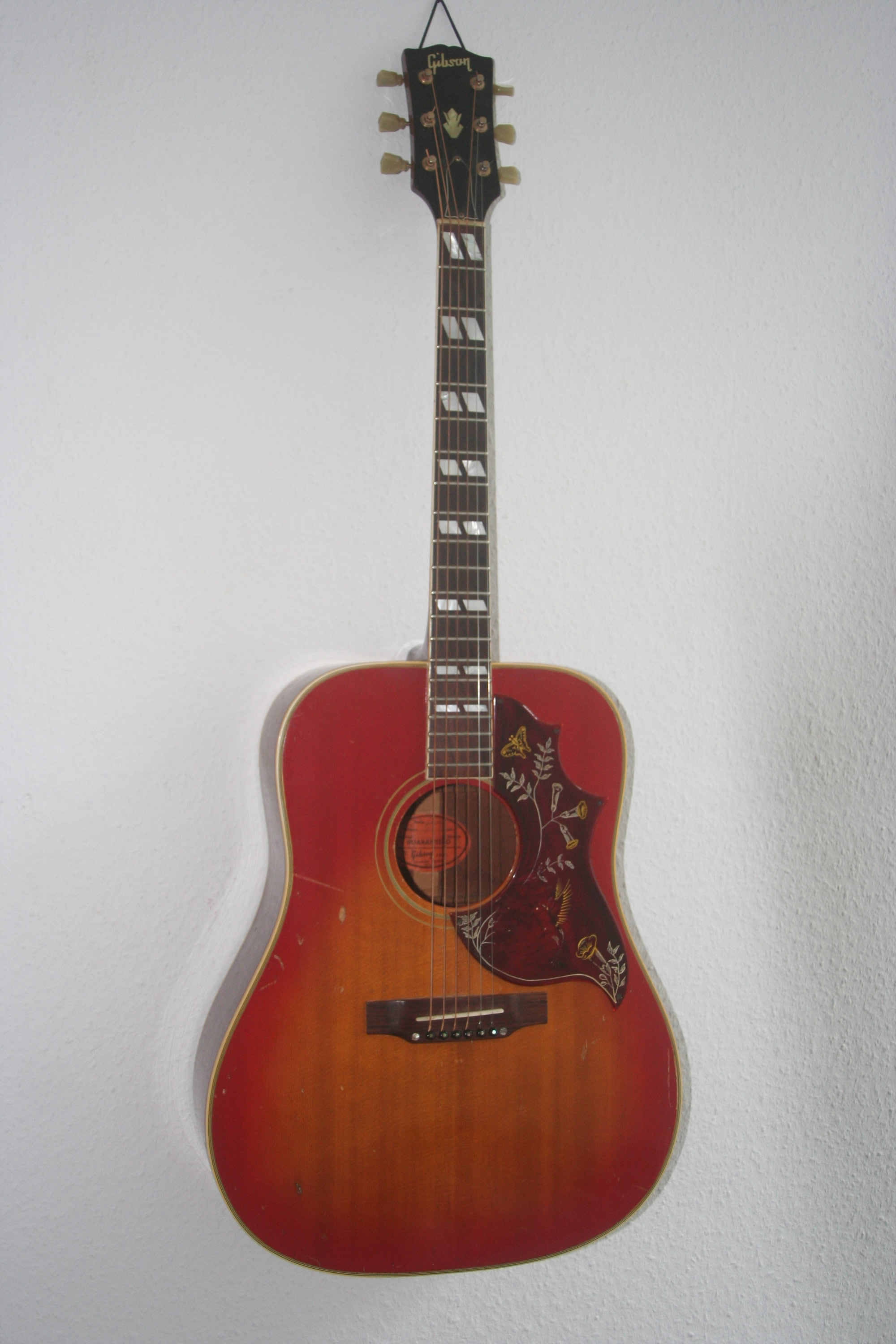
Gibson Hummingbird 1968. Photo by Guitarpimp. Licensed under CC BY 3.0. Via Wikimedia Commons. Gibson
Hummingbird
1960
Gibson gave it a hummingbird on the pickguard. Keith Richards gave it a cassette recorder.