Seagull
S6
Kim Deal liked it because it sounded flat and dull. James Blunt took his to Kosovo.
La Patrie, Québec, 1982. A village in the Eastern Townships, a family that already builds guitars under another name, and a plain job: a solid-top steel-string a working player can afford without pretending it’s a Martin.
- Introduced
- 1982
- Type
- Acoustic flat-top
- Class
- Production
Have a photograph of this guitar? Send a picture
The short version
1972
Norman first
Robert Godin is already building acoustics in La Patrie under the Norman name.
1982
Seagull takes off
Godin launches Seagull as its acoustic badge, and the S6 is the working guitar at the heart of it.
1992
On stage with Kim Deal
Deal starts playing an S6 live with the Breeders.
1993
“Cannonball”
The Breeders’ Last Splash comes out, and the S6 becomes Deal’s guitar in people’s heads.
2006
Blunt and the burst Seagulls
Godin announces James Blunt and builds him custom Seagull 6- and 12-strings for the tour.
2023
Back to the short scale
The S6 Collection 1982 revives the original scale and the old headstock.
Side A
A1
A real guitar on a piggy-bank budget
Some guitars are meant to be taken care of. They live in a case in a closet with a humidifier, and they come out for special occasions. The Seagull S6 was never meant to be one of those.
Robert Godin had been building acoustics in La Patrie, Québec, since 1972 under the Norman name. In 1982 he and some friends started a second brand, Seagull, with a clear idea behind it: take the things people love about an expensive handmade acoustic and put them on a budget a working player could actually manage. (One price guide dates the brand to 1980. Most accounts say 1982.) Necks and bodies still start in that village.
The S6 is the one that stuck. It’s been in production, in one version or another, for more than forty years. That usually doesn’t happen to a guitar by accident.
A2
Cedar, cherry, and a skinny headstock
The top is solid cedar, which is the part that matters most for the sound. Cedar is warm and quick to wake up. You don’t have to beat on it to get it talking, which is why fingerpickers and quiet strummers tend to like it.
The back and sides are laminated wild cherry, three layers of it. Godin pitches cherry as the middle ground between the warmth of mahogany and the brightness of maple, and that’s about right. A laminated back also shrugs off a dry winter or a hot car better than solid wood does, and that matters on a guitar that’s going to get used.
The body is a dreadnought, but a modified one, cut down a little to take off some of the boom. The top has a very slight arch built in, about a seven-metre radius above the soundhole flattening out toward the bridge, according to Godin, so it can stay thin without sinking over the years.
Then there’s the headstock, which is how you spot one across a room. It narrows toward the top, so each string runs straight from the nut to its tuner instead of bending sideways. It looks a little odd. It helps the thing stay in tune.
A3
Flat and dull, on purpose
Kim Deal grew up on Ovations, the bright, round-backed acoustics that were everywhere in the ’70s and ’80s. She didn’t love them. Years later she explained what she liked about the Seagull:
That high, bright, shimmery acoustic sound, I didn’t love that. The Seagull sounds very flat and dull, and I just liked that already.
That’s not an insult. That’s a person who knows what she wants to hear. Deal started playing an S6 Original live with the Breeders around 1992, with an LR Baggs pickup she picked herself, not a factory one. She had it in the “Cannonball” video, and “Cannonball” turned into the song everybody remembers from Last Splash.
Decades later an interviewer said to her, “You’re so associated with the Seagull acoustic you played on Cannonball.” The studio details beyond that aren’t documented, but the guitar people picture is the Seagull.
Flip the record · By the numbers
1982
The year Seagull launched. The design has been in production for more than forty years.
24.84"
The original scale. Today’s S6 Original is 25.5". Nobody has pinned down when it changed.
~7 m
The radius of the gentle arch built into the top above the soundhole, in Godin’s telling.
21
Frets. It’s a strummer’s guitar and doesn’t pretend otherwise.
Side B
B1
The one that went to Kosovo
James Blunt was a British Army officer before he was a pop star, and the S6 was, in Godin’s 2006 announcement, “the first acoustic guitar he actually went out and bought.” It was the personal item Captain Blunt took with him to Kosovo. Many of the ideas for Back to Bedlam, the album that made him famous, were written on it.
You may have heard the story about Blunt’s guitar strapped to a tank. The tellings of that one don’t name the guitar. The Seagull announcement names the S6 as the one that went.
Once he’d made it, Godin built him custom Seagull 6- and 12-strings in a high-gloss burst for the tour. Those aren’t S6s off the shelf. And in later interviews his standard guitar is a 1966 Gibson J-45. The S6 is the one from before any of that.
B2
Two scales and forty years
If you shop for a used one, know this: the S6 has changed length. The early guitars had a 24.84-inch scale, a little shorter and slinkier under the fingers. The current S6 Original is 25.5 inches, a bit tighter and brighter. When exactly it switched, nobody has nailed down, so check the listing.
“Slim” on an S6 means a narrower nut, not a smaller body. In 2023 Seagull brought back the old short scale and the old headstock on a model called the S6 Collection 1982. That’s a tribute, not a 1982 guitar.
What hasn’t changed is the job. It’s a solid-top guitar made to be played rather than protected, and people took it at its word. One of them took it on stage because she liked how flat and dull it sounded. Another packed it for Kosovo and came home with the ideas for an album.
Put this on
You’ve read about it. Now hear it. Here’s what this guitar sounds like, and what to listen for.
Back to Bedlam
Written, not necessarily recorded, on the S6. Blunt says many of the ideas for this album came to him on the guitar he took to Kosovo.
Find it on YouTube (opens in a new tab)
The cast
The people, and the specific guitars, that made the legend.
1992
Kim Deal
S6 Original
Played one live with the Breeders from 1992, with an LR Baggs pickup of her choosing. She liked that it wasn’t shimmery.
2006
James Blunt
S6
The first acoustic he actually went out and bought, and the one he took to Kosovo. His later standard is a Gibson J-45.
1982
Robert Godin
Founder
Started Seagull with friends in La Patrie as the acoustic line next to his Norman guitars.
Liner notes
Specs, construction, rarity, value, and every source we used.
A La Patrie cedar dreadnought with a tapered headstock — Seagull’s working folk guitar, not a Martin D-18 and not a Godin Multiac.
- Body
- Modified dreadnought; pressure-tested solid cedar top; laminated wild cherry back and sides. Factory: lower bout 15.87" (403.1 mm); upper 11.38" (289.05 mm); waist 10.54" (267.72 mm); length 19.8" (502.92 mm); depth 4.9" (124.46 mm). Mix flagged.
- Neck
- Silver leaf maple, integrated set. Dual-function truss (Sweetwater). Semi-gloss.
- Fingerboard
- Rosewood, 21 frets, 16" (406.4 mm) radius (B&H; MusicRadar 406 mm). Mix flagged.
- Scale
- 25.5" (647.7 mm). Mix flagged. Classic S6 and Collection 1982: 24.84". Do not average.
- Pickups
- None on the current Original. QIT / Presys II / Fishman Sonitone SKUs are other guitars on this plate.
- Hardware
- Rosewood bridge; Graph Tech Tusq nut and compensated saddle; 14:1 machines (Musician’s Friend)
- Electronics
- None (Original). QIT: Godin EPM Quantum IT, volume / bass / treble, tuner.
- Finish
- Custom-polished semi-gloss; natural typical. Burnt Umber and Classic Black exist.
- Nut
- 1.8" (45.72 mm) on dealer sheets that copy factory dimensions. Musician’s Friend: 1.805" (45.5 mm). MusicRadar 2018: 45 mm. Mix flagged. Slim: 1.72" (43.7 mm) in the 2006 factory release. Do not average.
Open the full research fileConstruction details, the complete player record, production numbers, dated value estimates, and sources
*Current typical = S6 Original, SKU 046386 (Godin; UPC 623501046386). Factory millimetres from the live S6 Original page. That table omits nut width; dealer copy of the same dimension set prints 1.8" (45.72 mm). Keep the nut split. S6 Original Slim, QIT / Presys II, Classic Black A/E, S6 Folk, and S6 Collection 1982 stay on this plate, not this table. Not a Godin Multiac. Not a Martin D-18. No Gibson SKU. Factory inches and millimetres sit together — mix flagged; no extra millimetres invented.*
Construction
La Patrie, Québec. The job was a solid-top steel-string a working player could buy without pretending it was a Nazareth dreadnought. Robert Godin already had Norman, 1972. Godin’s Canadian-story page: necks and bodies still start in La Patrie, assembly in Princeville or Richmond. Seagull is the 1982 acoustic badge. Wikipedia: founded that year by Godin and friends in the Eastern Townships village. MusicRadar, Ed Mitchell, 13 June 2018: Godin launched Seagull in 1982 to put handmade-acoustic attributes on a piggy-bank budget. Guitar World, NAMM 2023: more than forty years of the S6 design. This plate starts in 1982. Blue Book’s “1980, Godin introduced the Seagull guitar” is a brand-year, not an S6 factory stamp. Keep both.
It is not a Martin D-18 (martin-d-18). Square-shoulder mahogany Style 18, Nazareth, 1931. This is Canadian cedar on laminated wild cherry, a modified dreadnought Sweetwater says is cut to dump some of the boom. Lower bout 15.87" (403.1 mm) against Martin’s classic D 15 5/8". Same folk-dread search. Different factory, different wood, different headstock.
It is not a Godin Multiac (godin-multiac). Two chambers, a thin body, 13-pin synth access, 1993, nylon or steel. Godin’s Canadian-story page names Multiac as the Godin-badge hybrid and Seagull as the acoustic line. Same family. Different object. Do not hang Leonard Cohen’s photographed Godin here.
What you get is a 14-fret flat-top (MusicRadar, 2016) with a pressure-tested solid cedar top and three-layer wild cherry back and sides (Sweetwater). Godin’s copy: wild cherry sits between mahogany warmth and maple brightness. Silver leaf maple neck, “integrated set” — Seagull’s phrase for a glued joint with the neck pitch locked. Tapered headstock for straight string pull. Dual-function truss (Sweetwater). Graph Tech Tusq nut and compensated saddle. Thin custom-polished semi-gloss. Wikipedia’s Seagull architecture page, quoting Godin via Vancouver Music Gallery: a compound-curve top, about a 7-metre radius above the soundhole, flattening toward the bridge, so the top can stay thinner without sinking. That quote is Godin’s. It is not a factory millimetre on the current SKU sheet.
Scale is the change that still trips used listings. Current Original: 25.5" (647.7 mm) on the factory page. MusicRadar 2018: 648 mm (25.5"). The 2006 S6 Original Slim release still printed 24.84" (63 cm) and a 1.72" (4,37 cm) nut — mix flagged, comma and all. Guitar World on the NAMM 2023 Collection 1982: the reissue “touting the S6’s original 24.84" scale.” Keep 24.84 and 25.5. Do not average. Do not invent the week the long scale landed.
Slim is nut width, not a smaller body. S6 Folk is the concert-sized sibling (Elderly on a c. 1995: 15" body, 24-3/4" scale). Not this table. QIT is Godin EPM Quantum IT: undersaddle, volume / bass / treble, tuner. MusicRadar, Dave Burrluck, 20 March 2016, Burnt Umber Q1T: darker stain, new tuners, bolder logo, EPM undersaddle, Adirondack spruce bracing on that tester. Classic Black A/E (NAMM 2020, Guitar.com): Fishman Sonitone. Versions of this guitar, not a second encyclopedia object.
S6 Collection 1982 (NAMM 2023) is the cheaper current SKU with the short scale and retro headstock. Guitar World preorder $599. A tribute. Not a 1982 guitar.
Norman, Art & Lutherie, Simon & Patrick, and La Patrie classicals are other Godin badges. Coastline, Entourage, Maritime, and Artist are other Seagull lines. None of them is this table.
Players
Do not hang a Martin dreadnought or a Godin Multiac on this plate. Do not recruit S6 Folk, Artist Series, or a later Gibson as if they were this guitar.
Kim Deal. Guitar World (Jim Beaugez, 2 December 2025): “You’re so associated with the Seagull acoustic you played on Cannonball.” Deal: she grew up on Ovations and “that high, bright, shimmery acoustic sound, I didn’t love that. The Seagull sounds very flat and dull, and I just liked that already,” then LR Baggs pickups she liked in the 1990s. Breeders Archive: Seagull S6 Original, live from 1992; 1993 photograph. Equipboard: Cannonball video. The Baggs is her pickup, not factory QIT. Cannonball (Last Splash, 1993) is the association. Studio-tracking serial unpublished here.
James Blunt. Godin / Seagull press, Montreal, 26 October 2006: the S6 was “the first acoustic guitar he actually went out and bought”; the personal item Capt. Blunt took to Kosovo; “many of the ideas” for Back to Bedlam composed on it. The same release: Godin then built him Seagull 6- and 12-string models in high-gloss burst for the Back to Bedlam tour. Those tour guitars are custom Seagulls. They are not SKU 046386. Later interviews put a 1966 Gibson J-45 as his standard (Guitar Life, Adam St. James, 2010). Keep the split. Kosovo / first-buy is the S6. The J-45 is a Gibson. Wikipedia’s Blunt page has the guitar strapped to the tank; it does not name Seagull. The 2006 factory press does.
Also known to play stays short. Wikipedia’s Seagull player list names Emm Gryner (Folk S6 Original), Peppino D’Agostino (Artist Series), Sufjan Stevens, and others without citations on that page. Folk and Artist are other objects. None of those names is used here without a named interview.
Rarity
You can buy a new S6 Original tomorrow. Slim, QIT, Classic Black, Folk, and Collection 1982 all coexist as regular Canadian production. Godin does not publish S6 unit totals. None invented. Serials date a guitar (Jedistar quoting Michel Godin, 23 January 2007: year/week/day plus weekly rank on older numbers; 12-digit codes from late 2007 encode product, not a census — 029396 was the Cedar Original without electronics). They do not count a year.
What is actually thinner: early-1980s examples with the original short scale and the old headstock; maple-back outliers (named 1987 ask, not a factory option on the current sheet). Collection 1982 is a current SKU. It is not a 1982 guitar, and it is not scarce. Deal’s photographed S6 and Blunt’s Kosovo guitar are unique objects. They are not a vintage S6.
Value
Informal estimate, 11 September 2026. Not an appraisal.
Ask vs sold labeled. Celebrity lots are not-comps. No invented median or factory count.
New street. Godin.com S6 Original, SKU 046386: $749.00 USD (was $909.00; fetched 11 September 2026). Sweetwater Cedar Original Natural $699.00 (was $749.00). Musician’s Friend Natural $749.00. Collection 1982 NAMM 2023 preorder $599 (Guitar World) is a different SKU, historical list, not this cart.
Used modern. Reverb’s S6 Original Price Guide widget did not print a dollar band this pass (Ireland page: used estimate unavailable). Named used asks, not hammers: 2018–Present Very Good $275; Excellent $519.97; 2002 Very Good $507.25. Sweetwater Gear Exchange Price Advisor, S6 Original Cedar Natural: suggested used $259.00–$307.00 — that page still printed new $399.00, stale against current street. Reverb Price Guide, S6 Original QIT: $320–$511 (112 orders, Good to Mint). Left-Handed Original: $279–$467 (68 orders). Do not average those into an Original-only median.
Vintage / collectible. There is no pre-war tape. Early-1980s S6s trade as used working guitars, not Nazareth money. Named ask, not a hammer: 1987 maple S6 $1,100. A Fair listing of serial 892 as a 1982 first-generation (seller: Godin confirmed) is one object. Not a comps tape. Deal’s Cannonball guitar and Blunt’s Kosovo S6 are artist objects. Not comps.
See also
- godin-multiac — Godin-family chambered nylon/steel hybrid; 13-pin, not this cedar dread
- martin-d-18 — mahogany Style 18 dread people search; Nazareth, not La Patrie
- yamaha-fg180 — another working folk guitar at street money; Hamamatsu jumbo, not a Seagull
Sources
- Godin: S6 Original — SKU 046386; UPC 623501046386; $749 / was $909; pressure-tested cedar, silver leaf maple, semi-gloss; factory millimetres 25.5" (647.7 mm), 15.87" (403.1 mm), 4.9" (124.46 mm)
- Godin: A Canadian story — 1972; La Patrie necks and bodies; Princeville / Richmond assembly; Seagull as acoustic brand vs Multiac as Godin hybrid
- Wikipedia: Seagull (company) — founded 1982, La Patrie; compound-curve top / 7-metre radius and Godin quote via Vancouver Music Gallery; unsourced player list not used for credits
- Wikipedia: Godin Guitars — Seagull as Godin acoustic sub-brand; Multiac as hybrid; 1972 La Patrie
- MusicRadar: Seagull S6 Original review, Ed Mitchell, 13 June 2018 — Seagull launch 1982; 45 mm nut vs Slim 43 mm; 648 mm (25.5") scale; 406 mm radius; wild cherry laminate; tapered headstock
- MusicRadar: S6 Original Burnt Umber Q1T, Dave Burrluck, 20 March 2016 — 2016 refresh; 648 mm (25.5") scale; Adirondack spruce bracing; EPM Q1T
- Guitar World: S6 Collection 1982, Michael Astley-Brown, 15 April 2023 — 40+ years of S6; original 24.84" scale on the reissue; $599 preorder; Godin family / Multiac Mundial named as a different launch
- Seagull Slims Down press, 14 February 2006 — S6 Original Slim 1.72" (4,37 cm) nut; 24.84" (63 cm) scale; 16" (40,6 cm) radius; nitrocellulose; Quantum 1 optional; La Patrie
- Sweetwater: S6 Cedar Original Natural — $699 (was $749); 1.8" nut; 3-layer wild cherry; modified dreadnought; integrated set neck; compound curved top; Tusq; dual-function truss; La Patrie
- Sweetwater InSync: Guitar of the Day, S6 Original, 2 July 2014 — Seagull 1982; S6 Original as first of the line; Quantum 1; Slim 1.72" nut
- Musician’s Friend: S6 Original Natural — $749.00; 1.805" (45.5 mm) nut; 25.5" scale; 21 frets; 14:1 tuners; laminated wild cherry; no pickup; UPC 623501046386
- B&H: S6 Original (MFR 29396) — 25.5" / 647.7 mm; nut 1.8" / 45.7 mm; radius 16.0" / 406.4 mm
- Guitar World: Kim Deal, Jim Beaugez, 2 December 2025 — Seagull on Cannonball; “flat and dull”; LR Baggs in the 1990s
- Breeders Archive: Equipment Guide — S6 Original live from 1992; 1993 photograph
- Equipboard: Kim Deal — Cannonball video, S6 Original
- Godin / Seagull & James Blunt press, 26 October 2006 — S6 as first acoustic purchased; Kosovo; Back to Bedlam ideas; custom 6- and 12-string burst Seagulls for the tour
- Guitar Life: James Blunt, Travelin’ Man, Adam St. James, 2 July 2010 — later standard a 1966 Gibson J-45; not the Kosovo S6
- guitariste.com: Seagull endorse James Blunt, 30 October 2006 — same endorsement; S6 first acoustic; Kosovo; Back to Bedlam
- Jedistar: Seagull dating (Michel Godin email, 23 January 2007) — serial year/week/day; 12-digit from late 2007; 029396 = S6 Cedar Original without electronics
- Reverb: S6 Original — product page; Price Guide dollar widget unpublished this pass
- Reverb: S6 Original QIT Price Guide — $320–$511 used, 112 orders Good to Mint
- Reverb: S6 Original Left-Handed — $279–$467 used, 68 orders; typical new $749
- Sweetwater Gear Exchange: used S6 Original Cedar Natural — suggested used $259–$307; page still printed new $399
- Guitar.com: S6 Classic Black A/E, NAMM 2020 — Fishman Sonitone; blackwashed wild cherry
- Elderly: S6 Folk c. 1995 — Folk is 15" body / 24-3/4" scale, not the dreadnought table
- Blue Book of Guitar Values: Seagull — 1980 as Godin’s Seagull introduction (brand-year, not an S6 factory total)
- Reverb: Vintage Seagull S6 Maple 1987 — named ask $1,100; not a current factory option
- Reverb: Seagull S6 serial 892 — Fair listing as 1982 first-generation; seller: Godin confirmed; one object
Keep digging
Guitars this one gets compared to, confused with, or descended from.
- Send a picture
Godin
Multiac
1993
A nylon-string guitar that can stand next to a drummer, and talk to a synthesizer while it’s at it.
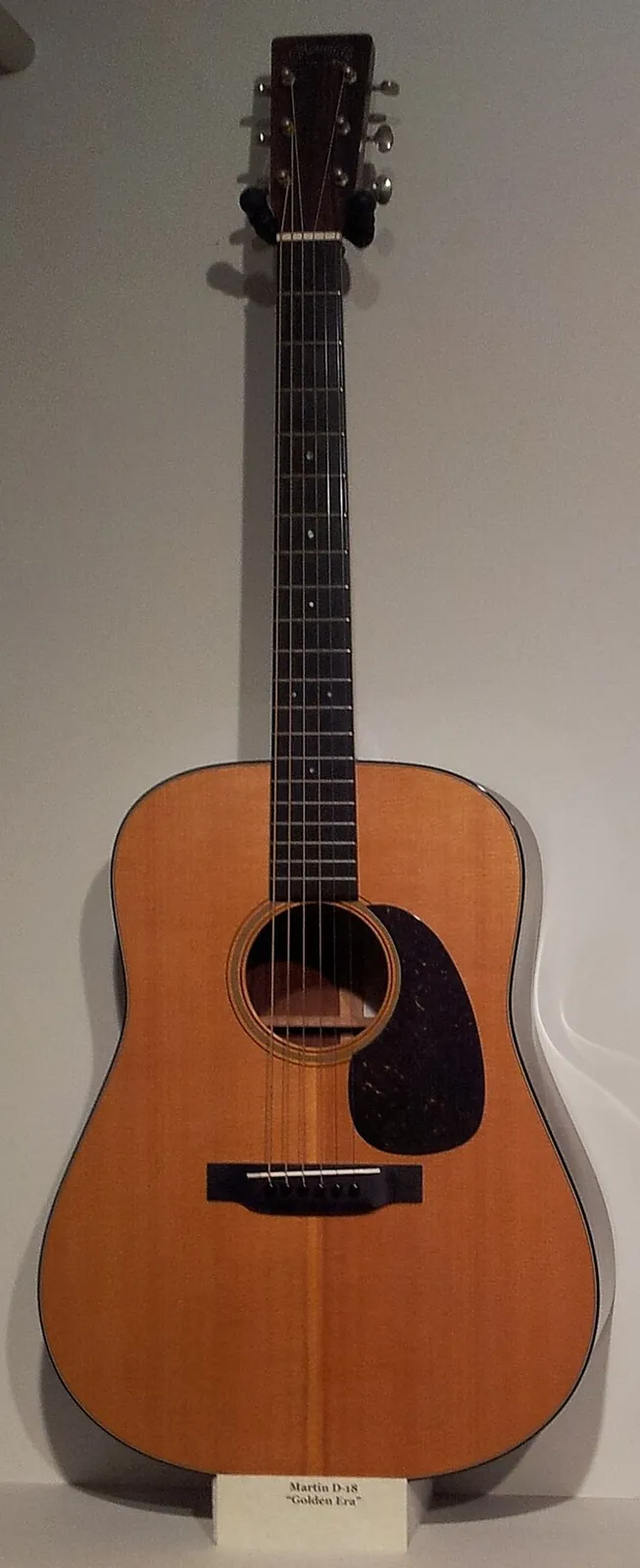
Photo: doryfour / Wikimedia Commons / CC BY-SA 2.0 Martin
D-18
1931
Elvis traded his D-18 up for a leather-covered D-28. The plain one had already been there for the Sun records.
- Send a picture
Yamaha
FG180
1966
Built to survive a ship’s hold. Decades later, the photos put one in Elliott Smith’s hands at the Oscars.