RainSong
WS1000
A physicist watched rain hit a wedding guitarist on Maui, and built a guitar with no wood in it.
RainSong spent years making graphite guitars that still had braces like wooden ones. In 1999 the company cut its line down to a single model with no braces at all. The WS1000 was the guitar it kept making until the doors closed.
- Introduced
- 1999
- Type
- Acoustic-electric flat-top
- Class
- Production
Have a photograph of this guitar? Send a picture
The short version
1980s
Rain at a wedding
At an outdoor wedding on Maui, physicist John Decker watches the rain come down on the hired guitarist.
1994
Production on Maui
Full production facilities open in December. The company's founding is dated anywhere from 1982 to 1995.
1996
A dozen models
The Maui shop makes graphite guitars from classicals to basses.
1998
Projection Tuned Layering
Ashvin Coomar becomes president and works out, with Decker, a graphite top that needs no braces.
1999
One guitar
RainSong narrows its line to the WS1000. Some of the earliest are dated 2000.
2001
The mainland
The shop leaves Hawaii, for Woodinville, Washington, or for Oregon, depending who you ask.
2023
Closing the doors
On 8 November RainSong announces that its owner is retiring and it will close in the coming months.
Side A
A1
Rain at the wedding
Sometime in the 1980s, John Decker was at an outdoor wedding on Maui when it started to rain. The hired guitarist got wet. So did his guitar.
Decker was a physicist. Most people at that wedding would have worried about the cake. The job he gave himself was a guitar that could stay out in the weather.
He started a company, Kuau Technology, and put together a team: Decker, a luthier named Lorenzo Pimentel, and a composites man named George Clayton. They called their test guitars RainSong.
A2
Graphite, braced like wood
The early RainSongs were graphite and epoxy, with a Kevlar mesh in the body and a neck over a foam core, laid up in a steel mold and cured with heat and vacuum. By 1996 the Maui shop was making about a dozen models, from classicals to basses.
When the company actually started depends on which date you trust. Research from 1985, full production facilities on Maui in December 1994, graphite guitars since 1995. One reference says 1982.
But under the carbon, those first guitars were built like wooden ones, with traditional bracing. They were graphite guitars pretending to be spruce guitars.
A3
One guitar
In 1998 Ashvin Coomar became president, and with Decker he worked out what they called Projection Tuned Layering. It was a way of layering the graphite so the top needed no braces at all.
Then in 1999 RainSong did something most guitar companies never do. It cut its line down to one guitar, the WS1000, on that new top. The company later called it "our first carbon fiber guitar to feature Projection-tuned Layering." By late 2000 the rest of the line was using the same idea.
The first year is a little loose. RainSong calls the original the 1999. One owner's guitar was made in April 2000, and the factory told him it was an early batch, with a blank headstock and the logo at the 12th fret. Another owner says he bought his in the mid-1990s.
Don't ask what WS stands for, either. RainSong's own page called the shape "RainSong's Signature Guitar" and never spelled out the letters.
Flip the record · By the numbers
0
Braces under the top or anywhere in the body. The layered graphite does the bracing's job.
1
Model in the line in 1999, after RainSong cut everything else.
5"
Deep at the tail, in a single-cutaway body.
$2,245
The price on a 2002 magazine review of the WS1000.
Side B
B1
No braces, no truss rod
Look inside a WS1000 and there's nothing to see. No braces under the top, none in the body. It's a deep single-cutaway, 5 inches deep at the tail, in woven graphite with an abalone rosette and sharks down the board.
The original neck, later called the N1, was a thin graphite neck with no truss rod, because graphite doesn't bow with the weather and the board was cast with the neck in one piece. Later, the N2 profile added a rod anyway. One longtime owner says that was partly because people worried about not having one. Steve Miller and luthier John Bolin are credited with that neck.
RainSong's own words for the Classic series were "Crystalline Clarity." There's a saddle pickup in it, and on some, a mic inside.
A 2002 review listed it at $2,245. By then the company was moving to the mainland, to Woodinville, Washington, or to Oregon, depending which account you read.
B2
The doors close, the guitars don't care
On 8 November 2023, a post on Coomar's site was titled "RainSong is Closing Our Doors." The owner was retiring. Every model was discontinued. Once the last guitars in stock and in process were gone, there would be no more. Near the end there was a short run of an "Original 1999" reissue, with the old N1 neck.
Ralph Flynn says every acoustic sound on his record Through the Years is either his WS 1000 or his twelve-string WS 3000. He doesn't say which songs are which. On a record like that, it hardly matters.
You can't order a new one. The company that made it is gone. But a used one still turns up now and then, no braces, no wood, a guitar built for a rainstorm on Maui.
Put this on
You’ve read about it. Now hear it. Here’s what this guitar sounds like, and what to listen for.
Through the Years
Flynn says every acoustic guitar sound on the record is his WS 1000 or his WS 3000, a twelve-string. He doesn't say which is which.
Find it on YouTube (opens in a new tab)RainSong WS1000 anniversary custom demo
A demo for Acoustic Guitar, on the one-off WS 1000 the magazine had made for its tenth anniversary in 2000. Raindrops on the board instead of sharks.
Watch it on YouTube (opens in a new tab)
The cast
The people, and the specific guitars, that made the legend.
1980s
John Decker
Founder
A physicist who saw rain hit a guitarist at a wedding and formed a company to build one that wouldn't mind.
1998
Ashvin Coomar
Co-developer of the brace-free top
President from 1998. The 2023 closing notice went up on his site.
2021
Ralph Flynn
A WS 1000, and a WS 3000
Says every acoustic sound on Through the Years is one of the two.
2020
Pete Madsen
The Acoustic Guitar 10th-anniversary custom WS 1000
Played it on camera for the magazine. A demo, not his record guitar.
Liner notes
Specs, construction, rarity, value, and every source we used.
No wood and no braces in a deep single cutaway — RainSong’s WS1000, an all-graphite flat-top, not Ovation’s carbon-capped roundback.
- Body
- All-graphite top, back, and sides. Deep single-cutaway WS shape. Round soundhole, abalone rosette. No top braces and no body braces.
- Neck
- All-graphite, bolted on Christopher Cozad’s 1999 and in Earl49’s general note. N1: no truss rod. N2: a modified U with a truss rod at the headstock.
- Fingerboard
- Epoxy or composite, cast with the neck. Shark inlays. Neck joins at the 14th fret. 21 frets.
- Scale
- 25.4" on guitar-list and on dealer sheets that print a scale. Earl49’s N1 note: 25.5". Mix flagged. Do not average. Do not invent millimetres for either figure.
- Pickup
- Saddle pickup. Vintage Guitar’s review guitar also had an internal mic, in a Fishman Blender.
- Hardware
- Chrome Gotoh, 1:18, on Guitar Gallery’s classic. Tusq saddle. Abalone-inlaid Tusq pins on that listing. The 2000 Acoustic Guitar custom has chrome Schaller.
- Electronics
- Onboard preamp, and not one part. Element on the 2006 sheet and on Blue Book’s card. Fishman Prefix Plus-T on the 2009 sheet and on Guitar Gallery’s classic. LR Baggs Stagepro Element on the reissue.
- Finish
- High-gloss UV-protective urethane (Vintage Guitar; Guitar Gallery). Guitar-list also prints polyurethane, in black or blue.
- Nut
- Tusq. Vintage Guitar: 1 3/4". Dealer sheets print 1.75". Dream Guitars’ 2022 CO-WS1000N2 prints 1.68 in (43 mm) — that pair is the Concert guitar, not a conversion of 1 3/4". Mix flagged.
Open the full research fileConstruction details, the complete player record, production numbers, dated value estimates, and sources
Classic living example = the all-graphite Classic Series WS1000: woven carbon, Projection Tuned Layering, sharks, a 14-fret neck. Blue Book’s card says manufacture 2000–present and Element electronics. The company’s own reissue copy calls the original the 1999 WS1000. YAML introduced: 1999 is that catalog year. It is not a vote that every early guitar left in 1999. WS3000 is the 12-string. WS9000 (2000–06) is nylon. WS1100 on the 2006 sheet is the pure-acoustic sister. A-WS1000 (2005–08), H-WS1000N2, S-WS1000N2, BI-WS1000N2, CO-WS1000N2, and CH-WS are other series on the same body letters. Not this table. Nothing to order new. Standalone. No Gibson SKUs. Mixed inch/mm flagged. Do not average 25.4" with 25.5", or 15.5" with 15.75" with 15.8". Do not invent millimetres for an unpaired inch.
Construction
The job was a flat-top that could stay out in the weather. Honolulu Star-Bulletin, 1 April 1996: physicist John Decker was at an outdoor wedding on Maui “a decade ago” when rain hit the hired guitarist. He formed Kuau Technology. The design team Blue Book names is Decker, luthier Lorenzo Pimentel, and composites man George Clayton. The Star-Bulletin puts Pimentel and Sons in Albuquerque and Clayton at BI-MAR in California. What they built then was graphite/epoxy with a Kevlar mesh in the body, and a graphite/epoxy neck over a foam core, laid in a steel mold and cured with heat and vacuum. House luthier: Mike Rock. They called the test models RainSong. That 1996 shop was already a dozen models, classical through “Tennessee flat-tops” to basses. It is not yet this plate.
Blue Book: research from 1985, full production facilities on Maui in December 1994, first generation on traditional bracing, a full range by 1997. Vintage Guitar’s WS 1000 review says the company had been building graphite/epoxy instruments since 1995. Wikipedia’s infobox prints founded 1982 on an article that asks for citations. Keep 1982, 1985, December 1994, and 1995. Do not collapse them.
The WS1000 is the guitar they kept. Blue Book: in 1998 Ashvin Coomar became president. With Decker he developed Projection Tuned Layering. In 1999 RainSong narrowed the line to one offering, the WS1000, on that new top. By late 2000 other models used the same idea. The company’s reissue copy, on its own Reverb listing: the original WS1000 Classic was “our first carbon fiber guitar to feature Projection-tuned Layering,” and the reissue is named Original 1999. Blue Book’s model card and guitar-list both date manufacture 2000. Christopher Cozad writes up a neck reset on his 1999 WS1000. George Seaton, under Aaron Short’s review: his was made in April 2000 and bought that May, and Dave Coram at RainSong called that an early batch — blank headstock, logo at the 12th fret, dueling sharks later. Chris Hughes says he bought his from East Coast Music in Danbury in the mid-1990s. A Reverb seller dates one Kihei guitar 1990. Keep 1999, 2000, the mid-1990s claim, and the seller’s 1990. YAML is the 1999 catalog year. It does not erase the others.
What “WS” means is the other trap. No catalog in this pass expands it as wing. RainSong’s own page, archived 19 October 2017, calls WS “RainSong’s Signature Guitar,” a body beside DR, JM, OM, and PA, and does not spell the letters. Premier Guitar (Adam Perlmutter, 24 November 2017) says the same: “signature body shape, the WS,” deep, 5" at the deepest. Reverb’s product title for the CO-WS1000N2 glosses it “Concert Wind Song.” Blue Book keeps a separate WindSong line — 12-fret and 14-fret, jumbo single-cutaway, the 12-string dated 1997–2003 — and a different card for the WS1000. Letters in front of WS are the series. RainSong’s 1 January 2006 price sheet files the WS1000 under Classic. An Acoustic Guitar Forum note (19 July 2016) says the letters in front of WS name the series — CO Concert, BI Black Ice — and that no letters, on his JM, means Classic. The 2017 factory page’s words for Classic are “Crystalline Clarity.” Concert is “Warm Tone,” and that line’s copy says a unidirectional top. Earl49, 7 July 2016: early Maui tops were unidirectional and cost more; production WS1000s went to a woven top; the shop later brought unidirectional back. The reissue copy specifies a woven soundboard. Keep unidirectional early, woven classic, unidirectional again on Concert. Do not average them into one cloth.
Vintage Guitar’s review guitar is the one to picture. Single-cutaway “jumbo dreadnought.” Woven graphite. Projection tuned layering, so no braces in the body or on the soundboard. Graphite/epoxy neck, 21 nickel-silver frets, 1 3/4" Tusq nut. Abalone rosette, mother-of-pearl sharks, high-gloss UV urethane. Fishman Blender: a saddle pickup and an internal mic. Price on that page, dated 30 July 2002: $2,245. Blue Book’s card says 14/21, sharks, abalone, Element electronics, all-graphite top, back, sides, and neck. Guitar-list: 25.4" scale, 5" deep, neck at the 14th, epoxy board, Tusq, Gotoh, black or blue. Guitar Gallery’s black classic: Performance Shape Casting of neck and epoxy board as one piece, no truss rod, Gotoh 1:18, Fishman Prefix+T, abalone-inlaid Tusq pins, hardshell case.
The neck got a second profile. Music & Arts, carrying RainSong’s copy: the N1 is the original low-profile six-string neck, pre-engineered, no truss rod. The N2 is “an extensive, long-term collaboration” with Steve Miller and luthier John Bolin, a modified U, truss rod accessible from the headstock. Audiofanzine, 9 January 2011, prints the same credit on the Studio Series. RainSong’s copy: graphite does not bow with the weather, and the rod is there so you can set relief. Earl49, 5 January 2025: N1 was named only once a second profile existed; he puts it at 1.75" nut, 1.5" string spacing, 25.5" scale, 14-fret join, thin, no rod. He says N2 came when the molds wore out, thicker, with a rod you can see by the cover on the peghead, partly because people worried about the missing one. He calls necks bolt-on, which matches Cozad’s 1999: the neck bolts, and the fretboard extension is bonded to the top. Cozad’s title says NS1. Earl uses NS for a short-scale N2, 24.9", on OM and parlor. Keep NS1 and N1. Do not rename Cozad’s neck.
Dimensions do not sit still on the page. Depth at the end pin is 5" on guitar-list and on the dealer sheets below. Lower bout: 15.75" on Earl’s tape and on RainSong’s CO-WS video; 15.8" on Musician’s Friend’s BI-WS1000N2; 15.5" on ProSoundGear’s CO-WS sheet; Dream Guitars’ 2022 CO-WS1000N2 prints 15.625 in, upper 11.475 in, heel depth 4.125 in, tail 5 in, length 19.5 in, scale 25.4 in (645 mm), nut 1.68 in (43 mm). RainSong’s own CO-WS video prints 11.5" / 15.75" / 9.25" / 5" / 19.5" (upper bout, lower bout, waist, depth, length) and a 1.75" nut. Earl’s tape of a WS on the wall: upper 11.5", lower 15.75", depth at the neck 4-1/8", tail 5". Mix flagged. The millimetre pairs belong to that Dream Guitars Concert guitar. Do not hang them on Vintage Guitar’s 1 3/4" or on a lone 25.4".
The shop moved, and the sources do not agree where. Blue Book: entire operations to Woodinville, Washington, in 2001, for materials, craftsmen, and shipping. The 2006 price sheet’s address is PO Box 834, Woodinville. Earl’s own WS1000 was built in Hawaii in early 2001, “before they moved mainland.” Vintage Guitar’s review still calls the company Hawaii-based and “in the process of moving.” NAMM’s 16 January 2003 oral-history summary says manufacturing moved to Oregon. Keep Woodinville and Oregon.
Then the doors. Ashvin Coomar’s site, 8 November 2023, “RainSong is Closing Our Doors”: the owner is retiring; they will close permanently “in the coming months”; every model is discontinued; once the inventory and the guitars already in process are gone, no new ones. The FAQ says the date depends on remaining stock. Wikipedia’s infobox prints 30 November 2023, on that same thinly cited page. Keep “coming months” and 30 November. Do not pretend a 2026 price list exists.
Not an Adamas (ovation-adamas). That top is a carbon-and-birch sandwich on a Lyrachord bowl, with epaulet holes and braces. Not a Balladeer. Spruce over the bowl. Not a Parker Fly. Carbon-glass skin on a wood electric. Not a CH-WS, a CO-WS, a Black Ice, a Hybrid, or an A-WS just because the letters WS are in the name. Not a WindSong from the 1997 Blue Book line unless the label says WindSong. Not a Martin or a Taylor. There is no spruce under the weave.
Players
Do not hang the 1996 names on this model. Star-Bulletin that April lists Keliʻi Reichel in the ad, Jon Anderson of Yes, and Nashville players Steve Gibson and James Burton, on RainSong, among a dozen models, before Blue Book’s 1999 narrowing. NAMM’s 2003 summary puts “a” RainSong on Ellen and records a black one given to the Museum of Making Music. It does not name the model. Steve Miller’s sourced credit is the N2 neck, with John Bolin, not a WS1000 on a record. David Wilcox’s DWSE and Al Petteway’s APSE are other RainSongs. Off this plate.
Ralph Flynn — a WS 1000 or a WS 3000, and he did not split them. His post in the RainSong Guitars group, 1 April 2021: every acoustic guitar sound on Through the Years is either his WS 1000 or his WS 3000. That is the player talking. It is not a track list.
The Acoustic Guitar 10th-anniversary Custom WS 1000 is one object, year 2000 on the magazine’s store page. December 2000 issue, as that page quotes it: entirely carbon fiber, projection-tuned layering, no traditional braces. The store’s own details differ from the catalog sharks: deep body with cutaway, chrome Schaller, abalone rosette, raindrop inlays, an abalone anniversary logo molded into the back, Fishman blender with piezo, microphone, and preamp. Pete Madsen demonstrates it in the magazine’s 2020 video. A demo, not his record guitar.
Also known to play stays empty. A mid-1990s purchase claim and a seller’s 1990 are dating arguments, not a cast.
Rarity
You cannot order a new WS1000. The 8 November 2023 note says the whole brand is done once the last stock ships. A used Classic still turns up. It is not a first-year Strat.
RainSong never published a WS1000 total. None invented. The Star-Bulletin’s “about 500 guitars a year” is Decker in 1996, on the whole Maui shop if they ramped up, and he also said they needed “like 50 guitars yesterday.” Wikipedia’s four or five a day, and five hundred to a thousand a year, sits on the page that asks for citations, and it is the company, not this model. Blue Book’s “seven people” is that sketch’s then-current Woodinville shop, not a 2026 headcount.
What is actually thinner: Maui WS1000s from the early batch Seaton describes, blank headstock and the logo still at the 12th fret; the one Acoustic Guitar anniversary custom, with raindrops instead of sharks; the Original 1999 reissue, a short Woodinville run with the N1 neck just before the close. A CH-WS at a lower price is a different guitar. So is an A-WS.
Value
Informal estimate, 26 October 2026. Not an appraisal.
Ask vs sold labeled. Celebrity lots are not-comps. No invented medians or factory counts. A CO-WS price-guide band is not a Classic WS1000 tape. An A-WS hammer is not one either.
New street. None. The factory cart closed with the 2023 announcement. Historical list, not 2026 street: Vintage Guitar’s review page, $2,245. RainSong’s suggested retail, effective 1 January 2006: WS1000 $2,995 with the Element system and a hardshell case; WS1100 pure acoustic $2,795. Effective 1 January 2009: Classic WS1000 still $2,995, now with Fishman Prefix Plus-T; CO-WS1000N2 $3,195; BI-WS1000N2 $3,295. Those Concert and Black Ice numbers are other series. The Star-Bulletin’s $3,500–$4,500 is April 1996, any RainSong, not a WS1000 list. RainSong’s own Reverb listing of a new Original 1999 reissue printed $1,999 and has ended. That is closeout-era factory asking, not a current MAP.
Used modern. Named asks this pass, not hammers: Reverb, a 2000 WS1000 in black, dropped from $1,700 to $1,600; Craigslist, Oregon, a 2008 WS1000 posted 12 May 2026 and still up 9 October 2026, $1,450. Earl49 in July 2016 said he was seeing used WS1000s at $1,000–$1,300. That is his scan, a decade earlier. Do not average it with the 2026 asks. Reverb’s CO-WS1000N2 guide, about $1,463–$2,515, is the Concert series. Leave it there.
Vintage / collectible. No sold median for a documented Maui WS1000 in this pass. The thin end is that early Hawaii batch and the anniversary custom, not every black classic. One sold listing, a different spec: Reverb marks a 2023 WS 1000 reissue with an Anthem upgrade (not the stock Stagepro) as sold and prints $2,200. Not a comps tape: Omega Auctions, 24 February 2026, an A-WS 1000, serial 9633, £420 hammer. Advanced series, 2005–08. Not this table.
See also
- Adamas — carbon and birch on a Lyrachord bowl; braces and epaulet holes; not an all-graphite flat-top
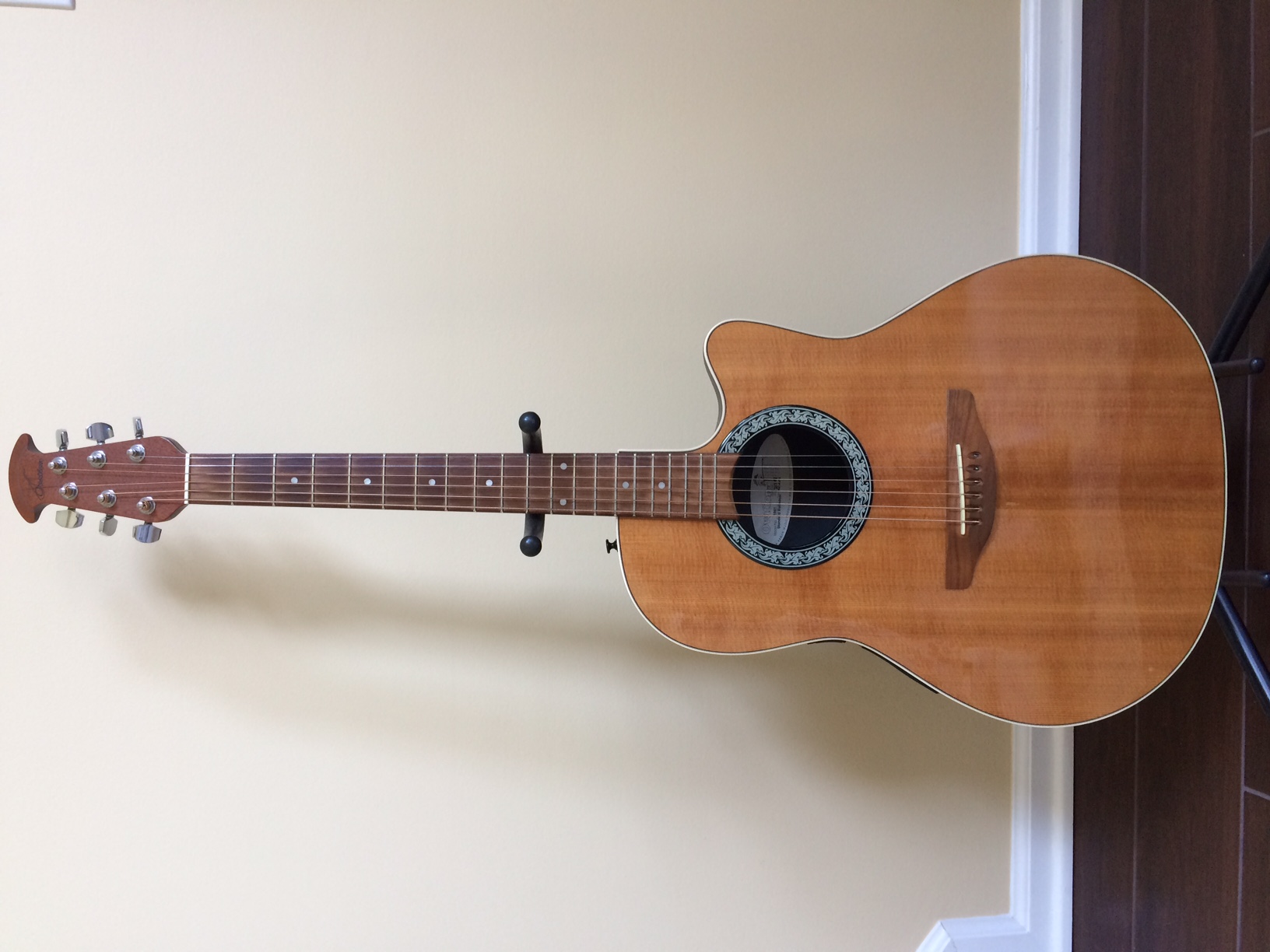
- Balladeer — spruce over the same bowl idea; the composite acoustic that is still a wood top
- Fly — carbon-glass skin on a wood electric; not a flat-top, and not brace-free graphite
Sources
- Blue Book of Guitar Values, RainSong — Decker, Maui; research 1985; production facilities December 1994; traditional bracing, then 1997 range; Coomar 1998; Projection Tuned Layering; 1999 line narrowed to the WS1000; other models by late 2000; Woodinville 2001; WS1000 card, mfg. 2000–present, 14/21, sharks, Element; WindSong as a separate line; A-WS1000 2005–08; WS3000; WS9000 2000–06
- Honolulu Star-Bulletin, 1 April 1996 — wedding “a decade ago”; Kuau Technology; Pimentel and Sons; George Clayton, BI-MAR; graphite/epoxy and Kevlar; foam-core neck; shop “last spring”; dozen models; Mike Rock; $3,500–$4,500; Reichel, Jon Anderson, Steve Gibson, James Burton; “about 500” a year if they ramped up
- Vintage Guitar, RainSong WS 1000 — page dated 30 July 2002; building since 1995; Hawaii-based, moving to the mainland; woven graphite; projection tuned layering; no braces; 21 nickel-silver frets; 1 3/4" Tusq; sharks; Fishman Blender; $2,245
- NAMM oral history, John Decker, 16 January 2003 — founded in Hawaii; summary says manufacturing moved to Oregon; Ellen appearance; black RainSong given to the Museum of Making Music; model not named
- RainSong shapes, archived 19 October 2017 — WS as “RainSong’s Signature Guitar”; DR, JM, OM, PA; Classic “Crystalline Clarity”; Concert “Warm Tone”; letters not spelled
- Premier Guitar, Adam Perlmutter, CH-WS, 24 November 2017 — signature body shape the WS; 5" at the deepest; CH-WS is carbon-and-glass back and sides; street $1,499; not this table
- Guitar-list, WS1000 — manufacture date 2000; 25.4" scale; 5" depth; 14th-fret join; 21 frets; epoxy board; sharks; Tusq; Gotoh; black or blue gloss
- Guitar Gallery, black WS1000 — Projection Tuned Layering; no braces; Performance Shape Casting; no truss rod; Gotoh 1:18; Prefix+T; abalone-inlaid Tusq pins
- Jedistar, 2006 Classic price PDF — effective 1 January 2006; WS1000 $2,995 with Element and hardshell; WS1100 pure acoustic $2,795; Woodinville address
- Jedistar, 2009 customer price PDF — effective 1 January 2009; Classic WS1000 $2,995 with Prefix Plus-T; CO-WS1000N2 $3,195; BI-WS1000N2 $3,295
- Music & Arts, RainSong Concert Series copy — N1, no truss rod; N2 as a Steve Miller and John Bolin collaboration; modified U; rod for relief, not for weather
- Audiofanzine, RainSong Studio Series, 9 January 2011 — N2 credit to Miller and Bolin; S-WS1000N2 retail $1,999
- Christopher Cozad, NS1 neck reset — his 1999 WS1000; no truss rod; neck bolted; fretboard extension bonded to the top
- Acoustic Guitar Forum, Matt, 19 July 2016 — letters in front of WS name the series; CO Concert, BI Black Ice; no letters on his JM means Classic
- Acoustic Guitar Forum, Earl49, 7 July 2016 — Hawaii WS1000, early 2001, before the mainland move; early unidirectional tops vs woven production; used asks he was seeing at $1,000–$1,300
- ProSoundGear, CO-WS1000N2 — Concert sheet: depth 5"; lower bout 15.5"; length 19.5"; nut 1.75"; scale 25.4"; not the classic table
- Chris Hughes, WS1000 demo — his comment: bought from East Coast Music, Danbury, in the mid-1990s; he calls it an original WS1000. A purchase claim, not a factory year
- Reverb, seller listing, “1990” Kihei WS1000 — seller-dated 1990; not a factory introduction year
- Acoustic Guitar Forum, Earl49, 5 January 2025 — N1 named later; 1.75" nut, 1.5" spacing, 25.5" scale; N2 when the molds wore out; NS as 24.9"; necks bolt-on
- Reverb, factory listing, Original 1999 WS1000 Classic Reissue — woven top; N1; abalone sharks; LR Baggs Stagepro Element; new ask $1,999, listing ended
- Reverb product title, CO-WS1000N2 — “Concert Wind Song” gloss; price guide $1,463–$2,515 is this Concert model, not the Classic
- Ashvin Coomar, “RainSong is Closing Our Doors,” 8 November 2023 — owner retiring; close in the coming months; all models discontinued; date depends on inventory
- Wikipedia, RainSong — infobox founded 1982 and defunct 30 November 2023; article flagged as needing citations; four or five a day is that page, not a factory census
- *Acoustic Guitar* store, WS1000 Custom 2000 — December 2000 issue; anniversary custom; Schaller; raindrop inlays; Fishman blender; year 2000
- Acoustic Guitar, Pete Madsen, 2020 — demonstrates the anniversary custom; not his record guitar
- Aaron Short, Original 1999 reissue review — George Seaton’s comment: made April 2000; Dave Coram called it an early batch; headstock logo and dueling sharks came later
- Ralph Flynn, RainSong Guitars group, 1 April 2021 — Through the Years: every acoustic sound is his WS 1000 or his WS 3000; tracks not split
- RainSong, CO-WS1000N2 video — company description: 25.4" scale; 1.75" nut; 11.5" / 15.75" / 9.25" / 5" / 19.5"; Concert series, not the classic table
- Dream Guitars, 2022 CO-WS1000N2 — 25.4 in (645 mm); nut 1.68 in (43 mm); body inches as printed; Concert series, not the classic table
- Musician’s Friend, BI-WS1000N2 — depth 5"; lower bout 15.8"; length 19.5"; nut 1.75"; Black Ice, not this table
- Reverb marketplace, WS1000 2000 black — ask dropped from $1,700 to $1,600 (fetched 26 October 2026)
- Craigslist, Oregon, 2008 WS1000 — posted 12 May 2026, updated 9 October 2026; ask $1,450
- Reverb, 2023 WS 1000 reissue with Anthem upgrade — listing marks it sold and prints $2,200; not the stock Stagepro
- Omega Auctions, 24 February 2026, A-WS 1000 — serial 9633; £420 hammer; Advanced series, not a Classic comp
- Guitar Site, Hybrid Series press release — 16 March 2010; H-WS1000N2 retail $2,399; carbon/glass; not the all-graphite classic
Keep digging
Guitars this one gets compared to, confused with, or descended from.
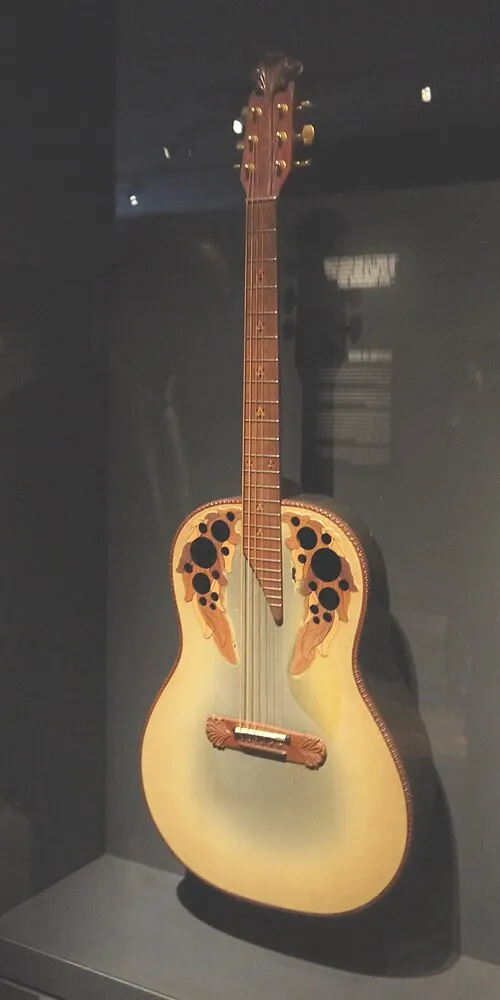
Photo: Eden, Janine and Jim / Wikimedia Commons / CC BY 2.0 Ovation
Adamas
1976
Seven years, 186 changes, and no hole in the middle. Ovation rebuilt the acoustic guitar top from scratch.
Ovation Model 1861 Standard Balladeer. Photo by Veradrive. Dedicated to the public domain under CC0 1.0. Via Wikimedia Commons. Ovation
Balladeer
1966
A helicopter builder looked at a guitar and asked why the back had to be made of wood. This was his answer.
- Send a picture
Parker
Fly
1993
Ken Parker built it like a lobster: wood on the inside, and all the strength in a skin thinner than the paint.