Parker
Fly
Ken Parker built it like a lobster: wood on the inside, and all the strength in a skin thinner than the paint.
The mid-1980s. Ken Parker, a man who builds archtops and studies lutes, pulls a solidbody six-string bass out of a blanket and shows it to Larry Fishman. It weighs about four pounds. Fishman has never seen anything like it.
- Introduced
- 1993
- Type
- Solidbody electric
- Class
- Production
Have a photograph of this guitar? Send a picture
The short version
1984
Parker meets Fishman
Larry Fishman meets Ken Parker, around this year.
1987
The prototype
A pre-production Fly, now in the Met, already has the carbon skin and the tangless steel frets.
1991
Parker Guitars
Parker and Fishman start the company to get the Fly built, with Korg’s money behind them.
1993
First Flys ship
From Wilmington, Massachusetts. Black was the only color they could paint that first year.
1995
Outside
Reeves Gabrels plays a Fly on David Bowie’s album, magnetic and piezo in stereo.
2003
Sold
U.S. Music buys the company. Ken Parker and Larry Fishman leave.
2016
Lights out
The Illinois factory closes. Ken Parker’s own account ends it in 2015.
Side A
A1
Don’t blame the pickups
Most new electric guitars start with the electronics. A better pickup, a smarter switch, a new circuit, bolted onto a body everybody already knows. Ken Parker thought that was backwards.
He came to electrics from archtops and lutes, and his view was simple. He didn’t want some secret sauce smeared on a Strat. A terrible electric guitar can’t be saved by its pickups. A good one will sound good with almost any pickup you put in it. So you start with the guitar.
That sounds obvious. Almost nobody builds that way. Parker spent the better part of a decade doing it.
A2
Built like a lobster
Parker’s trick was to put the strength on the outside. He compared it to a cicada or a lobster:
…all the strength of the structure is right at the outside surface.
So a Fly is wood on the inside, poplar on the Deluxe, wrapped in a skin of carbon fiber, glass, and epoxy that’s thinner than the paint. The fingerboard is the same material, about twenty thousandths of an inch thick. A Fly Deluxe weighs four and three-quarter pounds, which is how it got its name. Next to other solidbodies, it was light as a fly.
That skin let him do things wood alone wouldn’t allow. The heel, the lump where the neck meets the body, is almost gone, so you can actually reach the 24th fret. The frets are stainless steel, crowned and glued into shallow grooves with no tangs, because a tang would go straight through that thin board. The stainless lasted. The glue, not always.
The early Flys didn’t even have a truss rod. The carbon kept the neck straight. A rod showed up later, and the common reading is that buyers just didn’t trust a guitar without one.
A3
Two guitars in one cable
The Fly has two sets of ears. There’s a pair of DiMarzio humbuckers, like a normal electric, and a Fishman piezo in the bridge, which hears the strings the way an acoustic pickup does. You can use either or both, or send them out a stereo jack to two different places. The vibrato switches between locked, dive-only, and floating, all on one bridge.
Reeves Gabrels, playing with David Bowie, used both halves. On Outside in 1995 he ran the magnetic side and the piezo in stereo: bottleneck through a Univox Unitron on the magnetic side, the piezo on the other for definition. On “Little Wonder” two years later he used the 24th fret.
He also got the best line ever said about the company. Bowie, in an interview: “There’s no such thing as a cheap Parker.” Gabrels: “In my case, there are.” He meant the NiteFly, the cheaper bolt-on he used live. The Fly was not the cheap one.
Flip the record · By the numbers
4¾ lb
Factory weight of a Fly Deluxe. It was named for being light as a fly.
24
Stainless-steel frets, glued in, with no tangs. The heel is carved away so you can reach the last one.
.020"
Thickness of the composite fingerboard. A normal fret tang would punch right through it.
~30,000
Guitars and basses built in Massachusetts in the Parker years. Every model, not just Flys.
Side B
B1
Wilmington, and after
Parker and Fishman had met around 1984. There was a pre-production Fly by 1987, now in the Met, already skinned in carbon with those tangless frets. They started Parker Guitars in 1991, with Korg putting money behind it, and showed a “Super Fly” at NAMM in 1992. Parker put it plainly later: “We first shipped a Fly guitar in 1993.”
That first year, black was the only color they could paint. White showed every speck.
Korg pulled out in 2000. In 2003 U.S. Music bought the company and moved the work toward Chicago, and Parker and Fishman left. After that, new models came from the company’s engineers, not from Parker. The end depends who you ask: Parker says the company was out of business by 2015, and the Illinois factory closed in November 2016.
B2
Out of the reject barrel
The Fly I think about most isn’t a rock guitar at all. It’s the Concert, a Fly with only the piezo, no magnetic pickups.
Joni Mitchell’s was Western red cedar, pulled from a barrel of cracked guitars at the factory in Wilmington, and set up with a Roland output so she could run her tunings through a VG-8. She told Parker it looked like something found on a beach, and like something from outer space. By his account she performed with nothing else for six years.
Mary Chapin Carpenter came to her spruce Concert from Martin and Guild flattops. The way Parker tells it, she hit a G on stage to check it, and the crowd gasped.
Get the guitar right first, and even one out of the reject barrel can go on stage with Joni Mitchell for six years.
Put this on
You’ve read about it. Now hear it. Here’s what this guitar sounds like, and what to listen for.
The Hearts Filthy Lesson
Reeves Gabrels on a Fly, with the magnetic pickups and the piezo recorded in stereo. He says he kept the piezo there for definition.
Find it on YouTube (opens in a new tab)Voyeur of Utter Destruction (As Beauty)
Same album, same Fly, both pickup systems in stereo. For these sessions he ran bottleneck through a Univox Unitron on the magnetic side.
Find it on YouTube (opens in a new tab)Little Wonder
In the studio Gabrels uses the 24th fret and a Fernandes Sustainer on his Parker. The 22-fret NiteFly he rehearsed with live is a different guitar.
Find it on YouTube (opens in a new tab)
The cast
The people, and the specific guitars, that made the legend.
1993
Ken Parker
Designer
An archtop and lute man who decided a good electric shouldn’t need its pickups to rescue it.
1991
Larry Fishman
Co-founder
Saw the four-pound bass, started the company with Parker, and put his piezo in the bridge.
1995
Reeves Gabrels
Fly with mag and piezo
Bowie’s guitarist on Outside, running both pickup systems in stereo.
Joni Mitchell
Cedar Fly Concert
A piezo-only Fly pulled from a barrel of cracked guitars. By Parker’s account she played nothing else on stage for six years.
1990s
Mary Chapin Carpenter
Spruce Fly Concert
Came to it from Martin and Guild flattops. No magnetic pickups at all.
Liner notes
Specs, construction, rarity, value, and every source we used.
A wood core in a carbon-glass skin, 24 tangless stainless frets, and a Fishman piezo — Parker’s Fly, not the bolt-on NiteFly and not a Fly Bass.
- Body
- One-piece poplar with a carbon-glass-epoxy exoskeleton (Deluxe). Offset double-cut, almost no heel.
- Neck
- Basswood, carbon-glass-epoxy wrap, set; carved multiple finger joint
- Fingerboard
- Carbon-glass-epoxy .020" composite, 10"–13" conical, 24 hardened stainless-steel frets (.045" × .095"), no tangs
- Scale
- 25.5"
- Pickups
- Custom DiMarzio humbuckers (HH) plus 6-element Fishman piezo in the bridge
- Hardware
- Parker cast-aluminum vibrato, stainless saddles, Sperzel locking tuners; 3-mode step-stop (fixed / dive-only / floating)
- Electronics
- Mag volume, mag tone with push/pull coil-tap, piezo volume, mag/piezo 3-way, stereo/mono “smart” jack
- Finish
- Polyurethane
- Nut
- GraphTech, 1.68"
Open the full research fileConstruction details, the complete player record, production numbers, dated value estimates, and sources
Classic living example = USA Fly Deluxe (Wilmington, Massachusetts; factory Deluxe spec page, archived 20 August 2008). Factory inches only; no millimetres invented. Factory weight 4 3/4 pounds. Factory radius 10"–13"; Wikipedia and Reverb’s Deluxe Vibrato sheet also print 10"–15". Mix flagged. No current typical Fly SKU this pass: Ken Parker’s site dates US Music’s Parker Guitars out of business 2015; Wikipedia puts the Illinois plant closed November 2016. NiteFly is the bolt-on. Fly Bass is a bass. MaxxFly is a later US Music shape. None of those are this table.
Construction
The job was an electric that would answer like a quiet acoustic. Ken Parker had been making archtops and studying lutes. Reverb News (Tony Bacon, 13 July 2023): he did not want a secret broth smeared on a Strat. A terrible electric is not saved by its pickups. A good one will take almost any pickup. The Fly is named because, next to other solidbodies, it was light as a fly.
Larry Fishman met him around 1984 (Bacon; Ken Parker’s own Flys page). Guitar World (Dave Burrluck obituary): Fishman saw a solidbody six-string bass pulled from a blanket that weighed about 4 lb. “I’d never seen anything like it.” They founded Parker Guitars in 1991 to get the Fly built (Ken Parker). Korg’s US arm put money under patents and a factory. Wilmington, Massachusetts.
The Met’s pre-production Fly is dated 1987 — carbon-glass-epoxy, rosewood neck, first tangless stainless frets, “Rattlecan” metallic silver. Guitar World: the ‘Super Fly’ premiered at NAMM 1992. Ken, to Jedistar, 11 June 2023: “We first shipped a Fly guitar in 1993.” Keep NAMM and first ship. This plate starts in 1993.
The guitar is wood with its strength on the outside. Parker to D’Addario, via Guitar World: like a cicada or a lobster — “all the strength of the structure is right at the outside surface.” A thin carbon-fibre/glass/epoxy skin, thinner than the paint, wraps the back, neck, and headstock (Guitar.com, Justin Beckner, 28 June 2022). Fingerboard and headstock veneer are the same plastic. Bacon: a conical board, bonded tangless frets, self-lubricating nut, locking tuners, optional piezo, multi-function vibrato. Models were differentiated by body wood, chosen for tone: Deluxe poplar, Classic mahogany, Artist Sitka spruce, Supreme figured maple (factory handbook). Concert is piezo only. Spanish is nylon-string. Those stay on this plate as Flys, not second slugs.
The heel is almost gone, which is why the 24th fret is actually there. That carve would have been a weak joint without the skin. Frets are crowned stainless glued into shallow grooves — no tang, because a tang would punch through a .020" board (Guitar.com). Stainless lasted. The glue did not always. Vibrato: hardtail, dive-only, or floating on one bridge; early Flys put the spring-tension wheel on the face, later inside the body (Guitar.com). Stereo/mono smart jack sums or splits mag and piezo.
Early Flys had no truss rod (Guitar.com). The carbon wrap kept the neck. A rod arrived later; the common reading is that buyers would not trust a guitar without one. Factory Deluxe copy by 2008 lists a dual-function rod. That is the later guitar.
Not a NiteFly. Reverb News: cheaper bolt-on. Twenty-two frets on the NiteFly Gabrels used live (Guitar Player, June 1997). Not a Fly Bass. Not MaxxFly, the later conventional shape. Not a P-series Cort. Ken’s later archtops are a different shop.
2000: Korg pulled out (Bacon). 2003: U.S. Music Corp bought the company and moved work toward the Chicago area (Ken Parker). Fly Clone Project: Refined Deluxe and Classic announced 9 July 2003 at Summer NAMM — new control layout, balance wheel off the face. Ken and Larry left. Ken: from that sale on, new models including acoustics and semis were designed solely by Parker Guitars’ engineers. Jam Industries bought U.S. Music in 2009. Ken’s site: as of 2015, US Music’s Parker Guitars had gone out of business. Wikipedia: Illinois factory closed November 2016. Keep both end dates.
Classic vs current: 1993–2002 Wilmington Deluxe — poplar, 24 stainless, DiMarzio pair, Fishman piezo, face-wheel vibrato — against no new Fly you can order in 2026.
Players
Do not recruit NiteFly-only or Fly Bass players as if they were this guitar. Do not hang Ken’s later archtops here.
Reeves Gabrels (David Bowie). The Fly this plate can name. guitarguitar (Ray, 23 October 2020): on Outside (1995), “Voyeur of Utter Destruction” and “The Hearts Filthy Lesson” — Parker Fly, mag and piezo in stereo; bottleneck plus Univox Unitron on the mag side, piezo for definition. Guitar Player (Joe Gore, June 1997, republished 7 November 2023): Earthling studio “Little Wonder” uses the 24th fret and a Fernandes Sustainer on his Parker. Live Earthling rehearsal is a NiteFly (22 frets) — that bolt-on stays off the Fly table. Same interview: Bowie, “There’s no such thing as a cheap Parker.” Gabrels: “In my case, there are.” The NiteFly is the cheap one in that joke. The Fly is not.
Joni Mitchell. Bacon, quoting Ken: a Western red cedar Concert pulled from a factory barrel of cracked guitars in Wilmington, Roland hex-output, VG-8 for her tunings. She told Ken it looked found on a beach and from outer space. Ken: she performed exclusively with it for six years. Concert is piezo-only. It is still a Fly.
Mary Chapin Carpenter. Bacon, quoting Ken: spruce Concert, no magnetic pickups, onstage in the ’90s after Martin and Guild flattops. She hit a G to check it. Ken: the crowd gasped.
Also known to play stays empty this pass. Wikipedia laundry lists (The Edge, May, Townshend, Bellamy) are not named interviews here. None invented.
Rarity
No current Fly SKU. Factory does not publish Fly-only unit totals. None invented.
Ken Parker’s Flys page: Massachusetts produced about 30,000 guitars and basses. Bacon: Ken saw around 30,000 guitars ship, 1981–2003. Guitar World: “some 30,000 instruments later” by 2003. That combined Ken-era figure is not a Fly census. NiteFly, Fly Bass, and later Illinois/import lines sit inside it.
Wilmington pre-refined Flys (1993–2002), especially first-year and white — Bacon: in 1993 black was the only color they could paint; white showed every speck — are the scarce end. Refined 2003+ and MaxxFly are other factories on related names. Joni’s cedar Concert and Gabrels’ Outside Fly are unique objects. They are not a vintage Fly.
Value
Informal estimate, 1 September 2026. Not an appraisal.
Ask vs sold labeled. Celebrity lots are not-comps. No invented medians or factory counts. Reverb Price Guide widget on Fly Deluxe Vibrato (1993–2002) did not print a clean USD band in the static fetch this pass.
New street. No living Fly cart.
Used modern. Named asks this pass, not hammers: Reverb 1995 Deluxe Vibrato Purple $4,000; 1996 Deluxe signed by Ken Parker $3,650; 1999 Deluxe Black $2,800 (from $4,000); 1998 Deluxe Black #308048BP $5,439. A 1994 Deluxe White mint ask $16,999 is a dealer queen, not a typical tape.
Vintage / collectible. Pre-refined Wilmington Deluxe and Classic sit above Refined and far above MaxxFly / P-series. No sold median computed here. Joni’s Concert and Gabrels’ Outside guitar are unique. They are not a vintage Fly.
See also
- steinberger-gl — graphite headless paddle of overlapping years; not a Fly
- jackson-soloist — 1984 neck-through superstrat, not a carbon-skinned offset
- kramer-baretta — banana-headstock superstrat; not a Fly
Sources
- Ken Parker Archtops, Parker Flys — founded 1991 with Fishman; ~30,000 guitars and basses in Massachusetts; US Music 2003; out of business 2015
- Jedistar, Parker guitars USA — Ken Parker, 11 June 2023: “We first shipped a Fly guitar in 1993.”
- Parker, Fly Deluxe specs (archived 20 August 2008) — poplar; basswood neck; 25.5"; 24 frets; 10"–13"; GraphTech 1.68"; 4 3/4 lb; DiMarzio HH; Fishman piezo
- Parker Fly user manual (Fly Clone scan) — Deluxe poplar / Classic mahogany / Artist spruce / Supreme maple; 24 stainless; Sperzel; 6-element Fishman
- Reverb News, Tony Bacon, 13 July 2023 — named light as a fly; 1993 factory; Fishman ~1984; Korg; 2000 pull-out; US Music 2003; Joni Concert; Mary Chapin Carpenter Concert; ~30,000 Ken-era
- Guitar.com, Justin Beckner, 28 June 2022 — 1993–2016; carbon wrap; tangless stainless; early no truss rod; DiMarzio then Duncan; three-mode bridge; face wheel then hidden
- Guitar World, Dave Burrluck, Ken Parker obituary — lute; NAMM 1992 Super Fly; Fishman 4 lb bass; Korg; ~30,000 by 2003; Met 1987 prototype
- The Met, Parker Fly prototype — 1987; carbon-glass-epoxy; tangless stainless; 25 1/2" scale
- Guitar Player, Joe Gore, June 1997 / 7 November 2023 — Gabrels NiteFly live; 24th-fret Parker on Little Wonder; “no such thing as a cheap Parker”
- guitarguitar, Reeves Gabrels interview, 23 October 2020 — Parker Fly on Voyeur of Utter Destruction and The Hearts Filthy Lesson; mag + piezo
- Reverb, Fly Deluxe Vibrato 1993–2002 — poplar Deluxe; Refined after 2003 sale; 1995 Purple ask $4,000
- Reverb, 1996 Fly Deluxe signed by Ken Parker — ask $3,650
- Wikipedia, Parker Fly — 1993–2016; US Music 2003; Jam 2009; production ended 2016
- Wikipedia, Parker Guitars — Illinois factory closed November 2016
- Fly Clone Project, history summary — Ken years 1993–2004 Wilmington; Refined 9 July 2003 NAMM; US production closed 2015
Keep digging
Guitars this one gets compared to, confused with, or descended from.
- Send a picture
Steinberger
GL
1984
No headstock, no wood, and designed by a man who didn’t play. Eddie Van Halen wrote two songs on it in days.
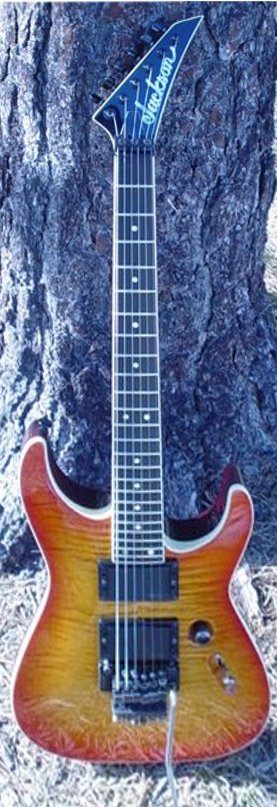
A 1987 Soloist archtop. Photo by Jimshine; perspective correction by GreyCat. Licensed under CC BY-SA 4.0. Via Wikimedia Commons. Jackson
Soloist
1984
Grover Jackson took the Strat shape and ran the maple neck straight through it. Jeff Beck’s was pink.
- Send a picture
Kramer
Baretta
1983
One humbucker, a bolt-on neck, a banana headstock. Kramer’s 1983 superstrat kept the loud part.