Ovation
Adamas
Seven years, 186 changes, and no hole in the middle. Ovation rebuilt the acoustic guitar top from scratch.
Connecticut, the early 1970s. Charles Kaman already has his fiberglass bowl. Now he wants to get rid of two things every acoustic guitar has had for as long as anyone can remember: the spruce top, and the round hole cut in the middle of it.
- Introduced
- 1976
- Type
- Acoustic-electric roundback
- Class
- Production
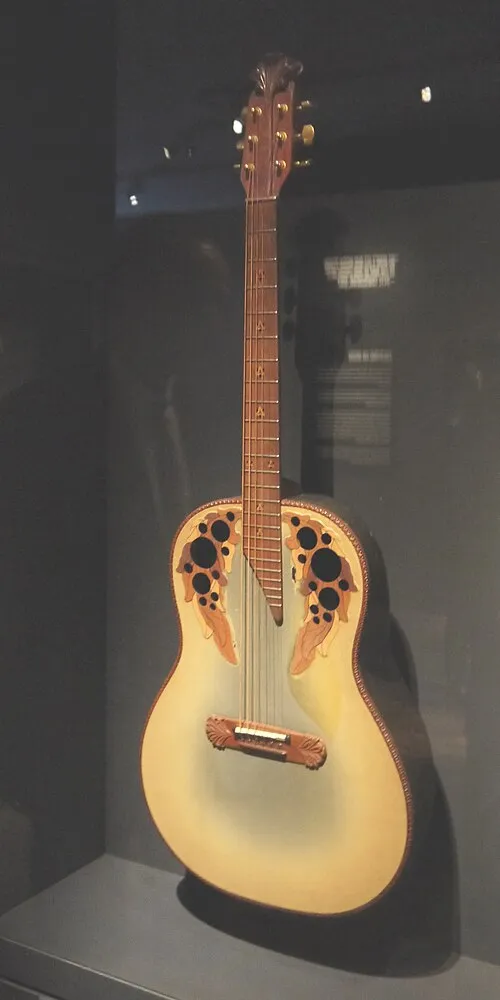
The short version
1966
The bowl comes first
Kaman’s Balladeer puts a fiberglass bowl under a spruce top.
1973
A carbon top
Ovation develops its first carbon-fiber soundboard.
1976
The Adamas
The usual introduction date. Some put the unveiling in 1977.
1977
Back on the line
After a stop to retool, production picks up again on 15 August.
1981
The Adamas II
About $600 cheaper, with a simpler neck, bridge, and headstock.
1982
The holes go wooden
Ovation puts the Adamas soundhole layout on wooden tops and calls it the Elite.
1989
Straight into the PA
Melissa Etheridge, Adamas 12-string, no stage amp.
Side A
A1
Take the hole out of the middle
Charles Kaman had already swapped the wooden back of a guitar for a fiberglass bowl. That was the Balladeer, in 1966. The next part he wanted to fix was the top, and his complaint was an engineer’s complaint.
A guitar top is under stress all the time, and the line of that stress runs from the headstock to the bridge. Right through the middle. Which is exactly where every acoustic guitar in history has a big round hole. To keep that weakened top from cracking, you brace it. And every brace you add is one more thing holding the top back from moving, which is the only way a guitar makes a sound.
So he wanted two things gone: the spruce and the hole. That kind of problem keeps engineers up at night. What I like is where the answer ended up: on a stage, in the hands of somebody playing alone.
A2
Carbon, birch, carbon
The answer was a sandwich. A paper-thin sheet of birch, with a layer of carbon graphite on each side. That let the top stay thin without cracking. How thin depends on who’s measuring. The usual figure is 1/32 of an inch, or somewhere under a millimeter, against something like three for an ordinary spruce top.
Ovation had its first carbon top working by 1973. Getting from there to a guitar you could buy took a long time. By one count the Adamas went through seven years and 186 modifications.
Ask when it came out and you’ll hear 1976 or 1977. Both are sort of right. The first several dozen were built mostly by hand, then production stopped for new tooling, and it started again on 15 August 1977. The usual date is 1976. The unveiling some people remember is 1977.
A3
Holes where the shoulders go
With the center hole gone, the sound had to get out somewhere. Ovation moved it to the upper bouts, up by your shoulders, and split it into twenty-two little holes of different sizes. Each cluster sits under a wooden leaf pattern called an epaulet, like the shoulder boards on a military coat. Nothing else on a stage looked like it.
The rest of it was built to match. A walnut neck, with a hollow cast-aluminum bar inside it called the Kaman Bar. A carved walnut bridge and a sculpted headstock. Finishes in blue, beige, red, or brown with a bronze shimmer in them, picked to look right under stage lights.
That last detail tells you who it was for. This was never a porch guitar.
Flip the record · By the numbers
186
Modifications over seven years of development before the Adamas was done.
1/32"
Thickness of the carbon-and-birch top, by the usual count. A folk-guitar spruce top runs about 3.2 mm.
22
Little soundholes in the upper bouts, where the stress isn’t.
$2,000+
The sticker on an Adamas in the late 1970s.
Side B
B1
Built for the lights
The guitar press loved it, and so did pros like Larry Coryell. It wasn’t cheap. In the late 1970s the sticker was over $2,000. In 1981 Ovation added the Adamas II, about $600 less, with a simpler neck, bridge, and headstock.
In 1982 Ovation took the Adamas soundhole layout and put it on wooden tops, and called that the Elite. If you’ve seen those little holes on a guitar with a wooden top, that’s probably an Elite, not an Adamas. The Adamas is the one with carbon on top.
It’s still made. The current one has the same carbon sandwich on a hand-laid bowl, the clusters of little holes, the walnut, and a fan pattern of bracing Ovation calls Quintad. The top now sits on a fiberglass ring, decoupled from the bowl. Fender bought Kaman Music in 2007, and GEWA runs Ovation now.
B2
One woman, one twelve-string
Here’s where all that engineering ends up.
In 1989 Melissa Etheridge told Musician how she worked. An Ovation Adamas 12-string, light strings, a .50 pick. No amp on stage. Straight into the PA. And for fifteen years before that, she had performed as a solo act with nothing but her 12-string Ovation behind her.
Ten years later, on the Breakdown tour, she was still at it, and she explained why:
…it’s the top of the line, and they’re the best ones for stage, because my guitar playing is basically percussion.
Seven years of carbon fiber, stress lines, and 186 revisions, and the person who got the most out of it was a woman who had spent fifteen years alone on a stage, hitting a twelve-string like a drum, with nobody else up there to help.
The cast
The people, and the specific guitars, that made the legend.
1976
Charles Kaman
The Smithsonian’s Adamas
Wanted the spruce and the center hole gone. Later gave an Adamas to the Smithsonian himself.
1989
Melissa Etheridge
Adamas 12-string
Fifteen years as a solo act with a 12-string Ovation. No stage amp, straight into the PA. Ovation makes a signature 12-string for her now.
Larry Coryell
An early Adamas
One of the pros who welcomed the Adamas enthusiastically when it arrived. No single record is pinned to it.
Liner notes
Specs, construction, rarity, value, and every source we used.
A carbon-graphite sandwich over birch, twenty-two epaulet holes, and a Lyrachord bowl — Ovation’s Adamas, not a spruce-top Balladeer.
- Top
- Carbon fiber and birch veneer sandwich, Quintad bracing, multi-soundhole
- Bowl
- Deep Lyrachord, hand-laid fiberglass; Adamas Suspended Top
- Neck
- Walnut
- Fingerboard
- Walnut, maple inlays
- Scale
- 641.35 mm (25.25"); nut 42.8 mm (1 11/16"). Mix flagged.
- Pickup
- OCP-1K piezo, OP-Pro Studio preamp with tuner
- Hardware
- Schaller M6 gold; carved walnut head plate and bridge; bone saddle
- Binding
- Composite rope
- Finish
- Reverse Red Burst typical SKU 1687GT-2-G
Open the full research fileConstruction details, the complete player record, production numbers, dated value estimates, and sources
Current typical = Adamas 1687GT Deep Non-Cutaway (ovationguitars.com / GEWA, fetched 2 September 2026). Factory mixed mm/inch flagged; Guitar Center also prints scale 25.28" (642 mm) and nut 1.69" (42.8 mm) — mix flagged, no millimetres invented. Factory MAP $5,399.00. Guitar Center Platinum Black $5,399.00. Reverb new 1687GT-5 Black $5,399. Made in USA, case included. 2087GT Deep Contour Cutaway is the same MAP with a bass-side multi-soundhole — sister, not this table. Adamas II (1681; five-piece mahogany/maple neck) is the 1981 budget line, not this table. Balladeer is spruce-top Lyrachord — other slug. Celebrity is mid-line. 1598-MEIII Etheridge 12-string is a signature on this name, not this 6-string table.
Construction
The job was a top that would stay thin without cracking. Charles Kaman had already put a Lyrachord (fiberglass) bowl under spruce in 1966 — that guitar is the Balladeer, other plate. Vintage Guitar (Michael Wright, December 2021): Kaman next wanted spruce off the soundboard and the round hole out of the middle. A center hole sits in the stress lane from head to bridge. Extra bracing damps the board.
The answer is a sandwich: paper-thin birch between two layers of carbon graphite. Wright: that let the top run 1/32" thick. GEWA’s house history: Adamas carbon top 0.9 mm against a folk spruce top of about 3.2 mm. MusicRadar (Matthew Wig, 30 October 2007, Collectors’ Edition review): two 0.13 mm (0.005") carbon outer layers and a 0.89 mm (0.035") birch or poplar veneer; carbon runs lengthways, wood grain offset 60 degrees. Keep all three thicknesses. Do not average them.
Twenty-two variously sized holes moved to the upper bouts, dressed in wooden leaf “epaulets” (Wright; MusicRadar, 23 May 2012). The living 1687GT page still says multi-soundhole. Quintad (fan) bracing is the Adamas pattern; the 1977 internal development document dates Quintad bracing from serial #172.
Introduced year is split. Wright, the Smithsonian (gift of Charles H. Kaman; model 1187-8, serial 652-93, made around 1978–79), and Jedistar put the Adamas on 1976. Jedistar: Ovation developed the first carbon-fibre top in 1973; first production instrument 1976. GEWA’s story page and MusicRadar’s bowl-back timeline date the six- and 12-string unveiling 1977. The internal document: proto units #1–26; small hand-work production #27–61; #62–76 new peghead and Kaman Bar; production stopped for tooling; production resumed 15 August 1977 from #77. Keep 1976 as the catalog year. Keep 1977 as the resume. Do not pick a winner.
Original Adamas (often Super Adamas / 1687): walnut neck, Kaman Bar — a hollow inverted-T of cast aluminum — under an epoxy-infused walnut board, carved hard-foam bridge and headstock, optional stereo piezo (Wright). Smithsonian: Fibronic soundboard (carbon graphite and birch), rounded fiberglass back, carved black walnut bridge, walnut neck, sculptured headpiece; bronze-highlight finishes in blue, beige, red, or brown for stage lights.
1981. Wright: Adamas II, about $600 cheaper. Five-piece mahogany/maple neck, simpler bridge and headstock, acoustic-electric only, stereo, a super-sensitive active tone. The factory development note puts II on an SMC bowl, a regular Ovation-type neck, ABS outer ring, fewer-piece epaulets. Not this table. Wright, from serial lists: the 1681 may have been replaced around 1999–2000 (highest 1681 found 17958). That is a serial-list reading, not a factory census.
1982. GEWA: the Adamas multi-hole design went onto wooden tops as Elite. Elite is wood. Not this slug.
The living guitar is still a carbon sandwich on a hand-laid deep bowl. Factory 1687GT: Adamas Suspended Top — GEWA: the graphite top sits on a fiberglass ring, decoupled from the bowl — Quintad, walnut neck/board/bridge, carved head plate and bridge, composite rope binding, Schaller M6 gold, OCP-1K and OP-Pro Studio. 2087GT is the cutaway Deep Contour at the same MAP. 156SP Evolution is another Adamas SKU on this name, not this table.
Wright: Fender bought Kaman Music Corp. in 2007. GEWA dates its own takeover 2021. Current carts are GEWA’s ovationguitars.com.
Not Balladeer. Spruce, center soundhole; living Pro Series is Deep Contour GS. Not Celebrity. Not a Martin dreadnought. Not a Taylor Grand Auditorium.
Classic vs current: 1976–77 Bloomfield Super Adamas — Fibronic sandwich, 22 epaulet holes, carved walnut, Kaman Bar — against the New Hartford 1687GT: same sandwich idea, Quintad, AST, OP-Pro Studio, MAP $5,399.00.
Players
Do not recruit Balladeer, Custom Legend, or Celebrity players as if they were this guitar. Glen Campbell’s 1969 signature and 1970 pickup are Balladeer-era (Wright). Many Campbell photos are Custom Legend / Adamas — do not flatten the Goodtime Hour to this SKU.
Melissa Etheridge. The Adamas this plate can name. Musician, June 1989: she plays an Ovation Adamas 12-string electric-acoustic with Adamas light-gauge strings; Dunlop .50 picks; no stage amp, straight into the PA. Same piece: for 15 years she had performed as a solo act with no more accompaniment than her 12-string Ovation. Andrián Pertout, Australian Musician 20, 6 December 1999 (Breakdown tour): “I mainly use the Ovation Odamus, it’s the top of the line, and they’re the best ones for stage, because my guitar playing is basically percussion.” Current factory 1598-MEIII is a mid-cutaway 12-string Adamas signature — sister, not the 1687GT table.
Larry Coryell. Wright: the Adamas was enthusiastically received by the guitar press and pros like Larry Coryell. Reception, not a named album this pass.
Al Di Meola’s Ovation of choice, per a reprinted Kaman artist note, was a stock Custom Legend with a smaller neck — not Adamas. Keep him off this table. Richie Sambora’s twin/triple-neck stage Ovations (MusicRadar) are not sourced as Adamas here.
Also known to play stays empty this pass. GEWA’s laundry list (Gilmour, Page, Lennon, Hetfield) is not a named Adamas interview. None invented.
Rarity
Adamas 1687GT is regular production. Ovation/GEWA do not publish Adamas unit totals. None invented.
Wright: how many Adamas IIs have been made is unknown. Serials apply to all Adamas variations and “appear to be approximately 1,200 to 1,500 per year.” That combined serial-list reading is not a 1687 census and not a factory total. Highest 1681 he found: 17958 (~1999–2000).
The thin window is proto #1–26 and first-configuration #27–61 (internal 1977 document). Smithsonian #652-93 (model 1187-8, gift of Charles H. Kaman) is one object. Etheridge’s 12-string and the MEIII are unique or signature objects. They are not a vintage 1687.
Value
Informal estimate, 2 September 2026. Not an appraisal.
Ask vs sold labeled. Celebrity lots are not-comps. No invented medians or factory counts.
New street. Factory MAP $5,399.00 (1687GT Deep Non-Cutaway; 2087GT Deep Contour Cutaway same MAP). Guitar Center Platinum 1687GT Black $5,399.00. Reverb new 1687GT-5 Black $5,399. Wright, historical: late-1970s sticker over $2,000; Adamas II saved about $600 in 1981 — not 2026 street.
Used modern. Named asks this pass, not hammers: 1979 1687-2 Red $4,999 (from $5,499); 1981 1687-8 Blue Burst $3,800 (from $5,500); 1991 Super Adamas 1687-7 $4,311.67 (from $4,527.25); 1995 1687-5 Black $3,397.61; used 1687GT Reverse Red Burst Excellent $4,859. Adamas II 1681 asks sit lower (named: 1681-5 $2,413; 1990 1681-8 $2,518; 1980 1681-8 $3,618) — labeled II, not this 1687GT.
Vintage / collectible. First-configuration #27–61 and carved Super Adamas 1687 sit above Adamas II. No sold median computed here. Smithsonian 1187-8 and Etheridge’s 12-string are unique. They are not a street tape.
See also
- ovation-balladeer — first production Lyrachord roundback, spruce top; not carbon, not Adamas
- taylor-814ce — wood cutaway AE flagship; not a roundback
- parker-fly — carbon-skinned electric; not a Lyrachord bowl
Sources
- Ovation, Adamas 1687GT Deep Non-Cutaway — MAP $5,399.00; carbon/birch sandwich; Quintad; AST; multi-soundhole; deep hand-laid bowl; walnut neck/board/bridge; 641.35 mm (25.25"); nut 42.8 mm (1 11/16"); Schaller M6 gold; OCP-1K; OP-Pro Studio; 1687GT-2-G
- Ovation, Adamas 2087GT Deep Contour Cutaway — MAP $5,399.00; bass-side multi-soundhole; Deep Contour; not this table
- Ovation, Adamas 1598-MEIII Melissa Etheridge Signature — 12-string mid-cutaway signature; not the 1687GT table
- Guitar Center, 1687GT Adamas Series Deep Black — $5,399.00; 25.28" (642 mm); nut 1.69" (42.8 mm); USA
- Vintage Guitar, Michael Wright, The Ovation Adamas II — introduced 1976; 1/32" sandwich; 22 epaulets; Kaman Bar; Adamas II 1981 ~$600 less; serials ~1,200–1,500/year all variations; 1681 highest 17958; Fender 2007
- Smithsonian, Adamas Guitar — introduced 1976; seven years, 186 modifications; model 1187-8, serial 652-93, ~1978–79; gift of Charles H. Kaman
- Ovation Tribute, Adamas Guitar History and Development Document (1977) — proto #1–26; #27–61 first configuration; #62–76 Kaman Bar; production resumed 15 August 1977 from #77; Quintad #172; Adamas II note
- GEWA, Ovation and Adamas guitars, story and presentation — 1977 introduction; carbon top 0.9 mm vs folk ~3.2 mm; AST; Elite 1982; GEWA 2021
- MusicRadar / Total Guitar, IN PRAISE OF: Ovation bowl-backs, 23 May 2012 — 22 smaller holes; 1977 Adamas six- and 12-string unveiled
- MusicRadar, Matthew Wig, Ovation 2005 Collectors’ Edition, 30 October 2007 — 0.13 mm carbon / 0.89 mm birch or poplar / 60°; Quintad
- Jedistar, Adamas guitars USA — carbon fibre top 1973; first production 1976
- Musician, June 1989 — Etheridge Adamas 12-string AE; Adamas light-gauge; Dunlop .50; 15 years solo 12-string Ovation
- Andrián Pertout, Australian Musician 20, 6 December 1999 — “Ovation Odamus… top of the line”; stage percussion
- One More Blog, reprint of Kaman Ovation artist note — Di Meola’s stock Custom Legend, not Adamas
- Reverb, Adamas 1687GT-5 Black — new ask $5,399
- Reverb, Adamas by Ovation acoustics — named used asks
Keep digging
Guitars this one gets compared to, confused with, or descended from.
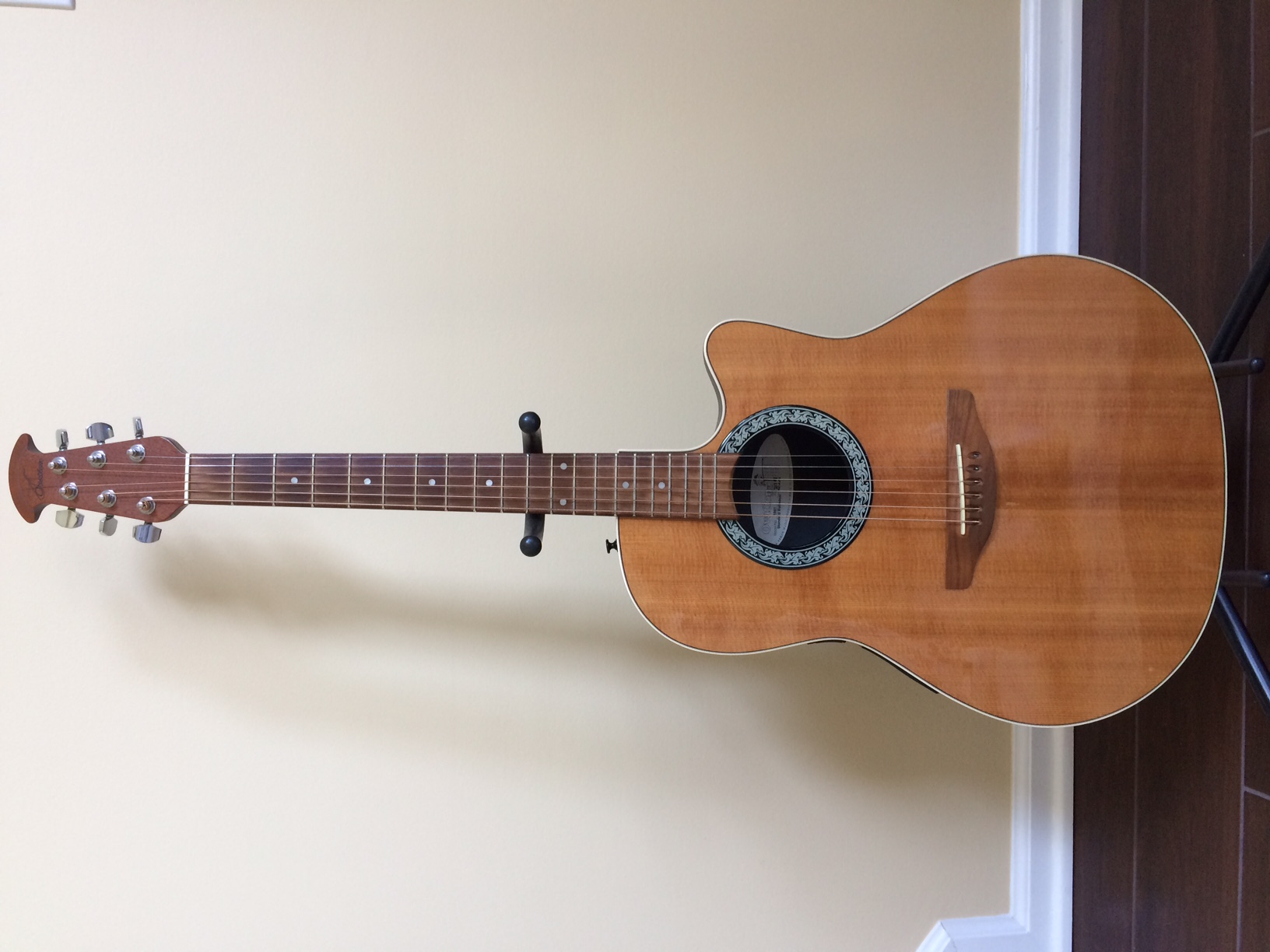
Ovation Model 1861 Standard Balladeer. Photo by Veradrive. Dedicated to the public domain under CC0 1.0. Via Wikimedia Commons. Ovation
Balladeer
1966
A helicopter builder looked at a guitar and asked why the back had to be made of wood. This was his answer.
- Send a picture
Taylor
814ce
1996
Taylor has rebuilt its flagship from the braces out, again and again, and kept the same three numbers on it.
- Send a picture
Parker
Fly
1993
Ken Parker built it like a lobster: wood on the inside, and all the strength in a skin thinner than the paint.