Maton
EBG808
It started as the measurements off a smashed Martin, for the quiet players in a Melbourne folk club.
Melbourne, 1978. A man named Gordon McIntyre wrecks his Martin 00-18 in a car accident, and the pieces end up on Chris Ffinch’s bench at Maton. Ffinch has been watching the players at Frank Traynor’s club, and he has an idea what they want.
- Introduced
- 1988
- Type
- Acoustic-electric flat-top
- Class
- Production
The short version
1946
May Tone
Bill May and his brother Reg start Maton in Thornbury, Victoria.
1966
Ffinch at the bench
Chris Ffinch starts at Maton two days after landing from England.
1978
The smashed 00-18
Ffinch takes dimensions off a wrecked Martin and builds the BG808. 133 are made in 1978–79.
1988
The electric 808
The EBG808 arrives, the same outline with an AP5 pickup system built in.
1994
“Mouse”
Maton’s timeline dates Tommy Emmanuel’s guitar “Mouse” to this year.
2011
AP5-PRO
The mic-and-piezo system developed with Emmanuel goes into production. A later brochure says 2013.
2014
The smaller hole
The soundhole goes from 100 mm to 95 mm in a range redesign. Emmanuel tours with two EBG808s and a TE.
Side A
A1
A Martin in pieces
Sometime in 1978, a man named Gordon McIntyre wrecked his Martin 00-18 in a car accident. The pieces went to Maton, in Melbourne, and onto the bench of Chris Ffinch.
Ffinch had been building Matons since 1966. He’d started two days after he landed from England. And he had noticed something at Frank Traynor’s Folk and Jazz Club: the players there were on smaller Martins.
So he took dimensions off the smashed one. He wasn’t making a guitar for everybody. He was making one for the people in that room.
A2
Not for the banjo-killers
What he built was a small body at full depth, with a longer scale than you’d expect. Most small guitars ran 24.9". Ffinch gave his 25.5". That extra length puts more tension on the strings, and a little more snap into a body that size. He cut the soundhole at 100 mm, bigger than the 95 mm he says was usual on small guitars.
He was clear about who it was for: fingerstyle players. It wasn’t for what he called the “banjo-killing flatpickers” pounding a loud mahogany dreadnought.
The name is a small mystery. “BG” came to mean Bluegrass, though Ffinch thought it may have started as Blues Guitar. As for the 808, it might be the 80 from Maton’s CW80, or the figure-8 of the body, or just a number Bill May liked. Nobody has settled it.
The first ones were humble. They had the same recipe as the CW80 of the day, with a Sitka top and laminated maple and basswood for the back and sides. They made 133 of them in 1978 and ’79. The best-known name on one is John Williamson.
A3
Learning to plug in
The guitar on this page is the electric one. The EBG808 arrived in 1988, with the same outline and a factory pickup system built in, the AP5.
That matters more than it sounds. A small fingerstyle guitar is exactly the kind that falls apart on a loud stage. Put a bare piezo under the saddle and you get the sound of the string and very little of the box.
Maton’s answer, in the version you buy today, was to put a microphone in there too. The AP5-PRO was built with Tommy Emmanuel. It has an undersaddle piezo and a small cardioid mic on an adjustable arm inside the body. Each one gets its own level, then they go to a master. In the listening sessions, Emmanuel said one of the development preamps was
the best recordable sound I have ever heard.
That was a prototype board, not the one that shipped. The company diary sends the PRO to production in June 2011. A later brochure says it “finally arrived” in 2013. Both dates stay.
Flip the record · By the numbers
133
Original BG808s, all acoustic, all laminated, made in 1978 and 1979.
25.5"
Scale length. Most small guitars used 24.9". Ffinch went long on purpose.
2
Pickups in one guitar, a piezo under the saddle and a microphone inside the body, each with its own level.
100 → 95 mm
The soundhole, before and after 2014.
Side B
B1
The man with two of them
Tommy Emmanuel’s first Maton wasn’t this one. It was an MS500, for him and his brother Phil, in 1960 or 1961 depending on whether you ask him or Maton.
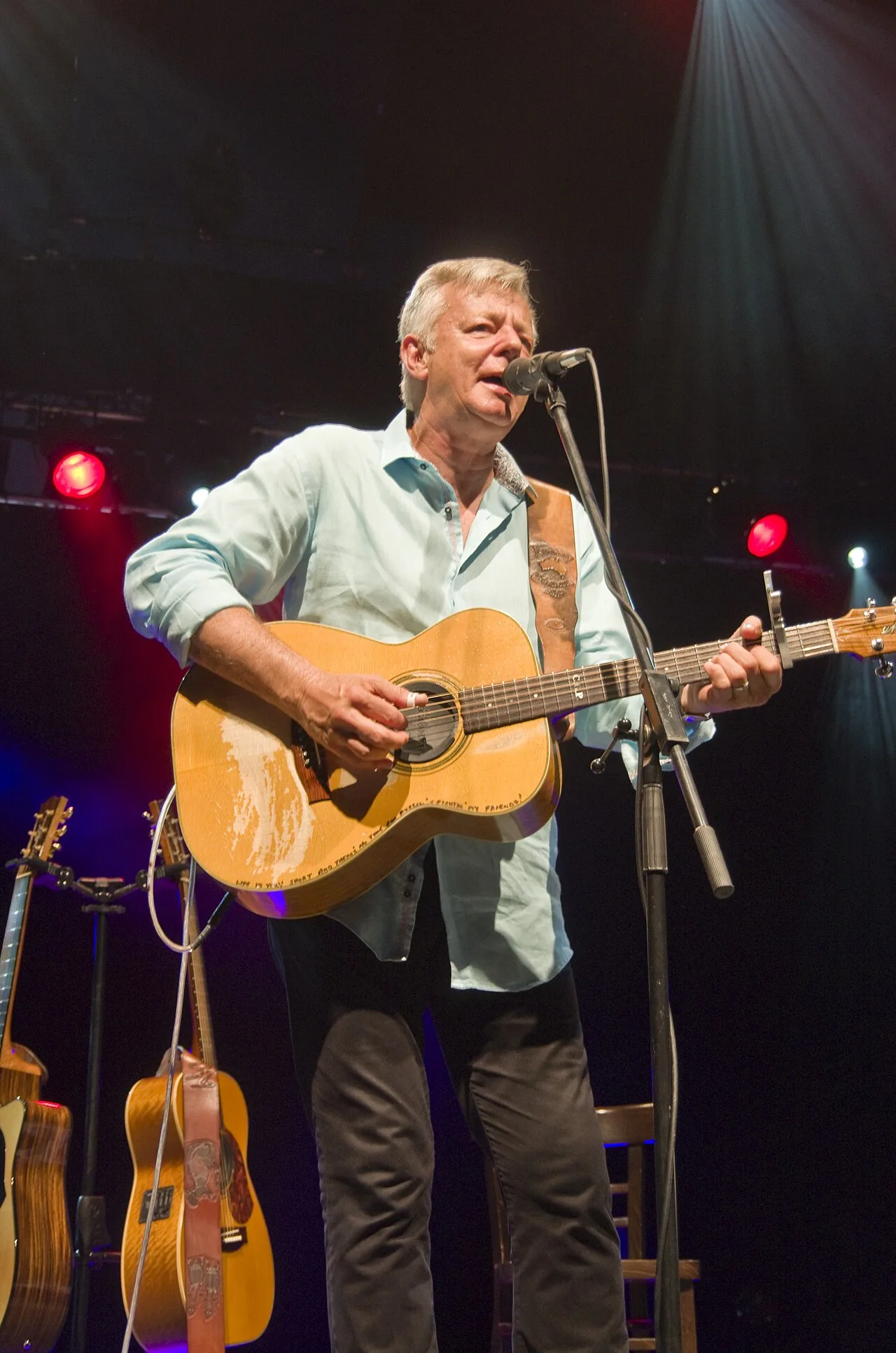
But the 808 is the guitar people connect with him. On his 2014 tour he carried two identical EBG808s, one in standard tuning and one a whole step down, plus an EBG808 TE, his signature model. Each had a feedback buster in the soundhole, and the rig after that was simple.
The TE carries a mother-of-pearl block at the 12th fret engraved C.G.P. That’s Certified Guitar Player, Chet Atkins’s title, which only a handful of other players hold.
His own favorites go further. In 2018 he showed off a TE Personal from the Melbourne custom shop, built on the EBG808 but thinner, in Queensland maple that he says “sounds more like mahogany,” and louder than his other EBG808. He calls it Mouse. Maton’s own timeline puts a “Mouse” back in 1994, so the dates don’t line up neatly. Most of his guitars, he says, have “TE Personal” written inside. Those are his. The one you order is the Artist.
B2
Still for the same people
That same year, 2014, Maton redesigned the range, and the 808’s soundhole shrank from 100 mm to 95 mm. That’s the size Ffinch had passed over in 1978.
Today’s EBG808 Artist has a top-grade spruce top, blackwood back and sides, an ebony board with snowflake inlays, and gold Grovers, and it’s made in Box Hill, where Maton moved in 2003. Keith Urban had an EBG808TE on his 2024 touring list. It’s a long way from a laminated guitar copied off a wreck.
But it’s still the guitar Ffinch drew for the fingerpickers, not the flatpickers. The mic inside just lets it play a room far bigger than Frank Traynor’s and still sound like a small wooden box played with fingers.
Put this on
You’ve read about it. Now hear it. Here’s what this guitar sounds like, and what to listen for.
Rig Rundown: Tommy Emmanuel
The 2014 tour rig. Two identical EBG808s, one in standard and one a whole step down, plus an EBG808 TE. Each has a feedback buster in the soundhole.
Watch it on YouTube (opens in a new tab)
The cast
The people, and the specific guitars, that made the legend.
1978
Chris Ffinch
Designer of the 808
Measured a wrecked Martin 00-18 and built the first BG808 for the fingerstyle players at Frank Traynor’s club.
1978
Gordon McIntyre
The Martin 00-18 that started it
Wrecked his small Martin in a car accident. The smashed guitar became the template.
1978
John Williamson
1978 BG808, not this electric
The best-known name on the original acoustic 808.
2014
Tommy Emmanuel
EBG808s and TE Personals
Toured in 2014 with two EBG808s and a TE. Worked on the AP5-PRO. His own “Mouse” is a thinner custom.
2024
Keith Urban
EBG808TE
On his 2024 touring list. Maton markets the Nashville trim as his choice.
Liner notes
Specs, construction, rarity, value, and every source we used.
A small full-depth flat-top on a 25.5-inch scale, mic and piezo in the body — Maton’s EBG808, not a 00-18, not a dreadnought, and not Tommy Emmanuel’s thinner custom.
- Body
- Non-cutaway 808 flat-top. “AAA Select” spruce top, “AA” blackwood back and sides, scalloped Maton X, herringbone rosette. Soundhole 95 mm. Factory page does not print width or depth.
- Neck
- Select Queensland maple
- Fingerboard
- Ebony, 21 frets, Jescar FW43080, 12" radius, mother-of-pearl snowflakes. Factory 14th-fret line prints 2.165" and “2 11/64” together.
- Scale
- 25.5"
- Pickups
- AP5-PRO: undersaddle piezo and an internal cardioid mic on an adjustable arm
- Hardware
- Gold Grover Rotomatic; ivory ABS pins; tortoiseshell pickguard with a gold M; bone saddle. Ships with Elixir Nanoweb phosphor bronze .012–.053 and a Maton hard case.
- Electronics
- Separate mic and piezo levels into a master; bass, treble, mid; FQ sweep 600 Hz–2.4 kHz (current AP5 PRO page)
- Finish
- Satin natural top, back, and sides; herringbone / rock maple binding; keyhole headstock with 2 mm blackwood veneer
- Nut
- Bone, 1.736". Factory line also prints 1 47/64".
Open the full research fileConstruction details, the complete player record, production numbers, dated value estimates, and sources
Classic living example = current EBG808 Artist, product code EBG808-ARTIST (Box Hill). Factory card is inches on scale, nut, radius, and the 14th fret, and millimetres on the soundhole. Mix flagged. Do not average 25.5" with dealer 64.77 cm, Bonedo’s 648 mm, or Age of Audio’s 650 mm (2017), or 1.736" with 44.1 mm / Bonedo’s 44 mm, or 12" with 304.8 mm. 2.165" is not 2 11/64". EBG808TE, EBG808C, and Nashville are other current codes on this outline, not this table. The 1978 BG808 is the acoustic ply ancestor. The TE Personal is a custom.
Construction
The job was a small guitar Melbourne folk players would actually pick up, then a way to take that guitar onto a loud stage without it turning into a piezo quack.
Maton is Bill May and his brother Reg, 1946, Thornbury, Victoria. The name is “May Tone,” pronounced May Tonne (Wikipedia). The shop is in Box Hill now; the history page dates that move to 2003. This plate is not the MS500, not Elvis’s Jailhouse Rock HG 100, not Keith Richards’s SE777.
The outline is 1978, and it is not yet this electric. Maton’s own account, “Chris Ffinch and the 808”: Ffinch had been at the bench since 1966, two days after he landed from England. Sometime in 1978 Gordon McIntyre wrecked a Martin 00-18 in a car accident. Ffinch had already noticed the players at Frank Traynor’s Folk and Jazz Club on smaller Martins. The smashed 00-18 (martin-00-18) went on the bench, and he took dimensions off it.
Small body, full depth, 25.5" scale. He contrasts that with the 24.9" scale on most other small guitars, and the occasional 25.4". Soundhole 100 mm, not the 95 mm he says was usual on smaller guitars. Same recipe as the CW80 of the day: Sitka top, Queensland maple sides in two plies with basswood inside, a three-ply basswood back, Queensland maple neck, Indian rosewood veneer, board, and bridge, 6 mm pearl dots, satin honey top, walnut stain on the back, sides, and neck, ivory ABS binding. 133 of them, 1978–79. “BG” is Bluegrass on the later telling. Ffinch thought it might have started as Blues Guitar. He says the guitar was for fingerstyle players, not “banjo-killing flatpickers” on a loud mahogany dreadnought. The “808” he leaves open: the 80 of the CW80, the figure-8 of the body, or a number Bill May simply liked. Example on the bench: B.G.808 serial 31, October 1978. That guitar is acoustic, and it is ply. It is not the table above.
The model code on this plate is the electric. Maton’s museum card for EBG808 (00) names it Blue Grass Acoustic Electric, Year Intro 1988, an example built in 2000, discontinuation listed as Current. AA solid Sitka, solid blackwood (the card spells it “Balckwood”) or Queensland maple, rosewood board and bridge, dot inlays, keyhole headstock, blackwood veneer, chrome deluxe machines, satin, herringbone, AP5. Not AP5-PRO. Not the 1978 ply back.
What the 1988 card adds, and a 1978 BG808 does not have, is a factory pickup. Maton’s features page: the first AP5, then the AP5-PRO built with Tommy Emmanuel. Ian Robinson’s diary: the PRO board went out for full production on 15 June 2011, after a listening session in which Emmanuel called one of the development preamps “the best recordable sound I have ever heard” — that quote is a prototype board, not a shipping Artist. The company timeline also says 2011. A 2024 AP5 brochure says the PRO “finally arrived” in 2013. Keep 2011 and 2013. The diary’s own mid-sweep note says 600 Hz–2000 Hz in one place and 600 Hz–2400 Hz in the criteria list. The living AP5 PRO page prints 600 Hz to 2.4 kHz. Mic and piezo have separate levels, then a master. The mic is a cardioid on an arm off the preamp. Don’t print a 2007 Artist’s APMic (Guitar Jar, a guitar bought that year) as if it were this circuit.
2014, Ffinch again: the soundhole went from 100 mm to 95 mm in a redesign of the range. That is the hole on the current Artist card.
The table is that Artist. AAA spruce, AA blackwood, ebony board and bridge, snowflake inlays, gold Grovers, satin all over, scalloped Maton X, case in the price. Cream City and Gladesville still print Indian rosewood and Dunlop 6260 fretwire. Gold Coast Music’s current Artist sheet matches the factory: ebony, Jescar FW43080. Don’t average the boards or the fretwire.
Not the TE. The production EBG808TE is the same 808 outline and the same 25.5" / 21-fret / AP5-PRO skeleton, with Queensland maple back and sides, a Queensland walnut headstock veneer, chrome Grovers, pearl dots, and a mother-of-pearl block at the 12th fret engraved C.G.P. Maton’s TE page prints an Indian rosewood board. Bonedo’s February 2026 review guitar had ebony. Keep both. Artisan’s TE sheets, not the Artist factory card, print a lower bout of 14 13/32", an upper bout of 11 7/32", and a depth of 4 59/64". One of those sheets adds 39 23/32" overall. Bonedo’s review TE weighed 2160 g. One guitar. Not a factory weight, and not the Artist.
Not a cutaway, and not Nashville. EBG808C is the cutaway code. The Nashville card is “AA Select” spruce, “A Grade” blackwood, Indian rosewood, gold Grovers, pearl dots, a vintage amber burst top. Australian Musician (27 February 2017) printed AAA spruce for that trim. The living factory card says AA. Maton markets the Nashville as Keith Urban’s choice. That is a trim, not a second body, and not this Artist.
Not a family, and not a T5. Wikipedia’s Performer is a slim 808-size stage guitar. The Mini is smaller. The ER90 can wear an 808 outline in spruce and rosewood and is also sold as a dreadnought. TE1 and TE Personal are other names in the TE series. None of them is this table. A Taylor T5 (taylor-t5) is a hollow thinline with f-holes and a five-way, El Cajon, 2005. This is a flat-top with a round hole.
Players
Do not hang his first Maton on this plate. He told Total Guitar (2018) that guitar was 1960. Maton’s timeline says 1961, and it is an MS500, for Tommy and Phil. Harrison’s MS500, Vanda’s Sapphire 12-string, Homme’s BB1200, and Vance Joy’s Heritage ECW80 are other Matons. Wikipedia says he “almost exclusively uses the BG808.” Premier Guitar, on the guitars in the room, says EBG808.
Tommy Emmanuel. The player who made this outline the one people ask for. Premier Guitar, 4 September 2014: three Matons on the tour. Two identical EBG808s, one in standard, one tuned down a whole step. Sitka tops, Queensland maple necks, AP5-Pro. The third is an EBG808 TE: Sitka top, Queensland maple back and sides. A feedback buster in each soundhole. Signal left the guitar for a Boss TU-3, then an AER Colourizer, with an AER Compact 60 on the bypass. That is a 2014 rack, not a lifetime inventory.
The C.G.P. block is Chet Atkins’s title, Certified Guitar Player. Maton’s TE page: held, besides Tommy, by John Knowles, Jerry Reed, and “Steve Warriner” — the page’s spelling. Bonedo: the title first showed up in 1988 on Atkins’s album of that name. The year Tommy received it is not pinned here.
His own guitars are not the Artist you order. Total Guitar, 2018: a TE Personal, Andy Allen in the Melbourne custom shop, based on the EBG808, Queensland maple that “sounds more like mahogany” to him, different bracing, thinner, louder than his other EBG808, AP5 Pro, Grover, bone nut and saddle. Most of his guitars, he said, have “TE Personal” on the inside. He calls the guitar Mouse. Maton’s timeline dates that “Mouse” to 1994. That line is not the museum’s 1988 intro, and it is not a catalog Artist.
His own gear page (2025) lists a Queensland-maple 808 TE Personal, a slightly thinner TE Personal, and an EBG808TE/C. The cutaway signature is a C. The factory ships the TE on Elixir .012–.053. His page’s strings are Martin SP Flexible Core, “Tommy’s choice” light .012–.054, and a medium .013–.056. No track-by-track credit is pinned here. Wikipedia’s “latest albums” line stays Wikipedia’s.
Keith Urban. Premier Guitar, 4 September 2024, touring list: a Maton Diesel Special, a Maton EBG808TE, and a Yamaha Keith Urban acoustic, beside electrics that are not this guitar. Maton’s Nashville page calls that trim the guitar of his choice. Keep both. No song is pinned to either code here.
John Williamson. Ffinch: the best-known name on the 1978 BG808, the ply acoustic. Not this electric.
Also known to play stays short. Wikipedia has Joe Robinson and Kieran Murphy on Maton guitars, not on a named EBG808. Nothing invented.
Rarity
You can order a new EBG808 Artist, a TE, a cutaway, or a Nashville. The living guitar is ordinary Box Hill production, not a closed run.
Maton has not published an EBG808 total. None invented. The counts that do exist are other objects. Ffinch: 133 BG808s across 1978–79, the ply acoustic. Wikipedia: over 1,000 Custom Shop guitars by Andy Allen, 2008 until he left in 2024, the whole shop. Moe’s, a US dealer, prints that only 600 Matons are imported into the United States a year. That is a dealer line about the brand, not a factory EBG808 census. Serials date a guitar. They don’t count a year.
What is actually thinner: a complete 1978 BG808, which is not this electric; an EBG808 from before the 2014 soundhole change, still on the 100 mm hole and the earlier AP5; Emmanuel’s TE Personals, which are one-off customs with his name inside. Those are not a new Artist.
Value
Informal estimate, 24 September 2026. Not an appraisal.
Ask vs sold labeled. Split Artist from TE from Nashville before you read a number. Australian dollars are not US dollars. The hard case is in the new price. No invented medians. No Reverb Price Guide band isolated this pass.
New street. Gold Coast Music, Artist, A$3,149.00, printed RRP A$4,199.00 (fetched 24 September 2026). Gladesville Guitar Factory prints A$3,375.00 against a regular A$4,499.00. Two Australian list figures are in circulation, A$4,199 and A$4,499. Don’t average the asks. United States: Cream City Music, Artist, $2,999.00, listed on order. Moe’s ended Reverb listing of a 2025 Artist was also $2,999. The TE is a different cart. Bonedo, 3 February 2026, review price €2,849.00. Historical lists, not 2026 street: Guitar Jar paid £1,160 in 2007 and put the going price near £2,100 in April 2012; Age of Audio’s 2017 Artist was €2,390; Riffi 2/2017 put the TE at €2,599.
Used modern. Flag: thin sold-comp access. No clean 2024–26 sold band isolated, and no midpoint invented. Don’t read a new $2,999 ask as a used price.
Vintage / collectible. There is no pre-war EBG808 market. Post-1988 electrics, when they trade, trade as used modern Matons. The 1978 BG808 is a different guitar, ply and unplugged, and no 2026 sold for one was isolated here. Emmanuel’s personal instruments are unique objects. Not comps. No 2024–26 Heritage or Christie’s hammer isolated.
See also
- martin-00-18 — the smashed small Martin Ffinch measured in 1978; this 808 kept a 25.5" scale
- martin-d-28 — the dreadnought this small, full-depth flat-top is not
- taylor-t5 — hollow hybrid thinline with a five-way; not this acoustic-electric flat-top
Sources
- Maton museum, EBG808 (00) — Blue Grass Acoustic Electric; Year Intro 1988; 2000 example; discontinuation Current; AA Sitka; solid blackwood (spelled Balckwood) or Queensland maple; rosewood; AP5; keyhole
- Maton, Chris Ffinch and the 808 — 1978 BG808 off a wrecked 00-18; 25.5" vs 24.9" / 25.4"; 100 mm hole, 95 mm from 2014; ply maple/basswood; 133 in 1978–79; John Williamson; Bluegrass vs Blues Guitar; serial 31 (10/78)
- Maton history — Thornbury 1946; 808 shape 1978; Box Hill 2003; Tommy Emmanuel “Mouse” 1994; AP5 PRO 2011; 1961 MS500 for Tommy and Phil; Elvis HG 100 (1957); Keith Richards SE777 (1969)
- Maton, EBG808 Artist — current Artist spec: AAA spruce, AA blackwood, ebony, 25.5", 95 mm, Jescar FW43080, 12", nut 1.736" / 1 47/64", 14th fret 2.165" / 2 11/64", AP5-PRO, gold Grover, Elixir .012–.053, case
- Maton, EBG808TE — Queensland maple back and sides; Indian rosewood board on this page; CGP block; “Steve Warriner”; walnut veneer; chrome Grover; AP5-PRO
- Maton, EBG808 Nashville — AA spruce, A-grade blackwood, Indian rosewood; marketed as Keith Urban’s choice
- Maton, The AP5 PRO Pickup — separate mic and piezo levels; bass, treble, mid; FQ 600 Hz–2.4 kHz
- Maton, Ian Robinson’s diary — PRO to production 15 June 2011; Emmanuel “best recordable sound” on a development board; 600–2000 Hz and 600–2400 Hz both printed
- Maton, Our features — AP5, then AP5-PRO with Tommy Emmanuel; piezo plus a microphone in the body
- Maton AP5 brochure PDF — “In 2013 … the AP5 PRO finally arrived”; Eric Johnson on the system, not on an EBG808
- Wikipedia, Maton — 1946, Bill and Reg May, “May Tone”; Box Hill; Tommy “almost exclusively” on the BG808; TE series includes EBG808TEC, TE1, TE Personal; Performer as a slim 808-size; Custom Shop 2008, over 1,000 by Andy Allen until 2024; Joe Robinson and Kieran Murphy on Maton, model unnamed; Vance Joy on a Heritage ECW80
- Premier Guitar, Rig Rundown: Tommy Emmanuel, 4 September 2014 — two EBG808s plus an EBG808 TE; Sitka; Queensland maple necks on the pair, maple back and sides on the TE; AP5-Pro; whole-step-down guitar; TU-3, Colourizer, Compact 60; Dawg picks
- Premier Guitar, Keith Urban, 4 September 2024 — touring list includes a Maton EBG808TE, a Diesel Special, and a Yamaha Keith Urban acoustic
- Total Guitar, Tommy Emmanuel / Maton TE Personal, 2018 — first Maton 1960; TE Personal based on the EBG808; thinner; Queensland maple; louder than his other EBG808; Andy Allen; AP5 Pro; “TE Personal” inside
- Tommy Emmanuel, Gear — 2025 rack: TE Personal, a thinner TE Personal, EBG808TE/C; Martin Flexible Core .012–.054 and .013–.056
- Bonedo, Maton EBG808 Tommy Emmanuel, 3 February 2026 — review TE: ebony, 648 mm, 44 mm nut, 304.8 mm radius, 2160 g, €2,849; CGP title on Atkins’s 1988 album
- Gold Coast Music, EBG808 Artist — A$3,149 sale, RRP A$4,199; ebony; Jescar; 64.77 cm (25.5"); 44.1 mm; 55 mm at the 14th; fetched 24 September 2026
- Gladesville Guitar Factory, EBG808 Artist — A$3,375 against regular A$4,499; Indian rosewood; Dunlop 6260; 64.77 cm; 44.1 mm; 304.8 mm; fetched 24 September 2026
- Cream City Music, EBG808 Artist — USD $2,999, on order; dealer spec prints Indian rosewood, Dunlop 6260, 64.77 cm, 44.1 mm, 304.8 mm
- Reverb, Moe’s, EBG808 Artist 2025 — ended ask $2,999; dealer line of 600 US imports a year, whole brand
- Australian Musician, Nashville, 27 February 2017 — AAA spruce in that writeup; Keith Urban “guitar of choice” line; current factory card is AA
- Guitar Jar, EBG808 Artist review, 23 April 2012 — 2007 purchase £1,160 with APMic; “nowadays” about £2,100
- Artisan Guitars, EBG808TE spec lines — dealer dimensions 14 13/32" / 11 7/32" / 4 59/64" / 39 23/32"; not the Artist factory card
- Riffi 2/2017, EBG808TE — 14 frets clear of the body; €2,599; 64.77 cm; Dunlop 6260 on that year’s guitar
- Age of Audio, EBG808 Artist, 19 April 2017 — €2,390; that review prints a 650 mm scale, not averaged with 25.5"
Keep digging
Guitars this one gets compared to, confused with, or descended from.
- Send a picture
Martin
00-18
1898
Not the big dreadnought. The small mahogany Martin you can carry into a field and write a song on.
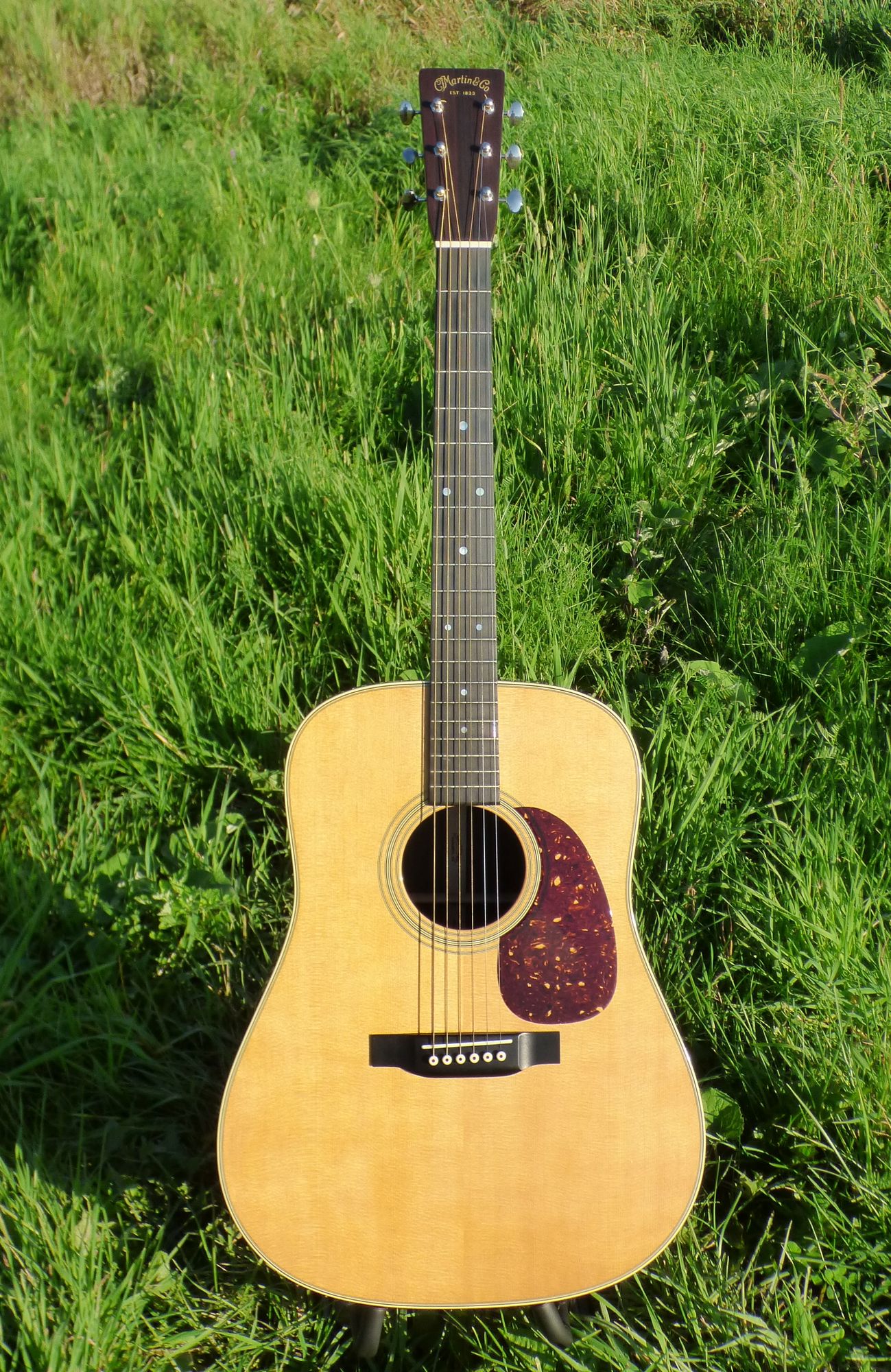
Martin D-28 Acoustic Guitar. Photo by Niranjan Arminius. Licensed under CC BY-SA 4.0. Via Wikimedia Commons. Martin
D-28
1931
You’ve heard a D-28 your whole life. It just never asked for the credit.
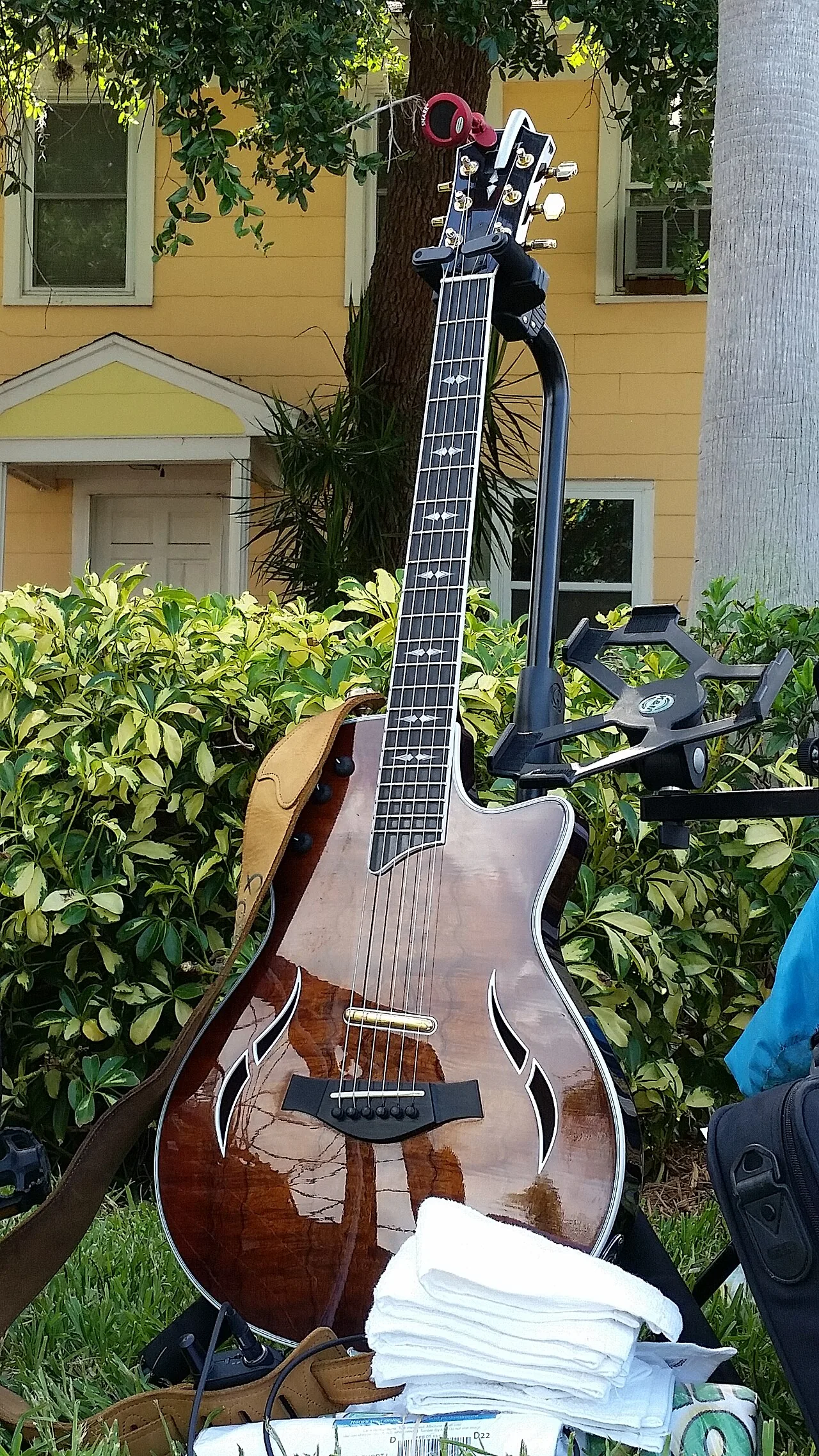
Photo: amateur photography by michel / Wikimedia Commons / CC BY 2.0 Taylor
T5
2005
Bob Taylor said Taylor would build an electric somewhere between never and a truly new idea. This was the idea.