Travis Bean
TB1000
A motocross racer watched a repairman fight wooden necks all day. So he made one out of aluminum.
Burbank, the early 1970s. Travis Bean works at a music store, and every day he watches the repairman, Marc McElwee, spend his hours on wooden necks. Bean is a machinist, not a luthier. He has an idea a luthier might never have had.
- Introduced
- 1974
- Type
- Solidbody electric
- Class
- Production
The short version
1972
The first one
Marc McElwee strings up the prototype, somewhere in the middle to late part of the year.
1974
Sun Valley
The shop opens in January, and production begins.
1975
Patent and price list
The Standard lists at $595, the Artist at $895. Keith Richards takes one on the Stones’ tour.
1977
First closing
The factory shuts at the end of the year.
1978
Back, briefly
Reopens in June, with magnolia bodies alongside the koa.
1979
Done
Production stops for good, in June or August depending on who you ask. Keith and Ronnie Wood play Artists with the New Barbarians.
2017
McElwee again
A new company shows Travis Bean Designs guitars at NAMM, with McElwee involved.
Side A
A1
The repairman’s bench
Travis Bean was not a guitar maker. He was a machinist, a metal sculptor, and a motocross racer. In the early ’70s he worked at a music store in Burbank, and he watched the repairman, Marc McElwee, at work.
McElwee spent his days on wooden necks, and wooden necks warp. You can fix one. Then, sooner or later, you fix it again.
Bean looked at that and saw a machining problem. He said later:
Right off, I thought of building the neck out of aluminum.
He had no idea that was supposed to be a bad idea. In his words, it was “based on my non-experience with guitars and my ignorance of old wives’ tales that would have made me believe a metal neck had to be wrong.”
A2
One piece of metal, tuner to saddle
McElwee strung up the first one in 1972. By January 1974 Bean had a shop in Sun Valley, California, and they were building guitars. The patent came through in October 1975.
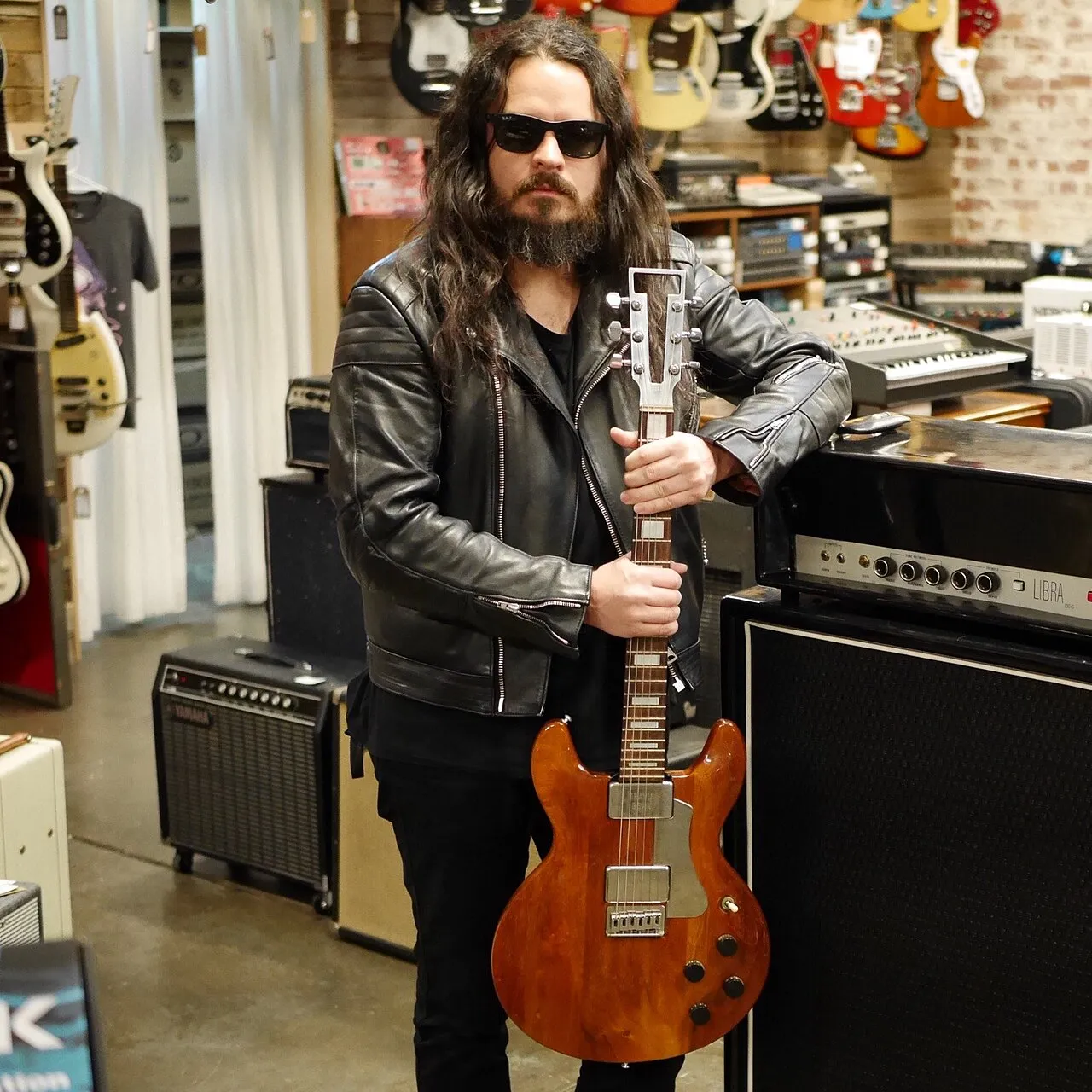
The idea is a single machined piece of aluminum: headstock, neck, and a long tongue that runs into the body and under the bridge. The catalog called it the “neck and receiver assembly.” The pickups bolt straight to the metal. So does the bridge. There’s no wood between the string at the tuner and the string at the saddle.
That was the whole point: nothing in the path from tuner to saddle that could warp.
Solid aluminum had its own problem, and the ads admitted it “robs vibration due to its mass,” so they hollowed out the base with chambers. The body is wood built around the metal, usually koa, because Bean walked into a store selling wood for art and it was the only thing that looked decent in one piece.
A3
Standard or Artist
The TB1000 came two ways. The Standard is a slab body with dot inlays, $595 in March 1975. The Artist is the carved-top one with pearl blocks, $895. Same neck, same two humbuckers with Travis Bean stamped on the covers, same T-shaped cutout at the headstock.
They are heavy. One 1976 Standard weighs nearly 11 pounds. The neck is a bit over three of that, and the rest is the wood.
And the neck feels cold. That bothered some players. Bean’s answer, in 1979:
Unless you’ve got a totally worn-out Telecaster, you’ve never felt wood in your life—you’ve been feeling the finish.
He had a point. Later on, the necks could be ordered with an Imron coating, described as “the same thing they paint airplanes with.”
Flip the record · By the numbers
$595
The Standard’s list price in March 1975. The carved Artist was $895.
755
Artists made, by one count, against 1,422 Standards.
10 lb 15 oz
What one 1976 Standard weighs. A little over three pounds of that is the neck.
6
Five-string guitars in the whole run. Two were Keith Richards’s.
Side B
B1
Stones, Dead, and Lizzy
The rock stars came fast. Keith Richards took a TB1000 on the Stones’ 1975 tour. Jerry Garcia got in touch, the Grateful Dead visited the shop, and he played an Artist on stage for a while. Joe Perry had one. Brian Robertson played an Artist in Thin Lizzy’s best years. Ace Frehley played a Standard. Francis Rossi used an Artist on Status Quo’s “Accident Prone.”
In 1979 Keith and Ronnie Wood both played Artists with the New Barbarians. Keith’s was one of only six five-string Beans ever made, and two of those six were his.
Not every aluminum neck from that era is a Bean. Gary Kramer worked at the shop, left, and started building aluminum necks with wood set into the back. That’s a different company and a different guitar.
B2
Shut down, twice
It didn’t last. The factory closed at the end of 1977, reopened in June 1978, and shut for good in 1979. The count of everything they made, guitars and basses together, lands somewhere between about 3,000 and 3,700, depending on who you ask. Of the TB1000s, the Standards outnumbered the Artists nearly two to one.
Bean tried again in the late ’90s and built a small batch of prototypes. How many is another number nobody agrees on.
Then in 2017 a company in Alabama brought the design back at NAMM as Travis Bean Designs. Marc McElwee was part of it.
Forty-five years after he strung up the first one, the repairman who spent his days fighting wooden necks was still standing next to the aluminum one.
Put this on
You’ve read about it. Now hear it. Here’s what this guitar sounds like, and what to listen for.
Accident Prone
Francis Rossi played a TB1000 Artist from around 1976–77 on this one. That same guitar later turned up in Mark Knopfler’s collection.
Find it on YouTube (opens in a new tab)
The cast
The people, and the specific guitars, that made the legend.
1972
Marc McElwee
The first TB1000
The Burbank repairman whose days on wooden necks gave Bean the idea. He strung up the first one, and helped with the 2017 revival.
1970s
Jerry Garcia
Custom TB1000 Artist
Played an Artist and a TB500 on stage for a time. The Grateful Dead visited the Sun Valley shop.
1975
Keith Richards
TB1000, then a five-string Artist
A TB1000 on the Stones’ 1975 tour. A custom five-string with the New Barbarians in 1979.
1979
Ronnie Wood
TB1000 Artist
With the New Barbarians, alongside Keith.
1970s
Brian Robertson
TB1000 Artist
Played one in Thin Lizzy’s best years.
1978
Francis Rossi
TB1000 Artist
Used on Status Quo’s “Accident Prone.” The guitar later passed through Mark Knopfler’s collection.
Liner notes
Specs, construction, rarity, value, and every source we used.
An aluminum through-neck into koa — Travis Bean’s TB1000, Standard slab or Artist carve, not the TB500 single-coil, not a Kramer.
- Body
- Double-cut; slab Standard, carved Artist. Koa typical. Magnolia after the 1978 reopening. Early teak / padauk.
- Neck
- Through-neck milled from Reynolds 6061-T6 aluminum; pickups and bridge on the metal. Mix flagged.
- Fingerboard
- Rosewood, 22 frets; dots (Standard) or pearl blocks (Artist)
- Scale
- Mix flagged. RetroFret 24½" (622 mm); Elderly / Cream City 24¾"; Guitar.com 24.75"; Guitar Player 25.5".
- Pickups
- Two house Alnico humbuckers; Travis Bean stamped on the covers
- Hardware
- Through-body six-saddle bridge; Schaller or Grover; T-cut headstock
- Electronics
- Two volume, two tone, 3-way
- Finish
- Natural koa typical; black, white, red. Artist pearl.
- Nut
- Mix flagged. RetroFret 1½" (38 mm); Elderly / Cream City 1-11/16".
Open the full research fileConstruction details, the complete player record, production numbers, dated value estimates, and sources
Classic living example = 1974–79 Sun Valley TB1000 (Standard and Artist on this table). No current typical SKU from the original factory this pass. Travis Bean Designs / Electrical Guitar Company reissues are later objects, not this table. Mixed inch/mm flagged; no millimetres invented. TB500 is the single-coil budget guitar. TB2000 is the bass. TB3000 Wedge is the closed-V. Kramer is Gary Kramer’s later shop. No Gibson SKU.
Construction
The job was a neck that would not warp. Clifford Travis Bean was a machinist, a metal sculptor, a motocross racer, not a shop luthier. In the early ’70s he worked at a Burbank music store and watched Marc McElwee, the repairman, spend his days on wooden necks. Bean told Don Menn for Guitar Player in 1979: “Right off, I thought of building the neck out of aluminum.” He had no brief against wood. “It was based on my non-experience with guitars and my ignorance of old wives’ tales that would have made me believe a metal neck had to be wrong.”
Vintage Guitar (Willie G. Moseley, January 1999): McElwee strung the first one mid-to-late 1972. Shop open January 1974. Vintage Guitar (Michael Wright, June 2018): guitars began to be made in ’74 at 11761 Sheldon Street, Sun Valley, California. Dave Hunter (Guitar Player, 5 January 2021): developed 1973–74, into production 1974, patent awarded October 1975. USPTO 3,915,049, issued 28 October 1975. This plate starts in 1974. First price list March 1975 (Wright; Tony Bacon, Reverb News, 19 May 2022): Standard $595, Artist $895, TB2000 bass $655, case $95.
What they built is a single machined billet — headstock, neck, and a receiver that runs into the body under the bridge — Reynolds 6061-T6. The 1975 catalogue (Bacon) called it a “neck and receiver assembly,” a solid metal link from tuner to saddle. Pickups bolt to the aluminum, not to a plastic ring in wood. Ads admitted solid aluminum “robs vibration due to its mass,” so they hollowed the base and tapered it. Hunter: three narrow chambers down the length. Premier Guitar (17 January 2011): by 1977 the chambering moved, a U-channel taken from the top instead of the side.
The wood is a body around that pan, not the other way around. Koa, because Bean walked into an art-wood store and it was the only timber that looked decent in one piece (Moseley). Magnolia after the reorganization. Teak and padauk on the earliest ones (Bacon; Guitar.com, Justin Beckner, 25 April 2023). Double-cut. Standard (TB1000S): slab top, dot board. Artist (TB1000A): carved top, pearl blocks. Same humbuckers, same T-cut head, same slug. Wright’s anecdotal order puts the Standard first; Guitar.com calls the Standard the first production guitar. Keep both as the opening guitar. Artist is the dress version, not a second page.
Not the TB500. Offset, single-coils, plastic covers, $500 in 1977 (Bacon). Wright has the 500 in the line by January 1976. Keep both dates. Garcia’s three-pickup 500 is that guitar. Not the TB2000 bass, and not Wyman’s short-scale customs. Not the TB3000 Wedge. Not a Kramer. Gary Kramer left this shop — Bacon 1975, Wright ’76 — and built aluminum necks in Neptune with wooden inserts down the back so they would not copy the patent. That is a different factory. No Gibson SKU.
They are heavy. Hunter’s 1976 Standard, serial 421, 10 pounds 15 ounces. Elderly’s 1434: 11.0 lbs. Bean, to Moseley: the neck was a little over three pounds; the wood was the rest. Cold aluminum bothered some players. Bean’s 1979 reply to Menn: “Unless you’ve got a totally worn-out Telecaster, you’ve never felt wood in your life—you’ve been feeling the finish.” Imron-coated necks were the later option, “the same thing they paint airplanes with.”
Premier Guitar (Dan Orkin, 17 August 2018): horns a bit larger mid-1977, body a bit thinner the next year. Bacon: factory closed at the end of 1977, reopened June 1978, closed for good August ’79. Wright: production ceased June 1979. Keep both. Bean and Rita tried again in the late ’90s — Hunter 1997, about 20 prototypes; Wright 1999, about 10; Wikipedia’s Condon run of 24 is a third figure. Keep all three. Kevin Burkett at Electrical Guitar Company, with McElwee, showed Travis Bean Designs at winter 2017 NAMM (Hunter; Orkin). Those are later objects.
Classic vs current: 1974–79 Sun Valley — 6061 pan into koa, house Alnicos, T-cut — against nothing you can order from that factory, and against an Alabama reissue that is not this table.
Players
Do not recruit Steve Albini. His Beans are a TB500 and a TB3000 Wedge. Do not recruit Bill Wyman; that is the TB2000 bass.
Jerry Garcia. The named TB1000. Hunter: he played a TB1000 and a TB500 for a time. Premier Guitar, 2011: custom TB1000A and TB500 onstage. Moseley: Garcia contacted the shop; the Grateful Dead visited Sun Valley. The 500 stays off this plate. The Artist is this guitar.
Keith Richards. Premier Guitar, 2011: a TB1000 on the Stones’ 1975 tour; a custom five-string TB1000A with the New Barbarians, 1979. Bacon, citing Bill Kaman II: six five-string guitars in the run, two of them Keith’s. Those two objects are not a street Artist.
Ronnie Wood. Premier Guitar, 2011: TB1000A, New Barbarians 1979. Hunter puts Keith, Ron, and Wyman on Beans with the Stones in the mid-’70s; Wyman’s is still the bass.
Brian Robertson. Premier Guitar, 2011: TB1000A in Thin Lizzy’s glory days.
Joe Perry. Hunter: a TB1000. Wright lists him among the pros who took the idea seriously.
Ace Frehley. Guitar.com puts him on the Standard. Axeology dates a black TB1000S to December 1975, Alive! encores. Keep the Guitar.com credit; do not invent a session log.
Also known to play stays last and short. Guitar.com: Rick Nielsen, Slash on the Standard. Orkin: Stephen Malkmus, Colin Newman. Wright: Stanley Jordan later. None invented.
Rarity
You cannot buy a new 1974–79 TB1000 from Travis Bean Guitars. That factory is closed. Travis Bean Designs / EGC reissues are a different shop on a related pan.
Bill Kaman II, Vintage Guitar 1995, as reported by Bacon: 1,422 TB1000 Standards, 755 Artists, 1,023 TB2000 basses, 351 TB500s, 45 TB3000 Wedges, 36 TB4000 Wedge basses, plus two doublenecks and six five-strings. Wright’s 2018 totals match the guitar counts and print 1,020 TB2000s and a June 1979 stop. Hunter: “some 3,650” instruments in five years. Premier Guitar, 2011: “around 3600.” Orkin: “around 3,700.” Bean to Moseley: “about 3,000.” Keep the spread. Those are attributed run totals, not a year-by-year ledger.
Serials stamp the T-cut. They date a guitar. They don’t count a year. That is why a first-year census is unknown, not the chapter.
What is actually thinner: first-year teak/padauk bodies; the 755 Artists against the 1,422 Standards; white and pearl; the six five-strings; the two doublenecks. Garcia’s Artist, Keith’s five-strings, and the Rossi/Knopfler Christie's Artist are unique objects. They are not a vintage TB1000.
Value
Informal estimate, 3 September 2026. Not an appraisal.
Ask vs sold labeled. Celebrity lots are not-comps. No invented medians or factory counts. Period list $595 / $895 (March 1975) and the later Artist $1,395 (Orkin; Bean to Moseley as the top of the original cart) are 1970s money, not 2026 street.
New street. None from the original factory. Mahar’s Vintage Guitars listed a 2022 Travis Bean Designs TB1000S reissue at $5,499.95 (sold out). That is a different cart.
Used modern. There is no modern Sun Valley TB1000 production to make a used-modern band. Reissues live on their own tape.
Vintage / collectible. Named asks this pass, not hammers: Elderly Instruments 1976 Standard, serial 1434, $6,000 (sold out); Cream City Music 1978 Artist $8,549 (from $8,999, sold out). Live Reverb asks on original TB1000s this pass sit about $6,500–$13,000, labeled asks. Orkin (2018) had Artist sales “closer to $6,000” and a 2018 average around $4,700 — dated, not a 2026 median. Do not average those asks.
Christie's, Mark Knopfler collection: a circa 1976–77 TB1000 Artist Francis Rossi used on Status Quo’s “Accident Prone” (1978). Celebrity, not a comp. Garcia lots, if they surface, are the same rule.
See also
- kramer-baretta — Kramer’s later banana-headstock superstrat; early Kramer aluminum-necks split from this Sun Valley shop, they are not this guitar
- rickenbacker-a-22 — earlier aluminum, a 1932 cast lap steel, not a Spanish-neck TB1000
- ampeg-dan-armstrong — another late-’60s material experiment, Lucite, not an aluminum through-neck
Sources
- Vintage Guitar, Michael Wright, The Travis Bean TB1000S Standard (June 2018) — 1974 Sun Valley; March 1975 list $595 / $895 / $655; Reynolds 6061-T6; Standard slab vs Artist carve; Kramer exit; June 1979 stop; 1,422 / 755 / 351 / 1,020 / 45 / 36
- Vintage Guitar, Willie G. Moseley, Travis Bean Interview (January 1999) — first string-up 1972; shop January 1974; Standard vs Artist; koa; Garcia / Wyman; ~3,000 instruments; 21 people; highest original $1,395; 1990s pan-back revival
- Guitar Player, Dave Hunter, Classic Gear: 1976 Travis Bean TB1000 Standard (5 January 2021) — T6061 through-neck; 1974 production; patent October 1975; 1,422 Standards; ~3,650 total; serial 421; 10 lb 15 oz; 25.5" scale; house Alnicos; Garcia TB1000 and TB500; 1997 revival ~20 prototypes; 2017 NAMM
- Reverb News, Tony Bacon, Travis Bean, Kramer & the Rise of Aluminum Neck Guitars (19 May 2022) — Menn 1979 quotes; Sun Valley models and intro prices; neck-and-receiver; Kramer 1975; factory closed end 1977 / June 1978 / August 1979; Kaman 1995 totals 1,422 / 755 / 1,023 / 351 / 45 / 36 plus two doublenecks and six five-strings
- Guitar.com, Justin Beckner, A Brief History of Travis Bean Guitars (25 April 2023) — 1974 start; Menn quotes; Standard first production, 1,422; Artist 755; Ace Frehley / Rick Nielsen / Slash on Standard; 24.75" scale; koa / magnolia / teak / padauk
- Premier Guitar, 1977 Travis Bean TB1000A (17 January 2011) — 1974–79, ~3600; 1977 chambering change; Garcia TB1000A and TB500; Richards / Wood New Barbarians 1979; Robertson Thin Lizzy
- Premier Guitar, Dan Orkin, Vintage Vault: 1977 Travis Bean TB1000A Artist (17 August 2018) — Artist ~$1,395 original; mid-1977 wider horns; thinner body 1978; ~3,700 total; 2018 Artist ~$6,000; 2018 average ~$4,700; Malkmus, Newman
- USPTO 3,915,049 — issued 28 October 1975
- Elderly Instruments, 1976 TB-1000 Standard SN 1434 — koa; 22 frets; 1-11/16" nut; 24-3/4" scale; 11.0 lbs; Schaller; ask $6,000 sold out
- Cream City Music, 1978 TB-1000 Artist — 1 11/16" nut; 24 3/4" scale; 10 lbs 14.3 oz; ask $8,549 from $8,999
- RetroFret, 1976 TB1000S Standard — serial 790; 24½" (622 mm); nut 1½" (38 mm); 39 3/8" / 14 1/8" / 1 3/8"; Standard $595 then $995
- Christie's, TB1000 Artist, Knopfler / Rossi — circa 1976–77 Artist; Rossi on Status Quo “Accident Prone”; celebrity lot
- New York Times, Douglas Martin, Travis Bean Aluminum Guitar Maker Dies at 63 (16 July 2011) — Bean 21 August 1947 – 10 July 2011
- Wikipedia, Travis Bean — 1974–79; ~3,600; model counts; Kramer 1975; late-1990s Condon run of 24
- Mahar’s Vintage Guitars, Travis Bean Designs TB1000S Reissue 2022 — reissue ask $5,499.95 sold out; later object, not this table
Keep digging
Guitars this one gets compared to, confused with, or descended from.
- Send a picture
Kramer
Baretta
1983
One humbucker, a bolt-on neck, a banana headstock. Kramer’s 1983 superstrat kept the loud part.
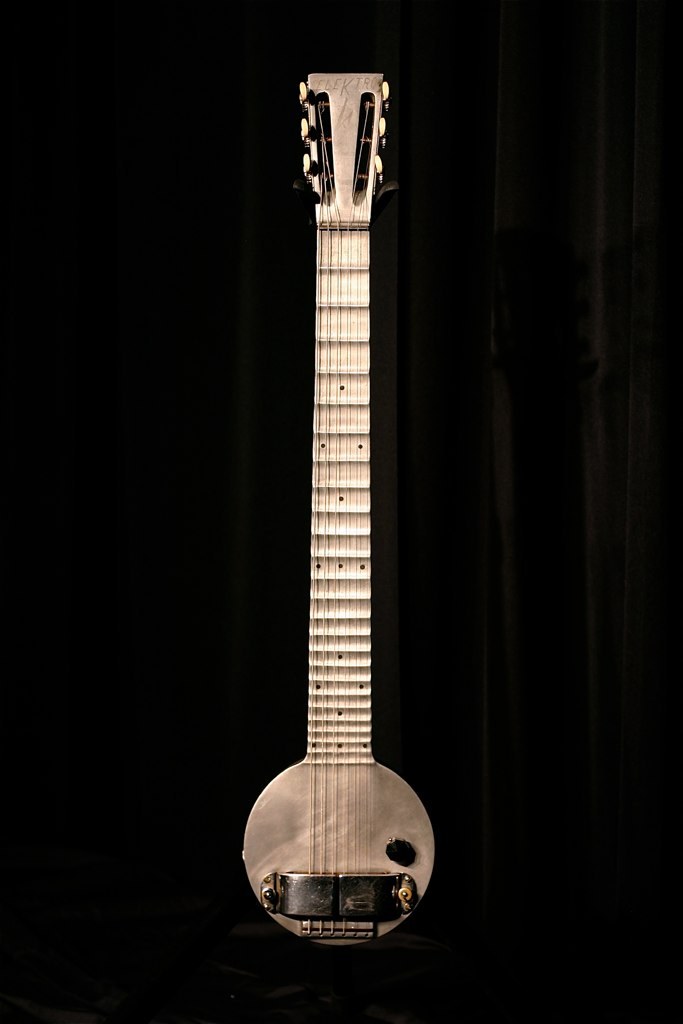
Photo: Museum of Making Music / Wikimedia Commons / CC BY 3.0 Rickenbacker
A-22 Frying Pan
1932
The first electric guitar you could buy looked like a frying pan. The patent office didn’t believe it worked.
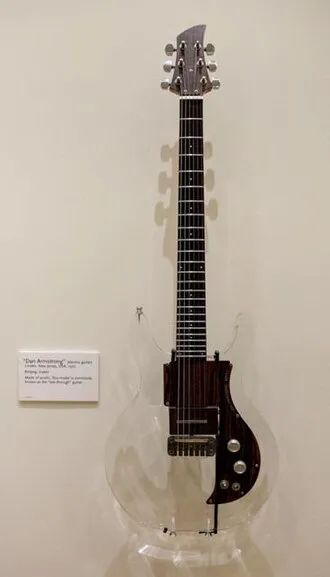
Photo: Frank Kovalchek / Wikimedia Commons / CC BY 2.0 Ampeg
Dan Armstrong
1969
A repairman who spent his days inside other people’s guitars designed one you could see straight through.