Martin
HD-28
For almost thirty years, a herringbone Martin meant finding an old one. In 1976 Martin added a letter.
Nazareth, Pennsylvania, 1976. The country is turning 200, and more people want an old Martin D-28, the pre-war kind with herringbone around the top, than there are old D-28s to go around. So Martin builds a new one, and puts an H in front of the name.
- Introduced
- 1976
- Type
- Flat-top steel-string acoustic
- Class
- Production
The short version
1947
The wait starts
The last herringbone D-28s leave Nazareth, in 1946 or early 1947 depending who you ask.
1969
Brazilian ends
Style 28 moves to Indian rosewood, years before the HD-28 exists.
1976
The H arrives
Herringbone, scalloped braces, and a zipper backstrip come back on a new model. Some lists say 1975, one says 1977.
1977
Second year
Martin builds 1,486 of them, nearly three times the first year.
2018
Braces move forward
The standard HD-28 gets the forward-shifted bracing and a wider neck.
2025
The D-28 catches up
The Standard D-28 gets scalloped braces too. Herringbone is what’s left to tell them apart.
2026
Two hundred fifty
A 250-piece commemorative edition for the country’s 250th, built on the HD-28.
Side A
A1
Waiting for an old one
Every good acoustic shop has a customer who checks the back wall first. They’re looking for an old Martin D-28, the pre-war kind, with a strip of herringbone around the top and braces carved so the whole top can swing. They don’t want a new one. They want that one.
In the ’70s, a lot of people were checking a lot of walls.
Martin had been making the D-28 the whole time. It never left the catalog. But the D-28 on the wall wasn’t the D-28 in their heads. The carved braces had gone straight by the end of 1944, and the herringbone ran out right after the war. For almost thirty years, if you wanted the old recipe, you had to find an old guitar and hope.
Then, in 1976, Martin put the herringbone and the carved braces back on a new dreadnought and gave it a new name.
A2
H is for herringbone
The name is a code, and an easy one. D is dreadnought, Martin’s big square-shouldered body. 28 is Style 28: rosewood back and sides. H is herringbone, that little zigzag strip of wood marquetry around the edge of the top.
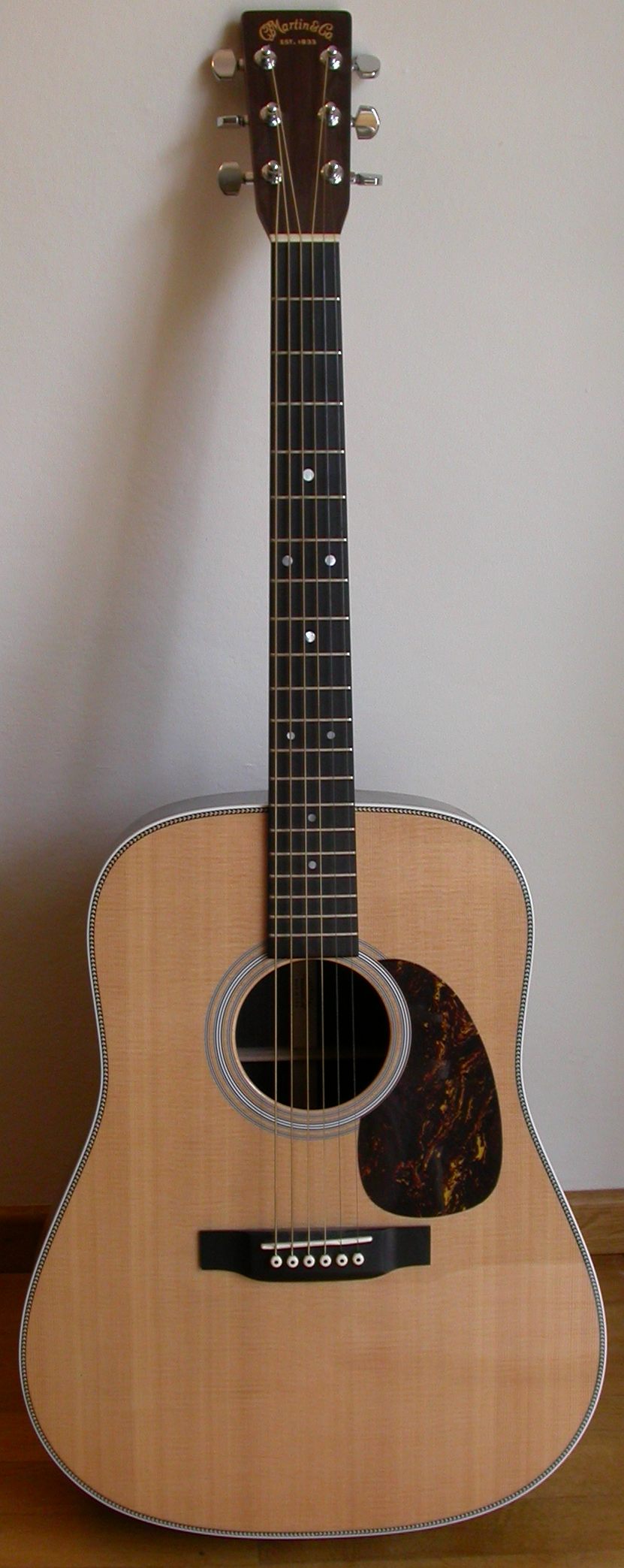
What came back in 1976 was a package: the herringbone, the scalloped X braces under the top, and the zipper stripe down the middle of the back. Scalloped means the braces are shaved down between the spots where they’re glued, so the top stays stiff where it has to and loose everywhere else. You hear that as more low end and a chord that hangs in the air a little longer. That’s the part players were really after. The herringbone is just how you spot it across the room.
What didn’t come back was Brazilian rosewood. Martin had moved Style 28 to Indian rosewood at the end of 1969, before there was any such thing as an HD-28. So this was never a pre-war guitar built late. It was a new model wearing the old one’s clothes, with the old one’s bracing underneath.
Nobody agrees on exactly when it showed up. One list has it available in 1975, most people say 1976, and one account has it reaching the catalog in 1977. Call it 1976 and you’re in good company. Martin built 500 that first year and 1,486 the next.
A3
Same letters, different guitar
Here’s where it gets fussy, and it’s worth being fussy, because an HD-28 from 1980 and one from last year are not the same guitar.
The first ones had a small maple plate under the bridge, the piece of wood the strings pull against. Around 1988 the plate got bigger, about two inches instead of one and three-eighths. A small plate lets the top move more. A big one keeps it together longer. Players still argue about which trade is the right one.
Then the family grew. Around 1996 the HD-28V arrived, with its X braces moved forward, closer to the soundhole, the way the old ones were. A run with Adirondack spruce tops followed. In 2018 the regular HD-28 got the forward bracing too, plus a wider neck.
And in 2025, Martin gave the regular D-28 scalloped braces, the same bracing as the HD-28. The bracing that made the HD-28 special in 1976 now lives on both guitars. What’s left to tell them apart is what you can see: herringbone around the top, the zipper down the back, and abalone diamonds and squares up the fingerboard where the D-28 has dots.
Flip the record · By the numbers
500
HD-28s built in the first year, 1976. Small next to the D-28, big next to 91 pre-war D-45s.
1,486
HD-28s built in 1977, the second year. People had been waiting.
1976
The usual year. The lists put it anywhere from 1975 to 1977.
250
Pieces in the 2026 Semiquincentennial edition, built on the HD-28.
Side B
B1
Who plays one? Probably you
Ask who made the D-28 famous and you’ll get a long list: Elvis, Neil Young, half of bluegrass. Ask who made the HD-28 famous and the honest answer is short. Martin’s product copy says countless icons have played one. Maybe so, but nobody has written down who.
A lot of the famous herringbone dreadnoughts people point to aren’t HD-28s at all. Neil Young’s “Hank” is a 1941 D-28. It has herringbone because it was built in 1941. The H is a letter Martin started using in 1976, and a guitar from 1941 doesn’t get one after the fact. Bob Dylan’s photonegative Martin gets lumped in too, but depending who you ask it’s a D-28 or something based on the HD-28V. Either way it’s a custom, not a guitar off the catalog page.
That’s not a knock. There’s no museum HD-28, no famous number one. Its history is mostly people walking into shops and buying one new.
B2
Two hundred and fifty
The HD-28 showed up the year America turned 200. Fifty years later, for the 250th, Martin built a 250-piece anniversary edition, and it built it on the HD-28. Chris Martin IV said using the HD-28 as the foundation felt right. It isn’t a pre-war recreation. It’s the guitar Martin started making at the last big birthday, brought out for the next one.
The pre-war D-28s are still out there, and there still aren’t many of them. The back-wall people are still checking.
But since 1976 there’s been another way. Walk in, point at the one with the herringbone, and take it home new, with no famous owner and nobody’s story on it yet. Every HD-28 out there started that way, the property of somebody who got tired of waiting.
The cast
The people, and the specific guitars, that made the legend.
2026
Chris Martin IV
HD-28 Semiquincentennial
Chose the HD-28 as the foundation for the 250-piece anniversary edition. He said it felt right.
1941
Neil Young
“Hank,” not an HD-28
His herringbone Martin is a 1941 D-28. It wears herringbone because of when it was built, not because of the letter.
Liner notes
Specs, construction, rarity, value, and every source we used.
The 1976 herringbone-and-scallop revival of the pre-war Style 28 look — not a pre-war D-28 — and now that the current Standard D-28 GE-scallops too, herringbone is the remaining badge.
- Body
- D-14 Fret dreadnought; spruce top with aging toner; East Indian rosewood back and sides; antique white binding, bold herringbone, Style 28 multi-stripe rosette; zig-zag with black stripe back
- Neck
- Select Hardwood (Martin spec — not named mahogany), GE Modified Low Oval with High-Performance Taper; satin, dark mahogany color; dovetail joint
- Fingerboard
- Ebony, abalone diamonds and squares long pattern, unbound, 20 frets, 14th-fret joint
- Scale
- 25.4"
- Pickups
- None (acoustic SKU; HD-28E is other)
- Hardware
- Ebony GE Modern Belly, drop-in saddle, 2 5/32"; bone pins with faux-tortoise dots; compensated bone saddle 16" radius; nickel open-gear butterbean; faux-tortoise pickguard
- Electronics
- None
- Finish
- Gloss body, satin neck, aging toner top
- Nut
- Bone, 1 3/4"; 12th-fret 2 1/8"
Open the full research fileConstruction details, the complete player record, production numbers, dated value estimates, and sources
SKU 10Y25HD28. 2025 Standard refresh. Forward-shifted GE-scalloped 5/16" X — same structure as current Standard D-28. Remaining HD-28 badges: herringbone, zipper/zig-zag backstrip, abalone diamonds-and-squares. D-28 is multi-stripe + dots. Not a 1976 recipe. Not a pre-war herringbone D-28.
Construction
C. F. Martin & Co., Nazareth. H = herringbone trim, D = dreadnought, 28 = Style 28. Indian rosewood — Brazilian Style 28 cutoff is late 1969 (GuitarHQ serial 254497), before HD-28 exists. Not OM/000.
After late-1944 non-scalloped braces and 1946/47 herringbone deletion, the catalog D-28 was a straight-braced, multi-stripe dreadnought. HD-28 is Martin's 1976 standard-line return of scalloped braces + herringbone + zipper. Revival of the look and category of pre-war Style 28, not a continuation of 1930s production. The D-28 never left the catalog.
Year stack, not a winner. GuitarHQ Style 28 list: 1975 scalloped/herringbone available on HD-28. Folkway, Vintage Guitar ("Bridge-Plate Blues"), and Martin's 2 July 2026 press: 1976. Folkway: catalog 1977. Usual prose year is 1976.
Three recipes:
1976–pre-2018 Standard — scalloped, standard-shifted, 1 3/8" maple plate in 1976 then ~2" ~1988 (UMGF), 1 11/16" nut. Sitka, East Indian. Reject Strum Avenue "non-scalloped 1976–2001"; Folkway, GuitarHQ, Guitar Center Riffs, and UMGF all have 1976 scalloped. Split that era: HD-28 = scalloped, standard-shifted; HD-28V = scalloped, forward-shifted.
2018 Reimagined — first factory forward-shifted on Standard HD-28, 1 3/4" nut, still scalloped while 2018 D-28 stayed non-scalloped.
2025 GE — scallop shared with D-28: forward-shifted GE-scalloped 5/16" X. Remaining HD-28 badges: herringbone, zipper/zig-zag, abalone diamonds-and-squares. Hide glue is not on the current Standard sheet. Neck is Select Hardwood.
HD-28E is the electronics SKU. HD-28V is Vintage Series (forward-shifted earlier). HD-35 and HD12-28 are other SKUs. No HD-28 Authentic sheet in this pass. Semiquincentennial 2026 is a 250-piece commemorative on the HD-28 platform, not a pre-war recreation.
Herringbone end dates, same as the D-28 page: Carter early 1947 herringbone / late 1944 scallop; Wikipedia 1946 German trim; GuitarHQ last herringbone serial 98223, 1947; Peghead 1946. Keep both. Don't flatten.
Players
The honest list is short. If a famous dreadnought story does not say HD-28, it does not go here.
The 1976 model-year itself — the factory answer to vintage D-28 demand (Carter; VG Bridge-Plate Blues; Martin 2 July 2026 Bicentennial press). No museum "number one."
HD-28 Semiquincentennial 2026, 250 pieces. Chris Martin IV: using HD-28 as foundation felt right. Factory meaning, not a player's guitar.
Known to play: none sourced comparable to the D-28 hall of fame. Martin's "countless icons" product copy is unsourced — not a player list.
Not this guitar. Elvis 1955 leather D-28; Lester Flatt 1950; Clarence White / Tony Rice 1935 D-28 58957; Waylon 1946; Billy Strings 1940 76283; Neil Young "Hank" 1941 herringbone D-28; Rich Robinson 1954; Don McLean; McCartney Blackbird; Paul Simon Mrs Robinson. Those are D-28s that wear herringbone because of when they were built. The H in HD-28 is a 1976 catalog letter. Do not put Dylan here — AG Player's Choice photonegative: the feature calls it a D-28; the store listing says based on HD-28V. Custom photonegative, not a catalog HD-28.
Acoustic Guitar's 1976 "old-style D-28" best-seller sentence never says HD-28 — Carter and Martin do. Martin did not "bring the D-28 back" in 1976.
Rarity
HD-28 as a name is not scarce. First-year and a few limiteds are scarce-ish vs later HD-28s. None of this is pre-war D-28 scarce.
- 1976 first year: 500 (UMGF citing Longworth)
- 1977: 1,486 (same)
- 1978–present Standard: unpublished by model. Do not treat all-Martin serial spans as HD-28 totals.
- HD-28LSV 1997–2005; last Adi serial #737277 (2000); no grand total
- HD-28V ~1996–2018; no factory total
- Semiquincentennial 2026: 250 (Martin press 2 Jul 2026)
500 first-year is small vs 1970s D-28 volume, large vs 487 original OM-28s or 91 D-45s. Collectible HD-28, not a grail. Mexican Road/X are not HD-28s. HD-35 is a different SKU.
Value
Informal estimate, 25 August 2026. Not an appraisal.
Modern/Indian HD-28s only. Joe's Jul 2026 pre-war D-28 excellent $80,000–$300,000 and Carter 1941 D-28 ask $120,000 are the other guitar. Label ask vs sold.
New street. Martin.com $3,699.99; working street ~$3,450–$3,700 natural (Music Den $3,499; Willcutt $3,449.99; Jackson's $3,449). HD-28E new Martin.com $4,099.99. Semiquincentennial dealer $6,299.99 (NW Music) — commemorative, not vintage substitute.
Used current / 2018–2024 Standard: Reverb $1,889–$2,589 (428 orders, Good to Mint) — sold estimate. UMGF 2026 leftover new ~$2,500.
Used 1993–2004: Reverb $1,552–$2,253 (266 orders). Named 2025–26 solds: May 2026 VG $2,600; May 2026 Exc $2,094; Feb 2026 Exc $2,000.
1976–1992 Standard: Reverb $1,890–$3,120 (147 orders). Named 2025 solds: Apr Exc $4,000; Mar VG $3,500; Jun VG $2,400; Apr Good $1,695.
First-year 1976 asks: Liberty $2,999.99; Soundpure SN 383961 $3,550 (neck reset, refret, peghead break). First-year premium is real and small (hundreds to maybe ~$1k), not a new tier. First-year solds 2024–26 not isolated as a separate SKU.
HD-28V 1995–2018: Reverb $1,921–$3,214 (353 orders).
HD-28LSV: TR Crandall 1998 Adi ask $3,999.99 (repaired top crack) — thin solds.
No six-figure HD-28 market. Top is clean 1976 / exceptional V-LSV / CS Brazilian / 2026 250-piece. CS Brazilian: thin, not 1960s Brazilian D-28 money (Joe's 1960–69 D-28 $6,000–$11,500). HD-28 used solds are plentiful — do not inflate with pre-war herringbone language.
See also
- martin-d-28 — the catalog sibling; pre-war herringbone D-28s live there, not here
- martin-om-28 — long-scale 000, not a dreadnought
- martin-d-45 — Style 45 pearl, not herringbone
Keep digging
Guitars this one gets compared to, confused with, or descended from.
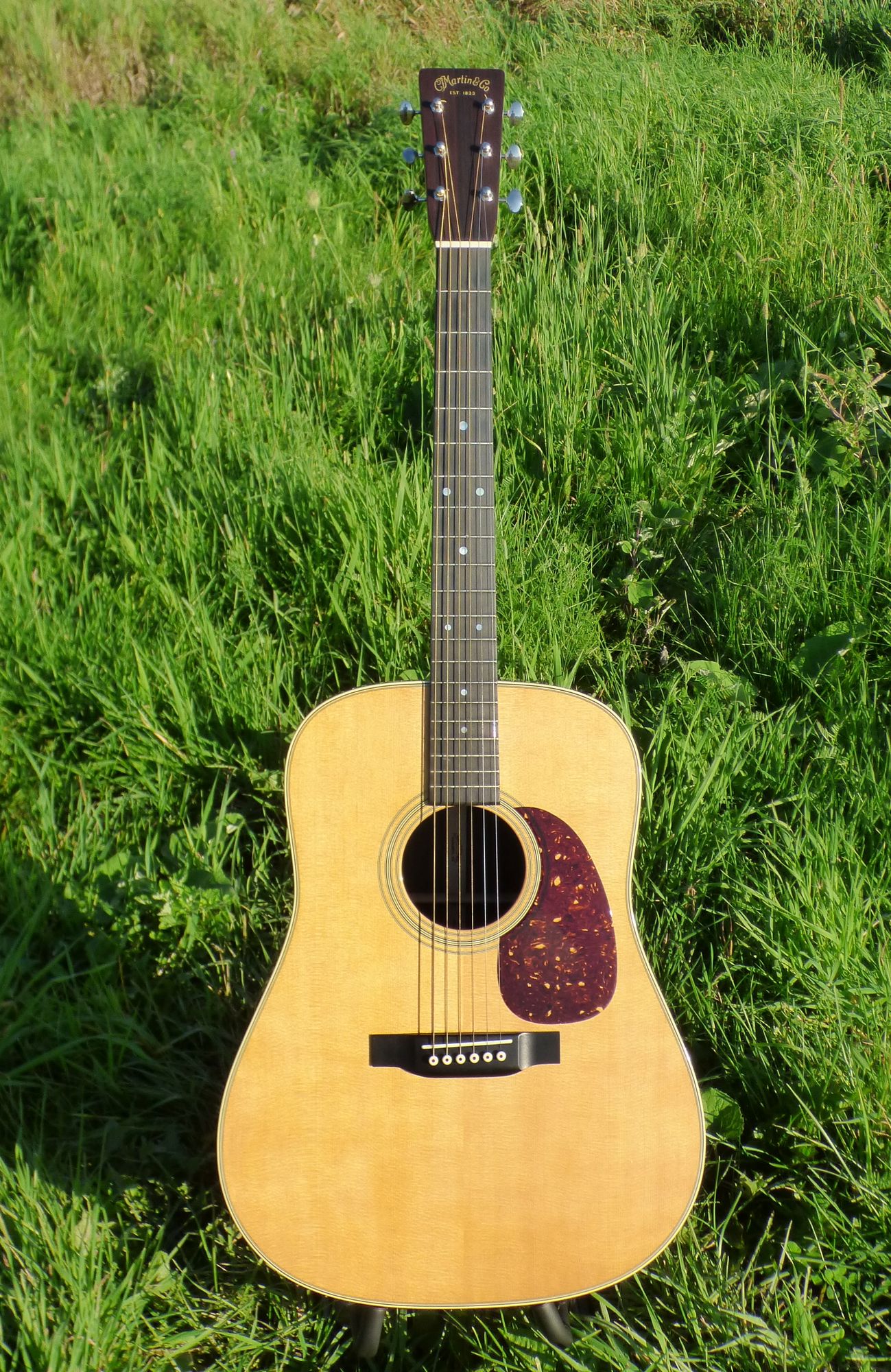
Martin D-28 Acoustic Guitar. Photo by Niranjan Arminius. Licensed under CC BY-SA 4.0. Via Wikimedia Commons. Martin
D-28
1931
You’ve heard a D-28 your whole life. It just never asked for the credit.
- Send a picture
Martin
OM-28
1929
In 1929 one player asked Martin for a longer neck. The answer was a new guitar, and it lasted about four years.

Photo: Eddie Janssens / Wikimedia Commons / CC BY-SA 4.0 Martin
D-45
1933
Pearl takes time. When the war took Martin’s time away, the D-45 stopped, and it waited 26 years to come back.