Schecter
Hellraiser
A borrowed shape, a set neck dressed as a neck-through, and a band that trusted it with the rhythms.
Schecter didn’t invent a new outline for the Hellraiser. It took the C-1 it already had, put active EMGs in it, and trimmed it in abalone and gothic crosses. By 2009 it was being called “our biggest line.”
- Introduced
- 2006
- Type
- Solidbody electric
- Class
- Production
Have a photograph of this guitar? Send a picture
The short version
1976
A parts shop in Van Nuys
David Schecter opens the business that will carry his name.
1998
The Diamond Series
Schecter’s import line goes public at summer NAMM, built in Incheon. Its boss dates the inception to 1997.
1999
The C-1
The double-cut the Hellraiser will sit on arrives. Other accounts say 2000, or 2002.
2005
The first EMG year
At Summer NAMM, Schecter’s vice president shows Hellraisers with active EMGs and a set neck that looks neck-through.
2006
The year Schecter prints
The company’s own copy dates the Hellraiser’s introduction to 2006. Keep 2005 too.
2009
The biggest line
A single-cut joins the family. On EMG’s camera at NAMM, the Hellraiser is “our biggest line.”
2010
A Star-Crossed Wasteland
In This Moment’s album comes out, with most of Chris Howorth’s rhythm parts tracked on a Hellraiser.
2012
Through the body, finally
The Hellraiser Extreme puts a real neck-through in the family, through 2015. A Sustainiac model arrives the same year.
Side A
A1
An illusion of a neck-through
Summer NAMM, 2005. JP Samo, Schecter’s vice president, is on camera with the new models. They’re in black cherry and black, with black chrome hardware and abalone around the edges.
It’s “the first year that we are using EMGs,” he says. Then he points out the trick. The neck is carved to give “an illusion of being a neck through but actually is a set neck.”
That’s the Hellraiser in two sentences. The shape was borrowed and the joint was dressed up. Then a working musician took it into the studio and trusted it with most of an album’s rhythm guitars.
A2
A shape it borrowed
The outline wasn’t new. Schecter started in 1976 as David Schecter’s parts shop in Van Nuys, and by the late ’90s it had an import line, the Diamond Series, built in Korea and set up in the States. In 1999 Schecter added the C-1, a double-cut. Other accounts say 2000, or 2002. Jerry Horton played one in Papa Roach’s “Last Resort” video. That guitar is a C-1. It isn’t this.
The Hellraiser is what Schecter built on top of the C-1. Mahogany body, quilted maple arched top, abalone binding, abalone gothic crosses down a 24-fret rosewood board, and active pickups.
Even its birthday is split. Samo said the models were introduced in 2005. Schecter’s own copy says 2006. Both stay.
A3
Which EMGs?
You’d think the first pickups would be easy. They aren’t. The 2005 clip has Samo saying an 81 in the bridge and an 81 in the neck, and the text under the same video says 707s. A 2007 review lists an 81 and an 85, a volume each, and a master tone.
Whichever pair it was, they were active, running off a 9-volt battery, and they were the reason the guitar existed. The outline was borrowed. The electronics were the point.
By NAMM 2009, Mark Lort, on EMG’s video channel, was calling the Hellraiser “our biggest line” and “the biggest thing for us for the last 2 years.” The new subject that year was EMG’s TW pickups. Today’s C-1 has an 81TW at the bridge and an 89R at the neck, with push-pull volume knobs for a split. The split belongs to the later guitar. Don’t read it back onto 2005.
Flip the record · By the numbers
24
Extra-jumbo frets on a 25.5-inch scale.
2
Active EMGs, powered by a clip-in 9-volt battery.
17
Hellraiser models on Schecter’s site in October 2026.
30"
Scale of the Hellraiser C-VI, more six-string bass than baritone.
Side B
B1
Daggers are not crosses
Once it sold, the name spread. A single-cut came in 2009, called a Solo-6 or a Solo II depending who you ask. A cheaper Hellraiser Special swapped the crosses for daggers. Daggers are not gothic crosses.
In 2012 the Hellraiser Extreme finally did what the first guitar only pretended to, with a real neck-through, and it lasted until 2015. The same year a Floyd Rose model added a Sustainiac, which keeps a note going on its own. It listed at $1,499.
Then the strings got longer. Seven, eight, nine strings, and a 30-inch C-VI that one reviewer called more six-string bass than baritone. In October 2026 there were seventeen Hellraisers on Schecter’s site. Schecter even put the name on an amplifier.
The shape was borrowed and the joint was dressed up.
B2
Most of the rhythms
The person who made it count was Chris Howorth of In This Moment. Ahead of A Star-Crossed Wasteland in 2010, he said it straight.
“I did actually track most of the rhythm guitars on my Schecter Hellraiser,” he said, “but we used a Les Paul, a Fender Strat, and some other assorted guitars for the album as a whole.”
Most of the rhythms. Not every solo. On the next record he credited Schecter and EMG for the rhythm tracks without naming the model, so that one stays unclaimed.
Put the record on and listen under the vocals, to the rhythm parts that hold the songs up. That’s a borrowed shape and a set neck pretending to be something else, and it’s doing the job.
Put this on
You’ve read about it. Now hear it. Here’s what this guitar sounds like, and what to listen for.
A Star-Crossed Wasteland
Chris Howorth tracked most of the rhythm guitars on his Hellraiser. A Les Paul and a Strat are on the album too, so the rhythms are the place to listen.
Find it on YouTube (opens in a new tab)Hellraiser C-7 FR-S demo
Schecter’s own video. Loomis plays the seven-string Hellraiser with a Sustainiac in the neck and an EMG at the bridge.
Watch it on YouTube (opens in a new tab)
The cast
The people, and the specific guitars, that made the legend.
2010
Chris Howorth
His Hellraiser
Of In This Moment. Tracked most of the rhythms on A Star-Crossed Wasteland with it. He doesn’t name the model for the next album, so it stays off that one.
2014
Jeff Loomis
Hellraiser C-7 FR-S
Demoed it for a Schecter video. A factory demo, not his signature guitar.
2005
JP Samo
The 2005 Hellraisers
Schecter’s vice president at the time. Showed the first EMG models at Summer NAMM and explained the set neck’s trick.
Liner notes
Specs, construction, rarity, value, and every source we used.
Gothic crosses, a set neck that only looks neck-through, and a pair of EMG actives — Schecter’s Hellraiser, not the C-1 shape it sits on, and not a Kelly or a Horizon.
- Body
- Mahogany, quilted maple arched top; abalone with black/white/black multi-ply
- Neck
- Set-neck 3-pc mahogany, Ultra Access, thin C. At the 1st fret .787" (20 mm); at the 12th .866" (22 mm). Mix flagged.
- Fingerboard
- Rosewood, abalone gothic crosses, 24 extra-jumbo, 14" (355 mm) radius. Mix flagged.
- Scale
- 25.5" (648 mm). Mix flagged.
- Pickups
- EMG 81TW (bridge), EMG 89R (neck). Sweetwater prints EMG 89, no R.
- Hardware
- TonePros T3BT TOM, string-through; Schecter locking tuners; black chrome
- Electronics
- Two volume (push-pull), tone, 3-way; 9V clip-in
- Finish
- Black Cherry (BCH). The parent record also names Gloss Black, Gloss White, and Trans Purple Burst.
- Nut
- Graph Tech XL Black Tusq, 1.653" (42 mm). Mix flagged.
Open the full research fileConstruction details, the complete player record, production numbers, dated value estimates, and sources
Current production typical = Hellraiser C-1, item 1788 (schecterguitars.com item record, 12 October 2026). Factory list $1,639.00, sale $1,149.00. Sweetwater $1,149.00. Certified open box from $869.99. Case not included. Strings: the item record says D’Addario NYXL 1046; Sweetwater’s Gear Exchange spec table says Ernie Ball Regular Slinky .010–.046. Keep both. Reverb files the model as made in Korea, years 2005–2025. The item record prints no country. C-1 FR (1794) is the Floyd sibling on this plate, not a second slug. Do not average 25.5" with 648 mm, or 14" with 355 mm. 25.5" is 647.7 mm. 14" is 355.6 mm.
Construction
The C-1 was already the double-cut. The Hellraiser is the EMG guitar Schecter put on that shape: active humbuckers, abalone, gothic crosses, and a set neck carved so it looks like the neck runs through. The outline was borrowed. The electronics were the point.
Schecter opened in 1976 as David Schecter’s Van Nuys parts shop (Wikipedia; Vintage Guitar, 6 July 2015). Hisatake Shibuya bought it in 1987 and sent it back to custom work. Ciravolo’s start is split: Wikipedia says Shibuya asked him to be president in 1996; Vintage Guitar’s caption says he has guided the company since 1995. The Diamond Series is the import line under him. He told Vintage Guitar the inception was 1997. About and Wikipedia put the public debut at summer NAMM 1998 — six non-custom guitars, Incheon, shipped to the U.S. for setup. Keep 1997 and 1998.
The shape under the first Hellraiser is older than the trim. About: the C-1 arrived in 1999, debuted by Jerry Horton in Papa Roach’s “Last Resort.” Wikipedia dates that introduction to 2000, the video. A Schecter press Premier Guitar ran on 12 December 2013 says the C-1 Classic originally debuted in 2002. Keep all three. Horton’s video guitar is a C-1. It is not this.
Schecter’s Hellraiser category copy: “Since its introduction in 2006.” The German distributor page and Andertons say the same year. JP Samo, then vice president, at Summer NAMM 2005 (Gearwire): models “introduced in 2005,” “the first year that we are using EMGs,” a set neck with “an illusion of being a neck through but actually is a set neck,” abalone, black cherry and black, black chrome. Reverb’s product years open at 2005. Cream City Music dated a black Hellraiser to 2005. Premier’s 16 November 2012 press says the line had been popular “over the past 5 years.” That is marketing, not a third birth year. This plate starts in 2006, the year Schecter prints. Do not bury 2005.
The first pickup pair is the same kind of fight. Samo’s auto-caption says an 81 in the bridge and an 81 in the neck. The description under that clip prints EMG 707. Ultimate Guitar’s editorial review (22 February 2007) prints an 81 and an 85, a volume each, a master tone, and no coil-split. A December 2007 owner, of a guitar he believed was Korean 2006, says 81/85 and Grover tuners, and that Schecter’s page showed an MSRP “a little under a grand.” No dollar invented from that phrase. By NAMM 2009, Mark Lort (EMGtv) is calling Hellraiser “our biggest line” and “the biggest thing for us for the last 2 years,” and the new subject is EMG TW. A July 2009 owner review still has Grovers on a 2008 006 and locking tuners on the 2009 C-1 Hellraisers. Living item 1788 is 81TW / 89R, push-pull on both volumes, Schecter locking. The split is the later guitar. Do not read it back onto 2005.
The other outlines followed the pickups. Premier’s NAMM 2009 booth caption: single-cuts were new, and Hellraiser was how Schecter entered them — 81 and 89, push-pull, string-through, TonePros. Lort calls that guitar a Solo-6. Andertons says Solo II. Keep both names. The same caption says “neck through.” Samo had already said the joint only looks like one. Do not build a through-neck Solo on an auto-caption.
Hellraiser Special, on Schecter’s own video by 19 July 2011, is the lower trim. zZounds: mother-of-pearl dagger inlays, EMG 81/85, a 3-piece mahogany set neck. Chorder’s spec table says that neck is maple. Keep both woods. Musician’s Friend’s Special C-8 copy drops the abalone binding and the locking tuners, and prints pearloid daggers, EMG-808, and a 26½" scale. Daggers are not gothic crosses. Not this table.
Hellraiser Extreme is the through-neck. Chorder, 27 January 2012: fresh for 2012, maple/walnut neck-through, EMG 81/89R, maple or ebony, satin. Reverb’s Extreme C-1 page: years 2012–2015, neck construction neck-through. It is not among the living seventeen. The C-1 in the table is still a set neck.
16 November 2012. Premier Guitar: the C-1 FR-S adds a Sustainiac to an EMG 81, set mahogany, rosewood, grey pearl gothic crosses, Grover, Floyd Rose 1000, MSRP $1,499.00. Historical list. Living item 1826 is still an EMG 81, not the 81TW, plus a Sustainiac and a Floyd nut at 1.625" (41.3 mm). Current price is in Value.
January 2014. Hellraiser Hybrid, in the 12 December 2013 press: Hellraiser fused with the SLS. EMG 57/66, compound-radius ebony, a metal cross at the 12th and not down the board. Initial streets, not today’s cart: C-1 MSRP $1,299 / street $899; C-1 FR $1,449 / $999; C-7 $1,449 / $999; C-8 $1,499 / $1,049; Tempest $1,299 / $899. Hybrid still sells. It is not one of the seventeen guitars on the Hellraiser category. The same press brings the C-1 Classic back, “faithful to its original specifications.” Classic is the older C-1, not an EMG Hellraiser.
The living category is those seventeen: double-cut C outlines, plus the C-VI (item record, 12 October 2026). The 25.5" hardtail is the table. Extended range stays on this plate and off it. C-7 item 1792 is 26.5" (673 mm) with EMG 707TW in both positions. C-8 item 103 is 28" (711 mm), EMG 808. C-9 item 1781 is 28", EMG 909, graphite nut 2.5" (63.5 mm). C-VI item 184 is 30" (762 mm) and still 81TW / 89R. Guitar World (Chris Gill, 18 March 2014) called that year’s C-VI more six-string bass than baritone, strung .020–.090 and tuned E–A–D–G–B–E. Those strings are the review. The living bridge line is a TonePros system with brass saddles. Prices for all of these are in Value.
Wikipedia’s model list also parks the name on a Solo-6, a V-1, a Tempest, an Avenger, and a 006. None of those is in the seventeen. The 2013 Hellraiser USA 100 is an amplifier James Brown designed (Premier Guitar, 11 January 2013; Wikipedia). The Hellwin is Synyster Gates’s amp. Hellraiser basses are basses.
Not the C-1 (schecter-c-1). That plate is the double-cut. This one is the active platform on top of it. Not Damien, not PT, not the 24.75" C-1 Custom, not a Synyster or Loomis signature, not a Kelly (jackson-kelly) or a Horizon (esp-horizon). No Gibson SKU.
Classic vs current: the 2007 review’s 81/85 and Grovers, against item 1788’s 81TW/89R, push-pull, and Schecter locking.
Players
Do not hang Horton’s “Last Resort” C-1 here. Avenged Sevenfold “play our product” is Ciravolo in the Los Angeles Business Journal (5 March 2017), on Diamond Series guitars in general. Not a Hellraiser credit.
Chris Howorth (In This Moment). The named one. The Metal Den (Randy “Rocket” Cody), ahead of A Star-Crossed Wasteland (Century Media, 13 July 2010): “I did actually track most of the rhythm guitars on my Schecter Hellraiser, but we used a Les Paul, a Fender Strat, and some other assorted guitars for the album as a whole.” Most of the rhythms. Not every solo, and not a serial. Guitar World (James Wood, 4 October 2012), on the next record, Blood: Schecter and EMG for the studio rhythms, “occasionally” a Les Paul or a Strat for solos. He does not say Hellraiser there. Keep the model off Blood. Wikipedia’s artist list later gives him a V-7 signature. Not this table.
Jeff Loomis. Guitar World (9 April 2014): he demos a Hellraiser C-7 FR-S for Schecter’s “Conquering RIFFtopia,” Sustainiac in the neck, EMG 81-7 at the bridge, beside Keith Merrow. A catalog video. Not his signature, and not Merrow’s KM guitars.
Dan Firth told Guitar World (16 November 2021) he had used Hellraiser basses since joining Cradle of Filth in 2012. Five strings. Not this plate.
Also known to play stays empty. None invented.
Rarity
You can order a new Hellraiser C-1 this week. Seventeen SKUs sit on the Hellraiser category. That is Korea Diamond production, not the Sun Valley custom shop. The Los Angeles Business Journal (5 March 2017): high-volume work in South Korea; Sun Valley handled custom orders, up to 44 instruments a month on that custom line. Forty-four is not a Hellraiser total. Schecter publishes no Hellraiser census. None invented.
A serial dates a guitar. It does not count a year. That is why a first-year number is unknown. What actually thinned out is what left the category: dagger-inlay Specials, 2012–15 Extreme neck-throughs, and the Solo, V, Tempest, Avenger, and 006 Hellraisers Wikipedia still lists. Discontinued branches, not a numbered cap. Howorth’s album guitar is one object. It is not a vintage Hellraiser.
Value
Informal estimate, 12 October 2026. Not an appraisal.
Ask vs sold labeled. Celebrity lots are not-comps. No invented medians or factory counts. The 2012 FR-S MSRP $1,499.00 and the January 2014 Hybrid streets are period lists. A December 2007 owner’s $579 at Guitar Center is one receipt in 2007 money.
New street. Item 1788: list $1,639.00, sale $1,149.00. Sweetwater matches the sale. Certified open box from $869.99. Floyd 1794: list $1,779.00, sale $1,249.00. FR-S 1826: list $2,139.00, sale $1,499.00. C-7: list $1,709.00, sale $1,199.00. C-8 and C-VI: list $1,859.00, sale $1,299.00. C-9: list $1,999.00, sale $1,399.00. Hybrid is the other pickup set. Sweetwater’s Hybrid reviews page showed $1,149.00 crossed from $1,199.00; Guitar Center also showed $1,199.00. Do not average that into a Hellraiser C-1.
Used modern. Reverb’s Hellraiser C-1 guide, as indexed this pass: estimated used $393–$667 on 461 orders, Good to Mint, against a typical new $1,149. Named sales in that fetch, not a fresh hammer: 28 November 2025 Very Good $425; 17 November 2025 Very Good $715.50; 7 December 2025 Very Good $475. The table stops in December 2025. Direct Reverb was bot-walled. Flag: thin live sold-comp access. Sweetwater’s Gear Exchange advisor, fetched the same day, is a suggested ask: Good $597–$712, Excellent $712–$804, Mint $747–$885. Do not average those asks with the Reverb band.
Vintage / collectible. There isn’t one. A 2006 Korea Hellraiser is the same Diamond guitar, used. Early 81/85 Grovers and the 2012–15 Extreme neck-throughs are the scarcer specs inside the name. No clean sold band for either turned up this pass. Howorth’s tracked Hellraiser is not a comp. No artist auction sits here.
See also
- schecter-c-1 — the double-cut this trim sits on; Horton’s video guitar is that shape, not a Hellraiser
- esp-horizon — the other active double-cut; neck-thru Japan, not this set-neck
- jackson-kelly — pointed offset metal solidbody; not a Schecter, and not these crosses
Sources
- Schecter, Hellraiser C-1 item record — item 1788; 12 October 2026 API; list $1,639.00 / sale $1,149.00; mahogany; quilt; set thin-C; rosewood; abalone gothic crosses; 25.5" (648 mm); 14" (355 mm); .787" (20 mm) / .866" (22 mm); 1.653" (42 mm); EMG 81TW / 89R; TonePros T3BT string-through; Schecter locking; Black Cherry; D’Addario NYXL 1046; case not included. Parent colors also Gloss Black, Gloss White, Trans Purple Burst
- Schecter, Hellraiser category — indexed copy: introduction 2006; EMG 81TW/89. Live category the same day: 17 SKUs (C-1 through C-9, C-VI, FR and Sustainiac). Hybrid is not in the 17
- Schecter sibling item records — 1794 Floyd 1000, 81TW/89R, $1,779 / $1,249; 1792 C-7 26.5" (673 mm), 707TW, $1,709 / $1,199; 103 C-8 28" (711 mm), EMG 808, $1,859 / $1,299; 1781 C-9 28", EMG 909, graphite nut 2.5" (63.5 mm), $1,999 / $1,399; 184 C-VI 30" (762 mm), 81TW/89R, $1,859 / $1,299; 1826 FR-S EMG 81 / Sustainiac, Floyd nut 1.625" (41.3 mm), $2,139 / $1,499
- Schecter, About — Diamond Series summer NAMM 1998; C-1 introduced 1999, Horton, “Last Resort”; Incheon, then U.S. setup
- Schecter Guitars Germany, Hellraiser Serie — Einführung 2006; mahogany, quilted maple, active EMG, optional Sustainiac
- Andertons, Schecter Hellraiser — introduced 2006; names C-1, C-7, and Solo II
- Gearwire, Summer NAMM 2005 — JP Samo: introduced 2005; first EMG year; set-neck that looks neck-through; abalone; black cherry and black; black chrome. Spoken caption: 81 and 81. Description: EMG 707
- EMGtv, NAMM 2009 — Mark Lort: biggest line “for the last 2 years”; EMG TW; Solo-6 as the first single-cut
- Premier Guitar, NAMM 2009 booth — single-cuts new; auto-caption says flagship and “neck through”; 81/89 coil-tap; TonePros
- Premier Guitar, Hellraiser C-1 FR-S, 16 November 2012 — “past 5 years”; Sustainiac; EMG 81; grey pearl crosses; Grover; Floyd 1000; MSRP $1,499.00
- Premier Guitar, Hellraiser Hybrid and C-1 Classic, 12 December 2013 — EMG 57/66; January 2014 streets; C-1 Classic debuted 2002
- Chorder, Hellraiser Extreme, 27 January 2012 — maple/walnut neck-through; EMG 81/89R
- Reverb, Hellraiser Extreme C-1 — years 2012–2015; neck-through
- Reverb, Hellraiser C-1 — made in Korea; years 2005–2025; indexed guide used $393–$667 (461 orders); typical new $1,149; sample sales through December 2025. Direct page bot-walled
- Schecter, Hellraiser Special video — 19 July 2011
- zZounds, Hellraiser C-1 Special — daggers; EMG 81/85; 3-piece mahogany; a review dated 9 September 2010
- Musician’s Friend, Hellraiser Special C-8 — no abalone, no locking tuners; pearloid daggers; EMG-808; 26½"
- Chorder, Hellraiser C-1 Special — maple neck; fights zZounds
- Wikipedia, Schecter Guitar Research — 1976; Shibuya 1987; Ciravolo 1996; Diamond 1998; C-1 in 2000 via the video; Incheon; Hellraiser amps 2013; Hellwin as Gates’s amp; Howorth V-7 on the artist list; Solo-6, V-1, Tempest, Avenger, 006, and Hellraiser basses on the model list
- Vintage Guitar, Standard in Custom, 6 July 2015 — caption “since 1995”; Diamond “inception” 1997 in Ciravolo’s quote
- Los Angeles Business Journal, Mark Madler, 5 March 2017 — Korea volume; Sun Valley customs up to 44 a month; Diamond line is not a Hellraiser credit for Avenged Sevenfold
- The Metal Den, Chris Howorth — most A Star-Crossed Wasteland rhythms on a Schecter Hellraiser; Les Paul and Strat also on the album
- Guitar World, James Wood, 4 October 2012 — Blood: Schecter and EMG for rhythms; model not named
- Guitar World, Loomis demos the C-7 FR-S, 9 April 2014 — factory video; Sustainiac; EMG 81-7
- Guitar World, Chris Gill on the C-VI, 18 March 2014 — 30"; more six-string bass than baritone; .020–.090
- Guitar World, Dan Firth, 16 November 2021 — Hellraiser bass since 2012
- Sweetwater, Hellraiser C-1 Black Cherry — $1,149.00; open box from $869.99; EMG 89, no R
- Sweetwater Gear Exchange advisor — suggested asks $597–$885; Ernie Ball Regular Slinky on that spec table
- Sweetwater, Hellraiser Hybrid C-1 reviews — $1,149.00 crossed from $1,199.00; not this table
- Ultimate Guitar editorial, 22 February 2007 — 81/85; no coil-split in the feature list
- Ultimate Guitar owner review, 20 December 2007 — $579 at Guitar Center; “2006 I believe”; Grover; “a little under a grand”
- Ultimate Guitar owner review, 31 July 2009 — 2008 006 still on Grovers; 2009 C-1 Hellraisers with locking tuners
- Cream City Music, Hellraiser dated 2005 — dealer year 2005; Floyd; gothic crosses
- Premier Guitar, Hellraiser amps, 11 January 2013 — Hellraiser-100 and the 2×12 are amps
Keep digging
Guitars this one gets compared to, confused with, or descended from.
- Send a picture
Schecter
C-1
1999
It made its debut in a Papa Roach video, dressed exactly like the music. It never changed clothes.
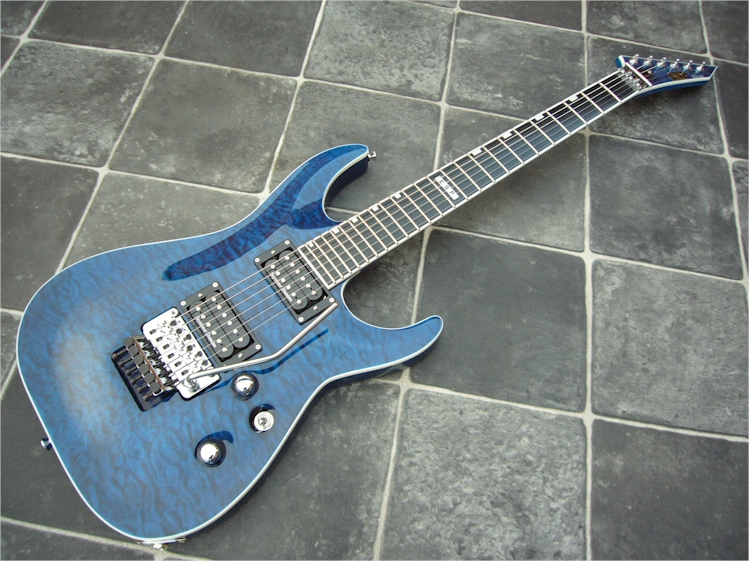
Photo: Cisco93 / Wikimedia Commons / Public domain ESP
Horizon
1987
Page Hamilton’s got smashed at First Avenue. Wooden dowels hold the horn on, and he says he’ll be buried with it.
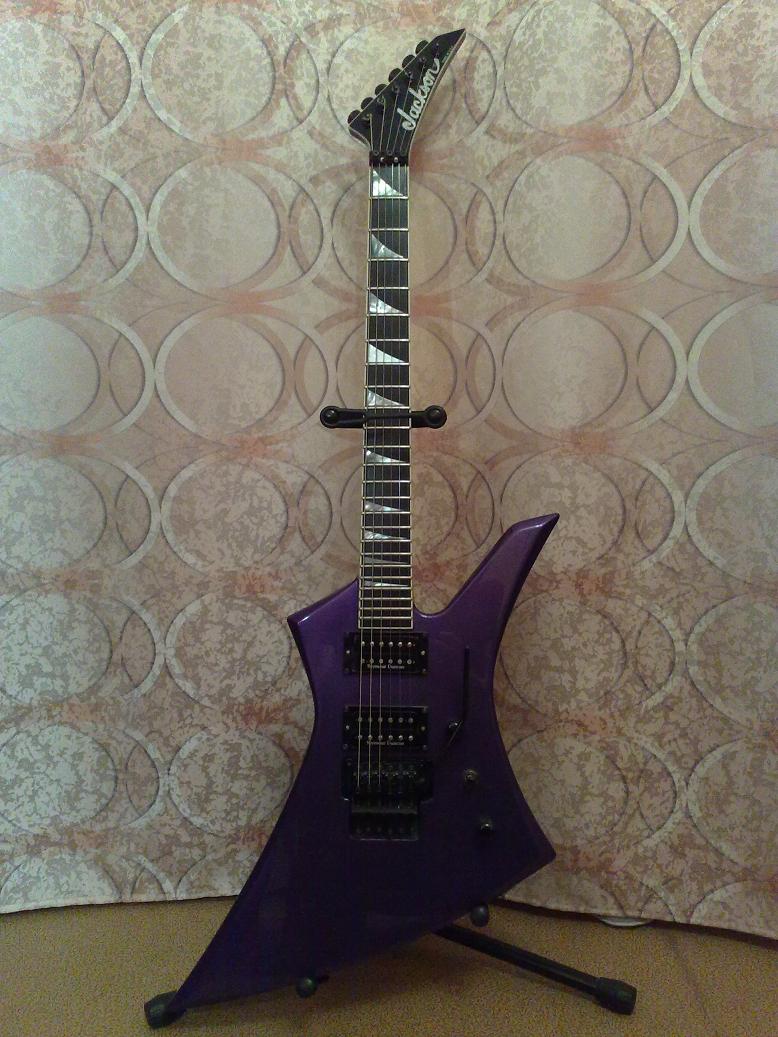
Photo: Saitaro / Wikimedia Commons / Public domain Jackson
Kelly
1983
It’s named after a guitarist from an Australian band called Heaven. Marty Friedman is why you know it.