ESP
Horizon
Page Hamilton’s got smashed at First Avenue. Wooden dowels hold the horn on, and he says he’ll be buried with it.
New York, 1989. Page Hamilton’s band has a 7-inch single out and no album yet. At ESP on 48th Street he picks up a Horizon: fuchsia, headstock pointing the wrong way, Floyd Rose on the back. It’s going to take a beating.
- Introduced
- 1987
- Type
- Solidbody electric
- Class
- Production
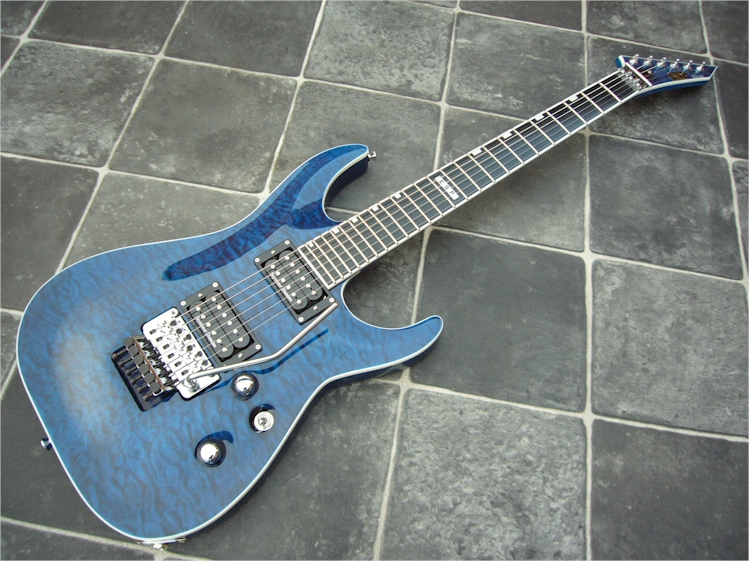
The short version
1984
The name appears
An ESP overseas catalog shows a “Horizon” with three single-coils. It has almost nothing to do with the later guitar.
1986
Original designs
ESP’s export line starts carrying its own shapes, the Horizon among them.
1987
The real Horizon
Arched top, neck-through, locking vibrato. Bruce Kulick gets a sunburst one around now.
1989
Fuchsia
Page Hamilton gets his in New York, for $600.
1992
Figured tops, and Meantime
The Horizon Custom brings quilted and flamed maple. Helmet’s Meantime comes out, on Page’s fuchsia one.
1994
Betty
Every rhythm track on Helmet’s Betty is the Horizon.
2014
New badge, same factory
The Japanese-made ESP Standard line becomes E-II. The Horizon carries on in it.
Side A
A1
Fuchsia, on 48th Street
In 1989, Page Hamilton had a band called Helmet, a 7-inch single, and no album. Strap It On wasn’t a record yet. What he did have was a new guitar from ESP’s shop on 48th Street in New York, a Horizon in fuchsia with a reverse headstock and a Floyd Rose.
He didn’t pay much for it, and he got a good deal after that too.
My ESP Horizon Custom. It was my first endorsement guitar that I paid $600 for, and they never charged me again.
Six hundred dollars, in 1989 money. Keep an eye on that guitar. It’s about to go through a lot.
A2
A parts company with its own ideas
ESP started out in Tokyo making replacement parts for other people’s guitars. By the mid-’80s it was in New York too, and by 1986 it was selling guitars of its own design overseas.
Where the Horizon starts depends on how you count. The name shows up on a 1984 catalog guitar with three single-coil pickups that ESP itself says is “totally different” from the one we know. The Horizon that stuck arrived in 1987: an arched top, a neck that runs the whole length of the body, and a locking vibrato.
ESP’s US president, Matt Masciandaro, puts it about as plainly as a company man can:
If a musician in the late ‘80s and early ‘90s wanted the very best available shred guitar, it was likely an ESP Horizon.
A3
The arch hides the trick
On a neck-through guitar, the neck wood runs from the headstock all the way to the tail, with the body wings glued on either side. No bolted heel in the way, so your hand gets all the way up to the 24th fret, and the whole thing rings together. The catch is that you can usually see the stripe of neck wood running down the face.
ESP’s answer was to glue a top over the whole thing and give it an arch, so the maple core disappears. It looks like a smooth, dressed-up body and plays like a neck-through.
There was one thing ESP couldn’t put on the catalog guitars in those days, and Bruce Kulick remembers it. ESP “didn’t have a Floyd Rose license,” so the production Horizon used a different locking vibrato. An artist, though, could get a real Floyd. Kulick had found ESP through its New York shop and started on an M-1. The “Banana” on the back cover of Crazy Nights is one of those, not a Horizon, whatever you’ve heard. He got his sunburst Horizon around 1987, took it out on the KISS Crazy Nights tour, and used it on a lot of Hot in the Shade. He also had a black “Radioactive” Horizon, with warning symbols his tech cut out of contact paper.
Flip the record · By the numbers
$600
What Page Hamilton paid for his in 1989. ESP never charged him for a guitar again.
3
Helmet albums with the fuchsia Horizon as the main guitar.
24
Frets on the 1987 Horizon, all of them reachable, thanks to the neck-through build.
1987
The year the Horizon became the arched neck-through guitar it still is. The name is three years older.
Side B
B1
Rhythm tracks and a broken horn
Page Hamilton’s fuchsia Horizon went everywhere Helmet went. CBGB, over and over. It was his main guitar on Meantime in 1992, Betty in 1994, and Aftertaste in 1997. Every rhythm track on Betty is that guitar, and if you know those records, you know that’s a lot of the sound: dry, tight, stop-on-a-dime riffs. (The one to leave out is “Beautiful Love.” That’s a Les Paul.)
It didn’t get treated gently. At First Avenue in Minneapolis, it got smashed. It was put back together, and wooden dowels hold the horn on to this day.
ESP kept changing the Horizon around it. Figured maple tops in 1992, a new headstock, then another one. In 2014 the Japanese-made line got a new badge, E-II, from the same Tokyo factory. Page has signature versions now, and in 2022 he picked out a brand-new American-made Horizon from ESP’s custom menu.
B2
Buried with it
None of that replaces the fuchsia one. It’s the guitar he bought when Helmet was a 7-inch and a lot of noise. It has dowels in the horn and CBGB in the finish, and it doesn’t owe him anything.
I’ll be buried with this.
You can buy a new Horizon tomorrow, and it’ll be a good guitar. It won’t have dowels in the horn. That part you have to earn.
Put this on
You’ve read about it. Now hear it. Here’s what this guitar sounds like, and what to listen for.
Meantime
Page Hamilton’s fuchsia Horizon is the main guitar. Listen to how dry and tight the riffs are, and how hard they stop.
Find it on YouTube (opens in a new tab)Betty
All the rhythm guitar is the Horizon. One exception on the album is “Beautiful Love,” which Page played on a Les Paul goldtop.
Find it on YouTube (opens in a new tab)Rise to It (video)
Bruce Kulick with his sunburst Horizon, the one he used on the Crazy Nights tour and a lot of Hot in the Shade.
Watch it on YouTube (opens in a new tab)Turn On the Night (video)
That’s Kulick’s black “Radioactive” Horizon. His tech cut the trefoil symbols out of contact paper.
Watch it on YouTube (opens in a new tab)
The cast
The people, and the specific guitars, that made the legend.
1989
Page Hamilton
1989 fuchsia Horizon, reverse headstock, Floyd Rose
Main guitar on Meantime, Betty, and Aftertaste. Smashed at First Avenue, doweled back together, and still his.
1987
Bruce Kulick
Sunburst Horizon, and a black “Radioactive” one
Took the Horizon on the road with KISS. The “Banana” on the back of Crazy Nights is a different ESP, an M-1.
2024
Matt Masciandaro
ESP’s US president
Remembers what the Horizon meant to shred players in the late ’80s and early ’90s.
Liner notes
Specs, construction, rarity, value, and every source we used.
ESP’s arched double-cut workhorse — Horizon, not the Eclipse single-cut, and not Kirk Hammett’s KH-2.
- Body
- Mahogany, quilted maple arched top; double-cut
- Neck
- Neck-thru 3-piece maple, thin U
- Fingerboard
- Ebony, 305 mm radius, 24 extra-jumbo stainless, offset blocks. Mix flagged.
- Scale
- 25.5". Mix flagged.
- Pickups
- EMG 57TW (bridge) and 66TW (neck), brushed black chrome
- Hardware
- Floyd Rose Original; Gotoh locking tuners; black; ESP strap locks
- Electronics
- Volume (push/pull), tone (push/pull), 3-way toggle; active
- Finish
- See Thru Black Cherry Sunburst, gloss
- Nut
- Locking, 42 mm. Mix flagged.
Open the full research fileConstruction details, the complete player record, production numbers, dated value estimates, and sources
Current typical = E-II Horizon FR-II See Thru Black Cherry Sunburst (Japan; espguitars.com, fetched 8 September 2026). Factory mixed inch/mm flagged; no millimetres invented for the 25.5" scale. Factory $3,289.00, form-fit case included. Sweetwater the same $3,289.00 on Tiger Eye Sunburst. Sibling NT-II $2,849.00 (Gotoh TOM and tailpiece, bone nut). 2026 FR-II Andromeda II Satin / Gun Metallic Black $3,249.00 are set-thru, EMG 81 / 89R — same plate, not this table. Factory clash on those 2026 pages: body copy Floyd Original / Gotoh locking; spec table Gotoh Locking bridge / Grover tuners. Keep both. ESP Original Horizon-I, USA Horizon-II, LTD H, and LTD Horizon Custom ’87 are the same silhouette on other lines — same plate, not a second slug. Horizon-III is the offset-horn cousin. MH mashes Horizon arch with Mirage; not this table. KH-2 and Eclipse are other slugs.
Construction
The job was ESP’s own double-cut, not a Strat copy and not a signature. Arched top. 25.5". Through-neck, later bolt-on and set-thru too. Floyd or a hardtail. Superstrat is a genre label, not an ESP SKU.
Not Eclipse (esp-eclipse). Eclipse is the set-thru 24.75" single-cut. This is a 25.5" double-cut. Different joint, different scale, different job. Not KH-2 (esp-kh-2). Kirk’s is a reverse six-in-line with skull-and-bones. This is the catalog workhorse, not a Hammett signature. Not Snakebyte, Iron Cross, or Truckster (Hetfield). Not Kamikaze (Lynch). Not M-1 / Mirage. No Gibson SKU lives here.
Year fight: ESP’s own model-history blog (4 March 2010; updated 30 August 2022) dates the name to a 1984 overseas catalog — three singles, Flicker-II tremolo, ST-style, “totally different” from current. Reverb News (James M. Brill, 6 January 2016) puts original ESP designs, “such as the Horizon,” on the 1986 400-series export. Japanese catalog 1987, New York Series: arched top, neck-through, ESP Sinclair locking trem. GrassRoots (8 August 2024): the current HORIZON spec “born in 1987.” Matt Masciandaro, ESP’s US president (25 January 2024): “If a musician in the late ‘80s and early ‘90s wanted the very best available shred guitar, it was likely an ESP Horizon.” Keep 1984, 1986, and 1987. This plate starts in 1987 as the living guitar. Do not flatten the 1984 three-single custom into this table.
The 1987 trick is the arch over a through-neck. ESP’s blog: wings and through-neck glued, then a top laminated on so the through-maple does not show on the face. Alder wings, maple core. Ebony, 24 frets. Sinclair locking trem, not yet a Floyd on the catalog page. Kulick, to Ultimate Guitar (5 December 2024): ESP “didn’t have a Floyd Rose license,” but could buy a real Floyd for an artist guitar. Keep catalog Sinclair and artist Floyd both on the table.
1989 catalog: unusual fingerboard inlay ESP itself calls scarce. 1992: HORIZON-CUSTOM, first quilted and flamed maple tops. 1993: Custom becomes HORIZON-I; ash-top HORIZON-II; figured-top stays CUSTOM; California Series. Offset-block markers, ESP at the 12th. 3+3 headstock joins the six-in-line — ESP: that 3+3 started on the Joy Stick bass, later called the Horizon head, “around 1992.” 2002: knife head (pointed six-in-line) replaces it on Horizon-I. Do not promote a Jackson-lawsuit story; the factory blog does not print one.
1998 Horizon Classic is a different job: maple or ash on mahogany, 5 mm thicker, mahogany neck, rosewood, 628 mm scale, set-neck, TOM and stop. ESP: Les Paul-type sound, later inherited by Potbelly. Not this table. 2000: Horizon-III, offset body from the Horizon bass. 2005: Horizon-II NT, mahogany-only, Floyd swapped for TOM and stop. 2012: CTM from through-neck to set-neck; double-stripe inlays on the bass side (I and II NT later follow). 2014: ESP Standard becomes E-II — same Tokyo factory, new badge (ESP: “until the end 2013”).
Bolt-on catalog Horizons exist. Set-thru is now a current option: USA Horizon-II, and the 2026 E-II FR-II Andromeda / Gun Metallic Black. The living Floyd table above is still neck-thru.
Classic vs current: 1987 New York Series — alder, maple through-neck, arch hiding the core, Sinclair, six-in-line — against the 2026 E-II FR-II: mahogany and quilt, Floyd Original, EMG 57TW / 66TW, Japan factory, $3,289.00. Original Series Horizon-I (alder, Cool Rails and JB/Custom Hybrid, $5,699.00) is the closer hand-built cousin, not this table.
Players
Do not steal KH-2, Eclipse, Lynch Kamikaze, or Hetfield credits. Do not hang Kulick’s M-1 “Banana” on this plate.
Page Hamilton. This is the named guitar. ESP Classic Customs (2018): 1989, 48th Street, New York. Fuchsia, reverse headstock, Floyd. He had a 7-inch out; Strap It On was not yet a record. “I’ll be buried with this.” CBGB many times. Main guitar on Meantime (1992), Betty (1994), Aftertaste (1997). Smashed at First Avenue in Minneapolis; wooden dowels hold the horn. Guitar World (September 1994): all Betty rhythm tracks on the ESP Horizon Custom. Guitar World (22 August 2024): “My ESP Horizon Custom. It was my first endorsement guitar that I paid $600 for, and they never charged me again.” Historical 1989 money, not 2026 street. Beautiful Love on Betty is a 1986 Les Paul goldtop — not this guitar. Signature relics (2009 MG; LTD PH-600 brushed aluminum) sit on this silhouette. They are not the 1989 fuchsia object. ESP USA Horizon-II reverse-burst (2022 unboxing; serial US211989) is a later USA guitar he picked off the configurator.
Bruce Kulick. ESP’s Japan blog names him as the player who pushed Horizon’s profile. His own tape (July 2019): sunburst Horizon, ebony, Duncans, Floyd, neck-through, “I probably got it in 1987,” Crazy Nights tour, Rise To It video, a lot of Hot in the Shade (1989). Black Radioactive Horizon in the Turn On The Night video — contact-paper trefoils his tech cut. The Banana on the back of Crazy Nights is an M-1. Keep it labeled. Not this table.
Also known to play stays empty this pass. None invented.
Rarity
E-II, USA, Original, and LTD Horizon SKUs are regular production. ESP does not publish Horizon unit totals. None invented.
Serials date a guitar, they don’t count a factory. That is why a first-year census is unknown, not the chapter. The 1984 three-single catalog guitar is scarce because it is not the living shape. 1987–early-’90s Japan neck-throughs with six-in-line and Sinclair or artist Floyd sit at the scarce end of this slug. 50th-anniversary Custom Shop Horizons are labeled limited: US page, ten (five flamed maple, five Buckeye burl); Japan announcement, 30 HORIZON-CTM. Keep both counts. They are not a vintage Horizon.
Page’s 1989 fuchsia and Kulick’s Radioactive are unique. They are not a street E-II.
Value
Informal estimate, 8 September 2026. Not an appraisal.
Ask vs sold labeled. Celebrity lots are not-comps. No invented medians or factory counts. Reverb Price Guide page for “ESP Horizon” did not resolve this pass. Flag: thin sold-comp access. Period $600 (Hamilton, 1989 endorsement) is 1980s money, not 2026 street.
New street. Factory E-II Horizon FR-II See Thru Black Cherry / Tiger Eye $3,289.00 (Sweetwater the same). 2026 set-thru FR-II Andromeda II Satin / Gun Metallic Black $3,249.00. NT-II $2,849.00. Original Series Horizon-I Deep Candy Apple Red $5,699.00. Horizon FR CTM $8,299.00. USA Horizon-II configurator from $5,199; Black Adamantium $4,899. LTD Horizon Custom ’87 $1,499.00. LTD H-1001FR $1,149.00 — labeled LTD, not this Japan E-II.
Used modern. Named asks this pass, not hammers: Gear Exchange Good-condition E-II FR-II Tiger Eye $2,167.71; 2012 Japan Horizon (seller: not E-II / not LTD) $2,276.18. Do not average LTD H streets into an E-II or Original.
Vintage / collectible. 1987–early-’90s Japan neck-throughs are the scarce end of the same slug, not a separate SKU. Named older asks, not a series: 1990 Horizon Custom NT magenta listing ended; 1990 Horizon-I with a non-original finish sold listing $1,225 (eight years ago). Do not average those asks. Page’s fuchsia and Kulick’s Radioactive are unique objects. Not comps.
See also
- esp-kh-2 — Kirk Hammett’s 25.5" reverse-headstock signature; not this workhorse
- esp-eclipse — ESP’s set-thru single-cut; not this double-cut
- jackson-soloist — the other famous neck-through superstrat; not an ESP
Sources
- ESP, E-II Horizon FR-II See Thru Black Cherry Sunburst — $3,289.00; neck-thru; mahogany; quilted maple; 25.5"; ebony 305 mm; 24 XJ stainless; 42 mm locking; Thin U; Floyd Rose Original; Gotoh locking; EMG 57TW / 66TW; Japan E-II
- ESP, E-II Horizon FR-II Andromeda II Satin — $3,249.00; set-thru; EMG 81 / 89R; 2026; body-copy vs table clash (Floyd Original / Gotoh vs Gotoh Locking / Grover)
- ESP, E-II Horizon FR-II Gun Metallic Black — $3,249.00; set-thru sibling
- ESP, E-II Horizon NT-II — $2,849.00; Gotoh TOM and tailpiece; bone nut
- ESP, Horizon Series (E-II) — FR-II, NT-II, 2026 FR-II listings
- ESP, Original Series Horizon-I Deep Candy Apple Red — $5,699.00; alder; Cool Rails / JB-Custom Hybrid; Floyd Original; Custom Shop
- ESP, Original Series Horizon — Horizon FR CTM $8,299.00; NT CTM $7,999.00; Horizon-I Andromeda II $5,799.00; Titan Metal $5,199.00; Horizon-II NT Black $5,499.00
- ESP, USA Horizon-II — starting $5,199; set-thru; 25.5"; 42 mm; 305 mm
- ESP, USA Horizon-II Black Adamantium — $4,899
- ESP, LTD ’87 Series — Horizon Custom ’87 $1,499.00
- ESP, LTD Horizon Custom ’87 announcement — Masciandaro late-’80s/early-’90s quote; alder; Floyd 1000; Duncan TB-5 / Hot Rails; 25 January 2024
- ESP, LTD H-1001FR — $1,149.00; set-thru; Floyd Rose 1000SE
- ESP, A Closer Look at the ESP E-II Series — Standard until end of 2013; E-II is the Tokyo factory rename; Horizon as an E-II series
- ESP Official Blog, モデルヒストリー ~HORIZON~, 4 March 2010 / updated 30 August 2022 — 1984 overseas catalog (3-single, Flicker-II); 1987 Japan New York Series arched NT Sinclair; Kulick; 1989 inlay; 1992 Custom; 1993 I / II / Custom; 3+3 from Joy Stick bass ~1992; 1998 Classic 628 mm; 2000 III; 2002 knife head; 2005 II NT; 2012 set-neck CTM and double-stripe
- ESP, GrassRoots G-HORIZON-FR — current HORIZON spec born 1987
- ESP, 50th Anniversary Horizon — ten Custom Shop Horizons (five flamed maple, five Buckeye burl)
- ESP Japan, HORIZON — 50th-anniversary HORIZON-CTM worldwide limited 30
- Sweetwater, E-II Horizon FR-II Tiger Eye Sunburst — $3,289.00
- Reverb News, James M. Brill, A Brief History of ESP Guitars, 6 January 2016 — 1986 400 series later includes Horizon; 1984 NYC parts; LTD 1996
- Guitar World, Joe Bosso, Page Hamilton on Betty, 22 August 2024 — ESP Horizon Custom; $600 first endorsement
- Guitar World, September 1994, Page Hamilton — all Betty rhythm tracks on ESP Horizon Custom
- ESP Guitars, Classic Customs Ep. 1 — Page Hamilton’s ESP Horizon — 1989 48th Street; fuchsia reverse-headstock Floyd; Meantime / Betty / Aftertaste; CBGB; First Avenue smash
- Premier Guitar, Creating Page Hamilton’s Signature Sound, 18 October 2024 — ESP Horizon, DiMarzio, Fryette; Exit/In 7 May 2024
- ESP Guitars, Page Hamilton Unboxes ESP USA Horizon-II — reverse-burst USA; serial US211989
- Bruce Kulick, KISS Guitar of the Month, July 2019 — 1987 sunburst Horizon; Crazy Nights tour; Rise To It; Hot in the Shade
- Bruce Kulick, Black Radioactive ESP Horizon, 16 November 2020 — Turn On The Night; contact-paper trefoils
- Ultimate Guitar, Bruce Kulick on Kiss-era guitars and ESP, 5 December 2024 — NYC shop; M-1 then Horizon / Mirage; no Floyd license, artist Floyd
- ESP Guitars, Bruce Kulick Interview 2013 — Banana is M-1; Crazy Nights cover; “not that dissimilar from a current Horizon”
- Sweetwater Gear Exchange, used E-II Horizon FR-II Tiger Eye — Good; ask $2,167.71
- Reverb, ESP Horizon (2012 Japan listing) — named ask $2,276.18; seller “not E-II / not LTD”
Keep digging
Guitars this one gets compared to, confused with, or descended from.
- Send a picture
ESP
KH-2
1995
Kirk Hammett walked into ESP in 1987 knowing exactly what he wanted. He’s been playing it ever since.
- Send a picture
ESP
Eclipse
1993
ESP’s single-cut has no famous record to lean on. It has to win you over the honest way, in your hands.
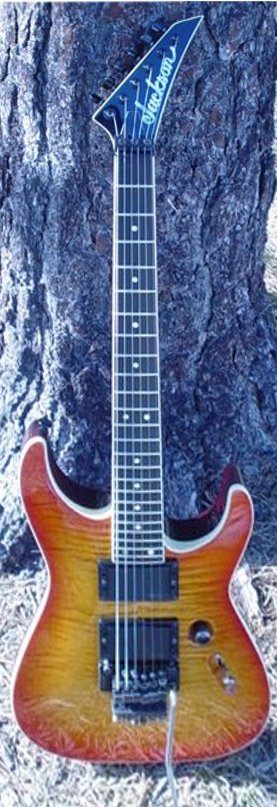
A 1987 Soloist archtop. Photo by Jimshine; perspective correction by GreyCat. Licensed under CC BY-SA 4.0. Via Wikimedia Commons. Jackson
Soloist
1984
Grover Jackson took the Strat shape and ran the maple neck straight through it. Jeff Beck’s was pink.