Reverend
Buckshot
Tele twang with more meat on it. Knopfler tried one for slide, and it never made a record. It kept working anyway.
Ann Arbor, Michigan, 27 April 2010. Mark Knopfler has just played a show on the *Get Lucky* tour, and the new owner of a Detroit-born guitar company is in the production office with an armful of guitars. One of them is a Buckshot. It goes home with Knopfler.
- Introduced
- 2007
- Type
- Solidbody electric
- Class
- Production
Have a photograph of this guitar? Send a picture
The short version
1997
A garage in East Detroit
Joe Naylor starts Reverend and takes it to its first NAMM show that July.
2005
Made in Korea
Reverend’s imports begin at the Mirr Music factory in South Korea. U.S. production ends the next year.
2007
The Buckshot
Announced in August at a list price of $699, in Cream with maple or 3-Tone Burst with rosewood.
2010
New owners, famous customer
Ken and Penny Haas take over Reverend in January. In April, Ken hands Knopfler a Buckshot in Ann Arbor.
2015
Toledo
Reverend moves its headquarters to Toledo, Ohio.
2024
On the list
A Buckshot shows up on Colin Meloy’s gear list in a magazine feature on the Decemberists.
2026
The name goes away
Reverend’s new catalog names its bolt-ons by pickup layout. The Buckshot name is gone.
Side A
A1
Six guitars, thirteen amps
Ken Haas had been running Reverend for about four months. He and Penny Haas took the company over in January 2010, and by April he was in a production office in Ann Arbor with guitars for Mark Knopfler and his band. Guy Fletcher wrote it up in his tour diary. Knopfler came away with a Buckshot.
Then it got its audition. Knopfler tried it for slide at British Grove, and Fletcher’s 2011 studio diary has six guitars lined up against 13 amps.
It didn’t make the record.
In a lot of guitar stories, that’s the end: famous man gets guitar, famous man doesn’t use it, curtain. But most good guitars never get a famous moment at all. They get bought, played, and put back in the case, a few thousand nights in a row. This is a story about one of those.
A2
What Van Halen might have done to a Tele
Joe Naylor started Reverend in 1997, in a garage in East Detroit. The early ones had bodies made of a phenolic resin on a mahogany center block, which tells you he was never much interested in doing what Fender did. By 2007 he had a korina bolt-on body and a Bass Contour knob, and he wanted a T-style guitar with a thicker overall tone.
Reverend’s press release that August put it plainly: “T-style tone, but thicker and more versatile.” List price $699.
The bridge pickup is where it starts. A Tele’s bridge pickup hangs in a metal plate. This one, the Greasy T, has a ceramic magnet and is screwed straight into the wood, “like something Eddie Van Halen would’ve done to a Tele had he been raised on country,” as one reviewer put it. Reverend calls it “slightly hotter and warmer sounding than a traditional T pickup.”
At the neck there’s a Filter’Tron-size mini-humbucker, first the Revtron and later the Retroblast, set a little farther from the neck than usual so it matches the bridge pickup. And instead of a Tele’s ashtray bridge, a tune-o-matic and a stop tailpiece. An Australian reviewer in 2009 called it Tele at the back, Gretsch at the front, “Tele on steroids.”
One small mystery from launch year. The 2007 press release describes a spruce top on a chambered mahogany body. Reverend’s own demo video that November calls it solid korina. That’s the paperwork arguing with itself, and I’m not going to referee.
A3
The knob that takes the bass out
Reverends have a third knob, Bass Contour. It’s a passive bass roll-off. Turn it down and the low end drains out of the pickups, so a fat pickup starts to sound like a thin one.
Naylor had the idea for a while. It got practical when Ron Asheton wanted a bright Strat sound and a fat sound out of one guitar. As Naylor put it:
You can literally re-voice your humbucker to sound like a single coil.
The knob went on the whole line. On the Buckshot it does something funny. The guitar was built to be a thicker Tele, and the 2007 copy tells you to roll the Bass Contour back when you want a traditional T-style sound. So the knob turns the Buckshot back into the thing it was designed not to be. That’s a very guitar-player solution.
Flip the record · By the numbers
$699
List price when Reverend announced the Buckshot in August 2007.
3
Knobs. Volume, tone, and the one that makes a Reverend a Reverend, Bass Contour.
300°F
The maple for the neck gets heat-treated above this, according to Reverend.
13
Amps in the room at British Grove when Knopfler’s crew lined up six guitars to try against them.
Side B
B1
Korina and roasted maple
The body is korina, the same wood as a 1958 Flying V, though nothing else about it is a Flying V. Naylor likes it for reasons a working player would: “It’s very consistent weight-wise, very resonant, and has a very even tonal quality that works well with almost any pickup.”
The neck is maple that’s been roasted above 300°F, bolted on with six screws. Later ones have a tech’s initials on the back of the headstock. The factory is Mirr Music in South Korea, where Reverend’s imports started in 2005. U.S. production ended in 2006, and the company moved its headquarters to Toledo in 2015.
Some owners swap Railhammer pickups into their Buckshots. That’s a mod, not a Buckshot. Railhammer’s first production guitar was a different Reverend entirely.
B2
The name comes off, the guitars stay out
At NAMM in 2026, Reverend showed a new lineup sorted by pickup layout instead of by name, “versus like a name like a buckshot or the flat rock.” The factory’s guitar list no longer has a Buckshot on it. What’s left is dealer stock, and the ones already out in the world.
Which is where they were always doing their real work. In 2024, a magazine feature printed Colin Meloy’s gear list for the Decemberists. There, between a Gibson J-200, a J-45, Guild twelve-strings, and a Gretsch 6120, is a Reverend Buckshot. Nobody has published which songs it’s on. It’s just on the list, with the guitars he plays.
Knopfler’s Buckshot got a diary entry. Meloy’s got a spot on the list. I know which one I’d rather be.
No hit single, no album cover, a name that’s now off the catalog. Plenty of guitars get one famous night. This one got a job.
Put this on
You’ve read about it. Now hear it. Here’s what this guitar sounds like, and what to listen for.
Buckshot Guitar (factory demo)
Reverend’s own launch-year demo, with Jason Van Doorn playing, back when the neck pickup was still a Revtron. Listen for what the Bass Contour knob does to that fat bridge pickup.
Watch it on YouTube (opens in a new tab)
The cast
The people, and the specific guitars, that made the legend.
2007
Joe Naylor
Designer
Founded Reverend in 1997 and drew the Buckshot as a T-style with a thicker overall tone.
2010
Ken Haas
The man with the armful of guitars
Took over Reverend with Penny Haas in January 2010 and brought guitars to Knopfler’s production office that April.
2010
Mark Knopfler
2010 Buckshot
A gift in Ann Arbor. Tried for slide at British Grove. It didn’t make a record.
2024
Colin Meloy
Buckshot
The Decemberists’ singer, with a Buckshot on his working gear list next to a J-200, a J-45, and a Gretsch 6120.
Liner notes
Specs, construction, rarity, value, and every source we used.
A korina T-style: Greasy T, a leaner mini-humbucker, and Bass Contour — Reverend’s Buckshot, not a Tele and not a Railhammer guitar.
- Body
- Korina solidbody, offset single-cut
- Neck
- Bolt-on roasted maple, Medium Oval, six-bolt
- Fingerboard
- Rosewood or roasted maple, 12" (305 mm) radius; 22 frets 0.110" × 0.050"
- Scale
- 25.5" (648 mm)
- Pickups
- Greasy T single-coil (bridge, ceramic, body-mounted); Retroblast mini-humbucker (neck)
- Hardware
- TOM with stop tail; Reverend Pin-Lock tuners; Triple Tree
- Electronics
- Volume with treble bleed, Tone, Bass Contour, 3-way
- Finish
- Gloss body, satin neck. Late named-SKU colors include Party Red, Chronic Blue, Cream, 3-Tone Burst, Venetian Pearl, Midnight Black
- Nut
- 43 mm Boneite. Factory FAQ: 1-11/16"
Open the full research fileConstruction details, the complete player record, production numbers, dated value estimates, and sources
Last typical named Buckshot. Dealer copy and leftover new stock, 8 September 2026. Factory live guitar list this pass has no Buckshot SKU — 2026 catalog folded named bolt-ons into Charger-by-pickup. Mix flagged: factory inches plus 43 mm nut; MusicRadar (Ed Mitchell, 3 September 2018) prints 648 mm / 305 mm against this inch card — mix flagged, not averaged. Factory FAQ neck depths .85" / .90" at 1st / 12th. Not a Railhammer guitar. Pete Anderson Eastsider T is the other Reverend T-layout. No Gibson SKU.
Construction
The job was T-style twang with more body. Joe Naylor already had a korina bolt-on and a Bass Contour knob. This one puts a ceramic T-pickup on the bridge, a Filter’Tron-size mini-humbucker farther from the neck than usual, and a tune-o-matic with a stop instead of an ashtray.
Harmony Central, 20 August 2007: Reverend introduces the Buckshot. “T-style tone, but thicker and more versatile.” List $699. Cream with maple, 3-Tone Burst with rosewood. Les Trem option, list $249. That press lists a 5.5 mm solid spruce top on a chambered mahogany body, Wilkinson EZ-Lock tuners, a T-style bridge pickup, and a Revtron at the neck. Reverend’s own demo, 6 November 2007, already calls it a solid korina body. Keep both. This plate starts in 2007. Reverb’s product years print 2008–2026.
Joe Naylor is the designer. Reverb News (Tony Bacon, 24 June 2021): Reverend 1997, Eastpointe — first NAMM that July. Early bodies were High Resonance phenolic on a mahogany center block. US production ended 2006. Imports started 2005 as Stage King, Mirr Music in South Korea, Hank Cho. Guitar World (Marsh Gooch, 31 May 2013): first solidbodies 2005. Ken and Penny Haas took over as CEO and COO in January 2010 (Guitar World, Jacob Paul Nielsen, 20 November 2024). Headquarters to Toledo, 2015 (Bacon). FAQ, fetched 2026: built in South Korea by Mirr; as of 2026 also PT Meari Music, Indonesia. Do not pin a Buckshot to Indonesia unless a named guitar says so.
Not a Fender Telecaster (fender-telecaster). Different factory, different wood, different bridge. MusicRadar: Naylor wanted a T-style with a thicker overall tone, so the Greasy T got a ceramic magnet and sits screwed to the korina, “like something Eddie Van Halen would’ve done to a Tele had he been raised on country.” Factory store: 42-gauge, ceramic, 7K. “Slightly hotter and warmer sounding than a traditional T pickup.” The neck unit began as a Revtron. Factory Retroblast page: a Filter’Tron-style pickup, direct replacement for Revtron or Retroblast. Neck: 42-gauge, oversized 5 mm Alnico 5, 6.5K. Harmony Central 2007 and the factory copy both say it sits slightly farther from the neck to match the bridge. Australian Musician (Paul Bignell, 24 November 2009): Tele rear, Gretsch front, “Tele on steroids.” Not a 6120 (gretsch-6120). Not a Gibson SKU. TOM and stop are hardware, not a Les Paul.
Bass Contour is the third knob. Naylor, Guitar World 2024: a passive bass roll-off he had in mind, made practical when Ron Asheton wanted bright Strat and fat on one guitar. “You can literally re-voice your humbucker to sound like a single coil.” It went on the whole line. Harmony Central’s 2007 Buckshot copy already tells you to roll it back for traditional T-style. Treble bleed on the volume is later standard.
Korina is the house wood, not a 1958 V. Naylor to MusicRadar: “It’s very consistent weight-wise, very resonant, and has a very even tonal quality that works well with almost any pickup.” White limba. FAQ: roasted maple heat-treated over 300°F. MusicRadar 2018 already has the roasted six-screw neck, 648 mm / 25.5", 12" / 305 mm, 22 medium jumbo, Boneite, Pin-Lock tuners. Current leftover stock is that guitar: six-bolt, dual-action rod at the headstock, Triple Tree, Pure Tone jack, hand-initialed headstock. Vintage Guitar (Pete Prown, on the Ron Asheton model): Zack Green sets them up in the US; initials on the back of the headstock. FAQ neck: Medium Oval, 1-11/16", about .85" at the first fret and .90" at the twelfth. Wildwood Chronic Blue serial 57391 measured .820" / .860" and 7.43 lb — one guitar, not a factory weight.
Not a Railhammer guitar. Guitar World 2013: first production Railhammer instrument is the Sensei RA, 2012. Rails under the wound strings, poles under the plains. That is a different pickup on a different model. Owners swap Railhammers into Buckshots. That is a mod, not the table.
Not Eastsider T. Pete Anderson’s signature is the other Reverend T-layout, still in the live catalog. Not Charger 290 (two P-90s). Not Flatroc. Premier Guitar’s NAMM 2026 floor tape: body styles differentiated by pickup configuration “versus like a name like a buckshot or the flat rock.” 2026 Chargers went string-through with six-saddle bridges. That is not this TOM/stop recipe. The live factory guitar list, fetched this pass, has no Buckshot. Jetstream RB is two Retroblasts. Greasy T is not in the current pickup filter.
Classic vs current: 2007 press — Revtron, T-style bridge, Bass Contour, $699 list, spruce/mahogany in that release versus korina in Reverend’s own demo — against the last named SKU, korina, roasted maple, Greasy T / Retroblast, Boneite, leftover new at dealers. Blackwood Tek boards exist from the CITES window (factory FAQ). Graphite nut on some older spec sheets. Les Trem was an option, not the table.
Players
Do not hang a Telecaster, a 6120, or a Railhammer Sensei on this plate. Do not recruit Billy Corgan, Reeves Gabrels, Ron Asheton, or Pete Anderson as if they were this guitar. Those are other Reverends.
Colin Meloy (The Decemberists). The named Buckshot this plate can put in a player’s hands. Premier Guitar (17 June 2024), As It Ever Was, So It Will Be Again feature: Meloy’s gear list includes a Reverend Buckshot beside a Gibson J-200, a J-45, Guild F-512s, and a Gretsch 6120. Ownership on a working list. Album-to-guitar credits for named Decemberists sides are unpublished here.
Mark Knopfler. Christie's lot essay: Ken Haas presented a 2010 Buckshot after the Ann Arbor show, 27 April 2010, on the Get Lucky tour. Serial #11599 / ZSG. Guy Fletcher’s 2010 tour diary: Haas brought guitars to the production office for Mark, Richard, and Guy. Tried for slide at British Grove; Fletcher’s 2011 studio diary has six guitars lined up against 13 amps. It did not make a record. Sale-room notice: the catalogue photo is a similar Buckshot, not the lot guitar. One artist object. Not a session log for Dire Straits.
Also known to play stays short. Equipboard tags Chris Freeman of Hot Mulligan on a Buckshot in a “Live From The Basement” video — he now has a Chris Freeman Signature, a different card. Guy Fletcher is listed on Reverend’s site (Equipboard). Cloud Nothings close-up on YouTube (Equipboard). None invented.
Rarity
You can still buy leftover new dealer stock. The factory live list does not print a Buckshot. 2026 Chargers are other guitars on a related outline. Current production of this named SKU is over even if cart pages linger.
Reverend has not published Buckshot unit totals this pass. None invented. Serials and tech initials date a guitar. They don’t count a year. That is why a first-year census is unknown, not the chapter.
What is actually thinner: 2007 first-run examples, especially if the spruce/mahogany Harmony Central recipe left the building; Revtron-neck guitars before Retroblast; Blackwood Tek boards; Les Trem options. Knopfler’s #11599 is a unique object. It is not a vintage Buckshot.
Value
Informal estimate, 8 September 2026. Not an appraisal.
Ask vs sold labeled. Celebrity lots are not-comps. No invented medians or factory counts. Harmony Central 2007 list $699 is 2007 money, not 2026 street. MusicRadar 2018 £729 is historical, not this pass.
New street. Named leftover-new asks, not a live factory cart: Musician’s Friend Chronic Blue roasted-maple $999; Reverb new Party Red $999; Equipboard snapshot 2 September 2026 $899–$999 (Sweetwater / Guitar Center / Reverb / Musician’s Friend $999, Thomann $899); Wildwood Chronic Blue $849 from $999; Guitar Center Party Red rosewood $799.95 from $899.95. Specialty Traders Venetian Pearl blem #58318 $539.40 from $899 — a blem, not the clean new band. Typical new widget on one Reverb listing: $999.
Used modern. Reverb Price Guide on the US product page did not print a clean USD band this pass (“Used estimate unavailable”). Flag: thin sold-comp access. Named asks, not hammers: 2023 Venetian Pearl $599; Cream gloss Very Good ended at $699. Named older sold, not a series: 2018 Sparkle Silver Excellent $950 (listing captured as sold). Do not average those asks.
Vintage / collectible. There is no 1950s Buckshot. Early Korean named-SKU examples are used modern with age, not a vintage band. Knopfler’s Christie's guitar is one artist object. Not a comp. Hammer unpublished here.
See also
- fender-telecaster — the ashtray T-style this korina bolt-on is not
- gretsch-6120 — Filter’Tron family the Revtron / Retroblast nods at
- g-l-asat — another independent T-layout; jumbo MFDs, not this pickup pair
Sources
- Harmony Central, Reverend Introduces The Buckshot (20 August 2007) — intro copy; T-style plus Revtron; Bass Contour; 25.5"; 12" / 22 frets; list $699; Les Trem $249; spruce 5.5 mm / chambered mahogany in that release
- Reverend Guitars, Buckshot Guitar (YouTube, 6 November 2007) — factory demo; solid korina in that copy; Revtron neck; Bass Contour; Jason Van Doorn
- Premier Guitar, Reverend Guitars-Buckshot, Reeves Gabrels Signature (4 August 2009) — Summer NAMM ’09; korina solidbody; T-style bridge / Revtron neck; maple bolt-on, rosewood board
- Australian Musician, Paul Bignell, Reverend Buckshot (24 November 2009) — bolt-on series; Tele rear / Gretsch front; Bass Contour; “Tele on steroids”
- MusicRadar, Ed Mitchell, Reverend Bolt-on Series Buckshot (3 September 2018) — korina (Terminalia superba); Naylor on korina and roasted maple; Greasy T ceramic, body-mounted; RevTron; 648 mm / 25.5"; 305 mm / 12"; six-screw; Boneite; £729; Joe: thicker T-style
- Reverb News, Tony Bacon, The Early Days of Reverend Guitars (24 June 2021) — 1997 launch; High Resonance phenolic; US production ends 2006; Stage King imports 2005; Mirr / Hank Cho; Haas 2010; Toledo 2015
- Guitar World, Marsh Gooch, Reverend Guitars and Heavy Rock (31 May 2013) — first solidbodies 2005; Sensei RA first Railhammer production guitar 2012
- Guitar World, Jacob Paul Nielsen, Ken Haas / Joe Naylor interview (20 November 2024) — Bass Contour for Ron Asheton; Haas purchase January 2010; korina vs alder on the Corgan Z-One (other guitar)
- Reverend FAQ — Mirr Music / Hank Cho; PT Meari Indonesia as of 2026; neck 1-11/16" / .85" / .90"; fretwire .110" × .050"; roasted maple over 300°F; Blackwood Tek CITES window; Railhammer keep-apart
- Reverend, Guitar Pickup – Greasy T — 42-gauge, ceramic, 7K; body-mounted
- Reverend, Guitar Pickup – Retroblast — Filter’Tron-style; Revtron replacement; neck 42-gauge / 5 mm Alnico 5 / 6.5K
- Reverend Guitars catalog — live list 8 September 2026; no Buckshot SKU; Charger / Kingbolt / Sensei / Roundhouse; Greasy T absent from pickup filter
- Reverend Our Story / Born in Detroit — 1997 East Detroit garage
- Premier Guitar, NAMM 2026 Reverend walkthrough — 2026 lineup by body; “buckshot or the flat rock” names dropped for pickup-config Chargers
- Premier Guitar, The Decemberists, As It Ever Was (17 June 2024) — Colin Meloy gear list: Reverend Buckshot
- Christie's, Reverend Buckshot 2010, lot 6465803 — Knopfler gift 27 April 2010 Ann Arbor; #11599 / ZSG; British Grove slide trial, not on a record; catalogue photo is a similar guitar
- Vintage Guitar, Pete Prown, Reverend Ron Asheton Model (18 June 2014) — Zack Green US setup; initials on headstock; Korea. Other model
- Reverb, Reverend Buckshot — years 2008–2026; Korea; leftover-new Party Red $999; US Price Guide USD band unpublished this pass
- Musician’s Friend, Buckshot Chronic Blue roasted maple — new $999; korina; Retroblast / Greasy T; Bass Contour
- Sweetwater, Buckshot Party Red — last typical recipe; page no longer available this pass; Greasy T ceramic 42-gauge; Retroblast Alnico V
- Wildwood, Buckshot Chronic Blue #57391 — 7.43 lb; .820" / .860"; roasted maple board; Greasy T / Retroblast; $849 from $999
- Equipboard, Reverend Buckshot — new $899–$999 snapshot 2 September 2026; Knopfler / Meloy / Freeman / Fletcher listings
- Guitar Center, Buckshot Party Red rosewood — $799.95 from $899.95
- zZounds, Buckshot — 6-bolt; Greasy T / Retroblast; 43 mm Boneite
- Thomann, Reverend Buckshot PR — available since July 2024; 648 mm / 305 mm / 43 mm; Party Red
- Reverb, used 2023 Venetian Pearl — ask $599
- Reverb, Cream gloss Very Good — ended ask $699
- Reverb, 2018 Sparkle Silver — sold Excellent $950
- Reverb, Specialty Traders Venetian Pearl blem #58318 — blem ask $539.40 from $899
Keep digging
Guitars this one gets compared to, confused with, or descended from.
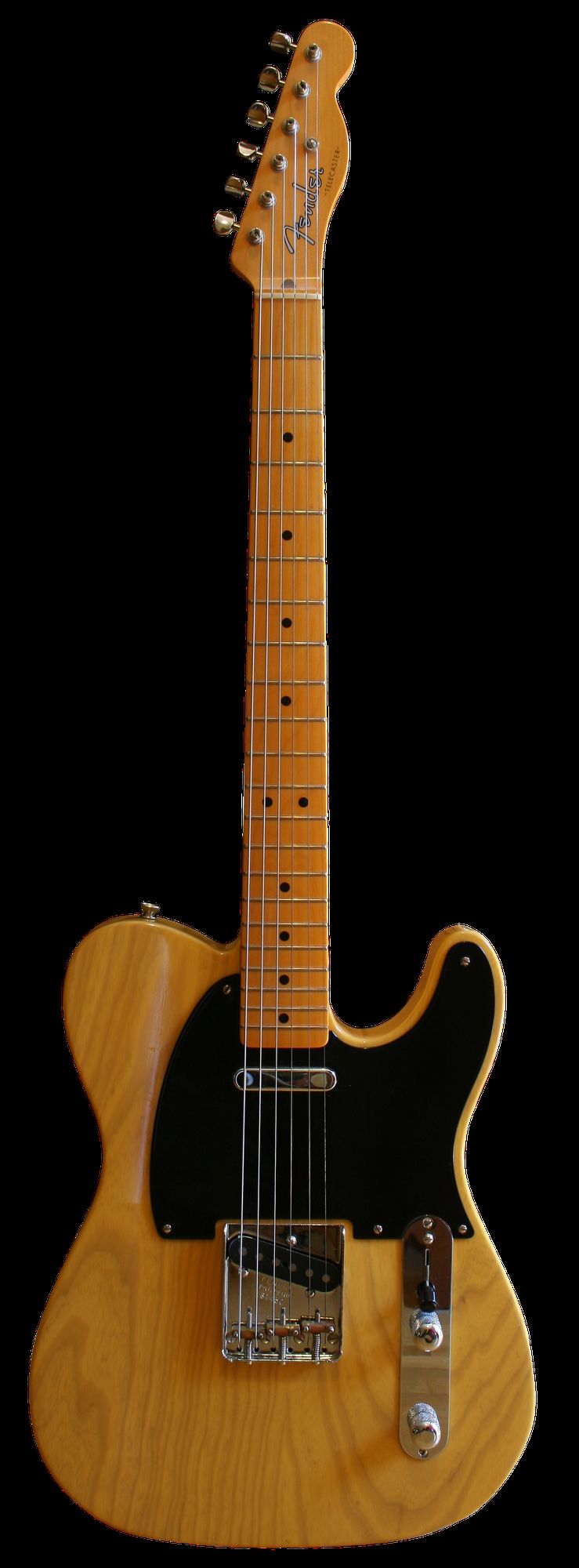
Fender Telecaster American Vintage 1952 with transparent background. Photo by Massimo Barbieri. Licensed under CC BY-SA 3.0. Via Wikimedia Commons. Fender
Telecaster
1950
Leo built it like a tool. The famous ones look like they just clocked off a double shift.
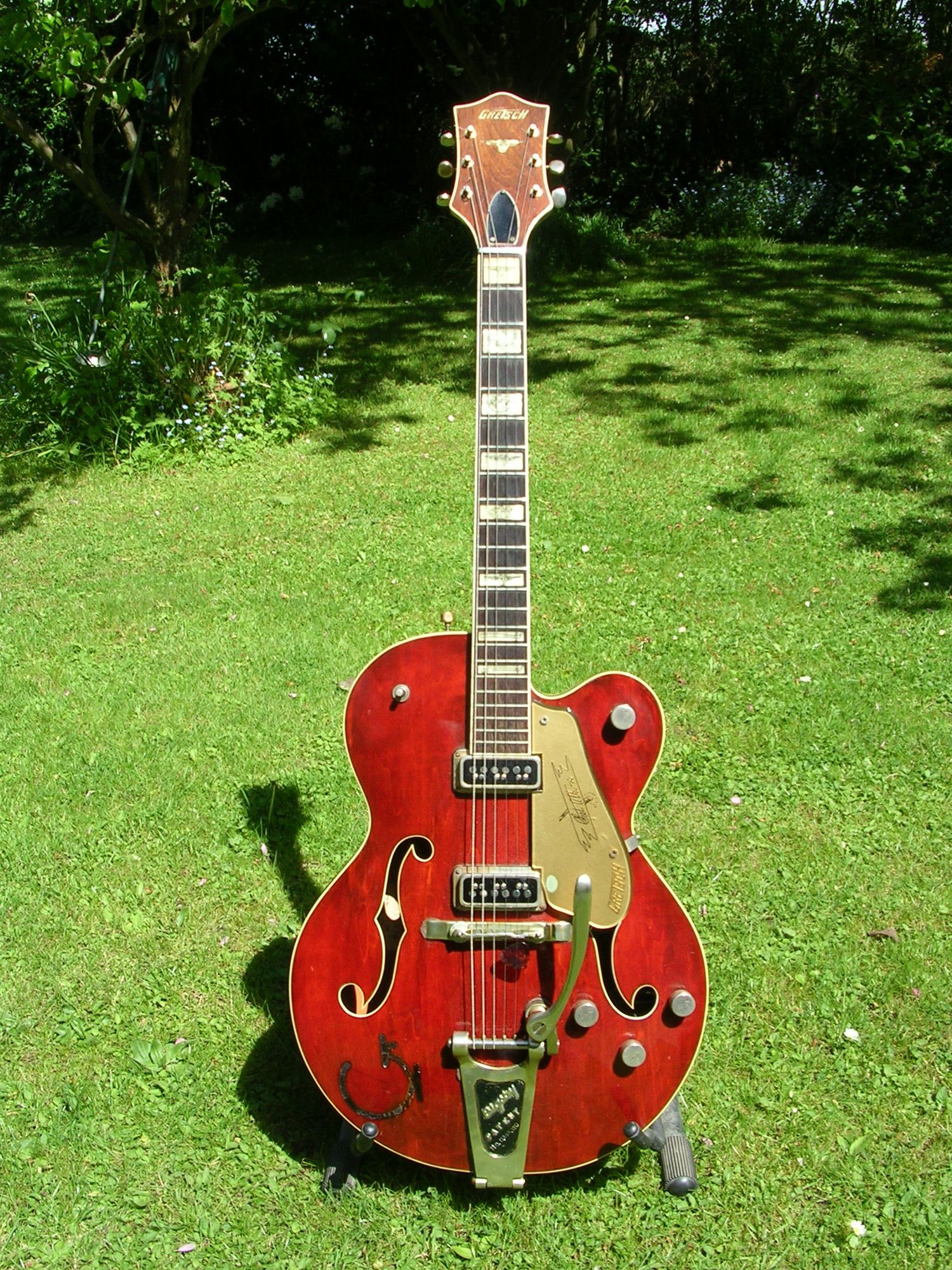
Gretsch 6120 G-Brand 1955. Photo by Francis pullen. Public domain (PD-self). Via Wikimedia Commons. Gretsch
6120
1955
Joe Walsh gave Pete Townshend one. Steve Miller gave Brian Setzer one. Chet Atkins just lent it his name.
- Send a picture
G&L
ASAT
1985
Thirty-five years after his first Broadcaster, Leo Fender built another one. Gretsch objected again.