Yamaha
FG180
Built to survive a ship’s hold. Decades later, the photos put one in Elliott Smith’s hands at the Oscars.
Hamamatsu, Japan, 1966. The Beatles have just played the Budokan, folk music is everywhere, and a piano company called Nippon Gakki is about to sell its first folk guitar. Before long it will have to survive a trip across the ocean in the hold of a ship.
- Introduced
- 1966
- Type
- Flat-top steel-string acoustic
- Class
- Production
Have a photograph of this guitar? Send a picture
The short version
1962
Hideo Ueda joins
The engineer who will develop the FG-180 starts at Nippon Gakki, the company that became Yamaha.
1966
The first folk guitar
The FG-180 and the smaller FG-150 go on sale in Japan in October, with light-green labels.
1967
Red label
The red soundhole label arrives, and with it the nickname. Yamaha’s own dates for it run later.
1968
America
The FG line reaches the United States.
1971
Taiwan
Late in the year most FG production moves to Taiwan. The labels change color soon after.
1998
The Oscars
Elliott Smith plays “Miss Misery” at the Academy Awards on a Yamaha identified from photos as a Taiwan-made FG-180.
2019
Red Label again
Yamaha launches the FG Red Label series, which it calls a revival of the FG-180.
Side A
A1
A guitar for the boat
In the mid-’60s Japan was in the middle of a folk boom, and Yamaha, still called Nippon Gakki then, was mostly known for pianos. An engineer named Hideo Ueda, who’d joined the company in 1962, developed its first folk guitar.
The FG-180 went on sale in Japan in October 1966. FG stands for Folk Guitar. Yamaha called the body a jumbo. Everyone else looked at it and saw a dreadnought, the big square-shouldered shape Martin made famous. There was a smaller sibling, the FG-150, at the same time.
It wasn’t fancy. It was the kind of guitar you don’t have to think about, which turns out to be a compliment.
A2
Why it isn’t solid wood
Dealers love to call these spruce and mahogany, and that’s true as far as it goes. But the export FG-180s had laminated tops, backs, and sides, three thin plies glued together. Yamaha’s own people say so.
There was a good reason. The early solid-wood Yamahas cracked in shipping. Plywood didn’t. So the guitar that went to America was built, first of all, to survive the boat.
It’s a big-bodied guitar, and it listed for $130 in America. That was a lot of guitar for the money.
A3
Green, red, tan, black
The label inside the soundhole is how people date these, and it’s a small hobby of its own.
The very first ones, in October 1966, had light-green labels, a smaller logo on the headstock, and a bell-shaped truss-rod cover that said REINFORCED NECK, which is about as reassuring as a guitar part gets. By mid-1968 that cover gave way to a triangular one with Yamaha’s tuning-fork logo. The famous red label came in early 1967 by the collectors’ count, around 1968 by Yamaha’s own history, and it’s why everybody calls them Red Labels. The guitars reached America in 1968. Late in 1971, most production moved to Taiwan, and before long the labels went tan, then black, then a white oval. The red-label guitars made in Japan, before the move, are the ones players hunt.
Which is the “right” red-label date depends who you ask. Yamaha has given more than one answer itself. The paper in the soundhole will tell you roughly when your guitar was born. It won’t tell you how many brothers it had, because nobody published that.
Nobody bought one to show it off. They bought one to play it.
Flip the record · By the numbers
1966
The year of Yamaha’s first folk guitar.
$130
The original U.S. list price.
3
Plies in the laminated top, back, and sides of the export guitars. Solid wood cracked on the boat.
400
Limited 50th-anniversary FG180s in 2016, by Yamaha Japan’s count. The number quoted for the U.S. market was 180.
Side B
B1
The guitar that shows up
Once you start looking, FG-180s turn up in the hands of people who could play anything. Matthew Caws of Nada Surf keeps a 1971 Japanese red-label one next to a Gibson J-200 and a Guild. Butch Walker has said he keeps a few ’70s and ’80s FG180s around the house and uses them on records.
One word of caution: not every old Yamaha in a famous photo is this one. Country Joe McDonald’s Yamaha at Woodstock is an FG-150. The other famous names that come up with Yamaha acoustics, from Bob Dylan to John Denver, were playing other models, not FG-180s.
In 2016 Yamaha made a limited 50th-anniversary FG180 with a solid spruce top and solid mahogany, and it put the early logo and the bell-shaped cover back on the headstock. In 2019 it launched a whole Red Label series, which Yamaha’s Shingo Ekuni described to Ueda as a revival of the FG-180.
B2
Standard-looking, big and loud
In 1998 Elliott Smith walked onto the stage at the Academy Awards in a white suit to play “Miss Misery,” his song from Good Will Hunting. People who have studied the photos identify the guitar, from its pickguard, as an FG-180, a Taiwan-made one, not a prized Japanese red label.
Asked once about his main acoustic, Smith said it was a Yamaha, and in the interviewer’s words, “the model number of which escapes him.” Here’s how he described it:
it’s a real standard-looking guitar… big and loud and made out of light wood.
Plain, sturdy, and easy to forget about. The model number escaped him, and it didn’t matter. He took a plain Yamaha to the Oscars and sang to the whole world.
Put this on
You’ve read about it. Now hear it. Here’s what this guitar sounds like, and what to listen for.
Miss Misery (live at the Academy Awards)
The white suit and a plain Yamaha. The guitar is identified as an FG-180 from photos only, and it’s a Taiwan-made one.
Watch it on YouTube (opens in a new tab)
The cast
The people, and the specific guitars, that made the legend.
1966
Hideo Ueda
Developer
Joined Nippon Gakki in 1962 and developed the FG-180.
1998
Elliott Smith
An FG-180, by the photos
Played a Yamaha at the Oscars that photos identify as a Taiwan-made FG-180. Separately, an interview described his main acoustic as “a yamaha, the model number of which escapes him.”
2012
Matthew Caws
1971 FG-180, red label
Nada Surf’s singer keeps a Japanese red-label one alongside a J-200 and a Guild F-50.
Butch Walker
1970s and ’80s FG180s
Keeps several around the house and on records, and has played the 50th-anniversary model too.
1969
Country Joe McDonald
An FG-150, not this one
The Yamaha glimpsed with him at Woodstock is the smaller sibling.
Liner notes
Specs, construction, rarity, value, and every source we used.
Yamaha’s first folk guitar — a jumbo with a red label in the soundhole, not a Pacifica electric.
- Body
- Yamaha jumbo (dreadnought). Spruce top, mahogany back and sides; Yamaha USA FAQ notes a 3-piece back. Lower bout 16 1/4" on a named 1967 (Pure Vintage).
- Neck
- Nato (Yamaha USA FAQ); dealers often write mahogany. Set. Soft C on that 1967.
- Fingerboard
- Indian rosewood, 20 frets, dots, join at 14th
- Scale
- 25" / 634 mm. Mix flagged.
- Pickups
- None on this table
- Hardware
- Open-gear tuners; rosewood bridge; black pickguard
- Electronics
- None
- Finish
- Natural gloss
- Nut
- 1 11/16" on named 1967 / 1971 dealer examples (Pure Vintage; Empire). Japanese dealer sheets ~44–45 mm. Mix flagged.
Open the full research fileConstruction details, the complete player record, production numbers, dated value estimates, and sources
Classic living example = late-1960s Nippon Gakki red-label FG-180. A current FG-180 SKU does not exist. FG5 Red Label (2019) and FG180-50TH (2016 limited) are other objects on this plate, not this table. Factory millimetres and dealer inches sit together — mix flagged; no extra millimetres invented. Export tops, backs, and sides are plywood on Yamaha’s own 50TH telling; keep that split in Construction.
Construction
Hamamatsu, folk boom. The job was a Japanese steel-string that could leave the country without cracking in a ship’s hold. Hideo Ueda, who joined Nippon Gakki in 1962, developed the FG-180. Yamaha’s Innovation Road plate dates it 1966: first folk guitar, first manufactured in Japan. The Beatles had played Budokan that June. Do not hang a Beatle on this guitar.
FG is Folk Guitar. Yamaha called the body jumbo. Everyone else hears dreadnought. FG-150 launched with it as the folk-size sibling, closer to a 000. FG-140 is the cheaper jumbo. Pacifica is the 1990 Strat-layout electric. Same badge. Different object.
The red paper is a dating fight, not a vibe. Yamaha Innovation Road: red label in the soundhole around 1968 to 1972, which is why players still say Red Label. yamahavintagefg.com: FG-150 and FG-180 were on sale in Japan in October 1966 with light-green labels, a smaller headstock logo, a slightly flared peghead, and a bell truss-rod cover reading REINFORCED NECK; the familiar red label arrives at the start of 1967. Yamaha USA’s dating note: red-label Japan prior to November 1971, then Taiwan, and the label goes beige. Keep all three. None of them is a factory count.
The line reached America in 1968 (yamahavintagefg). Bell “REINFORCED NECK” covers run into mid-1968; the triangular Yamaha / tuning-fork cover follows. Late 1971, most FG production moves to Taiwan. Early Taiwan still wears red; tan labels from September 1972, then black, then a white oval. Yamaha USA FAQ: years sold 1966–1974, original MSRP $130. yamahavintagefg keeps FG-180-1 on a black label in 1975, three-piece back. Serials and Showa stamps date a guitar. They do not count a year.
Wood is the other split. Yamaha USA FAQ: spruce top, mahogany back and sides, nato neck, Indian rosewood board, three-piece back. Dennis Webster, to Premier Guitar at NAMM 2016: the 1960s–70s FG-180 had laminate top, back, and sides. yamahavintagefg: export tops, backs, and sides are three-ply plywood — saw-cut plies, light X-bracing — because solid early Yamahas cracked in shipping. Dealer copy still says spruce and mahogany as if they were solids. Keep Yamaha’s laminate sentence. The 50TH and the 2019 FG5 are the solid-wood answers, not proof the old one was solid.
2016: FG180-50TH. Yamaha Japan: 400 limited, list ¥115,000 (tax-excluded), 1 March. Webster: 180 for the U.S. market, street about $899 with a case. Solid Sitka with A.R.E., solid mahogany, scalloped bracing, early logo and bell cover. A limited modern. Not 1966.
2019: FG/FS Red Label — FG3 / FG5 and the Atmosfeel FGX cuts. Shingo Ekuni, to Ueda, on Yamaha’s own page: a revival of the FG-180. Current FG5: solid Sitka A.R.E., solid mahogany, scalloped X, 634 mm (25"), bone nut 44 mm (1 3/4"), Japan. That nut is wider than the vintage dealer 1 11/16". Same silhouette. Not this SKU. FG800 is the mass laminated FG.
Players
Elliott Smith. The photograph is the Oscars: white suit, 1998, “Miss Misery” from Good Will Hunting. Mixdown IDs the guitar as an FG-180 from the pickguard, with a Bill Lawrence A-300 in the hole. Sweet Adeline’s FAQ, quoting Gearbox (Roger Len Smith): “his main acoustic guitar is a yamaha, the model number of which escapes him.” Smith: “it’s a real standard-looking guitar… big and loud and made out of light wood.” He tuned a step down by accident on a girlfriend’s guitar. Keep the quote as a Yamaha. FG-180 is the photo ID. The Oscars guitar is Taiwan — no Nippon Gakki on the red label. It is one object. It is not a vintage FG-180.
Matthew Caws. Premier Guitar, Nada Surf: Caws and Effect (6 April 2012), gear list: 1971 Yamaha FG-180, red-label Nippon Gakki version, beside a 1991 J-200 and a 1980 Guild F-50 in Nashville tuning.
Butch Walker, on Facebook (Equipboard): he keeps 1970s–80s FG180s around the house and on records; he also played the 50TH. Named post, not a session tape.
Do not steal Country Joe McDonald at Woodstock — that glimpse is an FG-150. Do not steal Bob Dylan (L-51 / FG-1500), John Lennon / Jimmy Page / Paul Simon (CJ-52), or John Denver (L-53). Those are other Yamahas. The Beatles’ Japan trip is the year, not a credit. Nick Drake’s cover guitar is a Guild M-20.
Rarity
FG-180 was regular catalog, Japan then Taiwan. Yamaha does not publish FG-180 unit totals. None invented. Neck stamps and Showa / Minguo date codes date a guitar; they are not a census.
Japan red-label examples (pre-November 1971 on Yamaha USA’s note) are the ones players hunt. Taiwan red, then tan, black, and white, are later factories on this name. Green-label 1966 Japan is earlier still. None of that is a factory ledger.
FG180-50TH is a closed 2016 run: 400 (Yamaha Japan) vs 180 for the U.S. (Webster / Premier Guitar). Keep both. It is not a 1966 FG-180. Current FG5 is regular Japan production of a revival. FG800 is volume on a later FG.
Value
Informal estimate, 2 September 2026. Not an appraisal.
Ask vs sold labeled. Celebrity lots are not-comps. No invented medians or factory counts.
New street. No current FG-180 SKU. Living Red Label analog is FG5, a different guitar: Sweetwater Natural $1,699.99 this pass. Music Store Live $1,449.99. yamaha.com MSRP $2,807.74 (current FG5) and $2,295.60 on the 2019–late 2024 FG5 page. 2016 50TH street about $899 (Webster) / Japan list ¥115,000 is not a 2026 cart.
Used modern (FG5). Sweetwater Gear Exchange Price Advisor, FG5 Natural: $754.00–$1,116.00. Not an FG-180.
Vintage / collectible (FG-180). Reverb Price Guide, FG-180 Jumbo Dreadnought Natural: $369–$732 based on 438 orders Good to Mint — labeled estimate, not a 2026 sold median computed here. Named U.S. solds on that tape: 26 December 2025 Very Good $575; 24 December Very Good $350; 23 December Good $485; 17 December Very Good $480 and $850. Reverb Canada’s widget on the same product: C$488–C$1,004 based on 464 orders, “estimate based on US sales prices.” Yamaha USA FAQ original MSRP $130 is historical list, not a 2026 hammer. The Oscars guitar is a celebrity object, not a street tape.
See also
- yamaha-pacifica — 1990 Strat-layout electric; not this acoustic
- martin-d-18 — mahogany dreadnought this was sold against; not a Yamaha
- gibson-j-45 — round-shoulder mahogany; not this jumbo
Sources
- Yamaha, Innovation Road: FG180 — 1966; first folk guitar; red label ~1968–1972
- Yamaha USA, Dating an FG 180 — sold 1966–1974; MSRP $130; spruce / mahogany / nato / Indian rosewood; 3-piece back; red label Japan prior to Nov 1971
- Yamaha USA, FG Red Label Since 1966 — Ueda develops FG-180; Ekuni 2019 revival
- Yamaha Japan, FG180-50TH — 400 limited; ¥115,000; 1 March 2016; 1966 FG180 / FG150
- Yamaha Japan, FG/FS Red Label — 25 April 2019; series first-year plan 1,200
- yamahavintagefg.com, History of the Yamaha FG 1966–1981 — Oct 1966 green-label Japan; red 1967; US 1968; Taiwan late 1971; plywood export
- Premier Guitar, NAMM ’16 Yamaha FG180 50th Anniversary Demo — Webster: laminate original; 180 for US; street ~$899
- Premier Guitar, Yamaha launches FG Red Label — 26 April 2019; 1966 Nippon Gakki; FG3/FG5 MSRP
- Premier Guitar, Nada Surf: Caws and Effect — 6 April 2012; 1971 FG-180 red-label Nippon Gakki
- Sweet Adeline FAQ — Gearbox / Roger Len Smith: cheap 70s Yamaha; model number escapes him
- Mixdown, Gear Rundown: Elliot Smith — 4 July 2023; FG-180 ID from pickguard; Lawrence A-300
- Pure Vintage, 1967 FG-180 — 25" / 1 11/16" / 16 1/4" lower bout
- Empire Guitars, 1971 FG180 — 25" / 1 11/16"; Taiwan red-label
- Sweetwater, FG5 Natural — $1,699.99
- Sweetwater Gear Exchange Price Advisor, FG5 Natural — used $754–$1,116
- Music Store Live, FG5 — $1,449.99
- Reverb Price Guide, FG-180 Jumbo Dreadnought Natural — $369–$732, 438 orders; named Dec 2025 solds
- The Bluegrass Situation, Yamaha artists — Country Joe FG150 at Woodstock; Lennon/Page/Simon CJ-52; lead only
Keep digging
Guitars this one gets compared to, confused with, or descended from.
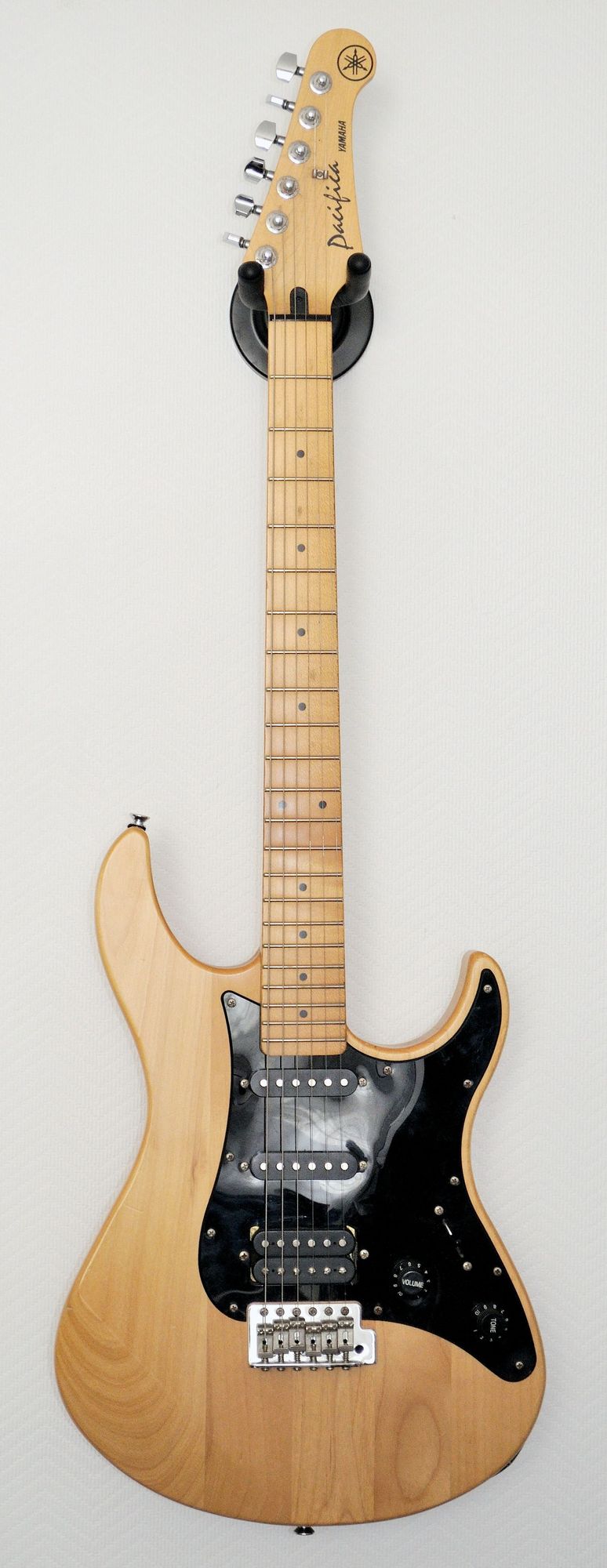
Electric guitar Yamaha Pacifica 112. Photo by BastienM. Licensed under CC BY-SA 3.0. Via Wikimedia Commons. Yamaha
Pacifica
1990
No hit record, no famous owner, no legend. Just the guitar that’s ready when a beginner is.
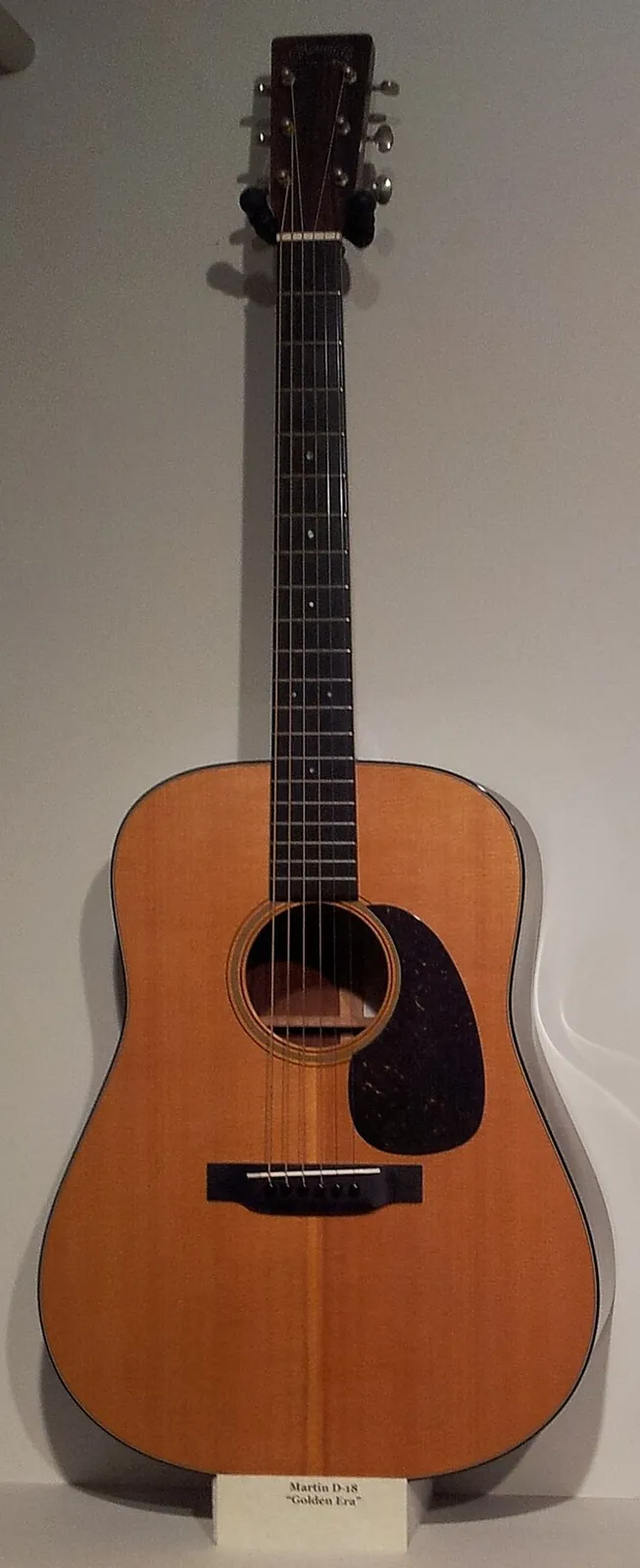
Photo: doryfour / Wikimedia Commons / CC BY-SA 2.0 Martin
D-18
1931
Elvis traded his D-18 up for a leather-covered D-28. The plain one had already been there for the Sun records.
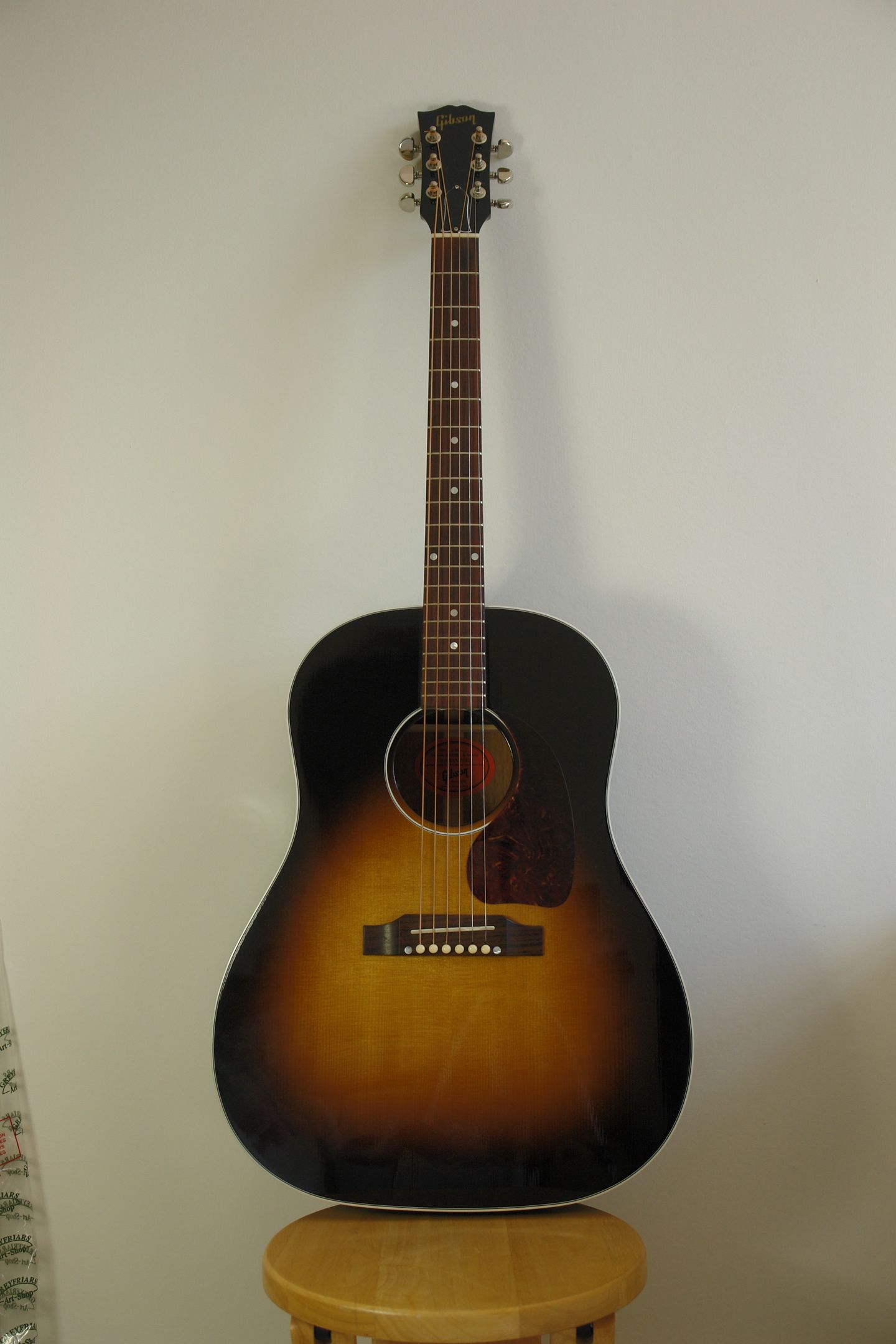
Gibson J-45. Photo by Jim Hutcheson. Licensed under CC BY 2.0. Via Wikimedia Commons. Gibson
J-45
1942
Born in 1942 out of whatever wood a wartime factory could find. Gibson calls it its best-selling acoustic ever.