Martin
D-18
Elvis traded his D-18 up for a leather-covered D-28. The plain one had already been there for the Sun records.
O.K. Houck’s music store, Memphis. A young Elvis Presley hands over a 000-18 and walks out with a 1942 Martin D-18. Metal letters on it spell E-L-V-I. The S has gone missing.
- Introduced
- 1931
- Type
- Flat-top steel-string acoustic
- Class
- Production
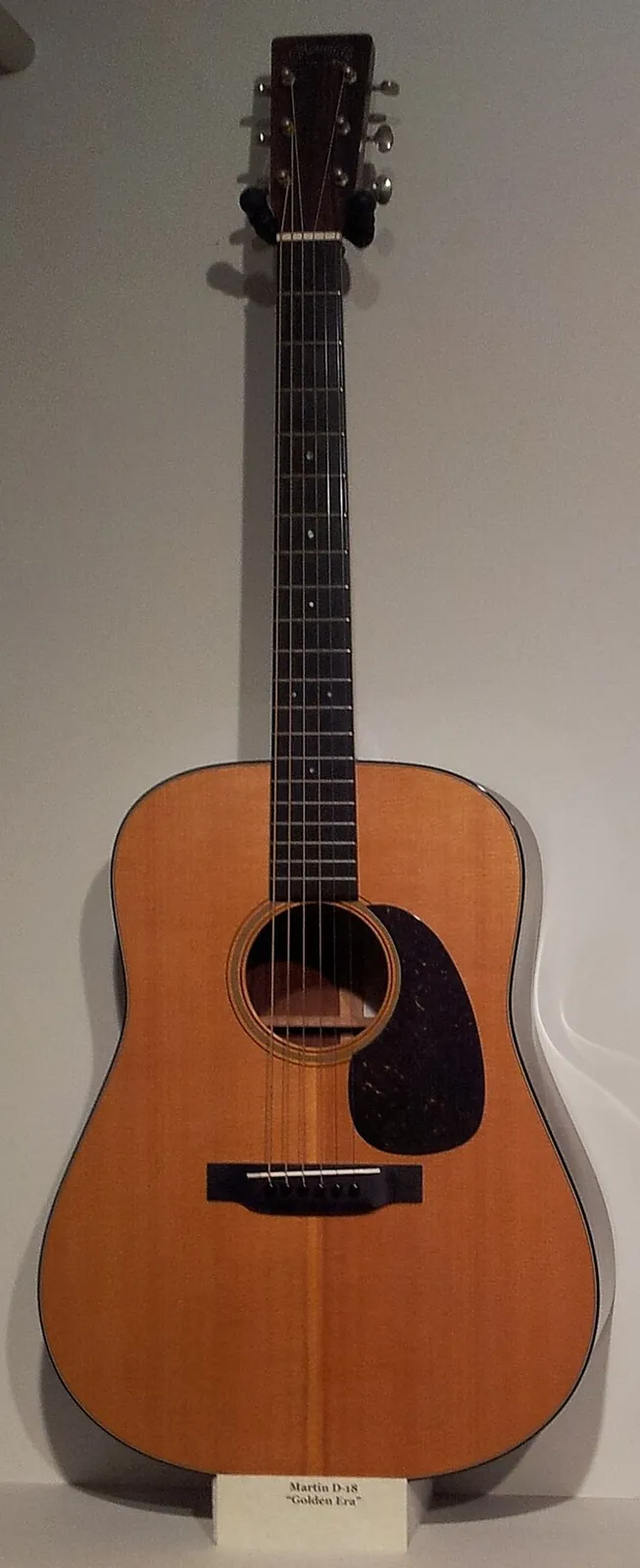
The short version
1916
Before the name
Martin starts building dreadnoughts for the Ditson company. The mahogany ones are the D-18’s ancestors.
1931
Twins
On 17 September a D-18 and a D-28 go through the shop on the same order.
1934
Fourteen frets
The 14-fret D-18 enters the catalog.
1942
Two famous ones
The year of both Elvis’s D-18 and Lester Flatt’s.
1944
No more scallops
Late in the year Martin stops scalloping braces. One of the first non-scalloped guitars on record is a D-18.
1947
Hank’s guitar
A D-18 ships to Art’s Music Shop in Montgomery. Hank Williams buys one there.
1955
The trade
Elvis plays the D-18 through the Sun days. How long depends who you ask, and some accounts run into 1956.
Side A
A1
E-L-V-I
A kid from Tupelo walks into O.K. Houck’s store in Memphis with a Martin 000-18 and trades it for something bigger: a 1942 D-18. It has metal letters on it that spell ELVI. The S is missing.
That’s the guitar Elvis Presley played in his Sun days. How long he had it depends who you ask. One account has him getting it in the middle of January 1955 and playing it until sometime after that June. Another stretches it from 1954 all the way into 1956, with the trade-in at Houck that September. I’m not going to pick one.
Either way, the D-18 went toward a D-28 with a leather cover, the fancy one. Fancy guitars are what you buy when it’s starting to go well. The plain one is what you were holding before.
A2
Mahogany, not rosewood
The D is Martin’s dreadnought, the big square-shouldered body. The 18 is the style: spruce top, mahogany back and sides, modest trim. The D-28 is the same box with rosewood and fancier binding.
Mahogany sounds drier and punchier than rosewood. Less boom in the bass, less sparkle on top, more of a thump right in the middle. That middle is where a singing voice lives. And there’s no herringbone on a D-18. That’s Style 28 trim. Anybody selling you a “herringbone D-18” is selling you a story.
The two models were born side by side. On 17 September 1931, a D-18 and a D-28 went through the shop on the same order. The mahogany dreadnought goes back further, to the ones Martin built for the Ditson company from 1916, but those aren’t D-18s.
A3
Plain, and getting plainer
Nobody has a clean count of the early ones. The first few years were twelve-fret guitars, a handful at a time, and the tallies don’t agree. In 1934 the 14-fret D-18 entered the catalog, and Martin built somewhere around forty that year.
The change that matters happened late in 1944, when Martin stopped scalloping its braces. That scalloping is the thinning that lets a top move freely, and it’s a big part of why a pre-war D-18 sounds the way it does. One of the first guitars built without it was a D-18. Two years later the tops went from Adirondack to Sitka spruce, and after that it’s mostly small trim changes, the kind people use to date these guitars from across a room.
Flip the record · By the numbers
ELVI
The metal letters on Elvis’s 1942 D-18. The S went missing somewhere along the way.
1917
The year Style 18 went from rosewood to mahogany.
~40
14-fret D-18s built in 1934, the first year. The counts land somewhere around 39 to 42.
Side B
B1
Three working men
Lester Flatt had a D-28, a 1950 one, and it’s a different guitar from this story. But for a lot of the 1950s Flatt & Scruggs recordings, the word is that Flatt preferred his 1942 D-18. He had the fancy one, and he reached for the plain one.
Hank Williams bought his D-18 at Art’s Music Shop in Montgomery, Alabama, in 1947. The paper trail matches it to a D-18 that shipped to Art’s that March. He later traded it to Curley Williams. Martin eventually ended up with it, and it sits in the Martin Museum now. If you’ve heard that the Martin Museum’s Hank Williams guitar is a D-28, it isn’t.
Hank Williams’s guitar at the Martin Museum isn’t the rosewood one. It’s the D-18 he bought at a music shop in Montgomery.
Gordon Lightfoot had a 1948 D-18. When it was sold, it went with a condition: it had to stay in Canada. A plain mahogany guitar, treated as part of a country’s history.
B2
The one with the missing S
Today’s D-18 is a regular catalog guitar. Nothing rare about it. The current Standard has scalloped braces again, set forward toward the soundhole, and the wider nut Martin used until 1939. You can walk into a shop and play one this afternoon.
The leather-covered D-28 is the Elvis Martin people picture. But when the Metropolitan Museum of Art put on its Play It Loud show, the one it hung on the wall was ELVI. That guitar was there for Sun, back when Elvis was still just a kid from Tupelo trading in his smaller Martin for a bigger one.
The cast
The people, and the specific guitars, that made the legend.
1955
Elvis Presley
1942 D-18
His Sun-period guitar, with metal letters spelling ELVI. Traded up later for the leather-covered D-28.
1950s
Lester Flatt
1942 D-18
Reportedly his favorite for many Flatt & Scruggs recordings. His 1950 D-28 is a different guitar.
1947
Hank Williams
1947 D-18
Bought at Art’s Music Shop in Montgomery, later traded to Curley Williams. Now in the Martin Museum.
1948
Gordon Lightfoot
1948 D-18
When it was sold, it came with one condition. It stays in Canada.
Liner notes
Specs, construction, rarity, value, and every source we used.
The mahogany dreadnought — Style 18 on a D body, not a D-28 — and this plate is the 2025 Standard, SKU 10Y25D18, not a pre-war.
- Body
- Square-shoulder D-14 fret dreadnought; solid Sitka spruce top with aging toner; solid mahogany back and sides; black binding, Old Style 18 multi-stripe rosette, Style 18 back purfling
- Neck
- Select Hardwood (Martin spec — not explicitly mahogany), GE Modified Low Oval with High-Performance Taper; satin, dark mahogany color; dovetail joint
- Fingerboard
- Ebony, Old Style 18 abalone dots, 20 frets, 14th-fret joint
- Scale
- 25.4"
- Pickups
- None on the current Standard. D-18E and other electrified SKUs are other guitars.
- Hardware
- Ebony GE Modern Belly bridge, drop-in saddle, 2 5/32" spacing; ebony pins (no dots on current spec); compensated bone saddle (16" radius); nickel open-gear tuners with butterbean knobs; faux-tortoise pickguard
- Electronics
- None
- Finish
- Gloss top and back/sides; satin neck; aging toner on top. Satin-body Standards are a cheaper finish SKU, not this gloss sheet.
- Nut
- Bone, 1 3/4"; 12th-fret width 2 1/8"
Open the full research fileConstruction details, the complete player record, production numbers, dated value estimates, and sources
SKU 10Y25D18. Current Standard Series only. Pre-war D-18s (scalloped Adirondack, 1 11/16" postwar nut, etc.) are vintage examples of the same model name, not this SKU. The 2025 D-28 GE-scallop / HD-28 herringbone trap lives on those plates.
Construction
C. F. Martin & Company, Nazareth. Square-shoulder dreadnought, 15 5/8" lower bout on the classic D size. 18 is Style 18: spruce top, mahogany back and sides, modest trim. Not Style 28 rosewood, herringbone, or zipper. guitarhq.com: Style 18 listed 1857 (originally rosewood); mahogany back and sides from 1917. D body under the Martin stamp from 1931.
Martin-built Ditson dreadnoughts from 1916 (VG: fan bracing on the earliest, then X-bracing; scarce). Style 111 Ditsons were mahogany, the ancestor of this wood set — they are not D-18s. 1931: Martin-brand D size. VG: D-1 equivalent to a 12-fret D-18 (Longworth: two D-1s in 1931, none after); first stamps D-18. Christie's on the paired 1931 shop order: serial 48324 D-18 and 48325 D-28, shop order 1100, 17 September 1931. 12-fret years were experimental and not in the catalog (VG). 14-fret catalog dreadnoughts from 1934.
Read the current spec first. SKU 10Y25D18 is the 2025 Standard Series refresh: Sitka spruce, GE-scalloped forward-shifted X (5/16" spruce), mahogany back and sides, black binding, Old Style 18 multi-stripe, ebony board with abalone dots, 1 3/4" bone nut, Select Hardwood neck, no factory electronics. Hide glue is not listed on the current Standard spec; guitarhq.com has it largely phased out after the 1964 factory move. Authentics, Golden Era recreations, D-18E, and satin-body Standards are other SKUs.
The 12-fret years are a count fight. Vintage Guitar / Gruhn (Martin records): D-18 1931: 1 / 1932: 3 / 1933: 9. guitarhq.com Style 18 text: 29 D-18s with 12-fret necks 1932–1933. Don't flatten. Don't pick. Longworth's later 1934 12/14 split is an estimate (UMGF quoting Longworth 1987: D-18 16 twelve-fret / 39 fourteen-fret). UMGF citing Martin Guitars: A Technical Reference: 14-fret D-18 1934: 42. Hutton (UMGF) prefers the Technical Reference over Longworth's 12-fret overcount. Keep the conflicts.
1934: 14-fret D-18 enters the catalog (VG). Early 1934 still bar frets / ebony neck reinforcement; by year's end, T-frets and steel T-bar (VG; guitarhq.com serial ~57305 on the D-28 page's shared factory calendar). Pre-WWII Style 18 D: mahogany back/sides/neck, Adirondack (red) spruce, scalloped X, ebony board and bridge, dark bindings (VG). Late 1938: X-brace junction moved back ("rear-shifted" / "low X"). UMGF (Hutton tables): first rear-X 71358; four prototype D-18s with rear-X earlier (71165–71170). Mid/late 1939: nut on 14-fret D and 000 narrowed 1 3/4" → 1 11/16" (serial 72740).
Late 1944: scalloped bracing discontinued. guitarhq.com / UMGF: first non-scalloped noted as a D-18, serial 89926 (exceptions both ways). 1946: Adirondack → Sitka on D models first (VG; guitarhq.com Sitka prevalent on D-18s by 1945–46). D-18 keeps ebony through 1946; rosewood fingerboard on D-18 from 1947 (guitarhq.com; VG: other Style 18s had gone rosewood ~1940). 1966: black body binding instead of tortoise; 1967: black pickguard (guitarhq.com). Neck reinforcement: square steel tube 1967 (UMGF Hutton notes). Brazilian rosewood is not this model's back/sides story — leftover Brazilian on Style 28 in 1969 is the D-28 plate.
Do not hang herringbone on a D-18. That trim is Style 28. Dealer blogs that invent a "herringbone D-18 era" are wrong.
Players
Named instruments first. A famous dreadnought story that does not say D-18 stays off this page.
Elvis Presley — 1942 D-18, serial 80221. Sun-period guitar; metal letters ELVI (the S missing). Scotty Moore archive: traded a 000-18 for it at O.K. Houck, Memphis, mid-January 1955; used until after 15 June 1955, then a D-28. Christie's lot text: used 1954–56 Sun sessions/concerts; traded at Houck in September 1956. Graceland's D-28 note (traded a 1942 D-18 for the 1955 leather D-28) is the later guitar — see martin-d-28. MET Play It Loud exhibited 80221. Keep the Houck dates as a conflict. Don't pick.
Lester Flatt — 1942 D-18, serial 81197. Bluegrass Heritage Foundation / Tut Taylor: Flatt preferred this D-18 for many 1950s Flatt & Scruggs recordings; the 1950 D-28 ("L-5") is a different guitar (Country Music Hall of Fame, 2008). Heritage Auctions lot 85180, October 2024. UMGF reports a $62,500 total ($50,000 + $12,500 premium). Celebrity lot — not a 1942 comps tape.
Hank Williams — 1947 D-18, serial 98611. Martin Museum: bought at Art's Music Shop, Montgomery, 1947; traded to Curley Williams; Christie's Country Music Sale 3 December 2009; Martin acquired it. Acoustic Guitar: $134,500. Christie's: batch 98600–98624 begun 30 January 1947; a D-18 shipped to Art's 17 March 1947. Martin Museum's Williams guitar is this D-18, not a D-28.
Gordon Lightfoot — 1948 D-18, serial 105249. UMGF: AH Wilkens, Toronto, sold with conditions that it stay in Canada; reported ~$330,000 USD including premium. Celebrity / national-heritage lot — not a 1948 comps tape. Auction-house year/model slip flagged in-thread.
Also known to play (weaker than the named serials): Style 18 as a working mahogany dreadnought in country and folk generally (guitarhq.com names Elvis's wartime D-18 as the 1950s example). Norman Blake's 12-fret D-18H is a special, not a catalog Standard (UMGF).
Not this guitar. Elvis's 1955 leather D-28; Lester Flatt's 1950 D-28; Clarence White / Tony Rice 1935 D-28 58957; Waylon 1946 D-28; Billy Strings 1940 D-28 76283; Neil Young "Hank" (a D-28, contested Williams provenance). Cobain's D-18E is a pickup guitar, not SKU 10Y25D18. Johnny Cash's famous Martin identity is the black D-35 / D-42 line. Dylan's famous early Gibson is a J-50. Harvest's main acoustic in the D-28 brief is a D-45, not a D-18.
Rarity
Current production: regular; not rare. No current-year factory total found. Used modern Indian-era / mahogany D-18s are common.
12-fret 1931–33: 1 / 3 / 9 (Vintage Guitar / Gruhn, Martin records) plus two D-1s in 1931 (Longworth / VG). guitarhq.com: 29 twelve-fret D-18s 1932–1933. Keep both. 1934 14-fret: 42 (Technical Reference via UMGF) vs Longworth estimate 39 fourteen-fret / 16 twelve-fret. Don't invent a pre-war grand total. Garrett Park's "fewer than 1,000" is dealer copy, not a factory census.
Pre-1945 scalloped D-18s are scarce relative to postwar D-18s — not in the same rarity class as pre-war D-45s (91 instruments) and usually priced under pre-war herringbone D-28s. 1946 ebony-board Sitka D-18s are a short window before the 1947 rosewood board.
Value
Informal estimate, 25 August 2026. Not an appraisal.
Ask vs sold. Celebrity lots labeled not-comps.
New street. About $2,500–$3,000. Martin.com gloss $2,999.99 (fetched 25 August 2026). Sweetwater 2025 Standard Natural $2,899. Peghead Nation $2,899 gloss / $2,499 satin. Dave's Guitar Shop list $2,999.99. Satin is a different finish SKU.
Used modern. No clean Reverb sold band captured this pass. Equipboard (12 June 2026 scrape) showed used asks around $2,395 next to new $2,799. Expect used to sit under current street; do not invent a midpoint.
Vintage / collectible. Joe's Vintage Guitars, July 2026, all-original excellent with case (dealer guide, not solds): pre-war D-18 (1931–1944) $25,000–$110,000; 1944–1949 $12,000–$45,000; 1950s $7,000–$11,000; 1960s $3,000–$6,000. Garrett Park pre-war mint/original $30,000–$50,000 / excellent $20,000–$30,000 / player $15,000–$20,000 — one dealer's posted guide. Not D-28 herringbone money, and not D-45 money.
Named auctions are artist markets: Christie's Hank Williams 1947 D-18 $134,500 (3 Dec 2009); Heritage Flatt 1942 D-18 UMGF-reported $62,500 (Oct 2024); Lightfoot 1948 ~$330,000 USD equivalent (AH Wilkens). Not comps for ordinary D-18s. Public hammers on non-celebrity pre-war D-18s were not isolated this pass.
See also
- martin-d-28 — rosewood Style 28 on the same D body; the 2025 GE-scallop / HD-28 herringbone story lives there
- gibson-j-45 — Gibson's round-shoulder mahogany dreadnought counterpart
- martin-d-45 — Style 45 pearl on a D; pre-war originals are a sidebar on that plate, not this one
Sources
- https://www.martinguitar.com/10Y25D18.html
- https://www.vintageguitar.com/30235/martin-d-28-and-d-45/
- https://guitarhq.com/style18.html
- https://guitarhq.com/martin.html
- https://www.pegheadnation.com/instruments-gear/instrument-demos/martin-d-18-standard-series/
- https://www.sweetwater.com/store/detail/D18SD--martin-d-18-standard-series-acoustic-guitar-natural-aging-toner
- https://www.davesguitar.com/products/new-for-2025-d-27
- https://www.joesvintageguitarsaz.com/martin-d-28-d-18-d-45-dreadnought-value-guide/
- https://gpguitars.com/pages/pre-war-martin-d-18-appraisal-value
- https://umgf.com/d-18-production-numbers-t129528.html
- https://umgf.com/confounding-production-numbers-t229633.html
- https://umgf.com/detailed-tables-of-dreadnought-guitars-1931-to-196-t205261.html
- https://www.christies.com/en/lot/lot-5482812
- https://www.christies.com/en/lot/lot-5273014
- https://www.christies.com/en/lot/lot-3613359
- Scotty Moore archive, 1942 D-18 — serial 80221; Houck trade from 000-18
- Graceland, Elvis’s guitars — 1942 D-18 traded toward the 1955 D-28
- Martin, Hank Williams 1947 D-18
- Martin Museum, Behind the Glass
- Acoustic Guitar, Hank’s D-18 — Christie's 2009 $134,500
- Bluegrass Heritage Foundation, Flatt D-18 #81197
- https://umgf.com/lester-flatt-d18-t233870.html
- https://entertainment.ha.com/itm/musical-instruments/acoustic-guitars/lester-flatt-s-1942-martin-d-18-natural-acoustic-guitar-serial-81197-total-2-/a/7387-85180.s
- https://umgf.com/gordon-lightfoot-s-1948-d-18-s-n-105249-t239530.html
- https://commons.wikimedia.org/wiki/Category:Martin_D-18
Keep digging
Guitars this one gets compared to, confused with, or descended from.
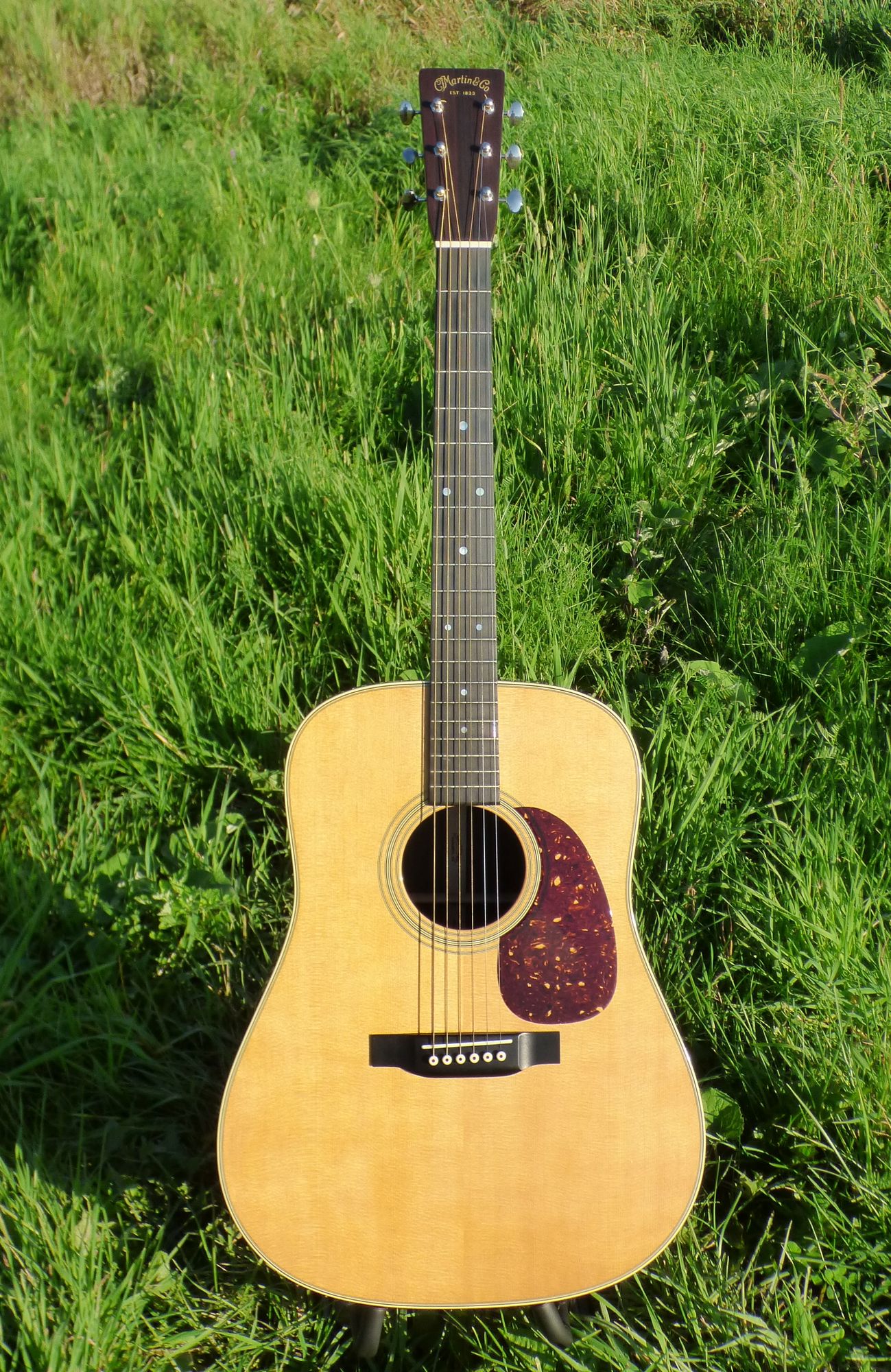
Martin D-28 Acoustic Guitar. Photo by Niranjan Arminius. Licensed under CC BY-SA 4.0. Via Wikimedia Commons. Martin
D-28
1931
You’ve heard a D-28 your whole life. It just never asked for the credit.
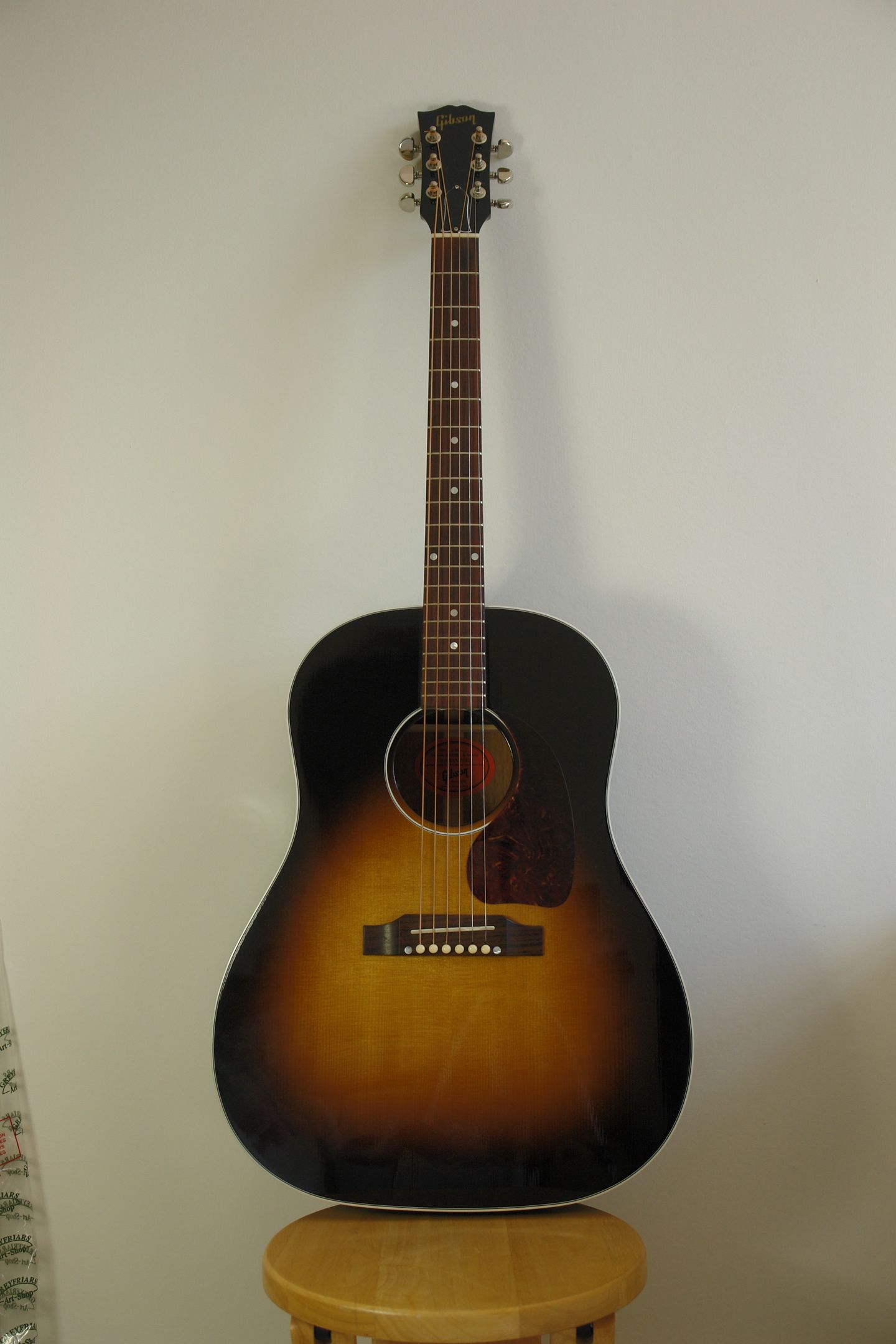
Gibson J-45. Photo by Jim Hutcheson. Licensed under CC BY 2.0. Via Wikimedia Commons. Gibson
J-45
1942
Born in 1942 out of whatever wood a wartime factory could find. Gibson calls it its best-selling acoustic ever.
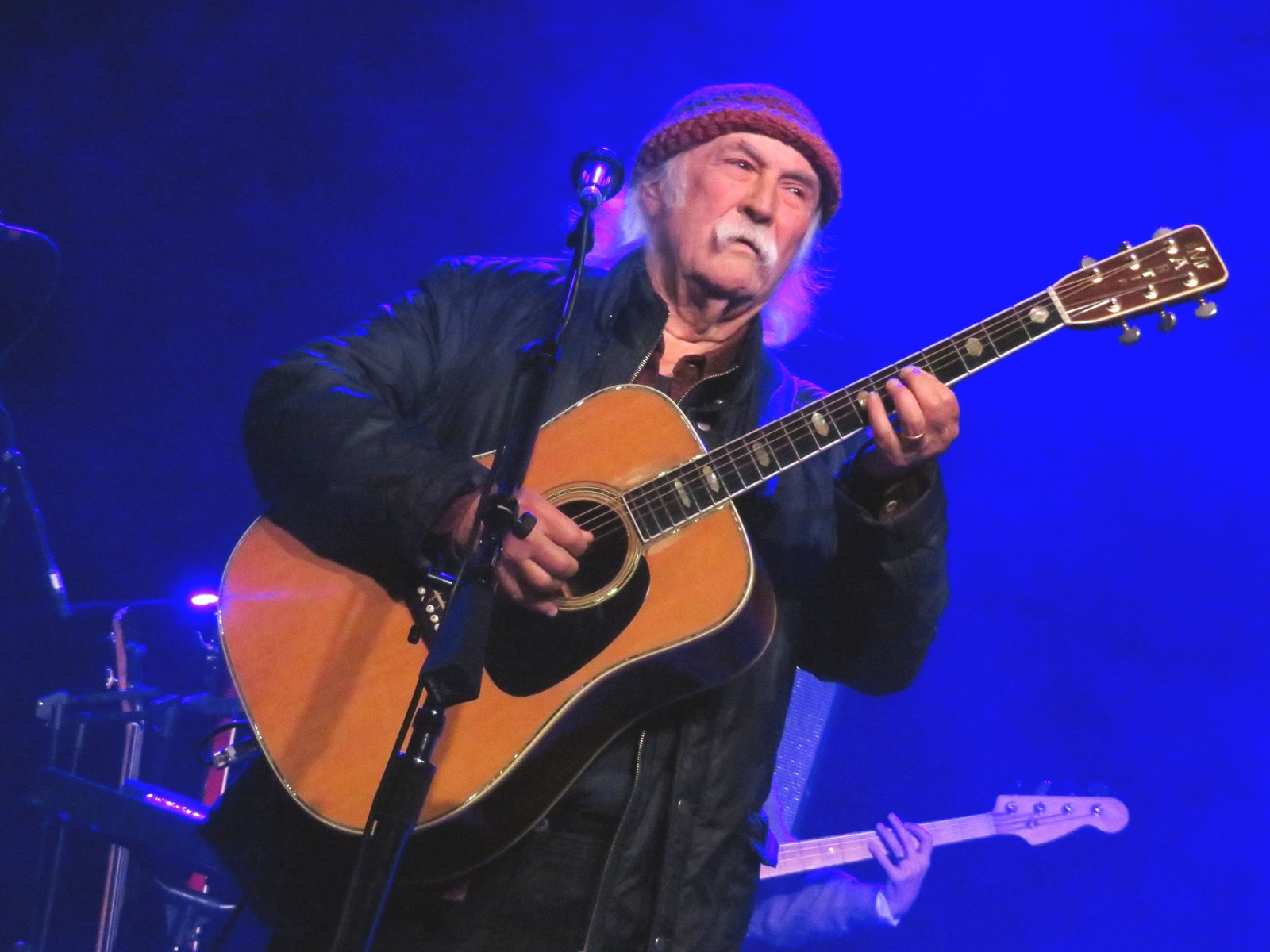
Photo: Eddie Janssens / Wikimedia Commons / CC BY-SA 4.0 Martin
D-45
1933
Pearl takes time. When the war took Martin’s time away, the D-45 stopped, and it waited 26 years to come back.