Gittler
Gittler
Allan Gittler kept taking parts off a guitar until all that was left was the guitar.
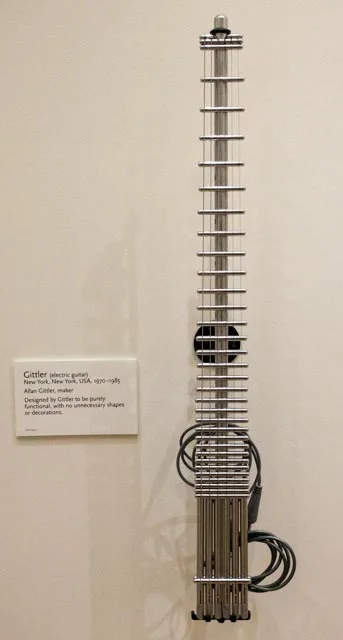
A stainless rod, bars pressed through it for frets, a pickup under every string, and the tuners at the wrong end. A man on the Lower East Side had sixty of them machined, sold one to Andy Summers, and then moved to Israel and kept going.
- Introduced
- 1975
- Type
- Solidbody electric (skeletal)
- Class
- Production
The short version
1928
Cleveland
Allan Gittler is born on 16 September.
1965
Too quiet for the drums
He records an 18-minute improvisation with Elvin Jones on classical guitar. Live, it can’t stand up to the drums.
1975
Stainless
The Museum of Modern Art dates its Gittler 1975 and buys it the next year.
1976
Filed
The patent is filed on 3 December and granted on 21 March 1978.
1982
Israel
He moves, by one dating, a year before the video. He takes the name Avraham Bar Rashi.
1983
The trash heap
Andy Summers plays one in the video for “Synchronicity II.”
2013
Titanium
Russ Rubman and Yonatan Bar Rashi bring the spine back in titanium at NAMM.
Side A
A1
Black velvet, one spotlight
Once, at a NAMM show, Allan Gittler laid his guitar out on black velvet under a single spotlight.
It needed the help. Without the light you might have missed it. A thin stainless rod, about 29 inches long, with bars pushed straight through it for frets, six little tubes lying along it under the strings, and nothing at all where a body should be. He told people, “It’s playable underwater.”
Please don’t.
What he was after was a guitar with nothing on it that wasn’t doing work. The only reminder he needed that it was a guitar, he said, was “the classic pitch of its six strings.”
A2
Two ways in
How he got there depends which of his stories you hear.
In one, it’s 1965, and he’s recording an 18-minute improvisation with Elvin Jones, on classical guitar. Live, that guitar couldn’t stand up to the drums. So he started designing electrics. The first ones were wood, “not much more than the neck,” and one in ebony he played for some years.
In the other, he’s spent fifteen years editing film, picked up patents on a printer, a reel, and a can, and left a film sitting in the lab after a fight with the producer. He ends up in the street with a Velasquez through a battery amp.
The two don’t join up neatly. Keep them both. Either way, he’s a man with a guitar that won’t do what he needs, and an instinct to take things away.
A3
Three sizes of bar
He filed the patent when he couldn’t take anything else off: 3 December 1976, granted in 1978. The Museum of Modern Art dates a finished stainless guitar to 1975, and bought it in 1976.
It is one rod. The frets are round bars pressed through slots, round so your finger slides and so a worn one can be turned to a fresh face. He held himself to three sizes of stock: one for the body, one for the pickups and tuners, one for frets, bridge, nut, and string anchors. With no wood between the frets, one reviewer compared the vibrato to a sitar’s. It isn’t a sitar. You can see why the comparison came up.
The tuners are at the bridge, so there’s no headstock. You can tune with a chord still fretted. The bit of rod sticking out past the nut was, he said, the only poetic length on it, and you could cut it off if you liked.
The stainless, he said, is the guitar.
Flip the record · By the numbers
60
Stainless guitars made in New York. Forty went by mail, twenty out of the apartment.
6
Pickups, one under each string.
3
Sizes of bar stock he allowed himself, for everything on it.
500, or about 300
Licensed copies with plastic bodies he called an abomination. Depends who you ask.
Side B
B1
Sextraphonic
Six pickups, one under each string. On the New York guitar, not a single knob. The stainless, he said, is the guitar.
The controls came in a separate box, battery-powered, about the size of a cigarette pack: six in, six out, a master, and a slider for each string. Pull one plug and that string leaves the mix for its own amplifier. Do it to all six and you have what he called a “sextraphonic freakout.”
He made them in New York with a machinist. Sixty, by his count. Forty went by mail. Twenty went out of his apartment on the Lower East Side, and one of those went to Andy Summers.
B2
The trash heap
In 1983 The Police made a video for “Synchronicity II.” Summers stands on a trash heap of ordinary guitars, and the one in his hands is the Gittler.
It looked like the future. It wasn’t on the record. The album was a ’63 Telecaster, a ’62 Strat, and a ’58 ES-335, and nobody has pinned a single take to the fishbone.
Gittler didn’t know the clip was running. By one dating he’d moved to Israel the year before, and he told the story of arriving with three cartons, three children, and no phone. He took the name Avraham Bar Rashi.
The only license he ever acknowledged went to a company called Astron, and he said they broke it at once. They were supposed to show him the first guitar. Instead, on his telling, they computer-machined 500, with an extra hole in each and the fret spacing drifting, then hid the rod in a metal box and a plastic body. Other counts say about 300. Either way, he sent dealers a form letter. Add-on boxes and bodies were an “abomination.”
It’s easy to see why. The whole guitar was the absence of a body.
B3
Twelve pieces
He didn’t stop. In Israel came plywood and MDF versions with wing-nut tuners, which he thought had all warped. By 2000 he was playing a guitar in solid mahogany with just twelve pieces of hardware doing the work of nut, bridge, and tuners. He died in 2002, or in 2003. The records don’t agree.
Others brought the spine back, in titanium, in 2013. Russ Rubman had owned one of the sixty and played it for years.
The New York stainless is gone from any shop. What’s left is the idea, and a rod that ends past the nut, with a little length he told you that you could cut off.
Put this on
You’ve read about it. Now hear it. Here’s what this guitar sounds like, and what to listen for.
Synchronicity II (video)
Andy Summers on a trash heap of ordinary guitars, holding the one that isn’t. Watch, don’t listen for it. The album was cut on a Telecaster, a Strat, and an ES-335.
Watch it on YouTube (opens in a new tab)
The cast
The people, and the specific guitars, that made the legend.
1975
Allan Gittler
Designer and builder, later Avraham Bar Rashi
Had the New York sixty machined, then kept reworking the idea in Israel, down to a mahogany guitar with twelve pieces of hardware.
1983
Andy Summers
New York stainless Gittler, bought at the apartment
Of The Police. The one the world saw, in the “Synchronicity II” video. The records are other guitars.
2013
Russ Rubman
One of the New York sixty
Played it for years, then built the titanium version with Yonatan Bar Rashi.
2024
Steve Miller
2015 titanium Gittler
Gave it to the Metropolitan Museum. A later guitar, not a New York stainless.
Liner notes
Specs, construction, rarity, value, and every source we used.
A stainless spine like a fishbone, a pickup on each string, and tuners at the bridge — Gittler’s guitar, not a Steinberger and not an Astron copy.
- Body
- No wooden body. A stainless rod. MoMA’s 1975 guitar: 2½ × 28¾ × 1" (6.4 × 73 × 2.5 cm), the museum’s rounding. MFA, about 1980: 28⅞ × 2⅞ in. (73.4 × 7.3 cm). Family company: 29" long, 3" wide, under 5 lb. Guitar.com: about 2.7 kg. Mix flagged. Do not average lengths or weights.
- Neck
- The same rod. Headless. Patent example: 1.905 cm diameter stainless. Bar Rashi to Vintage Guitar: 5/8" stock for the body, 3/8" for pickups and tuners. Mix flagged. Do not treat 1.905 cm and 5/8" as one bar.
- Fingerboard
- None. Stainless bars pressed across the rod. Patent example: frets F-1 through F-32, bar stock 0.635 cm — his 1/4". Astron-era reviews and the titanium Classic say 31. Mix flagged. Do not average 31 and 32.
- Scale
- Unpublished on the patent’s built example, on MoMA, and in Bar Rashi’s interview. Do not borrow the titanium Classic’s 25.50".
- Pickups
- Six, one per string, tubes lying with the string. New York: a lead each. Moseley put six phono plugs on them; Bar Rashi did not correct that.
- Hardware
- Tuners at the bridge end. Bridge a bar. Strings anchor at the nut end. No headstock.
- Electronics
- New York: nothing onboard. Battery mixer the size of a cigarette pack — six in, six out, a master, a slide pot each. Astron’s preamp and the titanium’s volume / treble / bass / D-13 are later.
- Finish
- Bare stainless.
- Nut
- A bar, same 1/4" stock as the frets in his sizing. Width unpublished. Not the titanium’s 1.687".
Open the full research fileConstruction details, the complete player record, production numbers, dated value estimates, and sources
Classic living example = New York stainless Gittler (the 60). No current stainless SKU. The titanium Classic, also called 2.0, is a later guitar: company page 30.25" × 3", scale 25.50", 31 frets plus a zero fret, nut 1.687". Vintage Guitar (2016) prints that Classic “a little over 30" long and 2" wide.” Weight on the titanium does not agree: Met’s 2015 example 3.8 lb; company copy about 3 lb; Guitar.com’s 2.0 figure 1.4 kg. Do not average. T2 is an aluminum bolt-on, not this spine. Three New York basses, numbered 1, 2, and 3, are basses. Astron’s plastic bodies are the license he disowned. No Gibson SKUs. Mixed inch/mm flagged on MoMA’s centimetres, the patent’s centimetre example, the MFA’s pair, and the Astron brochure. No millimetres invented past those printed conversions.
Construction
The job was a guitar with nothing on it that was not doing work. Allan Gittler — Cleveland, 16 September 1928, then the Lower East Side — told Willie G. Moseley (Vintage Guitar, March 2000) that the only reminder he needed was “the classic pitch of its six strings.”
Two doors. They do not collapse. 1965: an 18-minute improvisation with Elvin Jones, Gittler on classical (company biography). A second track later burned in a studio fire. Live, that guitar could not stand up to the drums, so he started designing electrics. First models were wood, “not much more than the neck.” One ebony he played for some years. Those years are unpublished. Not this plate. Moseley’s other door is later in the telling: fifteen years editing film, patents on a printer, a reel, and a can, then Parachute to Paradise left in the lab after a fight with the producer. He was in the street with a Velasquez through a battery amp. That guitar was not built for it either. The film’s year is unpublished here.
He filed when he could take nothing more off. U.S. patent 4079652, 3 December 1976, granted 21 March 1978. The Classic page says the tuners were developed in the early 1970s and were patent-pending until 1978. MoMA dates a finished stainless guitar 1975 and bought it in 1976 (object 292.1976, Gittler Guitar Inc., New York). The Met’s label, on a 2015 titanium, says the design was created in 1978. That is the grant year, printed on a later instrument. This plate starts in 1975. The wood necks are earlier. The patent is the specification, not a second birth.
One rod. Frets are bars pressed into slots. The patent’s built example is a 1.905 cm stainless spine, 0.635 cm fret bars, frets F-1 through F-32. He told Moseley he held to three sizes of stock: 5/8" for the body, 3/8" for pickups and tuners, 1/4" for frets, bridge, nut, and string anchors. The 1/4" and 0.635 cm are the same stock. The 5/8" and the 1.905 cm spine are not. Both stay. Round bars, the patent says, so a finger can slide, and a worn face can be turned. Maillard, in 1986, compared the vibrato to a sitar’s, because there is no wood between the frets. It is not a sitar.
Six pickups, one per string, lying with the string. No knob on the New York guitar. The stainless, he said, is the guitar. It shipped with a battery mixer the size of a cigarette pack: six in, six out, a master, a slide each. Pull one plug and that string leaves the master for its own amp. He called the full split a “sextraphonic freakout.” You tune at the bridge, so a chord can stay fretted. The rod past the nut was, he said, the only poetic length on it, and you could cut it off.
Machined in New York. 40 by mail. 20 from the Lower East Side apartment, where Andy Summers bought his. Once at NAMM, year unpublished: black velvet, one spotlight. “It’s playable underwater.” Not recommended.
Not a Steinberger (steinberger-gl). The L2 bass is 1979. The GL is 1984, a graphite paddle. This spine is earlier, and the tuner is already in the 1978 patent. Gittler Instruments says that patent preceded Steinberger’s tuner “by 2 years.” Steinberger’s tuning-system patent was filed 8 June 1982. Not two years. Keep both. He told Moseley he cut off his machinist after Steinberger got a look at the tuner, and that Washburn’s lawyer put the Gittler patent in front of a judge and the case was thrown out. His account. No docket in hand.
Guitar.com (Justin Beckner, 20 September 2022) dates the move to Israel at 1982, a year before the video. He told Moseley they had just arrived — three cartons, three children, no phone — and he did not know the clip was running. He took Avraham Bar Rashi, “from Rashi.” Moseley’s transcript prints “Rashill.” The company biography gives him twenty years there. Moseley reached him in Hebron.
The only license he acknowledged went to Astron Machine, and he said it was broken at once. They were to show him the first guitar. They computer-machined 500, an extra hole in each, fret spacing drifting, then a metal box and a plastic body to hide it. Serials continue from 61. The Hebrew reads “Bar Rashi, Israel.” He sent dealers a form letter. Add-on boxes and bodies were an “abomination.” Wikipedia’s history, flagged on that page as unsourced, prints about 300 and the name Astron Engineer Enterprises. Beckner says plastic moulding over warped spines. Moseley’s introduction says several hundred. Do not average 500 and 300. Chris Maillard (One Two Testing, April 1986) reviewed a stainless Gittler with 31 frets and a built-in preamp — later wiring, not the cigarette-pack guitar. A guitar-list transcription of an Astron Engineering brochure gives that body as 29" (73.6 cm) by 4.5" (11.5 cm) by 1.5" (3.8 cm), and calls the 31 frets an extra octave. Mix flagged. Wider, because of the plastic. Not the rod MoMA bought.
Then plywood and MDF, wing-nut tuners. He thought they had all warped. In 2000 the guitar he played was solid mahogany, twelve pieces of hardware doing nut, bridge, and tuner, heard on his CD Deep Hip. Later instrument. Not this table.
Death dates split. Vintage Guitar’s 2016 review, and Wikipedia’s header via the Social Security Death Index, print 2002. The family site and the MFA print 2003. He was alive for the March 2000 interview.
Russ Rubman and Yonatan Bar Rashi brought the spine back in titanium. Colin Joye’s name is on the 2013 instrument patent with Rubman. At NAMM 2013 Rubman said he had owned one of the sixty, “made back in the ’80s,” and played it for years. That dating is his. MoMA’s guitar is still 1975. The new one is 6AL-4V titanium, 31 frets, a quarter-inch jack, a Roland-style D-13, LED markers, a snap-on guard if you want a neck-shaped back. Musikmesse, in a company release of 5 March 2014. Same idea of a spine. Different metal, different factory.
Classic vs current: 1975 New York stainless — one rod, a pickup per string, tuners at the bridge, no knob, sixty of them — against a titanium Classic still on the family site, and against nothing stainless you can order new.
Players
Do not hang the Synchronicity album on this plate. Do not recruit the three basses. Do not put Elvin Jones here. The 1965 duet is classical.
Andy Summers (The Police). The one people saw. Bar Rashi sold it to him at the apartment. The video is “Synchronicity II,” 1983, Summers on a trash heap of ordinary guitars (Beckner). Moseley’s 2000 piece prints “Synchronicity III.” The 2016 review prints II. The album is other guitars. Vintage Guitar (Pop ’n Hiss, 5 June 2025): a ’63 Telecaster, a ’62 Strat, and a ’58 ES-335. “Every Breath You Take” stays on the Telecaster. No master here is pinned to this spine. No serial in these sources.
Steve Miller. Not a New York stainless. The Met’s electric guitar, object 2024.606, is a 2015 titanium, gift of Steve Miller, 2024. The label’s “1982” for the Summers video is a year early.
Also known to play stays short. Russ Rubman: one of the sixty, played for years before he and Yonatan built the titanium (NAMM 2013). No session named. None invented.
Rarity
You cannot buy a new stainless Gittler from the man who machined them. That run was a machinist, the mail, and an apartment. The titanium Classic is another company on the silhouette. The T2 is not even the silhouette.
He did not publish a year-by-year ledger. None invented. What he did tell Moseley is a total: 60 guitars in New York, 40 by mail and 20 from the apartment, basses counted separately. Astron, on his telling, is 500 computer-machined guitars. Wikipedia’s unsourced history says about 300. Moseley’s introduction says several hundred. Serials from 61 mark the license. They date a plastic-body guitar. They do not count 1975. That is why a first-year census is unknown, not the chapter.
What is actually thinner: the New York sixty against any plastic-bodied Astron; the patent’s 32-fret example if a guitar can be shown to match it; MoMA’s 1975 purchase; the MFA’s New York stainless, about 1980, sold by Bar Rashi to David Kean in Calgary in 2000 and to the museum in 2009. Summers’s apartment guitar is one object. A Reverb listing calls a 1995 left-handed guitar the only one he made that way. Wikipedia’s unsourced history says 1995 or 1996, nylon-thread frets, twelve parts, for a client in Jerusalem. That left-hander and the mahogany on Deep Hip are later instruments. They are not a vintage stainless Gittler.
Value
Informal estimate, 15 October 2026. Not an appraisal.
Ask vs sold labeled. Celebrity lots and museum gifts are not comps. No invented medians or factory counts. No 1970s list price for the New York sixty appears in the sources used here. He sold them himself. That absence is not a zero.
New street. No stainless cart. The titanium Classic’s own pages do not agree, and none of them is a 2026 shipped receipt. sonicstate, NAMM January 2013: US retail $4,039.95. Company notice, 1 July 2013: Classic $4,995, Armed Forces edition $5,995. A company product page titles the Classic at $7,495, deposit $2,000 (page stamped 17 July 2013; the button this pass is the deposit). Vintage Guitar, 10 June 2016: list $4,995. Do not average those lists. The T2’s cart price, $1,495, is a different guitar — aluminum body, bolt-on maple, 24 frets, 648 mm scale. Not this table.
Used modern. Titanium Classics trade as their own tape. Named asks, ended, not hammers: Music Zoo, a pre-owned Classic, $5,499, listed ten years ago (the dealer text says thirty-three frets — do not adopt 33). A 2014 Classic prototype with a guard, $4,250, listed nine years ago. No clean 2025–26 sold sample isolated. Don’t invent a midpoint.
Vintage / collectible. Reverb’s Gittler electric page, asks this pass, not hammers: a circa-1981 Very Good at $5,995, dealer line “Andy Summers era” — a nickname, not proof it is one of the sixty. A 1982 Model 2 in red, $3,692.85 (from $4,062.76). Another Model 2, $1,799.99 (from $2,999.99). Gittler III #193, #241, and #140, $3,500 each. If his serial story holds, numbers past 60 are Astron, and #140 sits in that run. A Sam Ash “New York” listing ended at $3,399.99, listed three years ago, the blurb pasted from Guitar.com, no serial in the fetch. Flag: thin sold-comp access. No Price Guide band isolated. Do not average those asks. The 1995 left-hander, ask $6,000 from $14,000, listed nine years ago, is one later object. Summers’s guitar, MoMA’s, and the MFA’s are not a street tape.
See also
- steinberger-gl — headless, tuners at the bridge, a few years later; graphite paddle, not this stainless spine
- veleno — another 1970s all-metal guitar; carved aluminum halves, not a rod with the frets pressed through it
- ampeg-dan-armstrong — 1969 Lucite you can see through; this one barely has a body to see
Sources
- Vintage Guitar, Willie G. Moseley, Gittler Guitar (March 2000) — 60 New York; 40 mail / 20 apartment, Summers bought his there; three basses numbered 1–3; 5/8", 3/8", 1/4" stock; cigarette-pack mixer; NAMM, “playable underwater”; Astron Machine, 500, serials from 61, “Bar Rashi, Israel,” form letter, “abomination”; Steinberger / Washburn account; mahogany, 12 pieces, Deep Hip; “Synchronicity III” in that piece; Hebron
- U.S. patent 4,079,652, Allan Gittler — filed 3 December 1976, granted 21 March 1978; built example, 1.905 cm spine, 0.635 cm fret bars, frets F-1 through F-32
- MoMA, Electric Guitar, 1975 — stainless; 2½ × 28¾ × 1" (6.4 × 73 × 2.5 cm); Gittler Guitar Inc., New York; object 292.1976, Purchase
- MFA Boston, Electric guitar (Gittler model) — about 1980, New York, stainless; 73.4 × 7.3 cm (28⅞ × 2⅞ in.); Bar Rashi to David Kean, 2000; to the MFA, 2009; dates him 1928–2003
- The Met, Electric Guitar, 2015 titanium — gift of Steve Miller, 2024, object 2024.606; 30.25" × 3" × 1.625", 3.8 lb; label says design 1978 and a 1982 Summers video
- Gittler Instruments, The Original Gittler — 1970s; patent 4079652; 29" × 3", under 5 lb; 60 guitars and 3 basses, late 1970s–early 1980s; Summers, “Synchronicity II”; death printed as 2003
- Gittler Instruments, Meet the Team — born Cleveland, 16 September 1928; 1965 Elvin Jones duet on classical; wood models, an ebony played for some years; 15 years editing; 20 years in Israel
- Gittler Instruments, Classic specs — titanium 6AL-4V; 30.25" × 3"; 25.50" scale; 31 frets plus a zero fret; nut 1.687"; tuners “early 1970s,” patent 1978, “by 2 years”
- Gittler Instruments, price notice, 1 July 2013 — Classic $4,995; Armed Forces $5,995
- Gittler Instruments, Classic deposit page — titled $7,495, deposit $2,000; page stamped 17 July 2013
- Gittler Instruments, European release, 5 March 2014 — NAMM the year before; Musikmesse; 3 lb; 31 frets
- Gittler Instruments, T2 — $1,495; aluminum; bolt-on maple; 24 frets; 648 mm scale; not this spine
- Guitar.com, Justin Beckner, 20 September 2022 — patent 1978; 3" × 29", about 2.7 kg; 60, late 1970s–early 1980s; three prototype basses; “Synchronicity II,” 1983, trash heap of guitars; emigration a year prior; Astron plastic over warped spines; 2.0 titanium, 1.4 kg, 31 frets
- Vintage Guitar, Gittler Classic, 10 June 2016 — “musical fishbone”; “Synchronicity II”; death printed as 2002; list $4,995; a little over 30" × 2"; 31 titanium fret rods
- Vintage Guitar, Pop ’n Hiss: Synchronicity, 5 June 2025 — album guitars: ’63 Tele, ’62 Strat, ’58 ES-335; not this spine
- One Two Testing, Chris Maillard, April 1986 — 31 frets; stainless spine; six pickups; built-in preamp; the later wiring
- guitar-list, Gittler II (Israeli) — transcription of an Astron Engineering brochure: 31 frets; 29" (73.6 cm) × 4.5" (11.5 cm) × 1.5" (3.8 cm)
- Wikipedia, Gittler guitar — header 1928–2002 via the Social Security Death Index; history section unsourced for ~300, Astron Engineer Enterprises, and the Fishbone nickname; do not treat that section as a factory table
- sonicstate, NAMM 2013 — Rubman owned one of the 60, “made back in the ’80s”; retail $4,039.95; 31 frets
- Steinberger tuning-system patent US4608904A — filed 8 June 1982; the “2 years” claim does not match this filing against the 1978 Gittler grant
- Gittler Instruments patent US9082385B2 — filed 1 August 2013; inventors Russell S. Rubman and Colin D. Joye; the titanium-era instrument, not the 1978 spine
- Reverb, Gittler electric guitars — asks this pass: circa 1981 $5,995; 1982 Model 2 $3,692.85; Model 2 $1,799.99; III #193 / #241 / #140 at $3,500
- Reverb, 1995 left-handed Bar Rashi — ask $6,000 from $14,000; listed nine years ago; later one-off, not a New York stainless
- Reverb, Sam Ash “New York” listing — ended ask $3,399.99; listed three years ago; blurb pasted from Guitar.com
- Reverb, Music Zoo used Classic — ended ask $5,499; listed ten years ago; titanium, not the sixty
- Reverb, 2014 Classic with guard — ended ask $4,250; listed nine years ago; titanium prototype, not the sixty
Keep digging
Guitars this one gets compared to, confused with, or descended from.
- Send a picture
Steinberger
GL
1984
No headstock, no wood, and designed by a man who didn’t play. Eddie Van Halen wrote two songs on it in days.
- Send a picture
Veleno
Veleno
1970
A rocket-parts machinist built an aluminum guitar, hid it in a closet, and waited to be asked twice.
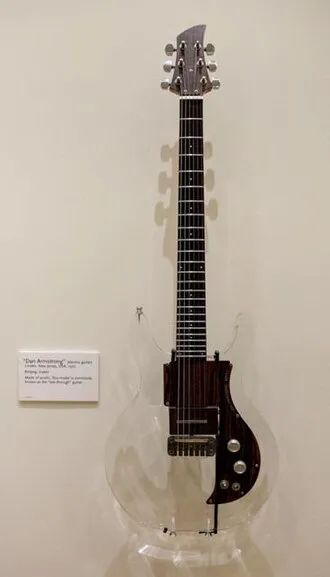
Photo: Frank Kovalchek / Wikimedia Commons / CC BY 2.0 Ampeg
Dan Armstrong
1969
A repairman who spent his days inside other people’s guitars designed one you could see straight through.