Steinberger
XM
Bill Wyman said the little Steinberger looked like a machine gun. The full-size one, he kept.
Early 1980s. Bill Wyman picks up one of the new headless Steinbergers, the small one, and puts it back down. He doesn’t like the feel. A few years later Steinberger bolts the same graphite neck onto a full-size maple body, and he buys a white one.
- Introduced
- 1987
- Type
- Solidbody electric bass (headless / XM platform)
- Class
- Production
Have a photograph of this guitar? Send a picture
The short version
1979
The L2
Steinberger’s headless bass shows at summer NAMM.
1984
The paddle guitar
The one-piece graphite GL goes on the market. Not this instrument.
1987
The M series
Maple bodies on graphite necks. Guitars first, basses soon after. One count dates the XM to this year; the factory timeline doesn’t give it one.
1988
In the catalog
The XM is already a current bass in the US retail book.
1989
Wyman’s white XM2
Bought this year, by his own archive, which also files it under 1998.
1991
Sleeker
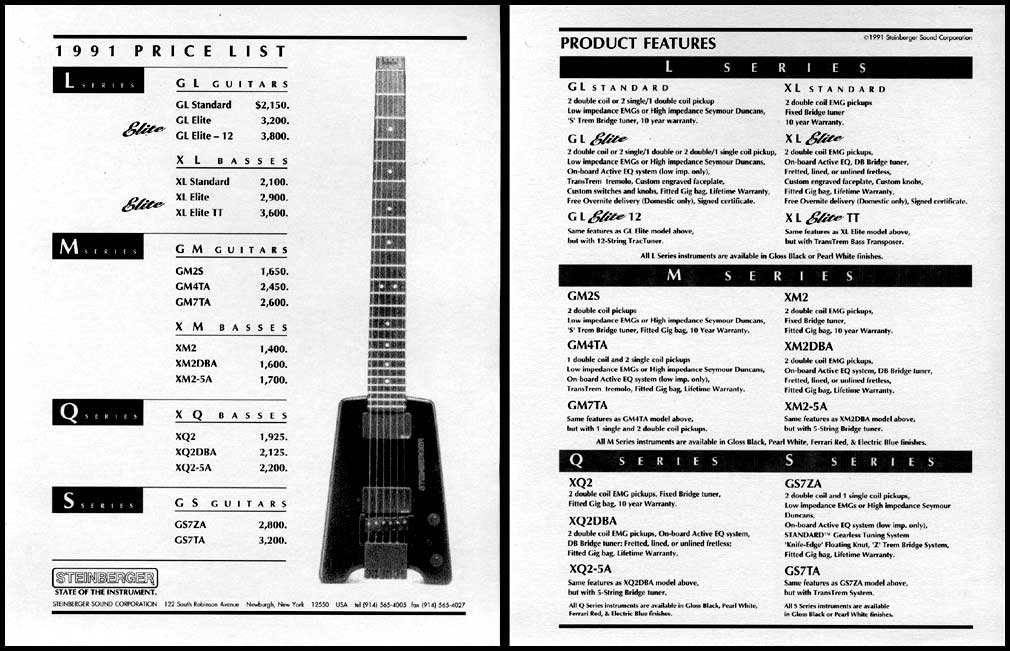
New body profile, redesigned heel, thinner neck. The XM2 lists at $1,400.
1992
Nashville
Production moves. The XM is marked out of production, and by 1994 it’s off the price list.
Side A
A1
The one that looked like a machine gun
Bill Wyman tried one of the little Steinbergers in the early ’80s. You’ve seen it: a graphite plank with no headstock, tuners down at the bridge. It looked like the future. It did not feel like a bass to him.
Years later he was blunt about it.
“I tried out one of those little Steinbergers in the early ’80s, the one that looks like a machine gun. I didn’t like the feel. The full-size ones are good.”
He wasn’t done with Steinberger. He was done with the paddle. The XM is the bass that sits between those two sentences.
A2
Throwing the headstock away
Steinberger’s first bass, the L2, showed at summer NAMM in 1979. It moved the tuners to the bridge, threw the headstock away, and was built in graphite. The company set up in Newburgh, New York, in 1983. The GL guitar followed in 1984.
That shape made the brand. But a lot of players still wanted something that sat like a bass.
A3
A body, finally
In 1987 Steinberger started the M series: wood bodies on graphite necks. The guitars came first, with Mike Rutherford of Genesis named among the inspirations. That’s a guitar, not this bass. The basses, as one history puts it, soon followed.
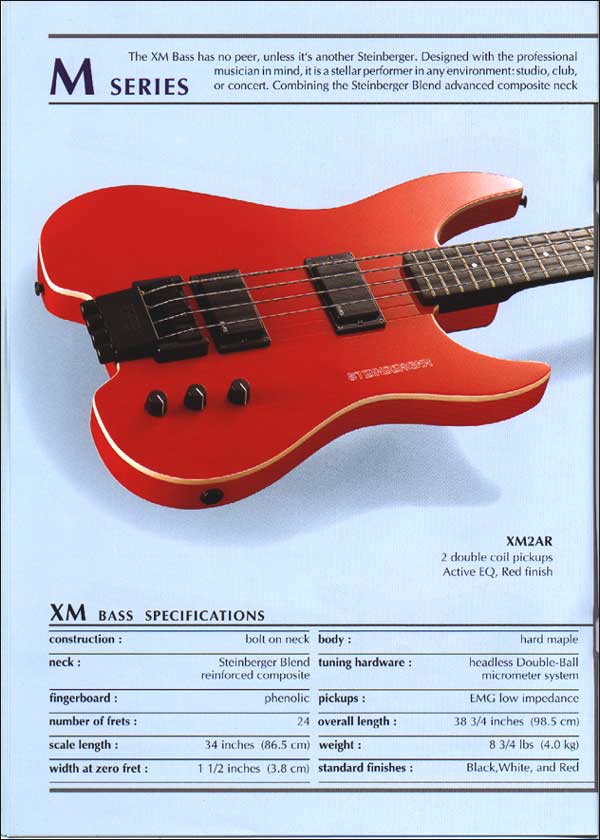
The letters tell you what you’re holding. X is a bass. M is a wood body on a graphite neck. The XM is the bass the paddle people were missing.
When exactly it arrived depends who you ask. One collector’s spec sheet says 1987. The factory history never gives a first year. By the 1988 catalog it’s already there as a current model, and the flier sold it with one line:
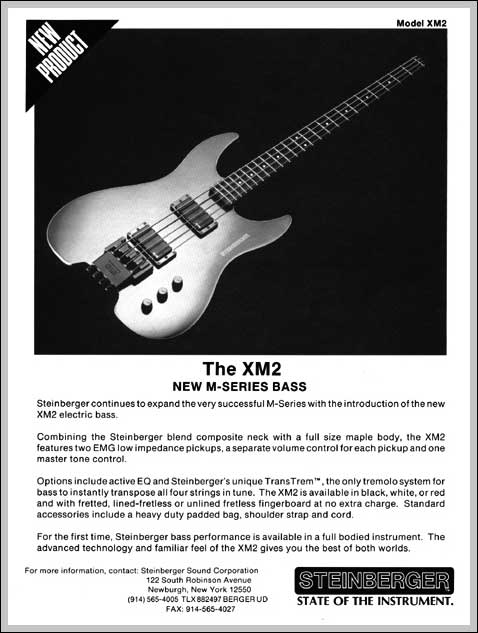
“For the first time, Steinberger bass performance is available in a full bodied instrument.”
Flip the record · By the numbers
34"
Scale. Full long-scale, on a bass with no headstock.
8 3/4 lb
Weight in the 1988 catalog. A real bass, not a paddle.
$1,400
The plain XM2 on the 1991 price list.
1987–88
The short window for the Bass TransTrem. Very few were built.
Side B
B1
What you actually hold
A full-size, double-cut body of hard maple, about 8 3/4 pounds. A graphite neck bolted on, with a phenolic fingerboard, 24 frets, and a zero fret instead of a nut. A 34-inch scale, the normal long-scale length. Still headless: double-ball strings, tuned down at the micrometer bridge, with no weight hanging off the end of the neck.
Two EMG pickups, a volume for each, and one master tone. Fretless came at no extra charge. Active EQ was an option.
So was the TransTrem, the option that could drop or raise all four strings at once and keep them in tune with each other. On the bass it only ran from June 1987 into 1988, and very few were built.
Steinberger didn’t make the wood. Outside shops built the bodies, which is why two XMs can both say maple and not be the same plank. Early M bodies had binding. By 1989 it was gone.
B2
Sleeker, and then gone
In 1991 the XM got a new body, a sleeker profile, a redesigned heel, and a thinner neck. The price list that year had a plain XM2 at $1,400, an active version at $1,600, and a five-string at $1,700, in Gloss Black, Pearl White, Ferrari Red, and Electric Blue.
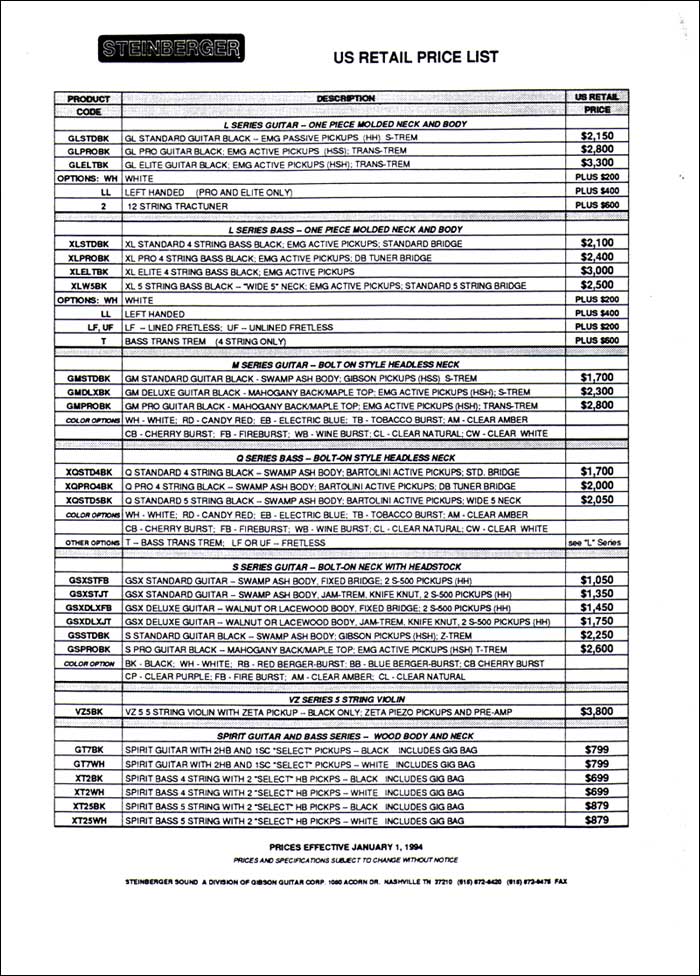
Then the company moved to Nashville in 1992, and in the Nashville years the XM is marked out of production. The price list that took effect on 1 January 1994 has no XM on it at all. Nobody published how many were made.
B3
The full-size ones are good
Wyman bought his in 1989, a white XM2. His own archive files it under 1998 and, on the same page, says he bought it in 1989. Keep both. He took it on the Rolling Stones’ Steel Wheels and Urban Jungle tours in 1989 and 1990, onstage and in the studio. Nobody has pinned it to a particular track.
He left the Stones in the early ’90s. The bass stayed. From 1995 to 2015 it went out with Bill Wyman’s Rhythm Kings: twenty years on a headless graphite neck.
He never called it an XM in that interview. He didn’t need to. He just said the full-size ones are good, and the white one he’d bought in 1989 was still going out with him.
The cast
The people, and the specific guitars, that made the legend.
1989
Bill Wyman
White XM2
Bought in 1989. Used for recordings and onstage on the Rolling Stones’ Steel Wheels and Urban Jungle tours.
1995–2015
Bill Wyman
The same white XM2
Onstage with Bill Wyman’s Rhythm Kings, 1995 to 2015.
Liner notes
Specs, construction, rarity, value, and every source we used.
A full-size maple body and a bolt-on graphite neck — Steinberger’s headless XM bass, not the one-piece GL paddle.
- Body
- Full-size hard maple, double-cutaway. 1988 catalog: 38 3/4" (98.5 cm) overall; 8 3/4 lb (4.0 kg). Mix flagged.
- Neck
- Bolt-on Steinberger Blend reinforced composite; headless. Finebergers: 5 bolts.
- Fingerboard
- Phenolic, 24 frets. Lined or unlined fretless was an option, not this row.
- Scale
- 34" (86.5 cm), 1988 catalog. Mix flagged.
- Pickups
- Two EMG low-impedance double-coils
- Hardware
- Headless Double-Ball micrometer bridge. 1991 XM2 is the fixed bridge. TransTrem and DB are other suffixes.
- Electronics
- Intro flier: volume per pickup, one master tone. Active EQ is the XM2AR / XM2DBA option.
- Finish
- 1988 catalog: Black, White, and Red. 1991 list: Gloss Black, Pearl White, Ferrari Red, Electric Blue.
- Nut
- Zero fret. 1 1/2" (3.8 cm) at the zero fret, 1988 catalog. Mix flagged.
Open the full research fileConstruction details, the complete player record, production numbers, dated value estimates, and sources
Classic living example = USA Newburgh XM2 — hard maple, bolt-on Blend neck, two EMG double-coils, fixed Double-Ball bridge. No current XM. The 1994 Nashville list has no XM line. Spirit XT-2 is the bass on sale in 2026: wood, through-neck, XL outline. Not this table. Do not average the catalog pairs. 34" is not 86.5 cm, 1 1/2" is not 3.8 cm, 38 3/4" is not 98.5 cm, and 8 3/4 lb is not 4.0 kg. Shop figures are single basses, not a new spec: Cream City’s 1987 fretless weighed 9 lb 1.9 oz; GIB’s N6820 weighed 4.380 kg, with a 38.0 mm nut, and that shop says the neck has no truss rod. The 1988 table doesn’t mention one.
Construction
The job was a Steinberger bass with a body. The paddle had already put the tuners at the bridge and thrown the headstock away. A lot of players still wanted something that sat like a bass. Full-size hard maple, a bolt-on graphite neck, double-ball strings. That is the XM.
Same company, other instrument. Factory history: L2 at summer NAMM 1979, Newburgh 1983, GL guitar on the market 1984 (steinberger-gl). That one-piece Blend paddle is not this bass. Factory 1987: the GM series, “inspiration of Mike Rutherford, Roger Griffin and Geoff Banks,” a maple double-cutaway. Steinbergerworld spells the luthier Roger Giffin. Keep Griffin and Giffin. Guitars came first. The site: “basses soon followed.” Finebergers (sheet 2.1.5, 11 May 2020): XM introduced 1987. The factory timeline never dates a first XM. It dates a 1991 body change. This plate starts in 1987. The first full spec sheet in hand is the 1988 US retail catalog, and there the XM is already a current bass.
That book is the instrument. Bolt-on Steinberger Blend, phenolic, 24 frets, 34" scale, hard maple, EMG low-impedance pickups, headless Double-Ball micrometer hardware. The spread’s own join: the Blend neck “with a full-sized hard maple body.” The photo line is the suffixes. XM2AR, two double-coils, active EQ, red. XM2TW, white, TransTrem Bass Transposer. XM2-5, five-string. XM2LF, lined fretless. The undated Newburgh flier, “NEW M-SERIES BASS,” matches the bones: Blend neck, full-size maple, two EMG low-impedance pickups, a volume for each, one master tone. Active EQ and the TransTrem are options. Fretted, lined-fretless, or unlined “at no extra charge,” with a bag, a strap, and a cord. The flier’s line: “For the first time, Steinberger bass performance is available in a full bodied instrument.”
Not the GL. Not the XL. HeadlessUSA: X is bass, G is guitar, M is the wood body on a graphite neck. Rutherford’s photographed first M is a GM1T. That six-string stays off this slug. So does every L-series bass.
The TransTrem is the option that could move every string and keep the intervals. Factory: Bass TransTrem 1987. The flier says it transposes all four. Finebergers, on the XM column: hardtail, and “very few” Bass TransTrems, June 1987 until 1988. The 1988 catalog still pictures an XM2TW. By the 1991 price list the three XM rows are fixed-bridge and DB, not a TransTrem suffix. Finebergers’ “only 140–200 Bass TT have ever been built” is written under the XL. That is not an XM census.
Factory 1988: the DB bridge, company-wide. It is not on the 1988 XM spread in hand. It shows up on the 1991 sheet as XM2DBA.
Steinbergerworld, on the 1989 catalog against the ’88 book: bindings on the M’s were dropped, and the XQ bass was added. Early M’s, the site says, were Newburgh-bound — black/white, white/black, red/white — and Steinberger did not make the wood. Unico, also Roscoe and Guitabec; Gibson Montana later. The pictures are mostly GM guitars. It is why two XM bodies can both say maple and not be the same plank.
1991, price sheet still at 122 South Robinson Avenue, Newburgh. Factory: new GM and XM bodies, sleeker profile, redesigned heel, and the XM neck changed to a thinner version “as is used on the XQ bass.” No figure for how much thinner. None invented. The list: XM2 $1,400, fixed-bridge tuner, two double-coil EMGs, gig bag, 10-year warranty. XM2DBA $1,600, on-board active EQ, DB bridge, fretted or lined or unlined fretless, lifetime warranty. XM2-5A $1,700, that feature set with a 5-string bridge. Finishes on the sheet: Gloss Black, Pearl White, Ferrari Red, Electric Blue. Historical list, not 2026 street. Fretless is no longer the flier’s free option on a plain XM2. It sits on the DBA and the 5A.
1992: Nashville, and Spirit by Steinberger — maple, wood, the headless idea without the Blend neck. Finebergers marks the XM out of production in the Nashville column (July 1992–August 1998). The US list effective 1 January 1994, Nashville address, still has GM guitars, Q basses, and Spirit. No XM block. Factory 2002 brings USA graphite back as GM and GR. Not an XM.
Classic vs current: a Newburgh XM2 against a Spirit XT-2 a shop will sell you. Guitar Center’s copy: the XL outline, a 3-piece maple through-neck, maple wings, rosewood, EMG Select humbuckers, 34" scale, 24 frets, 1.50" at the zero fret, 38.50" overall, $599.00. Amazon’s Frost Blue listing is $499.00 and prints basswood, engineered hardwood, and Steinberger-branded HB pickups. Mix flagged. Same brand. Different bass. Not this slug.
Players
Do not recruit L-series bassists, and do not put Mike Rutherford on this plate. His M-series guitar is a GM. Steinbergerworld files a 1983 Guitar Player piece as “Bill Wyman L2.” That one is the paddle.
Bill Wyman (Rolling Stones). MusicRadar, 23 September 2011: “I play a Steinberger — the guitar body, not the thin body. I tried out one of those little Steinbergers in the early ’80s, the one that looks like a machine gun. I didn’t like the feel. The full-size ones are good.” He does not say XM in that interview. His archive names the full-size bass: white XM2, serial N8812. The heading on the page says 1998. The same page says he bought it in 1989, and that Newburgh serials are the N numbers, stamped under the neck near the heel. Keep 1998 and 1989. The archive says he used it for recordings and onstage on the 1989–90 Steel Wheels / Urban Jungle tours, and with Bill Wyman’s Rhythm Kings, 1995 to 2015, and points at page 457 of Rolling With The Stones (2002). It names no track. The 2020 MusiCares auction was the Mesa/Boogie Steel Wheels rig, not this bass.
No second named XM turned up in a catalog credit or an interview this pass. None invented.
Rarity
You cannot order a new XM. It is off the US list by 1 January 1994, and Finebergers already has it out of production in Nashville. Spirit, the XQ, and the later GM are other models. They are not an XM count.
No factory XM total was published. None invented. The 140–200 Bass TransTrem figure is an XL-column note, not this bass. An N serial under the neck dates a Newburgh instrument. It does not count a year. That is why a first-year number is unknown.
What is actually thinner is an XM2T from the short TransTrem window, a narrow five-string, and a bound early body if the site’s binding note covers the bass as well as the GM. HeadlessUSA called one maple-colored board the only example they had seen, and assumed an experiment. Their assumption. Wyman’s N8812 is one object. It is not a vintage XM.
Value
Informal estimate, 1 October 2026. Not an appraisal.
Ask vs sold labeled. Celebrity instruments are not-comps. No invented medians. The 1991 list — XM2 $1,400, XM2DBA $1,600, XM2-5A $1,700 — is 1991 money.
New street. No XM cart. Guitar Center and Musician’s Friend list a Spirit XT-2 Standard in black at $599.00. Amazon’s Frost Blue is $499.00, on the other materials table. A new Spirit XT-2 white on Reverb showed $499. Those are Spirit prices. Don’t average them into an XM.
Used modern. There is no later factory XM to trade as a modern used bass. Don’t invent a midpoint between a Spirit and a Newburgh neck.
Vintage / collectible. Reverb asks, not hammers, and not a series to average: a 1989 black with white binding at $2,999; an 1988 black with the original gig bag at $3,295 (Thousand Oaks); an 1980s four-string with a drop-D at $3,495; an 1988 cut from $3,200 to $2,800; an 1980s excellent cut from $2,400 to $1,750. A 1987 black listing that has sold still displays $2,100 — a displayed figure, not a confirmed hammer. N8812 has not been in that set. Neither has the Mesa rig.
See also
- steinberger-gl — the one-piece graphite guitar paddle; not this maple bass
- spector-ns-2 — Ned’s earlier headed wood bass with Stuart Spector, before the headless company
- modulus-quantum — another bolt-on graphite neck on a wood bass; 35" scale, not a Steinberger
Sources
- 1988 Steinberger US retail catalog, XM spread — pages 9–10: hard maple; bolt-on Blend; phenolic; 24 frets; 34" (86.5 cm); 1 1/2" (3.8 cm) at the zero fret; 38 3/4" (98.5 cm); 8 3/4 lb (4.0 kg); EMG low-impedance; Double-Ball micrometer; Black, White, Red; XM2AR / XM2TW / XM2-5 / XM2LF. Inch/centimetre pairs do not convert cleanly.
- Steinberger XM2 intro flier — Newburgh, 122 South Robinson Avenue; Blend neck; full-size maple; two EMG low-impedance pickups; volume per pickup; master tone; active EQ and TransTrem optional; black, white, or red; fretless at no extra charge; “full bodied instrument”
- 1991 Steinberger US price list — XM2 $1,400 fixed bridge, 10-year warranty; XM2DBA $1,600 active EQ and DB, fretless option, lifetime; XM2-5A $1,700; Gloss Black, Pearl White, Ferrari Red, Electric Blue
- 1994 Steinberger US retail price list — effective 1 January 1994, Nashville; GM, Q, and Spirit present; no XM block
- Steinberger History — 1979 L2; 1983 Newburgh; 1984 GL; 1987 GM (“Roger Griffin,” Rutherford, Banks), Bass TransTrem, Gibson purchase; 1988 DB bridge; 1991 new GM and XM bodies, thinner XM neck; 1992 Nashville and Spirit; 2002 GM and GR, not XM
- Finebergers, Steinberger bass configurations 2.1.5 — XM introduced 1987; maple; graphite neck, 5 bolts; XM2 / XM2A / XM2-5 / fretless / XM2T; very few Bass TransTrems June 1987–1988; the 140–200 Bass TT figure is in the XL notes; XM out of production in the Nashville column
- Steinbergerworld, M Series — Rutherford and Roger Giffin; guitars first, basses soon followed; Newburgh-bound early M’s; Unico, Roscoe, Guitabec, later Gibson Montana
- Steinbergerworld, 1989 US catalog note — bindings on the M’s dropped versus the ’88 catalog; XQ added
- HeadlessUSA, model definitions — X = bass, G = guitar; M = wood body and graphite neck; 1.5" at the zero fret on an XM 4-string neck
- MusicRadar, Bill Wyman, 23 September 2011 — “the guitar body, not the thin body”; early-’80s “machine gun”; “The full-size ones are good.”
- Bill Wyman archive, XM2 white — heading says 1998; purchased 1989; serial N8812; N = Newburgh, under the neck; Steel Wheels / Urban Jungle 1989–90; Rhythm Kings 1995–2015; page 457 of Rolling With The Stones
- Bill Wyman, MusiCares rig — the 2020 auction is the Mesa/Boogie rig, not the XM2
- No Treble, 26 June 2020 — same rig, not the bass
- Guitar Center, Spirit XT-2 Standard Bass black — $599.00; XL outline; maple through-neck; rosewood; EMG Select; 34"; 24 frets; 1.50" zero fret; 38.50" overall
- Musician’s Friend, Spirit XT-2 Standard Bass black — $599.00
- Amazon, Spirit XT2 Frost Blue — $499.00; basswood; engineered hardwood; Steinberger HB. Mix flagged against Guitar Center
- Reverb, 1989 XM2 black / white binding — ask $2,999
- Reverb, Steinberger 4-string basses — asks on the category snapshot timestamped 28 August 2026: 1988 black $3,295; 1980s with drop-D $3,495; 1988 cut from $3,200 to $2,800; 1980s excellent cut from $2,400 to $1,750; new Spirit XT-2 white $499. Not sold prices
- Reverb, 1987 XM-2 black — sold listing still displaying $2,100; not a confirmed hammer
- Cream City Music, 1987 XM-2 fretless — one bass: 34", 9 lb 1.9 oz, active EMG, dual volume and master tone
- GIB Yokohama, XM-2 N6820 — one bass: 4.380 kg; nut 38.0 mm; no truss rod on this neck; phenolic; 34"
- HeadlessUSA shop, maple-board XM2 — sold; only maple-board example they report seeing; they assume an experiment