PRS
Custom 24
Paul Reed Smith spent a decade building guitars one at a time for touring stars. The Custom was for everybody else.
Annapolis, Maryland, 1985. Paul Reed Smith has been building guitars by hand for touring players since the ’70s, one at a time, for names like Carlos Santana and Peter Frampton. Now he has a factory on Virginia Avenue, and the first model out of it is called, simply, the Custom.
- Introduced
- 1985
- Type
- Solidbody electric
- Class
- Production
The short version
1980
Before the factory
Carlos Santana starts commissioning maple-top guitars from Smith.
1984
The tremolo
Smith patents his own vibrato bridge.
1985
The Custom
PRS’s first production model, built on Virginia Avenue in Annapolis.
1993
A new name
The Custom 22 arrives, so the original becomes the Custom 24. A stoptail option shows up too.
1996
Stevensville
The factory moves across Maryland to its current home.
2011
Goodbye, rotary
A five-way blade switch replaces the original rotary knob.
2025
Forty
New DMO pickups for the anniversary.
Side A
A1
Before there was a factory
For about ten years before PRS was a company, it was a guy in Annapolis. Paul Reed Smith built guitars by hand, one at a time, and he sold them to people who played for a living. Al Di Meola had a custom 12-string from him in the mid-’70s. Carlos Santana started commissioning maple-top guitars from him in 1980. Peter Frampton and Howard Leese were clients before there was a factory, too.
That’s a nice business if you’re one person. It doesn’t scale.
In 1985 Smith opened a factory on Virginia Avenue in Annapolis, and the first production model he put out was called the Custom. A few went out to customers earlier in the year, and the full line arrived that August. One documented guitar from March 1985 went out the door for $1,490, case included.
A2
Right between Gibson and Fender
The Custom is Smith splitting the difference on purpose, and the scale length is where you can see it most clearly. Gibson’s is about 24¾ inches. Fender’s is 25½. Smith put the Custom at 25, right in the middle. To my hands, that makes it a touch slinkier than a Strat and a touch tighter than a Les Paul.
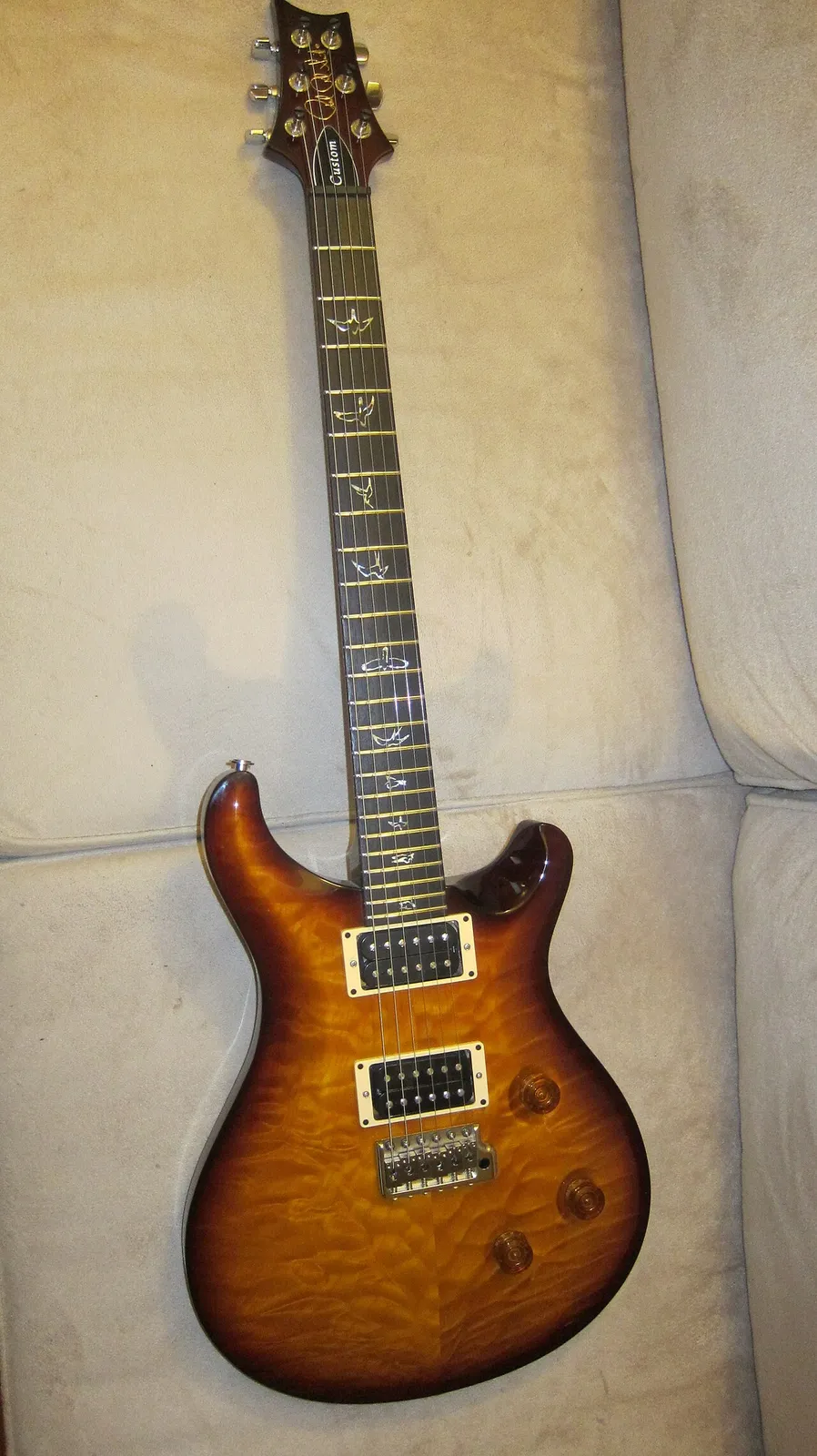
The rest follows the same thinking. A carved maple top on a mahogany back, the way a Les Paul does it. A mahogany neck glued in, with a rosewood board. Twenty-four frets, so two full octaves. Bird inlays, which became the thing you recognize a PRS by from across a room. And Smith’s own tremolo, patented in 1984.
It isn’t a Gibson and it isn’t a Fender. That was the point.
A3
The knob you had to look up
The original Custom had a five-position rotary knob instead of a switch, running through humbucker and split-coil sounds, plus a little tone-filter toggle called the “sweet switch.” It was clever, and it was also the kind of control you had to look up. In 2011 PRS replaced it with a five-way blade, like everybody else.
The name changed too. When the 22-fret Custom 22 arrived in 1993, the original became the Custom 24. Same guitar. Early ads just say Custom. A stoptail version showed up that year as well.
The pickups have rotated through the decades, from the original Standard Treble and Bass to the 85/15s to the DMOs that arrived for the 40th anniversary in 2025. So when somebody says they love the sound of a Custom 24, ask them what year.
Flip the record · By the numbers
25"
Scale length, set on purpose between Gibson’s and Fender’s.
$1,490
What one early Custom cost, with case, on a March 1985 invoice.
~400
Set-neck PRS guitars built in 1985. Every set-neck model, not just Customs.
1,000
Signature Series guitars made between 1986 and 1990.
Side B
B1
Santana plays PRS. That’s a different sentence.
The most common mistake about this guitar is hanging it on Carlos Santana. Santana was a Smith customer before the factory, and he has had his own Santana models since 1995. Those have a shorter scale, a fatter neck, and their own body and headstock. “Santana plays PRS” is true. “Santana plays a Custom 24” is not.
The same goes for some records people assume. Mikael Åkerfeldt made Opeth’s Blackwater Park on a second-hand CE 24, the bolt-on model, and used a blue late-’80s Custom 24 later on. Brad Delson’s first PRS, the one he’s pretty certain is on “One Step Closer,” was a CE 24 too.
Ted Nugent and Al Di Meola get called the Custom’s earliest adopters. They were also Smith clients before the factory, so exactly when they got a production Custom depends who you ask.
B2
Still on the same drawing
The factory moved to Stevensville, Maryland, in 1996, and it’s been building Custom 24s there ever since. The model has been in continuous production since 1985. The current one has a violin-carved maple top, a mahogany back, a 25-inch scale, twenty-four frets, birds, and a Smith tremolo. Apart from the switch and the pickups, set it next to the 1985 recipe and you’ll have trouble finding much to argue about.
The names on it now come from a different world than the pre-factory clients. Mike Einziger of Incubus. Mike Shinoda and Brad Delson of Linkin Park. Nolly Getgood and Mark Holcomb of Periphery. Ryan Knight of the Black Dahlia Murder.
Santana, Frampton, and Di Meola got theirs one at a time, from Smith’s own hands. Everybody else has been getting the same guitar off the same drawing for forty years.
The cast
The people, and the specific guitars, that made the legend.
1980
Carlos Santana
Pre-factory Smiths, then his own models
A Smith customer from before the factory existed. His guitars are their own family, not Custom 24s.
1970s
Al Di Meola
A mid-’70s custom 12-string
One of Smith’s earliest clients, and counted among the Custom’s early adopters. The timeline depends who you ask.
1980s
Ted Nugent
Early Smith guitars
Named among the Custom 24’s first adopters. He was a pre-factory client too.
Mike Einziger
PRS
Incubus. Named among Custom 24 players. Seeing him with a PRS is what sent Brad Delson to one.
Mike Shinoda & Brad Delson
Custom 24s
Linkin Park, both named as Custom 24 users. Delson’s first PRS, the one he’s pretty certain is on “One Step Closer,” was a CE 24.
Mikael Åkerfeldt
Late-’80s blue Custom 24
A later studio tool for the Opeth frontman. The guitar on Blackwater Park is a CE 24.
Liner notes
Specs, construction, rarity, value, and every source we used.
Smith’s first factory guitar is still a Stevensville Core: 24 frets, 25" scale, carved maple, birds. It is not a Santana, and it is not an SE.
- Body
- Solidbody; maple top with violin carve; mahogany back. Optional 10-Top
- Neck
- Set one-piece mahogany; Pattern Thin; PRS double-acting truss rod
- Fingerboard
- Rosewood, 10" radius, 24 frets, bird inlays
- Scale
- 25"
- Pickups
- PRS DMO treble and bass humbuckers
- Hardware
- PRS patented tremolo Gen III; Phase III locking tuners with wing buttons; nickel (hybrid on 10-Tops)
- Electronics
- Volume, tone, 5-way blade
- Finish
- High-gloss nitrocellulose
- Nut
- PRS nut, 1 11/16"; body end 2 1/4"
Open the full research fileConstruction details, the complete player record, production numbers, dated value estimates, and sources
Current US Core spec (2025/2026 catalog; January 2025 40th-anniversary update). 1985 Customs used a 5-position rotary and a “sweet switch.” DMO pickups are 2025, not the 1990s–2010s voice.
Construction
Paul Reed Smith’s first factory production model, introduced 1985 as the Custom. It became Custom 24 after the 22-fret Custom 22 appeared in 1993. Early ads say Custom. Same guitar, later name.
The recipe that stuck: 25" scale — Smith put it midway between Gibson’s ~24.75" and Fender’s 25.5" — carved maple top, mahogany back, set mahogany neck, rosewood board, 24 frets, bird inlays, and a PRS-patented tremolo (patent 1984). Continuous US production since 1985.
Current Core instruments are built in Stevensville, Maryland. The factory moved there in 1996 from Annapolis. Both are Maryland. Do not write “Annapolis-made” for a guitar leaving the line now.
The January 2025 40th-anniversary spec update put DMO (Dynamic, Musical, Open) humbuckers on the Core Custom 24. PRS describes them as more modern, open, and vocal than vintage-PAF voicings. They are not “the” Custom 24 pickup. Generations have rotated — Standard Treble/Bass, later 85/15, now DMO. Ask the year before you assume the sound.
Electronics today are volume, tone, and a 5-way blade. The original 5-position rotary (humbucker and split-coil sounds) plus a “sweet switch” tone-filter toggle is the historical circuit. The blade replaced the rotary in 2011. Stoptail option from 1993. Floyd Rose and piezo variants exist as Custom 24 sub-models, not the base guitar.
Pattern Thin neck: depth ~53/64" at the 1/2 fret, ~57/64" at the 12 1/2 fret. Inlaid signature headstock logo; “Custom” truss-rod cover. High-gloss nitro. Hardshell case. PRS Signature 10–46 strings. 10-Top is the extra-charge figured-maple option — deeper, more consistent figure — usually with hybrid hardware.
Three things this page is not.
SE Custom 24 is imported (Korea historically; Indonesia/China later). Maple veneer over a beveled top, maple “Wide Thin” neck, 85/15 “S” pickups, molded tremolo. Same silhouette. Not the same guitar. Street around $850. Do not use SE figures as Core comps.
S2 Custom 24 is Stevensville, faster line, flatter/beveled top, mixed US/import parts. Mid-price US. Not Core.
Santana signatures use a 24.5" (or earlier 24.25") scale, a Wide Fat neck, and different body/headstock DNA. Santana’s relationship with Smith predates the factory Custom. “Santana plays PRS” is not “Santana’s guitar is a Custom 24.” That collapse is a persistent encyclopedia error. Don’t repeat it.
Classic 1985 production started at Virginia Avenue, Annapolis. Full line August 1985; some customer-order Customs earlier that year. Original recipe: 25" scale, mahogany neck / rosewood board, mahogany back, maple top, patented tremolo, 5-position rotary, sweet switch. Early locking tuners on documented pre-production were Schaller-related. Original street with case: $1,490, from one documented March 1985 invoice (Premier Guitar Vintage Vault). Pre-1991 Brazilian-rosewood boards are a collector distinction (Guitar World 40th-anniversary feature). Those are not current spec.
Players
Do not default Carlos Santana to Custom 24. He commissioned pre-factory maple-top PRS guitars from 1980 and has had dedicated Santana models since 1995. Separate family. Peter Frampton and Howard Leese were pre-factory clients too (Premier Guitar). Same rule: pre-factory Smith is not a factory Custom 24. SE and S2 Custom 24s are not Core.
Do not default Mikael Åkerfeldt (Opeth) to Custom 24 either. Guitar World (Gill, 2020): a second-hand black CE 24 is the guitar on all of Blackwater Park (2001), including “Bleak.” That record is not a Custom 24 credit. The same interview then names a late-’80s blue Custom 24 and a black quilted-top Custom 24 as later studio tools — not the Blackwater Park guitar, and not a reason to list him as a Custom 24 default. Do not collapse CE 24 onto this page.
Sourced to Custom 24, or to the 1985 production Custom later so named:
Guitar World’s 40th-anniversary list (Chris Gill, 28 May 2025) names Mike Einziger (Incubus); Mike Shinoda and Brad Delson (Linkin Park); Adam “Nolly” Getgood and Mark Holcomb (Periphery); Ryan Knight (The Black Dahlia Murder) as Custom 24 users. The 2020 Gill feature is more precise for Delson: his first PRS was a blue CE 24, which he is “pretty certain” he used on “One Step Closer” from Hybrid Theory (2000), inspired by seeing Einziger with a PRS. Do not file Hybrid Theory as a Custom 24 record. Einziger is named as a PRS player in that interview, not specifically a Core Custom 24. Getgood, Holcomb, and Knight: known-to-play; no named instrument or track in that piece.
Ted Nugent and Al Di Meola: Guitar World 2025 calls them some of the Custom 24’s earliest adopters. Premier Guitar and the 2020 Gill feature document both as pre-factory Smith clients (Di Meola’s mid-1970s custom 12-string; later a Custom Singlecut Trem on Opus). Treat as early Smith/Custom-era players, not as proof they toured a 1985 factory Custom 24 specifically. The sources disagree on the timeline. Keep both.
Mark Tremonti’s signature is a singlecut. John Mayer’s is the Silver Sky. David Grissom’s DGT is a different Core model. None of those are this guitar.
Do not attach the unattributed “I’ve been playing PRS Custom 24’s since 1985…” quote on the current PRS product page to a named player.
Rarity
Not rare. Flagship. Continuous US production since 1985. SE/S2 volume is much higher and should not be used to judge Core rarity. Scarcity is 10-Top / Artist Package / Wood Library / Private Stock, not the shape.
1985 set-neck serials span about 0001–0400 — ~400 instruments, all set-neck models that year, not Custom 24-only (PRS serial table via Lovies). Later years mix Custom 24 with other set-necks. Do not treat the table as Custom 24 production.
Signature Series (1986–1990): 1,000 made. 2003 Brazilian Series Custom 24: 500. PRS does not publish 10-Top vs Core vs Artist vs Private Stock annual splits. Factory Custom 24 unit counts unpublished. None invented.
Value
Informal estimate, 25 August 2026. Not an appraisal.
Early PRS 2024–26 public sold ladders are thin. Prefer labeled asks over invented medians.
New street (US Core Custom 24). About $4,690 typical Core finishes; about $5,490 for 10-Top (Sweetwater, 2025 Core examples). Do not confuse with SE Custom 24 (~$849 Sweetwater). S2 is not Core.
Used modern Core. Sold confirmation thin. Asking examples: a 2024 Core Custom 24 demo $3,000 asking (Reverb); Guitar Center used 2020 Custom 24 35th Anniversary 10-Top asking $2,850. Treat used player-grade Core as typically well below current street, often high-$2,000s to low-$3,000s asking. A clean published Reverb sold band for ordinary Core Custom 24 did not extract. Gear-book.app’s “£2254 avg used Custom 24” sits in SE/import territory and likely mixes series. Unusable for Core.
Vintage / limited / collectible. Early 1985–90 Core / Signature Series: no reliable 2024–26 sold sample. Do not invent a band. Premier Guitar Vintage Vault states $7,500 excellent/all-original for one March 1985 pre-production Custom — article value, not a 2026 auction result. Original invoice on that guitar: $1,490. Wood Library Artist Package Custom 24 Piezo dealer example asking $7,650 (Wild West, 2024). Private Stock Custom 24-08 Reverb solds (not asks): $7,000 (29 May 2025), $9,050 (30 Sep 2025), $8,000 (12 Oct 2025), $9,500 (16 Mar 2026). 2003 Brazilian Series (500) and 1980s Signature (1,000): thin public sold data.
See also
- prs-ce-24 — bolt-on Core; Blackwater Park and Delson’s Hybrid Theory CE live there
- gibson-les-paul-standard — carved maple/mahogany dual-humbucker from the other American factory
- ibanez-jem — the other 24-fret production guitar players actually buy
- fender-stratocaster — the 25.5" pole Smith split the difference with
Sources
- PRS Custom 24 — current Core construction
- PRS Custom 24 2025 — same spec; DMO copy
- PRS 40th-anniversary Core update — Jan 2025 DMO; Stevensville
- PRS Core buyer’s guide — Core vs other series; violin carve; Gen III
- SE Custom 24 — different guitar
- Premier Guitar Vintage Vault, 1985 Custom — origin, rotary + sweet switch, $1,490 / $7,500, pre-factory clients
- Guitar World, 40 years of the Custom 24 — continuous production; 2011 blade; 1993 stoptail; Brazilian pre-1991; named players
- Sweetwater PRS Custom 24 — street ~$4,690 / $5,490 (Aug 2026 snippet)
- Lovies Guitars, PRS serial / model history — 1985 set-neck serials ~400, all set-necks
- Reverb, PRS Custom 24-08 Private Stock — sold table $7,000–$9,500
- Guitar Center, used PRS — 35th Anniversary 10-Top ask $2,850
- Wild West, WL Artist Package Custom 24 Piezo — ask $7,650
- Guitar World, 35 PRS guitarists (Gill 2020) — Åkerfeldt CE 24 vs later Custom 24s; Delson CE 24 / Hybrid Theory
- Guitar World / Reverb RPI on PRS used value — brand-level stability
- guitarprice.net PRS — aggregator Core band $4k–$6k+
Keep digging
Guitars this one gets compared to, confused with, or descended from.
- Send a picture
PRS
CE 24
1988
PRS meant it to be the cheaper, quicker one. Then a second-hand black one made Opeth’s Blackwater Park.

2006 Gibson Les Paul Standard (SN 000660573). Photo by wetwebwork. Licensed under CC BY-SA 2.0. Via Wikimedia Commons. Gibson
Les Paul Standard
1952
Gibson made about 1,500 sunburst Les Pauls, decided nobody wanted them, and stopped. Then the British blues boom happened.
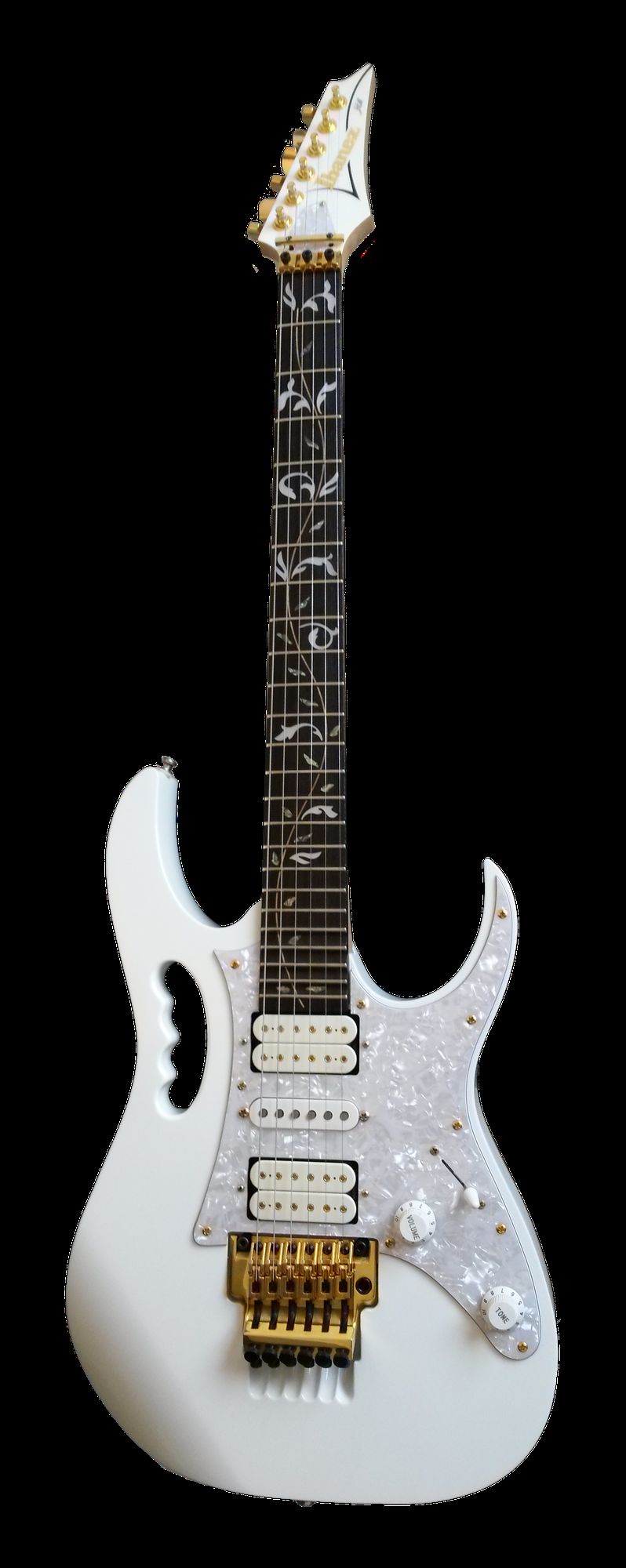
Ibanez Jem 7VWH vertical. Photo by Rachmaninoff; upright derivative by GreyCat. Licensed under CC BY-SA 4.0. Via Wikimedia Commons. Ibanez
JEM
1987
Steve Vai wanted a handle through the body and a finish that matched his curtains. Ibanez put it in the catalog.