Roland
G-707
Roland bent a guitar into a strange shape so a machine could hear it. Then the machine learned to hear any guitar.
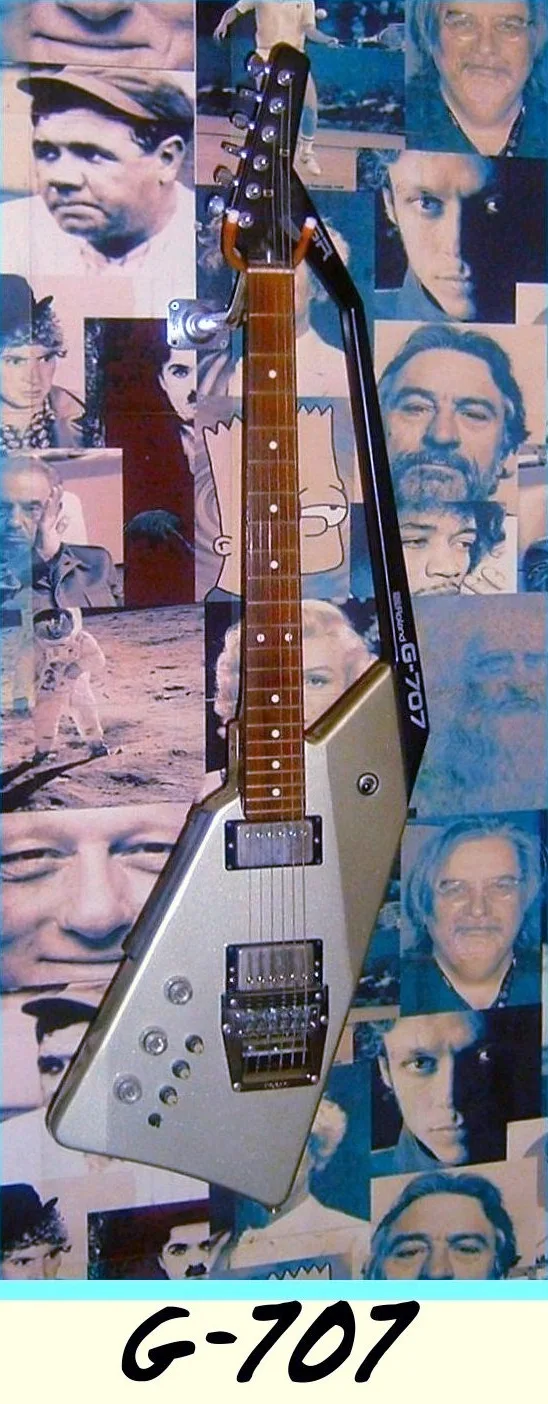
In 1984 Roland launched a synthesizer for the floor and a guitar built to drive it, with a bar bolted over the neck and a body like nothing else on the wall. Steve Stevens took one home, Jimmy Page had serial 01, and within three years Roland had stopped making guitars like it.
- Introduced
- 1984
- Type
- Solidbody electric (guitar-synthesizer controller)
- Class
- Production
The short version
1977
The first try
Roland’s GR-500 and GS-500 start the guitar-synth line. The controllers after it still look like guitars.
1983
Before the catalog
A pre-production G-707 is dated 7 October. Jimmy Page owns it. Some lists start the model this year.
1984
Launch
The G-707 and the GR-700 floor unit arrive together, shown at the Anaheim NAMM. The guitar is $1,150 with a case.
1985
The bass
The G-77 puts the same bar on a bass, for its own floor unit.
1986
Whiplash Smile
Steve Stevens uses his on Billy Idol’s record. Production ends around now.
1987
Goodbye to Roland guitars
The GK-1 pickup and GM-70 let any guitar talk to a synth. Roland stops building dedicated controllers.
Side A
A1
A closed room at Roland
Steve Stevens was in Japan promoting Rebel Yell with Billy Idol when Roland took him into a closed room and showed him a guitar and a box for the floor.
He could take it home, they said, if it went in the next video. The next video was “Flesh for Fantasy.” He played it on the Rebel Yell tour after that, and on Whiplash Smile in 1986. He believes he was the first player in the U.S. to have one.
Years later, this is how he described it.
“It had that long bar going across the top.”
A2
The bar
Everything strange about the G-707 is there so a machine could listen.
A guitar synth has to work out which note you’re playing from a vibrating string. It wants the fundamental, the plain note. A dead spot on the neck hands it harmonics instead, and the box guesses. Roland’s cure was a stabilizer bar running from the headstock to the upper bout, over the top of the neck, and a body that wouldn’t ring like an ordinary solid.
What that bar is made of, nobody agrees. One Roland piece says FRP plastic. A 1984 spec sheet says expanded ABS resin. Another says a synthetic material. Later writers say carbon fiber, or graphite. The bar is right there in your hand and it still has five names.
The body is an offset wedge, silver, red, or black. One reviewer called it “the cubist flymo” and “the dalek’s handbag.” He also found it more predictable than the more conventional Roland he A/B’d it against, which was the whole idea.
A3
Still a guitar underneath
Plug the regular jack in and it’s a guitar. Two humbuckers, a 3-way, volume and tone. A roller tremolo on sixteen-millimeter ball-bearing pivots with brass rollers, which Roland was very proud of.
The other half is a divided pickup at the bridge that reads each string on its own, and a 24-pin cable to the GR-700. That box was essentially a Roland JX-3P keyboard synth for the floor: six voices, 64 programs, MIDI out. On the guitar you get a cutoff knob, a resonance knob, a balance between guitar and synth, LFO depth, a mode switch, and two touch plates.
The guitar was $1,150 with a case at launch, and the GR-700 was another $1,995. Another list puts the guitar at $995. Keep both.
Flip the record · By the numbers
$1,150
The G-707 with a case, at launch. Another list says $995.
$1,995
The GR-700 floor unit it was built to drive. Sold separately.
64
Programs in the GR-700, a six-voice synth for your feet.
5
Words the sources use for what the bar is made of. Roland never settled on one.
Side B
B1
October 1983
It shows up in two years. The catalog launch is 1984, at the Anaheim NAMM. But a pre-production guitar, serial 01, is dated 7 October 1983, and Jimmy Page owned and played it. Page was on the cover of Roland’s user magazine in 1984.
Stevens’s dates wobble too. Another interview puts that closed room in 1982 and called his guitar a prototype, not yet on sale in the U.S. A prototype in a back room isn’t quite a catalog guitar, and he doesn’t give a serial. Keep both stories.
The catch was built into the box. The GR-700 would run off any earlier Roland controller except the very first. A lot of players skipped the wedge and kept the guitar they already had.
The bar can be right and still be in the way.
B2
Nightmare, then everybody
Glenn Tipton of Judas Priest had a silver one and added a Kahler. Live “was a nightmare,” he said. You had to learn not to glitch it.
“We were initially criticized for using it... then everybody started playing them.”
Jan Akkerman was photographed with one in the Netherlands in 1984. Wendy Melvoin is reported to have played one with Prince, in the “Girls & Boys” video and on stage, in paisley by the Parade tour, though that comes from one book read secondhand.
Be careful with the famous names. Andy Summers on “Don’t Stand So Close to Me” is an earlier Roland, a G-808. So is the controller Pat Metheny is known for. Neither is this guitar.
B3
The long bar
The ending was already in the box. In 1987 Roland put out the GK-1, a pickup you could fit to any guitar, and the GM-70 to go with it. One writer called it goodbye to Roland guitars, and it was. Other than some specials by Gibson and Steinberger, the dedicated Roland guitar was done.
Roland had bent a guitar into a cubist wedge so a machine could hear one clean note. Three years later the machine could hear the guitar you already owned.
Stevens still has his, in a storage locker. Ask him about it, and he’ll tell you about the bar.
Put this on
You’ve read about it. Now hear it. Here’s what this guitar sounds like, and what to listen for.
Flesh for Fantasy (video)
Steve Stevens got to take the G-707 home on one condition, that it went in the next video. This is the video. Watch for the bar over the neck.
Watch it on YouTube (opens in a new tab)Whiplash Smile
Stevens says he used his G-707 on this record. No track list comes with that, so listen for the synth-guitar parts across the album rather than one song.
Find it on YouTube (opens in a new tab)
The cast
The people, and the specific guitars, that made the legend.
Steve Stevens
G-707, possibly a prototype
Of Billy Idol’s band. Played it in “Flesh for Fantasy,” on the Rebel Yell tour, and on Whiplash Smile. He believes his was the first in the U.S. It’s in a storage locker now.
1983
Jimmy Page
Pre-production G-707, serial 01, dated October 1983
Owned and played it, and was on the cover of Roland’s user magazine with the system in 1984.
Glenn Tipton
Silver G-707 with an added Kahler
Of Judas Priest. Live, he said, “was a nightmare.” Then: “everybody started playing them.”
Wendy Melvoin
G-707, paisley by the Parade tour
With Prince and the Revolution, in the “Girls & Boys” video and live. That comes from one book, read secondhand, not a studio log.
1984
Jan Akkerman
G-707
Photographed with one in the Netherlands in 1984. A picture, not a discography.
Liner notes
Specs, construction, rarity, value, and every source we used.
A bar over the neck, so a synth could hear one note — Roland’s G-707, not the floor unit.
- Body
- Offset wedge. Roland copy: alder. Joness’s sheet: ash. Mix flagged.
- Neck
- Bolt-on maple, detachable. Stabilizer from headstock to the upper bout.
- Fingerboard
- Rosewood, 22 frets, dot inlays
- Scale
- 25 1/2" on Joness’s sheet. Unpublished in the brochure copy fetched this pass.
- Pickups
- Two Roland humbuckers, plus a divided pickup at the bridge for the synth
- Hardware
- Roland roller tremolo; sixteen-millimeter ball-bearing pivots and brass rollers (Roland Users Group). Gotoh 6-in-line (Joness).
- Electronics
- Master volume, guitar tone, 3-way, balance, cutoff, edit/resonance, LFO depth, mode I/II/III, two touch plates. 24-pin to a GR unit; 1/4" guitar out.
- Finish
- Acrylic. Catalog colors silver, red, black.
- Nut
- Polycarbonate (Joness). Width unpublished on the factory copy.
Open the full research fileConstruction details, the complete player record, production numbers, dated value estimates, and sources
Classic living example = 1984–86 Japan G-707, the controller drawn for the GR-700. No current typical SKU this pass. Once a hex pickup could bolt onto a guitar you already played, Roland stopped shipping dedicated controllers (Sound on Sound; Guitar Player, August 1987, on the GK-1 / GM-70). Joness’s sheet is in inches. The brochure bearing is sixteen-millimeter. Mix flagged. Do not convert. Nut width is measured, not factory: Chicago Music Exchange 1-11/16" on a modified example; ATB 40.5 mm; Joness prints neck width 1 5/8". Blue Book prints a reverse headstock; Joness prints 6-in-line and does not. G-77 is the bass. G-202 / G-303 / G-505 / G-808 also drive a GR-700. No Gibson SKUs.
Construction
The job was a guitar a pitch-to-voltage box could trust. Roland had been at it since the GR-500 and GS-500 in 1977 (Dave Hunter, Guitar Player, 9 June 2022; Norm Leete, Sound on Sound, August 1999). FujiGen then built controllers that still looked like guitars: Strat-like G-505, set-neck G-303, neck-through G-808, bolt-neck G-202 (Hunter). This one does not look like those.
The launch is 1984. Roland UK, Electronic Soundmaker, June 1984: they are launching the controller and the module together. Steve Hunter, International Musician, February 1985: he first saw the system at the 1984 Anaheim NAMM. Leete and Hunter’s 2022 piece both put the pairing in 1984. Roland Users Group, Volume 2, Number 3: suggested retail $1,150 with a case; the GR-700 at $1,995.
Earlier than the catalog. Julien’s, 6 December 2013: a pre-production G-707, serial 01, dated 83-10-7, owned and played by Jimmy Page. Blue Book prints manufacture 1983–86 and an introduction in 1983, package $2,995 ($995 controller, $1,995 floor unit). Keep 1983 and 1984. Keep $995 and $1,150. This plate starts at the 1984 launch. October 1983 is the door, not a second slug.
The bar is why the body is strange. A guitar synth wants the fundamental. Dead spots hand it harmonics and the module guesses (Roland UK). The cure they print is a tie-bar over the neck, and a body that does not vibrate like an ordinary solid. What the bar is made of, they do not say once. Users Group: “a new FRP plastic stabilizer bar.” The spec block Bill Hillman reprints, headed GR-700 (1984): “expanded ABS resins,” maple neck, rosewood board, alder body. Roland UK: alder, maple, the tie-bar “a synthetic material.” Leete: ABS resin. Hunter in 2022 writes carbon-fiber. Blue Book writes graphite. Keep the factory words. Do not pick one and bury the rest.
The tremolo is the other boast. Users Group: sixteen-millimeter ball-bearing pivots, brass rollers. Hillman’s reprint: the same bearings on the pivots and the roller bridges. Steve Hunter is not convinced a bar screwed into a bolt-on is stiffer than a neck-through. He still prints $1,150 with the case and $1,995 for the floor unit.
Under that shape it is still a guitar. Two humbuckers, a divided pickup, a phone jack that is only the guitar. Joness: this electronics package dropped the hex-fuzz option of the G-202 / G-303 / G-505 / G-808. Cutoff, an edit pot that is resonance until you are editing, balance, LFO depth, a mode switch, two touch plates. The GR-700 is a JX-3P for the floor — six voices, two DCOs each, 64 programs, MIDI out (Roland UK; Leete; Hunter 2022). MIDI, Leete notes, sits on channel 1 and does not send pitch-bend. The PG-200 is the same programmer as the keyboard, £210 in that June 1984 feature. Any earlier controller except the GS-500 will run a GR-700 (Leete; Hunter 2022). A lot of players kept the guitar they already had.
Not the G-77. Same bar, a bass, new in International Musician, November 1985, for the GR-77B. Not a Steinberger GL with a Roland card (steinberger-gl). Not a Gibson with an LPK kit. Leete: after this, the dedicated Roland guitar was done, “other than some specials by Gibson and Steinberger.” Warren Sirota, Guitar Player, August 1987: the GK-1 and GM-70 said goodbye to Roland guitars. FujiGen is Hillman’s identification of his own G-707, and the shop Joness files the earlier controllers under. No Gibson SKUs.
Joness’s sheet — the block dealers copy — prints ash, acrylic silver/red/black, polycarbonate nut, Gotoh 6-in-line, 25 1/2", 22 frets, body 9" wide and 1 3/4" deep, overall 39 1/2", 8 lb 12 oz. The brochure copy fetched this pass prints alder and does not print scale, nut width, or that weight. A pewter auction guitar (Gardiner Houlgate) is not the three-color line. You play it on a strap. Leete’s nicknames, for the look: “the cubist flymo” and “the dalek’s handbag.” He also A/B’d one against his G-808 and found the G-707 more predictable. The bar can be right and still be in the way.
Classic vs current: a 1984 wedge, bar, two humbuckers, divided pickup, roller tremolo, $1,150 with the case — against nothing you can order new, and against a GK pickup on somebody else’s guitar.
Players
Do not hang a GR-300 or a G-808 here. Andy Summers’s “Don’t Stand So Close to Me” is a G-808 and a GR-300 (Joness’s headnote to Roland Users Group, Volume 2, Number 2). Pat Metheny’s famous controller is a G-808; the Whistle Test clip Joness files is a G-303. Steve Howe’s 1984 Users Group profile is a G-505. Death Wish II is 1982. This guitar was not in the shops. Do not put that soundtrack on serial 01.
Steve Stevens (Billy Idol). The one a player can name. Guitar Player, 7 May 2025: promoting Rebel Yell in Japan, a closed room at Roland, controller and floor unit. He would take it home if it went in the next video. That video is “Flesh for Fantasy.” He believes he was first to have one in the U.S., used it on the Rebel Yell tour, and on Whiplash Smile (1986). It is in a storage locker. “It had that long bar going across the top.” Same piece, a Redferns frame: Stevens with one, Billy Idol, 12 April 1987. Australian Musician (Greg Phillips, June 2013) puts that room in 1982 and calls it a prototype, “not available in the United States yet,” used only in the video. Keep 1982 and the Rebel Yell trip. A prototype in a closed room is not a 1984 catalog guitar, and he does not give a serial.
Jimmy Page. The pre-production guitar. Julien’s: serial 01, 7 October 1983, “owned and played,” with Users Group Volume 2, Number 3, 1984, Page on the cover. Joness files a 1985 ad of the rig. Hunter (2022) puts him on the G-707/GR-700. The Les Paul, the EDS-1275, and the Danelectro stay on their own plates.
Glenn Tipton (Judas Priest). His own site: “I’ve got a silver Roland G-707 guitar synth with an added Kahler.” Live “was a nightmare.” Wind in some straight guitar. Learn not to glitch. “We were initially criticized for using it... then everybody started playing them.” Nostradamus synth-guitar work is a Godin LGXT. His note on the “Turbo Lover” video says a guitar synthesizer and does not name this silver one. Joness ties Priest to a GR-700 patch. The floor unit is not the body.
Wendy Melvoin, and Prince. Guitarcloud, citing Ro Ronin, Prince: Inside the Music and the Masks: a G-707, paisley by the Parade tour, Wendy in the “Girls & Boys” video and live. The same page hears the synth-lead “duck” on “Girls & Boys,” “Sexual Suicide,” and “Anotherloverholenyohead,” puts the system in the Parade sessions, and reports Prince on it for Sign o’ the Times. That is Guitarcloud’s reading of the book, not a studio log in hand.
Jan Akkerman. Hunter (2022) captions a Redferns frame: the Netherlands, 1984, a G-707. A photograph, not a discography.
Also known to play stays last and short. Hunter (2022) adds John Abercrombie, Robert Fripp, Al Di Meola, and Jim Stafford on The Tonight Show, “partly for comic effect,” all under “G-707/GR-700.” The slash matters. A GR-700 credit is not this wedge. A 2015 VGuitar post points at a 1985 Gateway clip of Abercrombie on one. No other named instruments invented for that list.
Rarity
You cannot buy a new G-707. Blue Book’s 1983–86 and Synth DB’s 1984–1986 are the published spans. Roland does not print a unit total. None invented. Serials date a guitar. They do not count a year. That is why a first-year census is unknown, not the chapter.
What is thinner: the October 1983 pre-production, Page’s 01 among them; a left-handed guitar, if the run-on brochure line Hillman reprints (“Left-handed Model available”) was built in any number; a complete 24-pin cable, which Joness treats as the part you cannot replace. Silver, red, and black are the catalog three. The G-77 is another bass. Page’s 01 and Stevens’s locker guitar are unique. They are not a vintage G-707.
Value
Informal estimate, 15 October 2026. Not an appraisal.
Ask vs sold labeled. Celebrity lots are not-comps. No invented medians or factory counts. A guitar alone and a guitar plus a working GR-700 are different objects. Do not average them. Period $1,150 with case (Users Group; Steve Hunter, February 1985) and Blue Book’s $995 / package $2,995 are 1980s list, not 2026 street. The floor unit at $1,995 is not this table.
New street. None.
Used modern. No later production to split off. A 13-pin conversion is a modified guitar, not a second market.
Vintage / collectible. Reverb Price Guide, this pass, Good to Mint, all models: $766–$2,057 on 79 orders. Reverb’s range, not a median computed here. Flag: thin sold-comp access on clean 2026 hammers. Named asks, not hammers: Guitar Center Springfield, guitar plus module, used good, $1,699.99 (was $2,699.99); Replay Guitars, silver pair, $2,962; a 1984 silver pair on the Reverb guide page, $2,511.22; Paul’s Boutique, Toronto, pair $3,760, listed about six months before this pass. A modified 1985 at $1,200 (from $1,500), Steinberger tuners and swapped pickups, is not stock.
Named older hammers, not a 2026 series: Gardiner Houlgate, 4 December 2024, a 1984 controller with replacement Seymour Duncans, £800 (estimate £700–£900). Omega, 12 September 2023, serial 442472 with the GR-700, £670. Julien’s, 6 December 2013, Page’s 01, $16,640. Celebrity. Not a comp.
See also
- steinberger-gl — a headless paddle that also took a Roland GR card; not this wedge
- godin-multiac — the later guitar-synth controller still made for the job; 13-pin, not a 24-pin G-707
- parker-fly — another odd solid of the synth years; Joni Mitchell’s Concert had a Roland hex, not a stabilizer bar
Sources
- Roland UK, “The Guitar Link,” *Electronic Soundmaker*, June 1984 — launch; alder, maple, synthetic tie-bar; dead spots; JX-3P / GR-700; 64 programs; PG-200 £210; interchangeable with earlier controllers
- Roland Users Group, Vol. 2 No. 3, via Joness — FRP plastic stabilizer; sixteen-millimeter ball-bearing pivots; brass rollers; G-707 $1,150 with case; GR-700 $1,995
- Hillman, reprinting the 1984 GR-700 spec block — FujiGen on his guitar; expanded ABS; alder, maple, rosewood, 22 frets, detachable neck; silver/red/black; humbuckers × 2; divided pickup; 16-millimeter bearings; “Left-handed Model available” in the run-on list
- Wayne Joness, G-707 — 1984; FujiGen on the earlier line; ash on his sheet; ABS bar; polycarbonate nut; Gotoh 6-in-line; 25 1/2"; 9" × 1 3/4"; 39 1/2"; 8 lb 12 oz; hex fuzz dropped; headnote that Summers’s “Don’t Stand So Close to Me” is G-808 / GR-300
- Sound on Sound, Norm Leete, August 1999 — 1984; ABS bar; “cubist flymo” / “dalek’s handbag”; more predictable than his G-808; JX-3P; MIDI channel 1, no pitch-bend; GS-500 excluded; Gibson and Steinberger specials after
- Steve Hunter, *International Musician*, February 1985, via Joness — 1984 Anaheim NAMM; $1,150 with case; GR-700 $1,995; bolt-on maple/rosewood; bar into headstock and upper bout
- Guitar Player, Dave Hunter, 9 June 2022 — 1984; carbon-fiber claim; earlier controllers also run a GR-700; Akkerman 1984; Abercrombie, Fripp, Di Meola, Page, Stafford; Metheny filed on the G-808
- Guitar Player, Steve Stevens, 7 May 2025 — Rebel Yell promo trip; “Flesh for Fantasy”; tour; Whiplash Smile; 12 April 1987; storage locker; the bar
- *Australian Musician*, Greg Phillips, June 2013 — Stevens: 1982 prototype, not yet on sale in the U.S., “Flesh for Fantasy”
- Julien’s Auctions, 6 December 2013, lot 353 — Page, serial 01, dated 83-10-7; Users Group cover; sold $16,640
- Glenn Tipton, guitar collection — silver G-707 with a Kahler; live glitching; later Godin LGXT on Nostradamus
- Guitarcloud, Roland G-707 — citing Ronin: Prince / Wendy; paisley; “Girls & Boys” video; Parade as Guitarcloud reads it
- Blue Book of Guitar Values, Roland G-707 — mfg. 1983–86; introduction dated 1983; package $2,995 ($995 + $1,995); graphite arm and reverse headstock, both contested above
- Synth DB, Roland G-707 — produced 1984–1986; 24-pin controller for the GR-700
- *International Musician*, “Shaping the Bass,” November 1985 — G-77 / GR-77B; not this guitar
- Reverb Price Guide, Roland G-707 — $766–$2,057, 79 orders, Good to Mint; 1984 silver pair shown at $2,511.22; modified 1985 shown at $1,200 (from $1,500)
- Guitar Center Springfield, 1984 pair — ask $1,699.99, was $2,699.99; guitar plus module
- Replay Guitars, silver G-707 and GR-700 — ask $2,962
- Reverb, Paul’s Boutique pair — ask $3,760, listed about six months before this pass
- Gardiner Houlgate, 4 December 2024 — hammer £800; replacement Seymour Duncans
- Omega Auctions, 12 September 2023, serial 442472 — sold £670 with the GR-700
- Chicago Music Exchange / Gbase, modified G-707 — nut 1-11/16"; scale 25 1/2"; radius 12"; 8 lb 8 oz; pickups and tremolo swapped
- ATB Guitars, one G-707 — nut 40.5 mm; weight 3.82 kg