 Guitaripedia
Taylor
GS Mini
Bob Taylor wanted a small guitar that didn't sound small. Tecate has built half a million.
Spring 2009. Taylor's small guitar had been the Baby for nearly fifteen years, and Bob Taylor wanted the next one louder and still a guitar you could throw in a bag. The answer was a Grand Symphony shrunk down, and built in Mexico.
- Introduced
- 2010
- Type
- Acoustic (travel)
- Class
- Production
Have a photograph of this guitar? Send a picture
The short version
1996
The Baby
Taylor's small guitar arrives. For years it's the only one.
2006
Grand Symphony
Taylor introduces the full-size shape the Mini would later scale down.
Spring 2009
Hot-rodding the Baby
Bob Taylor and David Judd try thin tops, longer scales, and hardly any bracing. They still sound like Babys.
April 2010
Before the shops
Damon Albarn is photographed playing his GS Mini at a Gorillaz show.
2010
In the shops
Unveiled that summer, in American stores in late July or in the autumn, depending who tells it.
2013
A pickup on board
The first GS Mini-e models arrive as limited editions.
2017
The bass
Andy Powers's GS Mini bass reaches dealers in February.
2024
500,000
Taylor marks half a million GS Minis, in the model's fourteenth year.
Side A
A1
Still sounded like Babys
Spring 2009. Bob Taylor and David Judd are trying to soup up a Baby Taylor. They make the tops paper-thin. They stretch the scale. They pull the bracing down to almost nothing.
They still sound like Babys.
The Baby had been Taylor's small guitar since 1996. Nearly fifteen years on, Bob wanted the next one louder. Not a bigger guitar. A small guitar that didn't sound small, and that still went in a bag.
A2
Shrink the good one
Larry Breedlove was on the same job, and he went at it from the other end. Bigger body. Deeper body. Longer scale. The Big Baby was already too close to a full-size guitar, so instead he took Taylor's own Grand Symphony, the shape the company had introduced in 2006, and scaled it down.
Once the outline stuck, so did the name. GS Mini.
The numbers are the guitar, so here are the ones that matter. The scale went from the Baby's 22-3/4" to 23-1/2". Bob says they tried a full-size scale too, and it didn't buy an improvement you could hear. That extra length is what lets the Mini sit in standard tuning on medium strings, instead of being strung high. The soundhole is 4", the full-size Taylor hole. And the neck, Taylor's patented joint, has a heel, where the Baby's doesn't. Bob's version: set the angle, ship it, and the heel gives it a stability the Baby never had.
The back is arched and has no braces at all, like the Baby's. The top is solid spruce. The back and sides are layered sapele, two thin veneers around a core, which is exactly what you want on a guitar that's going to live in an airport.
How deep is it? Depends who's holding the ruler. The story of how it was built says 4-1/8". The reviews that measured it, and Taylor's own page now, say 4-7/16". Either way it's deeper than a Baby by a long way, and deeper was the whole point.
A3
The overhead bin
The Mini was out in the world before it was in the shops.
In April 2010, Damon Albarn was photographed playing his at a Gorillaz show. That spring Bob Taylor carried one to Iraq on a USO trip with the Zac Brown Band, and wrote about putting it in the overhead bin. Taylor unveiled it officially that summer. The shops had it in late July, or in the autumn, depending which account you read. Both say 2010.
The suggested list was $678. The street price was $499. It was built in Tecate, Baja California, alongside the Baby, not in the California shop in El Cajon.
It came without a pickup. It came ready for one: an optional clip-in magnetic pickup that sat in the soundhole, $98 extra, with a special cable because the guitar had no volume knob. The built-in electrics came later, starting with limited GS Mini-e models in 2013.
Flip the record · By the numbers
23-1/2"
Scale length, against the Baby's 22-3/4"
500,000
GS Minis made by 2024, fourteen years in
$678
Suggested list in 2010. Shops sold it for $499
4"
Soundhole, the full-size Taylor hole. The Baby's is 3-1/2"
Side B
B1
Ten inches short
Then there's the bass, which shouldn't work.
Andy Powers, who wasn't at Taylor when the Mini was born, put a bass on the same 23-1/2" scale. A normal bass runs about 32 to 35 inches; even a short-scale is about 30. This one is roughly ten inches under a standard bass. Electric bass strings didn't work on it. Ukulele-bass strings didn't either. What worked was a set D'Addario made for it, nylon core wrapped in coated phosphor bronze, held in by two-pronged pins. It reached dealers in February 2017.
Slightly Stoopid's Miles Doughty has been pictured with a maple one. His bandmate Kyle McDonald, with a koa Mini. In 2024 Taylor filmed the band Creature Canyon playing "American Movie" on nothing but koa Minis and the koa bass. It's the maker's own video, so take it as a demonstration. It's still a whole band on travel guitars.
B2
Half a million
By 2020 Taylor was past 350,000 of them. In 2024, the Mini's fourteenth year, it passed 500,000.
The 500,000th is covered in signatures from the Tecate plant, about 300 of them out of the more than 400 people who work there, plus Bob Taylor, Kurt Listug, and Andy Powers. It's one of a kind. The other 499,999 are just GS Minis.
Andy Powers calls it "the people's guitar." The souped-up Babys of 2009 still sounded like Babys. This one didn't.
Albarn played one to a stadium. Bob Taylor put his in an overhead bin. Somewhere between those two places is where the rest of them live.
Put this on
You’ve read about it. Now hear it. Here’s what this guitar sounds like, and what to listen for.
American Movie
A performance Taylor made for its own channel, on a koa GS Mini-e, a Koa Plus, and the koa bass. The maker's video, not a record, but it's the Mini doing the whole band.
Watch it on YouTube (opens in a new tab)
The cast
The people, and the specific guitars, that made the legend.
2010
Bob Taylor
His own GS Mini
Took it to Iraq with the Zac Brown Band on a USO trip that spring, and wrote about the overhead bin.
2010
Damon Albarn
GS Mini
Photographed playing it at a Gorillaz show in April 2010, before it was in the shops. He has played one to a stadium.
2009–10
Larry Breedlove
Designer
Took the Baby bigger, deeper, and longer until it turned into a Grand Symphony.
2017
Andy Powers
GS Mini bass
Designed the bass on the same short scale, about ten inches under a standard bass.
Kyle McDonald
GS Mini Koa
Slightly Stoopid. Pictured with his in Taylor's magazine. No song is named.
Miles Doughty
GS Mini-e Maple Bass
Slightly Stoopid. Pictured with it in the same magazine story.
Liner notes
Specs, construction, rarity, value, and every source we used.
A 23-1/2-inch Grand Symphony from Tecate — deeper than a Baby Taylor, and not the full-size guitar the name borrows.
- Body
- Scaled Grand Symphony, no cutaway. Solid torrefied spruce top; layered sapele back and sides, 2-piece or 4-piece Simons wedge; matte; black pickguard; no binding, no armrest. Taylor’s shape page: 17-5/8" long, 14-3/8" wide, 4-7/16" deep, 8-3/4" at the waist. Staff (Josh M., 13 April 2026) repeats length, width, and depth. Soundhole 4" (Josh M., 7 April 2026).
- Neck
- Tropical mahogany, matte. Taylor Neck, the 1999 joint, with a heel — not the Baby’s heelless neck. Staff (Josh M., 26 August 2025): .840" at the first fret. He did not give a seventh-fret thickness.
- Fingerboard
- Ebony, 4 mm Italian acrylic dots, no binding. Radius 15" (Glen W., Taylor staff, 14 March 2025). Taylor.com’s spec tab does not print a fret count. Wood & Steel (summer 2010) gives 20 frets, against the Baby’s 19.
- Scale
- 23-1/2". Taylor.com prints inches only. Spanish Wood & Steel prints 597 mm for the 2010 scale. Guitar.com prints 597 mm (23.5 inches) on the bass.
- Pickups
- None on this guitar. The -e models use ES-B. Plus models use Expression System 2.
- Hardware
- Ebony bridge; NuBone nut; Micarta saddle; black pins; die-cast chrome tuners; D’Addario XS coated phosphor bronze medium, .013–.056. Gig bag. Spacing at the nut 1-7/16" (Josh M., 22 January 2026); at the bridge 2-3/16" (Josh M., 23 May 2025).
- Electronics
- None. Glen W. (17 April 2025): not every GS Mini has them.
- Finish
- Matte top, back, sides, and neck.
- Nut
- 1-11/16". Josh M. (9 July 2026): that is the only nut this model is built with. Not 1-3/4".
Open the full research fileConstruction details, the complete player record, production numbers, dated value estimates, and sources
Specs are for the current GS Mini on taylorguitars.com (UPC 00887766128151, $499, fetched 30 October 2026): torrefied spruce, layered sapele, no pickup, Tecate. The 2010 guitar was solid Sitka, a sapele neck, and a tortoise guard. A GS Mini-e, a bass, and the anniversary limited are other instruments under the name.
Construction
The Baby had been the small Taylor since 1996. After nearly fifteen years Bob Taylor wanted the next one louder, and still a bag guitar. Spring 2009, with David Judd, he hot-rodded the Baby: paper-thin tops, longer scales, braces that almost were not there. Wood & Steel (summer 2010, republished 2024): they still sounded like Babys. Larry Breedlove was on the same job. Bigger body, deeper body, longer scale. The outline they scaled was the Grand Symphony, Taylor’s own shape from 2006. The Big Baby was already too close to a full guitar.
The name stuck once that outline did. Summer 2010 Wood & Steel is the unveiling. Vintage Guitar and Premier Guitar, both 18 June 2010, put it in domestic shops in late July, suggested MSRP $678. Acoustic Guitar’s Scott Nygaard, October 2010, gives a street price of $499. MusicRadar (Dave Burrluck, 23 March 2011) says the American launch was the previous autumn, and that Britain had just got it at £499. Sources differ on the American shop month: late July, or autumn. Both are 2010. The spring 2009 instruments were experiments on a Baby. They are not a 2009 GS Mini.
Scale 23-1/2", up from the Baby’s 22-3/4". Bob says a full-size scale was tried and did not buy an audible improvement. Twenty frets to the Baby’s 19. Premier Guitar’s September 2010 review: the extra length is what lets it tune to standard instead of being high-strung. Medium strings. A 4" soundhole, the full-size Taylor hole; the Baby’s is 3-1/2". A patented Taylor neck with a heel. Bob: set the angle, ship it, and the heel is the stability the Baby’s heelless joint does not have. Layered sapele — two veneers around a core, in Colin Griffith’s 2021 Wood & Steel — solid Sitka, ebony board and bridge, an inlaid rosette, purfling, a tortoise guard, and, like the Baby, a braceless arched back. The top is X bracing: Josh M. of Taylor, 1 February 2024, answering a question about the Mini, and the current GS Mini-e Bass spec block, which prints “X Bracing.” Guitar Selection’s autumn 2013 note on the limited Japanese electrics prints “X Bracing w/Relief Rout.” That relief rout is not a line on the current sapele spec tab.
The inches are where the sources split.
Breedlove, in the 2010 story: body length from a 16" try to 17-5/8", against the Baby’s 15-3/4". Staff still prints 17-5/8". Width 14-3/8" is Nygaard in 2010 and the shape page now. Depth is not one figure. The 2010 story takes the body to 4-1/8", against the Baby’s 3-3/8", deeper than a Big Baby and nearly a Grand Concert. Premier Guitar, 2 September 2010, measures 4-7/16". Nygaard the next month says 4-7/16". The shape page and Josh M. (13 April 2026) print 4-7/16". Spanish Wood & Steel gives the 2010 story’s depth as 104.7 mm — the 4-1/8" number — and the body length as 44.76 cm. Overall length: Premier Guitar, 36-5/8"; Josh M. (30 May 2025 and 18 July 2025), 35-5/8". Spacing at the saddle: Nygaard, 2-1/4"; Josh M. in 2025, 2-3/16" at the bridge. Action, both Taylor staff, not the same number: Glen W. (17 April 2025), 6/64" bass and 4/64" treble at the 12th fret; Josh M. (16 September 2026), factory spec with little relief, 5.5/64" bass and 3.5/64" treble.
MusicRadar, in millimetres, sets the 2011 Mini against the full Grand Symphony: 51 mm off the scale, about 48 mm off the width, 86 mm off the overall length, 5 mm off the depth. The full steel-string scale, in the 2020 Wood & Steel recap, is 25-1/2". A Grand Concert is 24-7/8". This is neither of those.
Tecate, Baja California, from the 2010 debut (Wood & Steel, Jim Kirlin, 2024). Bo S. of Taylor, 26 June 2025, on the current sapele page: Tecate. MusicRadar in 2011 already had it in the Mexican factory with the Baby and the 100 and 200 Series. Kirlin’s plant is the 2014 building, 119,000 square feet, 43 miles from El Cajon. El Cajon is the California shop. This guitar is the other building.
The 2010 guitar was acoustic, pre-fitted for an optional ES-Go, a magnetic soundhole pickup you clipped in, plus a V-Cable because the guitar had no volume knob. Nygaard: the ES-Go was $98, separate. The -e comes later, and the accounts name different woods. GigGear (16 September 2013): new for 2013, limited, ES-T, quilted sapele, rosewood, or mahogany. Guitar Selection, the same autumn, lists rosewood and koa, also ES-T. Wood & Steel winter 2015, French edition: ES-T still on the rosewood Mini-e and on the koa, the koa “new for 2015” after a fall limited the year before. ES-B, in that issue, is the new Baby pickup, an ES2-style piezo with a preamp and a tuner. No year is given there for the six-string Mini’s move onto ES-B. Josh M. (26 July 2024): on the current Mini, ES-B is that behind-the-saddle pickup with a side-mounted 3-band preamp and tuner. Plus models use the upper-bout ES2 preamp.
The bass is Andy Powers’s, and he was not at Taylor in 2010. Wood & Steel: debut early 2017, dealers from February, 23-1/2" scale, 1-11/16" nut, solid Sitka, layered sapele, ebony, ES-B, matte, a hard bag. A normal bass scale, he says, runs about 32 to 35 inches, a short-scale about 30. This one is about ten inches under a standard bass. Electric bass strings and ukulele-bass strings were tried and failed. D’Addario’s set for it, and Taylor says the only set that works, is a nylon core with a coated phosphor-bronze wrap, held by dual-prong pins. Premier Guitar, 30 April 2017. Acoustic Guitar (Greg Olwell, August 2017): Mexico, MSRP $918, street $699. Guitar.com the same month: £827, 20 small nickel frets. The sapele guitar’s related rail, 30 October 2026, lists the GS Mini-e Bass at $899, and the current bass page prints a torrefied spruce top. A 2020 Wood & Steel caption also shows a GS Mini-e Maple Bass. That is not the spruce bass on the current page.
The living six-string is the $499 guitar in the specs above. Torrefied spruce where 2010 was Sitka. Tropical mahogany where Nygaard’s review guitar had a sapele neck. A black guard where 2010 copy said tortoise. No electronics on Taylor’s page, and no ES-Go. Alamo Music’s $499 listing still describes the clip-in pickup. The Acoustic Shoppe, 20 October 2026, still called the $499 top Sitka; Taylor.com and Manchester Music Mill’s 2026 card, same UPC, say torrefied. Mahogany tops, koa, rosewood, and the Plus models — ES2, and on the Koa Plus an AeroCase — are other orders.
Players
No GS Mini is famous by serial number. The credits that name the model are photographs and a maker’s video, not a session sheet.
Damon Albarn. Wood & Steel captions a photograph: Albarn playing his GS Mini at a Gorillaz show in April 2010. That is before the late-July dealer date in Vintage Guitar and Premier Guitar, so the guitar in the picture predates the shop arrival. Colin Griffith’s 2024 Wood & Steel piece says Albarn has played a Mini to a stadium. Neither names a song.
Slightly Stoopid. The 2020 “GS Mini Turns 10” story, republished 2024, captions Kyle McDonald with a GS Mini Koa and Miles Doughty with a GS Mini-e Maple Bass. A photograph in Taylor’s magazine. No song is named, and the maple bass is the instrument in that caption.
Creature Canyon. Taylor’s own video and blog (August 2024): the band plays “American Movie” on a GS Mini-e Koa, a GS Mini-e Koa Plus, and a koa GS Mini bass. A performance Taylor commissioned for the guitar. Not an outside session credit.
Bob Taylor carried one on a USO trip to Iraq with the Zac Brown Band in the spring of 2010, and wrote about the overhead bin. That is his guitar on the trip. It is not a Zac Brown instrument.
Taylor Swift’s small Taylor is a Baby Taylor. Ed Sheeran’s travel Martin is a Little Martin. Neither is this guitar.
Rarity
You can order a new one. Taylor’s 2024 Wood & Steel calls the passing of 500,000 GS Minis, in the fourteenth year of production. Guitar World (Matt McCracken, 14 August 2024) says the ten-year mark, 2020, was already past 350,000. Those are milestones, not a year book. Taylor has not published GS Mini totals by year. A serial dates a guitar. It does not count one.
The “about 60 a day” line in the 2010 story is Baby production, Big Baby excluded. It is not a GS Mini rate.
What sits thinner inside a common guitar: the 2013 limited electrics; the 2014 fall-limited koa before it became a 2015 regular; a maple bass, if the 2020 caption is the whole of that variant; the 50th Anniversary GS Mini-e. Guitar.com (Eric Dahl, 15 April 2024) caps that anniversary model at 1,974, sold only in the anniversary year: torrefied spruce, layered Indian rosewood. The signed guitar for the 500,000th, covered in Tecate signatures and also signed by Bob Taylor, Kurt Listug, and Andy Powers, is one object. Kirlin: more than 400 people in that plant, about 300 of the signatures. It is not a production model.
Value
Informal estimate, 30 October 2026. Not an appraisal.
Prices below are labeled as Taylor’s own figure, a dealer ask, or a sold price. No celebrity GS Mini sale turned up. The signed 500,000th is not a comp. The 2010 MSRP of $678 and the 2017 bass MSRP of $918 are old lists.
New street. Taylor.com, the sapele GS Mini, $499 (UPC 00887766128151), fetched 30 October 2026. Sweetwater lists the same $499, the mahogany GS Mini at $599, the GS Mini-e Mahogany at $699, and the GS Mini-e Koa Plus at $1,199. The Acoustic Shoppe, 20 October 2026, had those four at $499, $599, $999 (koa with ES-B), and $1,199 (Koa Plus). Taylor’s related rail the same day as the $499 page: GS Mini-e Mahogany $699, GS Mini-e Bass $899. Sweetwater’s bass is $899. A Koa Plus price is not a sapele price. Guitar.com prints the 50th Anniversary at $899 / £899; Guitar World prints $899 / £1,079. The sterling figures differ. The limited is closed.
Used, current sapele. Reverb’s “GS Mini Sapele” guide, 113 orders, Good to Mint, filed as 2023–present Natural: $286–$453. Printed solds: 24 October 2026 Excellent $350; 20 October Excellent $350; 12 October Excellent $350; 22 September Excellent $428; 3 September Excellent $385; 21 August Very Good $361; 17 August Excellent $400. That file is the recent sapele run. It is not a 2010 Sitka price, and Reverb did not show a separate guide for the first Sitka years.
Used, other Minis. These are different woods or a pickup, not the $499 guitar. Reverb, GS Mini-e Mahogany 2012–2022: $350–$618 (176 orders). A sold on 26 October 2026, Excellent, $550. The “2012” is Reverb’s label. GS Mini-e Koa 2015–2022: $466–$828 (1,248 orders), with a 15 September 2026 Excellent sold at $1,500 sitting far above the rest of that list. GS Mini-e Koa with 3-band EQ, 2022–present: $473–$847 (238 orders). GS Mini-e Rosewood with 3-band EQ: $469–$741 (119 orders, “all models”). Koa Plus: the guide printed $621–$735. A 2017 bass at $699 street is not a 2026 $899 bass, and not a six-string.
Vintage / collectible. There is no pre-war GS Mini market. A 2010 Sitka guitar is fifteen years old and still a used modern Taylor. The 1,974 anniversary guitars are not a comp for a shop Mini. No Heritage or Christie’s hammer turned up for one.
See also
- taylor-314ce — full-size Grand Auditorium with a Venetian cutaway; a different Taylor, not this travel guitar
- martin-backpacker — Martin’s 24-inch paddle; another maker, another shape
- taylor-t5 — 2005 hollow thinline with three magnetics; not this flat-top
Sources
- Taylor.com, GS Mini — UPC 00887766128151; $499; torrefied spruce; layered sapele, 2-piece or 4-piece Simons wedge; tropical mahogany neck; ebony; 23-1/2"; NuBone/Micarta; .013–.056; black guard; die-cast chrome; matte; no electronics. Fetched 30 October 2026. Staff: Tecate (Bo S., 26 June 2025); 1-11/16" only (Josh M., 9 July 2026); body 17-5/8" / 14-3/8" / 4-7/16" (Josh M., 13 April 2026); soundhole 4" (Josh M., 7 April 2026); overall length 35-5/8" (Josh M., 30 May 2025 and 18 July 2025); nut spacing 1-7/16" (22 January 2026); bridge spacing 2-3/16" (23 May 2025); .840" at the first fret (26 August 2025); action 5.5/64" and 3.5/64" (16 September 2026); radius 15" and 12th-fret height 6/64" and 4/64" (Glen W., 14 March 2025 and 17 April 2025); not all Minis have electronics (Glen W., 17 April 2025). Related rail: GS Mini-e Mahogany $699, GS Mini-e Bass $899
- Taylor.com, GS Mini shape — 17-5/8", 14-3/8", 4-7/16", waist 8-3/4", scale 23-1/2"
- Taylor.com, GS Mini series — from $499; solid spruce, mahogany, or koa tops; layered back and sides; 1-11/16" neck; ES-B on most, ES2 on Plus; three-ring rosette; 4 mm dots
- Taylor.com, GS Mini-e Koa — Josh M., 1 February 2024: X bracing, answering a question about the Mini’s top and its unbraced-looking back
- Taylor.com, GS Mini-e Mahogany — Josh M., 26 July 2024: ES-B is the ES2 pickup behind the saddle plus a side-mounted 3-band preamp and tuner; ES2’s preamp is the upper-bout unit. The question also asked about V-Class; the printed answer describes those two preamps
- Taylor.com, GS Mini-e Bass — spec block prints “X Bracing”; torrefied spruce top on the current bass; ES-B; $899 on the sapele guitar’s related rail
- Guitar Selection, autumn 2013 GS Mini-e — Japanese limited rosewood and koa; ES-T; “X Bracing w/Relief Rout”; scale 23 1/2"
- *Wood & Steel*, “How the GS Mini Was Born” (summer 2010, republished 2024) — introduced 2010; 500,000 in the 14th year; spring 2009 Baby prototypes; Grand Symphony of 2006; body to 17-5/8" and 4-1/8"; scale 23-1/2", 20 frets; 4" soundhole; heel neck; braceless arched back; medium strings; Albarn, Gorillaz, April 2010; Bob Taylor’s spring 2010 USO trip with the Zac Brown Band. The “60 a day” sentence is the Baby
- *Wood & Steel*, Spanish reprint — 44.76 cm body length; 104.7 mm depth; 597 mm scale. Those track the 2010 story’s 4-1/8", not the 4-7/16" reviews
- *Wood & Steel*, “The GS Mini Turns 10” (summer 2020, republished 2024) — Baby scale 22-3/4", Grand Concert 24-7/8", other steel-strings 25-1/2"; Andy Powers, “the people’s guitar”; Kyle McDonald, GS Mini Koa; Miles Doughty, GS Mini-e Maple Bass
- *Wood & Steel*, “Small Wonder: The GS Mini Bass” — debut early 2017; dealers in February; 23-1/2"; 1-11/16"; Sitka; layered sapele; ES-B; D’Addario nylon-core strings; dual-prong pins; scale against 32–35" and about 30"
- *Wood & Steel*, “Signature Model” (2024) — Tecate since 2010; 2014 building, 119,000 sq ft, 43 miles from El Cajon; the signed 500,000th; Randy Johnoff, about 300 signatures from more than 400 employees
- *Wood & Steel*, “Five (Hundred Thousand) Reasons” (Colin Griffith, 2024) — half a million in 14 years; Albarn to a stadium; Creature Canyon, “American Movie”
- Taylor blog, Creature Canyon (7 August 2024) — “American Movie” on GS Mini-e Koa, Koa Plus, and a koa bass. Taylor’s video
- *Wood & Steel*, “Mini Mania” (Colin Griffith, 2021) — layered back and sides as two veneers around a core; full-size soundhole
- Vintage Guitar, 18 June 2010 — 23-1/2"; Sitka; sapele laminate; ebony; tortoise guard; hard bag; dealers late July; ES-Go; V-Cable
- Premier Guitar, 18 June 2010 — same launch; MSRP $678; late July
- Premier Guitar review, 2 September 2010 — overall 36-5/8"; scale 23-1/2"; depth 4-7/16"
- Acoustic Guitar, Scott Nygaard, October 2010 — street $499; 14-3/8" wide; 4-7/16" deep; 23-1/2"; 1-11/16" nut; 2-1/4" at the saddle; sapele neck; ES-Go $98
- MusicRadar, Dave Burrluck, 23 March 2011 — Mexican factory; USA the previous autumn; UK £499; 51 mm, 86 mm, about 48 mm, and 5 mm against the full GS
- GigGear, 16 September 2013 — GS Mini-e, new for 2013, limited; ES-T; quilted sapele, rosewood, mahogany
- *Wood & Steel* Winter 2015, French PDF — GS Mini-e rosewood and koa on ES-T; koa new for 2015 after a fall limited; ES-B new that year on the Baby
- Premier Guitar, GS Mini-e Bass, 30 April 2017 — 23-1/2" bass review
- Acoustic Guitar, Greg Olwell, August 2017 — bass MSRP $918, street $699, made in Mexico
- Guitar.com, GS Mini-e Bass, 24 August 2017 — £827; 597 mm (23.5 inches); Mexico; 20 frets
- Guitar.com, Eric Dahl, 15 April 2024 — 50th Anniversary, 1,974; $899 / £899; torrefied Sitka; layered Indian rosewood
- Guitar World, Matt McCracken, 14 August 2024 — past 350,000 by 2020; anniversary $899 / £1,079; ES2; 23.5"
- Sweetwater, GS Mini series — sapele $499; mahogany $599; GS Mini-e Mahogany $699; Koa Plus $1,199
- Sweetwater, GS Mini-e Bass — $899
- The Acoustic Shoppe, 20 October 2026 — shelf card: sapele $499 called Sitka there; mahogany $599; koa ES-B $999; Koa Plus $1,199
- Manchester Music Mill, 2026 GS Mini Sapele — $499; UPC 887766128151; torrefied spruce
- Alamo Music, GS Mini — $499 listing that still describes the ES-Go
- Reverb, GS Mini Sapele — $286–$453 (113 orders, 2023–present Natural). Solds through 24 October 2026, including Excellent $350
- Reverb, GS Mini-e Mahogany 2012–2022 — $350–$618 (176 orders). “2012” is Reverb’s year label. Sold 26 October 2026 Excellent $550
- Reverb, GS Mini-e Koa 2015–2022 — $466–$828 (1,248 orders); 15 September 2026 Excellent $1,500
- Reverb, GS Mini-e Koa with 3-band EQ — $473–$847 (238 orders, 2022–present)
- Reverb, GS Mini-e Rosewood with 3-band EQ — $469–$741 (119 orders)
- Reverb, GS Mini-e Koa Plus — guide printed $621–$735; ES2; new asks at $1,199
Keep digging
Guitars this one gets compared to, confused with, or descended from.
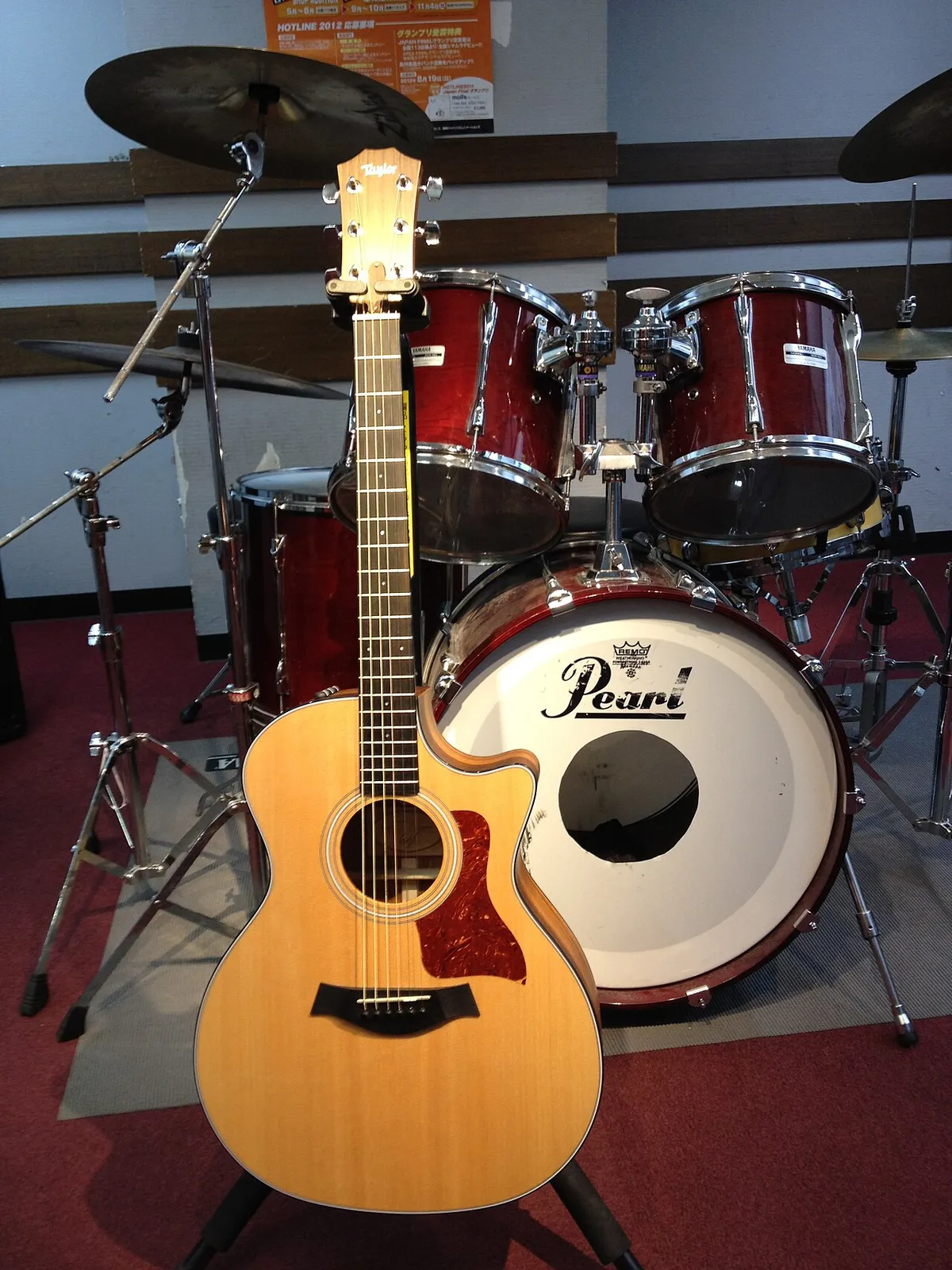
Photo: 佐藤将人 / Wikimedia Commons / CC BY-SA 3.0 Taylor
314ce
2000
Nobody writes songs about the workhorse. They just keep reaching for it.
- Send a picture
Martin
Backpacker
1992
Built to ride in a hiking pack. Martin’s first one went around the Earth 224 times.
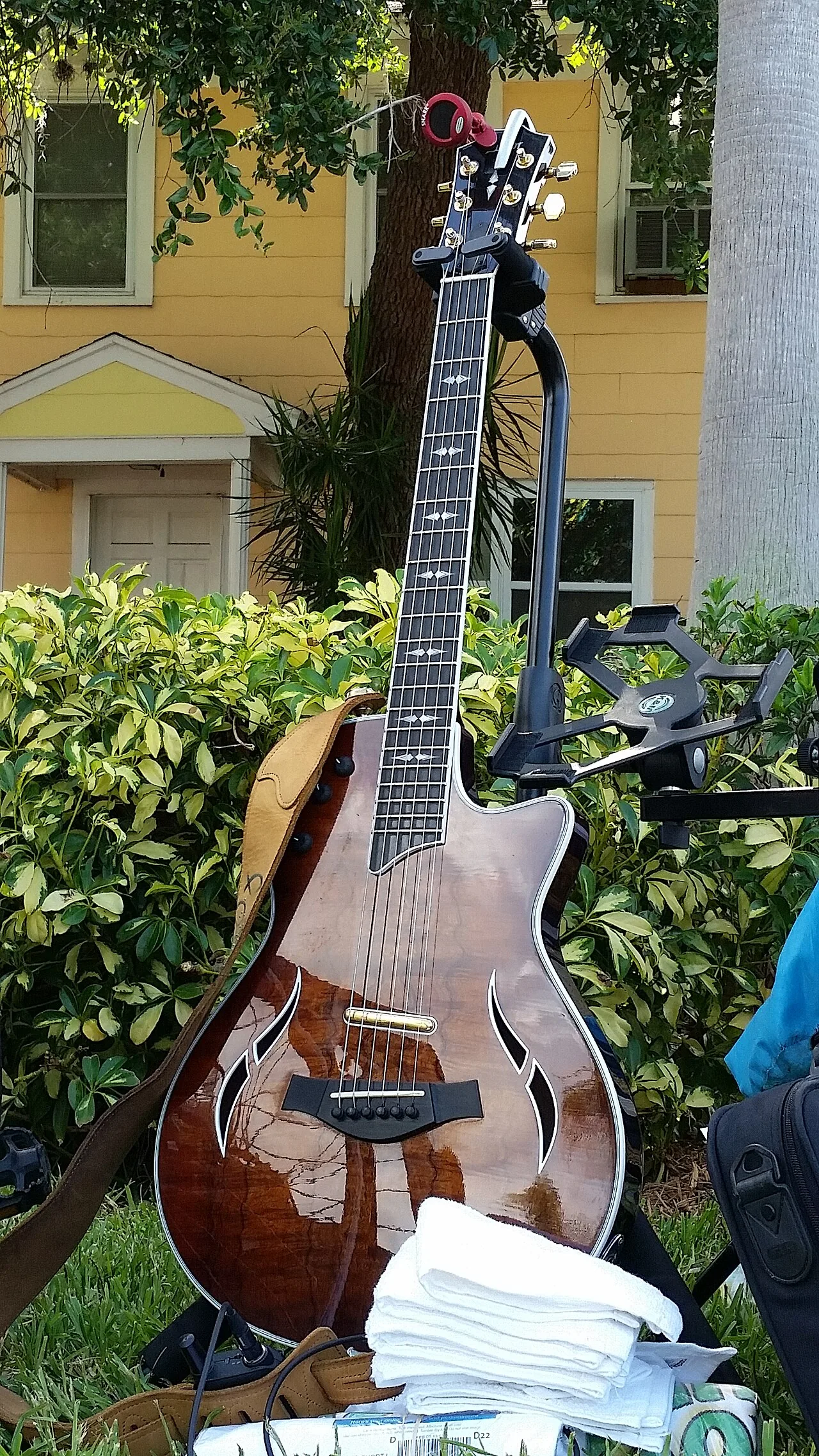
Photo: amateur photography by michel / Wikimedia Commons / CC BY 2.0 Taylor
T5
2005
Bob Taylor said Taylor would build an electric somewhere between never and a truly new idea. This was the idea.