 Guitaripedia
Tacoma
Papoose
It isn't a small guitar. It's a viola next to the violin, tuned A to A, with the hole in the wrong place.
A cedar-and-mahogany flat-top with a 19.1-inch scale, its soundhole up in the shoulder, tuned a fourth above a normal guitar. The Papoose was the first guitar sold under the Tacoma name, in 1997. It's a Tacoma, not the Martin Backpacker.
- Introduced
- 1997
- Type
- Acoustic (travel)
- Class
- Production
Have a photograph of this guitar? Send a picture
The short version
Early 1990s
A guitar factory next to a sawmill
Young Chang builds a plant in Tacoma, Washington, for piano wood, and the sawmill manager talks them into making guitars too.
Early 1990s
The prototype
Before the full-size Chief, a little cedar guitar with an offset hole and no brand name on it.
1997
Winter NAMM
The Papoose and the Chief debut, and the Papoose is the first guitar with Tacoma on it.
1999–2000
Kim buys it
Young Chang sells the line and the sawmill to J. C. Kim. The year depends on who you ask.
2003
Twelve strings
The P112 arrives in the summer, six tuners a side, still tuned A to A.
2004
Fender
Fender buys Tacoma effective 7 October, the Papoose name included, and says the teardrop-hole acoustics will stay.
2008
The plant closes
In February Fender announces the Frederickson plant will close by year's end. Tacoma doesn't come back.
Side A
A1
A guitar factory at a sawmill
Tacoma, Washington, the early 1990s. Young Chang, the piano company, has put more than $20 million into a 50-acre plant to cut wood for pianos. The sawmill manager, J. C. Kim, talks them into building a guitar factory next door.
For several years it makes about a hundred guitars a month for other people's names. Then, at winter NAMM in 1997, it shows two of its own. One is the Chief, a full-size flat-top. The other is the Papoose, and it's the first guitar ever sold as a Tacoma.
The Papoose wasn't meant to be a shrunken guitar. George Gruhn, the Nashville dealer, who holds what he calls the prototype, wanted something that sat next to a normal guitar the way a viola sits next to a violin. Same intervals, pitched higher, and loud, because a little box can project.
A2
Not a capo on a dreadnought
So it's tuned up. A to A instead of E to E, which is a fourth higher: A D G C E A. If you've ever stuck a capo on the fifth fret, you already know how to play one, and you know the sound. Bright, close, a little like a mandolin that went to guitar school.
The paperwork can't quite agree on this. One guidebook says it's tuned "a fifth above a regular guitar" and prints ADGBEA in the same sentence, then says it's like a capo at the fifth. A fifth would be seven frets, and ADGBEA leaves the B string where it was. Count the frets. It's a fourth.
The scale is 19.1 inches. Gruhn's prototype is 19, and it has a nut that's 1⅞ inches wide, which is wide on purpose. Packing frets onto a short neck makes them cramped, so it needed the width a normal neck has up around the fifth fret. Fifteen frets clear the body. The prototype has an oil finish, very thin, and no Tacoma name on it anywhere. It's older than the Chief.
A3
The hole in the shoulder
The first thing anybody notices is that the soundhole isn't under the strings. It sits up in the upper bout, off to one side, so the middle of the top can be braced less. The bracing isn't the usual X either. It's an A-frame.
Nobody agrees what to call that hole. A paisley. A kidney bean. A teardrop. A "quotation mark." Tacoma's own price list called it the Wing, and the guitars that wore it were the Wing Series. People don't even agree which side of the bout it's on. Look at one and you'll see why: it's a comma someone left on the top of a guitar, and it's the best-looking thing about it.
The plain P1 is a solid Western cedar top on solid mahogany back and sides, a one-piece mahogany neck bolted on, rosewood board, a pinless bridge, satin finish. In February 2007 it listed at $799 with a gig bag. If you wanted something fancier there was a rosewood P2, koa models, one with nylon strings, and from 2003 a twelve-string, the P112, still tuned A to A. In 2001 there was even a cedar-over-Brazilian-rosewood version.
Flip the record · By the numbers
19.1"
Scale length. The full-size Chief, launched alongside it, is 25.5.
5
Frets up. Playing a Papoose is like playing a normal guitar capoed at the fifth.
$799
List price in February 2007, gig bag included
1⅞"
Nut width on the prototype, wide on purpose
Side B
B1
Fender buys the name
Tacoma's ownership got complicated fast. Young Chang sold the line and the sawmill to Kim, in 1999 or 2000, depending on who you ask. Then, effective 7 October 2004, Fender bought it all: the plant and the names Tacoma, Olympia, Orpheum, and Papoose.
Fender also wanted the factory to build Guild. Fender's Bill Schultz said the teardrop-hole acoustics would stay, and for a while they did. About 50 people worked there, and the plant was building 7,000 to 10,000 instruments a year, every model together. Nobody ever said how many of those were Papooses.
On 1 February 2008 the Tacoma paper reported that the Frederickson plant would close by the end of the year, and that manufacturing was moving to Connecticut. Guild went. Tacoma didn't. In April 2009 dealers were told the line was dropped. The P1 had been in the catalog from 1997 to 2008.
B2
Still in the hands of the people who play it
The famous Tacoma names, Bob Dylan, the Dixie Chicks, Vince Gill, Bonnie Raitt, played the company's guitars. None of them is on record with a Papoose. The people who are, are the ones who wanted that particular voice.
Steve Ouimette played his on "We Three Kings" for Guitar Hero 3. In December 2025 he posted about it, noting the track had come out eighteen years earlier, almost to the day. Attila Vural has a 1999 P1 and a koa Papoose, takes them on tour, and made The Real Live Wires Are Talking mostly around them.
Used ones still turn up, the comma still up in the shoulder. Nobody was trying to fit a guitar in an overhead bin. They wanted a second voice, and you can still hear it.
Put this on
You’ve read about it. Now hear it. Here’s what this guitar sounds like, and what to listen for.
We Three Kings
Ouimette says he played this one for Guitar Hero 3 on his Papoose. One guitar, one track, and the bright, high voice is the A-to-A tuning doing its job.
Find it on YouTube (opens in a new tab)Spencer Turns Cogwheels
A studio video credited to his koa Papoose, which he calls a PK6. The tune is from The Real Live Wires Are Talking, a record he says is mostly dedicated to his two Papooses.
Watch it on YouTube (opens in a new tab)
The cast
The people, and the specific guitars, that made the legend.
Early 1990s
George Gruhn
The unnamed early-'90s prototype
Wanted a guitar that sat beside a normal one the way a viola sits beside a violin. Shares the design credit with Terry Atkins.
1997
Terry Atkins
Designer
Credited with Gruhn for the production design.
Early 1990s
J. C. Kim
Sawmill manager, later owner
Talked Young Chang into a guitar factory next to the sawmill, then bought the line, and sold it to Fender in 2004.
2007
Steve Ouimette
His own Papoose
Used it on "We Three Kings" for Guitar Hero 3.
2023
Attila Vural
A 1999 P1 and a koa Papoose
Takes them on tour, and built an album mostly around them.
Liner notes
Specs, construction, rarity, value, and every source we used.
A small cedar flat-top with the soundhole in the upper bout — Tacoma’s first guitar, tuned A to A instead of E to E.
- Body
- Small single-cutaway flat-top. Solid Western cedar top, solid mahogany back and sides. Offset soundhole. Wing Series (Musician’s Friend; Tacoma’s Winter 2007 list).
- Neck
- Bolt-on, one-piece mahogany (Musician’s Friend). The 2007 list: “We only use one-piece Mahogany necks.”
- Fingerboard
- Rosewood, white dots. Musician’s Friend: 21 frets. Blue Book: 15/21-fret.
- Scale
- 19.1 in. (Blue Book; Musician’s Friend). Gruhn’s prototype: 19 in. Sellers also print 19 1/8 in. and, on one Japanese card, about 485 mm.
- Pickups
- None on the plain P1. P1E: Fishman E-Passive transducer (Winter 2007 list).
- Hardware
- Pinless bridge (Blue Book). Tone-shaped rosewood bridge, compensated saddle, chrome tuners (Musician’s Friend). Three-per-side headstock (Blue Book). Gig bag with the 2007 P1.
- Electronics
- None on the P1. The P1E is a pickup and an endpin jack, and Blue Book says no controls.
- Finish
- Light natural satin (Musician’s Friend). The 2007 list says satin.
- Nut
- Graphtech Tusq (Musician’s Friend). The 2007 list does not print a width. Gruhn’s prototype: 1 7/8 in. Roadhouse Vintage printed 1.875 in. on a P1. Digimart measured one 2000 at 47.8 mm; Ikebe’s card prints 47.5 mm.
Open the full research fileConstruction details, the complete player record, production numbers, dated value estimates, and sources
Specs are for the cedar-and-mahogany P1, the Papoose still on Tacoma’s February 2007 list. No current model carries the name.
Construction
The job was a small guitar with its own voice. Not a three-quarter student box. Not a capo on a dreadnought. George Gruhn, holding what he calls the prototype, wanted a tenor beside a normal guitar the way a viola sits beside a violin: same intervals, pitched higher, loud because a little box can project. The hole is not under the strings. It sits in the upper bout so the middle of the top can be braced less.
Tacoma, Washington, started as a sawmill. Premier Guitar (Zachary Fjestad, 4 January 2016): in the early 1990s Young Chang put more than $20 million into a 50-acre plant for piano wood, and sawmill manager J. C. Kim talked them into a guitar factory next door. For the first several years it built about 100 guitars a month as a private label. Blue Book says that private-label project never got anywhere, and that Young Chang introduced the Tacoma line in 1997. Wikipedia agrees with Premier on the hundred a month. The New York Times (14 October 2004) says the company was founded in 1996. UPI, 13 October 2004, called it eight years old. Those are company dates. The Papoose’s catalog start is 1997.
Premier Guitar and Wikipedia: the Papoose and the Chief debuted at winter NAMM in 1997, and the Papoose was the first guitar sold under the Tacoma name. Blue Book’s P1 line is 1997–2008. The same book’s company paragraph runs instruments from 1995 to early 2008. Gruhn, on The Musician Network (13 October 2017): the prototype was made in the very early 1990s, before the full-size Chief, with no Tacoma name on it. His is the first offset-hole guitar. 1997 is the debut under the name.
That prototype is close to the P1 and not the same guitar. Cedar top, mahogany back, sides, and neck. Two bolts into metal threaded bushings. A truss rod the length of the neck, the neck running to the end of the board. Fifteen frets clear of the body. Scale 19 in., not the catalog 19.1. Nut 1 7/8 in., wide on purpose: frets packed onto a short scale need the width a normal neck has up around the fifth fret. Oil-rubbed, he says, very thin, not spray lacquer. Extra-light strings, or regular light. Wikipedia credits the production design to Terry Atkins and George Gruhn, and calls the bracing Voiced Bracing Support: an A-frame on the Wing Series, not a conventional X.
The specs above are that catalog P1. The hole’s name is not one word. Musician’s Friend: offset paisley. The February 2007 list: an offset “Wing” soundhole. Blue Book: a “quotation mark soundhole in the bass bout,” and, separately, a small off-center teardrop pickguard. Premier Guitar: a kidney bean in the upper-bass bout, and also “paisley.” Music Trades (November 2004): a teardrop in the upper right bout. Wikipedia: Gruhn’s paisley on the left side of the upper bout. Sources differ on which side of the bout.
So does the interval. A capo at the fifth fret is a perfect fourth: E A D G B E becomes A D G C E A. Wikipedia: a fourth higher, to A rather than E, “equivalent to a conventional guitar with a capo on the fifth fret.” Musician’s Friend: tuned to A, “Tuned from A to A.” Gruhn: five frets higher. Barry Rudolph, 2001: up a fourth. The 2007 list only says “Tuned A–A.” Blue Book, in one sentence: “tuned a fifth above a regular guitar (ADGBEA — playing the Papoose is like playing a regular guitar capoed at the fifth fret).” A fifth is seven frets, not five, and ADGBEA leaves the B string where it was. Oscar Guitars and a Digimart card on a 2000 P-1 print A D G C E A. An American Music listing prints ADGCEA and calls it “up a 5th.”
The other Papooses change wood or the string count. Blue Book: P2, rosewood back, sides, and board, bound, 1997–2002. P112 12-string, six-per-side tuners, summer 2003–07, still tuned A–A on the 2007 list. P1E, a piezo and an endpin jack, no controls, discontinued 2008; the list calls the pickup a Fishman E-Passive. P4KN, figured koa, nylon, ivoroid-bound top, discontinued 2003. P6K, figured koa, ebony board and bridge, gold hardware, gloss, discontinued 2003. Rudolph in 2001 already had a P6KG in koa and a P6BRG, cedar over Brazilian rosewood, both 30 in. long, ebony boards, gold tuners, gloss, 19.1 in. scale. The Chief is the other 1997 guitar: full-size, Blue Book’s 25.5 in. scale, ordinary pitch. The SP1 is a solidbody on these proportions — mahogany, a Duncan Designed humbucker, a headphone amp — and Wikipedia says it was discontinued by the end of 2006. Olympia was the separate budget brand. The 2007 list, printed from Scottsdale, says the Wing Series was not offered left-handed, and that a Papoose could take only the passive pickup.
Then Fender, then the stop. Blue Book: Young Chang sold the line and the sawmill to J. C. Kim in 2000, and dates the firm’s bankruptcy to 2004. Wikipedia dates the sale to Kim in 1999. Premier Guitar says the late 1990s. Fender bought the assets effective 7 October 2004, including the names Tacoma, Olympia, Orpheum, and Papoose, and the plant (the company’s announcement, 8 October 2004; the New York Times, 14 October). Seattle Post-Intelligencer, Dan Richman, 11 October 2004: price undisclosed; about 50 employees, “maybe one to five” laid off; the factory would also build Guild, which Fender had bought in 1995. Julian Henslee told the paper the plant built 7,000 to 10,000 instruments a year and would probably double. Music Trades (November 2004): bought from J. C. Kim; insiders at slightly under $2.0 million; a 42,000-square-foot plant; Bill Schultz said the teardrop-hole acoustics would stay, and that the point was also Guild’s capacity. The New York Times: about $8 million in annual sales. None of those stories gives a Papoose total.
The News Tribune, C. R. Roberts, 1 February 2008: the 44,000-square-foot Frederickson plant would close by the end of the year, 70 employees were being given assistance, and spokesman Jason Padgitt said manufacturing would move to Connecticut. Ferdinand Boyce, who had managed the plant when employment hit 96, told Roberts he was surprised. Premier Guitar: after Fender bought Kaman in 2007, Guild made the move and Tacoma did not resume; mothballed since 2008. Blue Book: in April 2009 Fender told dealers the line was dropped, and it is unknown whether any Tacoma was built in Connecticut. That book’s P1 window ends in 2008.
Players
Steve Ouimette. His own Instagram, 20 December 2025: the Tacoma Papoose he used on “We Three Kings” for Guitar Hero 3. He wrote that the song had been released 18 years earlier, almost to the day. That is his guitar and his track. It is one instrument.
Attila Vural. His site names a 1999 P1 and a PK6 Papoose, and says he plays them on tour and that the album The Real Live Wires Are Talking is mostly dedicated to them. A Leftover Studio video (19 February 2024) credits “Spencer Turns Cogwheels,” from that record, to his Tacoma PK6. German Wikipedia: he also plays a fourth-guitar (Quart-Gitarre) by Tacoma, and lists the album in 2023. His page’s PK6 is his spelling. Blue Book’s koa Papoose is the P6K, discontinued 2003.
The famous Tacoma names are not tied to this model. Seattle Post-Intelligencer, 11 October 2004: Tacoma Guitar instruments had been used by Bob Dylan, the Dixie Chicks, Vince Gill, Ben Harper, Nickelback, and Bonnie Raitt. The New York Times the same week names the Dixie Chicks and Bob Dylan as customers of the company. Gruhn, in the prototype video, says the guitars were endorsed by artists from Vince Gill and Ricky Skaggs, and that a fair number were still in Nashville studios. He does not name a Papoose on a song. No Papoose credit for any of them turned up.
Rarity
For eleven catalog years the P1 was an ordinary American flat-top you could order, satin cedar and mahogany, gig bag in the price. It is no longer made. Used ones are still a normal thing to find. They are not a one-off, and they are not a new guitar.
Tacoma never published a Papoose total. Henslee’s 7,000 to 10,000 a year, told to the Seattle Post-Intelligencer in 2004, is every guitar, mandolin, and bass the factory was building. Premier Guitar’s hundred a month is the private-label work before the Tacoma name. A serial dates one guitar. It does not count a year. Blue Book’s company line runs instruments from 1995; its P1 line starts in 1997. Neither number is a census.
What is actually thinner: the rosewood P2, a catalog window of 1997–2002; the koa P6K and the nylon P4KN, both discontinued in 2003 in Blue Book; Rudolph’s Brazilian P6BRG, a 2001 description with no production total; the 12-string, summer 2003 through 2007. The 2007 list did not offer the Wing Series left-handed. Gruhn’s unnamed early-1990s prototype is one object. The Chief, the Thunderchief bass, and the Thunderhawk baritone (tuned B–B on Wikipedia’s page) are other Tacomas. An Olympia is the budget line.
Value
Informal estimate, 28 October 2026. Not an appraisal.
Ask prices and sold prices are labeled below. Ouimette’s Guitar Hero guitar is one instrument, not a comparable sale. No celebrity Papoose auction turned up.
New street. Nothing to order. The last published U.S. suggested retail is Tacoma’s Winter 2007 list, effective 1 February 2007: P1 $799 with a gig bag; P1E $899; P112 $932; P112E $1,032. A standard Papoose case was $109.99, a deluxe Papoose case $149.99, and the passive-pickup upcharge $100. Musician’s Friend’s P1 page, still up and marked unavailable on 28 October 2026, showed $614.62. That is an old ticket on a dead page.
Used. Reverb’s Tacoma brand page, as it appeared on 20 October 2026, was asks, not hammers: a 1997 P1 cut from $899 to $629; another P1 from $699 to $649; a P-1 from $1,200 to $699; a 2000 P-1 with an added LR Baggs at $1,299. The Acoustic Guitar Forum, 12 May 2026: a 1999 with a factory pickup, hard case, and the original bag, asked $650. Ikebe, via Digimart, updated 1 December 2025, asked ¥110,000 tax-in for a used P1 with an added contact pickup. Yen is not converted. Named sold prices, not a median: eBay, best offer accepted 23 November 2025, a used P1 with no original case, $330. Oscar Guitars marked a 2000s P1 sold at €848.35; that shop page carries an 11 November 2025 date. No Reverb Price Guide band for the P1 was published on the pages checked 28 October 2026.
Vintage / collectible. A clean P1 is a discontinued catalog guitar, not pre-war money. The shorter-run wood variants — rosewood P2, koa, Brazilian — are the thinner objects, and no separate sold median for them turned up.
See also
- Martin Backpacker — Martin’s paddle-shaped travel guitar; a different maker, a 24-inch scale, not this A-tuned flat-top
- Martin 5-18 — Style 18 on size 5, a terz; small, and not a Papoose
- Martin 000-18 — a small Martin that is still a full guitar, not a travel box tuned up from E
Sources
- Tacoma, Winter 2007 price list (jedistar PDF) — effective 1 February 2007; P1 $799 cedar/mahogany/satin/gig bag, tuned A–A; P1E $899 Fishman E-Passive; P112 $932; P112E $1,032; Wing soundhole; one-piece mahogany necks; Wing Series not left-handed; passive-only upcharge $100; cases $109.99 and $149.99; Scottsdale address
- Blue Book, Tacoma Papoose series — P1 1997–2008, 19.1 in., 15/21-fret, quotation-mark soundhole, pinless bridge; “a fifth” and ADGBEA in the series note; P1E disc. 2008; P112 summer 2003–07; P2 1997–2002; P4KN and P6K disc. 2003
- Blue Book, Tacoma — Young Chang sawmill; 1997 line; sale to Kim in 2000; Fender late 2004 for Guild space; Kaman late 2007; move announced early 2008; dealers told April 2009; instruments 1995–early 2008; Chief 25.5 in.
- Musician’s Friend, Papoose P1 — Wing Series, offset paisley, tuned A to A, cedar, mahogany, bolt-on, 19.1 in., 21 frets, Tusq, compensated saddle, tone-shaped bridge, satin; page showed $614.62 and out of stock on 28 October 2026
- Premier Guitar, Zachary Fjestad, “Trash or Treasure: Tacoma Thunderchief,” 4 January 2016 — $20 million sawmill; ~100 a month private label; Papoose and Chief at 1997 NAMM; kidney-bean hole in the upper-bass bout; sale to Kim in the late 1990s; Fender late 2004; mothballed since 2008
- Wikipedia, Tacoma Guitars — 1991 Young Chang division; 1997 NAMM; Atkins and Gruhn; 19.1 in.; a fourth higher; paisley on the left of the upper bout; A-frame bracing; SP1 discontinued end of 2006; Chief 25.5 in.; Thunderhawk 29 in., tuned B
- George Gruhn, The Musician Network, 13 October 2017 — prototype, very early 1990s, no brand name, 19 in. scale, 1 7/8 in. nut, 15 frets clear, two-bolt neck, oil finish, five frets higher; Gill and Skaggs among endorsers; not in production after Fender closed the company
- Barry Rudolph, Tacoma Papoose Series — 2001: P6KG koa, P6BRG cedar/Brazilian, tuned up a fourth, 19.1 in., 30 in. long, ebony, gold, gloss; 4615 E. 192nd Street, Tacoma
- Roadhouse Vintage, P1 — 1.875 in. nut; 19.1 in. scale on that guitar
- Music Trades, November 2004 (Gale A125646295) — bought from J. C. Kim; insiders slightly under $2.0 million; 42,000 sq ft; teardrop hole in the upper right bout; Schultz; Guild capacity
- Seattle Post-Intelligencer, Dan Richman, 11 October 2004 — brands Tacoma, Olympia, Orpheum, Papoose; price undisclosed; ~50 employees; Henslee, 7,000–10,000 a year; Dylan, Dixie Chicks, Gill, Harper, Nickelback, Raitt on Tacoma instruments; Guild
- New York Times, 14 October 2004 — deal finalized 7 October; founded 1996; about $8 million sales; Dixie Chicks and Dylan as customers; terms not disclosed
- UPI, 13 October 2004 — eight-year-old company; Dylan and Gill named for Tacoma guitars, not a model
- Fender announcement, posted Harmony Central, 8 October 2004 — effective 7 October 2004; brand names and the plant
- The News Tribune, C. R. Roberts, 1 February 2008 — 44,000 sq ft Frederickson closed by year-end; 70 employees; Padgitt; move to Connecticut; Boyce, peak employment 96
- Steve Ouimette, Instagram, 20 December 2025 — his Papoose on “We Three Kings” for Guitar Hero 3
- Attila Vural, guitars — 1999 P1 and PK6; The Real Live Wires Are Talking
- Leftover Studio, “Spencer Turns Cogwheels,” 19 February 2024 — played on a Tacoma PK6
- Wikipedia, Attila Vural (German) — a Tacoma fourth-guitar; album listed 2023
- Digimart, Tacoma Papoose P-1, 2000 — measured nut 47.8 mm; 19.1 in. scale; string length about 485 mm
- Reverb, Tacoma brand — asks on 20 October 2026: $629, $649, $699, $1,299
- American Music via Reverb, P1 — prints ADGCEA and “up a 5th”
- eBay, Tacoma P1 Papoose, sold 23 November 2025 — best offer accepted at $330; no original case
- Oscar Guitars, 2000s P1 — marked sold at €848.35; page date 11 November 2025; seller prints 19 1/8 in. and ADGCEA
- Acoustic Guitar Forum, 12 May 2026 — 1999 with a factory pickup, asked $650
- Ikebe via Digimart, used P1, updated 1 December 2025 — ask ¥110,000 tax-in; nut card 47.5 mm; scale 485 mm
Keep digging
Guitars this one gets compared to, confused with, or descended from.
- Send a picture
Martin
Backpacker
1992
Built to ride in a hiking pack. Martin’s first one went around the Earth 224 times.
- Send a picture
Martin
5-18
1898
Martin sold it as a guitar for children. Marty Robbins took it onstage.
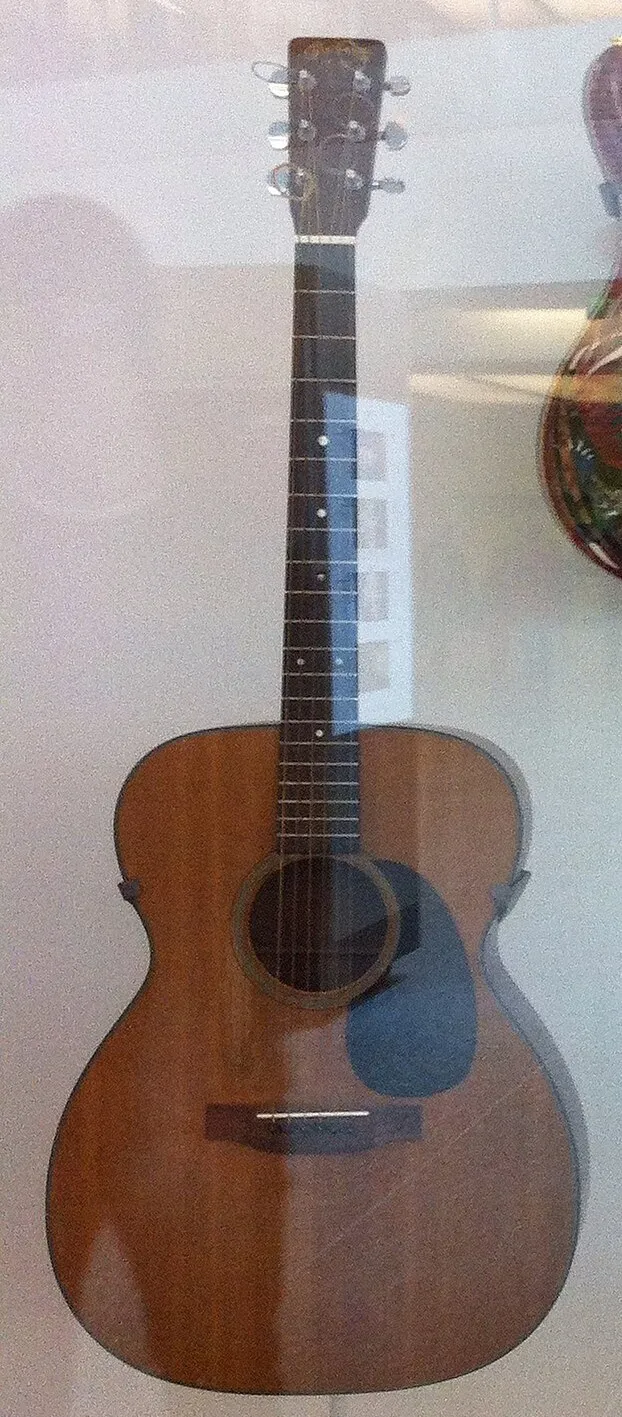
Photo: Tyfferz Y / Wikimedia Commons / CC BY 2.0 Martin
000-18
1934
Julian Lage’s 1939 000-18 had been in pieces. It showed up when his own left hand needed putting back together.