Martin
Backpacker
Built to ride in a hiking pack. Martin’s first one went around the Earth 224 times.
A guitar builder wanted something he could take up a trail, so he built a paddle with strings on it. Martin made it for more than thirty years, and the first one Martin numbered flew on the space shuttle.
- Introduced
- 1992
- Type
- Acoustic (travel)
- Class
- Production
Have a photograph of this guitar? Send a picture
The short version
1973
A builder starts
Bob McNally, who had been teaching and doing repairs, starts building instruments.
Early 1980s
The Backpacker
McNally builds a small-profile six-string for hiking and travel and gives it the name.
1992–93
Martin makes it
After Chris Martin sees one at the Philadelphia Folk Festival, Martin starts building Backpackers.
1993
NAMM
Martin takes 5,000 orders at the winter trade show.
1994
STS-62
Serial number 1 flies aboard Columbia, 4–18 March, with astronaut Pierre Thuot.
2002
New and improved
A wider body, a bigger soundhole, a more Martin-looking headstock. The one-piece mahogany neck and sides go.
2017
25th Anniversary
One year only, all sapele, with black tuners and black pins.
2025
The last ones
Japanese Martin dealers announce that production has ended.
Side A
A1
A guitar for the trail
Bob McNally had been teaching guitar and fixing them since the early 1970s, and building them since 1973. In the early 1980s he made a six-string for hiking and travel with almost no body, thin enough to strap to a pack and walk up a mountain with. He called it the Backpacker.
It doesn't look like a small guitar. It looks like a canoe paddle that learned to play. There's a round soundhole and almost no bout to speak of.
The point was simple. The guitar you can't carry stays home.
A2
The booth in Philadelphia
Chris Martin, of the Martin family, saw one at the Philadelphia Folk Festival. Martin started making Backpackers in 1992 or 1993, depending which page you read; the company’s own serial chart starts them in 1992. At the 1993 NAMM show it took 5,000 orders.
The paperwork on the deal doesn’t line up neatly. One account has McNally licensing the design to Martin in 1994, two years after Martin's own records say the guitars started. Keep both. What nobody disputes is whose idea it was.
Japanese catalog copy says the first 1992 Backpackers were made from leftover mahogany. They were built in Navojoa, Sonora, at the Mexican plant that, from the early 1990s, made Martin’s strings, ukuleles, and these.
A3
Too small for a truss rod
Pick one up and the first thing you notice is that there’s nothing to it. One dealer says under two and a half pounds. One that went on a shop scale came in at two pounds fifteen ounces. The scale is 24 inches, close enough to a regular guitar that your hands don't have to relearn anything. There are fifteen frets and the neck meets the body at the last of them. There’s no truss rod. Early steel-strings had a one-piece mahogany neck and sides, one slab of wood from headstock to tail.
As for the sound, don't expect a dreadnought. There's hardly any air in that body. What you get is a guitar in tune, in your hands, on a ridge or in a tent or a hotel room. That was the whole job.
Flip the record · By the numbers
224
Orbits of the Earth for serial number 1, aboard the shuttle Columbia in 1994.
5,000
Orders Martin took at the 1993 NAMM show. Orders, not guitars built.
24"
Scale length. An inch longer than the Little Martin’s.
15
Frets, and the neck meets the body at the last one.
Side B
B1
To boldly go
Astronaut Pierre Thuot wanted to take a guitar into space. The shuttle's personal-item compartment was, in Martin's words,
barely the size of a breadbox.
Thuot called Rickenbacker first. Its president, John C. Hall, sent him to Dick Boak at Martin. The guitar that flew was built for Martin by McNally himself.
On 4 March 1994 Columbia launched from Kennedy on STS-62 with a Martin Backpacker aboard, serial number 1, in a Nomex bag. It came back on 18 March after 224 orbits. The crew signed it. It went to the museum at the factory in Nazareth, where the plaque calls it the first guitar in outer space and reads “To Boldly Go Where No Guitar Has Gone Before!” Others say first American guitar in space. It was the first guitar on a NASA shuttle either way.
Martin's copy says a Backpacker has been up Everest, too. Nobody has pinned down whose guitar or which year, so neither will I.
B2
Wider, louder, gone
In 2002 Martin called it "New & Improved." The body got considerably wider, the soundhole bigger, the headstock more like a Martin's, and the body grew a shoulder at the 15th fret. Martin promised louder and more even. The one-piece mahogany neck and sides went away with that change, which is why the early ones are the thinner find now.
There were side roads. A nylon-string Classical Backpacker arrived in 1995 with a wider neck. For 2017 only, a 25th Anniversary came in all sapele, with black tuners and black bridge pins.
There was a sibling, too, and people mix them up. The Little Martin, from 2003, is a shrunken guitar-shaped guitar with a 23-inch scale. Ed Sheeran started out very early on a Backpacker, then moved to Little Martins, and his signature models are those. None of his records are pinned to the paddle.
B3
Number 1 is home
In 2025, Martin's dealers in Japan said production had ended. What's left is shop stock. Martin never published how many it made. The serial numbers ran past 311,000 by the last year, but serials date a guitar. They don't count them.
Serial number 1 is in Nazareth, in the factory museum, with the crew's names on it. The rest are wherever their owners carried them.
The cast
The people, and the specific guitars, that made the legend.
1994
Bob McNally
Designer; built the space guitar for Martin
Built his first Backpackers for hiking and travel in the early 1980s. Some books spell him McAnally; his own instruments say McNally.
1992–93
Chris Martin
Saw one at a festival booth
Spotted a McNally Backpacker at the Philadelphia Folk Festival, and Martin started making them.
1994
Pierre Thuot
Martin Backpacker, serial no. 1
Took it aboard Columbia on STS-62. It came home signed by the crew and went to the museum in Nazareth.
Ed Sheeran
A Backpacker, very early on
Started on one before moving to Little Martins. No recording is tied to the Backpacker.
Liner notes
Specs, construction, rarity, value, and every source we used.
A paddle-shaped travel guitar with a 24-inch scale — Martin’s, not a Little Martin and not a size 5.
- Body
- Thin paddle-shaped travel guitar (Blue Book). Spruce top. Back and sides: sapele on late US dealer cards that copy the factory sheet; “tonewoods” on Japanese cards; mahogany in Blue Book and Guitar.com (Heatley, 2018). Round soundhole. Non-scalloped Backpacker bracing, spruce, 5/16". Mix flagged. Do not pick.
- Neck
- Select Hardwood, Backpacker shape and Backpacker taper, hand-rubbed. Joins at the 15th fret. No truss rod (Martin Pro Tips, 2024). Early steel-strings: one-piece mahogany neck and sides through the 2002 redesign.
- Fingerboard
- FSC Certified Richlite on the last catalog card, 15 frets, white dots (1 at the 5th, 2 at the 12th). Blue Book’s long-running steel-string: hardwood. Mix flagged.
- Scale
- 24" (Japanese dealer cards print 609.6 mm beside it; Martin México 610 mm). Mix flagged. Do not convert. Do not average.
- Pickups
- None on SKU 11GBPC. Optional Martin 332 Thinline is an add-on (Blue Book), not this table.
- Hardware
- Backpacker steel-string bridge, FSC Certified Richlite; compensated white Tusq (16" radius); chrome enclosed gear, small knobs; white plastic pins. String spacing 2.187". 25th Anniversary (2017 only): black tuners, black Tusq, black pins.
- Electronics
- None
- Finish
- Hand-rubbed. Natural.
- Nut
- White Corian, 1 11/16" (Japanese cards print 42.9 mm in the same line). 12th-fret width 2 1/8". Mix flagged. Do not convert. Classical Backpacker: 1 15/16". 25th: black Corian.
Open the full research fileConstruction details, the complete player record, production numbers, dated value estimates, and sources
Classic living example = last catalog Steel String Backpacker, SKU 11GBPC (Navojoa, Mexico). Not a Little Martin (LX, 23" scale, summer 2003). Not a Dreadnought Junior. Not a size 5, not a 000, not a dreadnought. Classical Backpacker is nylon, 1995–disc. 25th Anniversary is 2017 only, all-sapele. Standalone. No Gibson SKUs. Mixed inch/mm flagged on factory 24" / 1 11/16" against printed 609.6 mm / 610 mm / 42.9 mm. No extra millimetres invented.
Construction
The job was a guitar that would go in the bag. Not a three-quarter student. Not a terz. Not the later Little Martin — that LX is a downsized 0, 23" scale, summer 2003 (Blue Book). This one is a paddle. Fifteen frets. A 24" scale. Thin enough to zip into a pack.
Bob McNally built the shape first. C. B. Gitty (Ben Baker, 31 January 2015), after talking with him at NAMM: teaching and repair in the early 1970s, building from 1973; in the early 1980s a small-profile six-string for hiking and travel, which he called the Backpacker. Wikipedia’s travel-guitar page prints the surname McAnally. The 1994 Martin press copy, Gitty, and McNally’s own signed instruments print McNally. Keep both. Those shop guitars are not this stamp. Gitty: he licensed the design to C. F. Martin in 1994. An Americana Auctions lot note repeats 1994. Martin’s own serial chart, and Blue Book’s manufacture line, start the Martin Backpacker in 1992. YAML introduced: 1992 is that catalog start, not a claim that McNally had not already been building paddles. Keep 1980s, 1992, and 1994.
Chris Martin saw one at the Philadelphia Folk Festival. UMGF, citing Martin Guitars: A History: Martin started making Backpackers in 1992/93 after that booth — the book prints McAnally — and took 5,000 orders at the 1993 NAMM show. Orders, not a factory total. None invented.
What you get is almost no extra bout. A round hole. Non-scalloped Backpacker braces, spruce, 5/16" on the late factory card. A neck that meets the body at the 15th fret. Fifteen frets in all. White Corian, 1 11/16". No truss rod. Extra-light 80/20, .010–.047 on dealer cards that copy the spec. George’s Music: under 2.5 lb. Chicago Music Exchange measured serial 252226 at 2 lbs 15 oz — that serial sits in the 2015 last-number band, not the early one-piece run. Mix flagged. Don’t average. Japanese catalog copy, including Kurosawa’s 25th-anniversary page, says the 1992 guitar was made from leftover mahogany. Navojoa, Sonora, Mexico — Blue Book’s factory; Guitar.com (Michael Heatley, 20 July 2018) prints Navajoa in one sentence and Navojoa in another. Same plant. Strings, ukuleles, and Backpackers from the early 1990s (Heatley).
Not a 5-18. Size 5 is a terz, 11.25" wide, a 12-fret box. Not a 000. Not a D. The paddle is its own body.
The 1994 Martin press release already has a Backpacker on Everest with the “Sir Edmund Hillary Expedition.” Hillary’s 1953 summit is not this guitar. Heatley: it “has also been up Mount Everest,” no climber. Blue Book: “from the Space Shuttle to the Himalayas.” No named climber or year is pinned here. Don’t invent one.
Then the instrument changed. UMGF quotes Martin’s 2002 “New & Improved” copy: a shoulder at the 15th fret, a more traditional Martin headstock, a considerably wider body, a larger soundhole — louder, more even. The one-piece mahogany neck-and-sides slab went with that change. Forum copy on that thread treats the one-piece run as the first decade. Keep 2002 as the named redesign. Do not invent an early scale; Blue Book’s steel-string line is 24" from 1992.
Classical Backpacker, nylon, Blue Book 1995–disc., 1 15/16" nut, padded bag. System 1 pickup on that stamp only, disc. 2004 (Blue Book). 25th Anniversary, 2017 only: sapele top, back, and sides, Richlite, black mini tuners, special label, gig bag (Blue Book; Kurosawa). Dealer cards sometimes paste that 25th label onto a plain 11GBPC. Don’t flatten.
Kurosawa G-CLUB Shibuya, 26 August 2025, and other Japanese authorized dealers: production ended in 2025. Martin’s own dating chart still gives a 2025 last Backpacker serial, 311991, after lumping 1992–2006 at 178146. Serials date a guitar. They don’t count a year. That last number is not a factory total. Martin.com still listed the steel-string at $299.00 in search snippets this pass. Leftover dealer stock is the living cart.
Classic vs current: 1992 Martin paddle — McNally’s design, spruce top, one-piece mahogany neck and sides — against the last 11GBPC, Richlite, sapele or “tonewoods,” Navojoa, and against no new stamp if the 2025 cut holds.
Players
Do not hang a Little Martin, a 5-18, or Ed Sheeran’s LX signatures on this paddle. Do not recruit a Dreadnought Junior.
Pierre Thuot — STS-62, Columbia, 4–18 March 1994. The named instrument. Wikipedia’s STS-62 page: a C. F. Martin backpacker flew aboard Columbia; 224 orbits. Martin press copy posted to rec.music.makers.guitar, 9 May 1994: launched 4 March 1994 from Kennedy; first guitar on NASA’s space shuttle; the personal-item compartment “barely the size of a breadbox”; fabricated for Martin by Robert McNally; signed by the crew on return; headed for the Nazareth museum, then the Rock and Roll Hall of Fame. The Nazareth museum plaque, photographed on the factory tour (Wikimedia, Alex Harden, 4 September 2009): serial #1, Nomex bag, “To Boldly Go Where No Guitar Has Gone Before!”, 224 orbits, Pierre Thuot, STS-62. NAMM.org (Elizabeth Dale): after 224 trips around Earth it came home to the Nazareth exhibit. John C. Hall, then president of Rickenbacker, on that same May 1994 thread: Thuot called him first, size limit “as I remember only 21 inches in length”; Hall put him on to Dick Boak at Martin. CollectSPACE, 8 February 2011: first American guitar in space — Chris Hadfield’s collapsible classical was later, and not this stamp. Keep the shuttle-first claim, the museum’s “first guitar in outer space,” and the American qualifier. Unique object. Artist-owned — not a comps tape.
Ed Sheeran. Guitar.com (10 April 2024): very early on, the Backpacker, then he graduated to Little Martin LX — LXME, then LX1E, then the album signatures. Those LX stamps are other guitars. No session is pinned to this paddle here.
Also known to play stays off. Equipboard photographs are not a census.
Rarity
You may not be able to order a new Steel String Backpacker from Martin. Japanese authorized dealers printed a 2025 cut. Leftover 11GBPC stock is not a Nazareth Standard. A Little Martin is the other travel cart, still in the book.
Martin did not publish Backpacker year totals. None invented. The factory dating chart lumps 1992–2006 under one last serial, 178146, then prints a year from 2007. That is why a first-year census is unknown, not the chapter. The 5,000 NAMM 1993 figure is orders in Martin Guitars: A History via UMGF, not a shipping book.
What is actually thinner: the one-piece mahogany neck-and-sides steel-strings before the 2002 redesign; the 2017 25th Anniversary (Blue Book: that year only); a Classical with the System 1 pickup (disc. 2004). Thuot’s serial #1 is one object. McNally’s own numbered shop guitars — Americana’s #438, a Reverb #951 dated 3/98 — are McNally instruments. They are not a vintage Martin Backpacker.
Value
Informal estimate, 22 October 2026. Not an appraisal.
Ask vs sold labeled. Celebrity lots are not-comps. No invented medians or factory counts. Thuot’s serial #1 is not a comp.
New street. Last catalog 11GBPC. Martin.com search snippets this pass: $299.00. Twin Town Guitars $299.00. George’s Music, Sam Ash, and Liberty Music $349.00. AVLGEAR $279.00, sold out. Don’t average those. Japanese leftover list, tax-in: Yamano Rock Inn / Digimart ¥57,200; Sparkplug sale ¥48,620. Yen is yen. If the 2025 cut holds, these are leftover tickets, not a 2026 Nazareth cart.
Used modern. Reverb Price Guide widget on a current US listing: $164–$203. Sweetwater Gear Exchange, used Natural: $155–$230, with a suggested band $194–$230 and $299.00 printed as new. Named asks, not hammers: Reverb Very Good $185; Excellent $250. Don’t invent a midpoint. Don’t average those asks.
Vintage / collectible. No clean vintage-year Price Guide band isolated on the 1992–2002 one-piece guitars this pass. They are the thinner object, not pre-war money. McNally shop numbers are another maker. The space guitar is one object. Not a comp.
See also
- martin-5-18 — Style 18 on size 5, the smallest standard Martin; a terz, not this paddle
- martin-000-18 — a small Martin that is still a guitar-shaped guitar, short-scale 000, not a travel stick
- fernandes-zo-3 — another travel silhouette; speaker in the ear of an elephant, not a Martin acoustic
Sources
- Martin, Dating Your Martin: Little Martin (LX) and Backpacker serials — Backpacker last serials: 1992–2006 178146; 2007 188539 … 2024 310826; 2025 311991. LX first year on that table 2005. Fetched 22 October 2026
- Blue Book, Martin Acoustic: Backpacker Series — McNally 1992; paddle-shaped; Space Shuttle and Himalayas copy; Navojoa, Sonora; steel-string 24 in., solid spruce, solid wood back and sides, one-piece mahogany neck, 15-fret hardwood, mfg. 1992–present; 332 Thinline add-on MSR $469; Classical 1995–disc.; 25th Anniversary 2017 only, sapele, Richlite, black mini tuners
- Blue Book, Little Martin (LX) Series — first LX summer 2003; 23 in. scale; downsized 0; not this paddle
- Martin, Steel String Backpacker — compact size, solid spruce top; $299.00 in search snippets this pass
- Martin, Travel-Sized Guitar? Yes Please. (27 September 2023) — LX 23" scale; Junior 24"; Little Martin is the other travel line
- Martin Pro Tips, Find Your Perfect Travel Guitar — Backpacker as the original travel guitar from Martin; all solid wood; Richlite board and bridge; no adjustable truss rod; 1994 NASA astronaut; gig bag
- Martin México, Guitarra Backpacker con Cuerdas de Acero, SKU 11GBPC — Pierre Thuot, Columbia, 1994, 224 orbits; scale 24" (610 mm)
- Digimart, Backpacker Steel String #310966 — late serial; spruce / tonewoods; 24'' (609.6 mm); 1 11/16'' (42.9 mm); white Corian; compensated white Tusq; FSC Richlite; chrome
- Kurosawa, Backpacker 25th Anniversary — 1992 leftover mahogany in that copy; 25th in 2017, sapele; NASA / museum sentence; factory card (1 11/16", 24", 15 frets, 15th-fret joint, black enclosed gear, black Corian, special label)
- Kurosawa, Backpacker Classical — 1992 launch copy; nylon; 1 15/16" nut; 24"; 15 frets; discontinued
- C. B. Gitty, Meet Bob McNally (31 January 2015) — early 1970s teaching/repair; building 1973; early-1980s Backpacker; licensed to Martin 1994; Strumstick is the other instrument
- UMGF, Martin Backpacker design change (14 July 2009) — Martin Guitars: A History: 1992/93 after the Philadelphia Folk Festival booth (McAnally); 5,000 orders at 1993 NAMM; 2002 larger body; one-piece mahogany neck and sides abandoned; Martin “New & Improved” copy (15th-fret shoulder, traditional headstock, wider body, larger soundhole)
- Guitar.com, Michael Heatley, Martin Guitar History (20 July 2018) — Backpacker into Earth orbit 1994; solid spruce top, solid mahogany back and sides; “has also been up Mount Everest”; Mexican factory Navajoa / Navojoa, early 1990s, strings, ukuleles, Backpackers
- Wikipedia, STS-62 — Columbia, 4–18 March 1994; 224 orbits; crew includes Pierre J. Thuot; “A C.F. Martin backpacker guitar was also flown aboard Columbia”
- rec.music.makers.guitar, Martin press copy (9 May 1994) — 4 March 1994 launch; first guitar on NASA’s space shuttle; breadbox compartment; fabricated for Martin by Robert McNally; crew signatures; Nazareth museum then Rock Hall; “Sir Edmund Hillary Expedition” summit copy in that release; John C. Hall (Rickenbacker) on Thuot, ~21" limit, Dick Boak
- Wikimedia Commons, C.F.Martin Tour-29.jpg (Alex Harden, 4 September 2009) — Nazareth museum plaque: serial #1, Nomex bag, STS-62, 4–18 March 1994, 224 orbits, Pierre Thuot, “first guitar in outer space”
- NAMM.org, Elizabeth Dale, Martin ukulele in orbit — 1994 Pierre Thuot, Columbia; 224 trips; Nazareth historical exhibit
- CollectSPACE, custom space-shuttle-inlay Martin (8 February 2011) — first American guitar in space; Hadfield’s collapsible classical later, not this stamp
- Guitar.com, What guitars does Ed Sheeran use? (10 April 2024) — early Backpacker, then Little Martin LXME / LX1E and album signatures; those LX stamps are not this table
- Wikipedia, Travel guitar — Martin Backpacker; Robert McAnally; first guitar taken into space; Everest
- Sam Ash, Martin Backpacker — SKU MBPTG; $349.00; Sitka spruce top; 24"; 1-11/16"; white Corian; white Tusq; gig bag
- George’s Music, Martin 11GBPC — $349.00; solid spruce; solid sapele; under 2.5 lb in that copy; 24"; 1.6875"; Corian/Micarta
- Liberty Music, 11GBPC factory-card copy — $349.00; 24"; 1 11/16"; sapele; 5/16" braces; 2.187" spacing; 15th-fret joint; dealer card also prints a 25th Anniversary label — mash, not a second SKU
- Chicago Music Exchange, Backpacker serial 252226 — measured weight 2 lbs 15 oz; 24"; 1-11/16"; Richlite. Serial sits in the 2015 last-number band (260267), not the 1992–2002 one-piece neck-and-sides run
- Twin Town Guitars, 11GBPC — $299.00; UPC 729789062008
- AVLGEAR, 11GBPC — $279.00, sold out this pass
- Yamano Rock Inn, Backpacker Steel String — leftover list ¥57,200 tax-in; production-complete copy; Sitka / tonewoods card
- Sparkplug.tokyo, Backpacker discontinuation — 2025 production end; sale ¥48,620
- Reverb, Robert McNally Backpacker #951 (3/98) — McNally shop guitar, not a Martin stamp; dealer copy on Everest and Columbia; “over 300,000 made” is that listing, not a factory total — not adopted
- Reverb, Martin Backpacker Steel String — years 1992–2026; made in Mexico; 15 frets
- Reverb, Backpacker Steel String Travel Guitar — ask $185; Price Guide widget $164–$203 this pass
- Sweetwater Gear Exchange, used Backpacker Natural — used $155–$230; suggested $194–$230; new printed $299.00
- Kurosawa G-CLUB Shibuya, 26 August 2025 — Japanese authorized dealer: production ending 2025; stock until gone
- The Gear Page, Backpacker discontinued (24 September 2025) — same Japanese discontinuation notice
- Americana Auctions, C.F. Martin & McNally Backpackers (30 June 2024) — McNally NJ #438; lot note licenses the design to Martin in 1994; Martin Mexico serial 110,894 is the other guitar in the lot

Keep digging
Guitars this one gets compared to, confused with, or descended from.
- Send a picture
Martin
5-18
1898
Martin sold it as a guitar for children. Marty Robbins took it onstage.
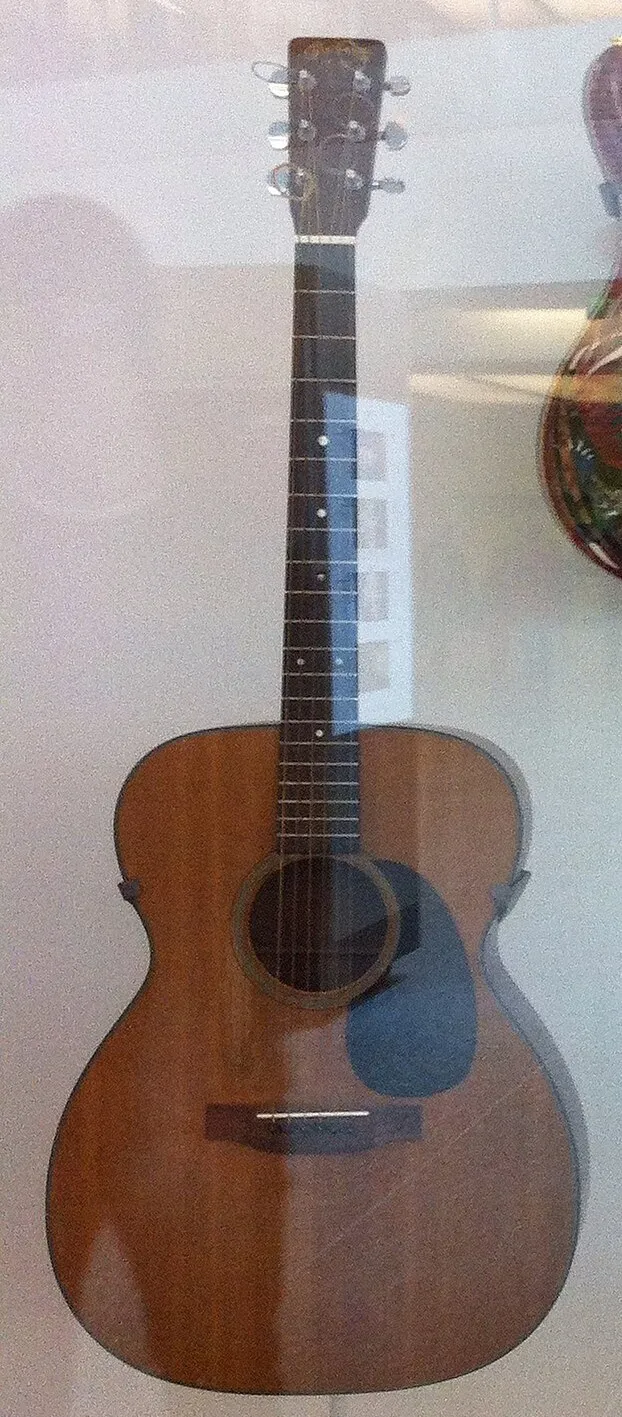
Photo: Tyfferz Y / Wikimedia Commons / CC BY 2.0 Martin
000-18
1934
Julian Lage’s 1939 000-18 had been in pieces. It showed up when his own left hand needed putting back together.
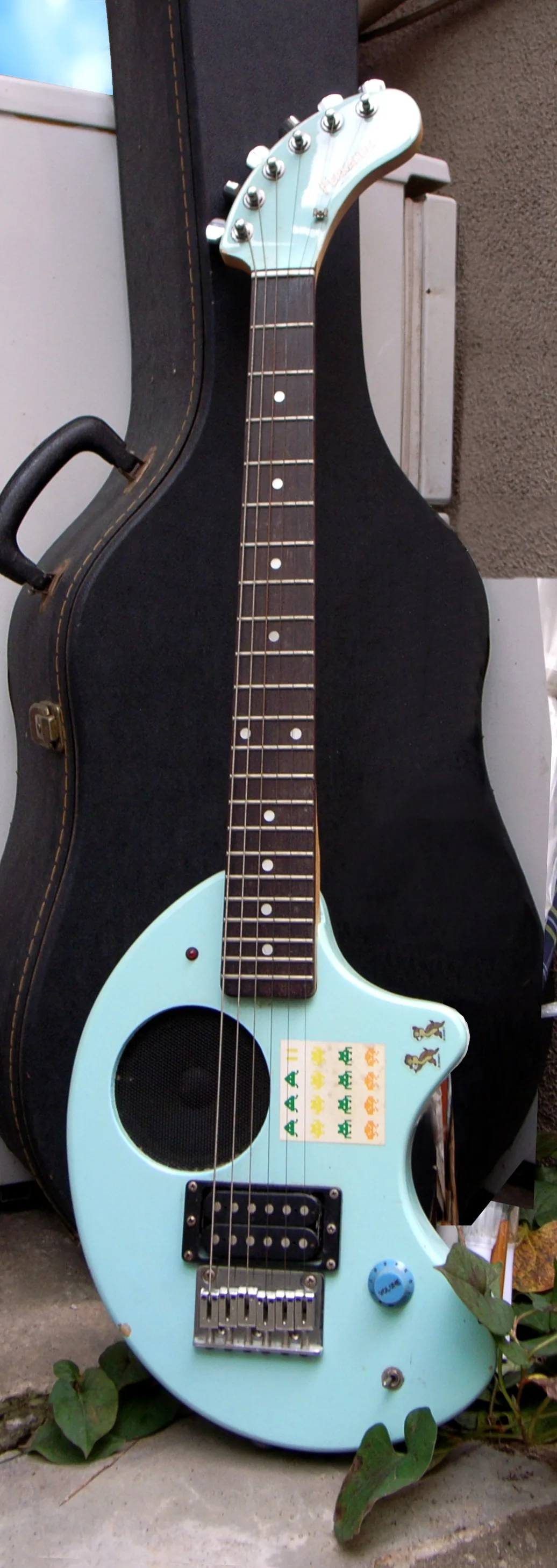
Photo: yoppy from Kawasaki, Kanagawa, Japan / Wikimedia Commons / CC BY 2.0 Fernandes
ZO-3
1990
A guitar shaped like an elephant, with the amp in its ear. Dave Navarro put one on a Chili Peppers record.