Tom Anderson
Classic
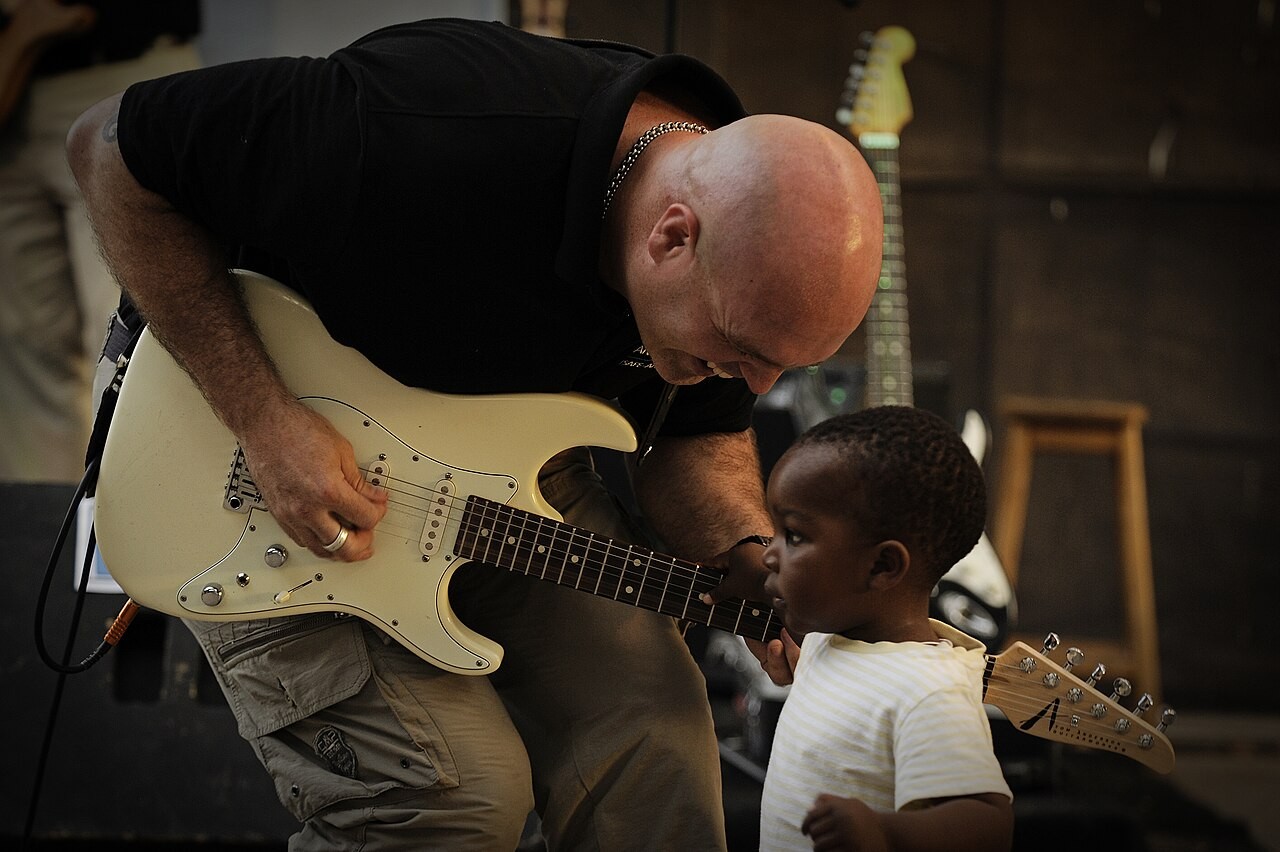
Tom Anderson grew up on vintage guitars and wanted them a little better. Forty years later, he’s still at it.
1984. Tom Anderson has just left Schecter after seven years. His first year on his own, the income is 300 Strat pickups for Schecter Japan, and he winds them in the kitchen.
- Introduced
- 1991
- Type
- Solidbody electric
- Class
- Production
The short version
1984
On his own
Anderson leaves Schecter and starts in a garage, winding pickups and cutting parts.
1986–87
Whole guitars
The first finished Andersons go to NAMM. Accounts differ on which year.
1990
No more parts
Anderson stops selling bodies and necks to other builders and makes only complete guitars.
1991
Santana’s Classic
A black Classic dated July 1991 goes home with Carlos Santana.
1992
UV finish
Fully UV-cured finishes on the guitars at NAMM.
2006
The Wedgie
A new neck joint, a compound wedge held with two screws instead of four.
2024
Forty years
A run of 40 anniversary guitars, signed on the headstock.
Side A
A1
Three hundred pickups in the kitchen
Tom Anderson spent seven years at Schecter, working with Dave Schecter. In 1984 he left and went out on his own. First in a garage, then a shop.
The first year, the money came from winding 300 Strat pickups for Schecter Japan. He wound them in the kitchen. That’s not a romantic origin story. That’s a guy getting a business off the ground one coil at a time.
What he wanted, then and now, was simple. He’d grown up on vintage guitars. He loved them. He also thought they could be a little better, and he’s been working on that idea for forty years.
A2
The parts guy
For the first few years Anderson mostly made bodies and necks for other people. Some of the customers are names you’d recognize now: John Suhr, when Suhr was at Rudy’s in New York, and Roger Sadowsky, and Jim Tyler. Before Anderson or Suhr sold a finished Strat-style guitar under his own name, Anderson was already cutting wood for Suhr.
He took finished guitars to NAMM in 1986 or 1987, depending on who you ask. By 1990 he’d stopped selling parts entirely. From then on, if it came out of his shop, it was a complete Anderson.
A3
Your dream guitar, improved
The Classic is the one with the pickguard. It’s the guitar that looks the most like what he grew up on, and that was the point. The company’s old line was:
We took the vintage guitar of your dreams and improved it.
So: a double-cut body under a pickguard, a bolt-on maple neck, a 25½-inch scale. The body wood is where you choose your flavor. Alder is the first choice and the most popular. Swamp ash if you want it more open. Basswood if you want that fat 1980s humbucker midrange.
Then the improvements. A fingerboard that’s rounder near the nut and flatter up high, so chords feel easy and bends don’t choke out. Locking tuners. A tuning system that tweaks the nut so chords sound more in tune all over the neck. And wiring that adds a neck-and-bridge sound a stock Strat switch won’t give you, plus a splitter for the humbucker. Those little changes are what make the Classic feel like more than a Strat with nice paint.
Anderson builds a lot of guitars in this outline, so know which one you’re looking at. The Drop Top Classic has a figured maple cap. The Hollow Classic, from 1996, has sealed chambers inside. The Pro Am is the one with no pickguard, and that’s the Anderson Kirk Hammett played. The plain Classic is the pickguard guitar.
When exactly the Classic got its name depends which paperwork you trust. There’s a black one dated July 1991. Another reference says it arrived in the mid-’90s, around 1995. Take your pick.
Flip the record · By the numbers
300
Strat pickups wound in the kitchen for Schecter Japan. The first year’s income.
25½"
The scale. Same as a Strat, on purpose.
~1,200
Instruments a year across the whole company, as of 2010. Not just Classics.
40
Limited guitars built for the company’s 40th anniversary in 2024.
Side B
B1
The one Santana took home
That black 1991 Classic is a good one to know about. Swamp ash, a birdseye maple neck, a pearloid pickguard, two single-coils and a humbucker. Carlos Santana bought it in Los Angeles that year.
Nobody has tied it to a stage or a record. It went into his private collection, the guitars a man who could have anything he wanted chose to keep at home. It’s signed on the body, and in 2004 he donated it to a charity guitar auction.
In Japan the Classic has its own hero. Dealers there attach the swamp-ash Classic in Bora Bora Blue to DAITA of SIAM SHADE, and Anderson says that color on that wood is “the most popular color and model in Japan.”
B2
Still the same guitar
Anderson has kept tinkering. By 1992 his guitars were wearing fully UV-cured finishes. In 2006 the shop changed the neck joint to a wedge-shaped heel held with two screws. In 2010 the whole company was building about 1,200 instruments a year, and the Classic is still made to order in Newbury Park, California.
In 2024 the shop turned forty and built 40 anniversary guitars, signed on the headstock. One of them was a Classic in Bora Bora Blue.
Anderson has said he’s still building the guitar he wished he’d had at twenty. The guy who wound pickups in his kitchen is still at the bench, making that guitar a little better.
The cast
The people, and the specific guitars, that made the legend.
1984
Tom Anderson
Builder
Grew up on vintage guitars, left Schecter, and has been refining the same idea ever since.
1977
Dave Schecter
Anderson’s old boss
Seven years together before Anderson went out on his own.
1980s
John Suhr
Customer, for parts
Anderson was cutting bodies and necks for him at Rudy’s, along with Roger Sadowsky and Jim Tyler.
1991
Carlos Santana
Black 1991 Classic
Bought in Los Angeles for his home collection. Later donated, signed, to charity.
DAITA
Bora Bora Blue Classic
The SIAM SHADE guitarist is the name Japanese dealers attach to the swamp-ash, Bora Bora Blue Classic.
Liner notes
Specs, construction, rarity, value, and every source we used.
Alder or swamp ash, a pickguard, and a 25½-inch bolt-on — Anderson’s Classic, not a Fender Stratocaster and not a Suhr Classic S.
- Body
- Alder or swamp ash; double-cut, pickguard. Factory: alder first/most popular; swamp ash the open “S” wood; basswood an option.
- Neck
- Bolt-on maple (caramel maple typical), satin back. Even-Taper .810–.870 at 1st/12th typical; 60’s Vibe / 62 Pete an option.
- Fingerboard
- Maple or rosewood; 12"–14" compound; 22 frets, stainless typical now (heavy / medium-jumbo). Mix flagged.
- Scale
- Traditional 25½" (25.5"). Factory inches. Millimetres unpublished on the Classic page this pass. Mix flagged.
- Pickups
- Typical HSS: Anderson SC1 neck and middle, HC2 (or HC2+) bridge. SSS and other Anderson sets exist.
- Hardware
- Vintage tremolo typical; locking tuners; chrome. Floyd / sunken locking tremolo and hardtail are options. Hardshell case.
- Electronics
- Volume, tone, 5-way; position 3 = middle, with neck+bridge and splitter. Buzz Feiten Tuning System.
- Finish
- Gloss or satin; company UV-cured polyester (in use by 1992 NAMM)
- Nut
- 1 11/16" typical; 1 5/8" option. Material unpublished on the factory Classic page this pass. Mix flagged.
Open the full research fileConstruction details, the complete player record, production numbers, dated value estimates, and sources
Current typical = made-to-order The Classic, Newbury Park, California (andersonguitarworks.com/the-classic; dealer cards fetched 10 September 2026). Factory and dealer print inches. Millimetres unpublished on that factory page; none invented. Mix flagged. Hollow Classic (Blue Book / guitar-list: 1996–present, sealed chambers, no soundholes) is a sister, not this table. Icon Classic is the three-knob vintage-control S. Drop Top Classic is the maple-cap-with-pickguard. T Classic is Tele-shape. Pro Am is the no-guard superstrat. Suhr Classic S (suhr-classic-s) is a different factory. No Gibson SKU. Standalone — not a Strat family card.
Construction
The job was a vintage-heart Strat-shape that played the way Anderson wanted the old ones to. Pickguard. Bolt-on maple. 25½ inches. Newbury Park, not Fullerton. Not a Fender Stratocaster (fender-stratocaster). Not a Suhr Classic S (suhr-classic-s). Before either man sold a finished S-type under his own badge, Anderson was already cutting bodies and necks for John Suhr at Rudy’s, plus Roger Sadowsky and Jim Tyler (Premier Guitar, Michael Ross, July 2010, via Make’n Music). Parts first. This plate is the pickguard Anderson.
He left Schecter in 1984 after seven years with Dave Schecter — garage, then a shop; first-year income was 300 Strat pickups for Schecter Japan, wound in the kitchen (same Premier Guitar interview). Complete guitars: Anderson told Guitar World (Charlie Wilkins, 27 April 2026) they started in 1986, first NAMM that year. Wikipedia, citing Fretboard Journal, puts completed guitars at the 1987 NAMM Show. Keep both. 1990: they stopped selling parts and built only finished instruments (Premier Guitar). Drop Top, the maple-cap flagship, is that era — guitar-list dates Drop Top 1990, Drop Top Classic 1991. Different tops. Different plates.
The Classic is the pickguard one. Factory Guitar Tales (11 July 2024): “We used to say, ‘We took the vintage guitar of your dreams and improved it.’” Anderson to Guitar World, 2026: he grew up on vintage guitars and still wanted them a little better; he is still building the guitar he wished he’d had at twenty. Live factory copy (fetched this pass) puts alder or swamp ash, kiln-dried, under a pickguard. Alder first. Swamp ash for the open S sound. Basswood if you want the 1980s humbucker midrange on a 25½-inch scale. That is the living recipe. It is not a Fender Custom Shop spec and it is not Suhr’s 60s C Vintage Standard / 1.650" Tusq card.
1991. Christie's Crossroads catalogue: TOM ANDERSON CLASSIC, neckplate 7-8-91P, black, HSS, donated by Carlos Santana. Heritage’s later lot on the same guitar: swamp ash, birdseye maple neck, pearloid pickguard, Kahler Steeler and locking nut. Named dated object. guitar-list prints The Classic introduced 1995, “mid 1990s,” and a 1996 list of $2,000. Blue Book: current manufacture, no start year on that card; Hollow Classic 1996–present, “similar to The Classic.” Keep 1991 (Christie's serial) and 1995 (guitar-list). This plate starts in 1991. Do not flatten Drop Top Classic’s maple cap onto that black swamp-ash guitar.
What you actually get now is a made-to-order bolt-on. Dealer cards this pass (Music Store Live serial 02-11-25P; Area 22 Satin Black): 25½" scale, 12"–14" compound, 22 frets, Even-Taper .810–.870 or a 60’s Vibe / 62 Pete carve, vintage tremolo, locking tuners, Buzz Feiten, 5-way with position 3 as middle plus neck+bridge and a splitter. Typical HSS is SC1 / SC1 / HC2. SSS is in the Blue Book description (three single-coils, four mini-switches on that card). Floyd and Switcheroo wiring are options, not the default table. Stainless frets are the current dealer norm. 2006: Wikipedia, citing Premier Guitar’s Atom review, dates the A-Wedgie neck joint — compound wedge, two screws instead of four. Company-wide. Pre-Wedgie four-bolt heels are the other construction, not a different slug. UV finish: Anderson to Guitar World — fully UV-finished guitars at NAMM by 1992.
Not this guitar. Hollow Classic is chambers in the same outline. Icon Classic is the three-knob, top-jack vintage control set. Drop Top Classic is a figured cap and a pickguard on the Drop Top body. Pro Am is the no-guard superstrat Kirk Hammett actually played. T Classic is a Tele. Baritom Classic is the long-scale. A Fender Stratocaster is a Fender. Suhr Classic S is 2018 as that name (suhr-classic-s). This one is Anderson’s pickguard S: alder or ash, 25½ inches, Newbury Park.
Players
Do not hang a Fender Stratocaster, a Suhr Classic S, or Hammett’s Pro Am on this plate.
Carlos Santana — 1991 Classic, serial 7-8-91P. Christie's, Crossroads Guitar Auction, 24 June 2004, lot 59: black HSS, signed on the body, donated by Santana. Catalogue: he bought it in Los Angeles in 1991 for a private home collection. Hammer with premium $16,370 (Where’s Eric archive of the sale). Heritage later resold the same object (24 July 2012 lot). Home guitar. Not a session log. Not a PRS. Celebrity lot, not a street tape.
DAITA (SIAM SHADE). Dealer copy on a Bora Bora Blue Classic (Reverb, sold): “This configuration is made popular by Japanese guitar phenom, Daita!” — swamp ash, pearloid, Schaller locking tremolo, Switcheroo. Nico-nico Guitars staff blog: Floyd-equipped SSH Classic in Bora Bora Blue as the guitar people mean by DAITA. Anderson’s own 40th-anniversary tale (July 2024) calls Bora Bora Blue on swamp ash “the most popular color and model in Japan.” Named color and model, dealer-attributed player. No serial isolated this pass.
Also known to play stays short. Kirk Hammett’s Andersons are Pro Am bowling-ball finishes from the …And Justice for All window (Guitar World, 2026; 1988 dated examples). They are not this pickguard. Joan Armatrading told Radio Times (2011) the Tom Anderson is the electric she reaches for first — company, not a pinned Classic. Steve Vai played Andersons before Ibanez (Guitar World, 2026) — too early, and not this slug. Do not recruit Clapton because Santana’s guitar later sat in a Crossroads catalogue.
Rarity
You can order a new Classic. Current production is made-to-order, not rare as a model. Anderson does not publish Classic unit totals. None invented.
Wikipedia, citing Fretboard Journal (2010): the company makes about 1,200 instruments a year. Company-wide, and a 2010 figure. It does not count Classics, and it does not date a 1991 run. Serials are date stamps (7-8-91P, 02-11-25P). They date a guitar. They don’t count a year.
What is actually thinner: 1991-era four-bolt, Kahler, and mini-switch examples; first-recipe SSS cards Blue Book still describes; Hollow Classic as a chambered sister from 1996, not a reason this solid one is scarce. 2024 40th Anniversary: factory tale, 40 limited guitars, 20 unique builds (two of each, “with a variant here and there”), signed on the headstock. One of those builds was a Classic in Bora Bora Blue for Danville Music. That is a limited object. It is not a census of The Classic. Santana’s 7-8-91P is one guitar.
Value
Informal estimate, 10 September 2026. Not an appraisal.
Ask vs sold labeled. Celebrity lots are not-comps. No invented medians or factory counts. guitar-list 1996 list $2,000 is 1990s money, not 2026 street.
New street. Made-to-order; options move the ticket. Named dealer cards this pass: Music Store Live The Classic HSS, Transparent Purple Burst, serial 02-11-25P, $4,438.00. Area 22 Satin Black $4,538.00 (out of stock). Reverb new Bora Bora Blue listing ended at $4,388. Peach Guitars UK, Classic in Black, £4,299.00 (serial 08-14-25A). Do not average those asks into a MAP.
Used modern. Reverb Price Guide on Tom Anderson Guitarworks The Classic: $1,780–$3,212, 145 orders, Good to Mint (fetched this pass). Named hammers on that guide, not a midpoint: 27 August 2026 Excellent $3,000; 24 August Excellent $2,300; 9 August Good $1,700; 27 July Excellent $2,150; 26 July Excellent $3,295; 18 July Excellent $2,250; 15 June Excellent $3,600. Icon Classic, Drop Top Classic, T Classic, and Pro Am are other Price Guide rows. Do not fold them in.
Vintage / collectible. Early 1990s four-bolt Classics trade as used Classics, not a separate SKU. Santana 7-8-91P at Crossroads $16,370 (2004, with premium) is one donated object. Not a comp. 2024 40th Anniversary Classic, Organic Grain Natural swamp ash, Roadhouse ask $3,799.00 (sold) is a limited modern, labeled adjacent.
See also
- fender-stratocaster — the 25.5" pickguard bolt-on this Newbury Park guitar is not
- suhr-classic-s — the other boutique Strat-layout; Anderson sold Suhr parts first
- music-man-silhouette — another California 25.5" bolt-on, not this pickguard
Sources
- Anderson Guitarworks: The Classic — factory copy; alder / swamp ash / basswood; 25½-inch; pickguard S. Fetched 10 September 2026. Millimetres unpublished.
- Anderson Guitarworks, Guitar Tales, 11 July 2024 — Classic naming; “vintage guitar of your dreams”; Bora Bora Blue / Japan; 40th Anniversary 40 guitars / 20 unique builds.
- Guitar World, Charlie Wilkins, 27 April 2026 — 1984 founding; complete guitars 1986; first NAMM 1986; CNC 1988; UV by 1992 NAMM; Hammett Pro Am-era influence; Vai before Ibanez; Markus Spohn.
- Premier Guitar, Michael Ross, July 2010 — via Make’n Music reprint, 20 January 2017: Schecter 1977–84; kitchen pickups; OEM to Suhr / Sadowsky / Tyler; complete guitars more rewarding; parts stop 1990; paint in-house ~1992, fully internalized 1993.
- Wikipedia, Tom Anderson Guitarworks — Newbury Park; ~1,200/year (Fretboard Journal 2010); 1987 NAMM completed guitars; A-Wedgie 2006; S-shape includes The Classic; Buzz Feiten. Lead/model list, not a millimetre card.
- Christie's: Tom Anderson Guitarworks, 1991, Tom Anderson Classic — serial 7-8-91P; Santana donation; bought Los Angeles 1991, home collection.
- Where’s Eric: 2004 Guitar Auction sale details — Crossroads 24 June 2004; lot 59 Classic $16,370 with premium.
- Heritage Auctions, 24 July 2012 — same 07-08-91P; swamp ash, pearloid guard, Kahler.
- guitar-list: Tom Anderson The Classic — introduced 1995 / mid-1990s; 1996 list $2,000; alder/basswood/swamp ash; HSS or SSS; 25.5"; 22 fret; bolt-on.
- Blue Book: Tom Anderson Guitarworks The Classic — current mfg; swamp ash Strat-style, pickguard, 22-fret, 25.5"; Hollow Classic 1996–present.
- MusicRadar, Dave Burrluck, Hollow Drop Top Classic, 5 February 2014 — “The Classic is Anderson’s long-running Stratocaster-based guitar”; Hollow Drop Top Classic 1995 (sister, maple cap + chambers — not this table); Even-Taper depths 21 mm / 22.6 mm and 305–356 mm radius on that guitar, labeled sister.
- NAMM Oral History: Tom Anderson, 10 July 2025 — Schecter 1977; company 1984; Guitar Player Tele shootout.
- Music Store Live: The Classic HSS, Transparent Purple Burst — $4,438.00; swamp ash; 25.5"; 12"–14"; 1 11/16"; Even-Taper .810–.870; SC1/SC1/HC2; vintage tremolo; serial 02-11-25P.
- Area 22: The Classic Satin Black — $4,538.00; alder; Even-Taper; SC1 SC1 HC2+; 5-way 3 = M, N+B with splitter; Buzz Feiten.
- Reverb Price Guide: Tom Anderson Guitarworks The Classic — $1,780–$3,212 / 145 orders Good to Mint; named 2026 solds.
- Reverb: The Classic Bora Bora Blue — dealer copy tying the Bora Bora Blue / locking-tremolo spec to DAITA.
- Nico-nico Guitars: DAITA — Floyd SSH Classic in Bora Bora Blue as DAITA’s Anderson.
- Radio Times: Joan Armatrading and her favourite guitars — Tom Anderson as the electric she tries first (company, not a pinned Classic).
- Roadhouse Vintage: 2024 40th Anniversary Classic — Organic Grain Natural swamp ash; ask $3,799 sold; VA7.2 / HC2; 60’s Vibe +.040.
- Peach Guitars: The Classic Black — £4,299.00; serial 08-14-25A; SF1/SF1/H2+; Even-Taper +.030.
Keep digging
Guitars this one gets compared to, confused with, or descended from.

Photo: Lightburst / Wikimedia Commons / CC BY-SA 4.0 Fender
Stratocaster
1954
The guitar most people mean when they say “electric guitar.” Designed by a man who didn’t play one.
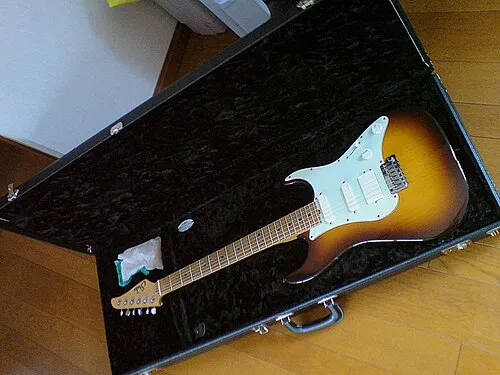
Photo: Akkun542 / Wikimedia Commons / Public domain Suhr
Classic S
2018
It looks like a Strat on purpose. Everything that’s different about it, you feel instead of see.
- Send a picture
Music Man
Silhouette
1986
People laughed at Music Man’s first guitar. Then Keith Richards picked one up.