Jerry Jones
Single Cutaway
A Sears guitar came in for a setup and left Jerry Jones holding the blueprint.
Nashville, the mid-1980s. A repairman who has already built himself an upgraded Danelectro gets a Silvertone U1 on his bench. Nathan Daniel had designed it to be cheap. Jerry Jones made it his blueprint.
- Introduced
- 1990
- Type
- Solidbody electric
- Class
- Production
Have a photograph of this guitar? Send a picture
The short version
1956
The U Series
Nathan Daniel's single-cut, masonite and lipstick tubes. The one-pickup U-1 lists at $75.
1958
Phased out
Longhorn and Shorthorn take the catalog. One photo caption dates a U1 to 1959.
1983
The Vanelectro
Jones finishes an upgraded Danelectro Pro 1 in December.
mid-1980s
A Silvertone on the bench
Bill Kenner brings in a U1 for a setup. It becomes the source for the prototype.
1988
Number 101
The first numbered Jones goes to Jack Daniels in May. It's a six-string bass.
1990
Fire Engine Red
The earliest guitar a dealer files as the Single Cutaway.
2010
The auction
Jones sells off the factory contents, presses, parts, and prototypes.
2011
Discontinued
The model's last listed year. One source dates the retirement to that April.
Side A
A1
A Silvertone on the bench
Jerry Jones was a Nashville repairman before he was a brand. By 1982 he had built guitars for Rafe VanHoy and Debora Allen. In December 1983 he finished something he called the "Vanelectro," a Danelectro Pro 1 with everything upgraded. That tells you where his head was.
Then, sometime in the mid-1980s, a man named Bill Kenner brought in a Silvertone U1 for a setup. In Jones's own notes, "that was the source for the prototype guitar."
Silvertone was Sears. The U1 was a single-cut with one lipstick-tube pickup, built to sell cheap. Jones looked at it and saw a guitar worth making again, properly.
A2
Seventy-five dollars in 1956
The outline was Nathan Daniel's. His U Series replaced the C Series in 1956: one cutaway, a body skinned in masonite, vinyl tape around the edge, a coke-bottle headstock, and one, two, or three pickups in chrome tubes that look exactly like lipstick. The one-pickup U-1 listed at $75.
Masonite is hardboard, the stuff of pegboard and clipboards. That was the trick: cheap, and nobody pretended otherwise.
By 1958 the U Series was being phased out for the Longhorn and the Shorthorn. One list dates the U1 to 1956 through 1958 and then captions a photo of one 1959. Keep both. Sears kept a single-cut going under its own name into the early sixties.
A3
Mascara caps from East Nashville
The first job was a six-string bass. Kenner's Longhorn Bass 6 got blueprinted around 1987, Jack Daniels asked for one that fall, and in May 1988 Daniels got the first numbered Jones guitar, #101. Not a Single Cutaway. Remember that if anybody tells you otherwise.
The pickups are the best story in the shop. Jones started with actual cosmetics: "Kissing Slicks" and "Aziza" mascara caps, $2.60 apiece from Mid-States Paper & Notion in East Nashville. Then he found Lakewood Medal in Waterbury, which made brass dome caps for 13 cents each, in lots of 20,000.
Twenty thousand caps is an order of brass. It is not a count of guitars.
Flip the record · By the numbers
$75
The one-pickup U-1 in Danelectro's 1956 catalog. The idea was cheap on purpose.
$2.60
What Jones first paid for each mascara cap he used as a pickup shell.
13¢
The brass dome caps that replaced them, ordered 20,000 at a time.
25"
The scale, with a 1 11/16-inch nut, on every measured Nashville Single Cutaway.
Side B
B1
A couple notches above
Here's what you get. A poplar frame with a sheet of masonite on each side and air in between. A bolt-on neck, a rosewood board, a 25-inch scale, a 1 11/16-inch nut. Two lipstick pickups, one volume, one tone, a selector. A rosewood saddle sitting in a chrome plate.
That saddle is the thing to check on a used one. It's a single strip of wood, not six little adjustable pieces, and some have been swapped for an adjustable bridge since. One that still has it is the rarer guitar. One magazine called his construction "a couple notches above" the vintage ones. That's the job in five words.
The earliest guitar a dealer files as the model is a 1990, Fire Engine Red, titled "Single Cut U2." One guide gives the two-pickup version 1997 to 2001 and 2004 to 2011, which leaves that 1990 guitar outside its own window. Keep the guitar and the guide's years. Don't pick a winner.
B2
Whose name goes on it
The other fight was over the word on the headstock. Jones went to court with Evets Corp., the company making new Danelectros. In his account, Evets "did not acquire the Danelectro trademark from the original company but rather from a New Jersey guitar dealer who simply registered the name in 1979." The settlement, as he tells it, left the old designs in the public domain, "meaning anyone can freely copy the original Danelectro designs."
There's another version: the trademark bought in the late 1980s by someone who made no guitars, then sold to Evets in late 1995. Depends who you ask.
Either way, the Danelectro-badged '56-U2 and the later '56 Single Cutaway are that other company on this outline. Jimmy Page's guitar is a 1961 Danelectro double-cut, nowhere near this shop. Not a Jones, any of them.
B3
The presses went to auction
In 2010 Jones auctioned the factory contents: the presses, the parts, the prototypes. He wouldn't be interviewed out of retirement. The Single Cutaway's last listed year is 2011.
Nobody published how many he made. You can date one by where the number is: hand-lettered on the headstock early on, then a label, then engraved on the jack plate, then a label in the cavity. It tells you when. It doesn't tell you how many.
You can't order one now. What's out there is what he built: masonite, a rosewood saddle, two lipstick tubes made from caps he bought by the twenty thousand. Somebody's cheap Sears guitar came in for a setup, and Jones built it again, the careful way, until the shop closed.
The cast
The people, and the specific guitars, that made the legend.
1956
Nathan Daniel
Danelectro U Series
Drew the single-cut outline Jones built. One cut, masonite, vinyl edging, a coke-bottle headstock.
mid-1980s
Bill Kenner
Silvertone U1
Brought it in for a setup. Jones says it was the source for the prototype.
1990
Jerry Jones
The Nashville Single Cutaway
A repairman first. He built these until the shop closed, and wouldn't come out of retirement to talk about it.
Liner notes
Specs, construction, rarity, value, and every source we used.
Lipstick tubes on a single-cut masonite body — Jerry Jones’s Nashville Single Cutaway, not Danelectro’s ’59 and not the Longhorn.
- Body
- Single-cut semi-hollow. Vintage Guitar (Oct 2001): most Jones guitars are a poplar frame between two Masonite skins, hollow inside. Music City’s 1990: masonite. Blue Book’s Shorthorn parent prints “poplar body.” Mix flagged.
- Neck
- Bolt-on. Music City 1990: maple, “C.” Blue Book’s Shorthorn parent: poplar. Mix flagged.
- Fingerboard
- Rosewood, dots, on the measured Single Cutaways. Fret count unpublished on those pages. Blue Book’s parent line prints 21. Mix flagged.
- Scale
- 25" (Music City 1990; Twelfth Fret 2008). Millimetres unpublished.
- Pickups
- Jones lipstick-tube single-coils. Two on the 1990 “U2” and the 2008 Sea Foam. Three-pickup examples exist. Blue Book’s two-pickup variant: 1997–2001, 2004–2011. Mix flagged.
- Hardware
- Rosewood saddle in a chrome plate (1990; 2008 tripod mount, Gotoh plate and tuners). 1990: vintage closed-back tuners. Coke-bottle head on the classic outline.
- Electronics
- Master volume, master tone, selector (Twelfth Fret 2008)
- Finish
- Gloss colors. Fire Engine Red and Sea Foam are named guitars, not a catalog color.
- Nut
- 1 11/16" (Music City 1990; Twelfth Fret 2008). Millimetres unpublished.
Open the full research fileConstruction details, the complete player record, production numbers, dated value estimates, and sources
Classic living example = Nashville Jerry Jones Single Cutaway. No current Jones SKU: the shop is closed. Dolphin Nose single-cut (Blue Book, 2009–2011, six-on-a-side Gotoh, 25 in., two lipsticks) is a late headstock, not this table. Single Cutaway 4 (Blue Book, discontinued 1992) and the single-cut Bass 6 / baritone are other instruments. Evets ’56-U2 (Commons, citing Blue Book: 1998–2003) and ’56 Single Cutaway (Commons: 2010 or 2011) are Danelectro-badged, not this factory. No Gibson SKU. Mixed inch/mm: none printed together on the measured Single Cutaways. Do not convert 25" or 1 11/16". Do not average maple and poplar, or two pickups and three.
Construction
The job was a lipstick single-cut you could take on a gig after Neptune had closed. Nathan Daniel’s U-series had been the outline: one cut, masonite, vinyl edge, coke-bottle head, one or two or three lipstick tubes. Premier Guitar (Zachary Fjestad, 18 September 2009, citing the 1956 catalog and Guitars From Neptune): the U Series replaced the C Series in 1956; the U-1, one pickup, listed at $75; the series was phased out by 1958, when the Longhorn and the Shorthorn took the catalog. Commons’ model list prints U1 and U2 as 1956–1958, and a photo caption on the same page dates a U1 to 1959. Keep both. Silvertone’s dolphin-nose single-pickup (#1417 / #1419, #1415 / #1416) runs 1959–1962 on that list. Those are Neptune and Sears. This plate is Nashville, later.
Jerry Jones was already a Nashville repairman. His own notes, printed by Ask Zac (17 April 2020): by 1982 he had built guitars for Rafe VanHoy and Debora Allen; the “Vanelectro,” an upgraded Danelectro Pro 1, was finished in December 1983. In the mid-1980s Bill Kenner brought in a Silvertone U1 for a setup, “and that was the source for the prototype guitar.” Kenner’s Longhorn Bass 6 was blueprinted about mid-1987. In the fall of 1987 Jack Daniels asked for a Bass 6. Daniels got the first numbered guitar in May 1988, #101. That first number is a six-string bass, not this Single Cutaway. The lipstick shells started as cosmetic caps — “Kissing Slicks” and “Aziza” mascara — $2.60 each at Mid-States Paper & Notion in East Nashville, then brass dome caps from Lakewood Medal in Waterbury at 13 cents, ordered in lots of 20,000. Caps. Not a guitar census.
This plate starts in 1990 because that is the earliest guitar a dealer files as the model. Music City Vintage Guitars: 1990 Single Cutaway, titled “Single Cut U2,” Nashville, masonite, maple “C,” rosewood, 25", nut 1 11/16", rosewood saddle, lipstick tubes, closed-back tuners, Fire Engine Red. A dated instrument, not a factory introduction announcement. No earlier Single Cutaway debut is published. Blue Book: “similar to the Shorthorn, except has single round cutaway style body, disc. 2011.” Its two-pickup variant: “mfg. 1997–2001, 2004–2011.” A 1990 two-pickup guitar sits outside that window. Keep the 1990 example and the Blue Book years. Do not pick a winner.
What you get is Daniel’s method, from Jones’s shop. Vintage Guitar, October 2001, on the Master Sitar and “most of Jones’ guitars”: poplar frame, Masonite both sides, a hollow chamber, and construction “a couple notches above” the vintage ones. The sitar’s own neck is maple, 25", 14½" radius, 21 frets — that review’s sitar, not a measured Single Cutaway. On this model the published numbers are the ones in the table. Two lipsticks, master volume, master tone, a selector, a rosewood saddle in a chrome plate. Twelfth Fret’s 2008 Sea Foam: two lipstick tubes, Gotoh plate and tuners, tripod mount, rosewood insert, 25 inches, nut 1 11/16 inches. Folkway’s three-pickup Single Cut adds a 5-way and a compensated saddle, still 25" and 1 11/16". That is a variant. The Dolphin Nose (Blue Book, 2009–2011) moves the tuners to six-on-a-side. Not the coke-bottle table.
Not the ’59 (danelectro-59). That plate is the two-lipstick shorthorn 3021, the double-cut with the seal guard. Jimmy Page’s Metropolitan Museum guitar is a 1961 3021. Not the Longhorn (danelectro-longhorn). Lyre horns, guitar and bass, Neptune 1958. Jones built Longhorns too. They are his other outline. Not the Silvertone 1448 (silvertone-1448). Sears’ one-lipstick amp-in-case, 1962, double-cut. Same lipstick idea, different job. The U1 Jones blueprinted is the earlier single-cut, not that case. Not a Les Paul Junior. One P-90 in a solid slab is a different cheap-guitar story.
The name on the headstock is the other fight. Jones’s letter, same Ask Zac page: Jerry Jones v. Evets Corp., Case No. 3-98-0793. Evets “did not acquire the Danelectro trademark from the original company but rather from a New Jersey guitar dealer who simply registered the name in 1979.” The settlement, in his account, made Evets abandon its applications and left the contested trade dress in the public domain, “meaning anyone can freely copy the original Danelectro designs.” Premier Guitar’s 2009 column has a different sequence: Anthony Mark bought the trademark in the late 1980s and produced no guitars; Evets bought it in late 1995. Keep both. The Korean ’56-U2 (1998–2003) and the later Danelectro ’56 Single Cutaway (2010 or 2011) are that other company on this outline. They are not a Nashville Jones.
The shop closed. Ask Zac: in 2010 Jones auctioned the factory contents — presses, parts, prototypes — and would not be interviewed out of retirement. Blue Book discontinues the Single Cutaway in 2011. Jedistar prints retirement in April 2011; the Bonds directory it cites is only for “early 1980s,” so April is Jedistar’s date, not a sentence of Jones’s. Keep 2010 and 2011. Classic vs current: a 25" Nashville single-cut, masonite, lipstick tubes, rosewood saddle — against no new Single Cutaway you can order in 2026.
Players
The Single Cutaway is the six-string working guitar in the Jones line. The famous photographs are other Jones models, or other factories.
Do not hang Jimmy Page here. The Met guitar is a 1961 Danelectro 3021, on danelectro-59. That is a shorthorn. Not this cut.
Do not hang Walter Becker’s auction guitar here. Julien’s: a Jerry Jones Shorthorn, circa 1992, black, three lipstick tubes, serial 3481 on the bridge, sold $2,240. Three pickups, double-cut. Not this plate. Not a comp.
Do not hang the basses, the baritone, or the Tuff Dog. Webb Wilder’s “Silver Jones” is Truetone’s name for a single-cut Bass 6, not this six-string. The single-cut baritone is another model. Merle Haggard’s Tuff Dog, in Jones’s own note, is the Tele-style guitar with the dog inlay. Not this plate.
Also known to play stays empty on purpose. No album-credited Single Cutaway turned up in a named interview this pass. None invented.
Rarity
You cannot buy a new Single Cutaway. The Nashville shop is closed. Living Danelectro ’59s, ’56-U2s, and ’56 Single Cutaways are other factories on a related idea. They are not a Jerry Jones.
Jones did not publish Single Cutaway totals. None invented. A dating note compiled by Jedistar — hand-lettered headstock mid-1988 to mid-1990, a headstock label into the early 1990s, the number engraved on the jack plate through the late 1990s, then a cavity label whose first two digits are the year — dates a guitar. It doesn’t count a year. The 20,000 figure in Jones’s letter is an order of brass caps. That is why a first-year census is unknown, not the chapter.
What is actually thinner: guitars still wearing the hand-lettered headstock numbers; a rosewood saddle that has not been swapped for an adjustable bridge; the one-pickup outline, if a production U1-style Single Cutaway survives apart from the mid-1980s prototype. Three-pickup and Dolphin Nose examples are later variants. They are not a counted rarity. Becker’s Shorthorn is one object, and it is the wrong model.
Value
Informal estimate, 2 October 2026. Not an appraisal.
Ask vs sold labeled. Celebrity lots are not-comps. No invented medians or factory counts. No Jones list price for the Single Cutaway turned up. Do not print Vintage Guitar’s $795 Master Sitar (October 2001) as this guitar. The 1956 U-1 at $75 is Neptune’s catalog, not 2026 street and not a Jones price.
New street. None. Not a current Jerry Jones SKU. A new Danelectro ’59 or ’56-style single-cut is a different cart.
Used. Flag: thin sold-comp access. No clean Reverb Price Guide band for the six-string Single Cutaway this pass. Named asks, not hammers, on guitar-list’s Jerry Jones feed (16 September 2026): Sherwood Green single-cut six-string, Very Good, $2,020; Single Cutaway 1992–1998 seafoam $3,500; a fair “Jerry Jones single cut” $1,850. Music City’s 1990 listing is sold out and the price string did not render as a readable dollar. Do not average those asks. Twelfth Fret’s 2008 Sea Foam sold with the price unpublished.
Vintage / collectible. There is no separate pre-Jones vintage of this model. Neptune U-1s and U-2s are the 1950s guitars, a different market. Becker’s Shorthorn at $2,240 is one estate guitar of another model. Not a comp.
See also
- danelectro-59 — the two-lipstick shorthorn 3021; Page’s 1961, not this single-cut
- danelectro-longhorn — Neptune’s lyre-cut guitar and bass; Jones built those too, on another plate
- silvertone-1448 — Sears’ one-lipstick amp-in-case; not the U1 Jones blueprinted, and not this Nashville guitar
Sources
- Ask Zac, The History of Jerry Jones Guitars, 17 April 2020 — Jones’s notes: VanHoy / Debora Allen by 1982; Vanelectro December 1983; mid-1980s Silvertone U1 as the prototype source; Bass 6 blueprint mid-1987; Jack Daniels #101, May 1988; lipstick caps $2.60 then 13 cents in lots of 20,000; Tuff Dog Tele; Case No. 3-98-0793; 1979 registration; trade dress in the public domain; 2010 factory auction
- Premier Guitar, Zachary Fjestad, Dynamic Danelectro, 18 September 2009 — U Series 1956; U-1 one pickup, 1956 catalog $75; phased out by 1958 for Longhorn and Shorthorn; masonite, vinyl, coke-bottle head, one/two/three pickups; Anthony Mark late 1980s; Evets late 1995
- Vintage Guitar, Jerry Jones Master Electric Sitar (Oct 2001 issue) — most Jones guitars: poplar frame, Masonite both sides, hollow chamber; sitar spec and $795 are that model, not this table
- Blue Book of Guitar Values, Jerry Jones Single Cutaway — similar to the Shorthorn except single round cutaway; discontinued 2011; two-pickup variant 1997–2001, 2004–2011. Dollar table behind a login
- Blue Book, Jerry Jones models — Shorthorn parent: double-cut poplar, bolt-on poplar, 21-fret rosewood, rosewood saddle, three lipsticks, 5-way; Dolphin Nose single-cut 2009–2011, 25 in., two lipsticks, six-on-a-side; Single Cutaway 4 discontinued 1992
- Music City Vintage Guitars, 1990 Single Cut U2 — model Single Cutaway; masonite; maple “C”; rosewood; 25"; nut 1 11/16"; rosewood saddle; lipstick; closed-back tuners; price string unread
- Twelfth Fret archive, 2008 SingleCut Sea Foam — two lipsticks; master volume and tone; selector; Gotoh plate and tuners; rosewood saddle; 25"; nut 1 11/16"; shop already closed; sold, price unpublished
- Folkway Music, SingleCut 3 Pickup — three lipsticks; 5-way; compensated saddle; 25"; nut 1 11/16"; Nashville through 2011. A variant, not the two-pickup table
- Wikimedia Commons, List of Danelectro models — U1 / U2 1956–1958; photo caption U1 1959; Silvertone dolphin-nose single-pickup 1959–1962; ’56-U2 reissue 1998–2003; ’56 Single Cutaway 2010 or 2011
- Jedistar, Jerry Jones — early 1980s (Ray Bonds); April 2011 retirement is Jedistar’s date; serial-placement scheme, not a factory total
- Julien’s Auctions, Walter Becker Jerry Jones Shorthorn — Shorthorn, not this model; c. 1992; serial 3481; three lipsticks; sold $2,240
- guitar-list, Jerry Jones electrics for sale, 16 September 2026 — asks, not hammers, on a mixed feed: Sherwood Green single-cut six-string $2,020; seafoam Single Cutaway 1992–1998 $3,500; fair “single cut” $1,850
- Truetone Music, Silver Jones Bass 6 — single-cut Bass 6; Webb Wilder nickname; poplar frame, Masonite skins; not this six-string
Keep digging
Guitars this one gets compared to, confused with, or descended from.
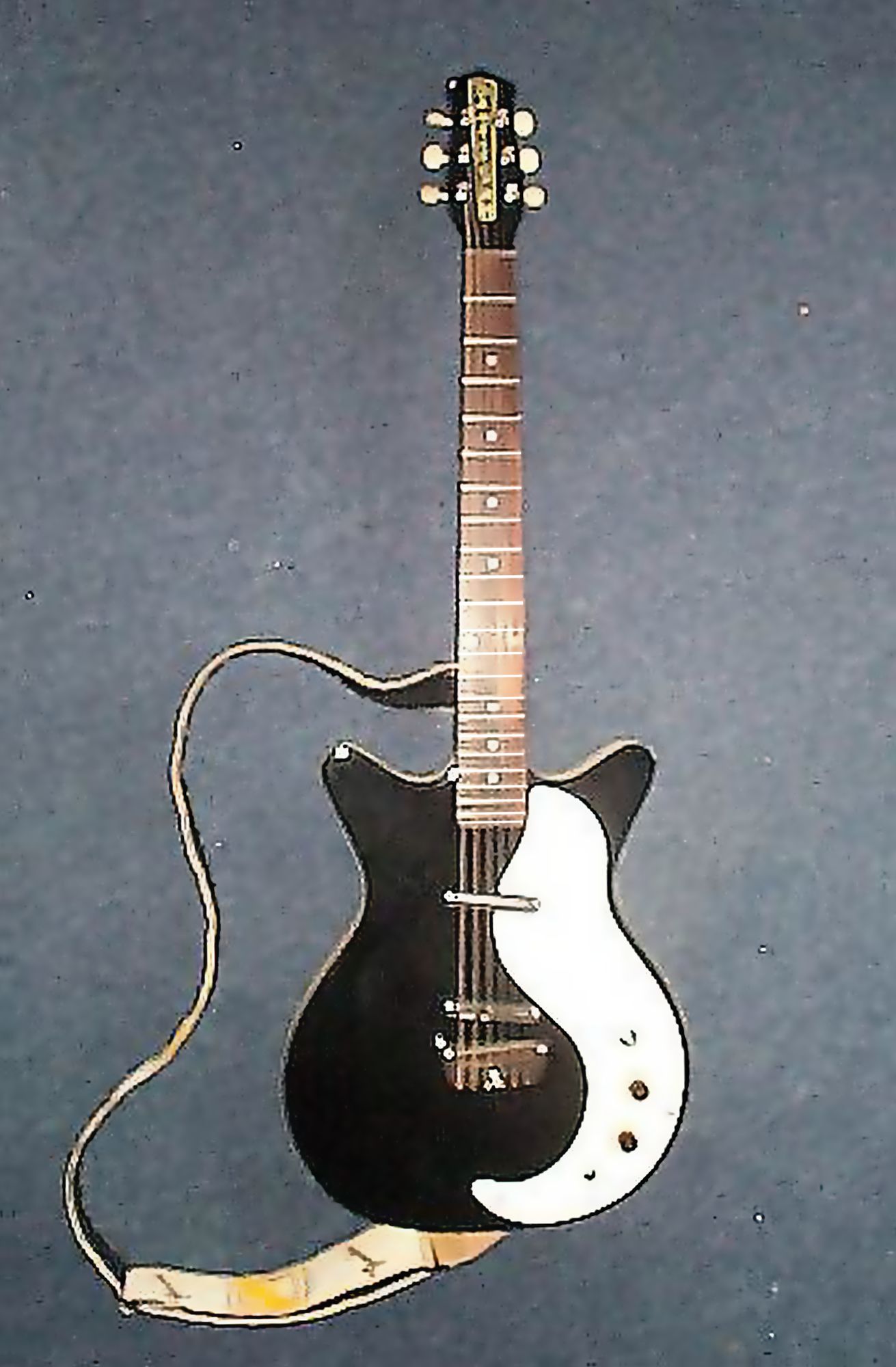
Danelectro 59-DC. Photo by Sander van Malssen. Licensed under CC BY-SA 2.0. Via Wikimedia Commons. Danelectro
59
1958
Jimmy Page’s has been shown at the Met. The same two lipsticks and coke-bottle head are hanging on a shop wall near you.
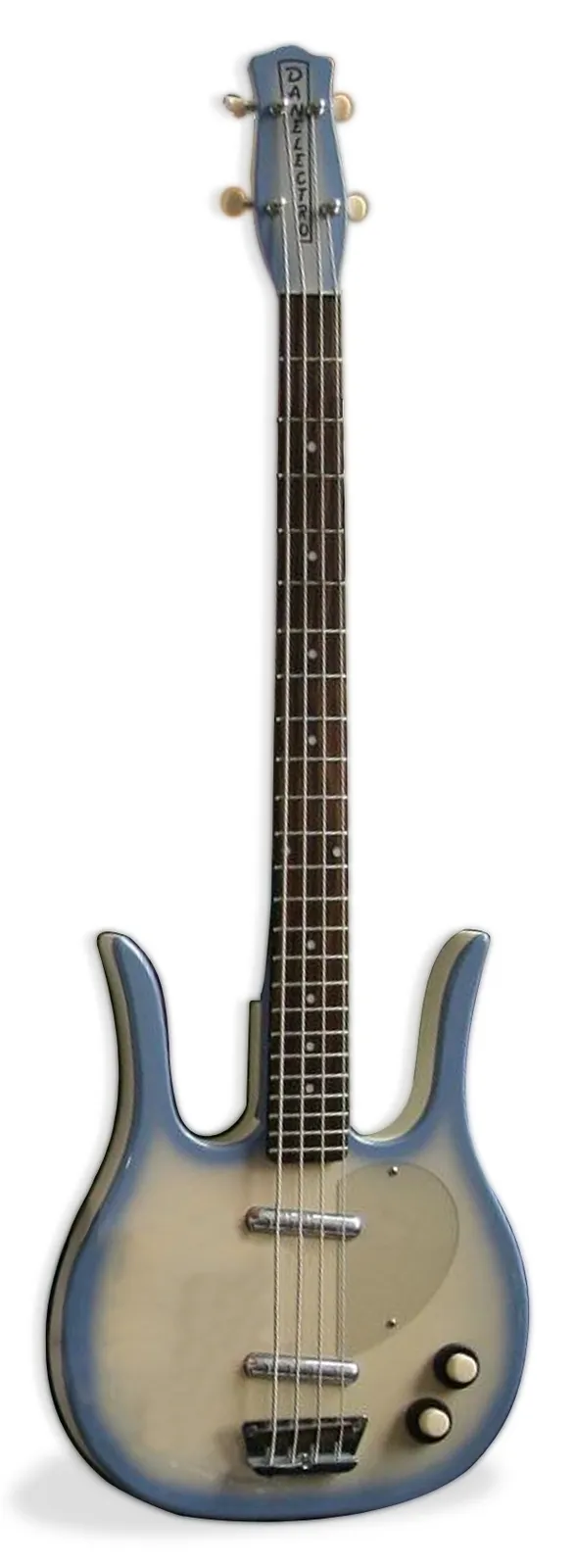
Photo: emily przybylinski / Wikimedia Commons / CC BY 2.0 Danelectro
Longhorn
1958
Garry Tallent worked in the Danelectro plant as a teenager. On Born to Run, he played its Longhorn.
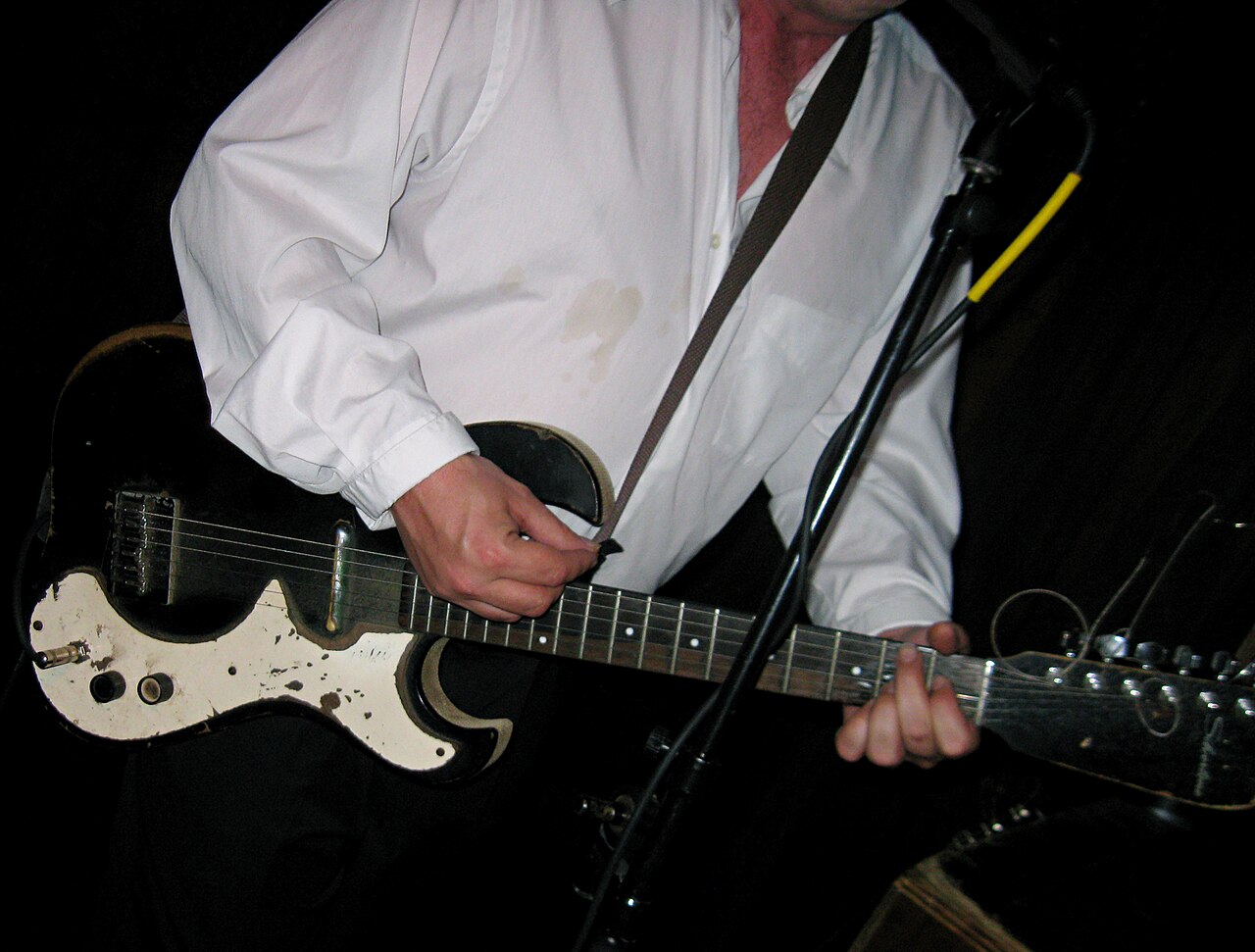
Photo: Rick Hall / Wikimedia Commons / CC BY 2.0 Silvertone
1448
1962
A beginner’s electric from the Sears catalog, with the amp in the case. Beck has played one his whole career.