Music Man
Silhouette
People laughed at Music Man’s first guitar. Then Keith Richards picked one up.
New Orleans, summer 1985. The Ball family’s string company owns Music Man now, which mostly means a famous name, a warehouse, and Leo Fender’s bass. At the NAMM show, the company brings four prototypes of the company’s first guitar. It doesn’t have a name yet. People laugh.
- Introduced
- 1986
- Type
- Solidbody electric
- Class
- Production
Have a photograph of this guitar? Send a picture
The short version
1984
Buying a name
On 7 March, Ernie Ball buys Music Man. Trademarks, inventory, a warehouse, no factory.
1985
Four prototypes
Summer NAMM in New Orleans. The guitar is called the “Ernie Ball Music Man Guitar.”
1986
Production
The design is finalized, production starts, and an in-house contest picks a name.
1987
Officially the Silhouette
Music Man officially introduces it as the Silhouette, by most accounts.
1992
Keith talks
Richards tells Guitar Player his new Music Mans are the most impressive guitars since the Tele or the Strat.
1995
The Special
A 22-fret sister arrives. The original keeps its 24.
2007
Twenty years
A 20th Anniversary model, counting from 1987.
Side A
A1
A name, a warehouse, and somebody else’s bass
On 7 March 1984, Sterling Ball bought Music Man. What he got was the trademarks, some inventory, and a warehouse. No factory. The famous name on the building was Leo Fender’s, and the thing that still sold was Leo’s StingRay bass.
That’s a strange spot to be in. You own a name that means something, and nothing you’ve built yet has earned it. The first instrument Ernie Ball’s Music Man made, in 1985, was the StingRay, Leo’s design. Leo’s StingRay guitar had already died. If the new company wanted a guitar, it was going to have to make one of its own.
Ball hired Dudley Gimpel, who had quit his job at Valley Arts first, so Ball wouldn’t be stealing an employee from one of his dealers. Gimpel’s job was simple to say: we need a guitar.
A2
Small enough for the overhead bin
What they built is small on purpose. Music Man describes it as compact enough to fit in an airline overhead bin. It’s contoured, with a Strat-length scale, 24 frets, and a headstock with four tuners on one side and two on the other, a nod to the StingRay bass’s three and one.
The clever bits are the ones a player notices after a week. The truss rod adjusts with a wheel at the heel, so you don’t need a special tool or have to take the strings off. And the pickups came mounted on swappable pickguards that plugged in, over a body routed out like a swimming pool underneath. Two humbuckers, three single-coils, a humbucker and two singles: a dealer could change the whole personality of the guitar without picking up a soldering iron.
Today’s version is the humbucker-single-humbucker one, with DiMarzio’s Virtual PAFs. DiMarzio doesn’t sell those anymore, so this guitar is the last place to get them.
A3
The guitar with no name
Gimpel took four prototypes to the summer NAMM show in New Orleans in 1985. The guitar was called the “Ernie Ball Music Man Guitar,” which is a description, not a name. Ball says people laughed.
They kept going. The design was finished at the winter show in 1986, and production started that year. For about the first year and a half, the headstock said Ernie Ball Music Man and nothing else. An in-house contest in 1986 came up with “Silhouette.” Music Man has said it unveiled the Silhouette in 1986, and most accounts put the official launch in 1987. Call it a guitar that was built in 1986 and introduced by name in 1987.
Flip the record · By the numbers
4
Prototypes at the 1985 summer NAMM show, before the guitar had a name.
24
Frets, on a body small enough for an airline overhead bin.
4+2
Tuners on the headstock, an echo of the StingRay bass’s 3+1.
~1½
Years the headstock said Ernie Ball Music Man instead of Silhouette.
Side B
B1
Keith
Then Keith Richards started playing one, and kept playing them through the ’80s and ’90s. He didn’t do it quietly. In 1992 he told Guitar Player: “Those new Music Mans I’ve been using — they impress the shit out of me.”
He liked the swappable pickups: “you can change that configuration of pickups in a few minutes.” Music Man built him a five-string, which, for a man who plays in open G with the low string taken off, is the right number of strings.
And he said the basic guitar was “the most impressive guitar since the Tele or the Strat.” He never said which model he meant. But by most accounts the Music Mans he was playing in those years were Silhouettes.
Then Keith Richards started playing it and they called me a genius.
That’s Sterling Ball, looking back. Ron Wood played them too.
B2
Still here
In 1995 Music Man added a sister, the Silhouette Special, with 22 frets so the neck pickup lands where a Strat’s does. The 24-fret original stayed. In 2007 a 20th Anniversary model counted the years from 1987. Steuart Smith of the Eagles played a limited-edition Silhouette double-neck, six and twelve strings, for “Hotel California” at the Kennedy Center Honors.
Go back to what Keith said. The Tele and the Strat were Leo Fender’s guitars, the ones the Music Man name leaned on when Sterling Ball bought it with no factory and a bass somebody else designed. The first guitar the new owners made, the one people laughed at in New Orleans, got held up next to Leo’s two best. The name had been bought in 1984. The Silhouette is how they paid for it.
Put this on
You’ve read about it. Now hear it. Here’s what this guitar sounds like, and what to listen for.
Hotel California (Kennedy Center Honors)
Smith played a limited-edition Silhouette double-neck, six and twelve strings, for this one. It’s the one big named performance tied to a Silhouette.
Watch it on YouTube (opens in a new tab)
The cast
The people, and the specific guitars, that made the legend.
1984
Sterling Ball
The buyer
Bought Music Man, needed a guitar, and got laughed at. Then Keith Richards started playing it.
1985
Dudley Gimpel
Designer
Hired to make Music Man a guitar. The first four prototypes went to New Orleans in 1985.
1992
Keith Richards
Silhouette, and a five-string
Played Silhouettes through the ’80s and ’90s. Music Man built him a five-string too.
Ron Wood
Silhouette
Keith’s bandmate. Music Man lists him among its Silhouette players.
Steuart Smith
Silhouette double-neck, 6/12
A limited-edition double-neck for “Hotel California” at the Kennedy Center Honors.
Liner notes
Specs, construction, rarity, value, and every source we used.
A compact alder body, a 4+2 headstock, and 24 frets — Music Man’s first Ernie Ball guitar, not the StingRay bass.
- Body
- Alder, double-cut, contoured; 12-1/4" wide, 1-3/4" thick, 36-1/2" long (31.2 cm, 4.5 cm, 92.7 cm). Mix flagged.
- Neck
- Bolt-on maple, 5-bolt sculpted joint; gunstock oil and hand-rubbed wax
- Fingerboard
- Select maple or rosewood, 10" (25.4 cm) radius, 24 high-profile medium-width frets. Mix flagged.
- Scale
- 25-1/2" (64.8 cm). Mix flagged.
- Pickups
- HSH — two DiMarzio Virtual PAF humbuckers, one DiMarzio custom single-coil
- Hardware
- Music Man strings-thru hardened steel, solid steel saddles (standard); optional Music Man vintage tremolo, bent steel saddles; Schaller M6-IND locking; 4+2 headstock 5-7/8" (14.9 cm)
- Electronics
- 250k volume and tone, .047µF tone cap, 5-way lever; graphite-acrylic cavity, aluminum-lined pickguard
- Finish
- High gloss polyester body; optional matching painted headstock
- Nut
- 1-5/8" (41.3 mm) at nut, 2-1/4" (56.9 mm) at last fret. Mix flagged.
Open the full research fileConstruction details, the complete player record, production numbers, dated value estimates, and sources
Current typical = hosted Silhouette HSH (San Luis Obispo; music-man.com, fetched 2 September 2026). Factory mixed inch/mm flagged; no millimetres invented. Shop cart Silhouette Black SKU 520-01-11-01-MB-CR listed $2,464.15, sold out this pass. Silhouette Special (22-fret HSS, Silent Circuit, 1995) is a sister, not this table. Silhouette Bass Guitar is a six-string bass-range sibling, not this guitar. StingRay is a bass — other slug.
Construction
The job was a guitar Ernie Ball Music Man could stand next to the bass that still sold. Sterling Ball bought Music Man on 7 March 1984 — trademarks, inventory, a warehouse, no factory (StingRay plate; Guitar World, Chris Gill, 16 September 2022). The first Ernie Ball instrument was a StingRay bass, 1985. This plate is not that bass. Leo’s StingRay 1 guitar had already died. Dudley Gimpel, hired after he quit Valley Arts so Sterling would not steal a dealer’s employee, was told they needed a guitar.
What they built is small on purpose. Official buying guide (Casey Ball, 16 February 2017): compact enough for an airline overhead bin. Alder, contoured, 25-1/2" scale, 24 frets, 10" radius, a 4+2 headstock that echoes the StingRay’s 3+1. Truss-rod wheel at the heel — no special tool, no string removal. Modular pickguards on Molex connectors over a swimming-pool route, so a dealer could swap HSH, HSS, SSS, or HH without a soldering iron. That is the original idea. It is still the living table: two Virtual PAFs and a custom DiMarzio single-coil.
1985. Gimpel, Ernie Ball Forums: the first four prototypes went to Summer NAMM in New Orleans. Official buying guide dates the same show and the first name: “Ernie Ball Music Man Guitar.” Sterling, to Gill: people laughed. Gimpel’s factory-tour tape: one early headstock still said Biffle Caster under the logo.
1986. Gimpel: Winter NAMM finalized the design. Production started that year. Serial 86034 is a named early example (Reverb listing with EBMM customer-service confirmation). Gimpel’s tape: for about the first year and a half the headstock still said Ernie Ball Music Man, not Silhouette. An in-house contest in 1986 named it. Official Ernie Ball archive (Wayback, 2007): “In 1986, Music Man unveiled the Silhouette.”
1987. Guitar World (Gill, 10 May 2007, 20th-anniversary review): “Introduced 20 years ago.” Gill again, 2022: “Two years later in 1987, Music Man officially introduced its first guitar model, the Silhouette.” Reverb News (29 July 2021): the 20th Anniversary celebrated “the two-decade anniversary of its first-ever guitar model.” Keep 1985 as NAMM prototypes, 1986 as production of the unnamed guitar, 1987 as the name. This plate starts in 1986.
Early construction is not the current table. Gimpel: six-bolt neck joint first, later five-bolt for a smoother heel. Forum CS (Dan, quoting Dudley, 2008): earliest bodies could be poplar, alder, or ash; by 1989 translucent red was alder. Original trem was a Schaller single-locking with roller saddles and a lock behind the nut (Ernie Ball Forums, 2005); the living option is Music Man’s vintage two-point, or strings-thru. Oil-and-wax necks arrive later — Gimpel’s 1985 NAMM guitar still had a finished maple neck.
1995. Silhouette Special: 22 frets so the neck pickup sits where a Strat’s does, HSS or SSS, Silent Circuit, vintage trem standard (buying guide; Vintage Guitar, Pete Prown, May 2004). Virtual PAFs are discontinued at DiMarzio; the buying guide says the Silhouette line is the remaining way to play them. Special is a sister. Not this table.
2007. 20th Anniversary (Gill; Reverb News): rear-routed electronics, book-matched flame or quilt maple over alder, a mahogany tone block under the pickups, two custom DiMarzio humbuckers, 3-way instead of 5-way. Gill: it is a Silhouette/Axis hybrid, not the stock HSH. One unplayed Vault example left the factory shop in 2021. That is one object. Not a census.
Current production is a hosted page, not a fat dealer cart. The Silhouette collection is still two instruments on music-man.com. The Black HSH shop SKU is sold out at $2,464.15. Roy Ziv Inspired Silhouette Special (Buttercream, $2,999) is a 2026 limited of the 22-fret sister — not this table. Harmony’s 1963 Silhouette, later Bobkat, is a different maker. StingRay II (Cory Wong, NAMM 2025) is a different guitar.
Classic vs current: 1986–87 unnamed-then-named SLO bolt-on — swimming-pool route, Molex guards, 24 frets, 4+2, six-bolt then five — against the hosted HSH: alder, Virtual PAFs, strings-thru or vintage trem, oil neck, $2,464.15 when the cart has one.
Players
Keith Richards (The Rolling Stones). The reason a compact SLO guitar got taken seriously. Jas Obrecht and Jesse Gress, Guitar Player, 17 September 1992 (published December 1992): “Those new Music Mans I’ve been using — they impress the shit out of me.” The basic guitar: “the most impressive guitar since the Tele or the Strat.” He did not name the model. He described the modular pickups: “you can change that configuration of pickups in a few minutes.” They made him a 5-string and a 6-string bass. Sterling, to Gill (2022): “Then Keith Richards started playing it and they called me a genius.” Guitar World (Jonathan Horsley, 24 May 2021): through the ’80s and ’90s he played a Music Man Silhouette. Gill’s 2007/2022 paraphrase — “has the opportunity to become like the Stratocaster or Telecaster or Les Paul” — is Gill’s wording of a Guitar Player interview, not the 1992 transcript above. Keep both. Do not hang Micawber or a Tele on this plate.
Steuart Smith (Eagles). Official buying guide: limited-edition Silhouette double-neck 6/12 on “Hotel California” at the Kennedy Center Honors. Named object. Not the six-string HSH table.
Also known to play (buying guide / archive Ernie Ball, last, short): Johnny Hiland; Ron Wood. Albert Lee’s 1993 Music Man is the Albert Lee model, not this guitar. Steve Morse’s signature is a different silhouette (Vintage Guitar, May 2004). Eddie Van Halen’s 1991 Music Man is Axis, later Peavey, later EVH Wolfgang — other plates. St. Vincent is a Harmony Bobkat idea, not a Silhouette.
Rarity
Ernie Ball Music Man does not publish Silhouette unit totals. None invented.
Serials date a guitar, they don’t count a factory. Early EBMM serials were reused; the customer-service database starts 1988 (named 1986 example 86034). That overlap is why a first-year count is unknown, not the chapter. 1986 unnamed headstocks and 1987 first-named examples are the thinner window. Six-bolt heels, Schaller locking trems, and ash/poplar bodies sit at the scarce end of the same slug. The 20th Anniversary is a different recipe; Reverb News’s 2021 Vault guitar is one leftover, not a run total. You can still open the factory page. Dealer stock is thin. Vault and the Roy Ziv Special are how a new one actually appears. Keith’s 5-string and Smith’s 6/12 are unique. They are not a vintage Silhouette.
Value
Informal estimate, 2 September 2026. Not an appraisal.
Ask vs sold labeled. Celebrity lots are not-comps. No invented medians or factory counts. Reverb Price Guide widget on the Silhouette product page did not print a clean band in the static fetch this pass.
New street. Factory shop Silhouette Black $2,464.15, sold out this pass (SKU 520-01-11-01-MB-CR). Roy Ziv Inspired Silhouette Special $2,999 is a limited 22-fret sister, labeled adjacent. Vintage Guitar, May 2004: Special list $1,665, piezo $1,965 — historical, not 2026 street.
Used modern. Named asks this pass, not hammers: 2004 Sparkle Sunburst Silhouette $1,615.50 (from $1,795); 1992 SSS Teal $1,615.50 (from $1,795); 2001 Red Sparkle $1,399 (from $1,699); HSH hardtail, Fair, $1,100. Silhouette Special HSS Tremolo Reverb Price Guide $933–$1,627 based on 65 orders Good to Mint — labeled Special, not this 24-fret. Named Special solds on that guide, not a midpoint: 12 November 2025 Good $1,200; 4 November 2025 Very Good $1,099; 9 August 2025 Excellent $1,699; 30 July 2025 Excellent $1,710. Do not average Special solds into a Silhouette median.
Vintage / collectible. 1986–87 first-year unnamed-then-named examples are the scarce end of the same guitar, not a separate SKU. A 20th Anniversary ended listing at $2,992.03 is an ask, not a 2026 hammer. Keith’s and Smith’s are unique. They are not a street tape.
See also
- music-man-stingray — Leo’s 1976 post-CBS bass; not this guitar
- fender-stratocaster — 25.5" bolt-on the Silhouette was answering
- evh-wolfgang — EVH-brand Wolfgang, not Music Man EVH / Axis, not this slug
Sources
- Ernie Ball Music Man: Silhouette — first production guitar; alder; 24 frets; HSH Virtual PAF + custom SC; 25-1/2" / 64.8 cm; 5-bolt; Schaller M6-IND; mixed inch/mm
- Ernie Ball Music Man: Silhouette Guitar Buying Guide (Casey Ball, 16 February 2017) — 1985 New Orleans NAMM; first name “Ernie Ball Music Man Guitar”; Special 1995; 22 vs 24; Silent Circuit; Johnny Hiland; Keith Richards; Steuart Smith 6/12 Kennedy Center
- Ernie Ball Music Man shop: Silhouette Black — SKU 520-01-11-01-MB-CR; $2,464.15; sold out this pass
- Ernie Ball Music Man shop: Roy Ziv Inspired Silhouette Special — $2,999; 22-fret Special, not this table
- Ernie Ball Music Man: Silhouette Special — 22 frets; HSS; Silent Circuit; vintage trem
- Guitar World, Chris Gill, 10 May 2007 — 20th Anniversary; “introduced 20 years ago”; Keith GP paraphrase; Special features from 1995; maple cap, mahogany block, HH
- Guitar World, Chris Gill, 16 September 2022 — 7 March 1984 purchase; StingRay bass 1985; “officially introduced” Silhouette 1987; Gimpel hire; Sterling on Keith
- Guitar World, Jonathan Horsley, 24 May 2021 — Silhouette through the ’80s and ’90s
- Guitar Player, Jas Obrecht / Jesse Gress, 17 September 1992 — “most impressive guitar since the Tele or the Strat”; modular pickups; 5-string and 6-string bass
- Vintage Guitar, Pete Prown, May 2004 — Special 22-fret; Silent Circuit; list $1,665 / $1,965 piezo; Morse model is a different guitar
- Reverb News, 29 July 2021 — 2007 20th Anniversary as two-decade mark; Caramel Burst, flame maple, DiMarzio PAF humbuckers
- Ernie Ball Forums, Dudley Gimpel, History of EB MM guitars — 1985 Summer NAMM four prototypes; Winter NAMM 1986 finalized; named Silhouette 1987
- Ernie Ball archive (Wayback, 6 February 2007) — 1986 unveiled; 4+2; Keith and Ron Wood; Special 1995
- Reverb Price Guide, Silhouette Special HSS Tremolo — $933–$1,627 / 65 orders; named 2025 solds
- Reverb, Ernie Ball Music Man Silhouette — HSH Tremolo 2015–2026; Price Guide widget blank this pass; named asks
- Ernie Ball Music Man: NAMM 2025 — StingRay II is a different guitar
Keep digging
Guitars this one gets compared to, confused with, or descended from.
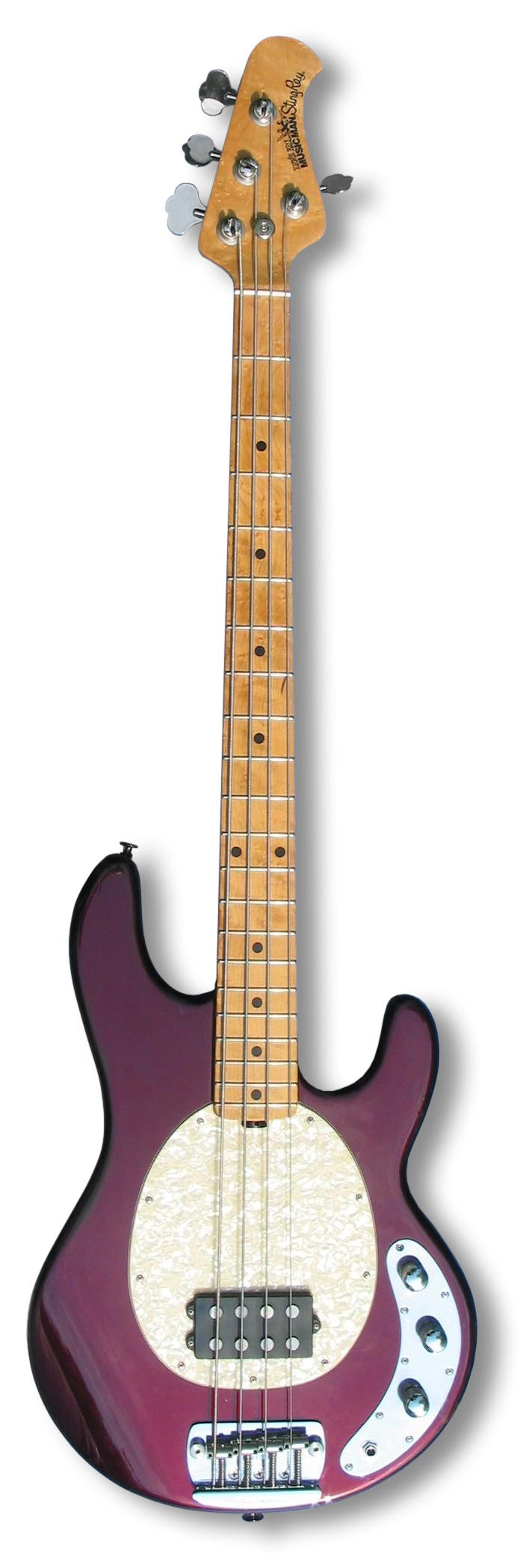
Photo: Th. Ott / Wikimedia Commons / CC BY-SA 3.0 Music Man
StingRay
1976
Leo Fender wanted a wide, bright bass. Louis Johnson hit it with his thumb, and funk had its sound.

Photo: Lightburst / Wikimedia Commons / CC BY-SA 4.0 Fender
Stratocaster
1954
The guitar most people mean when they say “electric guitar.” Designed by a man who didn’t play one.
- Send a picture
EVH
Wolfgang
2009
Eddie named it for his son. It took three companies before it lived under the family name.