Vigier
Excalibur
Patrice Vigier gave his strangest ideas the most ordinary body he could find, so people would pick them up.
Évry, outside Paris, 1991. Patrice Vigier has spent a decade building guitars that look like nothing else, and a lot of players walk right past them. So he draws a double-cut that looks like everybody else’s, and keeps his strange neck exactly as it was.
- Introduced
- 1991
- Type
- Solidbody electric
- Class
- Production
Have a photograph of this guitar? Send a picture
The short version
1980
The Arpège
Vigier moves from his parents’ garage to a workshop in Évry. His flagship is neck-through, active, and unmistakable.
1989
The 10/90 neck
A strip of carbon where the truss rod would be. Nothing to adjust.
1991
The Excalibur
“A more conventional design,” as the company put it, around the same unconventional neck.
1993
Most innovative
A trade paper names it the most innovative guitar of the year.
1995
Shawn Lane
Lane picks up an Excalibur Supra and plays nothing else until his death in 2003.
1997
Bumblefoot
Handed an Excalibur on his first French tour, Ron Thal plays the show on it.
2025
Closed
Vigier finishes the last guitars on the bench and retires.
Side A
A1
Nobody would pick it up
Some guitars fail because they’re bad. Vigier’s first ones had a different problem: they looked so unusual that a lot of players never took them off the wall.
Patrice Vigier started in his parents’ garage and moved to a workshop in Évry, south of Paris, in 1980. His catalog guitar was the Arpège. It was neck-through, with a metal plate under the fingerboard, active electronics, and a shape that announced itself from across the room. The trouble was getting people to play it.
He told a British journalist exactly what the new one was for:
The Excalibur is a compromise between what Vigier think is right and people think is right.
A2
An ordinary body, on purpose
So the Excalibur looks like a lot of other guitars. Double cutaway, two pieces of alder, bolt-on neck, a humbucker at each end and a single-coil in the middle. If you squint from the back of the bar, it could be anything from the early ’90s. The company’s own word for it was “a more conventional design.”
That was the bait. He said much the same thing again years later: if players won’t try a guitar because of its shape, the guitar never gets a chance. The outline went ordinary. The neck did not.
A3
The neck with nothing to turn
In 1989 Vigier had come up with what he called the 10/90 neck: ten percent carbon, ninety percent maple, with a strip of carbon sitting where a truss rod would be. There is no truss rod. There’s nothing to turn. The idea is that the neck stays put, through weather and string changes and whatever else, and you never go looking for an Allen key.
People still argue about whether that’s brilliant or a little scary. I lean brilliant. It was still in the catalog more than thirty years later.
In front of the nut is a zero fret, so an open string sounds against a fret, the same as a fretted note. The bridge is a Floyd Rose-style tremolo that pivots on bearings instead of the usual knife edges. The five-way switch splits the humbuckers and pairs them with the middle pickup, which gets you a row of thinner, brighter in-between sounds before you reach the full bridge humbucker.
In 1993 a music trade paper named it the most innovative guitar of the year. So much for conventional.
Flip the record · By the numbers
10%
Carbon in the neck. The other 90% is maple, and there’s no truss rod.
24+1
Frets, plus a hardened zero fret in front of the nut.
~500
Instruments a year out of the whole Vigier shop, every model included.
1991
The year the ordinary shape arrived.
Side B
B1
Two players who didn’t play it safe
In 1995 Shawn Lane met Vigier and went straight to an Excalibur Supra, two humbuckers and one single-coil. From then until his death in 2003, it was the only guitar he played. Lane was one of the fastest, most frighteningly fluent players of his generation, and he chose the guitar built to be easy to walk up to. Two years after he died, Vigier and Lane’s family made an improved replica, with a fingerboard that’s completely flat. For years it was the only flat board in the Vigier lineup.
Ron Thal, Bumblefoot, got his the way you’d want to. Vigier’s own history puts him on board as early as 1995, but his telling starts later. On his first French tour, in February 1997, somebody handed him an Excalibur and he played the show on it. That May he had dinner with Patrice and walked away with an endorsement. The first thing he recorded on the Excalibur they sent home with him was the solos on “Brooklyn Steakhouse.” A couple of years later he put a Roland synth pickup on the same guitar for the first version of “Uncool.” The foot-shaped guitar people know him for is a different build entirely.
B2
The last one off the bench
From 1991 on, the Excalibur was a catalog guitar. It wasn’t a limited run or a one-summer fad. In its later years the whole shop, every model, made around five hundred instruments a year, by then in Grigny, where Vigier had moved in the early 2000s. Nobody published how many of those were Excaliburs.
In November 2024 the French papers reported that Vigier was assembling his last instruments. By February 2025, his answer on the company forum was one line:
We do not take any orders, I retired.
The Excalibur outlived the problem it was built to solve. It went out the door looking like somebody else’s guitar, and it came back with a trade award, a flat-board signature, and a Bumblefoot record. The body was a compromise. The neck never had to be.
Put this on
You’ve read about it. Now hear it. Here’s what this guitar sounds like, and what to listen for.
Brooklyn Steakhouse
The first thing Ron Thal recorded on the Excalibur Vigier sent home with him was the solos on this track, from his album Hands.
Find it on YouTube (opens in a new tab)Uncool
The first version of the song, made after he fitted that same Excalibur with a Roland synth pickup. It went out on the Uncool tours in 2001.
Find it on YouTube (opens in a new tab)
The cast
The people, and the specific guitars, that made the legend.
1991
Patrice Vigier
Designer and builder
Started in his parents’ garage, moved to Évry in 1980, and built guitars in France until he retired in 2025.
1995
Shawn Lane
Excalibur Supra
Two humbuckers and a single-coil. He played it exclusively from 1995 until his death in 2003. His signature version has a completely flat fingerboard.
1997
Ron “Bumblefoot” Thal
The Excalibur Vigier sent home with him
Handed one on his first French tour, signed on over dinner with Patrice that May, and cut the “Brooklyn Steakhouse” solos on the one they sent home with him.
1998
Ron Laster
Clear Red Excalibur Supra
Fixed bridge, three Seymour Duncans, on the road with James Brown.
1999
Christophe Godin
Vigier player
Joined Vigier’s roster in 1999.
Liner notes
Specs, construction, rarity, value, and every source we used.
A carbon strip where the truss rod would be, a zero fret, and a bearing-pivot tremolo — the ordinary double-cut Patrice Vigier built so players would actually pick up a Vigier.
- Body
- Two center-joined pieces of naturally aged alder. Double-cut, no maple cap. Varnish dried five weeks minimum.
- Neck
- Bolt-on maple, dried at least three years, D profile, matte. 10/90: 10% carbon, 90% wood, no truss rod. Depth 19.5 mm / .76" at the first fret, 23 mm / .90" at the 12th. Mix flagged.
- Fingerboard
- Maple or rosewood, dots, 300 mm / 11.81" radius, 24 medium frets plus a hardened zero fret. Mix flagged. The sheet does not name the fret alloy.
- Scale
- 650 mm / 25.6". Mix flagged.
- Pickups
- Seymour Duncan HSH: SH-5 neck, SSL-6 middle, TB-5 bridge
- Hardware
- Vigier Floyd Rose pivoting on needle bearings; Vigier tuners; chrome or black. Strap button in a deep brass ferrule. Strings .009–.046. Gig bag.
- Electronics
- Volume, tone, 5-way (neck humbucker; neck split with middle; both splits together; bridge split with middle; bridge humbucker). Shielded. Pots 1 meg log from 2009, 500k log before. Ultra excepted.
- Finish
- Gloss varnish, plus a natural alder matte in the color list. Rock Art is an upcharge on this sheet (“DBF add 2 times the price”), not a second model.
- Nut
- Locking nut plus hardened zero fret. Width 42 mm / 1.65". Mix flagged.
Open the full research fileConstruction details, the complete player record, production numbers, dated value estimates, and sources
Classic living example = last catalog Excalibur Original (VIG-VE6-CV1, factory sheet still on vigierguitars.com; made in France). No new orders: Patrice Vigier, 16 February 2025, “We do not take any orders, I retired.” Supra, Special, and Indus use the non-locking trem and a Teflon string guide, not this locking nut. Ultra is EMG 81 / SA / 85 on a flamed top. Shawn Lane is a flat board at 630 mm / 24.8". Surfreter is fretless (French pages: Surfretter). G.V. is the single-cut. Expert is the other Strat outline. None of those are this table. The English Original sheet prints treble action 1.5 mm / .0059" and bass 2 mm / .0078". Those inch figures do not convert from the millimetres beside them. Not a second setup. Not averaged. Weight on that sheet is 3.5 kg / 7.7 lb. An older Vigier catalog page prints about 6.6 lb / 3 kg. Not averaged. Guitar World’s 2021 Indus prose says a 300 mm (11.6") radius; the same review’s spec box says 300 mm (11.81"). Not averaged.
Construction
The job was to get a Vigier into someone’s hands. The Arpège had been the catalog guitar since 1980: neck-through, a delta-metal plate under the fingerboard, active electronics, a shape that announced itself. Patrice Vigier told a British journalist what the new one was for. The company’s own press, marking the series’ tenth year, prints the line and the year together: in 1991 he offered “a more conventional design,” and “The Excalibur is a compromise between what Vigier think is right and people think is right.” Guitar World (Dave Burrluck, July 2021) has him again in 2012. If players will not try the guitar because of the shape, the guitar never gets a chance. The outline went ordinary. The neck did not.
The history page puts the shape at the start of the 1990s and prints no year. The press does: 1991, and a Supra anniversary line calling that the tenth year. Guitar World in 2021 calls the design thirty. This plate starts in 1991.
The neck was already the point. 1989, the 10/90: 10% carbon, 90% maple, where a truss rod would be. French pages say 90/10, wood first. Same fraction. Burrluck’s 2021 Indus: still argued over, and unlike a Charvel graphite rod there is nothing to turn. The Original sheet says a D. That Indus felt like a graduated C, 19.7 mm at the first fret, 23.35 mm at the 12th. Don’t average them.
A zero fret sits in front of the nut. On the Original the nut locks. On Supra, Special, and Indus it is a Teflon guide, and by 2021 the Indus zero fret is six pieces. The tremolo came with the model. History page: ball bearings, not Floyd knives. The Original sheet: “Floyd Rose pivoting on needles bearings.” Keep both. The non-locking 2011 is the Supra, Special, Indus, and Ultra. Ben, on the factory forum in 2008, separates that bridge from the Floyd. A fixed bridge was no-cost on the 2021 Indus. Not this table.
Original body: two-piece alder, no cap. Custom adds flame maple and a painted head. Patrice, August 2007: the SSS gap is 430 euros, not the 840 a buyer had read off a list. Special is the Supra plus the cap. Ultra is flamed maple and EMG 81 / SA / 85. Indus, matte alder, two DiMarzio humbuckers: 1998 in Guitar World, 1999 in Vigier’s press (“first made in 1999”). Supra and Special: the history page’s 1995, with Lane. Not one SKU.
Two towns. Patrice, Grand Paris Sud: his parents’ garage, then Évry in 1980. Le Parisien, 2 November 2024: Évry, then Grigny from the early 2000s. The sheet says France. It does not put a 1991 guitar in Grigny.
Pots, factory FAQ: 1 meg log from 2009, 500k before, Ultra excepted. Expert is 250k, a 2000 triple-single, not this guitar. Stainless frets spread across the line in the 2010s. This sheet still says “Medium” and skips the alloy. Left-hand Original: not available. The history page calls 2006 the first left-handed Excaliburs. The December 2006 press names them: Special and Indus.
Then the door. Le Parisien, 2 November 2024: he is assembling the last instruments, and production stops. Audiofanzine, 5 November 2024: finish the bench, then close the shop. His forum reply, 16 February 2025: “We do not take any orders, I retired.” Instagram, May 2025: ten G.V. guitars dated 1980–2025, “the year we will cease production.” Ten single-cuts. Not an Excalibur count.
1993. Wikipedia: The Music And Sound Retailer named the Excalibur most innovative guitar of the year. An award. Not a count.
The figure that does exist is the whole shop. Essonne, 2 September 2019: about 500 instruments a year, about twenty people, five luthiers. Grand Paris Sud: about 500 a year from Grigny, four on the build. Wikipedia’s 500 is Le grand livre des métiers (2008), every model. A back-plate serial dates one guitar. It does not count a year.
Players
Do not hang a G.V., an Excess, or a Passion on this plate. Roger Glover’s signature is an Excess. Audiofanzine’s closing note lists Geezer Butler among Vigier users and does not name the model. The company’s press does: Arpège and Excess, both basses. Guthrie Govan’s 2012 clip is a Surfreter.
Shawn Lane. The player the Supra is tied to. Vigier’s press: welcomed in 1995, and he went straight to an Excalibur Supra, two humbuckers and one single-coil. August 1996: first European workshop tour; that release calls him a new endorsee. The tour is new. The 1995 line stays. January 2005, with his family: an improved replica of the guitar he played exclusively from 1995, when he first met Vigier, until his death in 2003. Flat fingerboard. Scale 630 mm / 24.8" against the other Excaliburs. Action 0.7 mm / 0.027" at the 12th. The history page: production of that signature from 2005, and still the only flat board in the lineup when the page was written. That guitar is not the Original in the table. Which records the Supra is on, title by title, is not pinned here.
Ron “Bumblefoot” Thal. His account and the current history page do not match, and both stay. The history page puts him beside Lane in 1995. His own site: first French tour, February 1997, handed an Excalibur, played the show on it. May 1997, dinner with Patrice, an endorsement, and a plan for a guitar that was not a stock shape. Winter NAMM 1998 press still calls him “a recently signed” Excalibur endorser. The Excalibur they sent home is a named object: the first thing he recorded with it was the solos on “Brooklyn Steakhouse,” on Hands. The first version of “Uncool,” 1999, got a Roland synth pickup on that same guitar, then the Uncool tours in 2001. The foot-shaped guitar is a different build. So is the 2006 Bumblefoot signature. Young Guitar, May 2007: DiMarzios, a magnetized hole for the thimble, and “Guitars Suck” on 9.11 as the example. The DoubleBfoot is a doubleneck. None of those is the Original in the table.
Ron Laster. December 1998 press: an Excalibur Supra, Clear Red, fixed bridge, three Seymour Duncan Little ’59s, on tour with James Brown. A Supra. Not the Original in the table.
Also known to play stays short. Christophe Godin joined in 1999, on the factory history page. No record is named there.
Rarity
You cannot order a new one. The close is already dated: November 2024 in Le Parisien and Audiofanzine, no orders from 16 February 2025.
From 1991 until that close it was a catalog guitar, not a one-summer run. About 500 instruments a year is the whole shop. Vigier never published an Excalibur total. A 1991 census is unknown for that reason. The back plate dates one guitar. It does not count a year.
What is actually thinner is not “a used Excalibur.” A first-year Original, if the plate will date it. Lane’s own Supra, which is not the 2005 replica. The 2000 jeweled Surfreter, one fretless, valued at €30,000 (Wikipedia). The ten 1980–2025 G.V.s are the other model, and the company printed the ten.
Value
Informal estimate, 22 September 2026. Not an appraisal.
Ask and sold stay labeled. Celebrity lots are not comps. No invented medians. The 430 euros Patrice quoted in 2007 is a catalog gap between Original and Custom, not 2026 street. Company output of about 500 a year is not a price.
New street. None from Vigier. Patrice, 16 February 2025, takes no orders. Named leftover asks, not hammers: Stars Music, an Original HSS in Rock Art, €4,359, marked unavailable. A 2024 Supra Rock Art on Reverb (Nice), new, asking €4,400 after a drop from €4,600 — a Supra, not this table. One sold new Original, not a series: Broc Music (Nîmes), Original HSH, €3,590 including VAT. The listing does not print a hammer date. Do not average those. Historical lists, not a cart: Guitar World, July 2021, Indus £2,431 with the gigbag; Special from about £2,946. Premier Guitar, 15 January 2009, Ultra Blues MSRP $3,691, street $3,138. Premier’s Special 7 street of $3,495 (April 2013) is a seven-string.
Used modern. Asks on Reverb’s Vigier electrics index, this pass, not sold medians: an Indus in excellent condition at $2,500; a 2020 Indus at $3,000 (cut from $3,210); a 2023 Ultra Blues at $3,100 (cut from $3,400); a 2002 Ultra at $3,027.40; a refinished 2008 Special at $2,800. Audiofanzine’s Original HSH “market value” of $2,033.33 is older than six months and built from classified quotes, not retail. No clean sold series isolated. Flag: thin sold-comp access. A factory-forum ask, 19 April 2026, of $3,300 for a 2024 SpeciAl is one seller. Not a hammer. Not an Original.
Vintage / collectible. A 1991 guitar is early. It is not a separate published price band this pass. A 2018 Original HSS Rock Art, brand new, shows sold at $4,434.71 (Reverb). The listing does not print a hammer date. That sale is not a first-year guitar.
Bumblefoot’s own Surfreter, listed at $5,555 after a drop from $7,777, is a named object and a fretless. Not a comp. The jeweled 2000 Surfreter at €30,000 is one object. Not a comp.
See also
- fender-stratocaster — the outline he bent toward; this neck has no truss rod
- parker-fly — 1993 carbon-glass solidbody, set neck and a piezo, not a 10/90 bolt-on
- suhr-classic-s — the modern bolt-on Guitar World set next to Indus money; still a truss rod
Sources
- Vigier, History — Arpège 1980; 10/90 in 1989; Excalibur at the start of the 1990s, year not printed; ball-bearing Vigier/Floyd; Supra and Special 1995 with Lane and Thal; Godin 1999; Surfreter 1998; Expert at the turn of the century; Lane signature production 2005, only flat board; Bumblefoot and first left-handed Excaliburs 2006; stainless frets across the line in the 2010s; Govan on a Surfreter, 2012
- Vigier press archive — 1991 conventional design; compromise quote; Supra anniversary as the series’ tenth year; Lane welcomed 1995 on a Supra; August 1996 workshop tour; January 2005 Lane replica, flat board, 630 mm / 24.8", action 0.7 mm / 0.027"; Indus “first made in 1999”; Thal “recently signed” for Winter NAMM 1998; Floyd on ball bearings instead of knives; December 2006 left-handed Special and Indus; Geezer Butler on Arpège and Excess; Ron Laster, December 1998, Clear Red Supra, fixed bridge, three Little ’59s, James Brown tour
- Vigier catalog, Excalibur Original VIG-VE6-CV1 — alder; 10/90 D neck; 42 mm / 1.65" locking nut; 300 mm / 11.81"; 24 plus zero; 650 mm / 25.6"; SH-5 / SSL-6 / TB-5; Floyd on needle bearings; 3.5 kg / 7.7 lb; action 1.5 mm / .0059" and 2 mm / .0078"; France; left-hand not available; Rock Art upcharge line
- Vigier FAQ (French) — Excalibur pots 1 meg log from 2009, 500k before, Ultra excepted
- Older Excalibur catalog page — about 6.6 lb / 3 kg
- Vigier forum, Patrice on Original vs Custom, August 2007 — flame top and painted head; 430 euros, not 840
- Vigier forum, Ben on body wood and the 2011 trem, July 2008 — alder bodies; maple tops; 2011 distinct from the earlier trem
- Vigier forum, 16 February 2025 — “We do not take any orders, I retired.”
- Vigier forum, 19 April 2026 — ask $3,300 for a 2024 SpeciAl
- Vigier Instagram, May 2025 — ten G.V. guitars, 1980–2025; production ceases in 2025
- Guitar World, Dave Burrluck, Excalibur Indus, 14 July 2021 — 30-year-old design; 2012 shape quote; Indus 1998; 10/90 with no truss rod; six-piece zero fret; 2011 trem; £2,431; Special from about £2,946; measured neck and the 11.6" / 11.81" radius split; Suhr money in the same sentence
- Wikipedia, Vigier Guitars — Excalibur 1991; Surfreter 1998; Excess 1996; jeweled Surfreter €30,000 in 2000; Lane signature 2005; Bumblefoot signature 2006; G.V. 2009; retired 2025; average 500 instruments a year (Le grand livre des métiers, 2008); 1993 Music And Sound Retailer award
- Le Parisien, Florian Garcia, 2 November 2024 — Évry, then Grigny from the early 2000s; last instruments; production ending
- Audiofanzine, Jean-Baptiste Heuclin, 5 November 2024 — finish guitars in progress, then close; brand players named there include bassists
- Grand Paris Sud magazine — garage, then Évry 1980; Grigny from the early 2000s; about 500 a year; four people building
- Essonne, 2 September 2019 — about 500 a year; about twenty people, five luthiers
- Bumblefoot, Vigier Excalibur — February 1997, May 1997, Brooklyn Steakhouse on Hands, Uncool 1999 and the 2001 tours
- Young Guitar, May 2007, Bumblefoot interview — 1997 meeting; signature series; thimble hole; “Guitars Suck” on 9.11
- Premier Guitar, Ultra Blues, 15 January 2009 — MSRP $3,691, street $3,138
- Premier Guitar, Special 7, 15 April 2013 — street $3,495; a seven-string
- Stars Music, Original HSS Rock Art — €4,359, unavailable
- Reverb, Broc Music Original HSH — new, sold listing €3,590 including VAT; hammer date not printed
- Reverb, 2018 Original HSS Rock Art — brand new, sold listing $4,434.71; year 2018; hammer date not printed
- Reverb, 2024 Supra Rock Art — new ask €4,400 from €4,600; a Supra
- Reverb, Vigier electric guitars — used asks this pass; Bumblefoot Surfreter ask $5,555 from $7,777, not a comp
- Audiofanzine, Original HSH market value — $2,033.33, older than six months, classified quotes
Keep digging
Guitars this one gets compared to, confused with, or descended from.

Photo: Lightburst / Wikimedia Commons / CC BY-SA 4.0 Fender
Stratocaster
1954
The guitar most people mean when they say “electric guitar.” Designed by a man who didn’t play one.
- Send a picture
Parker
Fly
1993
Ken Parker built it like a lobster: wood on the inside, and all the strength in a skin thinner than the paint.
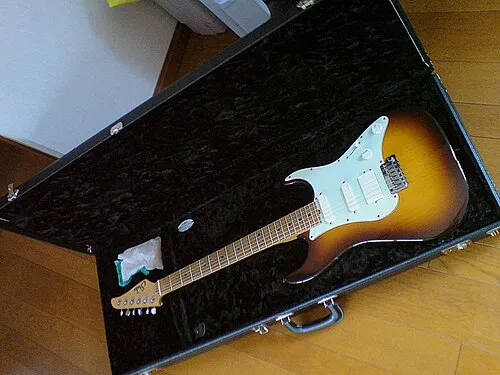
Photo: Akkun542 / Wikimedia Commons / Public domain Suhr
Classic S
2018
It looks like a Strat on purpose. Everything that’s different about it, you feel instead of see.