Boss
CE-2 Chorus
Guitarists asked for chorus in a box they could carry. Steve Stevens can’t imagine his songs without it.
New York, 1983. Billy Idol is making Rebel Yell, and Steve Stevens has a complete Boss pedalboard at his feet. One of the boxes on it is light blue, with two knobs, and it’s on his guitar tracks.
- Introduced
- 1979
- Effect
- Modulation
No photograph of this pedal yet. Have one? Send a picture
The short version
1975
The amp that did it first
Roland’s JC-120 Jazz Chorus amp comes out with chorus built in.
1975 or 1976
The big box
Boss puts the amp’s chorus and vibrato in the CE-1 Chorus Ensemble, a large, mains-powered stereo unit. The counts don’t agree on the year.
1977
The compact line
Boss launches its small battery-powered pedals, six of them. None is a chorus.
1979
Chorus to go
Guitarists ask for the effect in the compact series, and get the CE-2, tweaked for guitar.
1983
Rebel Yell
Steve Stevens records Billy Idol’s album with a complete Boss pedalboard, the CE-2 and a CS-1 compressor among it.
2016
Waza Craft
The CE-2W brings the CE-2 sound back, in stereo for the first time, with a CE-1 mode on the side.
2021
Marr says thanks
Accepting Boss’s Lifetime Achievement Award, Johnny Marr thanks it for the CE-2, “such a big part” of his sound in The Smiths.
2025
Stevens says where
Stevens takes the same award and names the songs, “Eyes Without a Face” and “Flesh for Fantasy.”
Side A
A1
A board full of Boss
New York, 1983. Billy Idol is making Rebel Yell across three studios, Electric Lady, RPM, and Mediasound, with Keith Forsey producing. Steve Stevens is on guitar, and he has come a long way from the kid who saved his paper route money for a Boss OD-1 overdrive. For this record he has a complete Boss pedalboard.
One of the boxes on it is little and light blue, with two knobs, and Stevens would later name two of the songs it’s on.
It’s a Boss CE-2 Chorus. And it exists because guitarists asked for it.
A2
The trick came from an amp
Chorus started at Roland, Boss’s parent company, inside an amplifier. The JC-120 Jazz Chorus came out in 1975 with the effect built in. Then Boss lifted the same chorus and vibrato circuits out of the amp and put them in a box of their own, the CE-1 Chorus Ensemble. Some count that as 1975 and some as the following year.
Here is what chorus does. The pedal copies your signal, delays the copy by a sliver of time, and keeps nudging its pitch up and down. Blend the two together and one guitar sounds like two that are very slightly out of tune with each other. The note shimmers and spreads.
The CE-1 did that beautifully, in stereo. It was also large and plugged into the wall. In 1977 Boss started its compact line, small battery-powered pedals you could line up on the floor, six of them at launch. None of them was a chorus.
A3
Smaller, please
That gap didn’t last. Once the compact series was out, guitarists started asking for chorus in the small box too.
The answer came in 1979: the CE-2, a modified version of the CE-1’s chorus, specially tweaked for guitar. Getting it into a stompbox meant leaving things behind. The vibrato went, and so did the stereo output, the volume and intensity knobs, and the built-in power supply.
What was left is about as simple as a pedal gets. Rate sets how fast the pitch wobbles. Depth sets how wide it swings. Inside, a bucket-brigade chip passes your signal along a line of tiny capacitors, a step at a time, and that’s where the delay comes from. One output, mono only. Stereo had to wait for the CE-3 in 1982.
And the sound? A gentle warble that keeps the middle of your tone where it was. Other chorus pedals could get woozy and weird. This one quickly became a staple for guitarists, and plenty of bassists and keyboard players used it too. Chorus became the sound of ’80s guitar, and this box is a big part of why.
Flip the record · By the numbers
2
Knobs. Rate sets the speed, Depth sets the sweep.
1
Output. The CE-2 is mono only; stereo waited for the CE-3 in 1982.
6
Pedals in Boss’s first compact line in 1977. Not one of them was a chorus.
2
Rebel Yell songs Steve Stevens names for its sound.
Side B
B1
Where would those songs be?
Back to New York. When Boss gave Steve Stevens its Lifetime Achievement Award in 2025, he named the songs himself:
Where would songs like ‘Eyes Without a Face’ and ‘Flesh for Fantasy’ be without the CS-1 Compression Sustainer and CE-2 Chorus on my guitar tracks?
Notice that he names two pedals. The CS-1 is a compressor, and it shares the credit, so don’t hand the CE-2 the whole sound. But put on “Eyes Without a Face,” the song Stevens co-wrote with Idol, and listen to the guitar tracks around Idol’s voice. It went to No. 4 in America as a single in 1984. Then “Flesh for Fantasy,” the other one he names, out as a single that summer.
Not the title track, though. Stevens didn’t name “Rebel Yell,” so neither will we.
B2
The Smiths’ blue box
Johnny Marr took the same award in 2021, and he used the moment to thank Boss for the CE-2, explaining how it had been “such a big part” of his sound in The Smiths. His first pedal of his own, back in 1980, was a purple Boss flanger. The chorus came after.
A word of care, though. A lot of Marr’s shimmering sound comes from the JC-120 amp’s own chorus, not a pedal. The two are cousins, and it’s easy to blur them. Andy Rourke, The Smiths’ bassist, used a CE-2 too, alongside a Boss GE-10 equalizer.
Or take the Pretenders. James Walbourne, the band’s guitarist now, says the original guitarist, James Honeyman-Scott, used the first Boss choruses, “the big CE-1 Chorus Ensemble and the CE-2 Chorus.” On the classic songs, Walbourne says, it’s “all over some of them.” Which song is which pedal, nobody has said.
B3
Back in stereo
In 2016 Boss brought the CE-2 back as the CE-2W Waza Craft. Its standard mode is the CE-2 sound, and for the first time ever you can have it in stereo, the thing that had to be cut to fit it in a small box. A second mode does the old CE-1, chorus and vibrato both.
Players asked for the big chorus in something they could carry, and Boss gave them two knobs and a light blue case. Forty-odd years later Stevens was still asking the same question about his own records: where would they be without it?
Put this on
You’ve read about it. Now hear it. Here’s what this pedal sounds like, and what to listen for.
Eyes Without a Face
From Rebel Yell, a single in 1984. Steve Stevens, who co-wrote it, puts the CE-2 and a CS-1 compressor on his guitar tracks.
Find it on YouTube (opens in a new tab)Flesh for Fantasy
Also from Rebel Yell. Stevens names it with “Eyes Without a Face” and asks where either would be without the CE-2 and the CS-1 on his guitar tracks.
Find it on YouTube (opens in a new tab)
The cast
The people who built it, and the players who made it famous.
1983
Steve Stevens
Billy Idol
Recorded Rebel Yell with a complete Boss pedalboard, and credits the CE-2 and a CS-1 compressor on his guitar tracks for “Eyes Without a Face” and “Flesh for Fantasy.”
2021
Johnny Marr
The Smiths
Thanked Boss for the CE-2 when he took its Lifetime Achievement Award in 2021, calling it “such a big part” of his sound in The Smiths.
Andy Rourke
The Smiths, bass
Used the same blue box as his bandmate, a CE-2, alongside a Boss GE-10 equalizer.
James Honeyman-Scott
Pretenders
The band’s original guitarist used the first Boss choruses, the big CE-1 and the CE-2. Today’s Pretenders guitarist says chorus is “all over” some of the classic songs.
Often paired with
The pedals and guitars it usually shares a board or a record with.
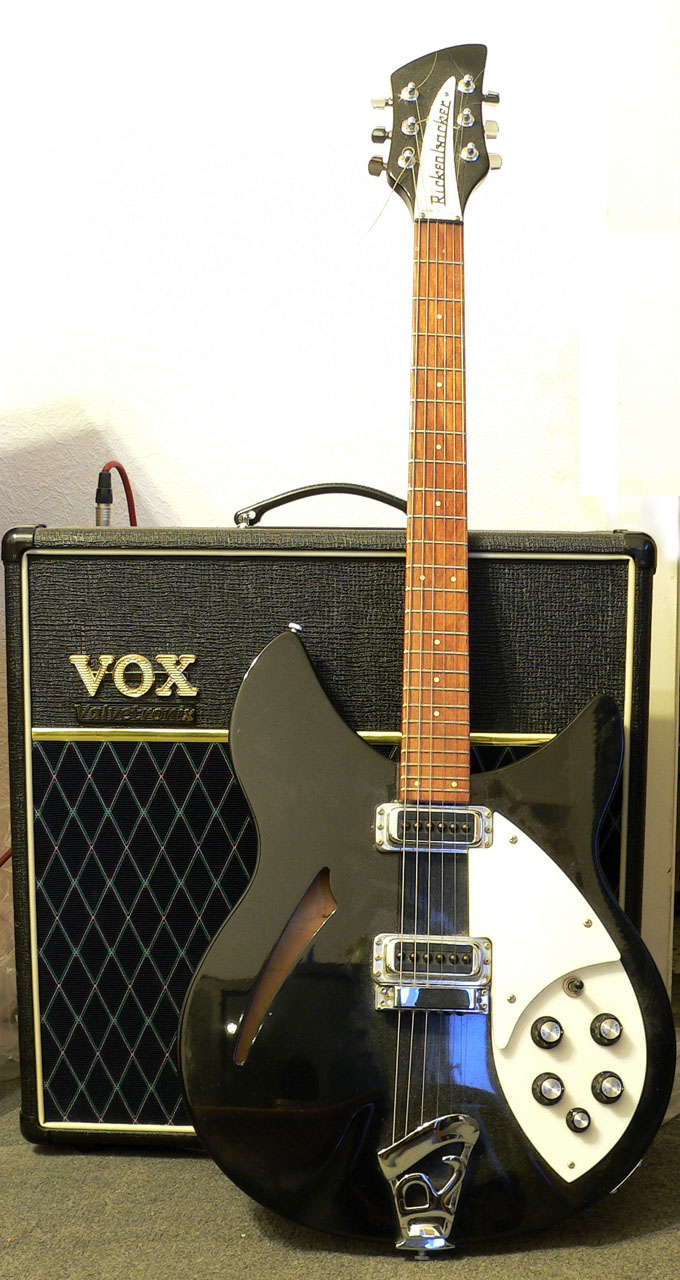
Rickenbacker 330JG. Licensed under CC BY-SA 3.0. Via Wikimedia Commons. Rickenbacker
330 / 360
1958 · 3 versions
Same body, same neck, same pickups. The 360 got the binding. The 330 got Paul Weller’s, with “I AM NOBODY” on it.
- Send a picture
Rickenbacker
360/12
1963
George Harrison was too sick to see it. Roger McGuinn saw it in a movie theater. Tom Petty bought one because McGuinn had one.