Rickenbacker
330 / 360
360/12
George Harrison was too sick to see it. Roger McGuinn saw it in a movie theater. Tom Petty bought one because McGuinn had one.
New York, 8 February 1964. Rickenbacker’s F.C. Hall has set up a display of guitars at the Savoy Hilton for the Beatles, and the star of it is a brand-new electric twelve-string. George Harrison, the Beatle who’ll end up with it, is sick and misses the whole thing. John Lennon tries it instead.
- Introduced
- 1963
- Type
- Semi-hollow electric 12-string
- Class
- Production
Have a photograph of this guitar? Send a picture
The short version
1963
The first two
Suzi Arden gets the first Rickenbacker 12-string that July. The second is the one Harrison ends up with.
1964
Savoy Hilton
Hall’s display on 8 February. Harrison misses it, and Lennon asks Hall to carry the twelve over.
1964
New Style
A rounded-top 360/12 goes into production in September, with an ‘R’ tailpiece instead of a trapeze.
1965
Jingle-jangle
Roger McGuinn, who bought one after seeing A Hard Day’s Night, makes Mr. Tambourine Man with the Byrds.
1965
Minneapolis
Harrison is given a second 360/12, the rounded New Style, on 21 August.
1973
Toasters retire
The 360/12 finally switches from the old “toaster” pickups to Hi-gains, three years after the six-string.
2023
Back to 21
The core 360/12 returns to 21 frets after nearly fifty years at 24.
Side A
A1
The guitar Harrison missed
F.C. Hall wanted Rickenbacker to have an electric twelve-string, and he didn’t want the usual kind, with a long headstock and six tuners down each side. Dick Burke worked out a compact slotted headstock with some of the tuners mounted sideways, so the whole thing stayed compact.
The first one went to a Las Vegas performer named Suzi Arden in July 1963. Hall brought it to her show and she kept it. The second was a Fireglo 360/12 with a flat top, a trapeze tailpiece, and toaster pickups.
In February 1964, Hall set up a display at the Savoy Hilton in New York for the Beatles. The twelve was the draw, and George Harrison was ill and missed it. So John Lennon tried it and asked Hall to carry it over to George. George kept it.
That’s how the sound starts. Not with a plan. With a guy who wasn’t in the room.
A2
The octave comes second
One detail makes a Rickenbacker twelve sound like a Rickenbacker twelve. On most twelve-strings, the thin octave string in each pair is the one your pick hits first. After the first prototype, Rickenbacker flipped it. The regular string comes first and the octave second.
It sounds like a small thing. It isn’t. You get the note, then the shimmer right behind it, and it rings like a bell with a fast echo. Put that on a semi-acoustic maple body with no center block, with toaster pickups, and you have the chime.
Harrison put it on A Hard Day’s Night. Rickenbacker names that title song, “You Can’t Do That,” and “Eight Days a Week” among the guitar’s records, and others point to “I Call Your Name” in March 1964. Which song came first depends on who you ask. I’m not going to choose.
The twelve-string that started the jangle got to its owner because he was out sick.
A3
Harrison’s second one
In Minneapolis on 21 August 1965, Harrison was given another 360/12. This one was the New Style that Rickenbacker had put into production the September before, with a rounded top, a checkerboard-bound back, and an ‘R’ tailpiece. That’s the guitar on “If I Needed Someone,” on Rubber Soul. It went missing after the 1966 touring.
They are two different guitars, and it matters if you’re buying a reissue. The 360/12C63 copies the 1963 flat-top, not the 1965.
Flip the record · By the numbers
2nd
Harrison’s 1963 twelve was the second Rickenbacker electric 12-string ever made. A Las Vegas performer got the first.
24¾"
Full scale, the same as the six-string 360. Lennon’s short-scale twelve is a different guitar.
1973
When the 360/12 lost its toaster pickups, three years after the six-string 360.
21
Frets on Harrison’s 1963 guitar, and on the core model again since 2023.
Side B
B1
It came out of a movie theater
The next chapter didn’t happen in a studio. It happened in the dark.
Roger McGuinn went to see A Hard Day’s Night, watched Harrison play the twelve, and went out and bought a 360/12. Back in the studio with the Byrds, compression and that Rickenbacker made the jingle-jangle sound of Mr. Tambourine Man in 1965. His later Byrds guitar was a three-pickup 370/12, which is a different model.
Over in Liverpool, the way Mike Pender of the Searchers tells it, he saw the same film and ordered a Rickenbacker twelve from Crane’s music shop, for “When You Walk In The Room.” That’s his memory, not a factory serial number, but it’s the same story twice: see the twelve on a screen, go get one.
B2
Passed down the line
Tom Petty loved Rickenbackers. His favorite for recording was a blond semi-hollow twelve, 360/12-class, that he used on “The Waiting” and a run of his classic twelve-string songs. He bought it because McGuinn played one.
One warning. The red twelve-string on the cover of Damn the Torpedoes is not a 360/12. Petty and Mike Campbell called it Campbell’s 660/12, a solidbody, and later writers have called it a 625/12 or a 620/12. Whatever it is, it isn’t this guitar.
Rickenbacker still builds the 360/12 in Santa Ana, to order. The twelve held on to its toaster pickups until May 1973, three years longer than the six-string 360, went to 24 frets in 1974, and came back to 21 in 2023. The core model has Hi-gains now. If you want Harrison’s 1963 setup, trapeze tailpiece and toasters and all, that’s the C63 reissue, which is a recreation, not an old guitar.
Follow the line back. Petty heard McGuinn. McGuinn saw Harrison in a movie theater. Harrison got the guitar because Lennon tried it for him while he was sick. Nobody passed the jangle down on purpose. They just kept hearing it and going out to find the guitar.
Put this on
You’ve read about it. Now hear it. Here’s what this guitar sounds like, and what to listen for.
A Hard Day’s Night
Rickenbacker names the title song among the records Harrison made with his 1963 twelve. The film of the same name is the one McGuinn walked out of wanting one.
Find it on YouTube (opens in a new tab)If I Needed Someone
Harrison’s second 360/12, the rounded New Style he was given in Minneapolis. Not the 1963 guitar.
Find it on YouTube (opens in a new tab)Mr. Tambourine Man
McGuinn’s 360/12 plus studio compression. That’s the jingle-jangle, and it came straight out of a movie theater.
Find it on YouTube (opens in a new tab)The Waiting
Petty’s favorite recording Rickenbacker, a blond semi-hollow 360/12-class twelve he bought because McGuinn played one. Not the red guitar on the Damn the Torpedoes cover.
Find it on YouTube (opens in a new tab)
The cast
The people, and the specific guitars, that made the legend.
1963
Suzi Arden
The first one, July 1963
F.C. Hall brought the prototype to her show in Las Vegas, and she kept it. Unlike the production guitars that followed, its strings were paired the conventional way.
1964
George Harrison
1963 360/12, his first twelve
The second Rickenbacker twelve ever made, with a trapeze tailpiece and toaster pickups. The A Hard Day’s Night guitar.
1964
John Lennon
The go-between
Tried the twelve at the Savoy Hilton when Harrison was too ill to come, and asked Hall to carry it over to him.
1965
Roger McGuinn
360/12
Bought one after seeing A Hard Day’s Night. His later three-pickup 370/12 is a different model.
1964
Mike Pender
A Rickenbacker twelve from Crane’s
The Searchers. By his own account, ordered his in Liverpool after seeing the same film, for “When You Walk In The Room.”
1981
Tom Petty
Blond semi-hollow 360/12-class
Bought it because McGuinn played one. Used it on “The Waiting” and a run of his classic twelve-string songs.
Liner notes
Specs, construction, rarity, value, and every source we used.
The deluxe electric 12 that made jangle — not a 330/12, not a 370/12, not the Petty *Torpedoes* cresting-wave, and not a C63 sold as if it were Harrison’s original.
- Body
- Semi-acoustic maple, 15" × 1 1/2" × 39 3/4"; factory 8.0 lb
- Neck
- Set-in maple & walnut
- Fingerboard
- Bound rosewood, 10" radius, triangle markers, 21 frets
- Scale
- 24 3/4" (62.9 cm)
- Pickups
- 2× Hi-gain
- Hardware
- 6-saddle / ‘R’ tailpiece; Gotoh tuners
- Electronics
- Mono and stereo (Rick-O-Sound)
- Finish
- Catalog Mapleglo, Fireglo, Jetglo
- Nut
- 1.63" (width only; material omitted from factory tables)
Open the full research fileConstruction details, the complete player record, production numbers, dated value estimates, and sources
Current core from rickenbacker.com, 25 Aug 2026: round-top, Hi-gain, 21 frets (returned January 2023). Many 1974–2022 used 360/12s are 24-fret; leftover dealer sheets still reprint 24. Prefer the factory table for a new one. Tables also omit truss-rod type and reverse pairing. 360/12C63 is a separate 1963 OS recreation — toaster, 21-fret, trapeze, 7 1/4" radius, parallel mono, Fireglo only — not a 1963 original. 360/12W is the current walnut / maple-board / 24-fret SKU. Do not collapse W with historical WB.
Construction
Deluxe Capri 12-string. Santa Ana, built to order. Factory word: semi-acoustic. Maple body routed from the back, separate back glued on. Deep neck pocket. No ES-335 center block. Not a solidbody. Not a 330/12 (unbound, dots, mono). Not a 6-string 360. Not a three-pickup 370/12.
1963 origin / 1964 catalog-scale production. Keep both. guitarhq invoices: 2× 360/12 OS in 1963. Official C63 page is a 1963 replica. guitarhq narrative: 360-12 “introduced in 1964.” rickenbacker101: first 12-string July 1963; New Style production September 1964.
F.C. Hall wanted a 12 whose peghead was not the usual elongated 6×6. Dick Burke slotted a compact headstock with sideways tuners. After the first prototype, production pairing is RIC reverse (octave struck second). Suzi Arden’s July 1963 New Capri used conventional pairing.
OS vs NS vs WB. OS: flat double-bound, 21-fret, trapeze — Harrison’s 1963 silhouette. NS round-top from the September 1964 catalog: no top binding, checkered back binding, bound soundhole, ‘R’ tailpiece. OS continued as custom order beside the round-top. WB (1974+) is 24-fret modern flat double-bound. It is not 1963 OS.
Toasters lag the 6-string. 6-string 360: first-gen Hi-gains April 1970. 360/12 keeps toasters until May 1973 (button-top Hi-gains). 24-fret in 1974. Do not copy the 6-string 1970 date onto this guitar unlabeled. Current core is back to 21; 360/12W stays 24.
Dual hairpin rods were a hallmark for decades. rickenbacker101: beginning of 2024, one dual-action rod on core guitars except C63. Official tables omit truss-rod type. Confirm on a serial. Do not freeze dual hairpin as current.
360/12V64 (1985–2001) and 360/12C63 (2005–) are recreations, not 1963 originals. 360/12BWB (1982–84) is period WB plus hot ~12k toasters — not 1963 spec. C63 is the current vintage-spec 12. Core 360/12 is the round-top Hi-gain stereo 21-fret.
Players
Verified 360/12 only. John Lennon’s 325 is not this guitar. Johnny Marr’s Smiths identity is a Jetglo 330 six-string — don’t recruit him here.
Suzi Arden — first 1963 prototype. New Capri, conventional pairing. Hall brought it to her Las Vegas show; she kept it. Not a pop-record identity.
George Harrison — second: 1963 OS Fireglo SN CM107, trapeze, toasters. A Hard Day’s Night guitar. Hall arranged a Savoy Hilton display (8 February 1964); Harrison was ill and missed it. Lennon tried the 12, asked Hall to carry it over, and Harrison kept it. RIC names “You Can’t Do That,” “Eight Days a Week,” “A Hard Day’s Night.” Wikipedia lead credits “I Call Your Name” (March 1964). Attribute; don’t pick a first-song winner. C63 copies this 1963 OS, not the 1965.
1965 NS, gifted 21 August 1965 in Minneapolis (B-Sharp Music, Babiuk / Guitar Player 2024). Rounded deluxe, checkerboard back, ‘R’ tailpiece. “If I Needed Someone” / Rubber Soul. Lost after 1966 touring. Not the 1963 guitar.
Roger McGuinn bought a 360/12 after seeing A Hard Day’s Night (Pix Theatre; Bacon oral history). Studio compression plus that 12 made the Byrds’ jingle-jangle; core record Mr. Tambourine Man (1965). Later Byrds guitar is a 370/12 — three pickups, not this page.
Mike Pender / The Searchers ordered a Rick 12 from Crane’s, Liverpool, after the same film, for “When You Walk In The Room.” Oral-history frame as 360/12, not a factory serial.
Tom Petty — favorite recording Rick is a semi-hollow blond 12-string (360/12-class): “The Waiting” and “all those classic 12-string numbers” (Vintage Guitar, November 2006). He bought it because McGuinn played one. Damn the Torpedoes cover is not this guitar. VG 2006: Petty and Campbell call the red cover 12-string Campbell’s 660/12 — cresting-wave solidbody. Later writers 625/12 or 620/12. Body family is not 360.
Rarity
The 360/12 is not scarce as a current model. Continuous Santa Ana catalog 12-string. Single-factory backorders are production-rate scarcity, not a limited run. Factory year counts: unpublished.
Actually scarce: 1963 prototypes (Arden New Capri; Harrison OS CM107); 1963–64 toaster OS; mid-1960s round-top toaster 12-strings. Custom-order OS ran beside the round-top. WB (1974+) is 24-fret modern, not OS. C63 (from 2005), V64 (1985–2001), and BWB (1982–84) are recreations, not vintage-scarce originals.
Value
Informal estimate, 25 August 2026. Not an appraisal.
Asking prices are not sold prices. Public 2024–26 sold histograms for 1960s originals were not extracted. Thin hammers; this is listings and dealer asks. Do not price a current 360/12, a V64, or a C63 as a 1963–64 toaster OS original. Harrison CM107 is a market factor, not a price for ordinary 360/12s.
New street. $3,099 for a 360/12 (1 Jan 2026 list / Guitar Center). C63 $3,899.
Used modern. Near new street: Carter 2018 Fireglo ask $3,250. Used C63 often ~$2,500–$3,000 asking. V64 ~$2,500–$3,750 asking. Not 1960s originals.
Vintage / collectible. Mid-1960s round-top toaster dealer asks (not solds): Carter 1966 Fireglo $11,500; Music City 1966 Mapleglo $10,000; Gary’s 1965 $10,995 / 1966 $9,995. Label ASK.
See also
- rickenbacker-330-360 — 6-string deluxe/standard pair; 330/12 is the unbound 12
- rickenbacker-4003 — Santa Ana deluxe bass; not a 360 and not a 4001
- gretsch-6120 — hollowbody jangle with a Bigsby instead of an R-tailpiece
Keep digging
Guitars this one gets compared to, confused with, or descended from.
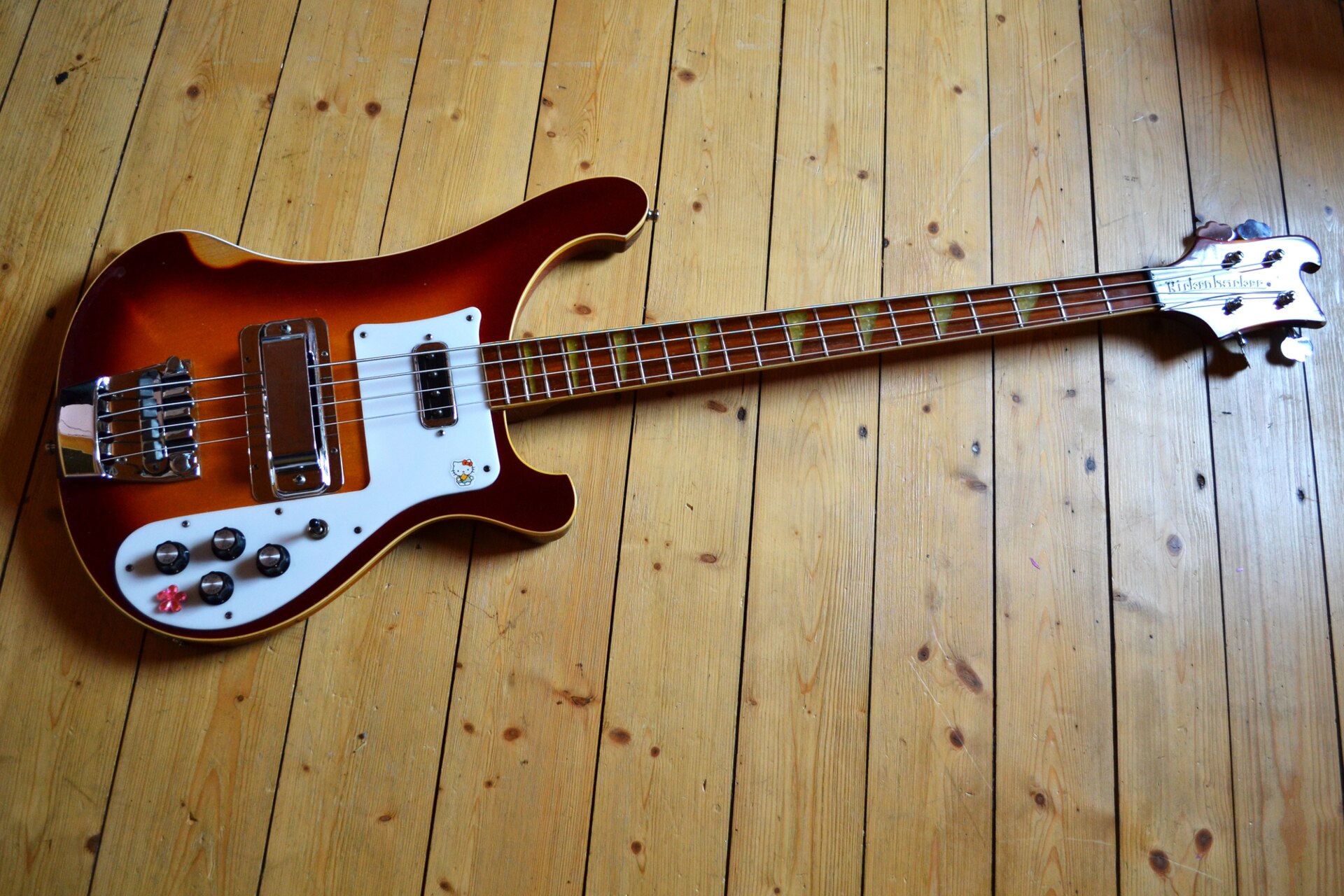
Rickenbacker 4003 (33 1/4" scale). Photo by DeLerkim. Licensed under CC BY-SA 2.0. Via Wikimedia Commons. Rickenbacker
4003
1980
Rickenbacker’s first answer to players’ new strings was to void the warranty. The 4003 was the better answer.
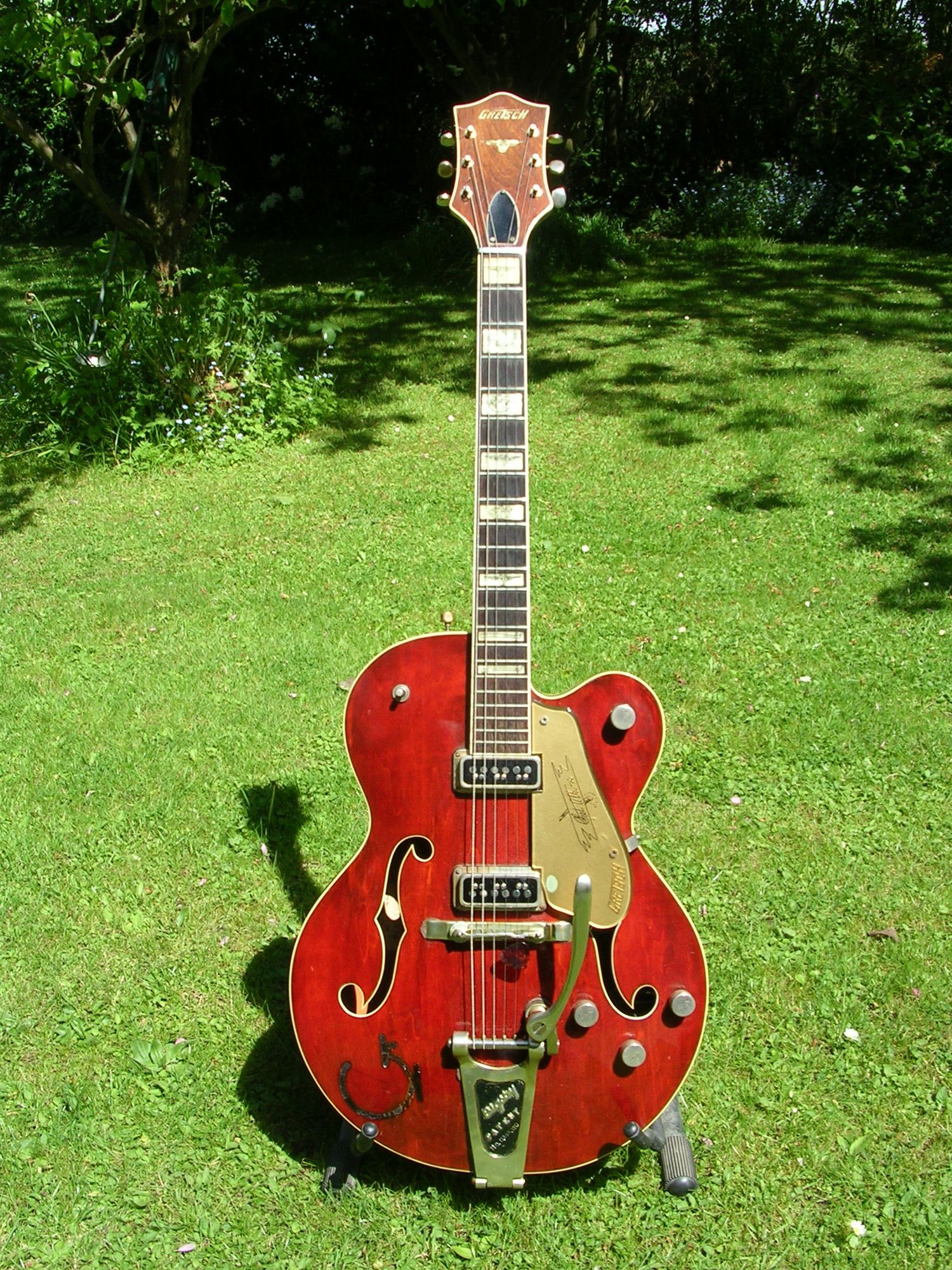
Gretsch 6120 G-Brand 1955. Photo by Francis pullen. Public domain (PD-self). Via Wikimedia Commons. Gretsch
6120
1955
Joe Walsh gave Pete Townshend one. Steve Miller gave Brian Setzer one. Chet Atkins just lent it his name.