Gibson
J-200
Gibson built the first one for a singing cowboy. It has been making people look like stars ever since.
December 1937. A cowboy singer named Ray Whitley takes delivery of a custom Gibson flat-top, logged in the books as the “L-5 Spec.” It is huge, it is fancy, and you could see it from the back of any room in America. Gibson puts it in the catalog the next year.
- Introduced
- 1937
- Type
- Acoustic
- Class
- Production
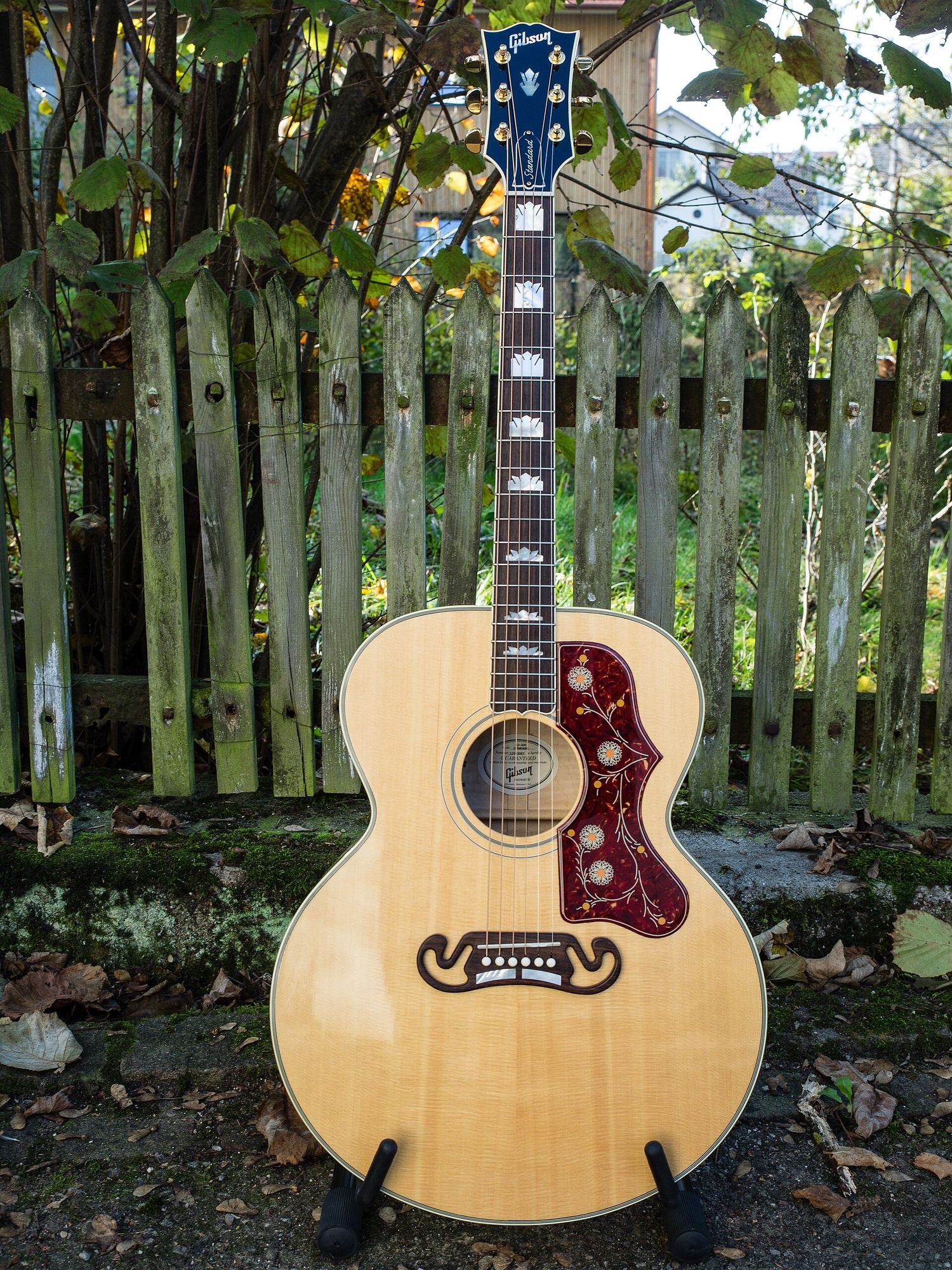
The short version
1937
The L-5 Spec
A custom order for Ray Whitley, presented in December.
1938
The Super Jumbo
First catalog appearance. Rosewood back and sides, about 17 inches across.
1943
Last of the rosewood
The last original pre-war-style Super Jumbo is logged on 24 August.
1947–48
Back, in maple
The Super Jumbo returns after the war with maple back and sides. Sources split on the year.
1956
The Cotton Bowl
Elvis plays his new J-200N onstage for the first time on 11 October, in Dallas.
1961
Metal bridge
A closed moustache bridge with a metal Tune-o-matic saddle.
1969
Two covers, one borrowed
Dylan holds one on the cover of Nashville Skyline. Led Zeppelin’s first album has Page on a borrowed one.
Side A
A1
A guitar you can see from the back row
Most guitars are designed to be heard. The J-200 was designed to be seen, too.
The first one was a custom order for Ray Whitley, a cowboy singer, and Gibson presented it to him in December 1937. The books called it the “L-5 Spec.” Gene Autry had a custom Super Jumbo of his own, a 12-fret version. These were men who performed in fancy western shirts. The guitar matched the shirts.
For almost ninety years, it has been the guitar people pick up when they want to be seen.
A2
Everything turned up
Gibson put it in the catalog in 1938 as the Super Jumbo, and in 1939 it became the Super Jumbo 200. The S in SJ-200 stands for Super. Not Southern. People get that wrong all the time.
The name wanders, too. After the war Gibson’s ads called it the J-200, while one history says it was labeled SJ-200 until about 1954. Today Gibson calls it the SJ-200 again. Same guitar.
Look at one. A narrow waist and a big, round lower bout about 17 inches across (some measure 16⅞). A bridge shaped like a handlebar moustache. A pickguard covered in flowers. Pearl crown inlays that grow as they go. Nothing about it is shy.
The first ones had Indian rosewood back and sides. Only about a hundred of those went out before the war shut them down. The last original was logged on 24 August 1943. Rosalie Allen had one of the 1938s. When the Super Jumbo came back in 1947 or ’48, it was maple, and it has mostly been maple since. In 1961 the moustache bridge got closed up and a metal Tune-o-matic saddle went in. Collectors like that version least.
In the ’50s Gibson also made a little sister, the J-185: the same outline shrunk to 16 inches, with a mahogany neck, from 1951 to 1959. Handsome guitar. Not a J-200.
A J-200 is what a guitar looks like when it’s dressed to be a star.
A3
Elvis in leather
On 11 October 1956, at the Cotton Bowl in Dallas, Elvis Presley walked onstage with a new natural-top J-200. It was the first time he played it in front of a crowd.
A few months later, in January 1957, it got a leather cover made by Underwood. Now it looked like Elvis. Graceland still has the guitar and the cover. Paramount even bought a second J-200 for the movies Loving You and King Creole.
One thing to keep straight: Buddy Holly’s Gibson with the leather was a J-45. Elvis’s was this.
Flip the record · By the numbers
~100
Pre-war rosewood Super Jumbos, 1938–43. One count says 96. Treat it as a ballpark.
17"
Width of the lower bout, by most counts. Some measure it at 16⅞.
6,913
Super Jumbos shipped from Kalamazoo, 1938 to 1979.
25.5"
Scale length on today’s version.
Side B
B1
The one that wasn’t his
Now for the quiet side of a loud guitar. When Jimmy Page made the first Led Zeppelin album, the big acoustic on “Babe I’m Gonna Leave You” and “Black Mountain Side” was a J-200. He told Guitar Player in 1977 that those were done on a “Gibson J-200, which wasn’t mine.”
Who lent it to him depends on who you read, Big Jim Sullivan or Mickie Most. The year of the guitar is split too, 1963 or 1964. What isn’t split is that sound. Put it on and listen to how much room the guitar takes up: huge, open, ringing.
Pete Townshend wrote “Pinball Wizard” on his 1968 J-200. Wrote it, that is; nobody’s saying it’s the guitar on the record. It went to the Rock and Roll Hall of Fame in June 1993.
B2
A new face on the cover
In 1969 Bob Dylan put out Nashville Skyline. On the cover he’s holding a J-200, smiling, tipping his hat. It’s a long way from the scruffy kid with the plain J-50 on his first album cover. Whether the J-200 was on the actual sessions is another question. The cover is what we know.
Emmylou Harris had a custom black 1955 J-200. Gibson shipped more than six thousand of them from Kalamazoo alone, the most in 1974. It still makes them in Bozeman, under the SJ-200 name.
Ray Whitley ordered the first one. Elvis dressed his in leather. Dylan held one on the cover of the record where he sounded like somebody new. The J-200 has been waiting at that moment for almost ninety years, all flowers and moustache, for whoever’s ready to walk out and be seen.
Put this on
You’ve read about it. Now hear it. Here’s what this guitar sounds like, and what to listen for.
Babe I’m Gonna Leave You
Jimmy Page on a borrowed mid-’60s J-200. In his words, this song and “Black Mountain Side” were done on a “Gibson J-200, which wasn’t mine.”
Find it on YouTube (opens in a new tab)Black Mountain Side
The other Led Zeppelin I track Page named for the borrowed J-200. Big, open, ringing acoustic.
Find it on YouTube (opens in a new tab)Pinball Wizard
Pete Townshend wrote the song on his 1968 J-200. That’s the claim the sources make, written on it, not necessarily recorded on it.
Find it on YouTube (opens in a new tab)
The cast
The people, and the specific guitars, that made the legend.
1937
Ray Whitley
1937 “L-5 Spec”
The cowboy singer who ordered the first one. Presented to him in December 1937.
1938
Rosalie Allen
1938 SJ-200, rosewood
One of the rare pre-war Super Jumbos.
Gene Autry
Custom 12-fret Super Jumbo
Not to be confused with his famous Martin D-45. Different guitar.
1956
Elvis Presley
1956 J-200N
First onstage at the Cotton Bowl on 11 October 1956. Leather cover from January 1957. Graceland has both.
1969
Jimmy Page
Borrowed mid-’60s J-200
The acoustic on Led Zeppelin I. Big Jim Sullivan or Mickie Most lent it, depending on who you read.
1969
Pete Townshend
1968 J-200
Wrote “Pinball Wizard” on it. It went to the Rock and Roll Hall of Fame in June 1993.
Liner notes
Specs, construction, rarity, value, and every source we used.
Super Jumbo — the S in SJ-200 is Super, not Southern. Not a J-45, not a Southern Jumbo, not a Hummingbird, not a J-185.
- Body
- Super Jumbo (shape SJ-200); Sitka spruce top, flame maple back and sides; multi-ply top and back
- Neck
- 2-piece maple, Rounded profile
- Fingerboard
- Rosewood, 12" (304.8 mm) radius, mother-of-pearl graduated crowns, 20 frets
- Scale
- 647.7 mm / 25.5"
- Pickups
- L.R. Baggs VTC under-saddle piezo (current Original; vintage Super Jumbos have none)
- Hardware
- SJ-200 Four Bar Moustache; bone saddle; Tusq pins; gold Gotoh Keystone tuners; SJ-200 floral pickguard (no border)
- Electronics
- Soundhole-mounted volume and tone
- Finish
- Gloss nitrocellulose lacquer; Vintage Sunburst
- Nut
- Bone, 43.81 mm / 1.72"
Open the full research fileConstruction details, the complete player record, production numbers, dated value estimates, and sources
Current Original (OCJB20VS, 25 Aug 2026). Standard leftover is two-bar, TUSQ, Anthem. Custom 1957 and Custom Pre-War Rosewood are different SKUs.
Construction
Super Jumbo: narrow waist, rounded lower bout, floral guard, moustache, graduated crowns. J-185 is the same outline at 16", mahogany neck, double parallelograms, Maltese reverse-belly, 1951–59. J-180 is Everly-sized. Vintage Kalamazoo; current Bozeman, often branded SJ-200. The S is Super.
First year is a fight. Gibson.com, Vintage Guitar (June 2021), and Guitar World (Rod Brakes, 3 March 2023) date it 1937: custom-order “L-5 Spec.” Guitar World: first catalogue Super Jumbo is 1938. guitarhq: available 1938–present. 1939: Super Jumbo 200. Postwar ads said J-200; VG (Rosalie Allen) labels “SJ-200” until circa 1954. Lower bout: 17" (guitarhq 1938, VG J-185 comparison) vs 16 7/8" (Wikipedia lead, VG Allen). Measure. Current scale 25.5".
Pre-war rosewood vs postwar maple is identity. 1938–43: Indian rosewood back and sides (guitarhq; VG Allen). VG 2026 “Brazilian body / mahogany by 1941” is the mahogany SJ-100. Spruce species is not named on guitarhq 1938 — do not copy Sitka onto pre-war. guitarhq 1938: double X, open moustache with six individual saddle bearings. 1941: one-piece saddle — not a ceramic J-45 ADJ. Last original 24 August 1943 (VG Allen). The wartime banner is a Southern Jumbo / J-45-family tell. No sourced confirmation this pass that Super Jumbo 200s wore it. Maple restart: 1947 (guitarhq) vs ’48 (VG Allen). 1961: closed moustache plus metal Tune-o-matic. Bozeman 2026: do not collapse Standard, Original (this table), Custom 1957, and Custom Pre-War Rosewood. Reissues are not 1938.
Players
Named instruments only. Do not dump J-45 / J-50 / Hummingbird / Country Western players here.
Ray Whitley’s 1937 L-5 Spec. VG (Allen); Guitar World (Huw Price, 14 June 2024): presented December 1937. Rosalie Allen’s 1938 SJ-200 (VG, June 2017): pre-war rosewood. Gene Autry’s custom 12-fret Super Jumbo (VG Allen): not Autry’s Martin D-45.
Elvis Presley’s 1956 Gibson J-200N, serial A22937. Scotty Moore archive: first onstage Cotton Bowl, 11 October 1956; Underwood leather cover from January 1957; Graceland holds guitar and cover. Not Buddy Holly’s leather J-45. Paramount bought a second J-200 for Loving You and King Creole. Gibson’s later “Elvis SJ-200” models a different mid-1960s gift later given to Marty Lacker — not A22937.
Pete Townshend’s 1968 Gibson J-200. Whotabs / Guitar Player (September 1989): wrote “Pinball Wizard” on it; Rock and Roll Hall of Fame, June 1993. Not a Hummingbird.
Jimmy Page — borrowed mid-1960s J-200 on Led Zeppelin I. Page to Steve Rosen (Guitar Player, July 1977): “Babe I’m Gonna Leave You” and “Black Mountain Side” were a Gibson J-200, which wasn’t mine. Year: Finding Zoso 1963; Gibson recreation 1964. Lender: Big Jim Sullivan vs Mickie Most — do not collapse. Not a Hummingbird. Not a J-45.
Emmylou Harris. Custom-black 1955 J-200 (Blue Kentucky Girl). Sheryl Crow is a Country Western story.
Bob Dylan — Nashville Skyline (1969) cover J-200. VG (Gruhn/Carter). Do not treat the cover as a verified tracking session. Early Dylan is a J-50. Tom Petty’s Damn the Torpedoes acoustic is an Epiphone Frontier, not his SJ-200 signature.
Rarity
Shipping figures are Meiners factory shipping, not calendar production. Pre-war rosewood Super Jumbo is the scarce object. guitarhq 1938–41 published 96 (1938: 25); VG Allen about 100 including Deluxe Jumbo prototypes; war 1942–47 unknown; last original 24 August 1943. Treat ~96–100 as order-of-magnitude, not a closed census. guitarhq footnote: pre-WW2 numbers “are probably not very accurate.” The guitarhq SJ / SJ n row is Southern Jumbo, not this guitar. J-45 banner shipping is a different, much larger model.
VGAB: 6,913 Kalamazoo 1938–1979 (96 pre-war + 6,817 post-war). Peak 1974: 571–572. Post-war low 1975: 109. Natural is the scarcer finish most 1948–66 years. GuitarHQ vs VGAB small cell diffs exist (1950 natural, 1959 sunburst) — ledger diffs, not a second census. Bozeman 1989–present: unpublished.
Value
Informal estimate, 25 August 2026. Not an appraisal.
Public 2024–26 sold histograms for original Super Jumbos are thin. Ranges mix labeled asks, dealer-guide comps, and a few dated solds. Ask ≠ sold. Top cracks, neck resets, replaced bridges, and refinishes move a 1950s J-200 a full tier.
New street. SJ-200 Original / Standard / 60s Original $5,699; Studio Rosewood $4,199 (gibson.com, Aug 2026). Custom 1957 Reissue $6,299. Pre-War rosewood reissue dealer street roughly $7,000–$12,200 (Carter 2024 sunburst ask $6,950; Russo Music Light Aged ask $12,239) — reissue, not a 1938. Carter 2025 used Studio Rosewood Burst ask $3,775. Thin labeled solds.
1960s maple. Dealer asks 2025–26 working band ~$7,000–$11,000 (Greg Boyd 1968 ask $7,350; repaired tops sit here). GuitarHQ rates 1961-and-later closed-moustache / TOM C vs maple B+ / rosewood A+.
1950s maple. Clean original dealer neighborhood ~$12,000–$22,000 ask. Carter 1952 Natural ask $22,000 (neck reset, cracks — an ask on a repaired guitar). Premier Guitar on a 1955 J-200N (one of 41 naturals that year): guide $12,500 — guide, not a hammer. Edgewater July 2026 1947–55 $8,000–$18,000 is a dealer-comp, not a sold. Curio Comp’s $30k–$60k+ excellent band is an outlier relative to live dealer asks and is not used as a sold median.
Pre-war rosewood. Edgewater July 2026 excellent $20,000–$45,000 looks low against specialist talk and is not a sold median. Circulating UMGF range: issues/refin above $50k; original excellent higher than $80k. Prefer scarce, private-treaty, well into five figures and often six over a fake median. Very thin 2024–26 public solds.
Elvis A22937 and other named-artist Super Jumbos are a separate provenance market, not a production price.
See also
- gibson-j-45 — round-shoulder mahogany workhorse; not a Super Jumbo, and the wartime banner lives there
- gibson-hummingbird — 1960 square-shoulder mahogany dreadnought; Page's Led Zeppelin I acoustic is not this one
Sources
- https://guitarhq.com/j200.html
- https://guitarhq.com/j185.html
- https://www.guitarhq.com/shippin2.html
- https://www.vintageguitarandbass.com/gibson/J200.php
- https://www.gibson.com/products/gibson-sj-200-original-vintage-sunburst
- https://www.gibson.com/products/gibson-sj-200-studio-rosewood-natural
- https://www.gibson.com/products/gibson-sj-200-60s-original-heritage-cherry-sunburst
- https://www.gibson.com/products/gibson-custom-1957-sj-200-vintage-sunburst
- https://www.gibson.com/products/gibson-custom-pre-war-sj-200-rosewood-vintage-sunburst
- https://www.gibson.com/en-gb/blogs/gibson-gazette/gibson-j-45-vs-gibson-sj-200-whats-the-difference
- https://www.vintageguitar.com/38403/the-gibson-sj-200/
- https://www.vintageguitar.com/32004/rosalie-allens-sj-200/
- https://www.vintageguitar.com/3892/gibson-j-200-rosewood/
- https://www.vintageguitar.com/20895/the-gibson-j-185/
- https://www.vintageguitar.com/40632/1939-42-gibson-sj-100/
- https://www.vintageguitar.com/88778/the-40-most-valuable-guitars-of-2026/
- https://www.guitarworld.com/features/gibson-sj-200-king-of-the-flat-tops
- https://www.premierguitar.com/1955-gibson-j-200
- https://edgewaterguitars.com/blog/what-s-my-vintage-gibson-worth-complete-2026-value-guide-by-model
- https://www.guitarvalueguide.com/guitars/gibson/j-200
- https://cartervintage.com/shop/gibson-sj-200-1952-natural/319tuGJ4lhsp8tbmUCVjRK9gJLc
- https://gregboyd.com/product/1968-gibson-j-200/
- https://www.retrofret.com/product.asp?ProductID=12537&name=Gibson-SJ200-Flat-Top-Acoustic-Guitar-1938
- https://acousticguitar.com/gibson-bob-dylan-sj-200-players-edition/
- https://www.gibson.com/en-eu/blogs/gibson-gazette/introducing-the-gibson-custom-jimmy-page-1964-sj-200
- https://www.scottymoore.net/56J200.html
- https://www.scottymoore.net/epm_propj200.html
- https://classicrockreview.wordpress.com/2013/05/04/led-zeppelin-interview-with-steve-rosen-chicago-1977/
- https://www.thewho.net/whotabs/gear/guitar/j200.html
- https://en.wikipedia.org/wiki/Gibson_J-200
Keep digging
Guitars this one gets compared to, confused with, or descended from.
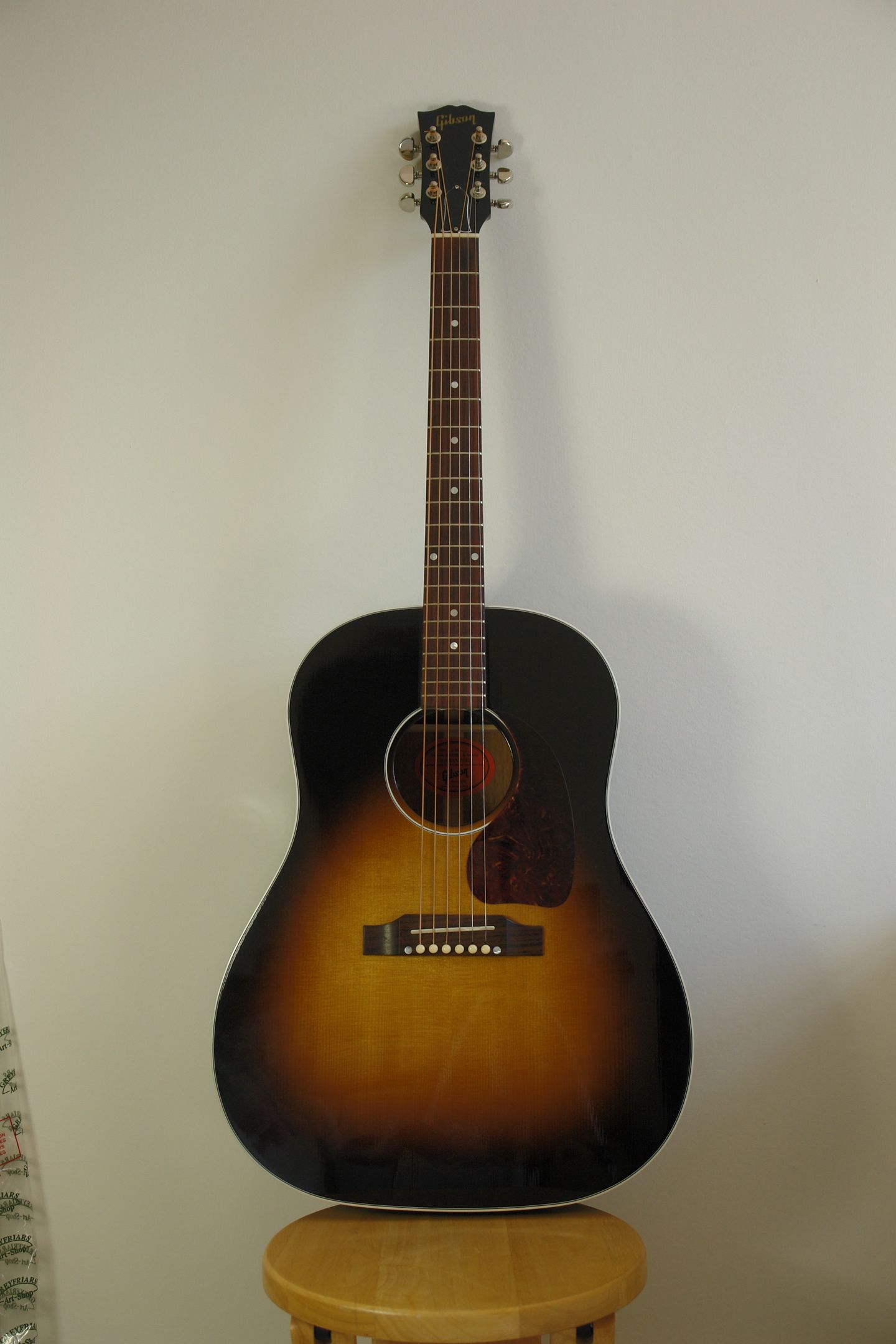
Gibson J-45. Photo by Jim Hutcheson. Licensed under CC BY 2.0. Via Wikimedia Commons. Gibson
J-45
1942
Born in 1942 out of whatever wood a wartime factory could find. Gibson calls it its best-selling acoustic ever.
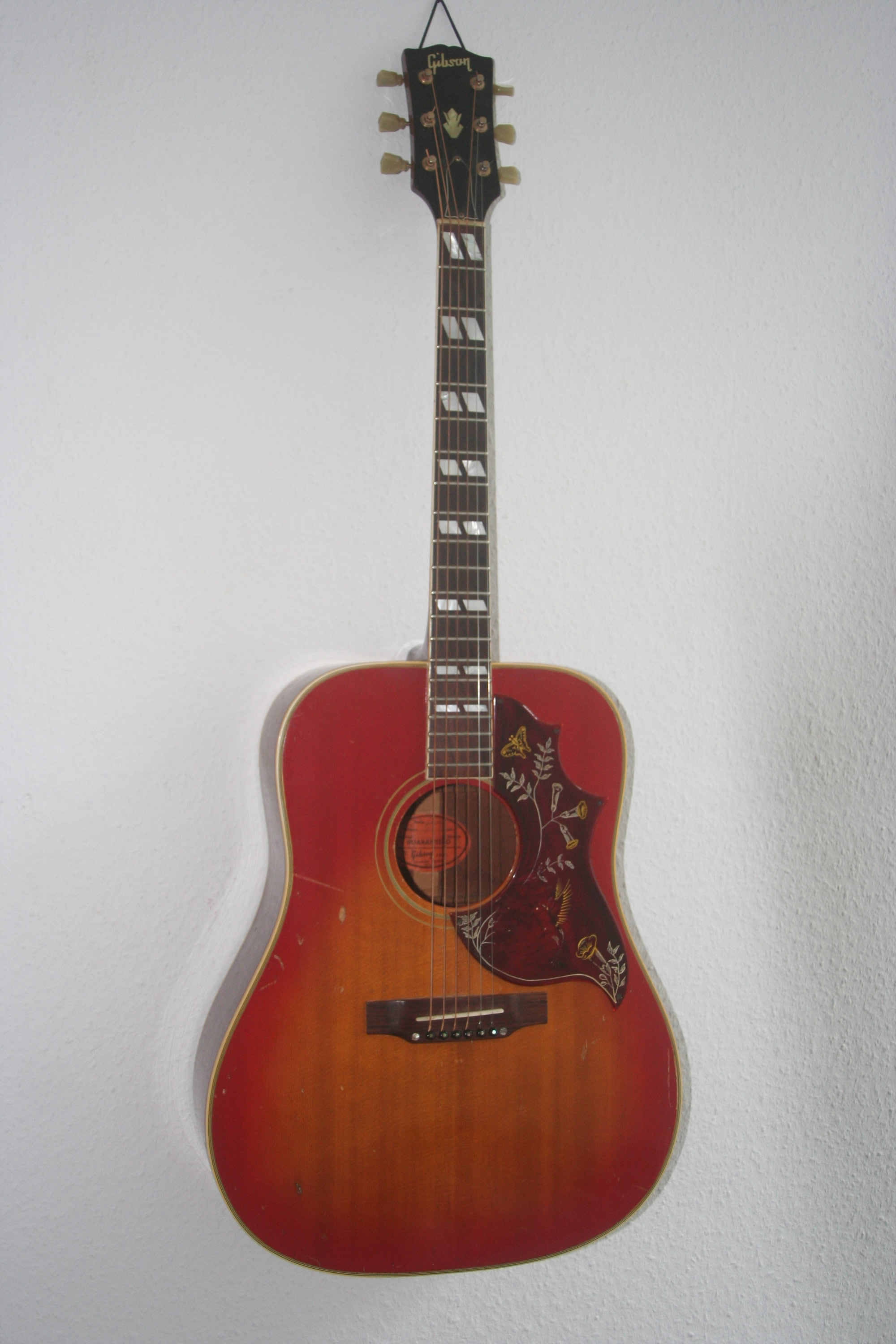
Gibson Hummingbird 1968. Photo by Guitarpimp. Licensed under CC BY 3.0. Via Wikimedia Commons. Gibson
Hummingbird
1960
Gibson gave it a hummingbird on the pickguard. Keith Richards gave it a cassette recorder.