Gibson
Hummingbird
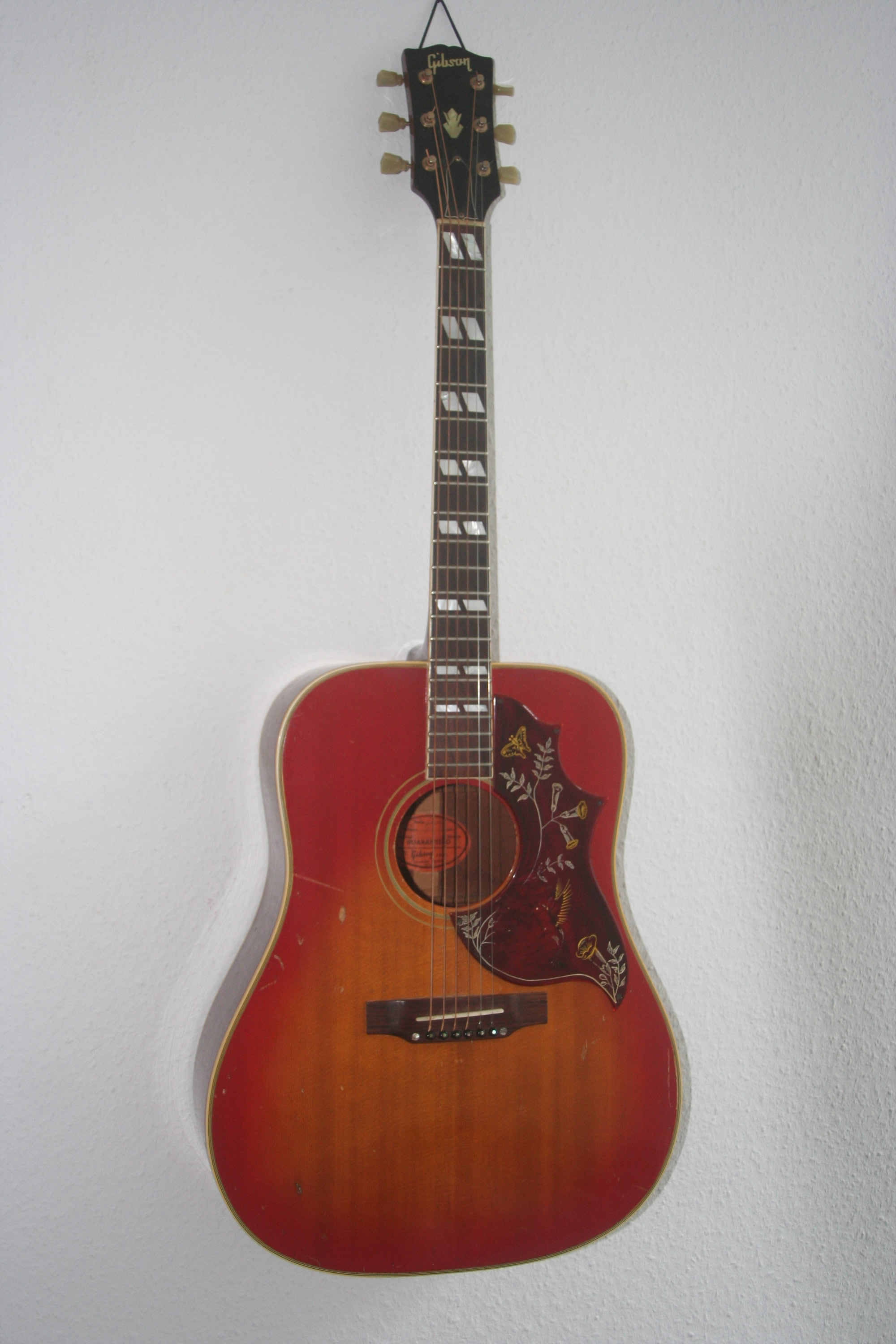
Gibson gave it a hummingbird on the pickguard. Keith Richards gave it a cassette recorder.
Olympic Studios, London, 1968. Jean-Luc Godard’s cameras are rolling, and Mick Jagger and Keith Richards are sitting with a pair of Gibson Hummingbirds, working on a song that isn’t finished yet. It’s going to be called “Sympathy for the Devil.”
- Introduced
- 1960
- Type
- Acoustic
- Class
- Production
The short version
1958
The cousin
Kalamazoo starts building the square-shouldered, maple Epiphone Frontier.
1960
The first Gibson one
The Hummingbird, Gibson’s first Gibson-branded square-shoulder dreadnought. Cherry sunburst only.
1962
Top shelf
The Hummingbird lists at $250, plus $50 for the case. Only the J-200 costs more. The maple Dove arrives.
1963
Natural, finally
A natural finish becomes an option. Gibson ships 1,461 Hummingbirds that year.
1968
Olympic
Richards records “Jumpin’ Jack Flash” and “Street Fighting Man” with a Hummingbird and a cassette recorder.
1984
Kalamazoo closes
The old factory shuts on 14 September. The vintage era ends there.
1989
Bozeman
Gibson’s acoustic factory in Montana opens. Today’s Hummingbirds are made there.
Side A
A1
A bird on the pickguard
Some guitars look like they were made for the shop window. The Hummingbird is one of them. A cherry sunburst top, gold tuners, and a hummingbird engraved on a big pickguard, flying across the front of the guitar like it belongs on a wedding invitation.
It wasn’t cheap, either. By 1962 it listed at $250, plus $50 for the case, and among Gibson’s flattops only the J-200 cost more.
So you’d think its big job would be looking good in photographs. It turns out the best-documented work a Hummingbird ever did was on a studio floor, with somebody hunched over it, trying to find a song that didn’t exist yet.
A2
Gibson goes square
In 1960 Gibson finally built a square-shouldered dreadnought with its own name on it. The big, square dreadnought was Martin’s shape. Gibson’s workhorse flattop, the J-45, had round shoulders. The Hummingbird was Gibson’s answer to Martin, and the first Gibson-branded guitar with that square outline.
It wasn’t the first one Kalamazoo built, though. The same factory had been making the Epiphone Frontier since 1958, square-shouldered and maple. Cousins, not twins. The Hummingbird was spruce on top and mahogany on the back and sides. Maple went into the Dove, the sibling that came along in 1962.
The first year, Gibson shipped 156, all cherry sunburst. By 1963 it was shipping 1,461 a year, more than the first three years combined.
Gibson dressed it for the front window. It did its best work on a studio floor.
A3
Measure before you argue
If you ever get your hands on a ’60s Hummingbird, bring a ruler. The catalog says the scale is 24¾ inches, and that’s what Gibson builds today. But one vintage dealer has measured ’60s examples at both 24¾ and 25½. Gibson didn’t settle on 24¾ for good until 1976.
The bridge is an argument too. One account says the very first 1960 guitars had a fixed saddle and the adjustable one came in 1961. Another says adjustable from the start. Nobody’s won that one, so I won’t pretend to settle it.
What nobody argues about is that it kept changing. Around 1965 the neck got narrower at the nut. By 1970 the tuners were chrome and the neck was three laminated pieces. Even the name wobbles: a lot of ’60s labels spell it “Humming Bird,” two words.
Flip the record · By the numbers
156
Hummingbirds shipped in 1960, the first year. All cherry sunburst.
$250
List price in 1962, plus $50 for the case. Second only to the J-200 among Gibson flattops.
1,461
Shipped in 1963, more than 1960, 1961, and 1962 put together.
97
Of those 1963 guitars, the ones finished natural.
Side B
B1
Kneeling at Olympic
In April 1968, Keith Richards was chasing a sound. He took his Hummingbird, tuned it to open D, put a capo on it, and recorded it into a Philips cassette machine along with a second acoustic in Nashville tuning. He did it for two songs, “Jumpin’ Jack Flash” and “Street Fighting Man.”
Richards remembers doing the “Street Fighting Man” date on his knees, “with my acoustic Gibson Hummingbird.” That little cassette recorder crushed the sound until the acoustics came out hard, dry, and gritty. Underneath all that grit is a guitar with a bird on it.
You’ll sometimes see “Angie” credited to a Hummingbird too. The only source for that is a magazine product review, and I wouldn’t bet the house on it.
B2
Before anybody’s listening
Other people had them, of course. A 1963 Hummingbird turns up in an old photo of David Kiely with the Marauders that same year. It’s Bex Marshall’s “’63 Hummingbird” now.
But the scene that sticks is the one Godard filmed. Jagger and Richards, two Hummingbirds, a song still in pieces. Nobody in that room knew yet what “Sympathy for the Devil” would turn into.
Gibson built the Hummingbird to be the prettiest thing on the wall. It earned its keep somewhere else, on a studio floor, before anybody was listening. The next time “Street Fighting Man” comes on loud, remember what’s underneath it: an acoustic with a bird on the pickguard, a cassette machine, and a man on his knees, looking for a riff.
Put this on
You’ve read about it. Now hear it. Here’s what this guitar sounds like, and what to listen for.
Jumpin’ Jack Flash
A Hummingbird in open D with a capo, a second acoustic in Nashville tuning, both squashed through a Philips cassette recorder in April 1968. Listen for how hard and gritty those acoustics come out of the little machine.
Find it on YouTube (opens in a new tab)Street Fighting Man
Same trick, same month. Richards remembers kneeling “with my acoustic Gibson Hummingbird” on the Olympic session.
Find it on YouTube (opens in a new tab)Sympathy for the Devil (the Godard film)
Jagger and Richards on camera with Hummingbirds, writing the song. That’s the writing session, not a claim that the finished record is a Hummingbird track.
Watch it on YouTube (opens in a new tab)
The cast
The people, and the specific guitars, that made the legend.
1968
Keith Richards
Hummingbird, open D, capoed
“Jumpin’ Jack Flash” and “Street Fighting Man,” through a cassette machine. No serial number has survived.
1968
Mick Jagger
A second Hummingbird
On camera beside Richards in Godard’s film, working out “Sympathy for the Devil.”
1963
David Kiely
1963 Hummingbird
Photographed with it in the Marauders in 1963. The original label survives.
2024
Bex Marshall
The same 1963 Hummingbird
Her “’63 Hummingbird,” the same guitar, written up in 2024. One headline calls it a 1965; the photo and label point to 1963.
Liner notes
Specs, construction, rarity, value, and every source we used.
Gibson's first branded square-shoulder dreadnought — 1960, cherry sunburst, an engraved bird on the guard — not a J-45, not an SJ, not the maple Dove, and not an Epiphone Frontier.
- Body
- Square-shoulder dreadnought; Sitka spruce top, mahogany back and sides; multi-ply top and back binding
- Neck
- Mahogany, rounded profile; compound dovetail neck-to-body joint
- Fingerboard
- Rosewood, 12" (304.8 mm) radius, mother-of-pearl parallelograms, 20 frets
- Scale
- 628.65 mm / 24.75"
- Pickups
- L.R. Baggs VTC under-saddle piezo (current Original; vintage originals have none)
- Hardware
- Traditional belly-up bridge (Gibson.com does not name the wood; dealer copy says rosewood); bone saddle; TUSQ pins; gold Gotoh Keystone tuners; Hummingbird pickguard
- Electronics
- Soundhole-mounted volume and tone
- Finish
- Gloss nitrocellulose lacquer; Heritage Cherry Sunburst or Antique Natural
- Nut
- Bone, 43.81 mm / 1.72"
Open the full research fileConstruction details, the complete player record, production numbers, dated value estimates, and sources
Current Original (Gibson.com Heritage Cherry Sunburst, model OCSSHBHCS). Standard, Special, and Custom Shop 1960 Historic / Murphy Lab recreations are different SKUs. Do not copy this 24.75" scale onto a 1960s guitar without measuring.
Construction
Square-shoulder mahogany dreadnought. guitarhq.com and Acoustic Guitar (Nov 2016): Gibson's first of that outline, 1960. Not a round-shoulder J-45. Not a Southern Jumbo. Maple is the Dove. Kalamazoo vintage and Bozeman current are different instruments. guitarhq.com ("1960 to present") and Gibson marketing treat the name as catalog-continuous — do not read the J-45's 1969–82 square-shoulder years as a Hummingbird discontinuation. Vintage lower bout 16.25" (guitarhq.com; Joe's Vintage). After 1963 the SJ is also square-shoulder mahogany; Hummingbird keeps the engraved bird on the guard, gold-era hardware, and cherry burst. J-45 is round-shoulder except 1969–82 (square, 25.5", teardrop, dots).
Kalamazoo body, especially 1960–69: spruce top. Acoustic Guitar 2016: earliest had solid Sitka; species on 1960 factory tickets is not on Gibson.com. Back and sides mahogany. guitarhq.com: "often the side was laminated." Acoustic Guitar 2016: solid mahogany backs, "solid or laminated mahogany sides." Do not assert all-solid for every vintage example. Binding 1960: multi-ply top, single-ply back (Joe's). Bracing 1960: single X, 3-ply maple bridge plate; scalloped vs not is not on those sheets. 1969: bulky braces. 1971: double X (Joe's). Hide glue is not sourced for 1960 Kalamazoo. Current Bozeman "hand scalloped X-bracing" is modern.
Neck 1960: mahogany, 1 11/16" nut (Joe's). 1965: nut narrows to about 1 5/8"–1 9/16" — measure. 1970: 3-piece laminated neck. Bound rosewood, double parallelograms, 20 frets. 1973: blocks. 1984: parallelograms return. "Compound dovetail" is Bozeman, not a 1960 spec sheet.
Scale is contested on sixties examples. guitarhq.com 1960 and Gibson's 1962 catalog (per tcgakki): 24.75". Current SKUs match that. Joe's (2026): measured sixties examples at both 24 3/4 and 25 1/2; Gibson standardized 24 3/4" in 1976. tcgakki's 1960s stock was long scale (~645 mm). Measure nut-to-12th doubled.
Bridge is contested; both accounts stay. Joe's: 1960 first examples had a fixed saddle; adjustable became standard during 1961 and ran until 1970. guitarhq.com 1960 intro lists an adjustable saddle — no 1960/61 split. Acoustic Guitar 2016 treats adjustable as the vintage-typical spec, dropped 1970. Do not pick a winner.
Finish 1960: cherry sunburst only. 1963: natural optional (97 of 1,461, Joe's); maple back/sides offered, rare. Tuners 1960: gold Kluson; headstock 17°, 14° from 1966; chrome from 1970. First year: FON R = 1960, no headstock serial. Joe's, citing Kalamazoo records: 156 shipped in 1960.
Dove (1962–): maple sibling, typically 25.5" — don't merge. Hummingbird Pro (1990s–2010s) borrowed the name for a smaller Songwriter-related guitar. Epiphone Inspired by Gibson Hummingbird is Indonesian.
Bozeman 2026: do not collapse Original, Standard, and Special. Original is the table above; Gibson.com does not say "solid," does not name bridge wood, and does not list hide glue. Standard dealer copy: hide-glue dovetail, TUSQ nut/saddle/pins, Grover Rotomatics, still VTC. Special: concert-depth, utile neck, satin nitro, L.R. Baggs Element Bronze. Custom Shop 1960 Historic: thermally aged Sitka, hide-glue dovetail, fixed bone saddle — a reissue, not a 1960.
Players
The documented job is Keith Richards in 1968. Unsourced celebrity dumps are not repeated here.
Kalamazoo had already been building the square-shouldered maple Epiphone Frontier since 1958. Guitar Player (Rod Brakes, 30 September 2021): this is Gibson's first Gibson-branded square-shoulder. Cousins in the same shop, not the same guitar. Do not migrate Frontier players (Tom Petty, Noel Gallagher). Petty's Damn the Torpedoes guitar is an Epiphone Frontier.
David Kiely / Bex Marshall — 1963 Hummingbird, orange-oval serial 11161. Vintage Guitar (August 2024) prints the label and a 1963 Marauders photo. Title says "1965"; body, photo, and Marshall's "'63 Hummingbird" caption say 1963. Treat 1963 as the purchase/use year. Family recollection that Jagger also got one is not a verified second guitar.
Keith Richards and Mick Jagger — Godard's Sympathy for the Devil, Olympic Studios, 1968. Guitar Player (Brakes, 30 September 2021): both on camera with Hummingbirds while they write the song. Writing session on film — not a claim the released Beggars Banquet track is a Hummingbird recording.
Richards — "Street Fighting Man" and "Jumpin' Jack Flash," 1968. Guitar Player: Hummingbird in open D, capoed, second acoustic Nashville-tuned, both through a Philips cassette, April 1968, both songs. Acoustic Guitar (2014) quotes him kneeling "with my acoustic Gibson Hummingbird" on the Olympic "Street Fighting Man" date. "Angie" is Acoustic Guitar November 2016 only — a product review, not a session document. Do not upgrade it. No surviving serial.
Do not dump J-45 / J-50 / SJ players here. Dylan's famous early Gibson is a J-50. Guthrie's "This Machine Kills Fascists" stencil is a Southern Jumbo. Holly's leather jumbo is a J-45. Page's Led Zeppelin I acoustic is a borrowed 1963 J-200. Sheryl Crow is a Country Western / SJ story. Gram Parsons is often a Dove.
Rarity
Not scarce as a name — the early Kalamazoo years are. Bozeman counts unpublished; used Originals and Standards are common.
Shipping from Joe's Vintage Guitars (Kalamazoo ledgers / Meiners-era compilation, 3 August 2026) — totals, not a survival census. 1960: 156 (cherry only; FON R; no headstock serial). 1961: 595 (Premier Guitar Vintage Vault restates this; serials begin). 1962: 503. 1963: 1,461, of which 97 natural. 1960–62 combined ≈ 1,254 — fewer than 1963 alone. GuitarHQ collectibility: 1960–65 C−, 1965–69 D−. Survival unknown.
Vintage market: Kalamazoo, 1960–early 1980s. Factory closed 14 September 1984. Bozeman acoustic factory 1989. 1960s orange ovals often HUMMING BIRD (two words); 1970s HUMMINGBIRD CUSTOM is a rename, not a higher grade. 1962 list $250 plus $50 case — second-most-expensive Gibson flattop behind the J-200. Richards / Godard 1968 is a demand factor, not a production count. Artist-owned instruments sit outside the ranges below.
Value
Informal estimate, 25 August 2026. Not an appraisal.
Sold comps are thin; this is listings and dealer guides. Reverb price-guide pages were blocked this pass; Heritage and Christie's returned no 2024–2026 Hummingbird lots. Joe's figures are typical dealer retail asks for clean originals. VG Price Guide 2026 figures are book values, not solds. Condition can move either end by about half.
New street: about $3,999–$4,499 (Norman's 2026 Standard VCS $3,999). Equipboard (June 2026): used current ~$2,600 (n=16 listings, not a sold histogram). Custom Shop 1960 Murphy Lab Light Aged new asks ~$5,200–$6,700. Reissues are not 1960 originals.
Vintage — ask vs sold labeled separately. Kalamazoo 1969–79 player: Joe's $1,600–$3,400. 1966–68: $3,750–$5,500. 1965 narrow-nut cherry: Joe's $5,000–$6,750. 1963–64 wide-nut cherry: Joe's $6,500–$9,750. 1960–62: Joe's $8,000–$12,000 (VG book lumps 1960–64 cherry at $7,500–$9,750). Documented 1960/61 can beat the book. Early natural and maple: premium / negotiation; no public sold series.
Ask: Chicago Pawners 1964, claimed wide-nut — $5,599. Sold: Greg Boyd 1964, 1 9/16" nut — $5,350; treat as a narrow-nut sold, not a wide-nut 1964 comparable. Almost no public sold histogram for clean 1960–62 originals in 2024–26. On Joe's chronology, a 1960 fixed saddle is first-year correct; 1961–69 collectors want an original adjustable. A 1970+ factory fixed saddle is the Norlin cluster, not a 1960 echo. Artist-owned lots are not comps.
See also
- gibson-dove — maple 25.5" square-shoulder sibling (1962); not this mahogany Bird
- gibson-j-45 — the round-shoulder mahogany workhorse; square-shoulder only 1969–82, and still not this guitar
- martin-d-28 — the square-shoulder dreadnought Gibson was answering in 1960
Sources
- https://www.gibson.com/products/gibson-hummingbird-original-heritage-cherry-sunburst
- https://www.gibson.com/en-eu/pages/gibson-hummingbird-acoustic-guitars
- https://www.gibson.com/products/gibson-custom-1960-hummingbird-heavy-aged-washed-cherry-sunburst
- https://www.gibson.com/blogs/gibson-gazette/gibson-j-45-versus-gibson-hummingbird-whats-the-difference
- https://www.guitarhq.com/gibson6.html
- https://www.guitarhq.com/j45.html
- https://www.joesvintageguitarsaz.com/post/vintage-gibson-hummingbird-history-value-guide/
- https://www.joesvintageguitarsaz.com/post/gibson-shipping-totals-1948-1979/
- https://acousticguitar.com/gear-review-the-2016-gibson-hummingbird-vintage-model-is-a-high-flying-acoustic-guitar-video/
- https://acousticguitar.com/gear-review-new-hummingbird-flutters-to-life/
- https://acousticguitar.com/guitar-review-epiphone-inspired-by-gibson-hummingbird/
- https://www.guitarplayer.com/gear/watch-keith-richards-and-mick-jagger-writing-sympathy-for-the-devil-using-their-trusty-gibson-hummingbirds
- https://www.guitarplayer.com/guitarists/how-keith-richards-reinvented-the-rolling-stones-with-a-cassette-recorder
- https://www.guitarplayer.com/reviews/gibson-sheryl-crow-country-western-supreme-review
- https://www.vintageguitar.com/76705/bex-marshalls-1965-gibson-hummingbird/
- https://acousticreview.co.uk/news/gibson-custom-announces-murphy-lab-heavy-aged-acoustic-collection/
- https://www.sweetwater.com/store/detail/OCSSHBHCS--gibson-acoustic-hummingbird-original-heritage-cherry-sunburst
- https://normansrareguitars.com/shop/gibson-hummingbird-standard-vcs-2026-vintage-cherry-sunburst/3D8WAZ81PgeNAxm7Oi3k8wNlWjG
- https://empiremusic.com/products/gibson-hummingbird-special-satin-honey-burst-46031
- https://www.dtownguitars.com/product-page/2026-gibson-hummingbird-special-acoustic-guitar-satin-ebony-1
- https://tcgakki.com/en/pages/gibson-hummingbird-history-and-specifications-explained
- https://en.wikipedia.org/wiki/Gibson_Hummingbird
- https://www.premierguitar.com/pro-advice/vintage-vault/gibson-hummingbird
- https://www.vintageguitar.com/product/the-official-vintage-guitar-price-guide-2026/
- https://forum.gibson.com/topic/184965-1960s-hummingbird-values/
- https://empiremusic.com/products/gibson-custom-shop-1960-hummingbird-murphy-lab-light-aged-heritage-cherry-sunburst-25019
- https://gregboyd.com/product/1964-gibson-hummingbird/
- https://chicagopawners.com/products/1964-gibson-hummingbird
- https://www.themusiczoo.com/blogs/news/factory-tour-gibson-montana-s-acoustic-guitars
- https://equipboard.com/items/gibson-hummingbird
Keep digging
Guitars this one gets compared to, confused with, or descended from.
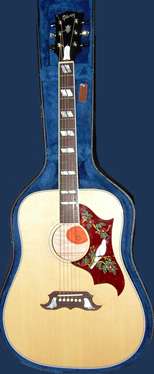
2005 Gibson Dove acoustic guitar. Photo by Rickfury. Licensed under CC BY-SA 3.0. Via Wikimedia Commons. Gibson
Dove
1962
It has the Hummingbird’s square shoulders and a bird on the guard. Different wood, longer neck, new voice.
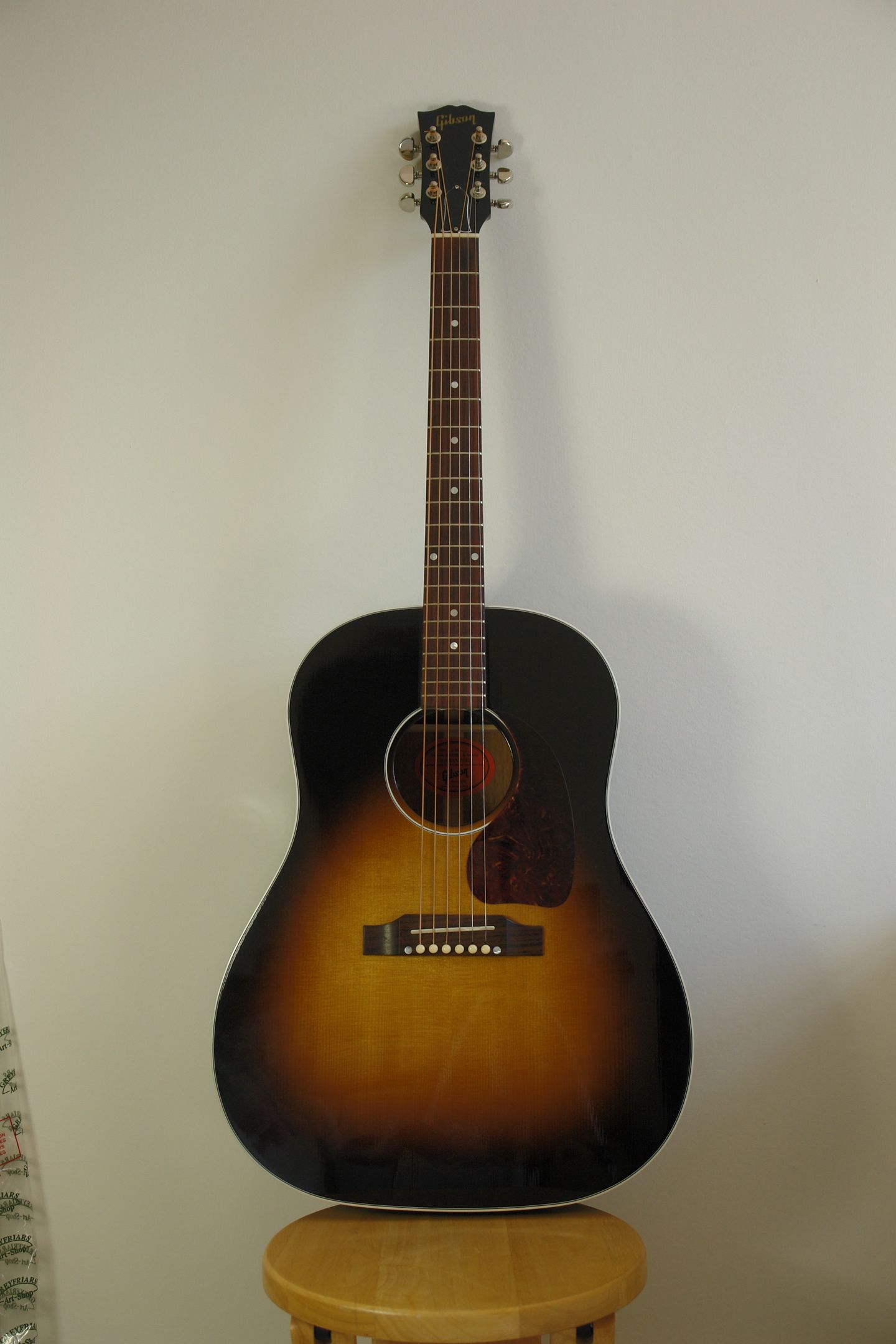
Gibson J-45. Photo by Jim Hutcheson. Licensed under CC BY 2.0. Via Wikimedia Commons. Gibson
J-45
1942
Born in 1942 out of whatever wood a wartime factory could find. Gibson calls it its best-selling acoustic ever.
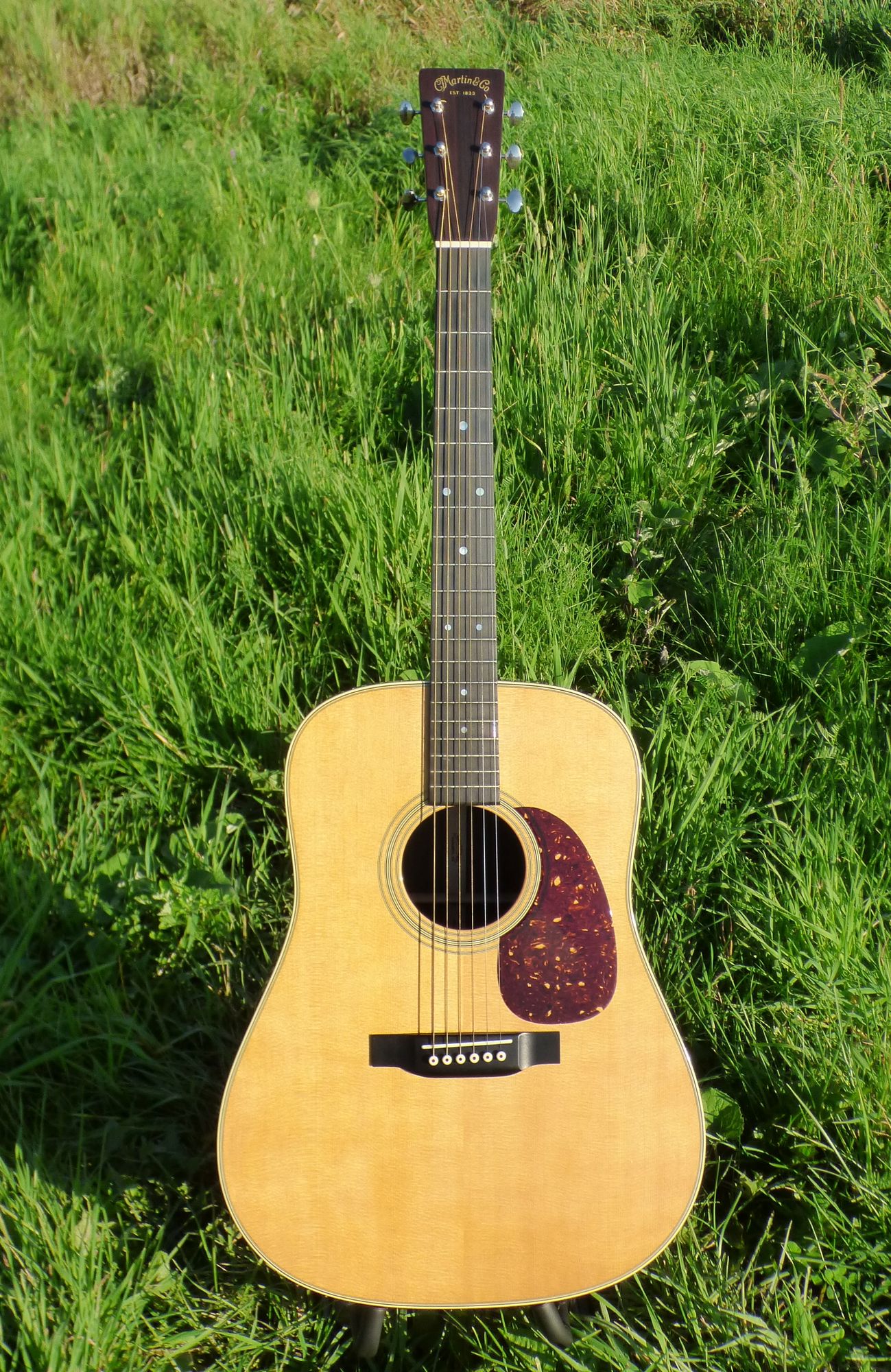
Martin D-28 Acoustic Guitar. Photo by Niranjan Arminius. Licensed under CC BY-SA 4.0. Via Wikimedia Commons. Martin
D-28
1931
You’ve heard a D-28 your whole life. It just never asked for the credit.