Gibson
Dove
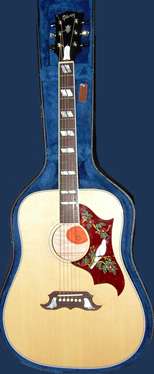
It has the Hummingbird’s square shoulders and a bird on the guard. Different wood, longer neck, new voice.
Kalamazoo, 1962. Two years after the Hummingbird, Gibson builds another square-shouldered dreadnought with a bird on the pickguard. From the front you’d swear it was the same guitar. Turn it over and the back is maple.
- Introduced
- 1962
- Type
- Acoustic
- Class
- Production
The short version
1957
Gibson buys Epiphone
Epiphone becomes part of Gibson, and Ted McCarty starts drawing.
1958
The Frontier
A maple, square-shouldered Epiphone, drawn up after the purchase. It comes first.
1960
The Hummingbird
Gibson’s first square-shouldered dreadnought under its own name. Mahogany.
1962
The Dove
The second one, and the first with Gibson’s name and maple back and sides.
1970s
Vegas
Elvis Presley plays a Dove through his Las Vegas years.
Side A
A1
Twins on the wall
Hang a Dove next to a Hummingbird and most people will tell you they’re the same guitar in different outfits. Square shoulders, fancy engraved pickguards, a bird on each. One’s a hummingbird, one’s a dove. Pick whichever you like the look of.
That’s the mistake. You can’t tell these two apart by looking. You have to take them down.
A2
Maple, and a longer neck
The Hummingbird came first, in 1960, with mahogany back and sides and a 24¾-inch scale. When Gibson built the Dove in 1962, it changed the two things that matter most to how an acoustic sounds. The back and sides went to maple. The scale went to 25½ inches.
Maple is hard and reflective, and a longer scale puts more tension on the strings. Put those together and you get a guitar that’s louder and brighter than its sibling, in every comparison that bothers to split the two. The Dove throws a note at the back of the room.
Gibson did dress it up. Early ones had a pearl dove set into the engraved pickguard, and there are doves inlaid into the bridge, and parallelogram inlays up the neck. A lot of ’60s Doves have an adjustable bridge too, a habit they share with the big J-200. But the dressing is the part the two guitars share. The wood and the neck are the parts they don’t.
From the front it’s the Hummingbird’s twin. From the back, and from across the room, it isn’t.
One more thing. Measure any ’60s Hummingbird you meet, because some of them turn up with the long scale too. The Dove’s 25½ is the one number everybody agrees on. Measure it anyway.
A3
Not even the first maple one
The Dove was the first maple square-shoulder with Gibson’s name on it. It wasn’t the first one from that factory. After Gibson bought Epiphone in 1957, Ted McCarty sketched a maple dreadnought called the Frontier, and it was on sale by 1958.
That matters, because people mix them up constantly. The acoustic on Tom Petty’s Damn the Torpedoes is a Frontier. Petty’s name still turns up on lists of Dove players. It wasn’t a Dove.
Flip the record · By the numbers
1962
The year the Dove arrived, two years after the Hummingbird.
25.5"
Scale length. The Hummingbird’s is usually 24¾ inches.
2nd
Gibson-branded square-shouldered dreadnought, after the Hummingbird.
1958
The year the Epiphone Frontier, a maple square-shoulder from the same factory, got there first.
Side B
B1
Vegas
The best-documented Dove player is a big one. “Elvis Presley also played a Gibson Dove throughout his Las Vegas period,” as one vintage writer put it. Not the Martin from the Sun days, and not the D-28 from Graceland. A maple Gibson, for a showroom stage.
Gram Parsons gets connected to a Dove in a lot of Gibson folklore too. Nobody has tracked down the actual guitar, so file that one under “probably.” Gibson’s own pages name plenty of other famous owners. Nice list. It isn’t proof.
B2
Same name, different guitar
You can buy a new Dove today, built in Bozeman, Montana, in natural or cherry sunburst, with a pickup in it. The ones from the ’60s were made in Kalamazoo and didn’t have pickups at all. Same name. Not the same guitar. Nobody even knows how many Kalamazoo made, because nobody has turned up a Dove count anyone trusts. Dealers will tell you the old ones are scarcer than ’60s Hummingbirds, and Gibson’s Custom Shop builds a recreation of a 1963 for anyone who can’t find one.
So if you’re standing in front of that wall, with the Dove and the Hummingbird side by side, don’t pick the bird you like. Play one, then the other. Your ears will tell you what the pickguards won’t.
The cast
The people, and the specific guitars, that made the legend.
1970s
Elvis Presley
A Gibson Dove
He “played a Gibson Dove throughout his Las Vegas period.” Not the Martin from Sun, and not the D-28.
1960s–’70s
Gram Parsons
Often said to be a Dove
Gibson acoustic folklore puts a Dove in his hands. Nobody has pinned down the actual guitar.
1958
Ted McCarty
The Frontier’s sketch
Gibson’s president drew up the maple square-shouldered Epiphone that came before the Dove.
1979
Tom Petty
An Epiphone Frontier, not a Dove
The acoustic on Damn the Torpedoes is the Frontier. People hang it on the Dove anyway.
Liner notes
Specs, construction, rarity, value, and every source we used.
Square-shoulder maple dreadnought — Gibson’s 1962 Dove — not a mahogany Hummingbird, not a J-45, and not Petty’s *Torpedoes* Epiphone Frontier.
- Body
- Square-shoulder dreadnought; Sitka spruce top; flamed maple back and sides; multi-ply binding
- Neck
- Maple (current Original: 3-piece); rounded profile; compound dovetail
- Fingerboard
- Indian rosewood, 12" radius, mother-of-pearl parallelograms, 20 frets
- Scale
- 25.5"
- Pickups
- L.R. Baggs VTC under-saddle (current Original; 1962 Kalamazoo originals have none)
- Hardware
- Dove-signature bridge with dove inlays; bone nut/saddle; nickel Grover Keystone tuners (dealer sheets); engraved dove pickguard
- Electronics
- Soundhole volume and tone on the current Original
- Finish
- Gloss nitro; Antique Natural or Vintage Cherry Sunburst on living Original SKUs
- Nut
- Bone, about 1.725" (dealer Original sheets)
Open the full research fileConstruction details, the complete player record, production numbers, dated value estimates, and sources
Current living guitar is the Bozeman Dove Original. Custom Shop 1963 Dove Light Aged / Murphy Lab is a Historic recreation (Gibson Custom page list $7,899), not the Original table. Epiphone Doves are not this guitar.
Construction
Second Gibson-branded square-shoulder dreadnought, 1962, Kalamazoo. Hummingbird was 1960 and mahogany / typically 24.75". This one is maple back and sides and 25.5" scale — louder/brighter in every factory and magazine comparison that bothers to split them (Gibson Custom 1963 Dove copy; Premier Guitar Vintage Vault 1964; Guitar World Hummingbird history). Do not merge the two plates.
Not the first maple square-shoulder in that factory. Guitar World: Epiphone FT-110 Frontier from 1958 is the maple D-size McCarty sketched after the 1957 buy. Dove is the first Gibson-branded maple square-shoulder (1962). Petty’s Damn the Torpedoes acoustic is an Epiphone Frontier (Hummingbird plate / J-200 plate). Do not steal it.
Vintage recipe (Premier Guitar on a 1964): maple back and sides; 25 1/2" scale; parallelograms; dove-inlaid bridge; engraved guard with a mother-of-pearl dove on early examples. Tune-o-matic / adjustable bridge is a Dove/J-200 family hallmark on 1960s pieces (tcgakki; Blue Book: adjustable 1969, non-adjustable 1970). Current Original uses a fixed Dove-signature bridge and Baggs VTC — Bozeman, not a 1964.
Hummingbird scale on sixties examples is contested (24.75 vs 25.5 on some measured Birds). Dove’s long scale is the consistent published split. Measure anyway.
Bozeman Original vs Kalamazoo vintage: same name. Not the same guitar.
Players
Manufacturer pages dump Elvis, Tom Petty, Alex Lifeson, Mellencamp. Treat those as Gibson marketing lists until a named instrument is sourced.
Elvis — Las Vegas-era Dove. Premier Guitar Vintage Vault (1964 Dove): “Elvis Presley also played a Gibson Dove throughout his Las Vegas period.” Not a Sun 1942 D-18 (that’s martin-d-18) and not a Graceland D-28.
Gram Parsons is often a Dove in Gibson-acoustic folklore (Hummingbird plate). No serial isolated this pass — known-to-play, not a comps tape.
Tom Petty. Do not put Damn the Torpedoes here. Frontier. Do not put the Torpedoes cover 12-string here either (cresting-wave Rick).
Do not dump J-45 / J-50 / Hummingbird / J-200 cover stories onto maple.
Rarity
Current Original is regular Bozeman production, not rare. Custom Shop aged Doves are limited relative to Original, not korina-V scarce.
Vintage 1962–69 Doves are scarcer than period Hummingbirds in dealer talk; Guitar World publishes Hummingbird shipping (156 in 1960, etc.) and does not print a matching Dove census in that piece. tcgakki’s “17 shipped in 1962” is dealer copy, not a guitarhq table. Don’t promote it to a factory total. No Dove shipping ledger isolated this pass.
Value
Informal estimate, 25 August 2026. Not an appraisal.
Ask vs sold. No clean Reverb sold median extracted this pass.
New street. Dove Original dealer copy around $4,500 USD-class (Pro Sound HQ average; Musicstreet UK £3,999). Custom Shop 1963 Light Aged $7,899 (Gibson.com). Hummingbird Original sits under that on the same comparison charts — don’t use Bird street as Dove comps.
Used modern Original. Expect used under street; unlabeled.
Vintage. Premier Guitar’s 1964 example is one instrument’s article price, not a 2026 sold ladder. Don’t invent a 1962–64 band. Early pearl-dove guards are the premium chapter in that Vintage Vault copy.
See also
- gibson-hummingbird — mahogany square-shoulder, 1960; not maple, not 25.5" as the house split
- gibson-j-200 — the other Gibson maple jumbo; Super Jumbo, not a dreadnought Dove
- gibson-j-45 — round-shoulder mahogany
Sources
- Gibson Custom, 1963 Dove Light Aged — 1962 intro; second square-shoulder after Hummingbird; 25.5" / maple vs Bird; $7,899
- Premier Guitar Vintage Vault, 1964 Dove — maple vs mahogany; 25 1/2"; early MOP dove guard; Elvis Vegas claim
- Guitar World, Hummingbird history — Frontier 1958 maple square; Dove 1962 first Gibson-branded maple square; Bird shipping (not Dove)
- Musicstreet, Dove Original Antique Natural — current Original construction (Sitka, flamed maple, 25.5", Baggs VTC, 3-piece maple neck)
- Pro Sound HQ, Hummingbird vs Dove — Original comparison table; ~$4,500 Dove vs ~$4,000 Bird (dealer averages)
- Blue Book, Dove series — 1962–96; 1969/1970 bridge changes; 1975 ebony board
- tcgakki, Dove history — 1962 catalog notes; TOM bridge; first-year “17” as dealer copy only
- gibson-hummingbird.md — Frontier / Petty / Gram Parsons split already on that plate
Keep digging
Guitars this one gets compared to, confused with, or descended from.
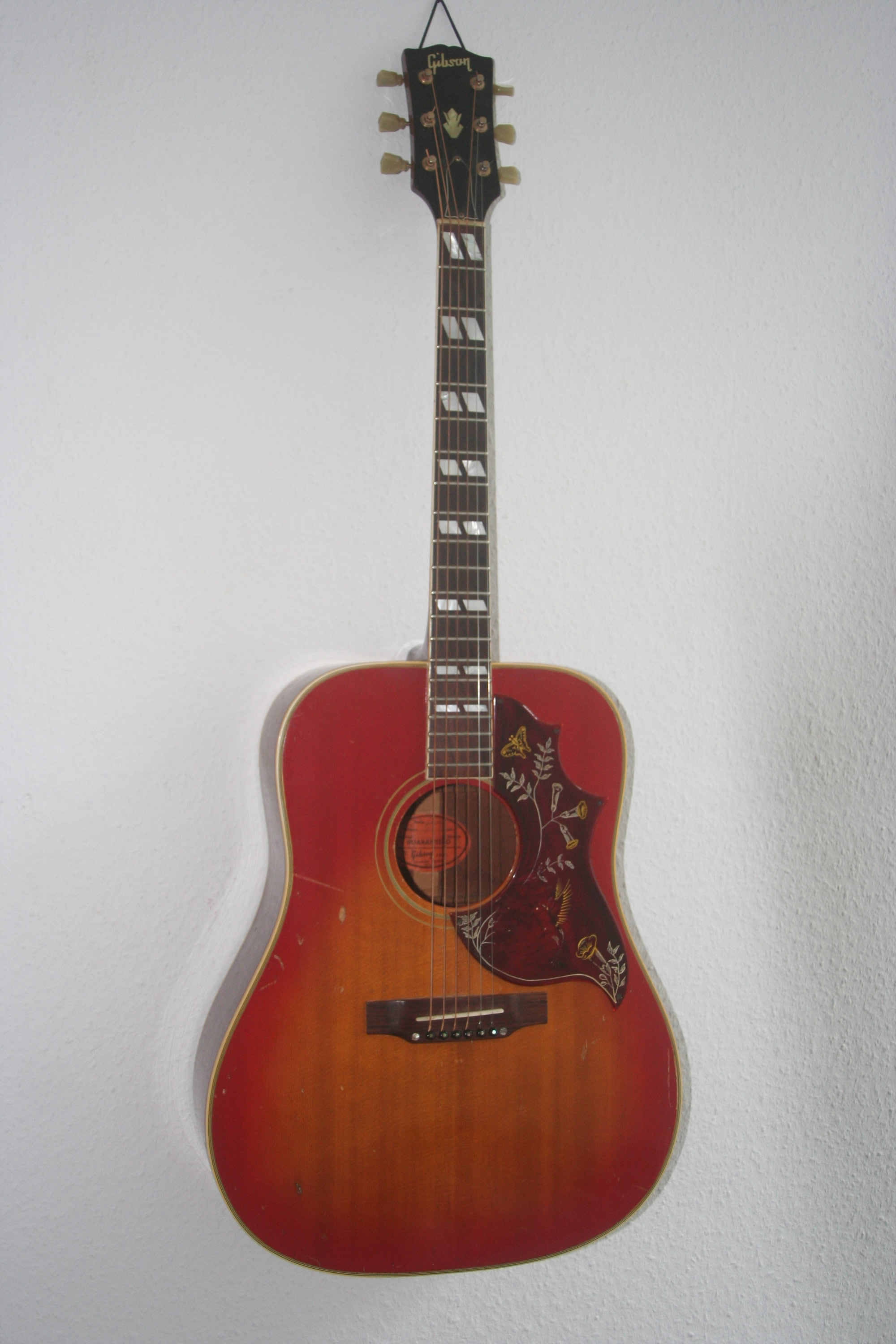
Gibson Hummingbird 1968. Photo by Guitarpimp. Licensed under CC BY 3.0. Via Wikimedia Commons. Gibson
Hummingbird
1960
Gibson gave it a hummingbird on the pickguard. Keith Richards gave it a cassette recorder.
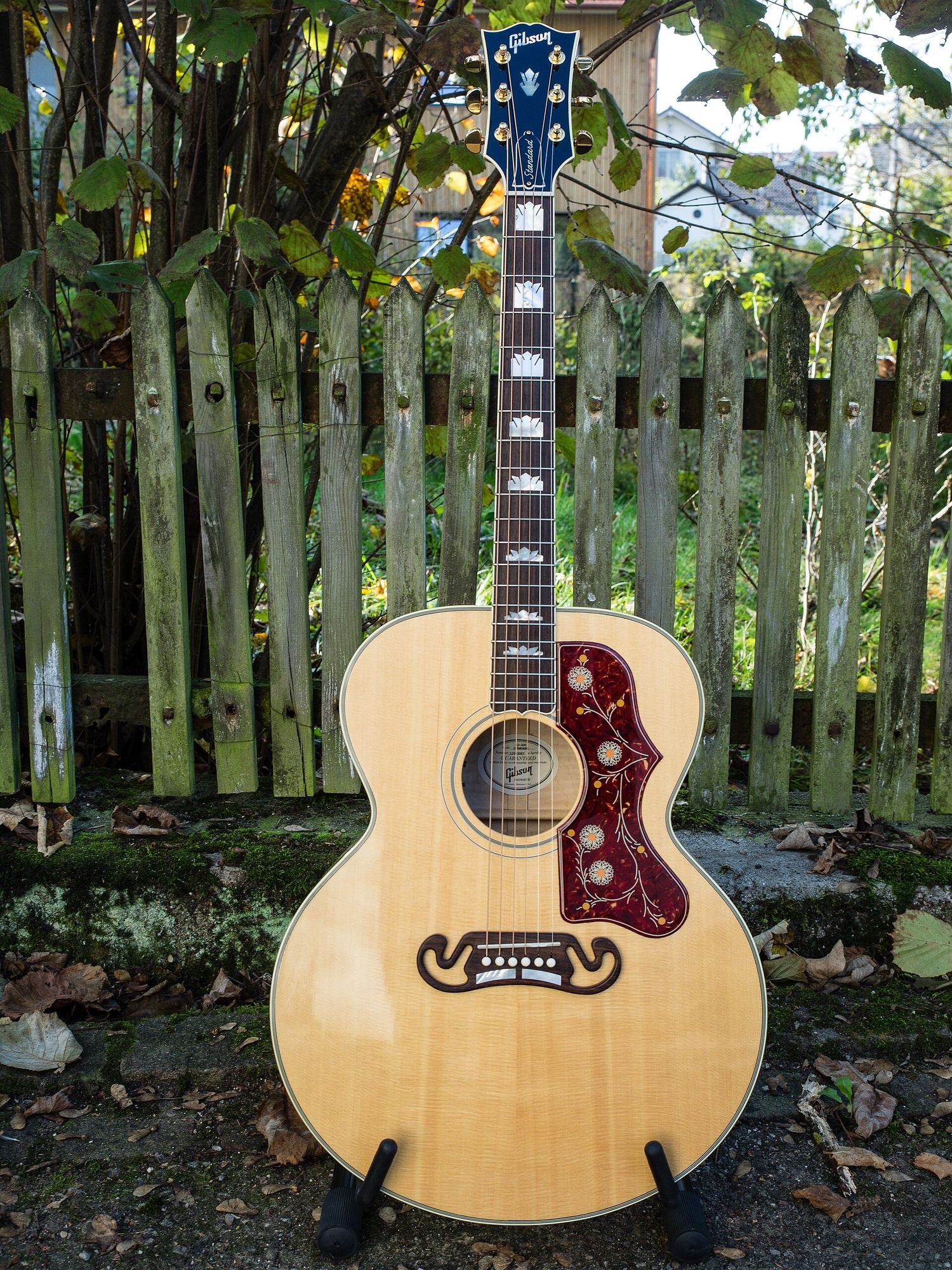
Gibson SJ-200 Standard Acoustic Guitar, Super Jumbo, Antique Natural Finish. Photo by Gibb Stutz. Licensed under CC BY 3.0. Via Wikimedia Commons. Gibson
J-200
1937
Gibson built the first one for a singing cowboy. It has been making people look like stars ever since.
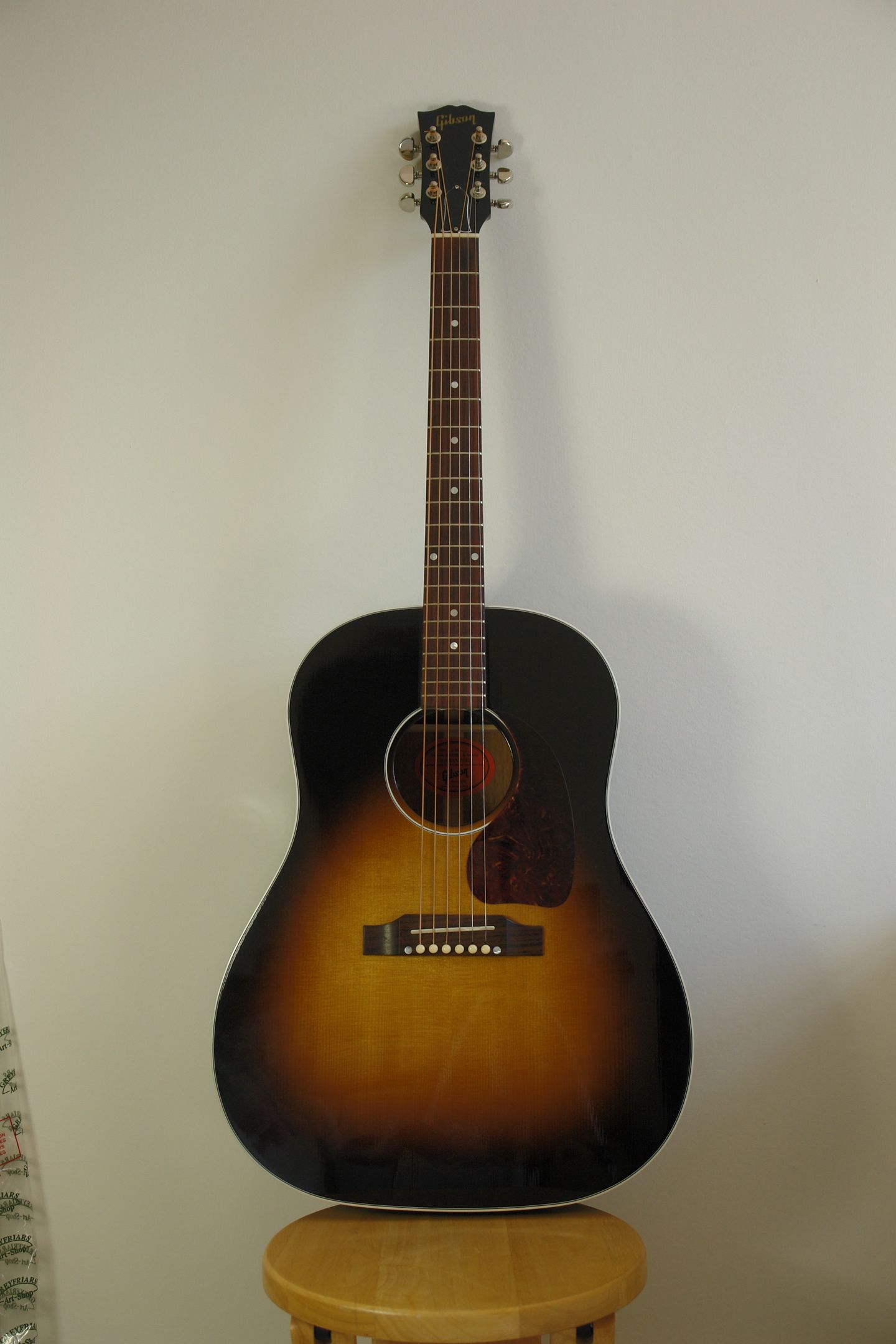
Gibson J-45. Photo by Jim Hutcheson. Licensed under CC BY 2.0. Via Wikimedia Commons. Gibson
J-45
1942
Born in 1942 out of whatever wood a wartime factory could find. Gibson calls it its best-selling acoustic ever.