Aristides
010
No wood, no heel, no options. The 010 was a concept car, and you could actually buy one.
The Aristides 010 is a Strat-shaped HSS tremolo guitar from Haarlem, cast in one piece, body and neck, from a material called Arium. It was finished in 2009, in matte black or a thin coat of aluminum, and sold on a fixed spec. It isn't a wood Strat, and it isn't the later 060.
- Introduced
- 2009
- Type
- Solidbody electric
- Class
- Production
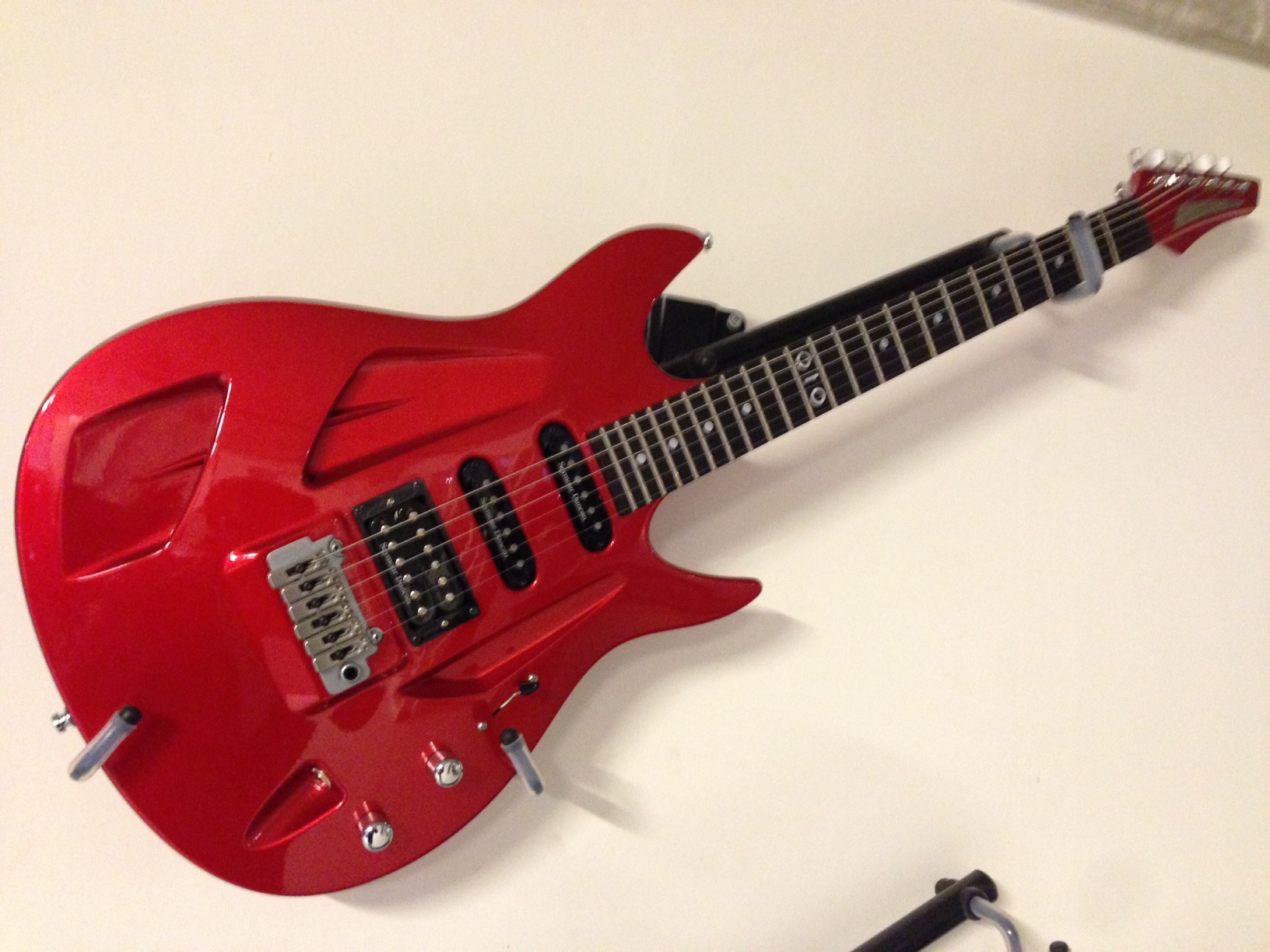
The short version
1995
Delft
A team working with TU Delft starts on a material that behaves like tonewood without the grain. They call it Arium.
2007
Haarlem
The guitar shop opens. Langelaar says he and his father started it and took over the Delft material.
2008
Already an 010
In November the company posts a video already titled "Aristides 010."
2009
Musikmesse
The 010 is finished and shown at the fair in aluminum, at €3,950.
2010
NAMM, with Vandenberg
The debut the company tells now, at Winter NAMM with Adrian Vandenberg. At one fair that year, about thirty orders come in.
2013
Spec it yourself
That summer the company bets on a seven-string the buyer can spec, and on selling direct.
2014
Still on order
In March the 010 is still taking orders, at $3,690 list. The 070 has already arrived with a new outline.
2024
The concept car
Langelaar calls the 010 the company's concept car.
Side A
A1
Not the plank
Frankfurt, April 2009. On the Musikmesse floor there's a Strat-shaped guitar in silver. It looks like an aluminum guitar. Under a thin coat of aluminum, it isn't.
The Aristides 010 has no wood in it. Body and neck come out of one mold, in one piece, made of a material its makers call Arium. One reviewer had the line for it: "all the spank without the plank."
It was built to be seen as different, and not for everyone. It came one way. You didn't choose your pickups or your frets. Years later, one of the men who founded the company would find the right name for that.
A2
Delft, or Haarlem
Where it came from depends on who's telling it.
The company's story starts in 1995, with a team working with TU Delft on a material that would behave like the usual tonewoods, without the grain telling the vibration where it's allowed to go. They named it Arium. The 2014 version of the story starts with Aristides Poort and Delft.
Langelaar tells it as a takeover. He and his father founded the company in 2007 and acquired the Delft material. Another account has the new firm taking over an earlier brand's concept and inventory, two employees included, on private money raised before the financial crisis.
Both stories end in the same place: a workshop in Haarlem, from 2007, making guitars out of something that isn't wood.
A3
Shell, then core
What they cast is a shell, then a core. The shell is a hard, hollow skin of glass and carbon, poured in an aluminum mold, then filled with Arium. There's no metal in the shell. While it's still open, a security chip goes in.
There's no neck joint, so there's no heel, and the 22nd fret is actually there when you reach for it. The board is ebony, the scale 25.5 inches. A Seymour Duncan humbucker sits at the bridge and two single-coils at the middle and neck, the middle one reverse-wound so the in-between positions cancel hum. The reviewer who had one in hand was clear about the construction: "not neck-thru — it's one whole slab."
The silver is a coat of aluminum on top, and in 2010 a German buyer paid €3,950 for it, €600 more than without. That's the finish. The guitar underneath is the same.
Flip the record · By the numbers
1
Casting. Body and neck come out of the same mold.
~30
Orders at one 2010 fair, mostly from dealers.
1.5
Guitars a month the bench could finish while those orders waited.
€3,950
The aluminum-coated 010 at its 2009 debut. Without the coating, €3,350.
Side B
B1
Thirty orders, one and a half guitars
The name was on a video before the guitar was finished. The company posted "Electric Guitar - Aristides 010" in November 2008. It was finished in 2009, and shown at Musikmesse that spring, designed with input from Adrian Vandenberg, the former Whitesnake guitarist. The debut the company tells now is Winter NAMM 2010, with Vandenberg at the booth. Three dates, three different days, and all of them count.
At one fair in 2010 they took about thirty orders, mostly from dealers. The bench was finishing about one and a half guitars a month. Langelaar calls 2010 to 2013 survival.
The spec drifted while they survived. The fretboard radius changed, a Hipshot tremolo became an option, and by 2013 there was a push/pull coil split on the volume. In March 2014 they were still taking orders for the 010, at a list of $3,690. By then the 070 had arrived, with a longer scale, 24 frets, and a new outline, and the company had moved off ebony.
B2
The concept car
The turn came in the summer of 2013. They bet on a seven-string the buyer could spec, and on selling direct. The shop that once finished one and a half guitars a month now makes about six hundred a year with about twenty people.
The 010 isn't on the order page. Langelaar, looking back in 2024, said its fixed specs "probably weren't completely in sync with the overall design." He has a name for it now: the concept car.
Concept cars mostly sit on a stand at a show. This one had Vandenberg playing it from day one, and it took orders.
Put this on
You’ve read about it. Now hear it. Here’s what this guitar sounds like, and what to listen for.
Aristides 010 review
A full review clip of a black 010, with the later Hipshot tremolo and the push/pull coil split. His later Aristides film is a different model, the 060.
Watch it on YouTube (opens in a new tab)Tri-Head
One of the company's own demo films, credited to an 010. It's a demo, not a Delain record.
Watch it on YouTube (opens in a new tab)
The cast
The people, and the specific guitars, that made the legend.
2009
Adrian Vandenberg
The original 010
Worked with the company on the first guitar, tested it "day 1," and helped debut the brand at Winter NAMM 2010. No Whitesnake record is tied to it.
Timo Somers
Aristides 010
Plays an 010 in the company's demo films, "Tri-Head," "Gazette," and "Face It."
2013
Ola Englund
A black 010
Reviewed one on video in May 2013. His later Aristides is a 060, a different guitar.
Liner notes
Specs, construction, rarity, value, and every source we used.
Body and neck from one Arium mold, HSS, and a non-locking tremolo — Aristides’ 010, not a wood Strat and not the later 060.
- Body
- One-piece molded Arium, body and neck in the same casting. Double-cut. A hollow glass-and-carbon shell filled with Arium (Charupakorn, on the siblings) — and, on the 010 Music Players played, one layered slab, not a neck-through. Shell + core, semi-“chambered,” on the maker’s 2007 note. Not an aluminum body.
- Neck
- Integral. C profile. 0.79" (20 mm) thick at the nut to 0.87" (22 mm) at the 12th; width 1.65" (42 mm) at the nut to 2.05" (52 mm) at the 12th (Premier Guitar, 18 December 2009). Truss rod above the nut (Music Players).
- Fingerboard
- Ebony, 22 medium-jumbo frets. Pearl on the 2009 sheet. Radius differs by source: the 2009 sheet and the 2011 review give 10" to 16" at the 22nd; the 25 March 2014 sheet gives 10" to 14".
- Scale
- 25.5". Audiofanzine prints 25.5" (648 mm).
- Pickups
- Seymour Duncan USA TB-5 (bridge), APS-2 RWRP (middle), APS-2 (neck)
- Hardware
- Sperzel locking tuners, Schaller strap locks. Wilkinson VS100N by Gotoh on the 2009 sheet and the 2011 review. March 2014 sheet: Hipshot US Contour or that Wilkinson. Englund’s May 2013 black one already had the Hipshot.
- Electronics
- Master volume, master tone, 5-way (Music Players; Englund 2013). Push/pull coil-split on the volume is on the March 2014 sheet and that 2013 clip. The December 2009 paragraph does not print it.
- Finish
- Thin aluminum layer; matt black or aluminum silver (December 2009). By March 2014: red and blue metallic, matte black, matte white, gold, aluminum. Finish, not the casting.
- Nut
- Graph Tech, 1.65" (March 2014). The 2009 sheet also prints “Graph Tech frets.” The review and the 2014 sheet put medium-jumbo wire on the board.
Open the full research fileConstruction details, the complete player record, production numbers, dated value estimates, and sources
The spec above is a Haarlem 010, the fixed-spec HSS tremolo completed in 2009. No current Aristides model carries the 010 name. The current range is the 060 / 070 / 080, S, T/0, H, and STX. The 020 is the hardtail and the 050 is the bass, both different models. The Parker Fly and the Steinberger GL are different guitars.
Weight differs by source. Music Players gives 8.4 lbs; Audiofanzine gives 3.8 kg. The two are close, in different units. Single aluminum guitars in two shops: Captain Guitar Lounge at 3.7 kg / 3790 g, GitaarBarbaar at 3788 g.
Construction
The job was a 25.5" HSS guitar that would not be wood, and would not move when the room did. Haarlem, not Fullerton. Double-cut, heel gone, so the 22nd fret is actually there. Music Players: a Strat-style alternative, “all the spank without the plank.” The shape is familiar. The casting is the point.
The research is older than the guitar, and the founding is not one story. Company page: 1995, a team with TU Delft, after a material with the behavior of the usual tonewoods and none of the grain telling the vibration where it may go. They name the result Arium. Same page: the shop did not exist until 2007. The March 2014 release, datelined Haarlem, starts with Aristides Poort and Delft in 1995, and guitar work in 2007 with Bouwmeester van Rens. Langelaar tells a takeover. Tone Journey, 12 January 2024: he and his father founded it in 2007 and acquired the Delft material. WijNoordHolland, 26 October 2026: a Delft graduation project; the new firm took the concept and the inventory of an earlier brand, two employees included, private money raised before the financial crisis. Both versions stand: Poort and 1995 in the company’s telling; Langelaar, his father, and the earlier brand in his.
What they cast is a shell, then a core. Maker, 2007: “shell + core” of Arium and fibre, semi-“chambered,” so it would be loud, tough, and lighter. Charupakorn, on the 070, and explicit that the method is the siblings’: a hard hollow exoskeleton, glass and carbon, filled with resonant Arium; liquid in an aluminum mold; one piece; a security chip while it is still open. Music Players, on the 010 in hand: resins and microscopic glass particles, layered in a mold, “not neck-thru — it’s one whole slab.” Langelaar at NAMM 2016 (Guitar Messenger) and again in 2024: carbon and glass for the shell, then resins and microscopic glass bubbles, and no metal in that shell. The December 2009 “thin layer of aluminum” is a coating. A German owner (Musiker-Board, 6 April 2010) paid up for it: €3,950 against €3,350. The guitar is not an aluminum instrument. The silver ones look like it.
The name is on a guitar before 2009. The company channel uploaded “Electric Guitar - Aristides 010” on 27 November 2008: Arium, one piece, luthiers in Haarlem. The 2009 date is the completion the maker prints — HSS, 22 frets, non-locking tremolo — and the Musikmesse introduction Charupakorn gives, designed in collaboration with Adrian Vandenberg. Audiofanzine, 6 April 2009: the aluminum guitar at the fair, €3,950, 3.8 kg, 25.5" (648 mm). The debut the company now tells is Winter NAMM 2010, with Vandenberg. That makes three firsts: the 2008 upload, the 2009 fair, and the 2010 NAMM booth.
The spec sheet then drifts, and the drift is in the specs above: radius 10"–16" against 10"–14", Wilkinson alone against a later Hipshot choice, push/pull absent in 2009 and present by Englund’s May 2013 clip and the March 2014 release. Vintage Guitar the same week (Ward Meeker, 28 March 2014) matches that hardware and the coil-split. The chip is “Snagg” in the 2011 review and “anti-theft” on the 2014 sheet. The case does not match its advertising. 2014 says a custom heavy-duty case and a leather strap. Music Players opened canvas over foam.
Frans van Rens is the name on the maker’s story for the first trio: 010 tremolo, 020 hardtail, 050 bass. The 2014 release says Bouwmeester van Rens. Same studio. Langelaar to Fretboard Frenzy (21 August 2024): built to be seen as different, not for everyone, not customizable. Fixed specs that, he says, “probably weren’t completely in sync with the overall design.” His phrase for it now is the concept car.
The 020 and the 050 are different models. So is the 070: 26.5", 24 frets, a new outline, Winter NAMM 2014. The maker’s 2013 chapter is the turn off ebony: stainless frets and Richlite became the rule. A 22-fret ebony 010 is the earlier object. The Parker Fly and the Steinberger GL are different guitars.
Summer 2013 they bet on a 7-string the buyer could spec, and on selling direct (WijNoordHolland). March 2014 they were still taking 010 orders. The current model page is not. By August 2024 Langelaar is calling the 010 the concept car. In January 2024 he had also said a Strat-style might be ready by the end of that year. That hope is not this guitar coming back, and the current guitars page lists no 010.
One Haarlem casting, ebony, TB-5 and two APS-2s, a non-locking tremolo. There is no new 010, and the 060 is a different body.
Players
Players of the 060, 070, 080, T/0, and STX are not 010 players. Langelaar’s 2024 names — Ihsahn, Mike Stringer, Devin Townsend — are the brand, not this model. The 2026 company profile has Misha Mansoor posting about a guitar that was sent. No model is named. Ola Englund’s May 2013 clip is a review of an 010. Guitar World, July 2014, is him on a 060, a different guitar. No Whitesnake record is tied to this mold.
Adrian Vandenberg (Whitesnake). The one player the sources tie to the 010, though not on a record. Charupakorn: designed in collaboration with him, introduced at Musikmesse 2009. Company story: he helped debut the brand at Winter NAMM 2010. FAQ: “day 1 with Adrian Vandenberg testing our original 010.” Langelaar: input on the first guitars, and he worked the fairs. The Gauntlet, 1 April 2011, quoting the company: autographs at Musikmesse, 7 and 8 April 2011. Music Players calls it an endorsement. Equipboard: a NAMM photo with an 010. “Here I Go Again” is 1987. Nothing in the sources ties a Whitesnake track to this guitar.
Timo Somers. Company titles put him on an 010 (“Tri-Head,” “Gazette,” “Face It”). A film from the maker, not a Delain album note. Guitar Messenger’s NAMM 2016 film has him on later models, not the 010.
Also known to play: none known. Magnus Tveiten is on company demo titles. A demo is not a record.
Rarity
You cannot order a new 010. The model page is the later shapes. “Concept car” is the right tense.
Aristides never published an 010 total. The early shop figure is not a model total. WijNoordHolland: about thirty orders at a 2010 fair, mostly dealers, while the bench finished about one and a half guitars a month. 2010–2013 he calls survival. Today’s output is still not an 010 count: about 600–700 instruments a year (Tone Journey, January 2024); about 600 a year, about twenty people (WijNoordHolland, 26 October 2026).
What is thinner is the first shape. Ebony, 22 frets, the outline the Standards dropped, a spec sheet you did not rewrite. Aluminum and plain black are the two the debut sheet named. A Bare Knuckle swap is no longer that guitar. Vandenberg’s, if he kept one, is one object. It is not a vintage 010.
Value
Informal estimate, 27 October 2026. Not an appraisal.
Ask prices below are not sales unless marked sold. Reverb’s Price Guide printed “Used estimate unavailable.” A 060, a 070, and a Fly are not comparable sales. List prices below are period list prices, not 2026 street prices.
New street. None under this name.
Used modern. Named asking prices, not sales. A pair, gold and aluminum, still showed $5,495 (was $5,995) plus $595 shipping, listed about four years (Reverb 48959183). Two guitars. A Greece line said a listing had sold. The item page showed no sale price. A modified 010, Bare Knuckle Cobras and a Black Hawk, ask €2,000 (was €2,100) plus €70, about nine months on Reverb. Not stock. Ended asks, no hammer date: wurst.guitars, aluminum, €1,999, sold out; Captain Guitar Lounge, a 2010 aluminum, €2,177 plus shipping, out of stock (page 8 June 2026); GitaarBarbaar, aluminum, €1,849 (was €2,150), sold out. That shop’s title says “010 Signature.” Haarlem does not describe a signature model.
Vintage / collectible. There is no separate price record for early guitars, and no auction result turned up. Audiofanzine, 6 April 2009: €3,950 aluminum. Musiker-Board, 6 April 2010: €3,350, or €3,950 with the coating. Music Players, August 2011: black €3,350, “roughly $5,400” for a US buyer that month. Premier Guitar, 25 March 2014: MSRP $3,690. Vandenberg’s guitar is not a comparable sale. No sale of it has turned up.
See also
- parker-fly — poplar in a carbon-glass skin, Wilmington, 1993; not a Haarlem Arium mold
- steinberger-gl — graphite headless paddle, 1984; not this HSS tremolo
- suhr-classic-s — a wood bolt-on doing the same HSS job; not a cast 010
Sources
- Aristides, The Arium Story — 1995 Delft; shop from 2007; shell + core; Frans van Rens; 010 completed 2009; Winter NAMM 2010 with Vandenberg; trio 010 / 020 / 050; 2013 070, then stainless and Richlite
- Aristides FAQ — Vandenberg testing the original 010 “day 1”
- Aristides, Guitars — current cart is 060 / 070 / 080, S, T/0, H, STX; no 010
- Aristides, Artists — Vandenberg at the NAMM 2010 debut; later names are not this model
- Premier Guitar, 18 December 2009 — molded Arium; ebony; 10"–16"; neck 1.65" (42 mm) / 2.05" (52 mm); 0.79" (20 mm) / 0.87" (22 mm); TB-5 / APS-2 RWRP / APS-2; Wilkinson VS100N; black or aluminum silver; “Graph Tech frets”
- Premier Guitar, 25 March 2014 — 25.5"; ebony 10"–14"; 22 medium-jumbo; 1.65" Graph Tech nut; Hipshot or Wilkinson; push/pull; MSRP $3,690; Poort and Delft, 1995; Bouwmeester van Rens
- Vintage Guitar, Ward Meeker, 28 March 2014 — 25.5"; ebony; coil-split; Hipshot or Wilkinson; Sperzel; Schaller
- Premier Guitar, Joe Charupakorn, 3 April 2014 — 010 with Vandenberg, Musikmesse 2009; hollow glass-and-carbon shell filled with Arium; the 070 is the next model
- Music Players, 22 August 2011 — layered mold; one slab; 8.4 lbs; 10"–16"; 22 medium-jumbo; Graph Tech nut; Wilkinson; 5-way; Snagg chip; canvas-over-foam case; €3,350 / roughly $5,400; endorsement
- Audiofanzine, 6 April 2009 — Musikmesse aluminum 010; 25.5" (648 mm); 3.8 kg; €3,950
- YouTube, Aristides, 27 November 2008 — official upload already titled 010; Haarlem
- YouTube, Ola Englund, 31 May 2013 — 010 review clip; Hipshot; push/pull; 5-way. Not the later 060 film
- Guitar World, 23 July 2014 — Englund on a 060
- YouTube, Guitar Messenger, NAMM 2016 — Langelaar on the carbon/glass shell and the Arium core; Somers on later models
- Fretboard Frenzy, 21 August 2024 — 010 in 2009; fixed specs; “concept car”; Vandenberg’s input
- Tone Journey, 12 January 2024 — Langelaar and his father, 2007; no metal in the shell; about 600–700 a year; Strat-style hoped for by end of 2024, not named as an 010
- WijNoordHolland, 26 October 2026 — ~600 a year; earlier brand’s inventory; ~30 orders in 2010; about 1.5 guitars a month; 2013 turn to a spec-able 7-string
- The Gauntlet, 1 April 2011 — Vandenberg at Musikmesse, 7–8 April 2011
- Musiker-Board, 6 April 2010 — €3,350, or €3,950 with the aluminum coating
- Equipboard, Aristides 010 — NAMM photo with Vandenberg. The card lists 24 frets; the maker and the reviews give 22.
- Reverb price guide, Aristides 010 — no used estimate shown
- Reverb, pair of 010s, 48959183 — ask $5,495 plus $595 shipping; two guitars; listed ~4 years
- Reverb, modified 010, 87794947 — ask €2,000 plus €70; not stock
- wurst.guitars, aluminum 010 — €1,999, sold out
- Captain Guitar Lounge, 2010 aluminum — €2,177 plus shipping; 3.7 kg / 3790 g; page 8 June 2026
- GitaarBarbaar, aluminum — €1,849 (was €2,150), sold out; 3788 g; shop title says “Signature”
- YouTube, Timo Somers, Tri-Head — company title credits an 010; a demo, not a Delain credit
Keep digging
Guitars this one gets compared to, confused with, or descended from.
- Send a picture
Parker
Fly
1993
Ken Parker built it like a lobster: wood on the inside, and all the strength in a skin thinner than the paint.
- Send a picture
Steinberger
GL
1984
No headstock, no wood, and designed by a man who didn’t play. Eddie Van Halen wrote two songs on it in days.
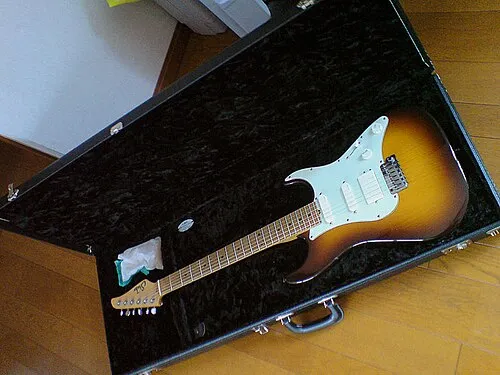
Photo: Akkun542 / Wikimedia Commons / Public domain Suhr
Classic S
2018
It looks like a Strat on purpose. Everything that’s different about it, you feel instead of see.