Burns
Bison
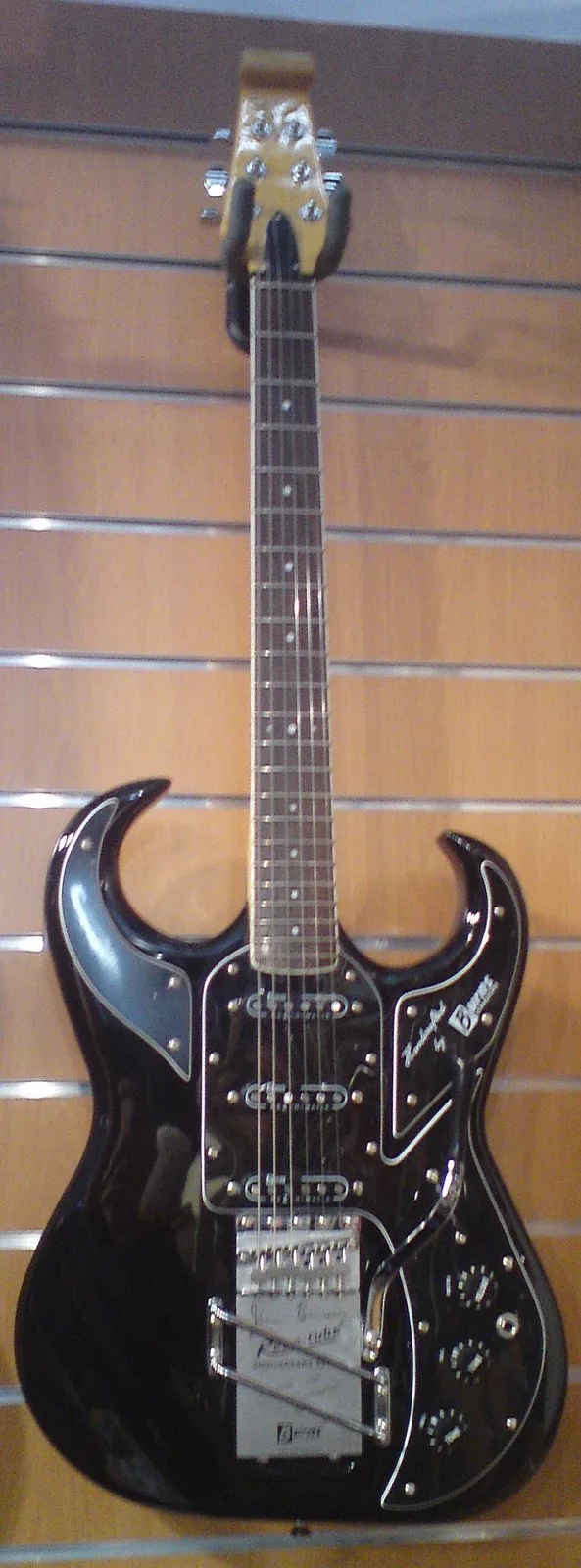
Ike Isaacs said it looked like a bloody bison. Burns changed almost everything else about it. Not that.
Hackney, east London, 1961. Burns has a new prototype on the bench, and its horns don’t just point forward. They curl in toward the neck and rise up off the body. Ike Isaacs takes one look and says it looks like a bloody bison. Nobody can think of a better name.
- Introduced
- 1961
- Type
- Solidbody electric
- Class
- Production
The short version
1961
The four-pickup
Set neck, four Ultra-Sonics, eight sounds. Melody Maker ads run in December.
1962
Three pickups and a Wild Dog
A bolt-on neck, one pickup fewer, and a thin out-of-phase setting. It sells better.
1964
Outranked
The Marvin takes the top of the line. In September the Bison is recut to match it.
1965
Baldwin
The American piano and organ company buys Burns. The paperwork says September; the trade press reported it in October. The Bison carries on, quietly.
1966
The lump
Jack Golder flattens the carved scroll into a head that wastes less wood.
1970
Line stopped
Baldwin has ended the run.
Side A
A1
A bloody bison
Most guitars get their names in a meeting. This one got its name from a man looking at a prototype and saying the first thing that came into his head.
The shop was Burns, in Hackney, and the job in 1961 was a British solidbody that could stand next to an imported Stratocaster. Burns already had the Artist, a short-scale set-neck. By the middle of 1961 they were ready to spend more wood.
A lot more wood. The horns on the new body curve in toward the neck and up off the face of the guitar, so the blank had to be thicker than a flat double-cut. The guitarist Ike Isaacs saw the prototype and said it looked like a bloody bison. It went out as the Black Bison, with a little cartoon bison on the vibrato arm and another on the cover plate.
That was the first thing anybody noticed about it. Remember the horns and the cartoon.
A2
Eight sounds and a stack of patents
The first Bison had a set neck, like the Artist, and the first Burns neck at a full professional scale, 24¾", same as a Gibson. Bound ebony board, English sycamore body, gold hardware, black finish. People ask whether Jim Burns was copying the SG. The SG was less than a year ahead, and few had reached England, so whether Jim had seen one is anybody’s guess.
The real show was the wiring. Four Ultra-Sonic pickups, low-impedance, under clear covers, running into transformers inside the body. Two selector knobs gave you eight combinations. One of them, Split Sound, was a mono take on Gretsch’s stereo Project-O-Sonic. These were the first Burns pickups with adjustable poles, and they were cleaner and less powerful than the Tri-Sonics before them. Jim Burns and Gordon Chandler patented the circuit on 20 October 1961. The floating vibrato got its own patent that December.
It listed at about £157. What a Strat cost next to it depends who you ask: one telling has a Fiesta Red Strat a scant £3 more, another has it about twenty pounds dearer. Either way, Burns priced a guitar from east London right up against the American one.
A3
Forty-nine, or fifty or so
Nobody kept a tidy ledger. Jack Golder, who worked there, remembered only 49 four-pickup Bisons. Other tellings say fifty or so, all handbuilt. Melody Maker ran ads for it in December 1961, and an April 1962 leaflet still showed the four-pickup. Call it late 1961 into early 1962.
A few went to work. Nicky Crouch played one in Faron’s Flamingos and then in The Mojos, and the best guess is that the Flamingos’ 1963 sides are that guitar. A best guess is as far as anyone can honestly go.
Fred Frith still plays a four-pickup, heavily modified. One of the few in America came from Chris Stein and sits at the Hard Rock Cafe in New York. A small number survive in collections. Several were destroyed or modified past saving.
Flip the record · By the numbers
49
Four-pickup Bisons, as Jack Golder remembered it. Other tellings say fifty or so.
8
Sound combinations from the first Bison’s two selector knobs.
24¾"
Scale of the first Bison. Burns’s first neck at a full professional length.
200
Bisons in one spray shop’s book, December 1964 to November 1965. One year, not a lifetime.
Side B
B1
The one with the Wild Dog
The four-pickup was too fussy to repeat. By mid-to-late 1962 Burns had a new Bison: bolt-on neck, three Ultra-Sonics, same horns. It sold better. Among its presets was a thin, out-of-phase sound from the rear pickups, the nasal bite you get when two pickups cancel out each other’s warmth. That setting got a name: Wild Dog.
This is the Bison most people mean. Heavy sycamore, black polyester, bound ebony, a zero fret. Around 140 to 150 guineas. Black was usual. White with a white guard got called the “albino.” Any other color is a serious find.
The Honeycombs were reported “all Burns” by September 1964. Allan Ward usually played an early three-pickup, and Martin Murray had several Bisons. Their records have a trebly Wild Dog edge, but how much of that is the guitar and how much is Joe Meek’s production has never been settled.
B2
Outranked
Then the Marvin arrived in 1964, built for Hank Marvin of the Shadows, and took the top of the line. Next to it, the Bison suddenly looked old-fashioned. So in September 1964, with the shop now in Romford, Burns recut the Bison to follow the Marvin.
Almost everything went. Sycamore gave way to a cheaper African hardwood. Bound ebony became unbound rosewood. The body got slimmer and lost its contours. Out went the Ultra-Sonics, in came Rez-o-Matiks. Out went the cradle vibrato, in came the Marvin’s Rezo-Tube and its scroll head. The catalog was so rushed it still promised Wild Dog, sycamore, and ebony. The named Wild Dog circuit was dropped, though some say the second switch still gets you close. I’d try it before I argued.
Baldwin, the American piano and organ company, bought Burns in 1965, after it failed to buy Fender. The paperwork is dated September, the trade press reported it in October, and nobody quite agrees what it paid. The Bison carried on, and in mid-1966 Jack Golder flattened the scroll into a lump that wasted less wood. By 1970 the line had stopped.
By the end, the Bison had lost its wood, its board, its pickups, its wiring, its vibrato, its headstock, and its place at the top of the catalog. It kept the horns, still curling up off the face the way they did when Ike Isaacs first saw them. It kept the little cartoon bison. Nobody has ever looked at one and mistaken it for anything else.
The cast
The people, and the specific guitars, that made the legend.
1961
Ike Isaacs
Named it
Saw the prototype and said it looked like a bloody bison. The name stuck.
1963
Nicky Crouch
Four-pickup Bison
One of the few who took an original four-pickup to work, in Faron’s Flamingos and then The Mojos. On an ES-330 by 1965.
1963
Allan Ward
Early three-pickup Bison
Lead guitar in the Honeycombs, “the dreamy one.” The photos prove the guitar. They don’t prove the records.
1964
Martin Murray
Several Bisons
The Honeycombs’ rhythm guitarist.
Fred Frith
Modified four-pickup
Still plays one, so modified that it may not quite count as original anymore.
Gaz Coombes
A reissue Bison
Supergrass. A later reissue, not a 1960s Black Bison.
Liner notes
Specs, construction, rarity, value, and every source we used.
Horns that rise off the face, low-impedance Ultra-Sonics, and a Wild Dog setting — Burns’ Bison, the flagship the Marvin later restyled, not a Marvin.
- Body
- English sycamore, contoured. Horns curve inward and up off the face (Kohman). Black polyester usual
- Neck
- Bolt-on from the 1962 redesign. The 1961 four-pickup was a set neck
- Fingerboard
- Bound ebony, zero-fret, plastic dots (Kohman, second generation). Fret count unpublished
- Scale
- 24¾" (Kohman). RetroFret’s 1966 and 1967 Baldwin examples measure 24½" (622 mm). Mix flagged
- Pickups
- Three Ultra-Sonic, low-impedance, adjustable poles, clear covers. The 1961 has four
- Hardware
- Floating-cradle vibrato: Series 1, then Series 2 by the higher serial 3,000s (Kohman). Van Ghent tuners are named on the 1961
- Electronics
- Four knobs, two of them selectors; eight combinations, including Split Sound. The thin out-of-phase rear setting is later named Wild Dog
- Finish
- Black usual. White “albino” exists. Any other color is rare (Kohman)
- Nut
- Unpublished on the 1962–64. RetroFret’s 1967 measures 1 11/16" (43 mm). Mix flagged
Open the full research fileConstruction details, the complete player record, production numbers, dated value estimates, and sources
Classic living example = 1962–mid-1964 three-pickup Black Bison. No current Burns Bison SKU this pass: burnsguitars.com did not serve (TLS error, 22 September 2026). Wikipedia, updated 15 September 2026, reports no new guitar production confirmed since the mid-2010s. 1961 four-pickup is the first run, not this table. September 1964 scroll-head — Rez-o-Matik, Rezo-Tube, unbound rosewood — is the Marvin graft, not this table. Bison Bass, Baby Bison, and Marvin stay off this slug. Mixed inch/mm flagged on RetroFret’s 1966 and 1967 Baldwin guitars: scale 24½" (622 mm), nut 1 11/16" (43 mm), overall 38¾" (98.4 cm), lower bout 13¾" (34.9 cm), depth 1⅝" (4.1 cm). Do not average Kohman’s 24¾" with that 24½". That depth is the later, slimmer body. Not a measured 1962 sycamore.
Construction
The job was a British solid that could sit next to an imported Strat. The Artist was already a short-scale set-neck. By the middle of 1961 the Hackney shop, listed at 300 Mace Street, was ready to spend more wood (Kohman).
Ike Isaacs named it. He saw the prototype and said it looked like a bloody bison. The guitar kept the name Black Bison, and a cartoon bison on the arm and the cover plate. Later Bisons kept the cartoon after almost everything else changed.
The horns curve in toward the neck and up off the face, so the blank had to be thicker than a flat double-cut. Body-ornament patent, August 1961. Set neck, like the Artist. A sculpted Fender-like head, not a Gibson’s. First Burns neck at a full professional length: Gibson’s 24¾". Kohman notes the SG was less than a year ahead, and that few had reached England, so whether Jim had seen one is unknowable. Not an SG (gibson-sg).
The point of the first run is the loom. Four Ultra-Sonics — “Ormston Burns Ultra-Sonic” under clear covers — into internal transformers. Two selectors, eight combinations, including Split Sound, a mono take on Gretsch’s Project-O-Sonic. The thin out-of-phase rear setting is not yet called Wild Dog. That name is the next generation. Circuit patent, Jim Burns and Gordon Chandler, 20 October 1961. First Burns pickups with adjustable poles, less powerful than the Tri-Sonics, cleaner (Kohman). A floating-cradle vibrato, patent 6 December 1961, “by which time the guitar was just being introduced into production.” Geared truss rod, hidden under a backplate, first used here; “final specification” filed 25 September 1962, so it may already have been reworked in the guitars. Gold hardware, a cover over the string ends, Van Ghent tuners, bound ebony, English sycamore, black.
Bacon (Reverb News, 26 April 2018): introduced 1961. List £157/10/-, which he writes £157.50. Kohman: £157, and a Fiesta Red Strat a scant £3 more from Selmer in 1962, an ES-335 two quid less. Bacon’s Strat for the same moment is £177.50. Keep both. They are not the same number.
How many left the bench is a recollection. Jack Golder told Kohman only 49. Kohman also says “50 or so,” handbuilt, many serials only two digits. blackguitars.com’s timeline dates Melody Maker ads to 9 and 16 December 1961, and an April 1962 leaflet that still shows the four-pickup. The run is 1961 into early 1962. RetroFret’s 1967 page calls “the original 1962” a four-pickup. Kohman, Bacon, and those December ads are the introduction. The RetroFret line is a dating conflict, not the year.
It was too fussy to repeat. Bacon: the following year, three pickups, Wild Dog among the presets, and it sold better. Kohman: bolt-on, three Ultra-Sonics, from about mid-to-late 1962. Same horns. The Bison Bass comes with it — 33½" scale, no Split Sound. A bass. Not this table.
What you mostly find from that run is heavy sycamore, black polyester, bound ebony, zero-fret, dot inlays (Kohman). Paul Day, correcting The Burns Book on blackguitars.com: 1962–63 Series 1, two-by-two alloy knobs; 1963 Series 1, four in-line skirt knobs; 1963–64 Series 2. Literature first says Series 2 in December 1963. Kohman’s plates agree: under 3,000, generally Series 1 and solid knobs; skirts by the 3,000s; Series 2 in the higher 3,000s through summer 1964, the largest batch. Price, 140 to 150 guineas. Black usual. White with a white guard is the “albino.” Any other color is a serious rarity.
Then the Marvin took the top of the line, and the Bison was recut to follow. Not the other way around. The shop was in Romford by then — Bacon dates the move to 1964. Kohman, Volume 5: flagship until the Marvin, then old-fashioned beside it. Horns stayed. Unbound rosewood replaced bound ebony. Sycamore gave way to cheaper African hardwood — RetroFret’s 1967 says African mahogany. Slimmer, lighter, contours gone, poly that checks. Scroll head like the Marvin. Kohman: the neck still 24¾". Three Rez-O-Matic coils; the covers are also marked Rez-o-Matik. Transformers and the named Wild Dog preset dropped. Rezo-Tube instead of the Series II cradle. Three-piece grey pearloid guard. A second selector stayed, about £15 under a Marvin. Bacon’s 1964 line: Bison £147, Marvin £162.50. The September 1964 catalog was rushed — Kohman says the text still promised Wild Dog, sycamore, and ebony. RetroFret’s 1967 copy says that second switch still reaches “Wild Dog”-like out-of-phase sounds. Kohman says the named circuit was abandoned. Keep both.
Scale will not sit still. Kohman: the restyle kept 24¾". RetroFret measured a 1966 and a 1967 at 24½" (622 mm). Mix flagged. Do not average them. Do not borrow a Baby Bison measurement. That is a different guitar.
Baldwin’s paperwork is 30 September 1965 (Kohman, Volume 9: “September 30”). Bacon: September 1965, £250,000, after the lost bid for Fender. Billboard, 23 October 1965, reports the buy. Vintage Guitar’s 2001 survey, from treasurer Richard Harrison, remembers about $380,000, mostly notes. Keep the pound figure, the dollar recollection, and September against October. The Bison continued. Kohman, Volume 9, and the 2001 survey both give it Model 511. Full scroll at first, then the flattened head of mid-1966, Jack Golder’s wood-saving lump, shared with the Marvin. Volume 9: hardly promoted, and built in small quantities after mid-1966. Baldwin stopped the line by 1970 (Bacon).
Not a Baby Bison. Two pickups, export, horns that do not hook in. Kohman had met two Burns-logo examples in thirty years (Volume 7). Not the Marvin (burns-marvin). Not Hank’s 1959 Fiesta Red Strat.
Classic vs current: a 1962–64 three-pickup — sycamore, ebony, Ultra-Sonics, Series cradle — against no new Bison in 2026. Actualizers, late 1970s, tried the shape again (Wikipedia, citing Per Gjörde). Barry Gibson’s Burns London, from 1992, catalogued Bisons; Bacon in 2018 still described a Bison series. Wikipedia, 15 September 2026: no new production confirmed since the mid-2010s, and the 2020 holding company has not relaunched. Kohman: the four-pickup was never revived.
Players
Do not hang a Marvin, a Bison Bass, or a Baby Bison on this plate. Do not recruit Hank’s Fiesta Red Strat. Do not treat a Honeycombs television appearance as a session log.
Nicky Crouch. One of the few who used an original four-pickup on the job. Pre-Beatles Merseybeat, Faron’s Flamingos and then The Mojos, a brief top 10 in spring 1964 (Kohman). Pictured with the guitar in both bands, then an ES-330 by 1965. Kohman: it seems likely the Flamingos’ 1963 Oriole sides “Do You Love Me,” “Shake Sherry,” and “Let’s Stomp,” and the Mojos’ “Everything’s Alright,” are this guitar. “Seems likely.” Not a studio sheet.
Allan Ward. Honeycombs lead, “the dreamy one.” Kohman: usually an early three-pickup, circa ’63. The band was reported “all Burns” by September 1964, and “Have I the Right” was the hit. Whether that record is a Bison is Joe Meek’s conjecture. Kohman says their discs have a trebly Wild Dog edge, and that how much is the guitar and how much is Meek is not settled. The picture is the fact. The single is not pinned.
Martin Murray. Honeycombs rhythm. Several Bison guitars (Kohman, Volume 5). He also posed with a TR-2. That is not this slug.
Wout Steenhuis. A studio player who re-cut hits the way the Ventures did, and a Black Bison owner (Kohman). Respected, and not a regular on Top of the Pops.
Billy Thorpe and the Aztecs. Australia. Kohman: they featured the Black Bison, and older Burns guitars went to the antipodes in some numbers. No song is pinned here.
Fred Frith. Still often plays a four-pickup, highly modified. Kohman: so little of it is original that it may not exactly count. A later life for the first run, not a 1961 spec.
Gaz Coombes. A reissue, not a 1960s Black Bison. Wikipedia, citing Joe Bennett, Guitar Facts (2002): Coombes of Supergrass played a reissue Bison. Which record is unpublished here.
Also known to play stays short. The Bison Bass had the higher-profile hands — Frank Allen, John Lantree, Paul Williams, Alan Henderson. That is the four-string. None of them go on this slug.
Rarity
You cannot buy a new Bison. The 1960s run ended with Baldwin. Burns London’s UK reissues, and the Korean Club Series Bison (Wikipedia), are later objects on these horns. They are not a 1962 Black Bison. The four-pickup has never been reissued (Kohman).
Burns did not publish a lifetime total. None invented. Golder’s 49 is a memory of the four-pickup run. Kohman’s “50 or so” is the same memory, worded once more. Neither is a factory book of every Bison that followed. Of that first fifty-odd, Kohman says a small number survive in collections and several were destroyed or modified past retrieval. One of the few in the U.S. came from Chris Stein and sits at the Hard Rock Cafe in New York. That is one object. It is not a vintage Bison.
Neckplates were one serial series for every Burns model, easily lost, and never installed in sequence (Kohman). They show a pattern. They don’t count a year. That is why a 1963 census is unknown.
What is actually thinner: four-pickup set-necks; white albinos; Burns-logo scroll-heads from the short window before the flattened 1966 head. A spray-shop log is the nearest count, and it is not a lifetime. G. Brunt, Charlotte Road, job figures December 1964–November 1965, signed off by Jack Golder, from a phone conversation with Paul Day (blackguitars.com): 200 Bison guitars and 80 basses in that twelve-month finishing book. Scroll-head era. Not the four-pickup. Not every Bison ever made.
Value
Informal estimate, 22 September 2026. Not an appraisal.
Ask vs sold labeled. No celebrity hammer on this slug. No invented medians or factory counts. Period money is not 2026 street: £157 / £157.50 for the 1961; 140 to 150 guineas for the second generation (Kohman); Bacon’s 1964 list £147.
New street. None under Bison this pass. The manufacturer site did not serve. Wikipedia’s 15 September 2026 account is that production has not been confirmed since the mid-2010s. Bacon’s 2018 remark that a Bison series was still in the line is 2018, not a cart you can open now.
Used modern. Burns London reissues, not 1960s wood. Named asks, live on Reverb this pass, not a Price Guide band: 2013 Bison 64 Club Series $1,017.95 and $1,065.86; Bison 64 Anniversary Series $900.70; a white ’62-style reissue, listed as circa 1992, $1,675.73. Do not average those with a Hackney four-pickup.
Vintage / collectible. Reverb’s /p/burns-black-bison price page did not resolve this pass. Flag: thin sold-comp access. Don’t invent a midpoint. Named asks, live this pass, and not the same guitar: a 1965 scroll-head with three Rez-O-Matiks, Very Good, $4,499 (published January 2026); a 1963 left-hand three-pickup, Very Good, $4,538.43 (the listing has sat since December 2023); a 1967 Baldwin, Very Good, $1,350 (published July 2026). The Baldwin ask is a different generation and a different market from the 1963. Do not average them. No live four-pickup ask turned up this pass — a recent Gearlord listing URL now 404s — so no dollar goes on the 49. A 1964 Bison Bass ask is a bass. Not a comp.
See also
- burns-marvin — the 1964 signature that took the flagship slot, then lent this guitar its scroll, Rez-o-Matiks, and Rezo-Tube
- vox-phantom — the other British solid Kohman sets beside the Bison as a shape of the early ’60s
- fender-stratocaster — the import the 1961 list was priced against; Hank’s Fiesta Red is not this guitar
Sources
- Vintage Guitar, Peter Stuart Kohman, Beat Portraits: Burns Volume 2 — developed 1961; Isaacs naming; horns off the face; 24¾"; set neck; four Ultra-Sonics; Split Sound; patents 20 October 1961, 6 December 1961, truss 25 September 1962; Golder’s 49; £157; bolt-on three-pickup from mid/late 1962; 140–150 guineas; albino; Crouch, Frith, Steenhuis, Ward, Thorpe; Stein / Hard Rock; serials shared and out of sequence; four-pickup never reissued
- Vintage Guitar, Peter Stuart Kohman, Beat Portraits: Burns Volume 5 — September 1964 restyle; African hardwood; unbound rosewood; 24¾" retained; Rez-O-Matic; Rezo-Tube; about £15 under the Marvin; catalog text not updated; Honeycombs; Murray’s Bisons; Ward’s circa-’63
- Vintage Guitar, Peter Stuart Kohman, Beat Portraits: Burns Volume 9 — paperwork 30 September 1965; Model 511; small quantities after mid-1966; Golder’s flattened scroll
- Vintage Guitar, Peter Stuart Kohman, Beat Portraits: Burns Volume 7 — Baby Bison at the 1965 show; export; two Burns-logo examples in thirty years
- Reverb News, Tony Bacon, A Brief History of Burns (26 April 2018) — introduced 1961; four-pickup then the following year’s three-pickup; £157.50; Strat £177.50; 1964 line Bison £147 / Marvin £162.50; Romford move 1964; Baldwin September 1965 £250,000; line halted ~1970; Gibson revival 1992; 2018 Bison series still described
- Vintage Guitar, Baldwin Guitars and Amplifiers (February 2001) — September 1965 takeover; ~$380,000 recollection; Model 511; scroll head, three Rez-o-Matik, Rezo-tube, two 3-ways, volume and two tones; black or white; flattened scroll mid-to-late 1966; Baby Bison is the export, not this outline
- RetroFret, 1967 Baldwin-Burns Bison #20580 — African mahogany; maple / rosewood; 38¾" (98.4 cm), 13¾" (34.9 cm), 1⅝" (4.1 cm); scale 24½" (622 mm); nut 1 11/16" (43 mm); 7.42 lb on this refinished example; product copy dates the four-pickup as 1962
- RetroFret, 1966 Baldwin-Burns Bison — same measured scale 24½" (622 mm) and nut 1 11/16" (43 mm) on a second Baldwin example
- Wikipedia, Burns London — page updated 15 September 2026; no new production confirmed since the mid-2010s; 2020 holding company has not relaunched; Actualizers tried the Bison again (citing Gjörde); Gaz Coombes reissue via Bennett, Guitar Facts (2002)
- Billboard, “Baldwin Buys Firm,” 23 October 1965 — trade report of the purchase, October, against Kohman/Bacon’s September
- blackguitars.com, Ormston Burns timeline — Melody Maker ads 9 and 16 December 1961; April 1962 four-pickup leaflet
- blackguitars.com, Paul Day’s three-pickup correction — Series 1 / Series 2 layouts, 1962–64; September 1964 catalog is the scroll-head, with some overlap
- blackguitars.com, G. Brunt spray figures — December 1964–November 1965, Golder / Paul Day: 200 Bison guitars, 80 basses; one finishing year, not a lifetime
- Reverb, 1965 scroll-head Black Bison — live ask $4,499, Very Good; published January 2026
- Reverb, 1963 left-hand Bison — live ask $4,538.43; listing up since December 2023
- Reverb, 1967 Baldwin Bison — live ask $1,350, Very Good; published July 2026
- Reverb, Bison 64 Club Series and Anniversary asks — 2013 Club $1,017.95 and the sibling pearl listing $1,065.86; Anniversary $900.70; ’62-style reissue $1,675.73; all live asks this pass, not sold prices
Keep digging
Guitars this one gets compared to, confused with, or descended from.
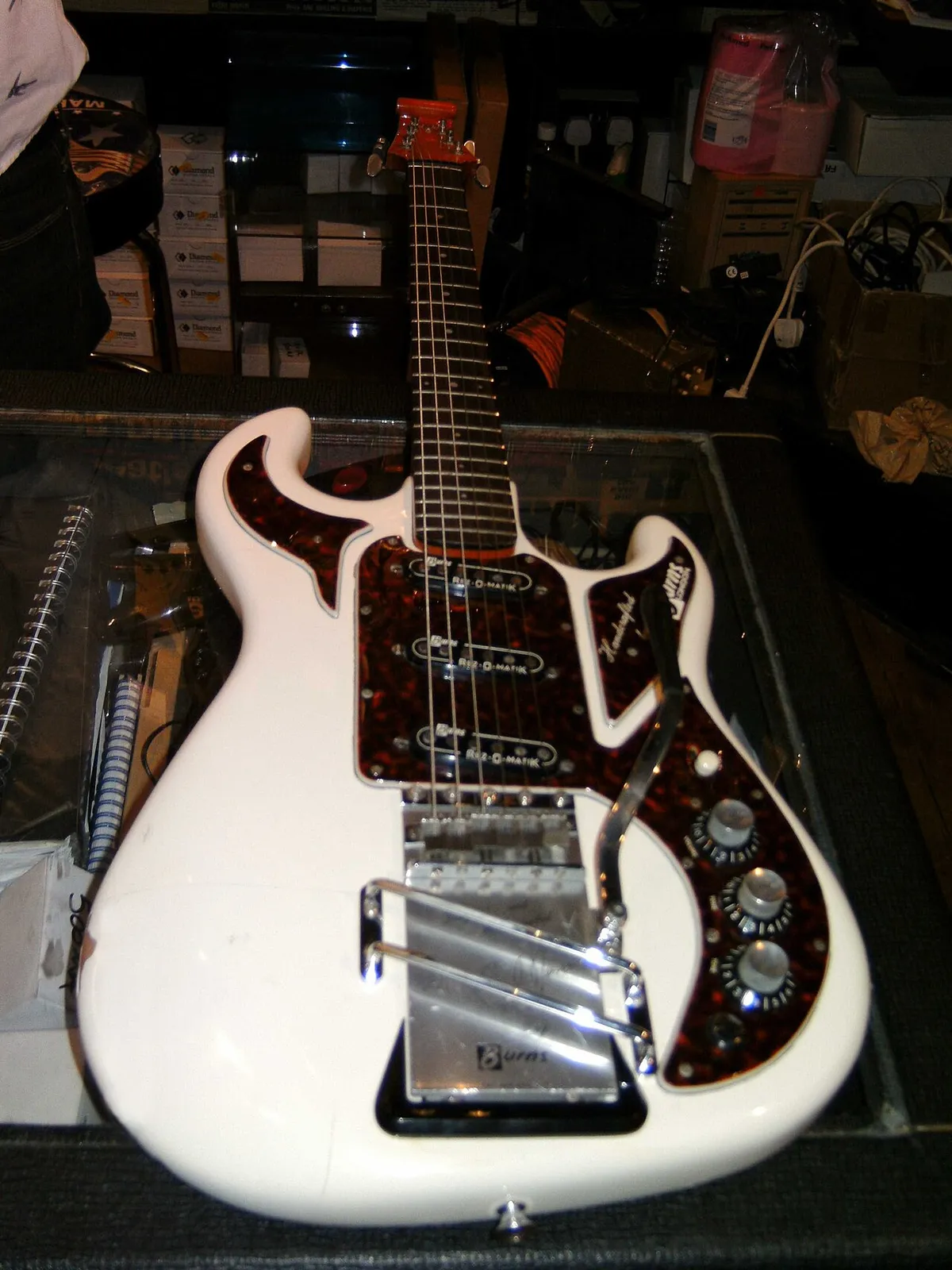
Photo: Bruce Marvin / Wikimedia Commons / Public domain Burns
Marvin
1964
Burns built Hank Marvin more than 30 prototypes to keep him in tune. Then somebody checked his jacket.
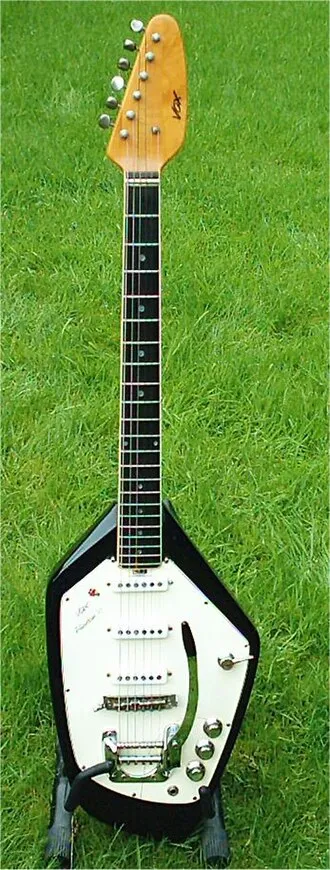
Photo: LittleRoughRhinestone / Wikimedia Commons / Public domain Vox
Phantom
1962
No Fenders in Britain, so Vox built a Strat in a five-sided coat you could spot from the back of the hall.

Photo: Lightburst / Wikimedia Commons / CC BY-SA 4.0 Fender
Stratocaster
1954
The guitar most people mean when they say “electric guitar.” Designed by a man who didn’t play one.