Gibson
SG
SG
Gibson has never stopped making SGs. Angus Young has lost count of his. He still only means one.
Kalamazoo, 1961. The Les Paul, heavy and carved and not selling, is out. In its place Gibson builds something thin, light, red, and sharp at both horns. It still says Les Paul on it. It won’t for long.
- Introduced
- 1961
- Type
- Solidbody electric
- Class
- Production
The short version
1961
The new Les Paul
The double-cut body arrives. Price lists still call it the Les Paul Standard. $290, plus $47.50 for the case.
1963
Just “SG”
Late in the year, the Les Paul name comes off. SG stands for Solid Guitar.
1966
Revolver
George Harrison plays his 1964 SG Standard on “Paperback Writer,” “Rain,” and the Revolver sessions.
1967
The Fool
Eric Clapton’s painted SG debuts at Cream’s first U.S. show, 25 March, in Manhattan.
1969
Passed on
Harrison gives his SG to Pete Ham of Badfinger.
1971
Sydney
By one account, Angus Young buys a ’60s SG in Sydney. The favorite he talks about is a red ’68.
2000
A reissue gets famous
Derek Trucks’s best-known SG is a 2000 ’61 Reissue, with a stop tailpiece.
Side A
A1
A Les Paul in name only
In 1961 Gibson needed a new Les Paul, because the old one wasn’t selling. So it built one that looked nothing like it: thin, light, double-cutaway, all mahogany, with pointed horns. The price lists kept calling it the Les Paul Standard into 1963.
Then the name came off. Les Paul’s endorsement lapsed, in 1962 or 1963, depending on who you ask. By late 1963 the guitar was just the SG. That stands for Solid Guitar. It’s about as plain a name as a guitar has ever had.
A guitar born as a replacement, with a borrowed name, then no name at all. Gibson has made it ever since, without a break. (So has the ES-335, whatever the SG people tell you.) There are an awful lot of SGs out there. You’d think that would make them interchangeable. Ask anybody who plays one.
A2
Thin, light, and a little breakable
Pick one up and the first thing you notice is how little it weighs. One 1961 that a dealer weighed came in at 6.07 pounds. The body’s thin, there’s no maple top, and the cutaways leave the whole neck open, so you can get right up to the top frets without fighting the guitar.
To my ears it’s a little brighter and snappier than a Les Paul. Same kind of pickups, same 24¾-inch scale, a lot less wood.
The catch is the neck joint. Early SGs have a small heel where the neck meets the body, and it’s the soft spot. The trade has known that for decades. Treat it kindly.
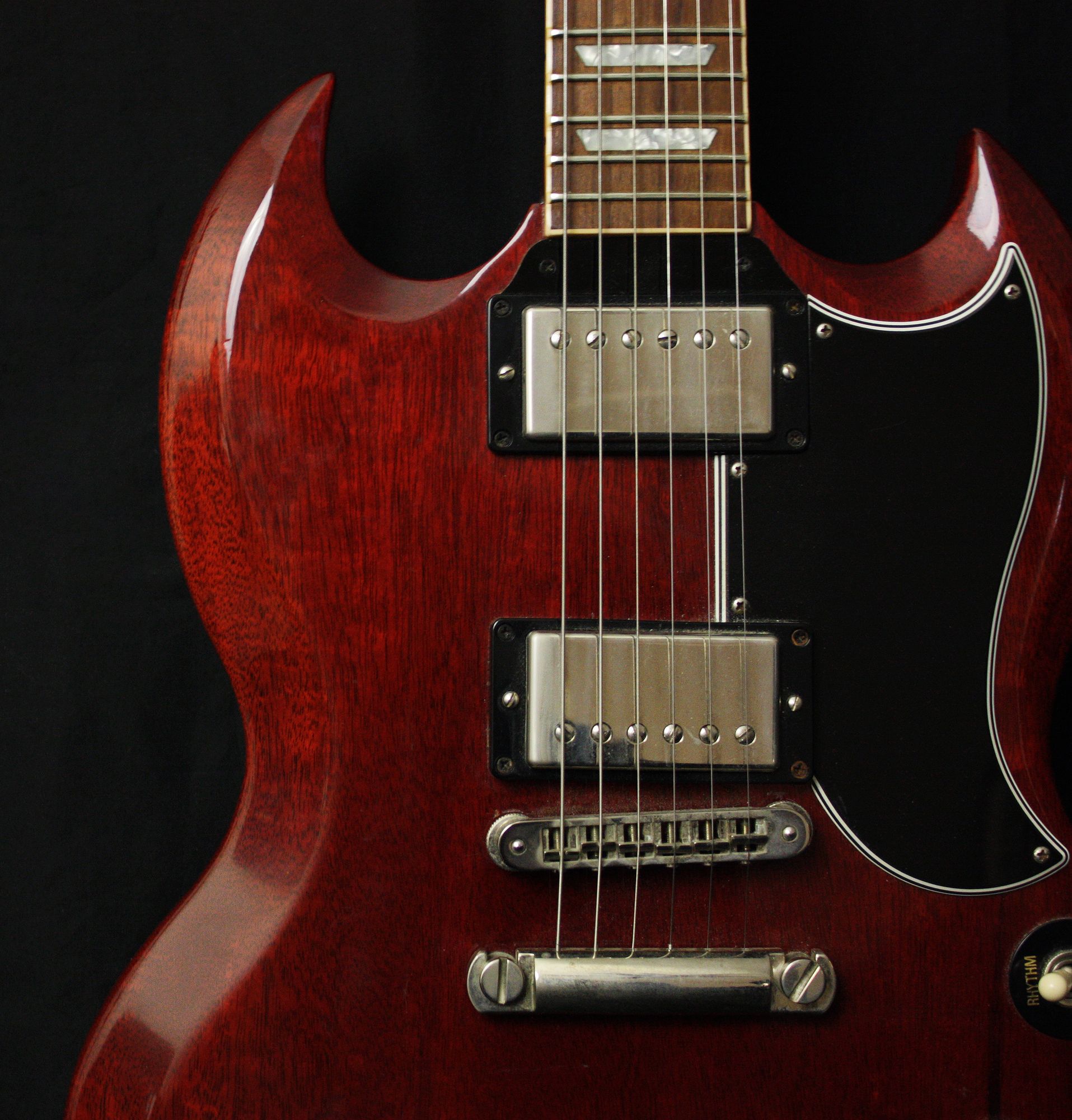
The look changed as it went. Early ones had a small teardrop pickguard and a wide neck, and the vintage crowd hunts for those 1961–65 wide-neck guitars. By the late ’60s it had the big “batwing” pickguard, which is the look Gibson still sells as the SG Standard.
A3
Special is not Standard
Before we get to the famous ones, a word from behind the counter. A lot of the most famous SG moments weren’t Standards. They were SG Specials, with P-90 single-coils instead of humbuckers.
Tony Iommi’s “Monkey” is a 1964 or ’65 Special. Pete Townshend at Woodstock and on Live at Leeds? Specials. Carlos Santana’s red SG at Woodstock? A Special. Robby Krieger’s “Light My Fire” guitar? Also a Special. Great guitars. Different guitar.
A lot of the most famous SGs aren’t Standards at all. Count the pickups, then look at the covers.
Flip the record · By the numbers
$290
List price in 1961, when it was still a Les Paul. The case was $47.50 more.
1,662
Les Paul Standards shipped in 1961. Most of them probably wore the new SG body.
6.07
Pounds, for one measured 1961. A lot lighter than the Les Paul it replaced.
Side B
B1
The Fool, and George’s
The two most famous Standards are from the ’60s, and one man owned both of them. After his Les Paul was stolen, Eric Clapton settled on a cherry SG Standard from around 1964. Two Dutch artists, Marijke Koger and Simon Posthuma, painted it, and it made its debut at Cream’s first American show, at the RKO Theater in Manhattan on 25 March 1967. It was all over Disraeli Gears. That thick, rolled-off “woman tone” came out of it. Later it passed to George Harrison, then Jackie Lomax, then Todd Rundgren, who called it “Sunny.”
Harrison had his own, too. His 1964 SG Standard left the factory in October 1964, and he had it by early 1966. It went straight onto the Revolver sessions, “Paperback Writer” and “Rain,” then the tours, Sgt. Pepper, the White Album, and “Hey Bulldog.” In 1969 he gave it to Pete Ham of Badfinger.
B2
That one guitar
Angus Young has owned more SGs than anybody can count, and that includes Angus. His favorite is a red 1968. Fans argue over whether some of the early photos really show the ’68 or a slightly later guitar, and one account has him buying a ’60s SG in Sydney in 1971. None of that changes which one he talks about.
Derek Trucks has a whole row of cherry SGs. The one people know is a 2000 ’61 Reissue.
Gibson has built SGs for more than sixty years, and it will sell you one tomorrow. That’s the funny part. It’s about as far from rare as a Gibson gets, and nobody who loves one talks about it that way. Here’s Angus:
I’ve lost count of how many SGs I have. But none of them match up to that one guitar.
Put this on
You’ve read about it. Now hear it. Here’s what this guitar sounds like, and what to listen for.
Rain
George Harrison on his 1964 SG Standard. It’s on “Paperback Writer,” the other side of the single, too.
Find it on YouTube (opens in a new tab)Disraeli Gears
Clapton used the Fool, his painted SG Standard, all over this album. Listen for the “woman tone,” the thick, rolled-off sound with the tone knob turned down.
Find it on YouTube (opens in a new tab)Back in Black
The song most people connect with Angus Young’s SG. One source says a cherry 1971 SG is on it. His favorite, he says, is a red ’68, so don’t assume they’re the same guitar.
Find it on YouTube (opens in a new tab)
The cast
The people, and the specific guitars, that made the legend.
1967
Eric Clapton
“The Fool,” circa 1964 SG Standard
Painted by Marijke Koger and Simon Posthuma. His main stage guitar into the summer of 1968. Later owned by Todd Rundgren.
1966
George Harrison
1964 SG Standard
“Paperback Writer,” “Rain,” Revolver, and on through “Hey Bulldog.” Given to Pete Ham in 1969.
1969
Pete Ham
Harrison’s 1964 SG Standard
Badfinger’s guitarist. A gift from George.
1970s
Angus Young
Red 1968 SG
His favorite of many. The year on some early photos is argued over, so “the ’68” is his word, not a serial.
2000s
Derek Trucks
2000 SG ’61 Reissue
Cherry, stop tail. He has a row of cherry SGs; this reissue is the one people know.
Contact sheet
More photographs of this model, including one out in the wild.
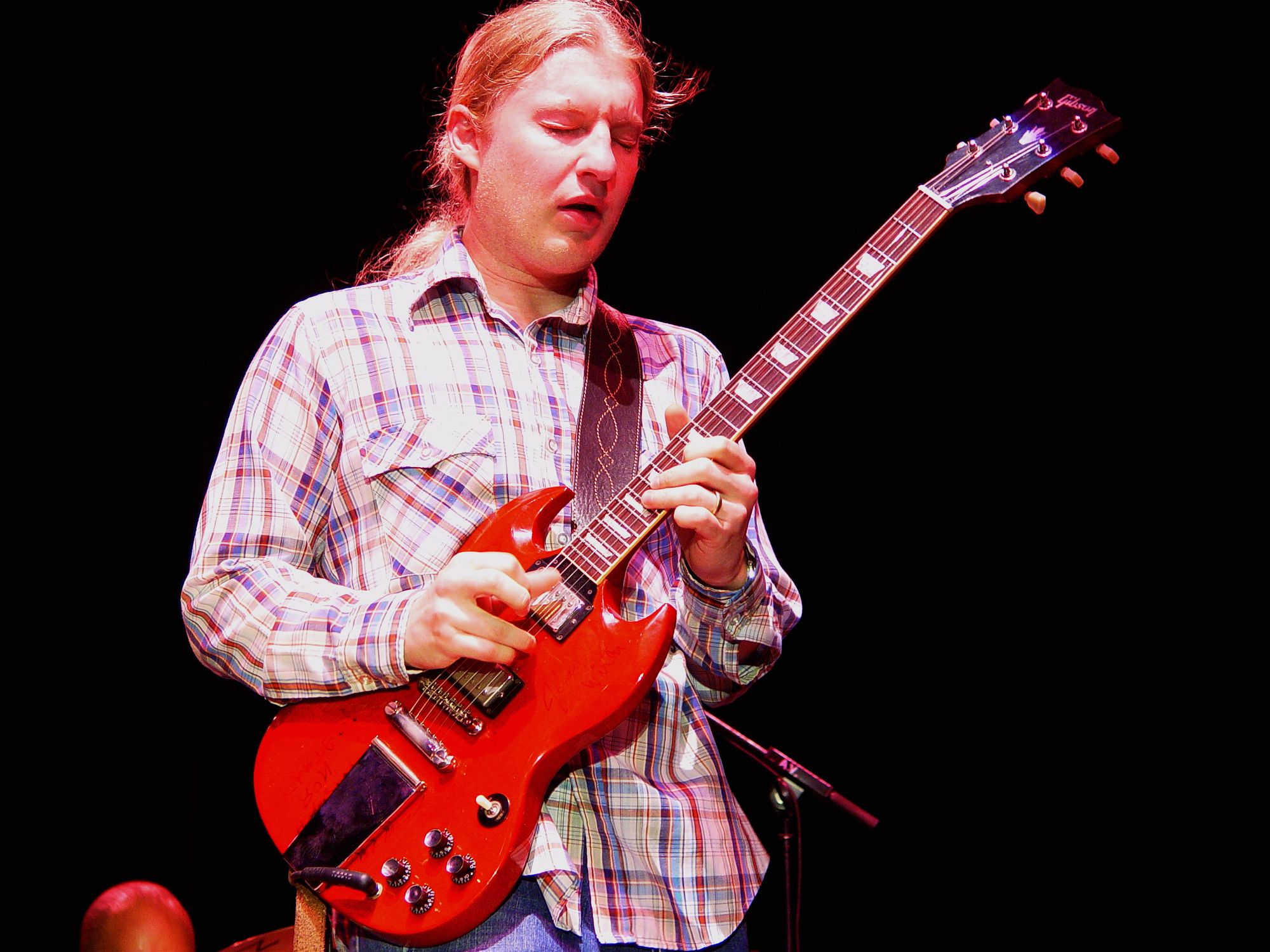
In playDerek Trucks. Photo by Xophersmith. Licensed under CC BY 3.0. Via Wikimedia Commons.Trucks’s known stage guitar is a 2000 SG Standard ’61 Reissue. This 2007 photo is that Standard family (trapezoids, humbuckers, teardrop), not a P-90 Special.
Liner notes
Specs, construction, rarity, value, and every source we used.
Two current Standards — late-60s batwing and early-60s teardrop — and neither is the 1961 Les Paul that first wore this body.
- Body
- SG shape; solid mahogany; no maple cap. Gloss nitro. Black 5-ply full-face (batwing) pickguard. Fretboard binding only (single-ply cream).
- Neck
- Set mahogany; Rounded profile; long tenon; 19th-fret neck joint (factory copy).
- Fingerboard
- Bound rosewood; 22 medium jumbo; acrylic trapezoids; 12 in radius. End-of-board 57.4 mm / 2.26 in.
- Scale
- 24.75 in / 628.65 mm
- Pickups
- 490R (neck) / 490T (bridge); Alnico 2
- Hardware
- Aluminum Nashville Tune-O-Matic; aluminum Stop Bar; Grover Rotomatic kidney; chrome
- Electronics
- 2 volume, 2 tone; 3-way toggle. (This SKU’s page does not claim Orange Drop / hand-wire.)
- Finish
- Gloss nitrocellulose (Ebony, Heritage Cherry, Dark Walnut on that family)
- Nut
- Graph Tech, 43.05 mm / 1.69 in
Open the full research fileConstruction details, the complete player record, production numbers, dated value estimates, and sources
Current USA SG Standard (late-60s-style batwing), $1,799, model SGS00EBCH1. The SG Standard ’61 Stop Bar is a separate SKU ($1,999): 5-ply teardrop guard, SlimTaper, 22nd-fret joint, 60s Burstbuckers, ABR-1, nickel, Vintage Deluxe Keystones, hand-wired Orange Drops, hardshell case. The 1961 SG-body Les Paul is vintage only — not a current catalog guitar.
Construction
SG means Solid Guitar. The body arrived in 1961 as a redesigned Les Paul: double-cut, thinner mahogany, no maple cap. Price lists still said Les Paul Standard (“Double Cutaway -- Cherry Finish”) into 1963. The SG name is generally dated to late 1963, after the Les Paul endorsement lapsed. Contract-expiry year is disputed: 1962 vs 1963 (Bacon vs Carter, Guitar Player). Body in late 1960 / 1961; name later. Do not write the 1961 SG-body Les Paul as a current SKU. Two current “typical” Standards — not the same guitar; the caption already splits them. Related current variants: Maestro Vibrola; Sideways Vibrola on some SKUs (some discontinued); Faded.
A True Vintage 1961 Les Paul Standard SG-body (serial 20728 — one guitar, not a factory spec sheet) measured 6.07 lb, nut 1 11/16 in, neck 0.81 in / 0.90 in, PAFs 7.3k / 7.5k. 1961 list $290 plus case $47.50. Meiners via True Vintage: 1,662 Les Paul Standards shipped in 1961 (hand ledgers; may include leftover single-cuts). Early examples: small teardrop guard, wide nut ~1 11/16 in, PAFs then patent-number pickups, sideways Vibrola on some. Cherry nitro, often faded. Customs typically white.
The vintage trade treats 1961–65 “wide neck” as desirable. Nut width narrowed on many Gibsons around 1965 — well-known, but not a gospel cutoff guitar-by-guitar. Late 1960s: larger batwing guard, the look of the current USA “SG Standard.” Early 1970s: some Standards/Customs used a Schaller “harmonica” bridge (Wikipedia lead). Junior / Special: P-90s, wraptail. Townshend and Iommi associations are often Special, not Standard. Custom: three humbuckers, extra binding. Current Historic 1961 Les Paul SG Standard Reissue VOS ($4,299 dealer, Sweetwater) is not a 1961. Early SGs are known for a small heel and a vulnerable neck joint — common trade knowledge, not a 1960s ad spec.
Players
Special vs Standard is the whole player story. Several of the most famous SG performances are Specials (typically P-90s), not Standards (typically humbuckers). Collapsing Iommi, Townshend, and Santana's Woodstock guitar into "SG Standard" is the usual error. Clapton's Fool and Harrison's Revolver guitar are Standards. Tharpe's Manchester guitar is a Custom. Clapton's Beano guitar is a Les Paul, not an SG.
Tony Iommi, "Monkey" — 1964/65 Gibson SG Special (left-handed, heavily modified). Not a Standard. Iommi's own site: originally identified by Gibson as a 1964/65 Special; nicknamed for a monkey-playing-violin decal added in the early 1970s. Became the main guitar after the bridge pickup on Iommi's white Stratocaster failed while recording "Wicked World" on Black Sabbath (1970). Used through the original lineup's classic era. Guitar World (NAMM 2020 / updated 28 October 2022): Gibson Custom Shop replica of the 1964 SG Special. Original displayed at Hard Rock Cafe, Times Square. 1964 vs 1965: either is acceptable; "1964/65 Special" is the careful form. Guitar Player: Les Paul too heavy / hard to reach upper frets after the injury.
Pete Townshend — Gibson SG Special (multiple, 1968–1973). Not a Standard. Whotabs: exclusive stage guitar from mid/late 1968 to 1971; Woodstock, Live at Leeds (14 February 1970, Leeds University), Isle of Wight, Tommy sessions, "The Seeker," Rolling Stones Rock and Roll Circus (December 1968). Townshend in Guitar Player May/June 1972: the SG "rang, it sang," with "plain pickups" (P-90s). He went through dozens; many smashed. Treat Woodstock as model-level (SG Special), not as one surviving serial — Whotabs notes conflicting auction/Hard Rock claims about which smashed body is "the" Woodstock guitar. He did use a 1961-type SG Standard at least once, 2 May 1969 at Ronnie Scott's — exception, not the famous live sound. Pete Townshend Signature SG (2000).
Carlos Santana — red Gibson SG Special, Woodstock, 16 August 1969. Not a Standard. Reverb (Tony Bacon): Santana "was one of the Woodstock SG fans, and his Special was something of a testbed" (Maestro vibrato moved, stop bar added, Grovers). Ground Guitar: cherry Special with P-90s at Woodstock; later a black SG Special in 1970. He later owned a 1961 Les Paul/SG Custom (Polaris White), bought 1974, sold 2005 — not the Woodstock guitar. Yamaha SG-type instruments are a later story.
Eric Clapton, "The Fool" — circa 1964 Gibson SG Standard. Not a Special. Separate from the Beano Les Paul. Tony Bacon, Guitar World, 9 August 2026: after the Beano Les Paul was stolen, Clapton settled on a cherry SG Standard; Dutch artists Marijke Koger and Simon Posthuma painted it; main stage guitar through 1967 into summer 1968; used extensively on Disraeli Gears. Debut of the painted guitar: Cream's first U.S. show, 25 March 1967, RKO Theater, Manhattan. Later owners include George Harrison, Jackie Lomax, Todd Rundgren ("Sunny"). "Woman tone."
George Harrison — 1964 Gibson SG Standard, serial 227666. Guitar World (Jamie Dickson, 17 March 2026) quoting Tony Bacon: playing an SG Standard at Empire Pool, May 1966; acquired early 1966 (shipped October 1964). Immediate use on Revolver sessions; Christie's / Jim Irsay Collection: Paperback Writer and "Rain"; promo films for those plus "Lady Madonna"; 1966 tours; Sgt. Pepper and White Album sessions; "Hey Bulldog." Gifted to Pete Ham of Badfinger in 1969. Standard.
Sister Rosetta Tharpe — white 1961 Gibson Les Paul SG Custom (three pickups). Guitar World: Blues and Gospel Train, Granada TV, Wilbraham Road station, Manchester, 7 May 1964; opened with "Didn't It Rain." Transitional Les Paul-branded SG-body Custom. Among the earliest high-visibility SG-body performances. Custom, not Special or Standard.
Angus Young — red 1968 Gibson SG (Standard-family; his favourite of many). Guitar World quoting Angus (2009): "I've lost count of how many SGs I have. But none of them match up to that one guitar." Used for major AC/DC recordings and tours; basis of a 2009 signature. Mixdown: a '60s Vibrola SG bought in Sydney in 1971, unusually thin neck. GC Riffs cites a cherry 1971 SG on "Back in Black." Fan research argues some early-stage guitars photographed as "the '68" may be later (1970–71) because of cutaway carving. Flag year of "the" first Angus SG as contested; his stated favourite is the red '68. Do not call it a Special unless a specific instrument is shown to be one.
Robby Krieger — red Gibson SG Special, serial 952727 ('63 or '64). Not a Standard. Krieger's own public appeal: the guitar used to audition for the Doors, to write "Light My Fire," and to record the first two Doors albums; missing for years. Recovery not confirmed here.
Derek Trucks: multiple cherry SGs; best known for a 2000 SG '61 Reissue stop-tail, plus a signature with PAF 57 Custom humbuckers. Gary Clark Jr., Carrie Brownstein, and Ian MacKaye are documented SG users (Mixdown). Steve Katz (Blood, Sweat & Tears) at Woodstock was unsure ("I guess I played a red SG Standard") — too weak to treat as a named-instrument claim.
Rarity
Current USA Standard and Standard ’61: regular production. Not rare.
Vintage 1961–63 Les Paul–logo SG-body Standards are uncommon relative to later 1960s SGs. 1,662 Standards shipped in 1961 (Meiners / True Vintage) — not a pure SG census. Shipped, not surviving; likely majority SG-bodied, with a possible handful of leftover single-cuts. Early wide-nut, nickel, PAF / early patent-number examples are the collected ones. Specials and Juniors of the same years are a different, usually lower, market. Historic 1961 Les Paul SG reissues are a current premium SKU, not vintage.
Mixdown claims the SG is the only Gibson electric in constant production since introduction. The ES-335 has also been in continuous production since 1958 (True Vintage; Gibson). Read as unique, the Mixdown claim is overstated.
Value
Informal estimate, 25 August 2026. Not an appraisal.
New street. SG Standard (batwing, 490s): $1,799 (gibson.com). SG Standard ’61 Stop Bar: $1,999 (gibson.com). Gibson Custom 1961 Les Paul SG Standard Reissue VOS: $4,299 (Sweetwater). 1964 SG Standard Reissue Maestro VOS: $4,699. Those reissues are not 1961 originals.
Used modern. Reverb Price Guide snippet (SG Standard ’61 Stop Bar 2019–present): $1,174–$1,528 estimated used, based on 1,243 orders, vs $1,999 new. (Page bot-blocked; snippet only.) AxeDB (updated 19 Aug 2026): SG Standard ’61 $1,350–$1,650 FMV; ~27 sales/month. AxeDB SG Standard (non-’61): typically $1,150–$1,450. Sweetwater Gear Exchange: ’61 Vintage Cherry used suggestion $1,299–$1,539. guitarprice.net: SG Standard used $1,500–$2,800 (broader bucket). Rounded informal: about $1,200–$1,900 for common used USA Standard / ’61.
Vintage / collectible. 1961–63 original Les Paul/SG Standard: True Vintage Guitar dealer $15,000–$25,000 (to ~$30,000). Sideways-Vibrola PAF examples sit at the top of that band; exceptional/unplayed/custom-color/provenance pieces above $30k. Original finish vs refinish, and provenance, can double or halve a result. Reverb asks for 1963–66 Maestro Standards observed $14,000–$20,000 — ask, not sold. Public sold comps for original 1961–64 SG Standards were thin in the research pass. Asking examples: Carter Vintage 1963 Standard (modified: Vibrola removed, replaced bridge pickup/bridge/nut/refret) $20,000; 1965 Standard Cherry $9,000 asking. TVG’s band is a dealer estimate, not a 2024–26 sold median. Celebrity SGs (Iommi, Angus, Fool) are a different market and were not priced from public 2024–26 auctions here. 1961 list $290 (True Vintage).
See also
- gibson-sg-special — Iommi “Monkey,” Townshend Woodstock / Live at Leeds, Santana Woodstock; pointed P-90 Special, not this Standard
- gibson-les-paul-standard — the single-cut this body replaced, plus the Burst sidebar
- gibson-es-335 — the other Gibson electric that never actually left production
- fender-stratocaster — Iommi started on one; the failed pickups are why Monkey exists
- gibson-melody-maker — student Gibson that later wore an SG body; not this two-humbucker Standard
Sources
- Gibson SG Standard Ebony
- Gibson SG Standard ’61 Stop Bar
- True Vintage: 1961 Les Paul Standard SG-body
- Guitar Player: SG history
- Mixdown: SG players
- Guitar World: Angus Young on his 1968 SG
- Guitar Player: Iommi and the Les Paul
- Guitar Center Riffs: SG history
- Reverb News: Guitars of Woodstock 1969
- Carter Vintage: 1963 SG Standard (asking)
- AxeDB: SG Standard ’61
- Reverb: SG Standard ’61 Price Guide
- Sweetwater: Custom 1961 Les Paul SG Reissue
- True Vintage Guitar: LP/SG 1961–63 values
- Iommi.com: SG “Monkey”
- Guitar World: Tony Bacon on Clapton’s Cream guitars
- Guitar World: Harrison 1964 SG
- Christie’s: Harrison SG Standard serial 227666
- Dave Hunter, Guitar Player: Classic Gear — 1962 Gibson Les Paul/SG — still Les Paul in the 1961 catalog.
- Guitar World: Gibson Custom Shop clone of Iommi's Monkey — updated 28 Oct 2022; 1964 SG Special.
- Whotabs: Pete's Gear — Gibson SG Special — Leeds, Woodstock, Tommy; Special, not Standard.
- Jim Irsay Collection: Harrison 1964 SG Standard
- Guitar World: Sister Rosetta Tharpe, Blues and Gospel Train — 7 May 1964; 1961 Les Paul SG Custom.
- Guitar World: Sister Rosetta Tharpe, electric guitar trailblazer
- Vintage Guitar: Ted McCarty — Les Paul replacement context.
Keep digging
Guitars this one gets compared to, confused with, or descended from.

2006 Gibson Les Paul Standard (SN 000660573). Photo by wetwebwork. Licensed under CC BY-SA 2.0. Via Wikimedia Commons. Gibson
Les Paul Standard
1952
Gibson made about 1,500 sunburst Les Pauls, decided nobody wanted them, and stopped. Then the British blues boom happened.

Photograph of a vintage 1960 Gibson ES-335TD. Photo by Lightburst. Licensed under CC BY-SA 4.0. Via Wikimedia Commons. Gibson
ES-335
1958
Larry Carlton played three 335s off a shop wall, unplugged, paid $850 for one, and became Mr. 335.

Photo: Lightburst / Wikimedia Commons / CC BY-SA 4.0 Fender
Stratocaster
1954
The guitar most people mean when they say “electric guitar.” Designed by a man who didn’t play one.