Burns
Flyte
Pop stars posed with it for the cameras. The guy in David Essex’s band paid full price and played it.
Britain, 1974. Jim Burns can put his own name on a guitar again, he has a new partner in Newcastle, and two of his old hands are cutting the wood in Harold Wood. The guitar they launch is shaped like a swept wing. It was going to be called the Conchorde.
- Introduced
- 1974
- Type
- Solidbody electric
- Class
- Production
Have a photograph of this guitar? Send a picture
The short version
1965
The name goes to Baldwin
Jim Burns sells his first company to Baldwin, and his name goes with it.
1970
The name comes free
Baldwin-Burns stops, and the Burns name is usable again.
1973
Newcastle
Jim teams up with Alan Wright of City Music Stores. The guitars will be sold as Burns UK.
1974
The Flyte
The swept-wing guitar arrives, with Shergold woodwork and Re-An electronics.
1975
Twelve in a Cortina
February. Twelve Flytes ride to the Frankfurt fair in one overloaded car.
1976
The plane catches up
January. Concorde, the airliner the guitar was nearly named for, starts commercial flights.
1977
Grounded
Burns UK goes under, and the Flyte goes with it.
2003–05
A Korean Flyte
The Club Series borrows the wing, with different woods, a different neck, and a locking nut.
Side A
A1
Twelve guitars in a Cortina
February 1975. Grahame Wright, the marketing director of Burns UK, is driving a Mark III Cortina to the Frankfurt trade fair with twelve Flytes in the back. German police pull him over. The cases are too heavy for the car.
The guitars in those cases weren’t quite the catalog, either. The silver paint had started turning greenish, so for the show they made specials in red, blue, white, and natural mahogany. Headstock plaques were hard to get. So were volume knobs. Wright thinks the Frankfurt guitars may have worn Fender knobs, with the Flyte name on a transfer on the small wing.
That’s the Flyte in one scene: a big idea, a small company, and a car carrying more than it should. It’s a guitar with a lot of famous photographs and hardly any famous recordings. The people who posed with it are the ones everybody remembers. The one who paid for it is the one who played it.
A2
Getting the name back
Jim Burns sold his first company to Baldwin in 1965, and his name went with it. For a while he designed the Hayman line for Dallas Arbiter. When that company died, he went north. In 1973 he teamed up with Alan Wright of City Music Stores in Newcastle, and the new guitars would be sold as Burns UK. Baldwin-Burns had stopped in 1970, so the name was his to use again.
The guitar the new firm developed was going to be the Conchorde. You can hear the pun. Concorde, the British and French airliner, was conceived in 1962 and flew as a prototype in 1969. It wouldn’t carry a paying passenger until January 1976.
The name didn’t stick. One account says they weren’t allowed to use it, and nobody knows whether a single guitar ever left the shop badged Conchorde. It came out in 1974 as the Flyte, more than a year ahead of the plane’s first paying passengers.
A3
A wing, not a copy
Look at it first. Symmetrical, built in two levels, swept back like a wing, with a sharply pointed head. It arrived in the copy era, and it didn’t look like a copy. Burns didn’t need another British solidbody that could pass for a Strat. It isn’t a Bison with new paint, and it isn’t a Marvin, either. Those were the ’60s flagships, all horns and scroll.
It’s wood, too, not a molded shell. The body is mahogany, the neck is bolt-on maple, and at least some of the fingerboards are ebonized maple. The woodwork came from Shergold in Harold Wood, the shop run by Jack Golder and Norman Houlder, both former Burns hands. The electronics came from Re-An. Newcastle was the company. Harold Wood was where the woodwork got done.
For something that looks like it needs a pilot’s license, the controls are almost plain. There are two Mach One Humbusters under five-sided metal covers. The ones people have looked at closely have a volume, a tone, and a three-way switch. The Dynamic Tension bridge carries over an old Burns idea: saddles on a plate that you can raise one string at a time. There’s no ’60s vibrato cradle. It’s a straightforward two-humbucker guitar in a very strange suit.
Flip the record · By the numbers
12
Flytes driven to the February 1975 Frankfurt fair in one Mark III Cortina. One shipment, not a production total.
1974
The Flyte’s launch. Concorde didn’t carry a paying passenger until January 1976.
2
Mach One Humbusters, in five-sided metal covers.
0
Published production totals. Nobody knows how many were made.
Side B
B1
Photographs, not records
This is where the Flyte’s fame comes from, and where you have to be careful.
One history says Marc Bolan of T. Rex played one. The company’s own marketing director is more cautious. What he knows is that Bolan was on the cover of a Top of the Pops magazine that also showed the winner of a Flyte that Bolan had handed over. He “might have used” one. The photographs of Bolan holding a Flyte are real. You’ll see shops hang “Telegram Sam” or “Gudbuy T’Jane” on it. Both came out in 1972, two years before the Flyte existed.
Slade is the same story, with more guitars. Dave Hill and Jim Lea were given Flytes and photographed with them at a Top of the Pops session at the BBC. Nobody has them onstage with the six-strings beyond that appearance, and Dave sold his, as he did with promo guitars. A Flyte bass made it onto at least one Slade LP track. Nobody has said which one, and it’s a bass.
The photographs are real. The records were made on something else.
B2
Full price
The company didn’t outlive the shape by much. Burns UK added the Artist and the Mirage in 1976 and the LJ24 in 1977. Then the old problem, Jim running the firm, brought it down, and the Flyte went with it in 1977. The Mirage, with Mach Two pickups, is the guitar usually named as its replacement. Depending on who you ask, it arrived in 1976 or around 1977. Jim came back in 1979 with a new company and a guitar called the Scorpion. No Flyte.
Nobody published a total. Nobody knows how many were made. One man remembers a Union Jack Flyte for the 1977 Silver Jubilee. A Korean Club Series Flyte came along in 2003 and ran until 2005, with a broader head, alder or basswood, and a locking nut. Later, a tribute from another maker. Neither is a mahogany guitar from Harold Wood.
And then there’s Mark Griffiths. He was playing with David Essex at the time, and Grahame Wright watched him buy a natural-mahogany Flyte and pay full price for it. He used it. Later he played a Flyte bass too. The shop even put a Burns neck on his old Stratocaster and cut the body down.
Bolan got the magazine cover. Slade got the television spot. Griffiths paid for his and took it to work.
The cast
The people, and the specific guitars, that made the legend.
Mark Griffiths
Natural-mahogany Flyte
Playing with David Essex when he paid full price for one and used it. Later he played a Flyte bass.
1970s
Marc Bolan
A Flyte, in photographs
One history says he played one. Burns UK’s marketing director only says he “might have used” it. The photos are real. No song is tied to it.
1970s
Dave Hill and Jim Lea
Promotional Flytes
Given Flytes and photographed with them at a Top of the Pops session. Dave sold his. Nothing puts the six-string on a Slade record.
1975
Grahame Wright
Burns UK marketing director
Drove twelve Flytes to Frankfurt in 1975. German police stopped the car. The cases were too heavy for it.
1973
Jim Burns
Burns UK
Sold his first company to Baldwin in 1965, came back with this one, and saw it go down in 1977.
Liner notes
Specs, construction, rarity, value, and every source we used.
Swept wings and a pointed head on mahogany — Burns UK’s 1974 Flyte, after Baldwin, not a Bison and not a Marvin.
- Body
- Mahogany. Symmetrical, bi-level, swept-wing (Michael Wright). Shergold woodwork, not a molded shell
- Neck
- Bolt-on maple
- Fingerboard
- Ebonized maple on at least some (Wright). Futone prints ebony. Fret count unpublished
- Scale
- Unpublished in Wright. Futone: 25½". Club Series reissue (Midgley): 24¾". Eastwood tribute: 24¾" (628 mm). Mix flagged. Do not average
- Pickups
- Two Mach One Humbuster humbuckers, five-sided metal covers
- Hardware
- Dynamic Tension bridge; saddles individually height-adjustable on the plate (Wright). Pointed head. Not the 1960s cradle vibrato
- Electronics
- One volume, one tone, 3-way (Futone; the same loom on a Curvy Sounds natural). Wright does not print it
- Finish
- Silver, white, natural, and Union Jack graphics (Wright). Exhibition specials and a paint problem sit in the caption
- Nut
- Unpublished on the 1974–77. Eastwood tribute: 1⅝" (43 mm). Mix flagged. Not this table
Open the full research fileConstruction details, the complete player record, production numbers, dated value estimates, and sources
Classic living example = 1974–77 Burns UK Flyte. No current Burns Flyte SKU. Wikipedia, read this pass, reports no new Burns production confirmed since the mid-2010s. Flyte bass is the four-string. Club Series (Korea, 2003–2005) and the Eastwood Flyte are later objects on the outline. Mixed inch/mm flagged on Eastwood’s 24¾" (628 mm) scale and 1⅝" (43 mm) nut, and on one Stockport six-string weighed at 6.46 lb (2.9 kg). Millimetres unpublished for the Burns UK scale and nut. Do not average Futone’s 25½" with either 24¾". Do not convert Gardiner Houlgate’s 3.02 kg on one circa-1975. A measured Flyte bass (jelutong, 77 cm scale) is not this table.
Construction
The job was a shape, not another British solid that could pass for a Strat. Baldwin had the old name. Jim Burns wanted his own back.
He had sold Ormston Burns to Baldwin in 1965 (Vintage Guitar, Michael Wright; Tony Bacon, Reverb News, 26 April 2018). In between he designed the Hayman line for Dallas Arbiter. Wright: after that company died, in ’73 he hooked up with an outfit in Newcastle and started guitars to be sold as Burns UK Ltd. Wikipedia: the partner was Alan Wright of City Music Stores, and the Burns name was usable again once Baldwin-Burns stopped in 1970. There, the guitar that was going to be called the Conchorde was developed and introduced in ’74. Futone says they were not allowed the airplane’s name. Michael Wright says it is not known if any were ever produced under Conchorde. Keep both. The airplane is Concorde. The proposed badge is his spelling.
The wing is the point. Concorde was conceived in ’62, a joint British and French project. Prototype flights 1969. First commercial flights January 1976 (Wright). The guitar is earlier than the paying passengers. Symmetrical, bi-level, swept-wing, sharply pointed head. Coming in the copy era, it did not look like the copies.
It is wood. Wright: the body was mahogany, the bolt-on neck maple, and at least some fingerboards were ebonized maple. Futone prints an ebony board and a 25½" scale. Curvy Sounds prints painted maple on one natural. Do not pick a winner, and do not average that scale with the reissue’s 24¾". Shergold’s own history: in 1974 the Burns UK range used Shergold woodwork. Wikipedia’s Shergold page: Jack Golder and Norman Houlder, former Burns hands, East London, Forest Gate then Harold Wood in 1973, making bodies and necks for other brands. Wright again: the guitars were made by Shergold, the electronics by Re-An. Newcastle is the company. Harold Wood is the wood. Not a molded resin shell, and not a 1960s odd-body with a new name on it.
Not a Bison (burns-bison). Not a Marvin (burns-marvin). Those are the pre-Baldwin flagships, horns and a scroll. This wing does not nest under either. The Dynamic Tension bridge builds on Burns’ ’60s hardware ideas — saddles you can raise one at a time, on a plate — and it is not the Series cradle vibrato. Two Mach One Humbusters, five-sided metal covers. Futone, and a Curvy Sounds listing of a natural: one volume, one tone, a 3-way. Wright never prints that loom. Fret count and nut width on the six-string are unpublished. Leave them unpublished.
Finishes will not sit in one list. Wright: silver, white, natural, and Union Jack graphics. Grahame Wright, who identifies himself as Burns UK’s marketing director, on a Guitarz thread: silver paint that was turning greenish; for the February 1975 Frankfurt show they made specials in red, blue, white, and natural mahogany. MartinF, on the same thread, remembers silver first, then light or dark natural and a brown sunburst at Music Ground in Doncaster, and one Union Jack for the 1977 Silver Jubilee, which he says is pictured in Pearls and Crazy Diamonds. A later owner on that thread described a glittery green all over. That can be the silver failing, or another guitar. Do not call green a catalog color.
Grahame Wright transported 12 Flytes to that Frankfurt fair in a MkIII Cortina. German police stopped the car. The cases were too heavy for it. Twelve is one shipment to a trade show. It is not a production total. Early on, the headstock plaques were hard to get, and the volume knobs were too. Grahame Wright thinks those show guitars may have worn Fender knobs, and that the Flyte name was a transfer on the small wing. MartinF expects a logo on the treble wing, an oval metal plaque on the head, and metal knobs. A red with neither is not automatically a catalog red.
The company did not outlive the shape by much. Wright: 1976 Artist and Mirage, ’77 LJ24, and the old problem — Jim running the firm — brought down Burns UK, and the Flyte, in 1977. MyRareGuitars: around 1977 the Mirage, with Mach Two pickups, was introduced to replace the Flyte. Keep 1976 and “around 1977.” Bacon: the 1979 return is Jim Burns Actualizers, including the Scorpion. Wikipedia: that firm also tried the Bison and the Marvin again. Not a Flyte. Not this table. The Flyte bass shares the wing and the years. A Dirk Witte 1976 bass is jelutong, with a 77 cm scale. A bass. Not this table. Michael Wright does not know of a guitar that left the shop badged Conchorde. Do not invent a second model to go with the pun.
Classic against current: a 1974–77 mahogany six-string — pointed head, two Humbusters, Dynamic Tension — against no new Flyte from Burns. Midgley’s Club Series, 2003–2005, Korea, is a broader head, alder or basswood, 24¾", 22 frets, a locking nut, and a Floyd Rose or a hardtail. Eastwood’s tribute, fetched 24 September 2026, is basswood, rosewood, 24¾" (628 mm), nut 1⅝" (43 mm), Valco humbuckers, list $949, and sold out in all three colors. Neither is a Shergold mahogany Flyte.
Players
Do not hang a Bison or a Marvin on this plate. Do not hang the Flyte bass on it. Do not pin a 1972 T. Rex or Slade single on a guitar that did not exist yet.
Marc Bolan. Michael Wright: T. Rex’s Bolan played one. That is the sentence. It is not a session log. Grahame Wright, the marketing director, is more cautious than the magazine: he only knows that Bolan was on the cover of a Top of the Pops magazine that also showed the winner of a Flyte Bolan presented. “Might have used.” G L Wilson, on the same Guitarz post, says the photographs of Bolan with one are real, and that he had not seen Slade with one. Keep the split. No song is pinned. “Telegram Sam” and “Gudbuy T’Jane” are 1972 records. PulseBeat’s shop copy that hangs either single on a Flyte is the wrong year. Bolan’s late-’50s Les Paul and his black tremolo Flying V are other guitars. Dealer paste of a 17 February 1976 television date did not turn up in a named account this pass. It stays out.
Slade. Wright names the band and stops. Grahame Wright: the photographs were a Top of the Pops session at the BBC, publicity, and the Flyte bass — not this six-string — was used on at least one Slade LP track. He does not name the track. MartinF: promo pictures of Dave Hill and Jim Lea, and as far as he knows they posed and did not play the guitars on stage or on a record. Ian Edmundson, of slayed.co.uk, on the same thread: they were given Flytes; no record of them on a stage apart from that Top of the Pops appearance; Dave sold his, as he did with promo guitars. The picture is the fact. The single is not.
Mark Griffiths. The one Grahame Wright watched buy the thing. Playing with David Essex at the time, he paid full price for a natural-mahogany Flyte and used it, and later a Flyte bass. The price he paid is unpublished. They also put a Burns neck on his old Stratocaster and cut the body down. That instrument is not this slug.
Also known to play stays short. A comment on the Guitarz thread says Nick Saloman of the Bevis Frond is on video with a red one. No song, no date, no better source this pass. None invented.
Rarity
You cannot buy a new Flyte from Burns. The run ended with Burns UK in 1977. A Korean Club Series from 2003–2005, and an Eastwood tribute, are other factories on this wing. They are not a mahogany Shergold guitar.
Burns UK did not publish a Flyte total. Wright: it is not known how many were made. Guitar Part, March 2026, says the same. None invented. The 12 that went to Frankfurt in February 1975 are one overloaded Cortina. MyRareGuitars’ 1976 example is numbered 172. That is one plate. It does not count a year.
What is actually thinner: exhibition colors outside the silver-white-natural run; a Union Jack, if MartinF is right that the Jubilee guitar was one; any silver that stayed silver, given the paint Grahame Wright says was turning green. Griffiths’ natural is one object. It is not a vintage Flyte.
Value
Informal estimate, 24 September 2026. Not an appraisal.
Ask versus sold, labeled. No celebrity hammer on this slug. No invented medians or factory counts. A 1974 list price did not turn up. Griffiths “paid full price,” and the figure is unpublished. That is not 2026 street.
New street. None under Burns. Eastwood’s tribute lists at $949. All three colors were sold out on the page fetched this pass. Their line that an original means “$3000+” is the tribute maker’s copy, not a price guide. Not a Burns, and not a comp.
Used modern. Club Series Flytes are a different guitar, Korea, 2003–2005. No clean named ask isolated this pass. Don’t invent a midpoint.
Vintage / collectible. No Reverb Price Guide band isolated this pass. Flag: thin sold-comp access. Named hammer, not a series: Gardiner Houlgate, sale 10 June 2025, a circa-1975 cream/white with an ebonised board, estimate £1,200–1,600, sold £1,200. The catalog notes buckle scratching and dings, and 3.02 kg on that guitar. Named shop bracket, not a hammer: Guitar Part, 24 March 2026, puts the Flytes they see at €2,500–3,000 depending on condition. Do not average the £1,200 with that bracket. A Flyte bass ask is a bass. Not a comp.
See also
- burns-bison — the 1961 Hackney flagship; sycamore horns and Ultra-Sonics, not this wing
- burns-marvin — Hank’s 1964 signature, and the scroll the later Bison borrowed. Not a Flyte
- vox-phantom — the previous decade’s British odd-body. Different factory, different outline
Sources
- Vintage Guitar, Michael Wright, Burns Flyte (February 2003) — ca. 1976 example; Conchorde name, unknown if any were badged that; Newcastle ’73, Burns UK, introduced ’74; Shergold woodwork, Re-An electronics; mahogany, bolt-on maple, at least some ebonized maple; Mach One Humbusters, five-sided covers; Dynamic Tension bridge; silver, white, natural, Union Jack; Bolan and Slade, no songs; Artist and Mirage 1976, LJ24 1977; company and Flyte down in 1977; total unknown; Concorde dates 1962 / 1969 / January 1976
- Reverb News, Tony Bacon, A Brief History of Burns (26 April 2018) — Baldwin September 1965, line halted by 1970; Burns UK 1974 including the angular Flyte; Actualizers 1979, including the Scorpion
- Wikipedia, Burns London — Alan Wright and City Music Stores; Flyte, Artist, Mirage, LJ24, 1974–1977; Shergold bodies and necks reported; ceased trading 1977; Actualizers also tried the Bison and Marvin again; no new production confirmed since the mid-2010s
- Shergold Guitars, history — 1974 Burns UK range built with Shergold woodwork
- Wikipedia, Shergold — Golder and Houlder, October 1967; Forest Gate, then Harold Wood 1973; woodwork for other brands, including Jim Burns
- Guitarz, Gavin Lloyd Wilson, 19 July 2013, and comments — Grahame Wright, identifying himself as Burns UK marketing director: 12 Flytes to Frankfurt, February 1975; silver paint turning green; exhibition red, blue, white, natural mahogany; Slade photographs are Top of the Pops publicity; Flyte bass on one unnamed Slade LP track; Bolan and the magazine giveaway; Mark Griffiths paid full price for a natural and later used a Flyte bass. MartinF: finish memory, Jubilee Union Jack, posed Slade pictures. Ian Edmundson: Hill and Lea given Flytes; stage record is that Top of the Pops appearance
- MyRareGuitars, Ugly Mugs No. 2: a 1976 Flyte — example numbered 172; count unknown; Mirage around 1977 with Mach Two pickups, described there as the replacement
- Futone Guitars, Jim Burns history — Alan Wright / City Music; liquidation 1977; mahogany, and this blog’s ebony board, 25½" scale, one volume, one tone, 3-way; “not allowed” the airplane’s name
- Trevor Midgley, Burns Flyte (Club Series) — Korea, 2003–2005; 24¾"; 22 frets and a locking nut; alder or basswood; Floyd Rose or hardtail; not the 1974 guitar
- Eastwood Flyte, product page — fetched 24 September 2026; basswood; 24¾" (628 mm); nut 1⅝" (43 mm); list $949; sold out in Stealth Black, Dark Cherry, and Harvest Gold Metallic; “$3000+” is their copy
- Curvy Sounds, 1970s natural (Reverb) — listing ended; mahogany, maple neck, painted maple board, two Mark One Humbusters, Dynamic Tension, one volume, one tone, 3-way
- Gardiner Houlgate, sale 10 June 2025, lot 327 — circa 1975; cream/white; ebonised board; 3.02 kg; estimate £1,200–1,600; sold £1,200
- Guitar Part, Burns Flyte 1976 (24 March 2026) — count unknown; a bass was also made; their bracket €2,500–3,000 by condition, not a hammer series
- Reverb UK, 1970s natural — listing ended; one guitar at 6.46 lb (2.9 kg). Mix flagged. Not a model weight
- Dirk Witte, 1976 Flyte bass — one bass: jelutong body, 77 cm scale. Not the six-string table
- PulseBeat, 1976 Burns Flyte — shop copy pinning “Telegram Sam” and “Gudbuy T’ Jane” on the Flyte. Both records are 1972. Rejected
Keep digging
Guitars this one gets compared to, confused with, or descended from.
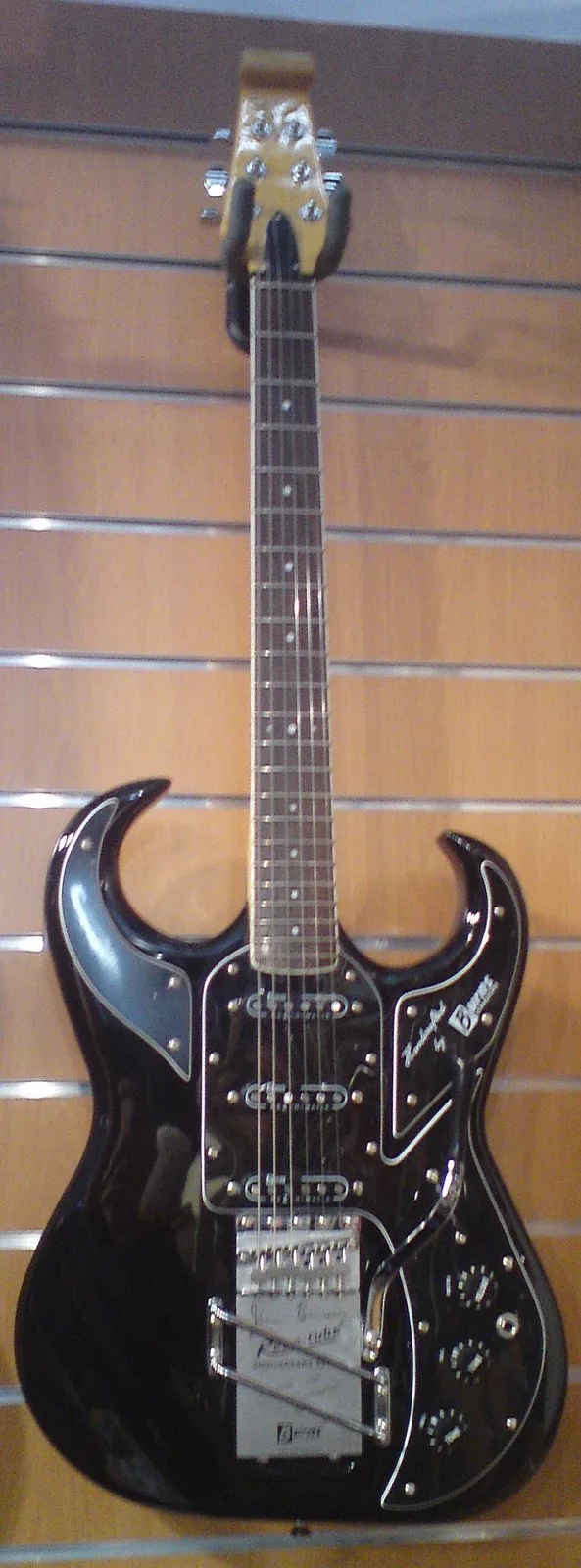
Photo: Bruce Marvin / Wikimedia Commons / Public domain Burns
Bison
1961
Ike Isaacs said it looked like a bloody bison. Burns changed almost everything else about it. Not that.
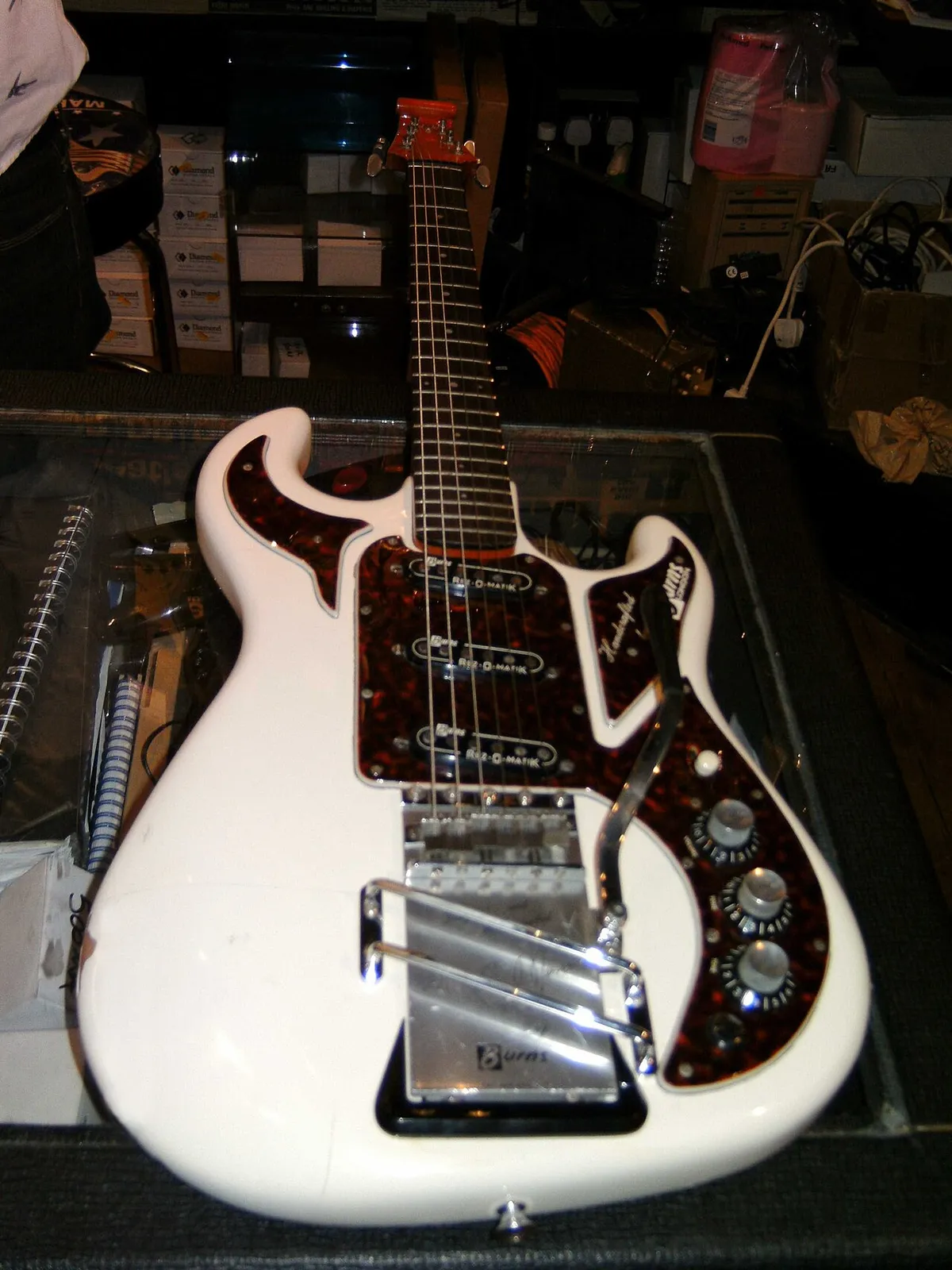
Photo: Bruce Marvin / Wikimedia Commons / Public domain Burns
Marvin
1964
Burns built Hank Marvin more than 30 prototypes to keep him in tune. Then somebody checked his jacket.
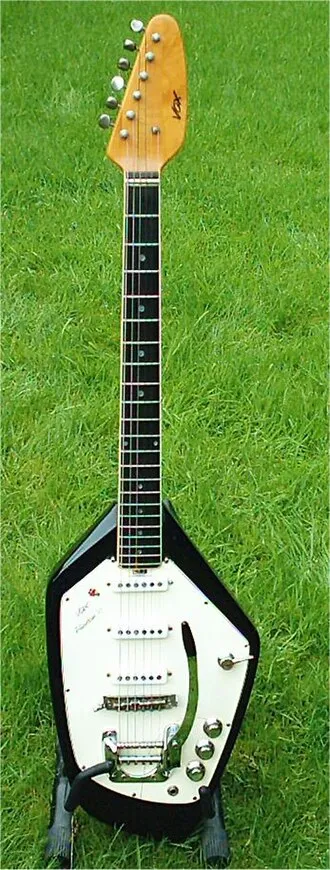
Photo: LittleRoughRhinestone / Wikimedia Commons / Public domain Vox
Phantom
1962
No Fenders in Britain, so Vox built a Strat in a five-sided coat you could spot from the back of the hall.