Charvel
Model 4
The stars got their Charvels from a shop in San Dimas. Everybody else could open a catalog and order a Model 4.
July 1986. A British magazine reviewer named Gary Cooper has a Cobalt Blue Charvel on his lap, fresh from a factory in Matsumoto, Japan. He plays it for an hour before the brochure tells him there’s a battery inside.
- Introduced
- 1986
- Type
- Solidbody electric
- Class
- Production
Have a photograph of this guitar? Send a picture
The short version
1985
The license
The Charvel name is licensed for production in Japan, and a factory in Matsumoto gets the work.
1986
Made in Japan
American production stops. The numbered Japanese Charvels arrive, with the Model 4 at the top of the bolt-ons.
1986
First sample
Gary Cooper reviews a Cobalt Blue Model 4 in Britain. It lists at £519.
1987
Sharkfins
The Model 4 sells well enough to get a bound fingerboard and shark’s-tooth inlays.
1989
The end of the number
Grover Jackson sells his interest. The Model 4 is usually dated 1986 to 1989.
Side A
A1
The guitars on the posters
In the mid-’80s the Charvel name meant a shop in San Dimas and the players it built for. The endorsee list in 1986 read like a festival bill: Jeff Beck, Bryan Adams, Elliot Easton, Vivian Campbell, Allan Holdsworth, Jake E. Lee, Sammy Hagar. Steve Vai had his Green Meanie. Warren DeMartini had guitars painted with crossed swords and a bloody skull. George Lynch had his tiger.
Those were shop guitars. You didn’t order one out of a brochure. And the American shop was winding down. When U.S. production stopped in 1986, it had built nearly 6,000 guitars. That isn’t many for a world full of kids with those players on their walls.
So the name went to Japan.
A2
Matsumoto, by way of Texas
The handoff happened in stages. IMC, a company in Texas, licensed the name in 1985, and a factory in Matsumoto City, Chu Shin Gakki, got the work. The first Japanese Charvels showed up in American stores in 1986. Who owned the company, and from when, depends who you ask: one account has IMC buying Jackson/Charvel in 1986, others put Grover Jackson’s sale in 1989.
The new line came in numbers. Models 6 and 5 sat on top, neck-through guitars with two-octave necks. Models 4 and down were bolt-ons with regular Strat-style bodies. The Model 4 was the top of that bolt-on stack, and it got the same American-made Jackson active electronics as the 6. In Britain that was £519 against £739. Same active circuit as the 6, for £220 less.
Flip one over and the neck plate says Ft. Worth, TX. That was IMC’s office. None of these were built in Texas. The headstock logo went white, “Charvel — By Jackson/Charvel,” and the neck got a clear satin finish instead of the raw maple the old shop was known for.
A3
A battery and three little switches
The body is basswood, medium weight but solid. Cooper’s sample had a maple neck with a shallow U shape, and a rosewood board that hangs out over the heel to make room for the 22nd fret. The vibrato was a Kahler with a locking nut, so it came back in tune after you leaned on it.
Then the electronics, which are the whole point. Two Jackson J200s in the neck and middle, a J50BC humbucker at the bridge voiced for the highs. No pickup selector. Instead, three little on/off toggles for the three pickups, so you can switch on any combination you like. And a mid-boost that pushes 6 dB around 650 Hz, the part of the sound that makes a solo jump out of the band. That’s what the battery was for.
People still argue about what the J200s even are. Single-coils, humbuckers, dual coils in a single-coil case: you’ll hear all three. They look like singles. They aren’t Strat pickups.
Flip the record · By the numbers
~6,000
Guitars the American Charvel shop had made when U.S. production stopped in 1986.
£519
UK list price in 1986. The neck-through Model 6 was £739.
3
Little on/off toggles in place of a pickup selector.
6 dB
The boost the onboard preamp adds around 650 Hz, right in the middle of the sound.
Side B
B1
A costume it doesn’t need
That Texas neck plate already trips up people shopping for a “Texas Charvel.” And some people have gone further and tried to turn Asian Charvels into something else. There are fakes out there made by putting a San Dimas plate and a gold USA decal on one. Read the logo and the plate together.
A Model 4 is a good guitar. It doesn’t need to be dressed up as a San Dimas.
B2
Highly successful
The Model 4 sold well enough for IMC that in 1987 it got an upgrade: a bound fingerboard and shark’s-tooth inlays. The Kahler gave way to a Jackson-licensed Floyd. So a first-year guitar, Kahler and plain dots, is a slightly different animal from the later sharkfin one. The run is usually dated 1986 to 1989, the year Charvel started building the Charvette in Korea.
How many were made? Michael Wright, who wrote the Model 4’s history, put it plainly:
…no real information on production totals is available, so we have no idea how rare this guitar is (or isn’t).
No famous name is on record with a Model 4. The stars had San Dimas. The Model 4 went to whoever walked into a music store in 1986 with the money saved, and a year later Charvel was dressing it up with sharkfins because those people kept buying it.
The cast
The people, and the specific guitars, that made the legend.
1986
Gary Cooper
Cobalt Blue Model 4
Reviewed one of the first samples to reach Britain, and found the battery an hour in.
1989
Grover Jackson
The shop it grew out of
Ran the San Dimas shop the Japanese line was built to stand next to. Sold his interest in 1989.
Jim Root
A Model 1, not a 4
Slipknot’s guitarist got a Charvel Model 1 for Christmas, one humbucker and a hockey-stick headstock. Same numbered family, different guitar.
Liner notes
Specs, construction, rarity, value, and every source we used.
Numbered Japan HSS with three toggles and a Kahler — Charvel’s Model 4, not a San Dimas shop guitar, and not a living San Dimas Style 1.
- Body
- Basswood, Strat-style full size (not Dinky). In Tune: a form of lime.
- Neck
- Bolt-on quartersawn rock maple, satin / matt back. In Tune: shallow “U.”
- Fingerboard
- Rosewood, 22 jumbo, 12"–16" compound (305 mm–406 mm on Axebition). 1986: unbound pearl dots. Mix flagged.
- Scale
- 25.5" (Music Zoo; Equipboard). Axebition: 25.59" (650 mm). Mix flagged. Do not invent 648 mm.
- Pickups
- HSS: two Jackson J200 (neck, middle), Jackson J50BC (bridge). JE-1200 mid-boost preamp.
- Hardware
- 1986: Kahler Standard with locking nut (Vintage Guitar; In Tune). Jackson-labelled tuners (In Tune: possibly Gotoh). Black typical.
- Electronics
- Volume; passive tone; active mid-boost; three on/off mini-toggles. PP3. In Tune: 6 dB @ 650 Hz.
- Finish
- Gloss metallic. In Tune sample: Cobalt Blue. Reverb / Ultimate Guitar: Black, Black Cherry, Burgundy Mist, Electric Blue, Pearl White, Red.
- Nut
- Phenolic (Vintage Guitar). Axebition / Reverb listing: 1-11/16" (43 mm). Mix flagged.
Open the full research fileConstruction details, the complete player record, production numbers, dated value estimates, and sources
Classic living example = 1986 Charvel Model 4 (Chu Shin / Chushin Gakki, Matsumoto, Japan). No current Model 4 SKU this pass. MJ Series is Charvel’s late-’80s Japan homage — Dinky, San Dimas Style 1, So-Cal — not this number. USA Select San Dimas Style 1 lives on charvel-san-dimas. Model 6 is the neck-through sibling, not this table. Mixed inch/mm flagged; no millimetres invented for the 25.5" scale.
Construction
The job was a Charvel you could order from a catalog. San Dimas was Grover Jackson’s shop. This is Matsumoto, numbered, bolt-on, HSS, three toggles, a Kahler. Superstrat is a genre label, not a Charvel SKU.
Not a San Dimas. That plate is the USA bolt-on from the shop Grover was already running; catalog year there is 1979. This is the numbered Japan Model 4, 1986. Not a living San Dimas Style 1, not a So-Cal, not a Pro-Mod, not a DK24. Do not nest this guitar under San Dimas. Not a Jackson Soloist (jackson-soloist) — neck-through, 1984. Not Model 6: same Jackson actives, same Kahler in year one, but poplar wings, neck-through, 24 frets, Dinky body (Vintage Guitar; In Tune). Model 6 is the Japan analog of a Soloist. This is the top of the bolt-on line. Not Model 5 (neck-through Dinky, HH). Not Model 3 (passive HSS). Not Charvette (Korea, 1989). No Gibson SKU.
Wayne Charvel’s repair shop, Azusa 1974, then San Dimas. Grover buys in 1978. USA Charvels — bolt-on, unfinished maple, pointy head from 1983 (Vintage Guitar) — run until American production ceases. Vintage Guitar: when American manufacturing stopped in ’86, Charvel had produced nearly 6,000 guitars. That is the USA shop, not this SKU.
Then Japan. Vintage Guitar: IMC licensing 1985; Chu Shin Gakki, Matsumoto City, awarded the work; IMC purchases Jackson/Charvel in 1986; first Japanese Charvels appear in the U.S. that year. Guitar World (March 2010 feature, reprinted 2026): standard Charvel production moves to Japan in 1986; Grover sells his interest in 1989. Wikipedia: USA Charvel ceases 1986 under the IMC license; Jackson sells to IMC in 1989; Charvel made exclusively in Japan 1986–1991. Keep 1985, 1986, and 1989. This plate starts in 1986. Do not date a Model 4 from a San Dimas neck plate.
Wikipedia’s tell for the import: neck plate reads Ft. Worth, TX (IMC’s office) — every one of those plates is Japan, none Texas. Headstock logo goes white, “Charvel — By Jackson/Charvel,” instead of the gold USA label. Neck gets a clear satin instead of the raw maple the shop was known for.
Vintage Guitar’s 1986 Chu Shin line: Models 6 and 5 at the top, two-octave neck-through Dinkys, American-made Jackson actives. Models 4 and lower, bolt-on, “regulation Strat-style” bodies, unbound dot necks. Model 4 sits at the top of that bolt-on stack with the same actives as the 6. Basswood, “medium weight, but solid.” Wide flat board. J50BC “accentuated high frequency.”
Gary Cooper, In Tune, July 1986, had a Cobalt Blue first sample in the UK. Rosewood board hanging over the heel for the 22nd fret. Kahler Standard with locking nut. Jackson-labelled machines he guessed were Gotohs. He played an hour before the brochure told him the circuit ran on a PP3. J200s Alnico V, J50BC ceramic, voiced for highs. Mid-boost 6 dB @ 650 Hz. Matt neck, shallow U. UK RRP £519 — 1986 money, not 2026 street.
The J200 name-fight stays on the table. Vintage Guitar calls them single-coils. In Tune calls them humbuckers in the neck and middle slots. Axebition: dual coils in a single-coil housing. Ultimate Guitar’s period-spec recitation: “Dual Coil, Bi-level.” Keep all four. They look like singles. They are not Strat coils.
1987. Vintage Guitar: the Model 4 “proved highly successful for IMC — so much so that in 1987 they upgraded it with a bound fingerboard and shark’s teeth inlays.” Axebition: 1986 Kahler 2520 and pearl dots; following years Jackson JT-6 and sharkfins. Guitar World flattens the later guitar onto the whole model — bolt-on HSS, Floyd Rose–licensed trem, bound rosewood, sharkfins. That is the JT-6 years, not the Kahler first year. Keep both. The JT-6 is a Jackson-licensed Floyd, not a German Original.
Reverb dates the HSS Model 4 1986–1989. Wikipedia’s 1986–1991 is the broader Japan-Charvel window (Classic, Fusion, Contemporary after the numbered series). Vintage Guitar: Charvette, Korea, 1989. Do not stretch Model 4 to 1991 without a catalog page. Model 4M is the maple-board variant (Reverb; Axebition 1988). Model 4B is a bass.
Classic vs current: 1986 Model 4 — basswood bolt-on, J200/J50BC, JE-1200, Kahler, 22 frets, Ft. Worth plate, Japan — against no Model 4 you can order from charvel.com in 2026. MJ Series copy (charvel.com): “Harkening back to the late '80s when Charvel guitars were manufactured exclusively in Japan.” Those SKUs are Dinky, San Dimas Style 1, So-Cal. They are not this number.
Players
Do not steal San Dimas customs. Eddie’s striped parts guitar, Vai’s Green Meanie, DeMartini’s Cross Sword / Bloody Skull / Frenchie / snakeskin, Jake E. Lee, George Lynch’s tiger, Holdsworth’s basswood specials — shop guitars. They live on charvel-san-dimas or they stay off this catalog number. Do not steal Soloist players (Beck’s pink/orange, Collen’s sparkle). In Tune’s 1986 endorsee list (Beck, Bryan Adams, Elliot Easton, Vivian Campbell, Holdsworth, Jake E. Lee, Sammy Hagar) is the custom shop the Japan line was trying to stand next to. Not this SKU.
Jim Root (Slipknot). Guitar World, 8 September 2022: Christmas guitar was a Charvel Model 1 — “one humbucker and a hockey stick headstock,” fulcrum trem. Sibling Model Series. Not this HSS. Do not flatten Root onto Model 4.
Also known to play stays empty this pass. None invented. This was the catalog guitar. That is the point.
Rarity
You cannot buy a new Model 4 from Charvel. The numbered run ended with the catalog. Living MJ, USA Select, Pro-Mod, and Custom Shop Charvels are other factories and other names on other silhouettes. They are not a 1986 Model 4.
Charvel / IMC did not publish Model 4 unit totals. None invented. Vintage Guitar, on these Japanese Charvels: “no real information on production totals is available, so we have no idea how rare this guitar is (or isn’t).” Serials on the bolt-ons lack a year digit (Vintage Guitar’s example 227735). They date a guitar. They don’t count a year. That is why a first-year census is unknown, not the chapter.
What is actually thinner: first-year 1986 Kahler, unbound dots. Complete originals with the J200/J50BC set and the JE-1200 still in. The Ft. Worth plate is common on this guitar and a trap for anyone shopping a “Texas Charvel.” Wikipedia: counterfeit “San Dimas” objects have been made by putting a San Dimas plate and a gold USA decal on an Asian Charvel. Read the logo and the plate together.
Value
Informal estimate, 8 September 2026. Not an appraisal.
Ask vs sold labeled. Celebrity lots are not-comps. No invented medians or factory counts. Period £519 (In Tune, July 1986, UK RRP) is 1980s money, not 2026 street.
New street. None under Model 4 this pass. MJ Series (charvel.com) is the late-’80s Japan homage — not this number, not this table. USA Select San Dimas Style 1 street lives on charvel-san-dimas.
Used modern / vintage. Same market: the 1986–89 Japan guitar. Reverb Price Guide on the Model 4 HSS product page (Good to Mint, 314 orders, fetched 8 September 2026): estimated used $658–$1,209. Dedicated Price Guide URL bot-walled this pass; the widget on the product page is the source. Named recent hammers from that same page, not a series: 16 July 2026 Very Good $1,099.99; 4 July Very Good $1,249.99; 23 June Very Good $1,399; 16 June Very Good $600; 20 May Good $755; 18 May Good $877.50; 14 May Excellent $875. Do not average those solds into a midpoint.
Named asks this pass, not hammers: Pearl White Very Good $1,579; 1986 Black Very Good $1,299.99; Electric Blue Good $825; Black Cherry with OHSC Very Good $2,099.99; Electric Blue with OHSC Very Good $1,999.99. Roadhouse Vintage, 1986 Black Cherry with original tweed case: listed $1,499, marked sold — one dealer object, not a comp tape. First-year Kahler/dot examples sit at the top of that ask tape when original. A refin, a swapped Floyd, or a dead preamp is a different guitar. No Burst tier.
See also
- charvel-san-dimas — USA bolt-on shop guitar; not this numbered Japan catalog
- jackson-soloist — neck-through from the same family; Model 6 is the Japan analog, not this bolt-on
- ibanez-rg550 — 1987 mass Japan superstrat contemporary; Wizard and Edge, not a Charvel Model 4
Sources
- Vintage Guitar, Michael Wright, The Charvel Model 4 (August 2013) — Japan from 1986; Chu Shin Gakki, Matsumoto; IMC license 1985 / purchase 1986; Models 1–6; Model 4 top bolt-on; basswood; quartersawn maple satin; J200 / J50BC; Kahler Standard; vol / tone / mid boost; three toggles; phenolic nut; 1987 bound sharkfins; serial 227735; USA shop ~6,000 through ’86; unpublished Japan totals
- In Tune, Gary Cooper, Flash In Japan!, July 1986 — first UK samples; Model 4 basswood, quartersawn maple, rosewood 22nd-fret overhang, Kahler Standard locking nut, J200 Alnico V / J50BC ceramic, PP3, 6 dB @ 650 Hz, three switches, matt U neck, Cobalt Blue; UK RRP £519; Model 6 neck-through, 24 frets, bound rosewood, wedge markers, £739
- Guitar World, Eric Kirkland, The story of Charvel (March 2010; reprinted 22 July 2026) — Japan shift 1986; Grover sells 1989; Model 4 bolt-on HSS, Floyd-licensed trem, bound rosewood sharkfins (later spec); Model 6 as Japan Soloist analog; Ft. Worth plate
- Wikipedia, Charvel — lead only; USA ceases 1986; numbered Japan models 1986; IMC sale 1989; Japan exclusively 1986–1991; Ft. Worth plate = Japan; white “By Jackson/Charvel” logo; satin import neck; San Dimas fake-plate warning
- Reverb, Charvel Model 4 HSS — years 1986–1989; basswood; bolt-on maple; 22 frets; 12"/16" radius; HSS; locking trem; Price Guide widget $658–$1,209 (Good to Mint, 314 orders); named 2026 hammers
- Reverb Price Guide, Charvel Model 4 HSS — dedicated URL bot-walled this pass
- Axebition, Charvel Model 4 specifications — Japan; 1986–1989; JE-1200; 12"–16" (305–406 mm); nut 43 mm (1-11/16"); scale 25.59" (650 mm); 1986 Kahler 2520 / pearl dots vs later JT-6 / sharkfins; J-50BC / J-200
- The Music Zoo, Charvel Model 4 Black Cherry 1989 — 25.5"; 22 frets; rosewood; basswood; maple neck; Jackson locking trem; J200 / J50BC; mid-boost; 8 lbs 6 oz
- Equipboard, Charvel Model 4 — 25.5"; basswood; maple neck; rosewood; JE-1200 (preamp active, pickups passive); JT-6; HSS; 22 frets
- Charvel, MJ Series — late-’80s Japan homage; Dinky / San Dimas Style 1 / So-Cal; not Model 4
- Guitar World, Jim Root Charvel signature, 8 September 2022 — Christmas guitar is Model 1, one humbucker, fulcrum trem; not Model 4
- Roadhouse Vintage, 1986 Charvel Model 4 Black Cherry — Kahler; J-200 / J-50BC; listed $1,499 sold
- Ultimate Guitar, Charvel Model 4 review — 1986 spec recitation: J200 dual-coil bi-level, J50BC, phenolic nut, Jackson SG38-07B, three mini-toggles
Keep digging
Guitars this one gets compared to, confused with, or descended from.
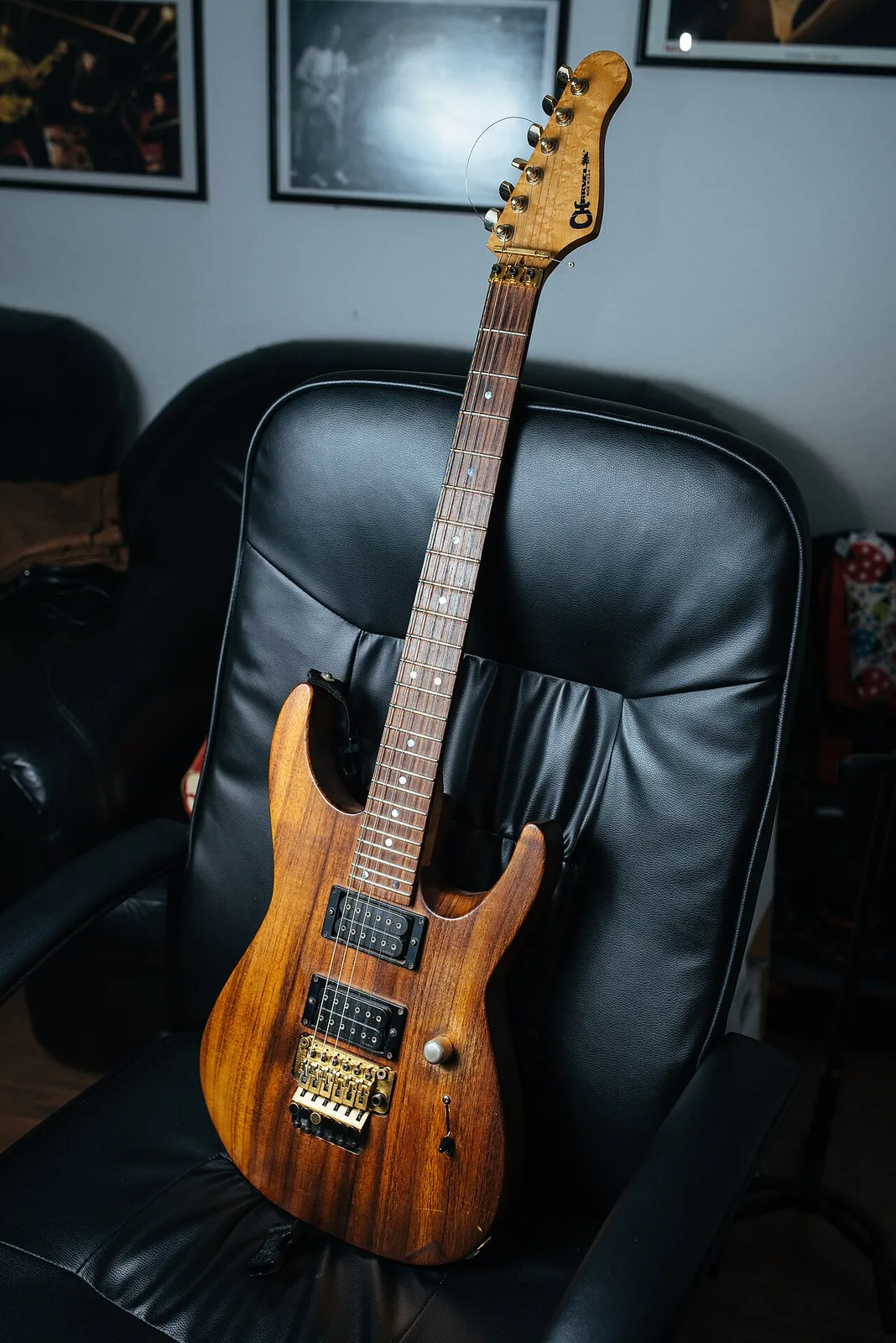
Photo: Nenad Stojkovic / Wikimedia Commons / CC BY 2.0 Charvel
San Dimas
1979
Named for a town, not a star: the place where a repair shop learned to build what players asked for.
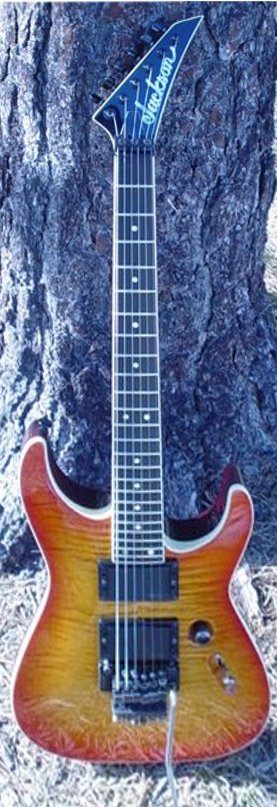
A 1987 Soloist archtop. Photo by Jimshine; perspective correction by GreyCat. Licensed under CC BY-SA 4.0. Via Wikimedia Commons. Jackson
Soloist
1984
Grover Jackson took the Strat shape and ran the maple neck straight through it. Jeff Beck’s was pink.
- Send a picture
Ibanez
RG550
1987
Nobody’s name on it. Just a thin neck, 24 frets, and a locking trem, and it keeps coming back.